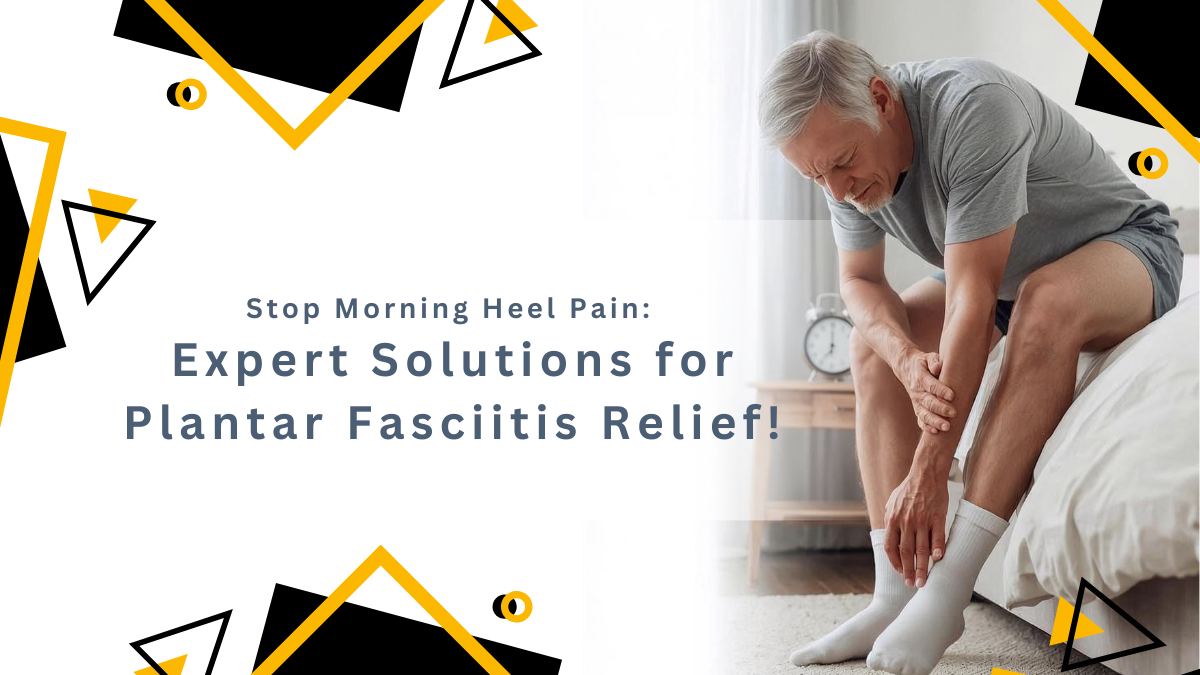
That Sharp Heel Pain When You First Stand Up? Here’s Why It Happens—And How to Stop It.
If you’ve been wincing through those first few steps out of bed, hobbling to the bathroom with a sharp sting in your heel, you know exactly how frustrating plantar fasciitis can be. You might find it eases off only to return after a long day on your feet. It’s a cycle that can feel endless. But what if that morning agony could be eased by what you do during the day? Here, we’ll explain why that pain strikes and give you clear, actionable steps to break the cycle for good.
“Hi NuovaHealth team,
I’m hoping you can help. For the last few weeks, I’ve been getting this really sharp pain in my heel, specifically when I get out of bed in the morning. It’s a proper sting that makes me hobble to the bathroom for the first few steps. It tends to ease off a bit once I’m moving, but if I’ve been on my feet all day at work, it starts to ache again by the evening.
I’ve done a bit of reading and I’m pretty sure it’s plantar fasciitis. It’s starting to get me down, and I’m worried it’s just going to get worse. My question is, could wearing arch support insoles during the day actually help with this, especially since the worst pain is in the morning when I’m not wearing them? What else should I be doing?
Thanks,
Andy
Andy, thank you for getting in touch. The pain you’re describing—especially that sharp first step in the morning—is the hallmark of plantar fasciitis. And your question about insoles is the most important one we can answer. That feeling of frustration is something we hear every day, and it’s exactly why NuovaHealth exists.
Let’s address your question directly: can insoles used during the day fix the pain you feel first thing in the morning? The answer is an emphatic yes. In fact, it is the most strategic and effective way to tackle the root of the problem. But to understand why, we need to correct a universal misunderstanding about what that morning pain actually signifies.
The Crucial Misunderstanding About Morning Pain
Andy, that sharp, stabbing pain with your first step isn’t actually caused by getting out of bed. It’s the aftermath of strain that built up in your feet throughout the previous day.
Here is the precise mechanism. Throughout the day, as you stand and walk at work, the thick, fibrous band on the bottom of your foot—the plantar fascia—is subjected to repeated stress. It acts as a primary shock absorber. If your foot mechanics are even slightly off, which is incredibly common, this creates micro-tears and localised inflammation within the tissue. It’s a subtle, accumulating injury that happens gradually with every step.
Overnight, as you sleep, your body goes into its repair cycle. Part of this natural process involves the tissue tightening and shortening as it attempts to heal the day’s damage. So, when you swing your feet out of bed and take that first weight-bearing step, you are aggressively stretching this already inflamed, sensitised, and now tight band. That sudden, forceful tension is the sharp sting you feel so acutely.
The goal, therefore, is not to treat the pain at the moment it strikes. That is merely managing a symptom. The true goal is to prevent the cumulative micro-damage that causes it during your waking hours. This shift—from chasing the pain to preventing its cause—is what finally leads to recovery.
What Is Plantar Fasciitis, Exactly?
The name itself provides the diagnosis. ‘Plantar’ refers to the sole of your foot. ‘Fascia’ is a tough, fibrous band of connective tissue. ‘Itis’ means inflammation.
In simple terms, plantar fasciitis is the inflammation of the thick, ligament-like band that runs from your heel bone to the base of your toes.
This structure isn’t just a passive band; it’s a dynamic, working part of your foot’s framework. It acts as a crucial shock absorber and, perhaps more importantly, it is a primary supporter of the medial longitudinal arch—the main arch of your foot. A useful way to visualise it is as the bowstring on a bow. The bones of your foot form the bow, and the plantar fascia is the tense string. When this bowstring is overstretched or overloaded—most often due to the way you walk or stand—it becomes irritated, leading to micro-tears and the inflammatory response that causes pain.
The most common and specific point of tenderness is almost always located on the inside bottom of your heel, precisely where the plantar fascia attaches to the heel bone (the calcaneus). Pressing firmly on this spot will typically reproduce the sharp pain you feel on those first steps, confirming the source of the issue.
The Pattern of the Pain: Why It Hurts When It Does
The pain of plantar fasciitis follows a clear pattern that directly reflects what’s happening to the tissue. It’s your body’s way of signalling overload.
- The First-Step Pain (After Rest): This is the hallmark sign. It is caused exclusively by the sudden, forceful stretch of the overnight-tightened, inflamed fascia. It’s worst in the morning because the tissue has had all night to stiffen up. You may notice a similar, though usually less intense, version after long periods of sitting.
- Pain That Returns After Prolonged Activity: This is a result of simple mechanical overload. Your plantar fascia, already irritated and inflamed, has a limited capacity for stress. After a certain threshold of time spent standing or walking, the inflammation and micro-damage reach a critical level, and a deeper, sorer, more persistent ache sets in. This is the ache you feel by the evening, a sign that the tissue’s tolerance for the day has been exceeded.
- Increased Pain on Hard Surfaces: Hard, unyielding floors like concrete, tile, or even thin carpet over solid flooring offer minimal shock absorption. With each step, the impact force travels almost entirely up your leg, with the plantar fascia and your heel bone taking the brunt of the force. This constant jarring exacerbates the existing irritation, accelerating the pain cycle.
This process creates a cycle that feeds itself, and it’s incredibly frustrating. The initial pain causes you to alter your walking pattern unconsciously—you begin to limp or favour the foot. This altered gait places new, unnatural strains on not only the plantar fascia but also on your ankles, knees, and hips. These fresh strains can further irritate the original problem, making it worse and often leading to secondary pains elsewhere.
Getting the Diagnosis Right: Is It Always Plantar Fasciitis?
While the symptoms you’ve described, Andy, are the hallmark of plantar fasciitis, it’s responsible to note that other conditions can cause heel pain. A key part of managing this effectively is being confident in the diagnosis. Here’s a brief look at how a healthcare professional distinguishes plantar fasciitis from other common issues, most notably Achilles tendinopathy.
The critical differentiator is the exact location of the pain.
- Plantar Fasciitis: The pain is consistently on the bottom of your heel, specifically on the inside portion where the fascia attaches to the heel bone. Pressing directly on the sole of your heel in that spot is exquisitely tender.
- Achilles Tendinopathy: The pain is located at the back of the heel, where the thick Achilles tendon attaches to the heel bone. The tenderness is not on the sole but on the back, and you may feel stiffness or pain in that area when you first start moving after rest. The pain often worsens with activity that loads the tendon, like pushing off on your toes when walking or running.
Other less common causes include a heel stress fracture (often causing a more generalised, deep ache in the heel bone itself), or nerve entrapment (which may include burning, tingling, or shooting pains rather than a pure sting).
Why does this matter? Because the treatment for Achilles tendinopathy, while sharing some elements like calf stretching, has different priorities, often focusing heavily on specific tendon-loading exercises. Applying a plantar fasciitis management plan to an Achilles issue would be suboptimal.
This clarity is the goal. The very specific nature of your pain—that sharp sting on the sole of the heel with the first steps—is what makes plantar fasciitis the most probable diagnosis. Confirming this, ideally with a professional, ensures every step you take in your recovery is in the right direction.
How Common Is It and Who Is Most at Risk?
Plantar fasciitis is exceptionally common, and the pattern you describe, Andy—the specific location of the pain and its timing—is the textbook presentation. This is why it’s the most probable cause. Confirming the diagnosis properly means ruling out other possibilities.
It is estimated to affect around one in ten people in the UK at some point in their lives. While it can theoretically affect anyone, certain factors significantly stack the odds against you. Andy, you mentioned being on your feet all day at work—that alone places you firmly in a high-risk category, as it provides the constant, low-grade strain that initiates the condition.
Other key risk factors include:
- Age: It is most prevalent between the ages of 40 and 60. As we age, the plantar fascia loses some of its natural elasticity and the protective fat pad in the heel can thin, making it more susceptible to strain and less resilient to impact.
- Foot Mechanics: This is a primary driver. Both flat feet (pes planus) and very high arches (pes cavus) can profoundly affect how weight is distributed across your foot during the gait cycle. Flat feet allow the arch to collapse, overstretching the fascia, while high arches are often rigid and provide poor shock absorption, again straining the fascia.
- Certain Types of Exercise: Activities that place repetitive, high-impact stress on your heel and attached tissue—such as long-distance running, ballet, aerobic dance, and ballistic jumping sports—are frequent contributors.
- Occupational Hazards: People with jobs that demand long hours standing or walking, especially on hard surfaces (e.g., factory workers, teachers, nurses, retail staff), are at significantly higher risk due to the unrelenting, cumulative strain.
- Excess Body Weight: Carrying extra body weight dramatically increases the force that travels through the plantar fascia with every single step. This is a simple equation of physics and is a major aggravating factor.
- Inappropriate Footwear: Regularly wearing shoes with inadequate arch support, thin soles, poor cushioning, or a completely flat design (like some fashion trainers or flip-flops) provides no protection from the ground, leaving the plantar fascia vulnerable.
Your Management Plan: The Three Fundamentals
Managing plantar fasciitis effectively is rarely about one single miracle cure. It is about a consistent, multi-pronged attack that addresses the inflammation, the tissue tightness, and the root biomechanical cause. Here is what you need to do, starting today.
1. Your First Priority: Calm the Inflammation.
- Ice Therapy: This is a powerful and non-negotiable tool. Roll your bare foot over a frozen water bottle for a solid 15-20 minutes, especially after you’ve been on your feet for a long period. This actively constricts blood vessels to reduce inflammation and provides a gentle, passive stretch. Aim for at least one session, ideally two, per day.
- Smart Activity Modification: This concept, often called “relative rest,” is crucial. It does not mean stopping your life and becoming sedentary. It means being intelligent and strategic. You must reduce the impact, duration, and frequency of the activities that you know provoke the pain. Swap a long run for a swim or a cycle. If your job involves standing, consciously find reasons to sit for five minutes every hour to offload the feet. Listen to the pain—it is a guide telling you when to stop.
2. The Daily Essentials: Stretching.
This is the foundation of your recovery. Getting this right is non-negotiable. Tightness in the calf muscles (the gastrocnemius and soleus) is a huge, and often overlooked, contributor to plantar fasciitis, as it directly increases tension on the plantar fascia.
- Calf Stretch: Place your hands on a wall. Step one foot back, keeping the knee perfectly straight and the heel firmly planted on the floor. Lean forward until you feel a strong, definite pull in the calf of the back leg. Hold this position for 30 seconds. Do not bounce. Repeat this 3 times for each leg.
- Plantar Fascia Stretch: While sitting down, cross your affected foot over your other knee. Using your hand, pull your toes back towards your shin until you feel a distinct stretch along the bottom of your foot, specifically in the arch. Hold this for 30 seconds. Repeat 3 times for each foot. This stretch can be done multiple times throughout the day.
3. Intelligent Footwear Choices.
The shoes you choose to wear are a fundamental part of your daily routine, and it’s one of the few factors you have total control over.
- Avoid walking barefoot on hard surfaces. This is a simple rule. The moment you get out of bed, you should step into a shoe or a sandal with a built-in arch support. This protects the fascia from that violent first stretch.
- Be intentional about your everyday shoes. Choose pairs that offer three essentials: genuine arch support, a sturdy heel cup that doesn’t collapse when you squeeze it, and enough cushioning to absorb shock.
How Arch Support Insoles Fit Into Your Recovery: Your Daytime Solution
This brings us to the core of your question, Andy. While stretching and ice are essential for managing the symptoms and improving flexibility, arch support insoles are the proactive tool that works silently all day long to address the fundamental root cause: faulty foot biomechanics.
It’s important to understand that this isn’t about a soft, generic comfort insert. This is about a support designed to correct your foot’s movement with every step, guiding it into a better, more stable position.
The intervention begins with the arch. When you have a foot that over-pronates—meaning it rolls inwards excessively—your arch collapses dramatically with each step. This collapse places a tremendous, repetitive stretching force on the plantar fascia, creating the micro-tears that lead to inflammation.
A quality insole is designed to sit precisely under your arch, providing a firm yet contoured prop that prevents this collapse. By holding your arch in its ideal position, it acts like a support beam. It takes the strain so your plantar fascia doesn’t have to. This means that with every step you take during your day, the fascia is protected from the excessive stretch that was causing the damage. This gives the fascia the consistent break it needs to finally begin healing. Do this consistently throughout your waking hours, and you go to bed with significantly less aggravated and inflamed tissue. This is the direct, causal mechanism by which daytime support systematically reduces morning pain.
Stabilising your heel is just as important. Your heel bone is the foundation of your entire foot structure—if it’s wobbly, everything else is compromised. A deep, contoured heel cup in a proper insole cradles the heel bone and the surrounding fatty pad, holding it in a secure, neutral position. This control directly limits the excessive inward roll (pronation) that places direct tensile stress on the plantar fascia. The immediate sensation is one of pronounced stability and solidity, as if your foot finally has a secure, reliable platform to land on with each step.
Furthermore, the materials and construction of a quality insole provide essential shock absorption. While structural support is the primary goal, the combination of a cushioned top layer and a resilient, supportive base layer acts as a sophisticated suspension system for your foot. This system works to absorb and soften the jarring shock that travels up your leg each time your heel hits the ground, particularly on unyielding surfaces like pavements and shop floors. This leads to a noticeable reduction in the general foot fatigue and background achiness that can build up over the course of a day, further contributing to a less irritated state for the plantar fascia by evening.
A Practical Guide to Using Insoles for Best Results
To achieve the optimal outcome from your insoles, follow these practical steps:
- Make Space for Support. Always remove the existing, flat factory insole from your shoe first. This is not a suggestion; it is a requirement. It ensures your orthotics sit completely flat against the sole of the shoe, allowing them to function as intended and preventing your foot from sitting too high, which can alter shoe fit.
- Take Your Time Adapting. Your feet, ankles, and legs are used to their old movement patterns. They need time to adapt to the new, correct alignment. Start by wearing the insoles for just 2-3 hours on the first day. Gradually increase the wearing time over the next 3-5 days until you can comfortably wear them all day. Some mild muscle ache in the arch or calf is normal as you adapt; sharp pain is not.
- Be Consistent. Wear them in your most frequently used shoes, every single day. The benefits build up over time. The more consistent you are, the faster and more effectively you will disrupt the vicious cycle of strain and inflammation. Sporadic use will yield sporadic, disappointing results.
- Keep Up with Your Entire Routine. It’s the combination that gets results. The insoles work to correct the cause of the strain during the day, while the stretching and ice address the flexibility and inflammation that result from it. Sticking with all of it is how you break the cycle for good.
What You Can Realistically Expect
With consistent use as part of your complete routine, many people begin to notice a positive change within the first one to two weeks. The first and most encouraging sign is often a measurable reduction in the intensity and sharpness of the morning pain. Over the following several weeks, as the tissue is consistently protected and finally given a chance to heal in a supported environment, you should experience a significant reduction in pain throughout the day and find you can stand and walk for much longer without pain.
An Overnight Strategy: How Night Splints Can Help
If you find that morning pain is particularly stubborn, you might consider a night splint. This is a lightweight brace worn while you sleep that holds your foot in a gentle, sustained stretch.
How they work: Remember, the morning pain comes from the plantar fascia tightening overnight. A night splint prevents this by keeping your foot flexed upwards (dorsiflexed) and your toes pointed slightly up. This maintains a constant, mild stretch on the plantar fascia and your calf muscles throughout the night, stopping them from shortening and seizing up. It’s a direct mechanical solution to the overnight tightening problem.
The benefits: By wearing a night splint, you effectively eliminate the “tightening phase” that leads to the first-step pain. Many people notice a significant reduction in the intensity of their morning sting within a few weeks of consistent use. This approach is especially useful if your symptoms are severe or haven’t responded fully to daytime stretches alone. It’s also beneficial for Achilles tendinopathy, as it similarly stretches the calf and Achilles tendon overnight.
Think of it as the nighttime counterpart to your daytime insoles. While insoles prevent strain during the day, a night splint manages the consequences overnight, creating a 24-hour approach to recovery.
In Summary: Your Blueprint for Pain-Free Movement
Andy, plantar fasciitis is a stubborn and frustrating condition, but it does respond to a focused strategy: calming inflammation, stretching the tissue, and supporting the arch throughout your day. The path forward is clear—it’s about understanding the cause and sticking with a consistent routine. That daily commitment is what ultimately breaks the cycle of pain.
Important Information for You
This detailed explanation is provided by NuovaHealth and is based on general clinical principles for common presentations of foot pain. It is intended for informational purposes only and is not a substitute for professional medical advice, diagnosis, or treatment. Always seek the advice of your GP, podiatrist, or another qualified health provider with any questions you may have regarding a medical condition.
If your pain is severe, worsening despite rest, or accompanied by numbness, tingling, significant swelling, redness, a feeling of heat, or an inability to bear weight on the foot, please seek immediate medical attention. Individual results will always vary based on a multitude of factors, and your consistent, patient effort is the most critical component for achieving the best possible outcome.