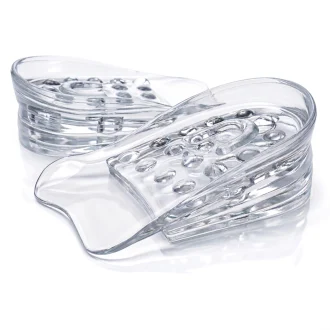
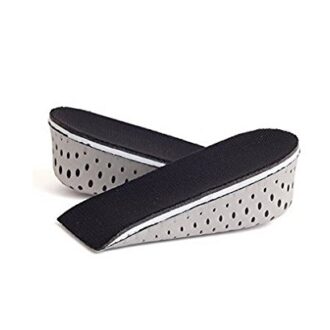
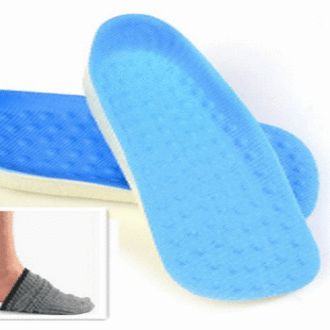
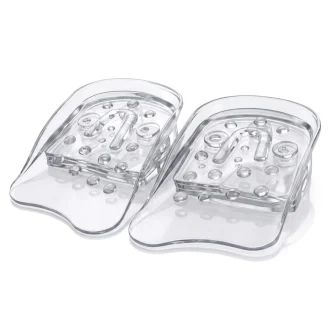
Height Increasing Insoles
Height‑increasing insoles: how support under the heel changes the way you stand
In short
- These insoles lift and support the heel, bringing the foot, and everything above it, closer to a natural line.
- A well‑built pair can ease calf tightness, support the arch and reduce the effort of standing and walking, while adding a discreet increase in height.
- There are three types to choose between — full‑length insoles, heel lifts, and lifts that sit inside the sock — and some come in layers you can add to or take from, so the height can be adjusted.
- The height is there from the first wear. The support is what pays off over the days and weeks that follow.
Why standing taller starts at the foot
Gaining extra height is the most common reason people start looking at these insoles, and it takes effect straight away. Plenty are also dealing with something else: feet and legs that feel tired by the end of a working day in a way that has become easy to stop noticing, a lower back that aches after a long spell on the feet, or something more specific such as a difference in leg length that has already been assessed, or heel pain that is sharp on the first steps in the morning. Whether the aim is height or support for a problem underneath, the place to look is where the heel sits and how well the arch is supported. That position shapes how everything above it lines up.
An insole works from underneath the foot. It lifts the heel towards the angle the ankle works best from, and it gives the arch the backing the shoe is not providing. The change in height is immediate. The change in comfort is what people tend to notice over the following weeks, in how the legs feel after a long shift or a stretch of time on the feet.
A thicker sole or a platform built into the shoe adds height without changing the angle the foot works at or the way the arch is held. You get the extra centimetres and nothing else. An insole gives the same height, but it also changes the position the foot sits in, and that positional change is what supports the joints above.
What a low heel and an unsupported arch do
Each step begins when your heel lands and your weight moves forward. Your foot rolls slightly inwards, the arch flattens and returns to shape, and your toes push you forward. That cycle runs thousands of steps a day — more again for anyone on the feet through work — and every step sends a pulse of force up through the foot and into the leg. No single step is heavy. The problem is the number of them. A position that is only slightly out of line shows up over days rather than in a minute.
That travelling force is what is meant by load. When a joint sits in a good position, the load spreads across several tissues. When it does not, more of it lands on fewer of them, and those tissues have to work harder than they were built to.
Begin with the heel. Your ankle and calf work best from a particular angle. In a shoe with no rise under the heel, your foot and shin meet closer to a right angle than they would in a shoe with a slight heel, and that holds the calf muscles and the Achilles tendon at a greater length. The Achilles tendon — the thick band running down the back of the lower leg that attaches to the heel bone — carries the resulting tension down to the heel. A brief spell at that length is harmless, because the tissue returns to its resting state as soon as the angle changes. A shoe that holds the same position from morning to evening means the tissue does not get that reset, and the pull stays present hour after hour. Nothing tears or snaps. By the evening, tightness at the back of the ankle is common on standing up from a chair.
Then there is the pelvis. When your ankle sits closer to a right angle and the calf is held longer than suits it, the pelvis tends to tip forward to keep the body’s weight balanced over the feet. The muscles in the lower back then have to work harder to hold the body upright, and the effect is clearest when standing still rather than moving. Standing still is harder on the lower back than walking is, because walking lets your muscles take turns while standing holds the same fibres working in one position. A long wait in a queue on a hard floor is often when the ache shows up.
The arch matters too. It is not a rigid block, but a springy curve that flattens under weight and returns to shape when the weight comes off. The band of tissue that runs from the heel bone to the toes along the sole, the plantar fascia, holds it, working alongside the small muscles of the foot. When a shoe gives it no backing and the heel sits low, that band has to absorb the full impact with no help from the shoe, step after step. Feet working that way tire sooner. The weight under the sole also spreads unevenly, concentrating where the shoe offers least. A long stretch on a hard floor often leaves the feet aching in one spot rather than evenly tired as a result.
Why foot problems turn up higher up
Load passes from one joint to the next. The ankle, calf, knee, hip, pelvis and spine are a connected line rather than a set of unrelated parts. Move one and the others have to adapt. Something starting at the foot often turns up as discomfort at the knee, the hip or the lower back, because the tissue there was never sized for that much force.
In everyday terms, this shows up as a cluster of small signals rather than one clear symptom: calves that feel tight after time on the feet, a lower back that aches in a way that is easy to put down to sitting, arches that feel flat and tired by mid‑afternoon, a sense that posture drifts forward without anyone deciding to let it. Any one of these is easy to shrug off. Together, they point to the joints above the feet working harder than they are built to.
Repetition keeps this going. The same demand lands on the same structures every day, so the muscles doing the extra work rarely get a full break before the next time on the feet. Nothing is damaged in a way that would be obvious. The tissues are holding a position for longer than suits them, day after day. Over weeks that shows up as tiredness arriving earlier in the day, and as standing straight taking more effort than it used to.
An insole cannot treat anything serious. Injuries and joint conditions belong in a clinic, not with a lift. It works by taking some of the work off the joints above, so they can settle into a more even line.
How a height‑increasing insole changes things
The first thing a height‑increasing insole does is raise the heel by a controlled amount. Lifting the heel reduces the angle between your foot and your shin. A smaller angle takes the calf and the Achilles tendon out of the position where a flat shoe holds them stretched through the day. The difference is between a calf that feels worked and a calf that feels tight by the afternoon.
Under the arch, the insole does some of the work the shoe is not doing. With something firm holding the arch up, the band along the sole shares the load with the shoe instead of absorbing every step, and pressure spreads across the underside of the foot rather than concentrating in one spot. It is most noticeable when standing still, because that is when the same spot under the foot stays loaded longest.
A raised rim behind the heel holds the foot so it cannot slide or roll from side to side inside the shoe. That steadier base changes how your ankle behaves on uneven ground, on a slope or on a stair, where the foot would otherwise be adjusting itself with every step. Stepping off a kerb or coming down a flight of stairs is where a steadier heel makes the most difference. The rim also keeps the insole in place, and a lift that stays where it is set is more dependable than one that shifts around under the heel.
The last part is cushioning. Where an insole has a shock‑absorbing layer, it gives slightly at the moment your heel lands and stretches the peak of that impact over a fraction longer. Across a long walk or a day on hard floors, softening some of that repeated impact is one reason the feet are less sore by the evening.
Two things happen on different timescales here. The height itself is immediate: the insole is working from the first wear. The calf and the Achilles tendon adapt to the new angle over days rather than minutes. The gap between those two timescales explains why a pair of insoles can feel fine for an hour and tight by the afternoon, and why how gradually a new height is introduced matters as much as which insole is worn.
Choosing between the types
Two things decide which insole suits you, and it is better to keep them apart. The first is where the lift sits: under the whole foot, under the heel only, or inside the sock. The second is how the height is set: a layered design you can add to and take from, or a single piece at a fixed height.
These two often get muddled. Where a lift sits and how it is built are separate choices, and they combine: a layered design can be built under the whole foot or under the heel alone, and so can a fixed one. The practical way to narrow it down is to pick the type that matches the shoes first, then decide whether the height needs to be adjustable.
For subtle height and general comfort, a discreet heel lift inside a close‑fitting shoe is usually the simplest answer.
Full‑length insoles
A full‑length insole replaces the removable footbed — the insole the shoe comes with — and lifts the entire foot rather than just the heel. Lifting evenly keeps pressure spread across the whole sole. Raise only the heel and the front of the foot ends up taking more load than it should.
Built‑in arch support and a raised rim around the heel hold the foot in a steadier position through each step. Where a heel lift mainly changes the angle at the ankle, a full‑length insole supports the foot along its whole length, so the weight is spread and the foot stays controlled as it moves. On days with a lot of walking or standing, that wider support tends to be what people notice: feet that are still comfortable at the end of the day.
This type suits trainers and walking shoes, and it gives the cleanest fit where the footbed lifts out. If the footbed is fixed, it can still work, but the edges may need trimming to match the shape of the shoe. Because a full‑length insole takes up more of the shoe, it works best where there is a little room to spare. In snug shoes, a heel lift is often easier.
Heel lifts, also called shoe lifts
A heel lift sits under the heel only. The same item is often called a shoe lift, so do not be thrown if a product is described either way. It is one item under two names, not two different products.
The lift raises the heel by a controlled amount, easing the angle between your foot and your shin. A smaller angle reduces the pull on the Achilles tendon, and bringing the pelvis closer to level takes some load off the lower back. On the feet for long stretches, the drop in that pull is often what shows up by the evening, as less tightness at the back of the ankle and less of a heavy, tired feeling in the lower legs.
Because it sits under the heel only, a heel lift does not take up the whole shoe, so it does not interfere with how the front of the shoe fits. That makes it a good match for tighter footwear — dress shoes, slim trainers, anything fitted closely around the toes — as long as the shoe holds the heel reasonably firmly. If the heel already moves around inside the shoe, a lift will struggle to stay put. Heel lifts use a dense material that resists flattening, so the height stays consistent through the week and holds up to daily wear rather than sagging after a few outings.
Layered designs, and when adjustability helps
Both the heel lifts and the full‑length insoles come in layered versions. Instead of one fixed piece, you get thin layers you can add or remove, so the height is something you set rather than something you accept. Lifts are measured in millimetres, and most layered designs adjust in small steps, with total lift typically under twenty millimetres depending on the shoe and the foot.
That matters in two situations. If a clinician has measured a difference in leg length, layers allow the lift to be fine‑tuned to the amount advised rather than getting close and leaving it. And where different shoes are worn on different days, one adjustable product covers all of them instead of a fixed design for each pair. The layers stay secure inside the shoe or sock and can be taken out for cleaning and drying. Dense material keeps them stable, so the height set stays accurate as they are worn.
In‑sock lifts
An in‑sock lift sits inside the sock rather than in the shoe, resting under the heel and held in place by the sock itself. That single difference changes how it behaves.
Because it travels with the foot instead of the footwear, it stays put when the shoes change. If several pairs are worn across a day or a week, there is no need to swap a lift from shoe to shoe or buy one for each pair. It also suits shoes that grip the heel loosely and would let a loose lift slide around inside them.
The rest works on the same principle as any other heel lift. Raising the heel reduces the angle between foot and shin, which eases the pull on the calf and Achilles through the day. For anyone whose shoes leave no room for anything bulkier — slimmer shoes, pairs that already feel snug across the top — it is often the only option that fits without changing how the shoe feels.
How shoe shape fits into the decision
Which type suits you depends on the shoe as much as the foot: how much room there is inside it, whether the footbed lifts out, and how firmly it holds the heel.
A close‑fitting dress shoe or a slim trainer usually has very little spare space, so a discreet heel lift is the natural choice. A walking shoe with a removable footbed has room for a full‑length insole and benefits from the even support. Where the shoe is close‑fitting or lets the foot move, an in‑sock lift sidesteps the issue by sitting inside the sock instead.
The firmness of the back of the shoe counts too. A shoe with a stiff back that cups the heel — often called a heel counter — keeps the foot and the insole steady, and both heel lifts and full‑length insoles work better in that kind of footwear. Soft, unsupported shoes let the foot move around, and that is when a lift starts shifting under the heel. In that case, the shoe is likely to be the limiting factor rather than the insole.
Something else to check is the shoe’s own heel height. A lift inside a flat shoe does something different from a lift inside a shoe that already has a raised heel. Where the shoe is already tilted, an insole adds to that tilt. If height is being fine‑tuned, it is worth knowing what the shoe is doing on its own before the insole goes in.
Whichever option is chosen, the insole and the shoe need to work as a pair. Together they hold the foot steady, so each step is stable and comfortable. When the two suit each other, the result is a better‑supported step rather than a crowded or awkward fit.
When a foot or leg problem is part of the picture
The section above is about choosing. This one covers the problems people most often want those insoles for, so they can be recognised rather than self‑diagnosed. If anything here sounds familiar beyond a mild ache, have it looked at properly before deciding on a lift.
A difference in leg length
When one leg is even slightly shorter than the other, the pelvis drops on that side to keep the head level, and that drop sends uneven load up through the hips and the spine. A small difference is common and often goes unnoticed for years. What tends to show up, if anything, is a lower back that aches after time on the feet, or a hip or knee that feels sore on one side more than the other. It rarely presents as anything obviously foot‑related, so it is easy to miss, and the link is often not made.
The pelvis is the base for everything above it. Even a few millimetres of difference is enough to make the spine curve slightly to one side to keep the eyes level. The muscles around the lower back and hips are then holding the body upright from an uneven base, which is tiring work, and holding that adjustment costs more as the day goes on. A past injury to the hip or the knee usually makes the effects show up sooner, because the body is already working harder to stay balanced. A hard surface or a long staircase tends to bring it on faster than a soft floor or flat ground, and it is often at the end of a working day that it is first noticed.
Because the mismatch itself is fixed, so is the drop. It does not ease off the way a pulled muscle does, and an evening back ache tends to become a regular pattern rather than an occasional one. Lifting the shorter side brings the pelvis closer to level and evens out the load through the joints. This is one of the clearest uses for a heel lift. The lift sits at the foot; the relief shows up at the hip and back. If there is a measured difference, the lift goes in the shoe on the shorter side. A layered design matters most here, because it allows thin layers to be added or removed to match the amount that has been assessed. If a real difference in leg length is suspected, have it assessed first, because the wrong amount of lift can tilt the pelvis the other way.
Plantar heel pain
Sharp pain under the heel with the first steps after getting up is the classic sign. If it eases as movement continues, the cause is usually the plantar fascia, the band of tough tissue running along the sole from the heel bone to the toes. It supports the arch and absorbs shock as your foot lands, and when it is repeatedly overloaded, the tissue can become irritated where it attaches to the heel bone.
How it behaves is fairly specific. The first steps after rest are the worst, and morning is the clearest example: your foot goes down as you get out of bed and the heel gives a sharp stab, then it eases as movement continues. Standing up after sitting for a while can bring the same response. Through the day it tends to settle, then build again after a long stretch on the feet. The tissue stiffens while it is unloaded and rested, and the first load after rest pulls hardest on the irritated attachment before the tissue loosens again.
Long hours standing and unsupportive shoes both raise the risk, and an arch that is either very high or very flat has the same effect. Either way, the band under the sole ends up doing more work than it can manage comfortably. Left alone, the irritation usually persists rather than settling, since the tissue is strained again every time weight goes through it. It rarely clears by itself, so it often drags on for months, and the first step each morning remains the clearest marker of whether it is improving.
For this one, a full‑length insole is the better match, because the sorest moment is the first load after rest and the band along the sole is the structure in trouble. Backing the arch takes some of that load off the band, and raising the heel slightly reduces the tension where the band attaches to the heel bone. Between them, the tissue has less to absorb at the point where it hurts most.
Achilles tendon and tight calf
Tightness and soreness at the back of the heel, where the Achilles tendon attaches to the heel bone, are common in the tendon itself. It carries a large share of the load every time your foot lands, and both overuse and calf muscles that stay tight can irritate it. It is usually stiffest first thing in the morning or at the start of a walk, eases as movement continues, and then returns after a period of rest.
Tight calves and a long habit of wearing flat shoes both keep the tendon working near the top of its range, held stretched close to the limit of that range before the foot pushes off the ground. Stairs and slopes ask more of it than flat ground, because both require the calf and the tendon to stretch further under load. Coming down a hill or a flight of stairs often brings the soreness on more sharply. If nothing changes, ongoing irritation can lead to wear in the tendon tissue itself, which takes far longer to settle and is more difficult to reverse.
A gentle heel lift helps by easing the angle at which the tendon works through the day. Even everyday walking and time spent on the feet sits differently when the tendon has a little less pull on it. This is usually a short‑term measure that eases symptoms while the tendon settles, not a permanent fix. Calf stretching remains important alongside a lift, because the aim is to lengthen the calf enough that the lift is no longer needed. If the tendon stays sore or gets worse, have it looked at rather than adding more height.
Materials and build
Dense foam that holds its height under daily load does the job far better than soft material that flattens where the heel presses hardest. That is the general standard a height‑increasing insole needs to meet, and it matters more than any single material name. It is worth checking the materials listed for the specific product.
The top layer draws moisture away from the skin, so the foot stays drier through a long day, which also helps keep odour down. The base layers use closed‑cell foams — foams with sealed pockets inside that do not soak up water. That keeps them fresh over months of wear and stops them becoming heavy or damp after a hot day. Between the breathable top and the sealed base, the foam resists compression rather than slowly packing down.
The shaping matters as much as the material. A supportive arch and a raised rim around the heel do part of the work, and cushioning lets weight transfer smoothly from heel to toe. Where those are done well, the support in the first week is still there months later.
A lift only works if the height on day one is still the height a year later.
Using your insoles well
Comfort depends on how well the body adapts to the new heel height, and everyone adapts at a slightly different pace. Going slowly helps more than anything else.
Start by wearing the new insoles for a few hours at a time. Once that feels normal, add a little more time each day. A taller lift changes the angle at the ankle, and the calf and the Achilles tendon need time to follow. The change happens over days rather than hours, and how quickly depends on how much height was added. A small raise might take a few days. A larger one, or one used to address a specific problem, can take longer.
There is a simple way to check whether the height is right. Put the insole in the shoe, stand normally, and rock gently from side to side. If your heel lifts or slides, the fit is too loose. Then take a short walk and pay attention to your calf and the back of your heel. If the calf feels gently worked rather than tight, and there is no pulled sensation at the back of the ankle, the height is manageable. If either of those appears within a few minutes, the lift is more than the calf can take yet, and a layer should come out.
If the insole feels too tall, or the shoe starts to feel crowded — pinched across the top, or tight at the toes — take a step back in the same way. Remove a layer if it is a layered design, switch to a thinner one, or move to an in‑sock lift if the shoes simply have not got the space. Build up again from there. Adding height faster than the calf can adjust is the most common reason people find insoles uncomfortable.
If the insole shifts or squeaks, it is usually one of two things. Either the shoe is holding the foot too loosely, in which case check the fit and consider a different type, or the insole has slipped out of position. Take it out, set it back in flat, and check that the heel is sitting over the raised rim rather than beside it.
Removable layers can be lifted out for cleaning and drying, and the rest can be wiped with a damp cloth. Let them dry between wears rather than leaving them in a closed shoe. If the insole starts to flatten, or the lift no longer feels as noticeable as it did, that is usually the point to replace it. Adding a layer over a flattened base is not the same as replacing it, because the base is what sets the height.
When to seek help
These insoles support the foot. They do not diagnose anything.
If there is an existing foot, knee or back concern, or the amount of lift is unclear, speak to a clinician such as a podiatrist or physiotherapist first. They can look at how you walk, check whether there is a real difference in leg length, and consider footwear, then suggest a suitable lift height.
If symptoms are new, or more complex than the ones described here, have them assessed rather than trying to work them out with a lift. And if a lift has been used for Achilles soreness and the tendon is getting worse rather than better, stop adding height and get it looked at.
Comfort and stability should always come before extra height.
Where to go from here
Height‑increasing insoles work best when they match the shoes, the feet and the reason for wearing them. The principle is the same across every type: support the heel and the arch, and let the body align more naturally above. Get that right, and the difference shows up across the day, in how the body stands and how long it can stay on the feet.
The quickest way to narrow it down is to think about which shoes are worn most and whether the aim is subtle height or support for a specific problem. From there, check the fit against those shoes. If symptoms are new or more complex than the ones covered here, speak to a podiatrist or physiotherapist. The right option will tend to feel steady from the first week, with a flatter footfall, less calf tightness by the evening, and a heel that stays where it is put.
-
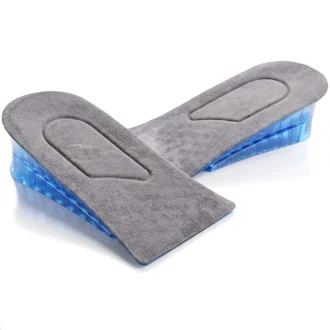
Heightboosters™ Shoe lift inserts for height
- Discreet height boost: Stand up to 38–40 mm (about 1.5 in) taller—hidden inside your shoes, so they look the same from the outside
- Adjustable layers: Start low, add height as you adapt—you control the progression
- Honeycomb gel cushioning: Softens hard floors, spreads pressure, eases harsh heel landings
- Stable, cupped base: Wider heel platform guides balanced motion and steadies each step
- May ease everyday discomfort: Plantar heel pain, Achilles irritation, calf tightness, small leg-length differences
- One size fits most: 3/4-length design fits UK 5–12 (EU 38–46) without trimming—slips into trainers, dress shoes, boots
- Breathable, lightweight, easy care: Wipe clean, air dry, swap between shoes in seconds
- 30-day money-back guarantee: Try them risk-free—if they don’t work, return for a full refund
£11.99inc VAT -
Adjustable Shoe Lifts
- HeightBoosters Shoe Lifts are adjustable heel lifts that discreetly add up to 1.5 inches to your height, correct leg length discrepancies causing hip or back pain, or reduce strain from Achilles tendonitis and plantar fasciitis. Made from medical-grade silicone gel with 5 removable layers, they let you adjust the height from about 8mm to 38mm. Sold as a pair: 5 layers for left foot, 5 layers for right foot (10 layers total).
- Sizing: One size fits all. Heel-cup-length design sits under your heel only.
- Lifespan: 6-12 months with regular use (varies by body weight and activity level).
- Who they’re for: People who want to increase their height discreetly. Those with leg length discrepancies causing hip or back pain. Anyone managing Achilles tendonitis or plantar fasciitis who needs a heel lift to reduce strain.
- How they work: The adjustable layer system lets you add or remove layers to reach your desired height. Lower heights (8-16mm, or 1-2 layers) are typically used for therapeutic purposes like Achilles tendonitis or plantar fasciitis. Higher heights (24-38mm, or 3-5 layers) are used for height increase or larger leg length discrepancies. Medical-grade silicone gel cushions your heel and absorbs impact as your body weight presses down. The deep heel cup wraps around the back and sides of your heel, stabilising it and preventing your foot from sliding forward in your shoe.
- What to expect: Immediate height increase. For leg length discrepancies, gradual reduction in hip and back pain as your pelvis levels out. For Achilles tendonitis and plantar fasciitis, reduced strain on the affected structures.
- Fit: Designed for trainers, boots, and casual lace-up shoes. Gradual adaptation recommended—start with fewer layers and build up over 2-3 weeks.
- Guarantee: 30-day money-back guarantee from NuovaHealth.
- Delivery: UK delivery 3-5 working days. In stock and dispatched within 24 hours.
£11.99£14.99inc VAT -
Heel Lifts
- Discreet internal heel lifts for everyday comfort and alignment – Discreet internal heel lifts for adults made from firm, medical‑grade silicone that sit under your heels inside enclosed shoes to change how your heels, calves, knees, hips and lower back take your weight throughout the day.
- Stacked, interlocking layers for precise, adjustable height – Five stacked, interlocking layers for precise height control, with each HeightBoosters heel lift featuring five firm silicone layers that lock together securely so you can start with a modest stack under each heel, usually 2–3 layers, for a gentle initial raise, add or remove layers in small, predictable steps to find the lowest height that eases your symptoms, and avoid sudden jumps in heel height that can tighten calves, irritate the Achilles tendon or unsettle the lower back, giving you a layered system that lets you gradually “dial in” the amount of heel raise that suits you instead of being stuck with a fixed, all‑or‑nothing lift.
- Targeted support to ease common heel and lower‑leg pain – Designed to ease familiar types of heel and lower‑leg pain through the combination of controlled heel height and local support, it is intended to take the edge off sharp, first‑step pain under or just in front of the heel by gently lifting and cushioning the heel area, reduce pulling on a sensitive Achilles tendon, particularly on stairs, slopes and longer walks, soften the “walking on bone” feeling on firm floors when shoes feel thin or flat, and help, under professional guidance, to gently reduce small pelvic tilts linked to mild leg length differences so one side of the lower back is not always working harder, reflecting some of the most common ways heel and lower‑leg pain behave in everyday life, especially for people who spend a lot of time on their feet.
- Firm, forgiving silicone gel cushioning right where you need it – Firm, forgiving silicone gel cushioning positioned directly under the heel, which compresses a little and springs back so it supports your natural heel fat pad instead of collapsing under it, spreads impact over a slightly larger area and longer time with each step to take some shock away from the heel bone itself, and helps reduce that deep, bruised heel feeling and heavy, tired legs after long days on firm floors, particularly in thin or very flat shoes, with material that holds its shape rather than packing down quickly so the height and cushioning you choose stay more consistent from day to day.
- Deep heel cup and heel‑only design to protect toe room – Deep heel cup and heel‑only shape to protect toe space, with the lift cupping the sides and back of your heel and stopping at the rear arch so your heel sits centred and is less likely to roll off the edge when you turn, walk on slopes or use stairs, your ankle and knee track in a more predictable line that reduces the need for your ankle muscles to work just to control wobble, and the ball of the foot and toes stay on the shoe’s own insole to preserve space at the front of the shoe and avoid the “sliding into the toes” feeling that is common with higher‑heeled shoes, as the lift runs from the very back of the heel into the start of the arch and no further, so it does not sit under the ball of the foot or the toes.
- Grippy surfaces for stable, confident steps – Grippy top and bottom surfaces for real‑world stability, with silicone designed to cling to both the shoe insole and your sock so the lift stays in place instead of sliding forwards or backwards as you walk, your heel does not feel as though it is “skating” inside the shoe, and your ankle and foot muscles do not have to overwork just to keep you steady on stairs, slopes or uneven ground, reducing the need to claw with the toes for grip and providing a stable base that helps the ankle and knee receive more predictable forces with each step.
- Suitable for many everyday heel, leg and low‑back issues – May suit several situations many people recognise, including when you get sharp pain under the heel with the first few steps after rest that eases into a dull ache as you move around, feel pulling or burning at the back of the heel or lower calf on stairs, inclines or after busier days, finish long days on firm floors with heels that feel bruised and legs or lower back that feel heavy and tired, have been told you have a mild leg length difference and notice one‑sided hip or low‑back aching when you stand or walk for longer periods, or would like to stand a little taller inside everyday trainers, walking shoes, work shoes or boots without relying on higher‑heeled shoes that often push more weight into your toes, can feel less stable on stairs and uneven ground, and make it obvious the extra height is coming from your shoes rather than from a discreet change inside them, which are exactly the kinds of day‑to‑day patterns NuovaHealth customers report when they choose HeightBoosters heel lifts.
- Durable, easy‑clean silicone for long‑lasting support – Durable and easy to clean for consistent support, with resilient silicone designed to hold its shape rather than packing down quickly to help the heel height and cushioning you choose stay steady over weeks of use, and a non‑porous surface that wipes clean with mild soap and water and should be dried fully before reuse, which is especially helpful if you wear them for long hours or in warmer conditions.
- 30‑day money‑back guarantee so you can test them properly – 30‑day money‑back guarantee so you can test them properly, with NuovaHealth supplying HeightBoosters heel lifts with a 30‑day money‑back guarantee that gives you time to try different layer heights in your usual enclosed shoes, build up wear time gradually over a couple of weeks so your muscles and joints can adapt comfortably, see how your heels, calves, hips and lower back respond across typical work and home days in real‑life conditions, and return them within 30 days if they do not suit you or your shoes, letting you make a controlled change in heel height and cushioning with the reassurance that you have space to adjust and assess the difference rather than committing to a permanent change straight away.
£11.99£14.99inc VAT -
Heel Lift Height Increasing Insoles
- 1x pair of Heel Lift Height Increasing Insoles ideal for boosting your height and confidence
- Can be used to help correct leg length discrepancy and help ease foot injuires such as Plantar fasciitis and Achilles tendinitis
- Cushions and supports your heels helping you stay injury free
- Available in 3 different heel heights: 4.3cm, 3.3cm & 2.3cm
- These height increasing insoles have been made to slip discreetly inside your shoes so nobody will know you are wearing them
- They are lightweight, and non bulky and will fit inside just about any type of shoes with ease
- Breathable holes help better circulate air around your feet stopping the build up of sweat, odour and bacteria.
- Heel cups provides your heels with more stability, balance and support and prevents the build up of damaging pressure underneath your heels by spreading this pressure evenly across your whole heels.
- Includes a full 30 day money back guarantee, no questions asked!
£9.99inc VAT -
In-Sock Height Increasing Arch Support Insole
Now presenting a new innovation in our height increasing range of products. Are you annoyed that you can only be tall when wearing shoes? Want to be tall – ALL the time? Simple to use and highly effective, slip these inserts into your sock and walk taller. Secretive design means that nobody will ever know you are wearing them.
Get all the usual benefits of height increase ranging from increased confidence to increased attention.
Designed to increase height by an extra inch.You get:
- 2x High-Quality In-Sock Height Increase Inserts
- 30-day money back guarantee which means if you are not happy with your new pair of insoles you can simply send them back within 30 days of receiving them to get a full refund!
£9.99inc VAT -

Adjustable Gel height increase heel lifts for leg length discrepancy
- What they are: Firm, shock‑absorbing ¾‑length silicone‑gel heel lifts with a gentle heel cup and soft fabric top, supplied by NuovaHealth, designed to sit neatly inside most closed shoes.
- Who they may help: People with sharp “first‑steps‑after‑sitting” heel pain, aching at the back of the heel or lower calf, sore or “bruised” heels after long days on hard floors, a mild leg length difference (under clinician guidance), or height‑related posture and confidence concerns.
- Main benefits: Reduce the sudden stretch under the heel and arch when you stand, ease pull on the Achilles tendon during walking and stairs, soften impact on firm surfaces, support a more level pelvis in mild leg length differences, and add a modest, discreet height increase inside closed shoes.
- Adjustable height: Two‑piece gel stack (main layer plus clip‑in layer) so you can start with a smaller raise and increase to a higher setting if comfortable, rather than guessing a fixed wedge height.
- Support and stability: Firm silicone‑blend gel to absorb shock and spread pressure, ¾‑length wedge to support the heel and back of the arch, gentle heel cup and grippy underside to help keep the heel centred and the lift stable in the shoe.
- Use in one or both shoes: Wear in both shoes for general heel comfort and extra height; use under one heel only, on clinical advice, to help with a mild shorter leg and reduce pelvic tilt.
- Shoe fit: Slim ¾‑length design to suit most closed trainers, lace‑up casual or work shoes and many boots; one size intended to fit most people without crowding the toes.
- Guarantee: Backed by a 30‑day money‑back guarantee from NuovaHealth, so you can try the heel lifts in your own shoes and return them if they are not right for you.
£11.99inc VAT -
Height increase Heel Lifts for shoes
- Helps with common heel and lower‑leg pain – including sharp pain under the heel when you first stand (often linked with the band under the arch), stiffness or ache at the back of the heel (often linked with the Achilles tendon), tired feet on hard floors, and one‑sided loading from a mild leg length difference.
- Adjustable stacked‑layer system – each side has five interlocking silicone gel layers, giving up to around 1.5 inches of height increase at the heel. You can add or remove layers in small steps on one or both feet to fine‑tune ankle position or gently reduce a mild leg length difference under clinical guidance.
- Firm, controlled silicone cushioning – medical‑grade gel compresses slightly under load to slow and spread impact under the heel, easing bruised or stabbing sensations, while staying firm enough that you do not sink through and lose height.
- Heel‑only, one‑size‑fits‑most design – compact shape cups the heel and runs into the start of the arch, leaving the forefoot on the shoe’s own insole. Fits most adult closed shoes with a firm heel cup and enough depth, with no trimming in most cases.
- Supports plantar fascia and Achilles mechanics – gently raises the heel so the band under the arch (plantar fascia) and the Achilles tendon start each step slightly shorter, spend less time at the tightest upward ankle bend and experience fewer sharp pulls, especially with first steps, slopes and stairs.
- Helps soften the impact of hard floors – puts a cushioning, grippy layer under the heel so part of the shock is taken by the gel, not just by the heel pad and bone, which can make long shifts on firm surfaces feel less bruising and tiring.
- Option for discreet extra height – worn inside your usual closed shoes to raise your heel by a chosen amount without changing how the footwear looks from the outside, for people who feel more confident standing a little taller.
- 30‑day money‑back guarantee – if you try these heel lifts as directed and find they are not right for you, you can return them within 30 days for a refund, so you can test the fit, feel and height adjustment with less risk.
- Clinician‑friendly choice – if you already see a GP, physiotherapist or podiatrist about heel, Achilles or leg length issues, these adjustable heel lifts are straightforward to discuss and to tailor to their advice.
£11.99£14.99inc VAT -
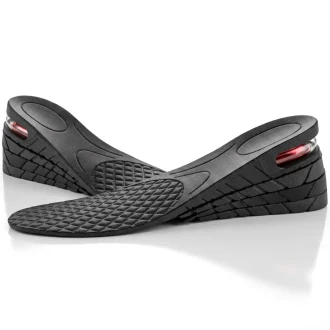
Height Increasing Insoles
- 2x High Quality Height Increasing Insoles Left and Right (3 Layered System)
- The perfect option for quickly and effectively boosting your height and confidence
- Total height gain using 3 layers = 3.5 Inches
- Out of sight and out of mind – These insoles fit discreetly inside your shoes so that nobody will know your wearing them
- Features shock absorbing air cushion heels that will help protect your feet and lower limbs from pain and injury when you walk
- Inbuilt arch and heel support specially designed to keep pressure and strain off your feet helping to treat and prevent common foot injuries such as Plantar Fasciitis and Achilles Tendonitis
- Comes with a full 30 day money back guarantee!
£16.99inc VAT