Why Do My Legs Feel So Tired and Heavy by the End of the Day?
By 3pm, your legs are exhausted. By the time your shift ends, your ankles are swollen, your calves ache, and standing for one more minute feels impossible.
You’re not injured. You’re not out of shape. But your legs feel like they’ve run a marathon when all you’ve done is stand behind a till, walk a hospital ward, or carry plates through an eight-hour shift.
There’s a reason for that. Blood is pooling in your lower legs instead of flowing back to your heart. And while it’s not dangerous for most people, it is uncomfortable—and over time, it can lead to varicose veins (swollen, twisted veins visible under the skin) and chronic venous problems.
Here’s what’s actually happening, who’s most at risk, and what you can do about it.
The Short Answer
Blood is pooling in your lower legs instead of flowing efficiently back to your heart. When you stand or sit for long periods, gravity works against your circulation. Blood accumulates. Pressure builds. Fluid leaks into your tissues. Your legs feel heavy, achy, and exhausted.
Why It Happens
Your leg veins have a tough job. They have to push blood upward, against gravity, all the way back to your heart. To do this, they rely on two things.
First, there are one-way valves inside the veins that stop blood from flowing backwards. These valves open when blood is moving upward and snap shut when it tries to fall back down.
Second, there’s the calf muscle pump—the squeezing action of your calf muscles as you walk or move. Every time you take a step, your calf muscles contract and push blood upward through your veins. When you relax, the valves close and hold the blood in place, ready for the next push.
This system is effective—but only when you’re moving regularly.
When you stand or sit still for long periods, the calf muscle pump isn’t working. Blood isn’t being pushed upward—it pools in your lower legs. As it accumulates, pressure builds inside your veins.
This pressure stretches your vein walls and puts strain on those delicate one-way valves. Over time, the valves can weaken or fail, allowing blood to leak backwards even when you do move.
The increased pressure also forces fluid out of your veins and into the surrounding tissues. This is what causes the swelling—oedema—that you see around your ankles and feel in your calves. Your legs feel heavy because they literally are heavier. There’s extra fluid sitting in your tissues that shouldn’t be there.
And because your veins are stretched and under strain, they ache. The tissues are swollen and inflamed. Your legs feel tired because your circulatory system is working overtime just to keep up.
This isn’t a sudden event—it’s cumulative. Every hour you spend standing or sitting still, more blood pools. More pressure builds. More fluid leaks out. By the end of an eight- or ten-hour shift, your legs have been under strain for hours. The swelling is at its worst. The aching is at its peak.
For most people, overnight rest allows the fluid to drain and the veins to recover. You wake up feeling fine. But the cycle starts again the next day. And over months and years, that daily strain can cause lasting damage to your vein valves and walls.
Who’s Most Affected
Tired, heavy legs can affect anyone—but some people are far more likely to experience it than others.
People Who Stand All Day
If your job keeps you on your feet for hours at a time, your legs are under constant strain. Retail workers, nurses, waiters and waitresses—you’re standing for 8–12 hours straight. Your veins are under constant pressure, and by the end of the day, the strain shows.
Yes, you’re moving around a bit. Your calf muscle pump is working. But gravity is relentless. Over a full shift, blood still pools. Pressure still builds. And by the time you get home, your legs are done.
People Who Sit All Day
Sitting for long periods puts equal strain on your circulation. When you’re sitting, your calf muscles aren’t contracting at all. The muscle pump is barely working. Blood pools even faster than it does when you’re standing. If you’re sitting for six, eight, ten hours a day, your circulation slows significantly. And if you cross your legs or wear tight clothing, you’re restricting blood flow further.
Frequent Travellers
Long flights, train journeys, and car trips commonly cause tired, swollen legs. You’re sitting in a cramped space with limited room to move. Your legs are often bent at awkward angles. Cabin pressure on flights can make fluid retention worse. And if you’re travelling for hours, the cumulative effect is significant.
Pregnant Women
Pregnancy increases your blood volume by up to 50% and relaxes your vein walls, making them more prone to stretching. And as your baby grows, the pressure from your expanding uterus can compress the veins in your pelvis, making it harder for blood to return from your legs. Most pregnant women experience tired, heavy legs and swollen ankles, especially in the second and third trimesters. Varicose veins often develop or worsen during this time, too.
People with a Family History of Venous Problems
Genetics determine how resilient your vein valves are. If your parents or grandparents had varicose veins, weak vein valves, or chronic venous problems, you’re more likely to develop them too. Early signs include tired legs by evening, visible veins, night cramps, and restless legs.
Older Adults
As we age, our vein walls and valves naturally weaken. Muscle tone decreases. Circulation becomes less efficient. The risk increases with age, especially after decades of standing or sitting work.
What You Can Do About It
Movement activates your calf muscle pump. Calf raises, ankle circles, and walking breaks all help. Elevating your legs at the end of the day drains pooled fluid and gives your veins a chance to recover. Staying hydrated keeps your blood flowing smoothly. Avoiding tight clothing around your legs prevents constriction.
But these provide only temporary relief and don’t prevent tomorrow’s fatigue. The most effective, evidence-based solution? Compression socks.
When Compression Socks Help
Compression socks are a clinically proven tool for managing tired, heavy legs. Doctors have used them for decades to treat chronic venous insufficiency (when vein valves fail and blood pools persistently), varicose veins, and post-surgical swelling. They’re also popular for preventing leg fatigue during long work days and travel.
Compression socks squeeze your lower legs—firmest at the ankle, gradually loosening up your calf. That squeeze mimics what your calf muscles do when you walk. It pushes blood upward and stops it from pooling.
The pressure narrows your veins, which pushes blood upward faster. Faster-moving blood is less likely to pool. Lower venous pressure means less strain on your vein walls and valves. Less fluid leaks out into your tissues. And your legs feel lighter, less achy, and less tired.
Compression socks support your circulatory system when your muscles aren’t doing the job on their own—whether that’s because you’re standing still, sitting for hours, or your vein valves are already weakened.
Decades of clinical research support compression therapy. Studies consistently show that graduated compression reduces leg fatigue, swelling, and discomfort in people who stand or sit for prolonged periods. It’s widely recommended by GPs, vascular specialists, and physiotherapists for managing venous insufficiency, varicose veins, and oedema.
Compression socks are also standard advice for frequent travellers to reduce the risk of swelling and discomfort on long flights. And they’re commonly prescribed during pregnancy to ease the strain on leg veins.
Compression therapy is a well-established, evidence-based intervention that works.
Compression socks are particularly helpful for people who stand or sit for long periods, frequent travellers, pregnant women (with medical clearance), and people with varicose veins or a family history of venous problems. However, they’re not suitable for everyone—see the safety information below before use.
What to Look For in Compression Socks
Not all compression socks are created equal. If you’re going to invest in a pair, here’s what actually matters.
Graduated Compression
This is the most important feature. The compression must be graduated—firmest at your ankle, gradually decreasing up your calf. Socks that apply uniform pressure all the way up your leg don’t work the same way. They can even restrict circulation at the top, which defeats the entire purpose.
Comfortable for All-Day Wear
If your compression socks are uncomfortable, you won’t wear them. And if you don’t wear them, they can’t help. Look for breathable, moisture-wicking fabric that keeps your feet dry throughout long shifts. The socks should stay in place without rolling down or digging into your skin. There should be no tight bands at the top that restrict circulation—that defeats the entire purpose.
Anatomical Support
Good compression socks don’t just squeeze your calves—they support the structures in your feet and ankles too. Integrated arch and heel zones reduce strain on your plantar fascia, Achilles tendon, and the ligaments and joints that take the brunt of prolonged standing. This is particularly helpful if you’re dealing with plantar fasciitis or general foot fatigue.
Antimicrobial and Moisture-Wicking Properties
When you’re wearing socks for 8–12 hours straight, odour control and moisture management matter. Antimicrobial fabric inhibits bacterial growth, which keeps your feet fresher. Moisture-wicking material pulls sweat away from your skin, preventing that damp, uncomfortable feeling by the end of the day.
Durable Construction
Compression socks take a lot of wear, especially around the heel and toe. Reinforced sections in these high-wear areas are essential. Quality socks should maintain their compression for three to six months with daily use and proper care. Cheap compression socks lose their elasticity quickly—the compression weakens, the fabric thins out, and within a few weeks they’re no longer doing their job.
Look Like Regular Socks
You shouldn’t have to choose between effective compression and normal-looking socks. Medical-grade compression stockings are often beige, shiny, and obviously clinical. Good everyday compression socks should look like regular socks—something you can wear with any shoes, under trousers, at work, while travelling, without anyone noticing.
Our compression socks are designed with all of this in mind.
Our Recommendation
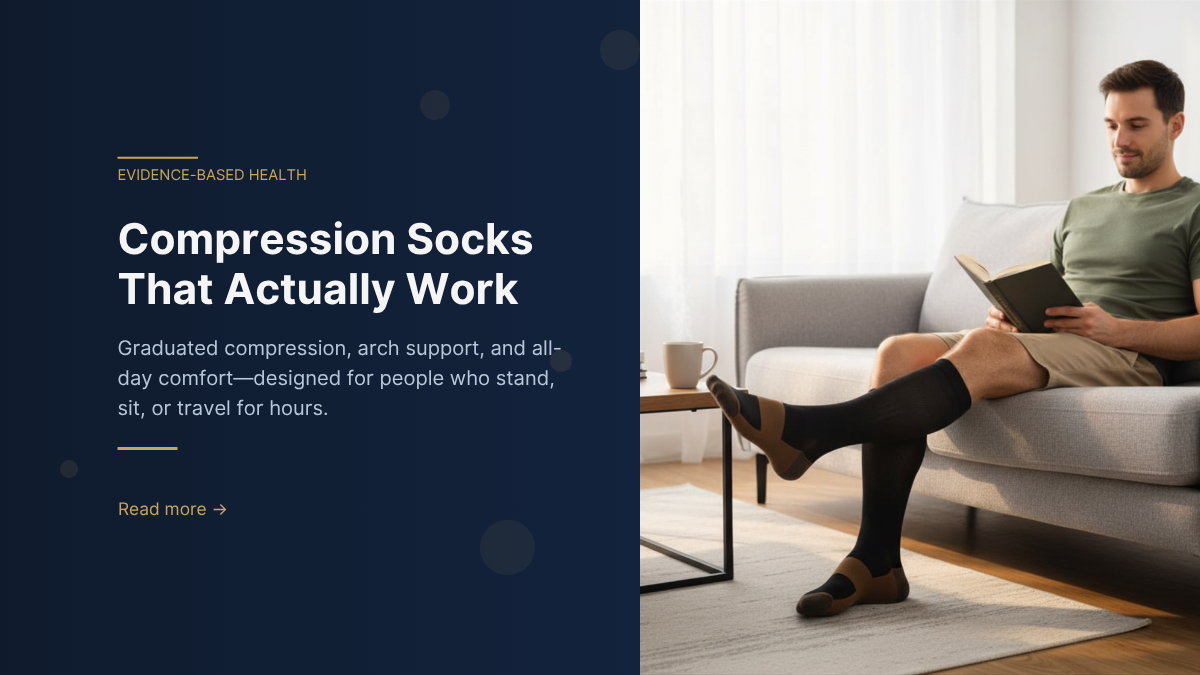
Our compression socks are designed to reduce leg fatigue, swelling, and discomfort for people who stand, sit, or travel for extended periods. Here’s how they meet every criterion:
- Graduated compression — Firmest at the ankle, tapering up the calf. This speeds venous blood flow and reduces pooling, which directly addresses the heaviness and swelling you feel by the end of the day.
- Integrated arch and heel support — Reduces strain on your plantar fascia, Achilles tendon, and the key ligaments and joints in your feet and ankles. Particularly helpful if you’re dealing with plantar fasciitis or general foot fatigue from long hours standing.
- Copper-infused antimicrobial fabric — Copper ions inhibit bacterial growth, which controls odour even after 8–12 hour shifts. The moisture-wicking fabric keeps your feet dry throughout the day.
- Flexible, breathable knit — Moulds to your leg contours, stays in place without digging in, no rolling down or tight bands that restrict circulation. Comfortable enough to wear all day.
- Reinforced heel and toe sections — Built for durability in high-wear areas. With proper care, these socks maintain their compression for months of daily use—they won’t lose elasticity quickly like cheaper options.
- Look like regular socks — Black with copper-coloured reinforced heel and toe. Wear them with normal shoes, under trousers, at work, while travelling. No one will notice they’re compression socks.
Available in two sizes: S/M (UK 5–9.5 women / 5–9 men) and L/XL (UK 10–13.5 women / 9.5–12 men). Machine washable on cold, delicate cycle—air dry flat or hang (never tumble dry, bleach, or use fabric softener). 30-day money-back guarantee if you’re not satisfied.
Important Safety Information
These socks do not prevent or treat blood clots (deep vein thrombosis, or DVT). They are not medical-grade compression stockings.
They are not suitable for people with peripheral arterial disease (poor arterial blood flow to the legs), severe heart failure, acute skin infections or open wounds on the legs, or severe neuropathy (loss of sensation in the feet or legs) without medical clearance.
If you have diabetes or any chronic health condition, speak to your GP before using compression socks.
If your leg symptoms are severe, getting worse, or accompanied by pain, redness, warmth, or sudden swelling in one leg, see a doctor immediately. These could be signs of a more serious problem.
Shop NuovaHealth Compression Socks — Free UK delivery, 30-day money-back guarantee.
Common Questions
When should I put compression socks on?
Put them on in the morning before swelling starts. If you wait until your legs are already swollen, they’ll be harder to get on and less effective. For best results, put them on within 30 minutes of waking up, before you’ve been standing or sitting for long periods.
Can I sleep in compression socks?
No. Compression socks are designed for daytime use when you’re upright and gravity is working against your circulation. When you’re lying down, your legs are elevated and blood flows back to your heart naturally. Wearing compression socks overnight isn’t necessary and can be uncomfortable.
How tight should they feel?
They should feel snug and supportive, not painful or restrictive. You should feel firm pressure around your ankle that gradually eases as it moves up your calf. If they’re cutting off circulation, causing pain, or leaving deep marks in your skin, they’re too tight. If they’re sliding down or bunching up, they’re too loose.
How long does it take to feel a difference?
Most people notice less heaviness and swelling by the end of the first day. The difference becomes more obvious after a few days of consistent wear, when you compare how your legs feel at the end of a shift with compression versus without. For chronic venous problems, it can take a few weeks of daily use to see significant improvement.
Can I wear compression socks if I have diabetes?
Speak to your GP first. People with diabetes can have reduced sensation in their feet (neuropathy) and impaired circulation (peripheral arterial disease). If you can’t feel whether the socks are too tight, or if you have poor arterial blood flow, compression socks can cause harm. Your GP can assess whether they’re safe for you and recommend the right compression level.
Will compression socks make my legs weaker over time?
No. This is a common misconception. Compression socks support your veins—they don’t replace your muscles. Your calf muscle pump still works when you move. The socks simply assist your circulation when you’re standing or sitting still for long periods. They don’t cause muscle atrophy or make your legs dependent on them.
Are they difficult to put on?
They’re firmer than regular socks, so they take a bit more effort—but they’re not medical-grade stockings that require special tools. Turn them inside out to the heel, slide your foot in, then roll them up your calf gradually. Putting them on in the morning before swelling starts makes it easier. If you have limited hand strength or mobility, there are sock aids available that can help.
Final Thoughts
Tired, heavy legs by the end of the day aren’t something you have to accept. You now understand the mechanism—blood pooling in your lower legs, venous pressure building, fluid leaking into tissues—and the evidence-based interventions that help.
Compression socks are a clinically proven tool that makes a real difference. They won’t cure underlying venous problems, but they assist venous return, ease symptoms, and improve daily comfort.
If you’re experiencing persistent leg fatigue, swelling, or discomfort, compression therapy combined with regular movement, leg elevation, and proper hydration can provide significant relief.
If your symptoms are severe or worsening—particularly if you’re seeing visible varicose veins, experiencing night cramps, or noticing skin changes around your ankles—consult your GP. Early intervention significantly reduces the risk of long-term venous damage.
Proper circulatory support makes a real difference to both immediate comfort and long-term vein health.
Shop NuovaHealth Compression Socks — Free UK delivery, 30-day money-back guarantee.
This post is for informational purposes only and does not constitute medical advice. If you have concerns about leg pain, swelling, or circulation problems, consult your GP or a qualified healthcare professional.