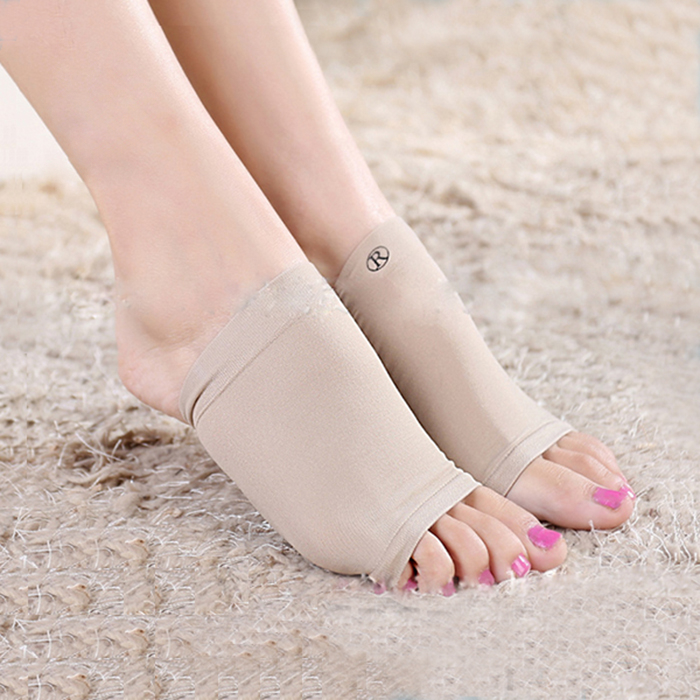
Gel Arch Support Compression Sleeves for Plantar Fasciitis relief & Flat Feet

£7.99inc VAT

In stock

  • One pair of gel arch support foot compression sleeves
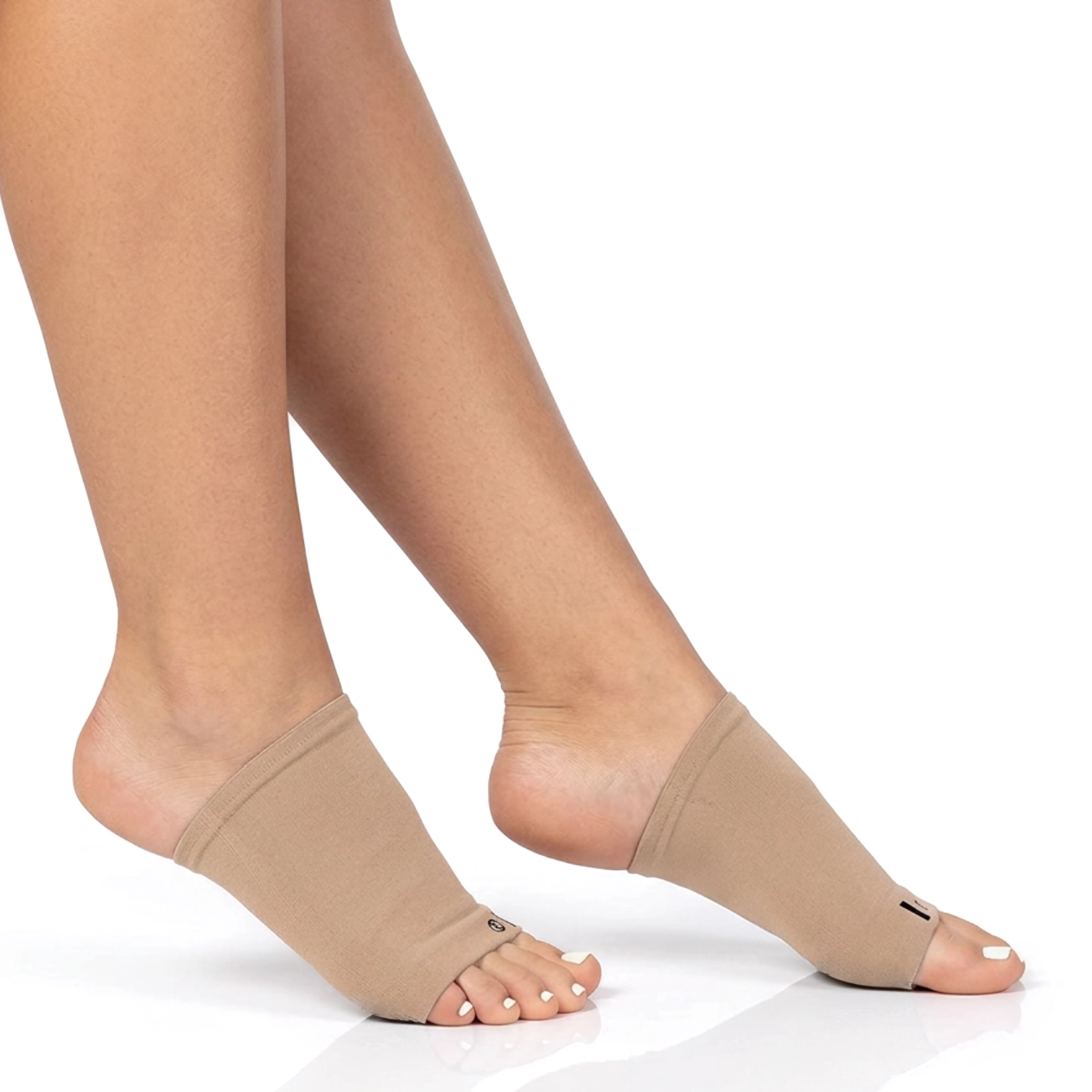
  • Left- and right-shaped, so the pad sits along the arch on both feet
  • Suits men and women — one size that stretches to fit
  • Designed for plantar fasciitis, flat feet, fallen arches, high arches, and everyday heel and arch pain
  • Suits tired, aching feet after long hours on hard floors
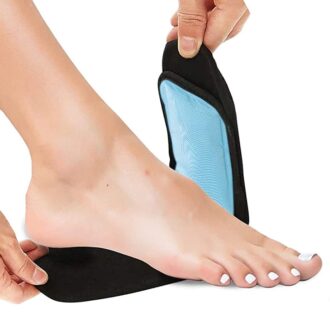
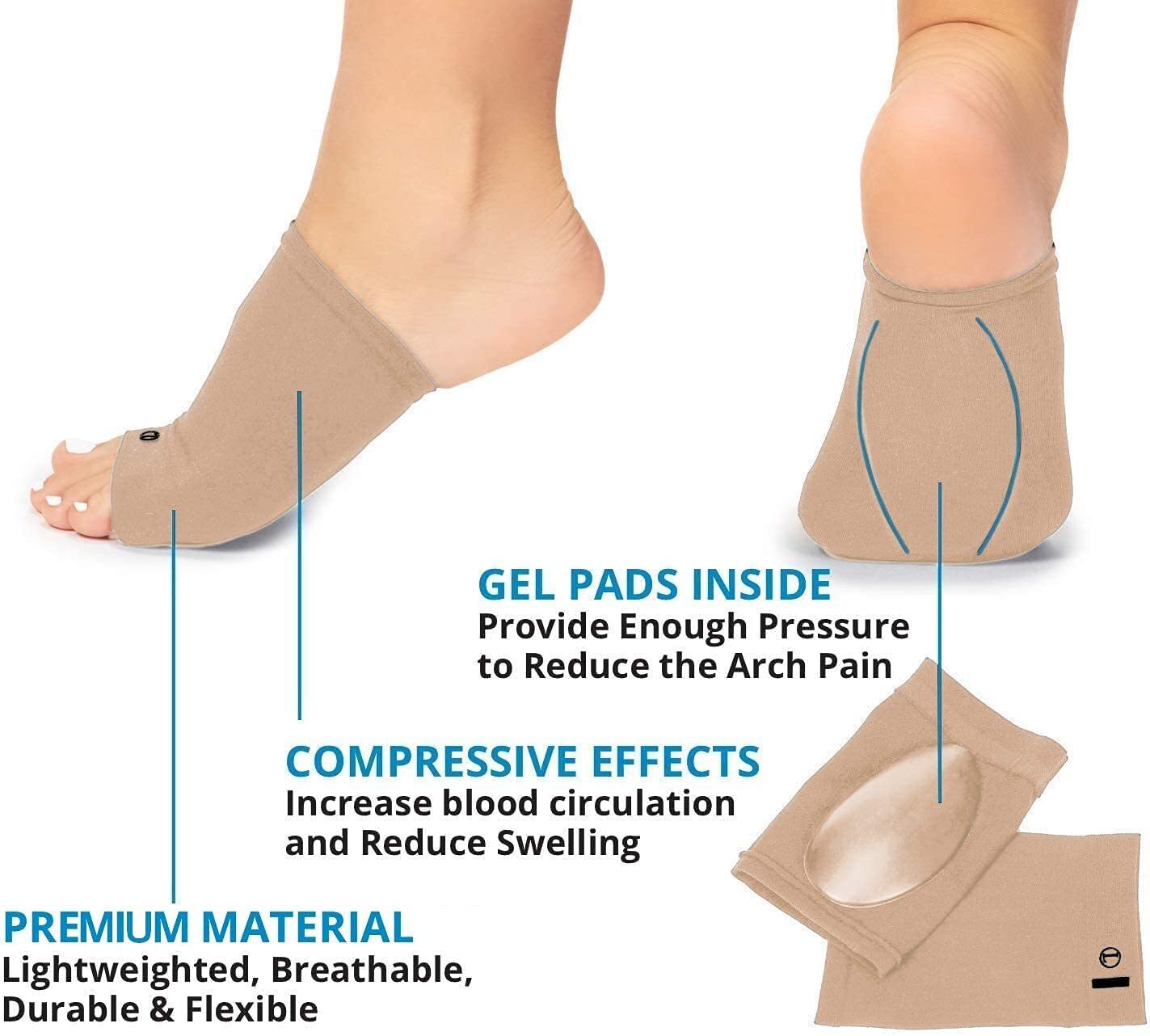
  • Moulded medical-grade silicone gel runs the full length of the arch
  • The gel absorbs the shock of each step and spreads pressure across a wider area of the sole
  • Adds gentle, even compression around the foot
  • Thin enough to sit inside most everyday shoes and trainers
  • Can be worn alongside insoles or orthotics you already use
  • Comfortable at home, with or without socks
  • Start with an hour or two a day, then build up over a week or two
  • For daytime wear only, not overnight
  • 30-day money back guarantee

Please note there is no guarantee of specific results and that the results can vary for this product.

EAN: 5061006078108 SKU: 116334 Categories: , , , , Tags: , , , Brand:

Gel Arch Support Foot Compression Sleeves – 1 Pair for Plantar Fasciitis, Flat Feet and Everyday Heel Pain

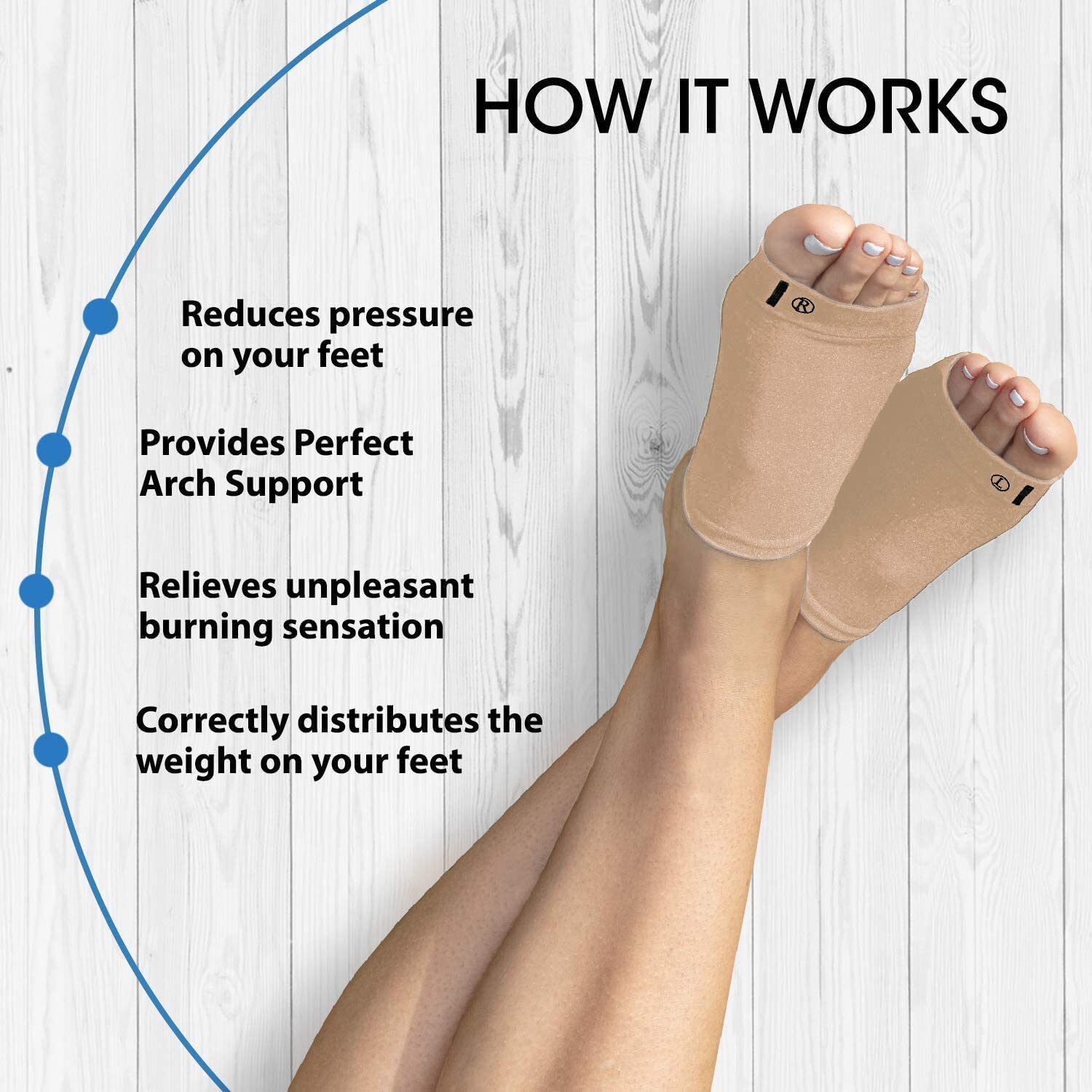
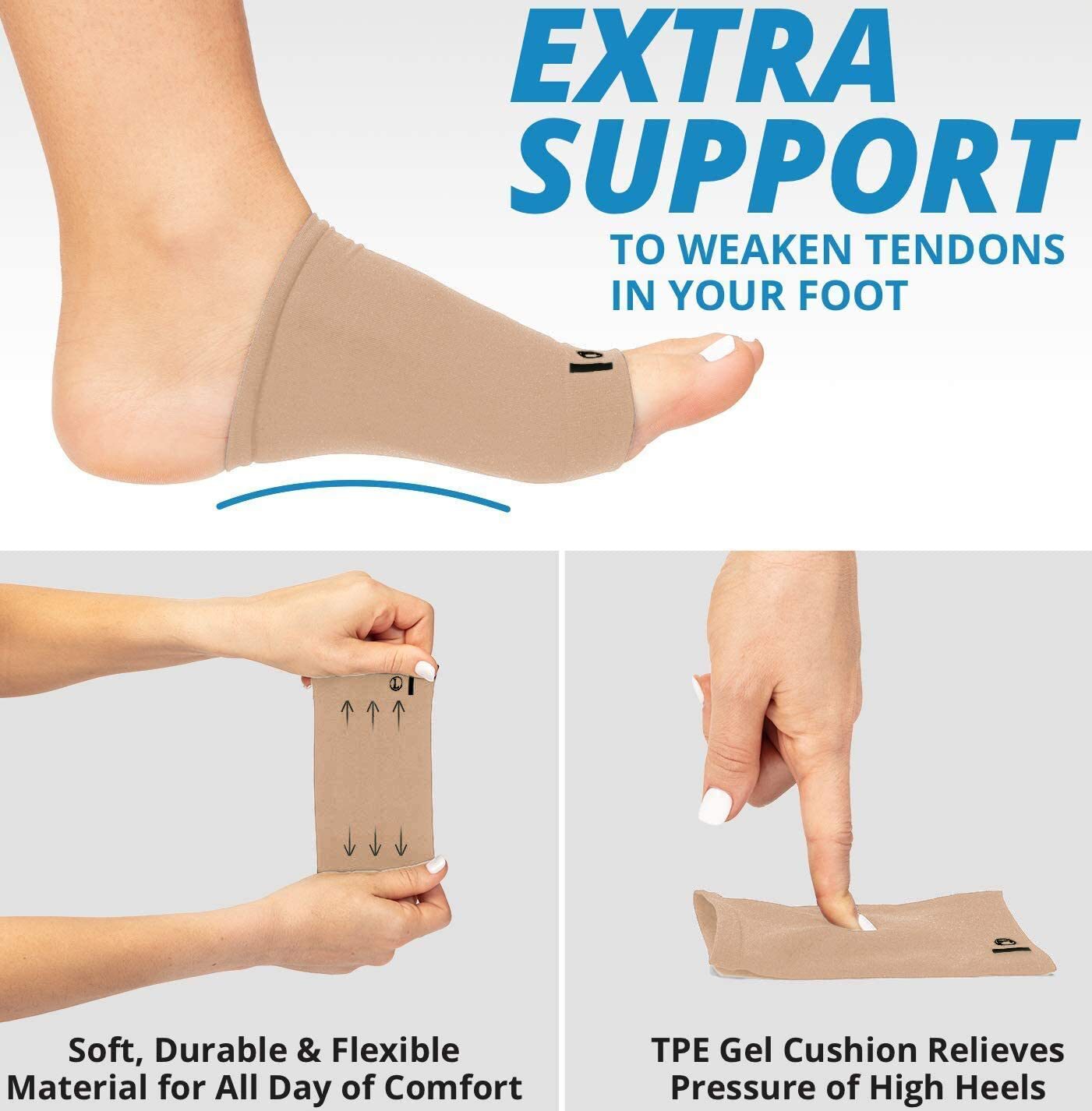
A pair of soft, stretchy foot sleeves, each with a moulded gel pad that runs along the length of the arch. The gel cushions the sole, the sleeve adds gentle compression, and between the two they take some of the load off the band of tissue that holds your arch up.


Is this you?

If you’ve found your way here, you already know something is wrong with your feet. You may not have a name for it yet. You may have several. Either way, the experience tends to follow a familiar shape.

The most common version starts in the morning. You swing your legs out of bed, put your feet on the floor, and the first few steps send a sharp, tight pain through the heel or along the inner arch. It eases as you get moving, which tricks you into thinking it’s passed. Worst on the very first steps, better once you’re up and about — that combination is almost a signature of one particular problem.

For others it isn’t sharp at all. It’s a dull, heavy ache that builds as the day goes on. By mid-afternoon your feet feel tired and hot. By evening they feel bruised. If you spend long hours on your feet on hard surfaces — concrete, tiles, wooden flooring, factory floors, hospital corridors, shop floors — that will feel very familiar. Carpet and grass soften the load a little. Hard floors don’t give at all, so the full force of every step travels back up through your foot.

Then there are the pressure points. A spot under the ball of your foot that feels like you’re standing on a small stone. Rubbing along the side of your big toe. Thickened skin where the shoe presses. An ache along the outside of the foot after a long walk. Discomfort that seems to move around the foot rather than staying in one place.

What all of these have in common is that your foot isn’t managing load well. The same amount of walking, standing or running that a well-supported foot would shrug off is landing in the wrong places. That’s why it keeps coming back, and why resting for a few days rarely fixes it properly. Rest takes the load off, but it doesn’t change where the load lands once you start moving again.


What is actually going on in your foot

It helps to picture the foot in three layers. Underneath, a band of tissue holds the arch together. Above it, the arch itself — a curve, not a solid block. And running through both, a pattern of movement that repeats every time you take a step. When any of the three stops working as it should, load starts to gather in the wrong place.

The band underneath. The plantar fascia is a thick strip of tough, slightly elastic tissue that runs from your heel bone along the sole to the base of your toes. Think of it as the strap that keeps the arch in shape, and as a spring. As you land, the arch flattens and stretches it. As you push off, it snaps back and helps launch the next step. Every step you take passes through it. When that strap becomes irritated — usually right where it attaches to the heel bone — the result is plantar fasciitis, a common reason adults get heel pain.

The curve above it. Your arch is held up by three things working together: the shape of the bones, the plantar fascia underneath, and the muscles and tendons running through the foot and up into the lower leg. It works a bit like a bridge. When everything works as it should, your weight travels from the heel, along the outside of the foot, across to the ball, and out through the toes. When it doesn’t, pressure gathers in one place and the tissue there takes the strain.

The pattern of the step. Every step runs through the same sequence: heel down, weight rolling through the foot, push off from the ball. That sequence is your gait, and small differences in it change where load lands.

The main difference is how far the foot rolls inwards as it lands. A little roll is normal and useful, because it absorbs shock. Roll in too far or for too long and you have overpronation. Roll in too little and weight stays along the outer edge — that’s supination. Either way, the foot stops sharing load the way it was designed to.

Foot shape adds to the same picture. A low arch drops further with every step, so the inner edge takes load it wasn’t built to carry. A high arch contacts the ground on a narrower strip, so the same weight is spread over a smaller area. Both change where pressure lands.

What shapes the outcome at least as much as the shape itself is demand — how long you’re on your feet, what you’re standing on, what you’re wearing, and how much weight the foot is carrying.


Why a gel arch sleeve is a sensible answer

If load is the problem, the answer is to change how that load is spread.

The gel pad under the arch gives your foot something to press against. When you stand for a long shift on a hard floor, the arch flattens slightly with every step, and the fascia is stretched each time it does. A pad beneath it limits how far it drops, so the fascia isn’t being pulled to its full length thousands of times across a working day.

Then there’s the cushioning. A soft layer between your foot and the ground spreads pressure over a wider area rather than letting it gather in one spot. The total weight going through your foot doesn’t change — the way it’s carried does. If you spend an afternoon walking on pavements, or an hour standing in a queue on a tiled floor, this is where the difference shows. The peak force under the heel or the ball of the foot is lower, and the tissue there isn’t being pressed quite so hard with each step.

On top of that, the sleeve fits closely around the foot, giving gentle, even pressure all the way round. This isn’t the same as a medical compression garment, which is much firmer and used for specific medical conditions. What it does here is subtle. A supported foot often feels steadier underfoot, and the swelling that builds through a long day tends to settle a little more comfortably by the evening.

That’s the whole mechanism. It isn’t dramatic. But across thousands of steps a day, those three things together can change how your feet feel by the time you get home.


What these particular sleeves are like

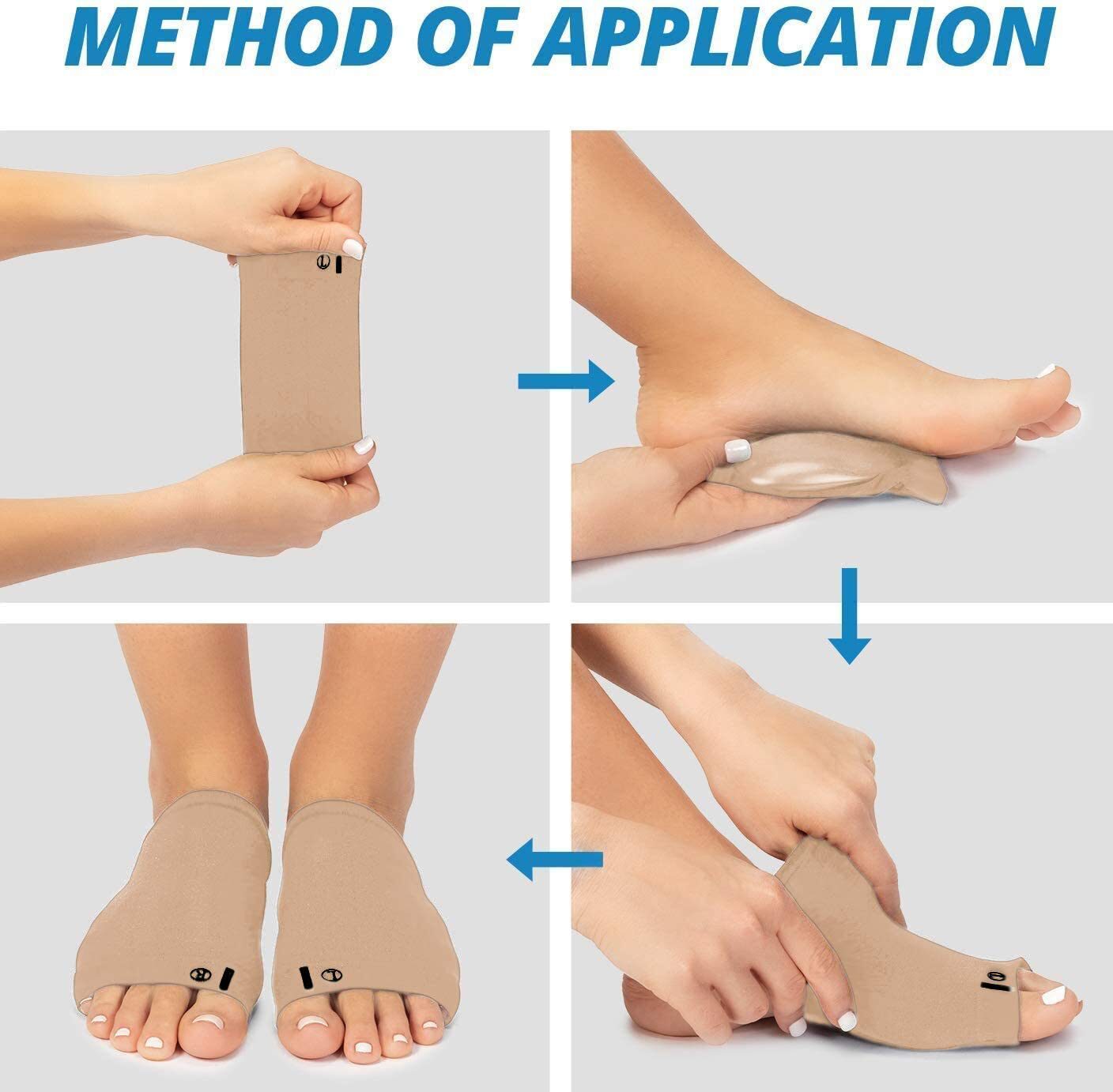
The left and right sleeves are shaped separately, rather than being two identical tubes. A generic tube of fabric tends to sit slightly twisted on one foot or the other, which puts the padding in the wrong place and makes the whole thing feel half-hearted. With a left and a right, the pad lands along the arch on both feet, which is where it needs to be whether you’re standing for a full shift or heading out for a long walk.

The pad itself runs the full length of the arch, from just in front of the heel to the base of the toes. It’s moulded medical-grade silicone gel — soft, rubbery, and it holds its shape under pressure rather than flattening out after a few steps. Because it runs the whole length, you can shift the thickest part towards the heel or towards the ball of the foot, which means you can put the cushioning directly under the spot that hurts rather than off to one side of it. If your pain sits at the front of the heel, the pad goes further back. If it sits under the ball of the foot, the pad goes further forward.

Both sleeves are slim enough to sit inside most everyday shoes and trainers. They can generally be worn alongside insoles or orthotics you already use, so you don’t have to choose between what you have and what you need. The gel pad is firm enough to give real support under the arch, but not so bulky that you feel like you’re walking on a golf ball.

To look after them, wash by hand in cool water with a little mild soap, air dry away from direct heat, and keep them away from anything sharp. Don’t machine wash or tumble dry. Treated sensibly, the gel keeps its shape and the fabric keeps its stretch.

They come in one size that stretches to fit both men and women.


The conditions these sleeves are made for

The conditions below are the ones these sleeves are made for. They’re written one at a time, because they don’t all behave in the same way. Some start with a jolt on the first step of the day. Some build quietly across a shift on your feet. Some of them show up first when you’re trying on shoes. Start with the one that fits your feet.

If you want a shortcut: a sharp jolt on the very first steps of the day usually points to plantar fasciitis. If the pain feels like a stone under the ball of the foot and comes across as a bruising ache, metatarsalgia is likely. And if that same feeling burns, stings, or fades once the shoe comes off, it’s more often a Morton’s neuroma. If one of those three fits, start there.

Two of the conditions are different in kind from the rest. Poor circulation and neuropathy aren’t things a sleeve can solve, and they need a conversation with a clinician before you put any kind of compression on your feet. They’re here so you can recognise them, not so you can manage them with a purchase.

Plantar fasciitis
The sharp, tight pain on the first step of the day is the most reliable clue this condition gives you. It happens because of what your foot has been doing all night. Lying flat and relaxed, the plantar fascia — the band that runs from the heel bone forward along the sole — has been sitting in a shortened position. The moment you stand, it’s pulled suddenly to full length before it’s had a chance to warm up, and the pull is felt most sharply where it attaches to the heel bone. That’s the jolt.

Within a few minutes the pain fades. You walk to the kitchen, make tea, and by the time you’re dressed your feet feel almost normal. That warm-up is the most misleading part of the whole thing, because it teaches you that walking fixes it. It hasn’t fixed anything. The tissue has simply loosened again. Sit down for a meeting, or drive for half an hour, or watch an episode on the sofa, and the same pattern runs: the foot shortens, then stands up cold, and the pain is back — shorter this time, less sharp, but unmistakably there. Long car journeys and long meetings are the two situations people describe most often.

By the afternoon the character has changed. The sharp morning jolt has gone, replaced by a dull ache that sits in the heel and spreads along the inner arch. On hard floors this is where it builds. On softer ground it may barely arrive at all. By the evening the foot is sore in a third way — heavy, tired, tender to press. Tired feet in the evening aren’t unique to this condition, but with plantar fasciitis they’re usually paired with the morning pattern, and it’s the pairing that tells the story.

What matters most with this one is when it hurts, not where. First-step pain, easing with movement, returning after rest, building through the day. If your heel pain follows that shape, the tissue under the arch is almost certainly involved.

Some things reliably make the pain worse. Walking barefoot on hard floors first thing in the morning is the worst of them, because it repeats the first-step stretch over and over with nothing supporting the arch. Thin-soled flat shoes leave the fascia doing all the work. Standing still for long stretches is harder on it than walking, because the same spot is loaded continuously. A sudden increase in distance, or a route with more incline than you’re used to, adds load the tissue hasn’t had time to adapt to. Cold weather stiffens it. And a long sit followed by a stand brings it straight back.

Other things ease it. Cushioned footwear with some give under the heel helps more than most people expect. Keeping the calf and ankle mobile helps too, because a stiff ankle forces the fascia to take on more of the movement with every step. A soft pad under the arch, worn through the early part of the day when the tissue is most reactive, can reduce how hard it’s stretched on those first steps. If your pain sits at the front of the heel, the thicker part of the gel pad should sit under the heel end of the arch rather than the toe end. From there, it presses on the band where it’s sore.

This condition is commoner than most people assume, and it isn’t confined to runners. The clearest risk factors are a recent increase in time on your feet, and a foot that has always worked harder than it should. Both low arches and high arches raise the odds, for different reasons: a low arch stretches the fascia every time it flattens, while a high arch concentrates pressure under the heel. Tight calves contribute too. It’s most common between the forties and sixties, but it appears at any age.

It isn’t the only thing that hurts at the heel, though. A bruised heel pad is worse the longer you stand and better after rest — the opposite of this pattern. A trapped nerve at the heel burns or shoots rather than pulling tight. Achilles tendonitis sits at the back of the heel and ankle, not underneath. If the pain doesn’t follow the first-step rhythm, it may not be the fascia at all.

Left alone, it usually begins as occasional morning stiffness, becomes a daily feature, then starts to interfere with ordinary walking. Some people find it settles by itself over several months, but that’s a long time to be uncomfortable, and plenty of people find it lasts far longer without a change in approach. With consistent load management, most people notice a meaningful difference over four to eight weeks, with the morning pain improving first and the end-of-day soreness settling last. Flare-ups after unusually busy days are normal and don’t mean you’re back at the start.

If the pain has been running for several weeks, is severe, or is getting worse rather than better, get it assessed properly. A support helps with load. It can’t tell you what’s driving the problem.

Metatarsalgia
Think of the ball of your foot as a map with five points of contact. The metatarsals are the five long bones running through the middle of the foot and ending at the base of the toes. The rounded ends — the metatarsal heads — form those five points. Almost half your body weight passes over the map every time you take a step and push off.

Metatarsalgia is what happens when weight stops being shared across the map and starts landing on one or two points instead. People describe it in a very particular way: like a small stone under the ball of the foot. Each point has its own story, and one of them is usually the one that turns sore.

Under the base of the big toe, the first head is paired with the sesamoids — two small bones embedded in the tendon beneath the joint — and it carries the largest share of push-off force of any point on the foot. Load problems here tend to feel sharp, and they often get worse when you rise onto your toes or climb stairs. When the first head is the sore one, sesamoiditis is worth ruling out before assuming metatarsalgia.

Under the second toe, the second head is the most common site, and there’s a simple reason. The second toe is usually the longest, so it takes the greatest load of the five. It’s also the least flexible in most feet, because it sits next to the rigid big toe rather than enjoying the mobility of the outer toes. When someone points to the stone under the ball of their foot, it’s usually here.

The third head is less commonly the primary site, but it often becomes involved once the second has been sore for a while. Once one point hurts, you shift your weight sideways to protect it, and the neighbouring points pick up more load than they were designed for.

The fourth and fifth heads sit along the outer edge of the map. Problems here are more often down to a high, rigid arch than to the second-toe-length effect, because a high arch concentrates weight along the outer strip of the sole. Pain here is frequently paired with hard skin building along the outer edge.

Where the sore point sits tells you something about how your foot is loading. A single point of pain under the second head with a normal arch points to footwear or a recent increase in load. Pain across several points, more prominent with high arches, means too much body weight landing on too small a surface. Pain that shifts over months, moving from one point to another, suggests the foot is shifting load away from the sore spot, which usually means the problem has been going on for a while.

The pattern is common in people with high, rigid arches, and in anyone whose footwear pushes force forward: narrow toe boxes, thin soles, raised heels. It also shows up after a sudden increase in step count, and in people whose foot shape has changed, such as with a bunion or a stiff big toe joint, both of which force the other heads to take on more work.

Cushioning only helps if it lands in the right place. If the stone sits under the second or third head, the thicker part of the gel pad needs to move towards the front of the sole, so the soft layer sits directly under the sore point rather than leaving it pressing against a thin sole. That doesn’t remove the load, but it spreads it across a wider area of the ball of the foot, and over the course of a day that can change how the ball feels by evening. Wider shoes, a lower heel and a sole with some give all lower the peak pressure. Rest helps briefly, but the load itself has to change for the soreness to settle.

Hard flooring, thin soles, walking barefoot on tiles, standing still for long stretches, and sudden increases in distance all make it worse. Raised heels are a particular problem, because they shift weight forward onto the very points that are already overloaded. Hard skin building under a sore point makes it worse again, because it concentrates pressure instead of spreading it.

Several other things can look similar. A stress fracture of a metatarsal is pinpoint on one spot of the bone, and is typically worse at night. Sesamoiditis sits under the big toe rather than across the ball. If the pain is very sharp or very localised, that points away from simple metatarsalgia.

Left alone, it tends to spread. It starts under one head and, as the foot compensates, often shifts to others or to the other foot. The soreness lasts later into the evening and the morning relief gets shorter. With the pressure genuinely reduced, most people notice a difference within a few weeks, with further improvement over the following month. Hard skin that’s built up takes longer to soften even after the pain has eased.

If the pain is sharp, or comes with numbness or tingling into the toes, that needs assessing before you start managing it yourself.

Sesamoiditis
Nearly everything about sesamoiditis happens in a single moment: the instant you push off. The heel has already lifted, the toes are bending, the weight is rolling forward onto the ball of the foot and out. It lasts a fraction of a second, and it repeats thousands of times a day.

Beneath the big toe joint, embedded in the tendon that runs along the underside, are two small bones called the sesamoids. They sit inside the tendon like two peas in a pod. They act as a pulley, changing the angle at which the tendon pulls on the bone, and they take a genuine share of your body weight every time you push off. Because they carry load directly rather than being cushioned inside a joint, they’re exposed. Repetitive pressure irritates the tissue around them, and the area under the big toe becomes tender to press.

They hurt most at the one moment each step when they’re working hardest. The big toe joint is the last thing to leave the ground, and at that moment it carries more load than any other part of the foot. Everything else has already unloaded. Problems here are hard to settle for a simple reason: there’s no way to walk without loading the area, so the tissue never really gets a proper rest.

Before you push off, the foot may feel fine. During the push, there’s a dull ache that sharpens. Afterwards, there’s often a residual soreness. Walking on tiptoe, going up stairs, or standing on the balls of your feet makes it worse. Flat ground in cushioned shoes is more comfortable than hard ground in thin soles. Pressing the area under the big toe produces a clear, localised tenderness — the clearest thing you can notice for yourself, because it points straight at the structure.

It turns up more often in people who spend a lot of time up on the front of the foot: runners, dancers, sports involving pivoting or jumping. It’s also more common in those with a high, rigid arch, where pressure is concentrated under the front of the foot rather than spread across it, and in anyone wearing shoes that press firmly under the big toe. A change in activity, a new pair of shoes with a different heel-to-toe drop — the difference in height between the heel and the front of the shoe — or a long stretch of hard-ground walking can all set it off. It can also follow one heavy episode, such as a long day of hiking in thin-soled boots.

Cushioning is most useful here when it sits under the ball of the foot rather than under the arch. If you move the thickest part of the gel pad forward, it takes the edge off the push-off moment — the peak force through the sesamoids is lower, and the tissue around them isn’t being squeezed quite so hard with every step. Softer, more cushioned shoes make a real difference alongside it. Runners often find they need to reduce hill work and speed work temporarily, because both put extra load through the front of the foot on every step.

Thin-soled shoes, hard surfaces, walking barefoot on tiles, hills, stairs, and anything that puts you on the balls of your feet all make the instant worse. Barefoot running is a particularly common trigger, because it concentrates force under the front of the foot with nothing to soften it.

Several other things live at that same instant. Metatarsalgia produces pain across the ball of the foot, whereas this is more localised, directly under the big toe. A stress fracture of a sesamoid produces sharper, more constant pain, often worse at night. A turf toe injury — damage to the ligaments around the big toe joint itself — usually follows a specific incident with immediate pain and swelling. Gout in the big toe joint produces a hot, red, swollen joint with sudden severe pain, usually overnight.

Left alone, it generally gets worse rather than settling. Soreness after activity becomes soreness during activity, then soreness with ordinary walking, then soreness at rest. In some people the bone itself becomes involved, which lengthens recovery considerably. That progression is why acting early beats waiting to see whether it clears. With a genuine reduction in front-of-foot load, improvement usually starts within a fortnight, with fuller recovery over the following month or two.

If the pain is severe, or you’re unable to push off at all, get it looked at. If it isn’t improving after several weeks of sensible changes, or if the pain is sharp and constant, an assessment is worthwhile, because the treatment for a fracture is different from the treatment for inflammation.

Morton's neuroma
This is a condition that’s almost always described wrong at first. People arrive convinced they have a stone in their shoe, a fold in their sock, or a bunion developing between two toes. None of those things are there.

The most common description is a small stone or a pebble under the ball of the foot, usually between the third and fourth toes. People take the shoe off, shake it out, put it back on, and find the pebble is still there. It’s the most distinctive feature of the condition. The second most common is a fold in the sock or a seam pressing into the foot — the feeling has the quality of something soft squeezed between the toes rather than something under them. Less often it’s described as a bunion developing between the toes, because there’s a sense of a lump. In reality there’s no lump you can feel from outside, because the thickening is on the nerve itself, buried between the bones.

Between the long bones of the foot run small nerves. In this condition, one of them becomes thickened and inflamed. It isn’t a growth or a lump. It’s a nerve that’s been repeatedly squeezed in a narrow space and has responded by swelling. The squeezing comes from the metatarsal bones closing together, which is why footwear plays such a large part in the story.

This is nerve pain, and nerve pain behaves quite differently from the aches most foot problems cause. It can burn, shoot, sting, or arrive as a sharp electric jab. It can be entirely absent when you’re sitting and ferocious the moment you put a shoe on. It often eases when the shoe comes off, which is a strong clue that footwear rather than load is the driver. It also doesn’t respect the usual rules about rest and activity: it can flare for no obvious reason and settle just as suddenly.

It’s far more common in women than in men, which is generally attributed to footwear rather than anatomy. Narrow toe boxes, pointed shoes and raised heels all compress the front of the foot, and the squeeze they apply is what thickens the nerve over time. It most often appears between the forties and sixties, though it occurs younger. People who spend long periods standing in tight-fitting work shoes report it frequently.

Where the pad sits makes more of a difference here than in almost any other condition on the list. Put it just behind the ball of the foot, where it gently spreads the metatarsal bones and takes some of the squeeze off the space the nerve sits in. Shoe choice helps more still. A wide toe box, a lower heel and a soft lining change how the day feels, and a difference is often apparent within a few weeks purely from changing what you wear. Rest, reduced time in tight shoes, and avoiding long periods on hard floors all help. Walking barefoot is often more comfortable than wearing a tight shoe, which is another clue that pressure rather than load is the main driver.

Narrow shoes, high heels, standing for long periods, and anything that compresses the front of the foot all keep it going. Ignoring it keeps it going too, because nerve tissue doesn’t respond to load management the way tendon does. Left alone, it becomes more frequent rather than more severe at first. Pain that once appeared only after a long day starts appearing during an ordinary walk. The numb or burning sensation becomes more persistent and may not fully settle between episodes. Over a long period, some people develop lasting numbness in the affected toes. It’s uncommon for it to disappear completely on its own once the nerve has thickened.

A broad, bruising ache across the whole ball of the foot is more likely to be metatarsalgia. A sharp, pinpoint pain on one spot of the bone is more likely to be a stress fracture. Tingling along the whole sole and heel points somewhere else again. The toes involved, and whether the pain burns or bruises, are usually the giveaway.

Changes in footwear often produce noticeable improvement within a few weeks, and padding can help over a similar period. If symptoms continue to worsen despite these changes, that’s the point at which a clinical assessment becomes worthwhile. Options beyond footwear and padding exist, and they’re best discussed with someone who can examine the foot.

Achilles tendonitis
Most people picture the Achilles tendon as an isolated structure at the back of the ankle. It’s better understood as one link in a chain that runs from the calf, down through the heel, and forward along the sole of the foot. Tension moves up and down that chain with every step, and a problem at any link changes how the others are loaded.

At the front of the chain, the plantar fascia runs from the heel bone along the sole. It stores and releases energy as the arch flattens and springs back. When the arch is well supported, that happens efficiently. When it isn’t, the fascia stretches further than it should, and the whole chain has to work harder. At the back of the chain, the calf muscles feed into the Achilles tendon, and their flexibility directly affects how far the ankle can move. Tight calves are a consistent contributing factor in Achilles problems, because a stiff ankle forces the tendon to take more of the movement with every step.

The two ends meet at the heel bone. The plantar fascia attaches to the underside, the Achilles to the back. That shared attachment point is why heel pain and Achilles problems so often appear together, and why a change at one end can produce symptoms at the other.

Achilles problems come in two main types. Mid-tendon problems affect the body of the tendon a few centimetres above the heel. They typically produce a thickened, tender area and pain that eases with activity and worsens after it. Insertional problems affect the point where the tendon attaches to the heel bone. They tend to be worse going uphill, worse first thing in the morning, and are often accompanied by a bony prominence at the back of the heel. It’s worth knowing which one you have, because they respond to training differently. Insertional problems are usually aggravated by anything that presses the tendon against the heel, which includes some heel-raise exercises — rising onto the toes against resistance — used to help the mid-tendon type.

The pattern runs along the back of the ankle: stiffness and soreness, worst first thing in the morning or after sitting. It eases as you warm up, then aches again once you stop. The tendon may feel thickened or tender to squeeze — one of the simplest things you can check yourself. Running, jumping and sudden increases in activity are common triggers.

It’s easy to read that warm-up easing as a good sign. It isn’t. It encourages you to carry on as normal while the tissue is being loaded in a pattern it isn’t recovering from. The tendon often feels worse the morning after a hard session than it did at the time. That delayed pattern is a useful signal to watch.

It’s common in runners, particularly those who have increased mileage or hill work, or switched to shoes with a lower heel-to-toe drop. It’s also common in people in their thirties to fifties who play sports involving sudden acceleration. Tight calves are a significant contributor. It appears in non-runners too, often after a change in footwear or a sudden increase in walking.

The arch support sits at the foot end of the chain, not on the tendon itself, so it’s a supporting measure rather than a treatment. Graded loading is the foundation of recovery — that means loading the tendon in a way it can recover from, building up over weeks rather than days — and it’s best set out by a physiotherapist who can assess how the tendon responds. Rest alone tends to leave it painful when you return to activity. What the arch support adds alongside that is a reduction in how far the foot rolls inwards, which takes some rotation out of the tendon’s day, and that’s helpful while you build back up. Cushioned footwear and attention to calf flexibility support the same process.

Sudden increases in running volume or hills, speed work, low-drop shoes introduced too quickly, aggressive stretching of a painful tendon, and continuing to train through pain that’s worsening rather than stable all strain the chain. Repeated steroid injections weaken the tendon and are generally avoided.

Several other things hurt along the same chain. A small fluid-filled cushion between the tendon and the heel bone — the retrocalcaneal bursa — can become inflamed, and that’s usually worse when the shoe presses. Heel bone problems produce pain deeper in the heel. Plantar fasciitis is underneath the heel and worst on the first steps. A partial tear produces a sudden, sharp event with a change in function.

Left alone, mid-tendon problems often follow a cycle of flare and partial recovery, gradually becoming more persistent. The tendon may thicken permanently. In a minority of cases it goes on to tear, particularly if training continues through worsening symptoms. Insertional problems tend to be slower to settle than mid-tendon ones.

With sensible load management, many people notice clear improvement over six to twelve weeks, though the tendon often needs three to six months to become fully resilient. The last part — returning to full training without symptoms — takes considerably longer than getting out of pain.

If you felt a sudden snap, or there’s a lump in the tendon, seek urgent advice. If symptoms have been present for more than a few weeks, or are worsening despite sensible changes, a physiotherapist can set out a proper loading plan.

Shin splints
Shin splints is rarely a mystery, but it’s almost always investigated in the wrong direction. Rather than starting with the pain and looking forwards, the useful move is to start with the pain and work backwards through the weeks that produced it.

The pain itself runs along the shin bone, usually on the inner side, and develops with repetitive impact. It usually covers a broad area — often ten centimetres or more in length — rather than sitting on a single point. It tends to start after a certain distance into a run, then begin earlier on subsequent runs, and eventually be present on walking. Pressing along the shin produces soreness over a wide band. Some people notice mild swelling.

What changed seven days ago? A longer run than usual, a faster one, a route with more hills, or a change of surface. A sudden switch from grass or track to pavement is a common trigger, because the foot absorbs less of each impact and the shin takes more of it. Worn-out shoes are often the quiet culprit here, because the cushioning that was protecting the shin has gone.

Three weeks back usually reveals the volume change. Mileage added too quickly, a return to running after a break, or the start of a training block. Muscles in the lower leg attach to the shin bone along a long, thin line, and every time you land they contract to control the foot and ankle, pulling on that attachment. Normal training gives them time to adapt. Repeated impact without enough recovery doesn’t.

Two months back often reveals something structural: a change of shoes, a change of work that increased standing, or a change in foot shape. This is where gait enters the picture. When the foot rolls inwards too far during each step, the lower leg rotates with it, and the muscles along the shin have to work harder to control that rotation. Runners who overpronate are more prone to shin pain for exactly this reason.

The pattern of the pain is unusually informative. Shin splints is a load problem, so it responds to load. Pain that appears at three miles on Monday, two miles on Wednesday, and one mile by Friday is a load problem getting worse. Pain that appeared suddenly at a specific point on a specific day is often something else.

This isn’t a condition the sleeve treats. It’s a training problem, and training is what has to change. What the sleeve can do is reduce how far the foot rolls inwards on each landing, which takes some of the rotation off the muscles along the shin, and many runners find that helpful while they rebuild. Treat it as one small part of the picture rather than the answer.

The foundation for recovery is training management. Reducing volume and intensity, then building back gradually. Hard surfaces should be avoided for a while. Worn shoes should be replaced. Cross-training that keeps your fitness without the impact, such as swimming or cycling, allows the tissue to recover while keeping you conditioned. Gradual reintroduction of running, with walk breaks if needed, tends to work better than a sudden return.

Sudden increases in mileage, downhill running, sprinting or hill work, running on hard pavement, worn-out shoes, and returning to full training as soon as the pain eases all keep the problem going. The last of those is the most common reason it comes straight back.

The most important distinction to make is between this and something worse. Shin splints produces a broad band of soreness. A bone stress injury produces pain on one small, precise spot on the bone, often the size of a fingertip, and it tends to hurt at rest and at night. Compartment syndrome — a build-up of pressure inside the tight, unyielding sections of the lower leg — produces tightness and pain that builds during exercise and settles with rest, often with numbness. If the pain is localised to a single point, or present at rest, it needs assessment before you carry on running.

With reduced training load, most cases settle over two to six weeks, though the tissue often takes longer to become fully resilient. Without changes to training, the pain tends to appear earlier in each run and eventually to be present during ordinary walking. It has a strong tendency to recur if the underlying training pattern isn’t changed, which is why the build-back phase is as important as the rest phase.

Expect two to four weeks of reduced load before a gradual return, with a full return to previous volume over the following month or two.

If the pain is on a very specific spot on the bone, or you have pain at rest, seek advice before continuing to run.

Flat feet and fallen arches
Flat feet aren’t one thing. They’re at least two, and the difference between them shapes everything that follows.

Some people are born with flat feet and have no trouble with them at all. The structure is simply their normal, and the foot works well within it. This is called a flexible flat foot, and it isn’t a problem that needs fixing. The arch may look flat when standing and form slightly when sitting or on tiptoe, because the tissues that hold it still work; they just sit lower than average. The foot has adapted to its own shape over decades.

Others develop fallen arches gradually, as the tissues that support the arch lose some of their spring. This is a change rather than a shape, and it behaves differently. The arch that was there is going, usually over months rather than years. Pain along the inner ankle and the midfoot is common, and the foot may be harder to keep in shoes than it used to be.

The simplest test to tell the difference is the tiptoe test. Stand and look at your arch, then rise onto your toes. In a flexible flat foot, an arch appears. In a rigid flat foot, it doesn’t. Ask yourself too whether the shape has changed within your memory. A foot that’s always been flat is a different situation from a foot that wasn’t.

When the arch sits low, weight gathers along the inner edge instead of being shared evenly, and the plantar fascia is stretched further with every step because the arch flattens more than it should. That repeated stretch is what produces the end-of-day ache many people with low arches describe.

Flat feet are common and often harmless. What changes the story is demand. Two people can have identical arches and only one will develop symptoms, because of what they do all day, what they wear, and how much they weigh. The arch didn’t become a problem on its own. It became a problem under a particular load. Weight change, and long periods on hard surfaces, are commonly implicated.

If the foot has always been flat and isn’t causing pain, nothing needs doing. If it’s causing the end-of-day tiredness a low arch often produces, the pad sits under the arch, giving the foot something to press against and reducing how far the arch drops with each step. That lower drop means the inner edge of the foot isn’t being asked to carry quite so much, and the plantar fascia isn’t being stretched quite so far, thousands of times a day. If the arch has been actively dropping, the same position helps with comfort, but it isn’t the whole answer. Something is driving the change, and footwear, activity and any underlying tendon problem all need looking at.

Long periods of standing on hard floors, thin-soled shoes, walking barefoot on hard surfaces, sudden increases in activity, and weight gain all increase the load the arch has to manage.

One condition can look like a dropped arch but isn’t. Tibialis posterior dysfunction happens when the tendon that runs down the inside of the ankle and helps hold the arch up becomes painful and stretched. It often causes a progressive flattening of the arch with pain along the inner ankle and midfoot, and it’s a different problem from a foot that’s always been flat. A rigid flat foot that’s appeared recently also warrants assessment, because some causes are clearer to act on early.

A foot that’s always been flat tends to stay flat without much change. A foot whose arch is actively dropping tends to change more quickly and is more likely to become painful, particularly along the inner ankle and midfoot. If you’ve noticed the shape changing, or if the foot has become painful over months rather than years, that needs a proper look.

Support and footwear changes often improve comfort within a couple of weeks. Where the arch has been progressively dropping, improvement depends on addressing the underlying cause rather than just the support.

If your feet are painful, or the arches have dropped noticeably over a short period, get them assessed.

High arches
The easiest way to start is with a footprint. Wet your feet and stand on a hard floor. A high arch produces a striking shape: the heel, the ball, and a thin strip along the outside, with a large gap where the arch is. Nothing connects the two ends of the foot. That gap tells you most of what you need to know.

Most people with this shape describe their feet as bony, and they can feel every bump in the pavement through thin-soled shoes. A long day on your feet often leaves an ache under the heel or across the ball, and that ache is usually the first sign the foot is asking for more cushioning than it’s getting.

High arches also tend to be stiff. The foot rolls inwards less as it lands, which means it absorbs less of the impact. Instead of the arch flattening slightly to cushion the landing, the force travels more directly up through the heel, the ankle and the leg. That’s why people with this shape are more prone to heel pain, to stress through the leg, and to discomfort in the ball of the foot after long periods on hard ground.

A high arch is usually structural and often inherited, and in most cases it’s simply a variation in foot shape rather than a sign of anything else. Very pronounced, rigid high arches are occasionally associated with other conditions, so they’re worth mentioning to a clinician. Many people with this shape go through life without trouble until something changes — a new job on hard floors, a running programme, or simply the cumulative effect of age.

The gel pad helps here by softening the landing. Spread under the sole, it takes the edge off each step and gives the foot some of the shock absorption it isn’t providing for itself. If you notice the day-end ache most under the heel or the ball of the foot, that’s where you want the cushioning sitting. Footwear helps as much as the sleeve, though — a well-cushioned midsole suits this shape better than firm, flat shoes, which can feel like walking on concrete. A slightly wider fit helps too, because the foot is often broad across the ball.

Thin-soled shoes, flat firm footwear, hard floors, long periods of standing, and sudden increases in walking or running all make the pattern worse. Going barefoot on hard surfaces tends to be uncomfortable. Firm, minimal shoes that work well for some foot shapes are the wrong choice for this one.

Heel pain with a high arch is frequently assumed to be plantar fasciitis. It may be, but with this shape the heel pain is often a result of repeated high pressure rather than a specific irritation of the fascia. The distinction is worth knowing, because the approach leans more towards cushioning than towards reducing fascia strain.

The shape itself doesn’t change. What tends to change is tolerance. Feet that coped with a certain amount of standing or walking may cope less well over time, and areas of high pressure tend to build hard skin and become tender. Left unmanaged, discomfort often becomes more persistent rather than settling on its own. With better cushioning, many people notice a difference within one to two weeks, particularly in how their feet feel after a long day. Hard skin over the high-pressure areas takes longer to soften.

If your feet are painful, or you’re developing hard skin along the outer edge or under the ball of the foot, it’s worth getting them looked at. Very pronounced, rigid high arches that have developed recently rather than being present for years should be assessed.

Overpronation
Overpronation is a movement pattern. It isn’t, by itself, a medical problem, and treating it as one has caused a great deal of unnecessary shoe-buying.

The roll becomes a problem when it goes too far, or continues for too long. Overpronation means the arch drops further than it should with each step. The foot stays in contact with the ground for longer, the plantar fascia is stretched repeatedly, and the inner ankle and knee have to accommodate more rotation than they’re designed for. The useful question isn’t whether you overpronate — plenty of people do, with no symptoms at all. It’s what the pattern is causing. Pain in the heel, the arch, the shin, or the knee is where the answer lives.

The simplest way to see the pattern is to turn your shoes over. If the inner edge of the sole — under the big toe and along the inside of the heel — is worn noticeably smoother than the rest, your foot is spending more time than it should on that inner edge.

Because the foot is the base of the whole leg, the extra rotation travels upwards. Knees that ache after long walks, hips that feel tight, and lower back discomfort can all be downstream effects of a foot that’s rolling too far, thousands of times a day. The connection often goes unnoticed until the foot starts getting some support, and then the knee ache eases too.

It’s more common in people with flat or low arches, and in those with very flexible joints. It can also develop over time as the tissue supporting the arch loses some of its spring. It isn’t something you’re doing wrong. It comes from the shape of the foot, how flexible it is, and how much time it spends on hard floors.

When it’s producing symptoms, the pad sits under the arch. What it does there is limit how far the arch can drop on each step, which is a small change applied across thousands of steps. If you’re on your feet all day on hard floors, that limit on how far the arch drops means less repeated stretch of the plantar fascia and less rotation for the knee and ankle to absorb. Shoes with a supportive midsole and a slightly firmer heel help as well. For runners, appropriate footwear and a sensible build-up do more than any single intervention.

If the pattern is showing in your shoes but isn’t producing pain, there’s nothing that needs correcting. It’s easy to forget this, because the marketing around foot mechanics has historically encouraged people to treat patterns rather than problems. A wear pattern tells you something. It doesn’t tell you everything.

Very flexible, unsupportive shoes, walking barefoot on hard surfaces for long periods, and sudden increases in distance or time on the feet all make the pattern worse. Fatigue plays a part too — as the muscles supporting the arch tire, the foot tends to roll in further, which is one reason symptoms often appear late in a long day rather than first thing in the morning.

Overpronation is a pattern rather than a condition, so the question is usually what it’s causing. Heel pain pointing to plantar fasciitis, shin pain pointing to shin splints, and knee pain centred around the kneecap can all have overpronation as a contributing factor. Where the pain sits determines which of those is the most useful thing to examine.

The pattern itself tends to persist. What changes is whether it causes symptoms, and that depends largely on load. Many people go decades without trouble, then develop symptoms after a change in activity, footwear or weight. Support and appropriate footwear often change how the feet feel fairly quickly, and end-of-day tiredness and aching heels are usually the first things to ease. Changing how a foot actually moves takes much longer than changing how it feels.

If you have persistent knee, hip or back discomfort alongside your foot symptoms, mention it when you get assessed. The foot is often a contributing factor, but it’s rarely the only one.

Supination
Almost everything written about foot mechanics over the past few decades has been about one direction: the foot rolling inwards too far. Shoes, supports and advice have been built largely around that pattern. Supination is the other direction, and it’s received a fraction of the attention. The usual advice was written for the other pattern, so it often doesn’t fit this one.

Someone with a supinated foot may have been sold firm, controlling shoes designed for the opposite pattern. Firm shoes and a stiff foot are a poor combination, because the foot already absorbs shock poorly. The result is often more jarring, not less. Recognising the pattern is the first step towards choosing something that actually suits it.

Where an overpronated foot rolls in too far, a supinated one doesn’t roll in enough. Weight stays along the outer edge through the whole step. It’s less common than overpronation, and it goes hand in hand with high, rigid arches.

People who supinate often describe a sense of instability, particularly on uneven ground. The ankle feels as though it could turn. There’s soreness along the outside of the foot and ankle after long walks, and the outer edge of their shoes wears down faster than the inner. Because the foot isn’t rolling in to absorb shock, the impact of each step travels more directly up through the foot and into the leg. That’s why supinators often report a general jarring sensation when walking on hard surfaces, and why they can develop pain along the outer edge of the foot.

One of the reasons it goes unnoticed is the wear pattern. Because the foot rolls outwards, the shoe can look fairly evenly worn from above, and the outer-edge wear is easy to overlook. Another is that supination isn’t usually addressed by mainstream shoe design, which has historically focused on the opposite problem. So the solutions offered for foot pain are frequently the wrong ones for this pattern.

It’s most common in people with high, rigid arches, whose feet are naturally less mobile. It can also develop after an ankle injury, where the foot becomes more protective of the outer side, or where ligament damage has altered how the ankle moves.

A foot that doesn’t absorb shock well needs help from underneath, so the pad goes under the sole and gives the foot something to press into as it lands. On a hard pavement, or across a tiled floor at work, that soft layer takes the edge off the impact before it travels up through the foot, and the day often feels less jarring as a result. Footwear helps just as much — softer, cushioning shoes suit this pattern better than firm, controlling ones, which can make the jarring worse. Some people also find the pad gives the foot a steadier base, which helps with the feeling of insecurity. Balance work, when appropriate, helps rebuild the ankle control that supinators often lack.

Firm, controlling shoes designed for the opposite pattern, thin soles, hard surfaces, uneven ground, and long periods on the feet without cushioned footwear all make it worse. Fatigue, as with overpronation, tends to make the pattern more pronounced as the day goes on.

Supination is a movement pattern. Ankle instability is a separate matter — it involves looseness of the ligaments after injury, and it needs its own treatment. Pain along the outer edge of the foot can also come from a stress injury to the fifth metatarsal bone, which produces sharp, localised pain rather than the general jarring soreness of supination. If the pain is pinpoint and sharp, that isn’t the same thing.

The pattern itself tends to persist. Left unmanaged, the most likely course is ongoing jarring discomfort, gradual hard skin building along the outer edge, and in some cases ankle sprains, because the ankle is less well controlled on uneven ground. It doesn’t usually resolve by itself, because the foot isn’t developing the shock absorption it lacks.

With more cushioned footwear and the pad under the sole, feet often feel less jarred within a fortnight or so. The ankle stability, where that’s an issue, takes considerably longer and is often best addressed with specific balance work.

If you’re rolling your ankle repeatedly, or the ankle feels genuinely unstable, get it assessed. That’s a different problem from simple supination, and it deserves proper attention.

Bunions
The clearest way to understand a bunion is to follow someone through the process of buying shoes. It shows up in how shoes fit long before it shows up as pain.

It starts with a pair that used to be comfortable. You put them on and there’s pressure on the inside of the big toe. Not pain, at first — just pressure. You loosen the laces. It persists. Over the following months, the same size feels wrong. The size that fits the length no longer fits the width across the ball of the foot, so people start going up half a size, then a full size, and the shoe becomes too long. The upper starts to bulge on the inner side where the joint presses against it. And because the shoe that’s long enough is too big elsewhere, the foot slides. Sliding creates friction, friction creates hard skin, the hard skin presses against the shoe, and the rubbing starts again.

The bump is only the visible part. Underneath, the joint at the base of the big toe is angling outwards, and the toe is leaning towards the others. That means the joint no longer carries weight the way it used to. Load shifts towards the inner edge of the foot. The joint stiffens and becomes less able to bend and roll through a step. What turns a bump into something that actually hurts is the loss of that movement, because a joint that can’t roll properly forces the rest of the foot to compensate with every step.

People with bunions usually describe two separate problems. The first is a deep, dull ache in the joint itself, worst after a long day or in cold weather. The second is superficial: sore, red, thickened skin where the shoe presses against the bump. They need different answers. The deep ache responds to cushioning and load management. The skin soreness responds to softer, wider footwear and less friction.

Cushioning under the sole takes some of the impact off the joint at the base of the big toe as you walk, which is what tends to help the deep ache more than the sore skin. For the rubbing, footwear does the rest — a wider, softer shoe changes how the day feels more than anything worn inside it.

Some bunions cause very little trouble for years, and others become painful quite quickly. The difference usually comes down to how much the joint still moves and how well the footwear accommodates the shape of the foot. A pronounced bunion in a wide, soft shoe can be far more comfortable than a milder one in a narrow, stiff shoe.

They run in families, which suggests a structural tendency. They’re far more common in women, largely because of footwear history. Shoes that taper towards the toes and compress the front of the foot encourage the toe to drift inward over years of wear. They can also develop alongside a low arch or certain inflammatory joint conditions.

When you’re shopping, look for wider shoes with a soft upper and a sole that doesn’t force the toe to bend sharply. Cushioning under the sole takes the impact off the joint. Keeping the big toe joint mobile as far as comfort allows helps preserve function. Soft toe spacers reduce irritation for some, though this is comfort rather than correction.

Narrow or pointed shoes, high heels, stiff soles, and long periods on hard floors all make it harder. Walking barefoot on hard surfaces can also be sore, because the joint has to bend without the support of a shoe.

A bunion involves the joint at the base of the big toe. A gout attack can affect the same joint and produces sudden, severe pain with a hot, red, swollen joint, often overnight — quite different from the steady ache of a bunion. A cyst near the joint can look like a bump but tends to be softer. A stiff big toe without a bump is a related but separate problem: the joint itself has stiffened, even though the toe hasn’t drifted.

Bunions tend to progress slowly and unevenly. Some people have one for thirty years that changes very little. Others see noticeable change over a decade. Progression is usually faster when the joint moves less, because a stiff joint tends to drift further. Pain doesn’t always follow the size of the bump — a small bunion with a stiff joint can hurt more than a large mobile one.

Comfort can improve within a few weeks of changing footwear and adding cushioning. The shape itself won’t change, and it isn’t expected to. Realistic goals are less rubbing, less aching after a long day, and a joint that stays as mobile as possible.

If the joint is hot, swollen and painful without an obvious cause, or if the toe is changing quickly, have it assessed. Different causes need different management, and some aren’t managed with footwear alone.

Calluses
Calluses aren’t random. They form in the exact places where your foot takes repeated pressure or friction, so the pattern of hard skin on your feet tells you how you walk.

Thick, hard skin under the ball of the foot, especially under the second toe, points to pressure concentrating at the front. The second toe is usually the longest and takes the most load, so it’s the first place the skin responds. This pattern is common in people with high arches, where less of the sole touches the ground, or in anyone whose footwear pushes weight forward.

Hard skin along the inner side of the foot and the inner heel points to a foot that rolls inwards more than it should. Hard skin along the outer strip is the opposite pattern — a foot that rolls outwards, usually with a high arch. Hard skin on the heel points to pressure at the back of the foot, usually from the heel taking load on a hard surface. It’s the most common site of all, and the most likely to crack in dry weather, because the skin is thick and a lot of weight passes through it.

The thickening itself is a protective response. Skin that’s repeatedly rubbed or pressed lays down extra keratin — a tougher protein the skin produces — to toughen up, and up to a point that’s helpful. The trouble is that thickened skin is hard and unyielding. Pressure landing on soft skin spreads and dissipates. Pressure landing on a dense pad of thickened skin doesn’t — it concentrates. Over time the thickened area can become painful in its own right, and the tissue underneath can become bruised.

Once the skin cracks, the layer beneath is exposed. That’s a route in for infection, and it’s painful enough to change how you walk. On the heel, a crack can make every step feel like a splinter. In people with reduced circulation or reduced sensation, a cracked area is a more serious matter, because healing is slower and infection is harder to spot.

Anyone who spends long hours on their feet, particularly on hard floors, will develop thickening in the spots that take the most load. The pattern varies with foot shape. Dry skin and cold weather make cracking more likely. Footwear that allows a little too much sliding increases friction, which adds to the problem even when the pressure isn’t especially high.

If the hard skin sits under the ball of the foot, the pad wants to move forward to sit under it. If it sits along the heel, the pad stays at the back of the arch. Either way, the soft fabric of the sleeve also reduces friction between your foot and the inside of the shoe. Hard skin is driven by two things — pressure and sliding — and the sleeve reduces the second. Keeping the skin supple with a simple moisturiser helps prevent cracking, particularly on the heel. Wearing shoes that hold the foot without pinching reduces the sliding. If you remove hard skin, do so gently and gradually. Taking too much off at once leaves raw skin that’s more vulnerable than the thickened area was.

Thin soles, loose shoes that let the foot slide, walking barefoot on rough surfaces, dry weather, and long periods on hard floors all blur the picture. Shoes that are slightly too small create pressure; shoes that are slightly too big create friction. Both contribute.

A callus is broad and diffuse, with thickened skin spread over an area and no clear core. A corn is small, sharply defined and hard, with a painful centre, usually where a bone presses against a shoe. A verruca tends to be painful when pinched rather than pressed, and may show tiny dark dots inside. A blister appears suddenly and contains fluid. If the sore spot is very small and sharply painful, it’s more likely a corn than a callus.

Hard skin builds slowly over months. Left alone, it thickens and the tissue underneath becomes more sensitive. In some people the skin becomes dry enough to crack, particularly on the heel. The underlying load pattern tends to stay the same, which is why it commonly returns in exactly the same place even after you’ve had it softened or removed.

Softening hard skin takes several weeks of consistent care, and the change is usually gradual. Reducing friction often produces a noticeable difference in comfort within a couple of weeks, even before the skin itself changes much.

If a callus is painful, cracked, bleeding or showing signs of infection, see a podiatrist rather than trying to manage it yourself. If you have diabetes or reduced circulation, have any foot callus reviewed professionally rather than treating it at home.

Blisters
Blisters are easier to understand if you follow a single walk from start to finish, because the whole process happens over a few hours of walking.

You set off. The shoes feel fine. There’s a little movement in the heel with each step, and the sock shifts slightly, but nothing you’d notice. The skin is dry and intact, and the shear — the sideways tugging force under the surface — is gentle and well within what skin tolerates.

Then something changes. The heel is warm and slightly tender when you press it, and there’s a faint raised feeling. This is the hot spot — the most important moment in the process — because nothing has separated yet. The skin layers are being tugged at but are still together. Stopping here for two minutes to adjust the lacing, or to place a soft covering over the area, often ends the story before it starts. Most people walk straight past it, because it doesn’t hurt much yet.

Further on, the shear has repeated enough times that the top layer of skin has separated from the layer beneath. Fluid collects in the gap. This is the blister. Heat and moisture have made it more likely: a warm day softens the skin, and sweat adds lubrication that increases the sliding. The damage is done now, and it won’t undo itself because you’ve stopped walking.

At the end of the walk, the blister is either intact or it has burst. An intact one reabsorbs over a few days if nothing rubs it. A burst one leaves tender skin that’s prone to infection, and walking on it for the rest of the week is uncomfortable.

It’s rarely about delicate skin. It’s about repeated shear in the same spot, often with a shoe that allows a little too much movement. Two people can walk the same route in the same shoes and only one will blister, because the way their feet slide is slightly different. People who sweat heavily are more prone, as are people with very flexible feet. New shoes, worn-out shoes, and shoes that have been wet and dried out of shape are all common triggers.

Blisters cluster in predictable places, and the location tells you something about the movement. On the heel, it usually means the heel is lifting slightly inside the shoe. On the side of the big toe, the shoe is narrow or the foot is sliding forward. On the tops of the smaller toes, the toes are rubbing together or against the upper. Under the ball of the foot, it points to pressure and sideways movement combined.

The thin layer of fabric between your skin and the shoe is what makes the difference here, because it gives the skin a smoother surface to slide against than the rougher lining of a shoe against bare skin or a bunched sock. It won’t undo a blister that’s already formed, but it changes what the skin is working against through the rest of a long day. Moisture-wicking socks reduce the sliding that produces shear, and socks that bunch or wrinkle create pressure points of their own. On longer walks, changing socks partway through helps. And stopping at the hot spot is the most effective thing anyone can do.

A corn is a hard, dry plug that builds over weeks, not hours. A callus is broad and diffuse. An infected blister becomes red, hot, swollen and increasingly painful, and may produce pus or spreading redness. A friction burn is raw skin with no fluid pocket. If the area around a blister becomes hot and red, it’s no longer a simple blister.

A small blister settles in two to four days if nothing is rubbing it. A larger one, or one that’s burst, can take a week or two. Repeatedly blistering in the same spot produces thickened, hardened skin over time. Preventing recurrence is mostly about addressing the sliding, and the difference is often immediate once the fit is corrected.

If a blister becomes very painful, or the area around it becomes hot, red and swollen, seek advice. This applies particularly if you have diabetes or reduced circulation, where any break in the skin deserves prompt attention.

Sprains and strains
Injuries of this kind are usually described at the moment they happen and then forgotten until the person is trying to return to normal walking. The part that takes longest isn’t the injury. It’s the return. The return usually follows a recognisable shape, phase by phase.

Day one. There was a moment: a twist, a roll, a sudden stop. Pain arrived immediately, along with swelling. The foot doesn’t want to take weight, or takes it reluctantly. This is the phase where protection counts most — not heroics. Elevation, gentle movement within a comfortable range, and avoiding anything that makes it worse.

Day three. The worst swelling has usually peaked. Bruising may be appearing, sometimes further down the foot than the injury itself, which alarms people unnecessarily. The foot is beginning to tolerate some weight, and the temptation now is to test it and conclude that because it can bear weight, it’s fine. It isn’t fine yet. It has simply stopped being acute.

Week one. Most mild injuries are functional by now. Walking is possible, if not comfortable. The swelling is reducing. This is the phase where the two tissue types begin to behave differently. A ligament injury often leaves the joint feeling loose or unstable. A muscle or tendon strain tends to produce pain on contraction — that is, when you use the foot, rather than when you simply stand on it. That distinction is one of the simplest ways to tell which you have.

Week three. For a moderate injury, this is the awkward middle. The foot works, but it doesn’t feel right. Paving stones feel more uneven than they used to. There’s a nagging sense that the foot might roll again. Swelling may reappear after a long day and settle overnight. This is normal, and it’s a sign the tissue is still being irritated by load rather than that something has gone wrong.

Month two. Most moderate injuries are close to normal function here. Balance and control are improving. This is where gradual increases in walking distance and time on the feet do more good than rest, provided the increases are sensible.

Then there’s the phase nobody warns you about: confidence. Part of what keeps you stable isn’t strength but sensation. Small receptors in the ligaments and muscles tell your brain where your foot is and how fast it’s moving. When tissue has been injured, that feedback is temporarily less reliable. This is why a foot can be structurally healed yet still feel like it might give way. The gap between being healed and feeling safe is where a lot of people get stuck. They avoid uneven ground, walk more cautiously, and gradually do less. The foot is fine. The confidence hasn’t caught up. Rebuilding that tends to happen through ordinary, unremarkable walking rather than any specific exercise.

Ankle sprains are common in sports involving sudden changes of direction, and in everyday life on uneven ground or stairs. People who have had one sprain are considerably more likely to have another, because the feedback system has been disrupted. Those with very flexible joints or reduced balance also sprain more easily. Foot and toe strains are more common in people who have recently increased activity or changed footwear.

During the return-to-walking phase, a gentle sleeve gives the foot a reassuring sense of being held, and it takes some of the jarring out of hard ground. Treat it as comfort and support while you rebuild, not a treatment for the injury itself. Alongside it, the useful measures are straightforward: protection and reduced swelling in the first days, gentle movement rather than complete stillness, a gradual return to walking once weight-bearing is comfortable, balance work when appropriate to rebuild the feedback system, and supportive footwear to reduce jarring during the return period.

Returning to sport too early is the most common cause of a repeat injury. So is ignoring persistent swelling, which suggests the tissue is still being irritated. Walking on very uneven ground before control has returned, or on hard surfaces for long periods, also slows things down.

A sprain usually follows a specific twist with immediate pain and swelling. A stress fracture develops gradually with pain that increases over days and is worse with impact and often at night. Tendon pain tends to come on gradually and be worst in the morning. If there was no moment of injury, it’s probably not a sprain.

Mild injuries settle within one to three weeks and leave little trace. Moderate injuries take four to eight weeks, often with a period where the foot works but still feels vulnerable. Severe injuries can take several months and may leave lasting looseness. In each case, the tissue heals before the confidence comes back, which is why the last part often takes longer than you’d expect.

If you have significant swelling or bruising, or you can’t bear weight, get the foot assessed before you start wearing anything supportive. If you’ve had repeated sprains of the same ankle, ask about the underlying stability rather than simply managing each episode.

Foot fatigue
Foot fatigue builds across a single working day. It resets overnight and starts again from the moment you put your shoes on.

At the start of the shift the feet feel fine. The muscles and soft tissues of the foot are working constantly to keep you balanced, control your arch and absorb the forces of each step. That’s invisible work, but it’s real and cumulative. On a well-supported foot, the work is spread evenly. On an unsupported one, the arch muscles are already running harder than they need to, before the day has properly begun.

By the middle of the day the first signs appear. The feet feel warm. There’s a general heaviness under the arch. If you notice yourself shifting from foot to foot while standing, that’s the muscles looking for relief. On hard surfaces this arrives early. Concrete, tiles, wooden flooring and shop floors don’t give, so all the force of each step comes back up through the foot. Carpet and grass absorb some of it.

The last hour is where the shift becomes uncomfortable. The feet are hot, heavy and used up. The ache sits under the arch and sometimes spreads to the ball of the foot. Some people find their shoes feel tighter than they did in the morning, which is swelling rather than the shoes changing.

Sitting down on the way home helps, but an hour later the feet throb — the swelling and the tiredness arriving together. Most people describe this stage as more noticeable than the shift itself, because there’s nothing left to distract from it.

Then the next morning arrives and the feet feel better. The key distinction is this: ordinary fatigue resets overnight. If your feet are still aching and swollen the next morning, or if the soreness has settled into one specific spot rather than spreading across the whole foot, that’s no longer simple tiredness.

It’s most common in occupations that combine long hours standing with hard floors: healthcare staff, teachers, retail workers, factory and warehouse staff, chefs, security staff, hospitality. It isn’t confined to those groups — a long day of walking on a city break can produce the same effect in someone who normally sits at a desk. Foot shape plays a part. People with flat feet and people with very high arches both tend to fatigue faster than those in between, for different reasons: one takes more repeated stretch through the arch, the other takes higher peak pressure under the heel and ball. Carrying extra weight increases the load the feet carry all day.

A pad under the arch gives the muscles that hold it up something to lean on through the day, so they aren’t working quite so hard to keep the foot stable with every step. The mild compression may help with the swelling that builds towards the evening, helping the foot feel less heavy by the time you get home.

Beyond what the sleeve does, the practical measures help too. Rotating between two pairs of shoes helps, because different shoes load the foot slightly differently. Sitting down when possible, even briefly, allows the muscles to recover. Elevating the feet in the evening reduces swelling. A cushioned mat at a standing workstation makes a genuine difference.

Long shifts without sitting, hard floors, thin-soled or worn-out shoes, standing still rather than moving, and hot weather all make each shift worse. Hot weather increases swelling. Sudden increases in standing time — a new role, a busy season, a holiday with a lot of walking — commonly produce fatigue in feet that were previously fine.

Fatigue that recovers overnight is different from plantar fasciitis, which is worst on the first steps of the day, and from metatarsalgia, which concentrates under the ball of the foot. Swelling that persists despite elevation, or that appears in only one foot, isn’t ordinary fatigue. Numbness or tingling during the day points towards a nerve issue rather than tired muscles.

On its own, fatigue tends to stay a daily pattern rather than becoming an injury. But persistent overload in an unsupported foot can gradually tip into something more specific — heel pain, ball-of-foot pain, or a general increase in sensitivity — which is why a tired foot that never quite recovers needs looking at rather than pushing through. Support and cushioned footwear often produce a noticeable difference within a week or two, because the change is about reducing daily demand rather than healing anything.

If fatigue is accompanied by numbness, sharp pain, or swelling that doesn’t settle overnight, that’s more than tiredness and worth investigating.

Arthritis in the foot
Rather than listing symptoms, the clearest way to understand foot arthritis is to look at one joint across a lifetime. The big toe joint is the most commonly affected and the most disruptive, so it’s the one to follow.

At thirty, the joint bends freely, absorbs force without complaint, and you never think about it. Cartilage covers the ends of the bones, smooth and slightly springy, and it spreads load evenly across the joint surface. Thousands of steps pass through it each day without incident. There may be a family tendency, or a previous injury, but nothing is showing yet.

By fifty the cartilage has thinned. It isn’t gone, but it’s less forgiving. The first signs are usually subtle: stiffness in the joint for the first few steps in the morning, or after a long car journey. Ache after an unusually long walk. The joint may still bend well, but it doesn’t tolerate a sudden increase in load the way it used to. This is the stage where footwear choices start to shape the next two decades, and where people who adjust early tend to have an easier time.

By seventy the changes are usually visible. The joint is stiffer, and the toe may sit at a slightly different angle. There’s often a bony bump on top of the joint. Walking loads the joint less evenly, and the rest of the foot has begun to compensate — the ball of the foot takes more pressure, and hard skin builds where it didn’t before. That compensation is the reason foot arthritis isn’t only about one joint. When the big toe stops rolling through a step the way it should, the rest of the foot has to work around it.

There are more than two dozen small joints in each foot, and every one has to tolerate load, movement and repetition for decades. Worn cartilage doesn’t absorb force as well as healthy cartilage. So the same walk that felt fine ten years ago now leaves the foot sore. It isn’t that the walk has changed. It’s that the foot’s ability to cope has reduced.

Osteoarthritis becomes more common with age and is influenced by previous injuries, foot shape, and years of heavy load. Inflammatory types of arthritis, where the immune system attacks the joints, can begin much earlier, often in the twenties or thirties, and tend to affect both feet in a more symmetrical pattern. A previous fracture or a long-standing bunion can make a particular joint more likely to wear.

Many people find the mornings stiffest and the evenings sorest, with a window in the middle of the day where the foot feels most usable. That’s the window for anything demanding, and it often helps as much as anything you wear. Cold, damp weather makes it worse. So does a sudden increase in activity. So does a long period of stillness, which makes the first few steps afterwards uncomfortable.

Cushioning helps at every stage. As the joint loses its own cushioning, support from the shoe grows more important. On a long walk or a full day on your feet, the difference is usually felt most in how the joint behaves after the day rather than during it. Softer, wider footwear with a rocker-shaped sole — one that curves up at the front and back — reduces how much the big toe joint has to bend. Keeping the joint as mobile as comfort allows is generally better than letting it stiffen completely. Warmth helps many people in cold weather. At the later stages, weight management grows in significance rather than reducing, because it lowers the daily load on a joint that has less capacity to absorb it.

Arthritic pain is related to use and to rest, with stiffness that takes time to ease. Plantar fasciitis is worst on the very first steps and eases quickly. Nerve pain burns or tingles. Gout produces sudden, intense attacks with a hot, red, swollen joint, often overnight — quite different from the steady ache of arthritis. If a joint becomes hot and red without warning, that isn’t ordinary arthritis.

Osteoarthritis in the foot tends to be slowly progressive and uneven. A good few months, then a flare. Stiffness in the big toe joint usually increases gradually. The joint keeps working well for a long time, particularly if footwear is adjusted early. This is something you manage over years, not weeks. Cushioning and footwear changes often produce noticeable improvement within a month, and that improvement tends to hold as long as the changes are kept up.

If your joints are becoming hot, swollen and painful for no clear reason, or if the pattern of your pain has changed, that needs proper assessment. Different types of arthritis are managed differently, and getting the type right is the first step.

Poor circulation in the feet
This one is different from the others. For every other condition here, the useful thing is to understand the problem and find ways to make the day more comfortable. For this one, the useful thing is to recognise it and stop.

Poor circulation in the feet needs proper medical assessment. It has many possible causes, and it isn’t something a foot sleeve can diagnose, treat or correct. If any of what follows sounds familiar, the most important sentence here is this one: speak to a clinician before wearing compression of any kind.

Reduced circulation commonly shows up as feet that are persistently cold, even in warm rooms. Swelling that builds during the day and settles overnight. Skin that heals slowly, or that looks shiny and thin. A heavy, numb or tingling sensation after a long time on the feet. Skin that looks unusually pale or faintly blue when the feet are down, and turns even paler when they’re raised. Cramping in the calves on walking, which eases on stopping, is another signal often mistaken for ordinary tiredness.

Cold feet are easy to put down to the weather or to being generally chilly. The clues that point somewhere else are persistence, and whether one foot is noticeably different from the other. Feet that are cold in a warm room, or one side much colder than the other, should be mentioned to a clinician rather than ignored. Slow healing is easy to miss too, because it happens gradually and there’s no single moment when it becomes obvious.

People with diabetes, people who smoke, and people with a history of heart or blood vessel problems are at higher risk and should pay closer attention to changes in their feet. The same applies to anyone who has noticed a wound on the foot that’s healing unusually slowly.

Mild, gentle compression suits most people. It doesn’t suit everyone. When circulation is already reduced, pressure that a healthy foot would shrug off can be too much, and it can do harm rather than good. Front-of-shoe pressure and firm compression around the foot both carry a risk when the blood supply is already poor. That’s why it’s worth speaking to a GP, physiotherapist or podiatrist before you buy anything, not after. It isn’t a case of trying something and seeing how it goes.

The general measures still apply, even before any clinician has been involved. Keeping the feet warm without compressing them. Avoiding smoking. Staying active within comfort. Inspecting the feet daily for changes. Well-fitting shoes that don’t press on the toes or the top of the foot are more important here than in almost any other condition on this list.

If a clinician has confirmed that gentle compression is appropriate for you, the pad goes under the sole, and the cushioning side still helps soften the impact of walking on hard floors during long days on your feet. It should be worn for short periods to begin with, and the feet checked afterwards.

Smoking, cold weather, prolonged sitting with the legs down, tight shoes or socks that restrict the foot, and anything that presses firmly on the toes or the top of the foot all make it worse. Walking long distances on hard surfaces without any cushioning can leave the feet more uncomfortable than they need to be.

Cold feet from ordinary temperature feel normal once you warm them up. Cold feet from reduced circulation stay cold, and they’re often uneven between the two feet. Nerve-related symptoms produce burning or numbness rather than coldness and pallor. Swelling from circulatory causes tends to be worse in the evening and better after a night with the feet raised, whereas swelling from other causes behaves differently.

How this behaves over time varies enormously depending on the underlying cause, which is one of the reasons clinical assessment is the right first move. Some causes are managed well with lifestyle changes and monitoring. Others need specific treatment. What the pattern usually doesn’t do is resolve on its own.

Seek advice promptly if there’s a wound that isn’t healing, if the feet are persistently cold and uneven, if there’s sudden pain or discolouration, or if you notice a change in the colour or temperature of a foot or toe.

Neuropathy
Every other condition here begins with something you can feel. This one begins with something you can’t. The main risk in neuropathy isn’t the discomfort. It’s the loss of sensation. Reduced feeling in the feet means you may not notice a shoe rubbing, a small cut, a blister forming, or a support pressing in the wrong place. Problems that would normally announce themselves can develop quietly, which makes this condition fundamentally different in character from the rest.

When symptoms do show, they vary. Some people describe numbness, as though the feet are wrapped in thick socks. Others get tingling, pins and needles, burning, or a stinging sensation that’s worse at night. Some find their feet feel oddly hot or cold compared with the rest of them. In some cases sensation is diminished without any unusual feeling at all. A common description is that the feet feel like they belong to someone else, or that the floor feels different under each foot.

Nerve changes usually begin at the furthest point from the spine and work backwards. That means the toes and the front of the foot are often affected first, and the heel last. It’s one of the reasons symptoms can feel uneven across the foot rather than uniform.

It’s most commonly associated with diabetes, and it’s one of the reasons regular foot checks are part of routine diabetes care. It also appears in people with long-standing alcohol use, certain vitamin deficiencies, thyroid problems, and some inherited conditions. In a substantial number of cases, no single cause is identified. It becomes more common with age, and it’s often present for some time before it’s noticed.

For most people, a sleeve that presses too tightly makes itself known quickly. With reduced sensation, that feedback may not arrive. This is why the fit check is the main safety measure, not an optional extra. Look over your feet before and after wearing anything supportive, checking for redness, marks, swelling or skin changes that weren’t there before. Checking the inside of your shoes for small stones or rough seams matters for the same reason. Daily foot inspection is the most useful habit here.

The pad sits under the heel and ball of the foot, which is where reduced pressure counts most, because those are the areas most likely to develop problems unnoticed. Well-fitting footwear with a wide toe box and no seams that press helps alongside it. Keeping the skin moisturised helps, though it’s best to avoid moisturising between the toes. Any wound, however small, deserves prompt attention rather than waiting to see how it develops. Speak to a GP, physiotherapist or podiatrist before wearing compression sleeves of any kind.

Tight shoes, going barefoot, walking on very hot or very cold surfaces, badly fitting socks with seams, and ignoring small injuries all raise the risk. Reduced sensation also means burns from hot water bottles or hot floors can happen without warning, so temperature is worth being careful about.

Neuropathy produces sensory changes that are often symmetrical across both feet in the same pattern. Reduced circulation produces coldness and colour changes rather than numbness. A trapped nerve usually produces symptoms in one specific area rather than symmetrically. If symptoms are one-sided or follow a very local pattern, that points towards a different cause.

It tends to progress slowly. Reduced sensation spreads gradually, and symptoms that begin in the toes extend backwards along the foot. In many people it stabilises at some point, particularly if the underlying cause is managed. The changes are usually measured in years rather than months.

For this condition, a foot support changes comfort rather than the condition itself. The benefit is cushioning and reduced pressure, and it tends to be apparent within days rather than weeks. The condition itself is managed elsewhere, by a clinician.

If you notice any change in your feet that concerns you — a cut, a blister, a red patch, a change in colour or temperature — seek advice promptly rather than waiting.

Whichever condition brought you here, the practical side of wearing them is the same.


How to wear them

Start with an hour or two a day, then build up gradually over a week or two. Wear them during the day. Barefoot or over a sock, at home, at work, out walking, or during sport.

They suit people who stand for long hours on hard floors, and people who are more active. If a specific spot feels pinched, move the gel pad until it sits comfortably. If they make your feet feel worse, take them off and give your feet a rest.


What to expect

A couple of hours every day will do more than eight hours once a week. Think of these as something that changes how your day feels, not something that fixes a foot overnight.

Most people notice a difference in comfort fairly early — often within the first week or two of regular wear, once the gel pad is positioned where their foot actually hurts. Where load has been building up over months, the end-of-day soreness is usually the last thing to settle, simply because it reflects the accumulated demand of the whole day.

If nothing changes after a few weeks of consistent wear, that’s useful information too. It may mean the pad is in the wrong place, that your footwear is working against you, or that something else is driving the pain and needs looking at properly.


When to be careful, and when to get help

These sleeves aren’t a medical-grade compression garment. They give mild, gentle compression only, and they aren’t designed to prevent blood clots. They’re for daytime wear only, so don’t wear them overnight.

Speak to a GP, physiotherapist or podiatrist before you try them if you have diabetes, poor circulation, an open wound on the foot or lower leg, or a marked foot deformity. Don’t wear them on broken, damaged or irritated skin.

Take them off and seek advice if you notice numbness, tingling, a change in the colour of your toes, or increasing pain while wearing them.

If your pain is severe, is getting worse rather than better, or has been present for several weeks without improvement, get it assessed by a clinician. Similarly, if you develop any new or unexplained symptoms that don’t settle, have them looked at rather than working around them.


Where this leaves you

Foot pain rarely comes from nowhere. It usually comes from load landing in the wrong place, repeated thousands of times a day. Flat feet, fallen arches, high arches, overpronation and supination all change where that load goes, and none of them need to be something you simply put up with.

Give your arch something soft to press into, spread the pressure across a wider area of the sole, and let the compression do what it can. No single step will feel different. But across the course of a day, on your feet more hours than not, what you notice is how the day adds up.

If they help, keep going — consistency is what drives the result. If they don’t, or if your pain is getting worse, get your feet looked at properly by someone who can tell you what’s actually going on.

Check the size and the left- and right-foot shaping against your feet, and take the usage guidance and the safety notes carefully into account before you wear them. If you’re unsure, it’s worth asking a clinician first.

There’s a full 30-day money back guarantee, so you can wear them through your own daily routine and decide from there.


Disclaimer

The information on this page is general guidance. It isn’t a substitute for individual medical advice, diagnosis or treatment. If you’re unsure whether these sleeves suit your situation, or if you have new, changing or more complex symptoms, speak to a GP, physiotherapist or podiatrist for personalised advice. No specific outcome is promised or guaranteed.

Be the first to review “Gel Arch Support Compression Sleeves for Plantar Fasciitis relief & Flat Feet”

Your email address will not be published. Required fields are marked *

Reviews

There are no reviews yet.

Fast & Secure Checkout Through Paypal

Pay with Paypal the secure payment gateway that accepts all credit and debit cards. Paypal is free and secure and no credit or bank information is ever stored or shared with us.

Fast Dispatch

Enjoy your items soon with quick dispatch via Royal Mail. Expect to have your items between 1-3 working days for domestic orders. 7-10 Working days for international orders.

Return Policy – 30 Day Money Back Guarantee

In the unlikely event, you are unhappy with your purchase you can return it within 30 days for a refund. Please contact us via the form on the contact us page to start your return.

To return an item please send it to: Nuova Health UK, 81 Highfield Lane, Waverley, Rotherham, S60 8AL. Please include a note with your order id so we know who to refund. Please retain your postage receipt as proof of postage. All that we ask is that the item is in the original packaging and unused.
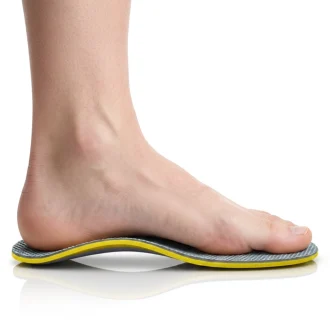
Main Menu

main prodcut image showing women's feet wearing the Gel arch supports for flat feet and plantar fasciitis relief for men and women

Gel Arch Support Compression Sleeves for Plantar Fasciitis relief & Flat Feet

£7.99inc VAT

Add to cart