No products in the cart.
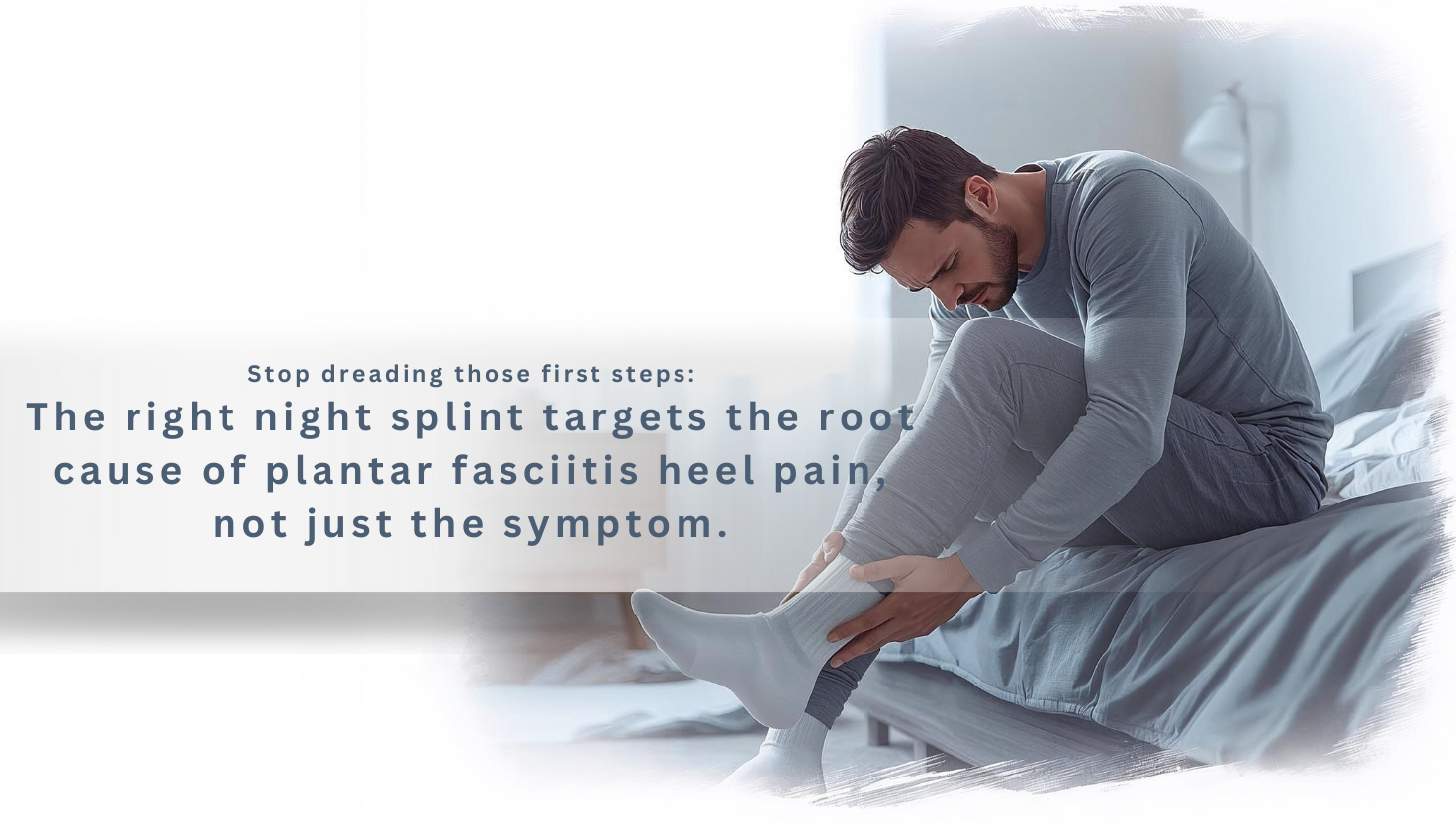
Plantar Fasciitis Night Splints: Can They Really Ease That First‑Step Heel Pain?
If the first steps of the day send a sharp stab of pain through your heel, you are not alone. Many people in the UK wake up each morning to that same pattern and wonder:
- Is this plantar fasciitis?
- Am I making it worse by walking on it?
- Can a plantar fasciitis night splint actually help?
- And if so, which type is worth trying?
This Q&A takes a detailed look at those questions and explains how the FootReviver™ Plantar Fasciitis Night Splint fits into a sensible, clinically grounded plan.
A reader’s question to Nuovahealth
“Hi Nuovahealth,
For the last few months I’ve had a really sharp pain under my heel when I get out of bed or stand up after sitting. The first few steps feel awful, then it eases off a bit, but it never quite goes away and it seems to be getting worse. I’ve read a bit about plantar fasciitis and it sounds a lot like what I have, but I’m not sure if that’s definitely the cause.
I’m worried about doing more damage if I keep walking on it. Are there things I can do myself to ease the pain and stop it getting worse? Would wearing a plantar fasciitis night splint help, and if so, how does it actually work? I’ve seen your FootReviver™ Plantar Fasciitis Night Splint at Nuovahealth but I’m not sure if a night splint is right for me or how to choose a good one. I’d really appreciate some guidance on what might be going on and what the best options are to help my heel pain settle.”
What this guide will cover
The aim here is to help you:
- Understand what is happening in your heel.
- See which treatments genuinely help.
- Decide whether a plantar fasciitis night splint – and specifically the FootReviver™ design – is likely to be useful for you.
This information is general and does not replace an assessment from a GP, physiotherapist, podiatrist, or other clinician, but it should make your options clearer and help you have a more focused conversation if you do seek professional advice.
How the heel and plantar fascia work (in plain language)
Each time you stand, walk or run, a lot of force travels through your feet. The heel bone (calcaneus) is the first major contact point for many people. Under the foot is a thick band of tissue called the plantar fascia. It runs from the heel bone to the base of the toes and:
- Helps support the arch of the foot.
- Shares some of the load every time weight passes through the foot.
- Stores and releases elastic energy, helping the foot behave a bit like a spring with each step.
At the back of the lower leg, the calf muscles join into the Achilles tendon, which attaches to the back of the heel bone. Together, the calf, Achilles tendon and plantar fascia form a linked system that helps control how the ankle and foot move and how forces are absorbed or transferred when you move.
When this system is working well, the heel and arch can cope with normal daily loads with little complaint.
Common causes of heel pain – from most to less common
Heel pain is usually driven by one of a small number of patterns. The rest of this guide focuses mainly on plantar fasciitis, because it matches what you describe and is by far the most common cause. For completeness, here is how it sits alongside other conditions that clinicians often consider.
1. Plantar fasciitis / plantar heel pain
Plantar fasciitis is the label most people have heard, and for good reason – it is the most frequent cause of pain under the heel in adults.
In this condition, the plantar fascia (the strong band under the foot) becomes irritated where it joins the heel bone. It is not usually a single “tear” but many micro‑strains building up over time, especially when the tissue is asked to cope with more load than it is used to.
Typical features include:
- Sharp, stabbing pain under the heel, often slightly towards the inner side.
- Pain that is worst with the first few steps after getting out of bed.
- Pain when standing after sitting or after driving.
- Pain that may ease a bit after the first few minutes of walking, but returns with longer standing or walking, particularly on hard floors.
The key here is how the pain behaves: at its sharpest when you first stand after rest, then easing slightly, but never fully going away.
2. Achilles tendon‑related problems
Problems with the Achilles tendon can cause pain at the back of the heel and sometimes make the whole heel region feel sore, especially when you first start moving.
The Achilles tendon joins your calf muscles to the back of the heel bone. With repeated loading – particularly in running, jumping, or long walks – small areas can become worn and irritable, often called Achilles tendinopathy.
Common features are:
- Pain and stiffness at the back of the heel, especially with the first steps in the morning.
- Discomfort when going downstairs or down slopes, as the tendon is lengthened under load.
- Stiffness that eases with gentle movement (a short walk, easing into activity) but returns after heavier use.
Mechanically, this is similar to plantar fasciitis: a sore area does not like sudden stretching after rest. However, the pain is more behind the heel than under it.
A plantar fasciitis night splint can sometimes help the morning stiffness part of Achilles problems by keeping the calf–Achilles complex nearer its working length overnight. The main treatment, though, tends to be a strengthening and loading plan for the tendon itself.
3. Heel fat pad irritation or atrophy
Under your heel bone is a natural “shock‑absorbing” fat pad that cushions impact when your heel hits the ground. Over time, or after repeated stress, this pad can become thinner or irritated.
People with fat pad issues often describe:
- A bruised or sore feeling directly under the centre of the heel, as if they had landed on a stone.
- Pain that is worse on very hard surfaces, particularly if they are barefoot or in very thin‑soled shoes.
- Less of the classic sharp pain with the first few steps, and more of a constant tenderness with each heel strike.
This type of pain is driven more by impact straight through the heel bone than by pulling of the plantar fascia. It can co‑exist with plantar fasciitis but feels a little different.
What often helps here:
- Shoes with good, soft cushioning under the heel.
- Sometimes simple heel cups or inserts to bolster the fat pad and spread impact over a larger area.
A night splint does not directly change the fat pad, but by reducing how sharply the plantar fascia and calf pull on the heel when you stand, it may make the heel region feel less sore overall.
4. Nerve‑related causes
Nerves around the ankle and heel can become irritated or compressed in certain situations. One example is a tarsal tunnel‑type problem, where a nerve running behind the inner ankle bone is squeezed within a tight space.
When nerves are involved, the discomfort often has a different feel:
- Burning, tingling, or numbness in the heel or sole.
- Pain or altered sensation that may be worse with particular positions or at night.
- Less of the clear “first few steps after rest” mechanical pattern seen in plantar fasciitis.
In these cases, the key issue is nerve sensitivity or compression, not just soft‑tissue overload. Treatments tend to focus on relieving pressure on the nerve and calming its sensitivity. A standard plantar fasciitis night splint is not usually the first approach for nerve‑driven pain, unless a clinician has a specific reason to use it to control ankle position.
5. Less common but important causes
There are a few other, less common causes of heel pain that clinicians think about, especially if the story or examination does not fit a simple plantar fasciitis picture.
These include:
- Stress fracture of the heel bone – often after a big increase in impact activity (for example, a sudden jump in running distance). Pain tends to be more constant, sharply worsened by weight‑bearing, and not clearly linked to the first few steps after rest.
- Inflammatory arthritis or systemic illness – conditions that cause pain in multiple joints, with marked morning stiffness and sometimes fatigue, weight loss or other general symptoms.
- Infection or serious pathology – rare, but considered if there is severe pain, heat, redness and feeling generally unwell.
If you notice:
- Sudden severe pain after a fall or jump.
- Marked redness, heat, or swelling around the heel.
- Pain at night that does not ease with rest.
- Unexplained weight loss, fever, or feeling systemically unwell.
- New numbness, weakness, or burning in the foot.
then self‑management is not appropriate. This is when changing shoes or buying a splint is not enough, and prompt medical assessment is needed.
It is also possible to have more than one problem at the same time – for example, plantar fasciitis alongside some Achilles irritation. That mix is another reason a proper assessment with a GP, physiotherapist, or podiatrist can be useful if pain is persistent or the pattern is unclear.
Is it likely to be plantar fasciitis in your case?
From what you describe, plantar fasciitis (also called plantar heel pain) is very likely. The most characteristic features are:
- Pain under the heel, often slightly towards the inner side.
- Pain that is at its sharpest with the first few steps after getting out of bed.
- Similar “start‑up” pain when you stand after sitting, driving, or resting for a while.
- Pain worsened by long periods standing or walking, especially on hard floors.
- No single major trauma event.
Most people with plantar fasciitis do not need to stop moving altogether – they just need to stop asking a sore heel to do too much, too often.
At the same time, only a clinician who can examine you, and arrange investigations if needed, can confirm the diagnosis and rule out other causes. It is usually wise to see a GP, physiotherapist or podiatrist if:
- Symptoms have lasted more than a few weeks without meaningful improvement.
- The pain is significantly limiting daily life.
- There are any of the red‑flag features outlined above.
Why Is Plantar Fasciitis So Painful First Thing in the Morning?
Plantar fasciitis is driven by how tissues are loaded and how they behave under load and at rest.
During the day:
- Every step loads the plantar fascia, especially where it attaches near the heel.
- If that area is already irritated, each load adds a little more stress.
When you rest or sleep:
- The foot is off the ground.
- The plantar fascia and the calf–Achilles unit relax and shorten slightly.
- Common sleeping postures – toes pointing down, feet hanging off the mattress, ankles rolled inwards – let them shorten more and hold that position for hours.
When you stand up:
- All your bodyweight suddenly travels through a plantar fascia and calf that are now shorter and stiffer than they were at the start of the night.
- They are asked to lengthen and take load in the same instant.
- The sore area near the heel is pulled abruptly, giving that stabbing pain with the first few steps.
That is why, even after a full night’s rest, the first few steps can feel like the worst part of the day. It is also why the pain often settles slightly as you walk and the tissues warm and lengthen.
This is exactly the part of the pattern a night splint is designed to change.
Treatment Options for Plantar Fasciitis: What Really Helps?
Simply hoping plantar fasciitis will go away while you carry on exactly as before often leads to months of persistent pain. Stopping all movement for long periods rarely helps either and can make tissues weaker. The aim is to reduce the strain on sore tissues and gradually improve their capacity, not to immobilise everything.
1. Adjusting activity
The goal is to take the worst aggravators down a notch, not to stop using your foot completely.
For most people this means:
- Cutting back or modifying activities that clearly flare symptoms, such as long runs on hard pavements or long days of continuous standing.
- Swapping some high‑impact exercise for lower‑impact options like cycling or swimming while the heel settles.
- Breaking up long standing periods into shorter blocks with brief sits, if your day allows.
Anything that suddenly increases how much impact or standing your heel has to cope with – a new job on hard floors, a rapid jump in walking or running distance, a new high‑impact class – can push the plantar fascia beyond what it is used to. The idea is steady, gradual load that the tissue can adapt to.
2. Footwear changes
Footwear has a major influence on heel pain.
Helpful features include:
- Cushioning under the heel to soften impact on hard surfaces.
- A supportive heel cup that holds the heel steady.
- A sole that does not twist easily.
A cushioned, supportive trainer or walking shoe is often far better for plantar fasciitis than a thin, flat pump or flip‑flop. Very worn‑out shoes, where cushioning has flattened, can also allow more shock to go straight into the heel.
3. Insoles and arch supports
Insoles or orthotics can help when:
- The foot rolls in a lot (overpronation).
- The arches are very high and rigid.
- The heel fat pad is thin or irritated and needs extra cushioning.
They aim to:
- Spread load more evenly across the foot.
- Reduce excessive pulling on the plantar fascia near the heel.
Be cautious of any insole claiming to “cure” plantar fasciitis on its own. Insoles help with load‑sharing but are usually one part of the picture rather than the whole solution.
4. Stretching and mobility
Gentle stretching can improve how far tissues can move without complaint.
Examples include:
- Calf stretches: Facing a wall, one foot back with the heel flat, gently leaning forwards to feel a stretch in the calf. Repeat with the back knee slightly bent to target different calf muscles.
- Plantar fascia stretches: Sitting with one ankle crossed over the opposite knee, gently pulling the toes of the affected foot towards the shin until a mild stretch is felt in the arch.
Stretching should be gentle and controlled. If a stretch causes sharp pain, ease off and keep it lighter rather than forcing it.
5. Strengthening and progressive loading
As pain allows, strengthening helps the plantar fascia and calf cope better with everyday forces.
Typically this means:
- Starting with simple heel raises on flat ground, lifting and lowering in a controlled way while holding onto a support.
- Progressing, under guidance if possible, to controlled lowering from a step, and later to heavier or slower exercises as tissues adapt.
Progressive strengthening:
- Improves the tissues’ ability to share and tolerate load.
- Makes it less likely that ordinary activities will keep aggravating the sore area.
A physiotherapist can help design and progress such a programme safely.
6. Manual therapy and physiotherapy
Physiotherapists and podiatrists may also:
- Mobilise stiff joints in the foot and ankle so that movement is shared more evenly.
- Use soft tissue techniques to reduce excessive tightness around the calf or plantar fascia.
- Apply taping to support the arch temporarily, easing strain on the plantar fascia while other measures settle in.
- Tailor exercise and activity advice to your specific pattern.
This can be particularly helpful if:
- Pain has lasted for several months.
- There are other joint or tendon problems.
- You have already changed how you walk to dodge the pain.
7. Injections and specialist treatments
In some stubborn cases, clinicians may discuss treatments such as:
- Shockwave therapy.
- Injections (for example, steroid injections).
These:
- Are not usually first‑line.
- Are considered when a good self‑care and exercise plan has not helped over a reasonable period.
- Have potential risks and benefits that need discussion for each person.
8. Surgery
Surgery for plantar fasciitis is:
- Rarely needed.
- Generally reserved for very persistent, severe cases where all other options have been explored.
- Not guaranteed to solve the problem and carries its own risks.
Most people improve without surgery if a sensible non‑surgical plan is followed.
Even with good management, plantar fasciitis can take several weeks to months to settle. The aim is steady improvement, not an overnight change.
Do Night Splints Work for Plantar Fasciitis?
A plantar fasciitis night splint is designed to tackle one specific part of the problem:
- The way the plantar fascia and calf shorten at rest.
- The sharp pull that occurs when you first stand up.
In practice, many people add a night splint once they have:
- Made basic footwear changes.
- Started gentle stretches.
or at the same time as those steps, rather than before doing anything else or as an absolute last resort.
Night splints are most likely to help if:
- Your heel or arch pain is clearly at its worst with the first few steps after sleep or when you stand up after sitting.
- You have confirmed or very likely plantar fasciitis.
- You are prepared to wear a structured support during sleep or rest.
- You are also looking at shoes, activity levels, stretching and strength.
They are not suitable to use on your own without advice if:
- You have diabetes with foot ulcers, marked neuropathy, or poor circulation.
- You have serious circulation problems for other reasons.
- You have severe foot deformity or very stiff ankles.
- You have red‑flag symptoms as described earlier.
For many people whose heel pain is sharpest when they first stand after rest, a night splint does make a noticeable difference to how the morning feels.
How a plantar fasciitis night splint works
Most plantar fasciitis night splints:
- Hold the ankle close to a right angle.
- Gently lift the toes towards the shin.
This positioning:
- Keeps the plantar fascia and calf–Achilles unit nearer to the length they work at during the day.
- Reduces how far they have to lengthen when you first stand up.
- Limits extreme positions (toes pointed sharply down, feet hanging off the bed, ankles twisted) that allow them to shorten fully and stay there.
In simple terms, the core job of a plantar fasciitis night splint is to reduce how sharply sore tissues are pulled when you first stand, taking the edge off those first few steps.
Night splints:
- Are not instant cures.
- Usually help over several weeks when worn regularly.
- Work best alongside other measures such as footwear changes, activity adjustment, stretching and strengthening.
They do not make good shoes, sensible activity, stretching or strengthening any less important. They are meant to sit alongside those steps, not instead of them.
How to choose a good plantar fasciitis night splint
When you are choosing a night splint, it helps to understand what matters and why.
1. Helpful position
The splint should hold your ankle close to a right angle and keep your toes gently lifted towards your shin, not forced.
This matters because that position is what stops the plantar fascia and calf from tightening fully overnight, so the first steps demand less sudden movement from sore tissue.
2. Adjustable angle
You should be able to start with a mild stretch and gradually increase the angle as symptoms and comfort allow.
This matters because pain sensitivity and stiffness vary between people and over time. Sore, long‑standing tissues rarely tolerate a strong, fixed angle from day one.
3. Comfort you can sleep in
Look for:
- Padding over the shin, front of the ankle and top of the foot.
- Materials that allow your leg to breathe.
- Straps that spread pressure rather than cutting in.
This matters because a splint that is technically “correct” but too uncomfortable to wear for long enough each night will not give the tissues enough time in that improved position to make a difference.
4. Structural stability
The splint should have enough structure to actually hold your ankle and toes in the chosen position and to stay there if you move in your sleep, rather than twisting off to the side.
Very soft sock‑type devices, where a thin strap at the front is meant to lift the toes, often bend out of position and do not give a consistent effect. On the other hand, very bulky or harsh‑edged devices may be effective in theory but impossible to tolerate in practice.
A good splint needs to be both supportive and wearable.
How the FootReviver™ Plantar Fasciitis Night Splint helps
The FootReviver™ Plantar Fasciitis Night Splint has been designed around the real‑world pattern of plantar fasciitis and related heel and Achilles pain.
Targeted positioning
It:
- Holds the ankle close to a right angle.
- Gently lifts the toes towards the shin, creating a mild, steady stretch through the plantar fascia under the foot and the calf–Achilles complex at the back of the ankle.
- Limits common aggravating positions such as toes hanging down over the edge of the bed or ankles rolling strongly inwards or outwards when lying on the side.
In simple terms, it is built so that it actually holds the foot where it needs to be at night, in a way many people can sleep in.
Adjustable and adaptable
The splint uses several straps so that you can:
- Secure the foot so it does not slide inside.
- Decide how much the ankle is held up.
- Choose how far the toes are lifted.
You can start with a softer angle if your pain is very sensitive, and gradually build up the stretch as comfort and symptoms allow.
This avoids the “one fixed angle” problem seen in some basic splints, where that single position may be fine for one person and far too much for another.
Designed with real nights of sleep in mind
The FootReviver™ splint:
- Uses a firm front panel to stop the ankle sagging out of position.
- Has soft padding on key contact points like the shin, front of the ankle and top of the foot.
- Is made from lightweight, breathable materials to help reduce overheating.
If you cannot realistically sleep in a splint, it will not help, however good the theory is. FootReviver™ is built so that most people can wear it for several hours at a time, which is what you need for meaningful benefit.
Built with clinician feedback
The strap and padding layout reflects where physiotherapists and podiatrists most often see people complain of rubbing or pressure with other designs. The angle range and structure have been chosen so that the same positioning can also support some Achilles and inner‑ankle tendon patterns when used on a clinician’s advice.
In other words, it is not just any night splint; it is built to do this specific job in a way that most people can realistically live with night after night.
Short Q&A – common questions about night splints
Can a night splint stop plantar fasciitis getting worse?
Used regularly and alongside other measures (appropriate footwear, activity adjustment, stretching, strengthening), a night splint can:
- Reduce the repeated sudden strain on the sore part of the plantar fascia when you first stand.
- Help each day start from a better baseline, supporting healing rather than constant flare‑up.
It does not guarantee that the condition will not progress, but it helps shift the balance towards improvement rather than ongoing irritation.
How long should I wear a night splint for each night?
Most people:
- Start with 1–2 hours in the evening while sitting.
- Progress to wearing it for part of the night.
- Aim, if comfortable, for most or all of the night.
Consistency over weeks is more important than reaching a full‑night stretch on day one. Finding the right angle is often a matter of small adjustments over several nights rather than getting it perfect straight away.
Can I just use a night splint and nothing else?
No. A night splint:
- Deals with what happens when you are off your feet.
- Does not replace the need for suitable shoes, sensible activity levels, stretching and strengthening.
All of these elements work best together.
When should I see a GP, physiotherapist or podiatrist?
Seek professional advice if:
- Pain has lasted more than a few weeks without real improvement.
- It is limiting your normal daily activities.
- You have any red‑flag features such as:
- Sudden severe pain after a fall or twist.
- Marked redness, heat, or swelling.
- Pain at night that does not ease with rest.
- Unexplained numbness, burning, or tingling.
- Pain in both feet with other concerning symptoms.
Bringing this understanding of your pattern – and how a night splint might fit – to an appointment can help you and your clinician agree the most sensible next steps more quickly.
Making a decision – and a practical next step
If your experience matches what has been described – sharp heel pain with the first steps after sleep and sitting, easing a bit with movement but never fully disappearing – plantar fasciitis is a likely explanation. A proper assessment can confirm that and rule out less common causes.
From there, a multi‑step approach usually works best:
- Adjusting clearly aggravating activities.
- Choosing supportive footwear and, if needed, insoles.
- Using gentle stretching and, ideally, progressive strengthening.
- Considering a plantar fasciitis night splint to reduce the sharp morning pull on sore tissues.
Night splints are not magic, but they are a logical way to target one of the main mechanical drivers of that first‑step pain. Designs that are adjustable, structured enough to hold the right position, and comfortable enough for real nights of sleep are the ones most likely to help.
The FootReviver™ Plantar Fasciitis Night Splint has been designed with those principles in mind. If this matches what you are living with day after day, it is a reasonable next step to try for a few weeks, wearing it most nights and combining it with the daytime measures described here, to see how much it eases your first‑step pain.
The 30‑day money‑back guarantee is there so you can give it a proper trial without feeling stuck with it. Most people with this pattern of pain improve when they understand it and address it step by step; you do not have to put up with dreading your first steps every day. If you are unsure whether it is right for you, or if anything about your symptoms feels unusual, a GP, physiotherapist or podiatrist can help you decide how best to fit a night splint like FootReviver™ into your overall plan.