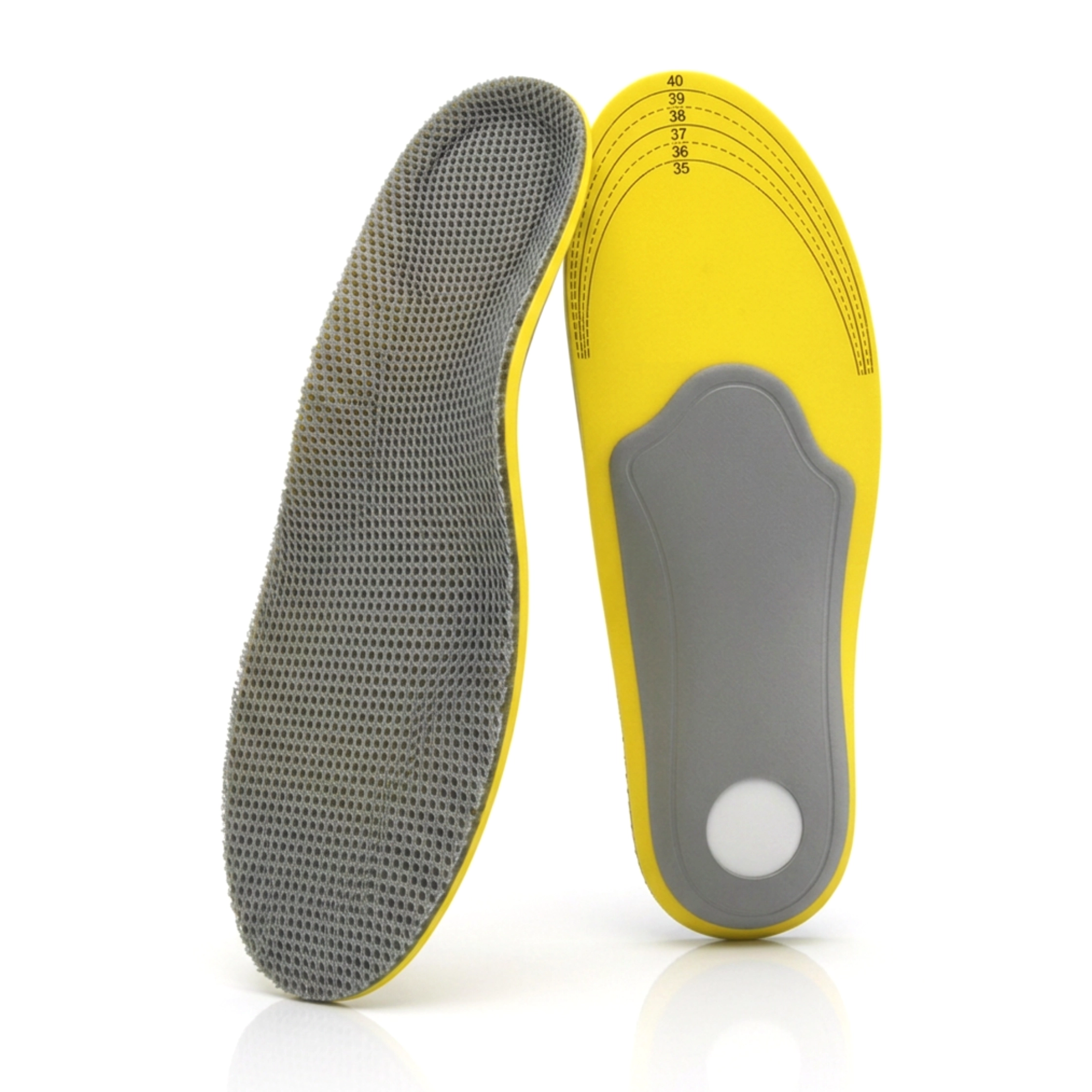
Arch Support Insoles for Plantar Fasciitis and Flat Feet

£9.99£11.99 (-17%)inc VAT

Key Features & Benefits at a Glance

  • Expertly Engineered for Targeted Pain Relief: Specifically crafted for individuals with flat feet and plantar fasciitis, these arch support insoles deliver focused relief by addressing the underlying causes of foot and heel pain. They provide a structured foundation that helps reduce discomfort from the first step, supporting your path to improved daily comfort.
  • Orthotic Alignment for Improved Biomechanics: Experience comprehensive orthotic arch and deep heel cup support that encourages proper alignment of your feet and lower limbs. This design helps correct imbalances like overpronation and supination, distributing pressure more evenly with each step. By fostering optimal alignment, you can minimize strain on vulnerable areas and enhance natural foot function throughout your activities.
  • Holistic Support for Common Foot Conditions: Rely on these insoles to assist in managing, alleviating, and preventing a variety of foot and lower limb issues. They offer consistent, therapeutic support for conditions such as plantar fasciitis, heel spurs, arthritis, metatarsalgia, Morton’s neuroma, bunions, blisters, sesamoiditis, Achilles tendonitis, ankle sprains, and shin splints, contributing to overall foot health.
  • Advanced Shock Absorption for Lasting Comfort: Protect your feet from the repetitive impacts of daily life with insoles designed to absorb shock and distribute weight uniformly across the sole. This reduces high-pressure points and discomfort, making them an essential choice for those who stand for long periods on hard surfaces or experience tired, aching legs and feet. The result is a stable, cushioned foundation that helps combat fatigue and maintain comfort.
  • Antibacterial Material for Enhanced Freshness: Crafted from Active Carbon Fibre, these insoles naturally inhibit bacterial growth, effectively neutralise odours, and promote a drier, fresher feeling throughout the day. This material choice ensures that comfort extends beyond support to include a more pleasant in-shoe environment.
  • Reinforced Stability for Active Pursuits: Benefit from added support and stability that makes these insoles ideal for runners and athletes. They provide extra protection during high-impact activities like running or jumping, helping to safeguard your feet and ankles while promoting confident movement.
  • Customisable Fit for Versatile Use: Designed to suit both men and women, the insoles are available in sizes 7-11 and 3-7. With a simple trim-to-fit feature, you can easily adapt them to any enclosed footwear—from trainers and boots to casual shoes—ensuring the support elements are perfectly positioned for maximum effect.
  • Risk-Free Trial with a Satisfaction Guarantee: Purchase with assurance thanks to a 30-day money-back guarantee. This allows you to experience the transformative comfort and support of these insoles firsthand, providing peace of mind as you invest in your foot health.

Please note there is no guarantee of specific results and that the results can vary for this product.

Clear

Get 15% off - When bought together with:
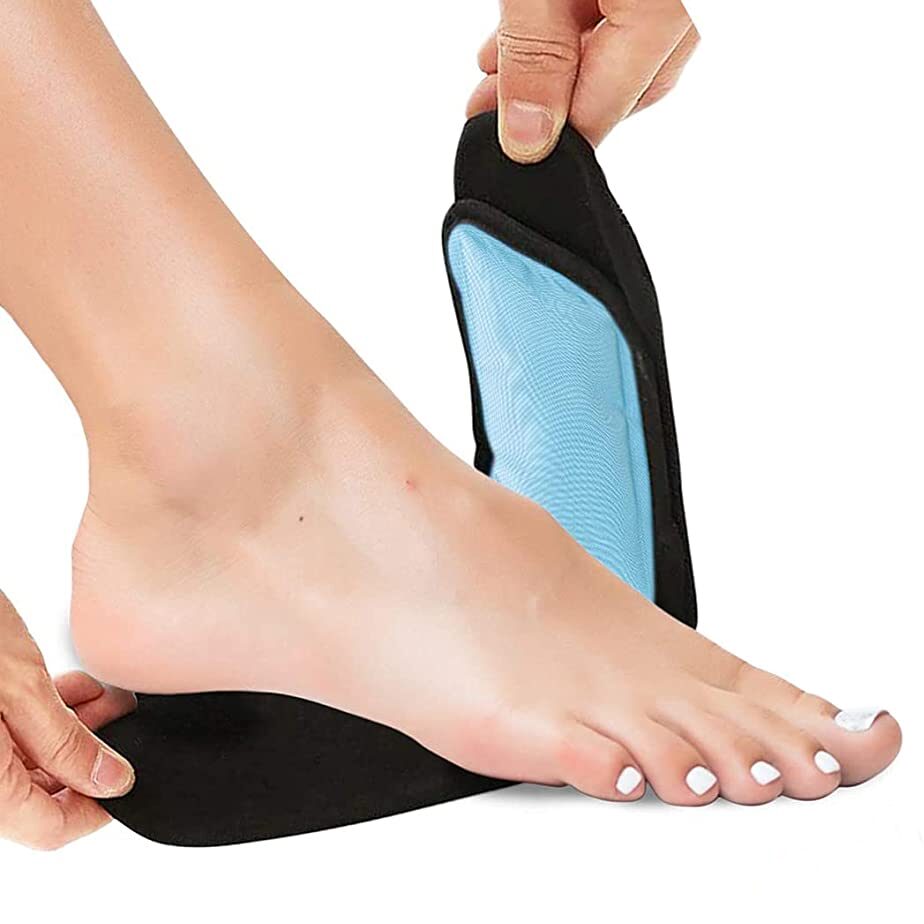
Struggling with a sharp, stabbing pain in your heel first thing in the morning? Do your arches feel tired and sore, as if they are collapsing by the end of the day? These are classic signs of plantar fasciitis and flat feet, two problems that often go hand in hand. Both can make every step feel like hard work and turn long days on your feet into a real challenge.

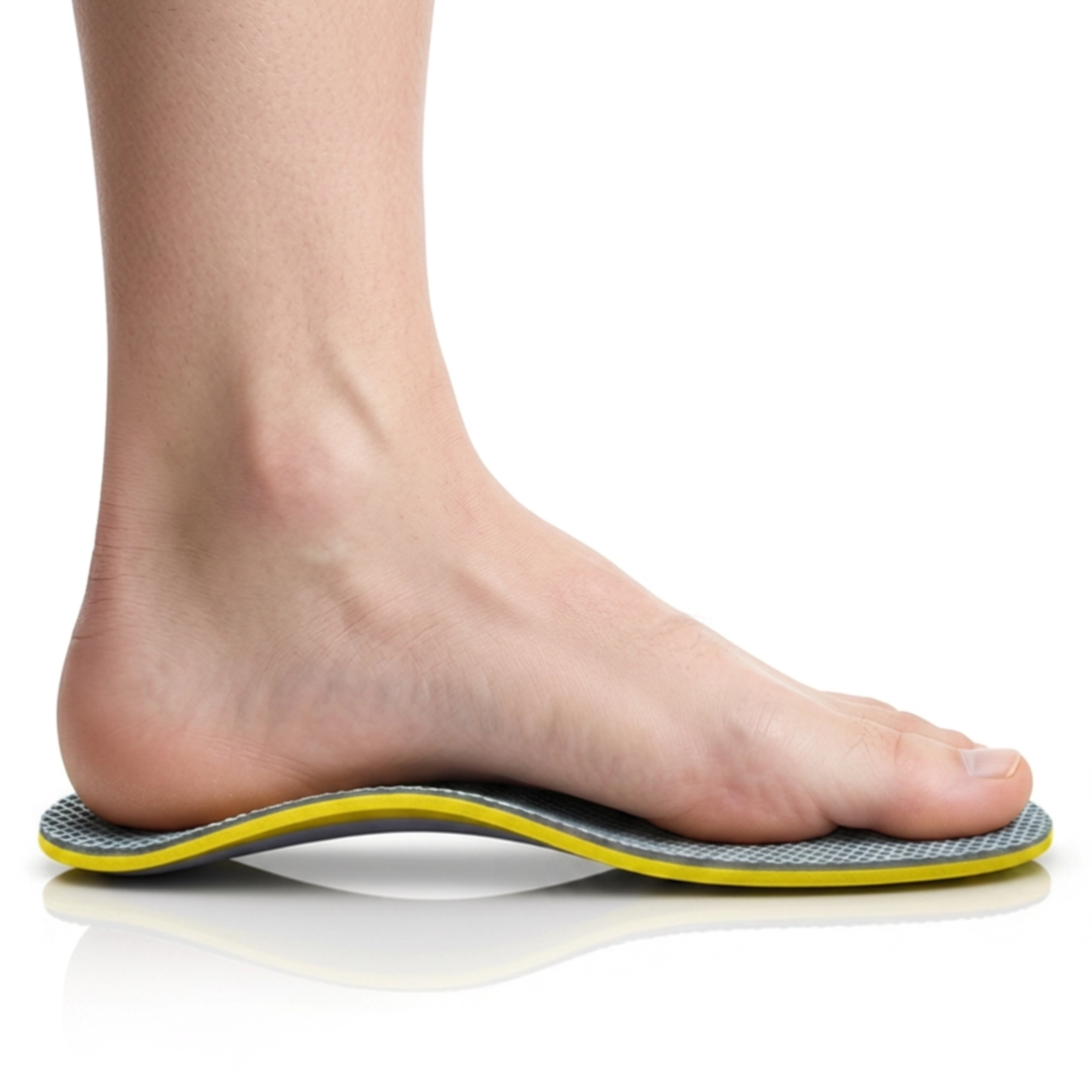
These orthotic arch support insoles are designed specifically for plantar fasciitis and flat feet. They support your arches, cradle your heels, and spread pressure more evenly across the soles of your feet, so the sensitive tissues under your heel and along your arch are not being pulled and overloaded with every step. The aim is to make walking, standing, and moving through your day feel more manageable again.

Before looking at how the insoles do this, it helps to understand what plantar fasciitis actually is, why it can become such a stubborn problem, and how orthotic arch supports fit into a wider, sensible plan for settling it down.


At a Glance: How These Insoles Are Intended to Help

    • Provide structured arch support for plantar fasciitis and flat feet
    • Help reduce sharp heel pain when you first get up and start walking
    • Cradle the heel in a deep cup for better stability and more even pressure
    • Cushion the whole foot to soften impact on hard floors and pavements
    • Support tired arches so your feet and ankles feel less fatigued
    • Trim‑to‑fit design for most closed‑toe shoes, from work shoes to trainers

Do These Heel and Arch Symptoms Sound Familiar?

Plantar fasciitis / plantar heel pain

    • Sharp, stabbing pain under the heel with the first few steps in the morning
    • Heel or arch pain after getting up from sitting that eases as you walk, then returns later
    • A tender spot near the inner front of the heel when you press on it
    • Aching or tightness along the arch after standing or walking for a while
    • Pain that is worse after long days on hard, unforgiving floors

Flat feet / fallen arches

    • Little or no visible arch when you stand; most of the inner side of the foot touches the ground
    • A heavy, tired feeling through the arches and ankles after walking or standing
    • Ankles that seem to roll inwards, with shoes wearing down more on the inside edge
    • Feet and legs that fatigue more quickly than they used to during everyday tasks
    • A history of being told you have “weak arches” or “collapsed arches”

If several of these points sound familiar, there is a good chance that plantar fasciitis, flat feet, or both are contributing to your discomfort. These insoles are designed with that combination in mind, while also helping with a range of related issues that stem from how your feet are supported.


What’s Going On in Plantar Fasciitis (and How Flat Feet Fit In)

The plantar fascia is a strong band of tissue that runs along the bottom of your foot from the heel bone (calcaneus) to the base of the toes. It acts a little like a bowstring under the arch – helping to support it, share load and let your foot work as both a shock absorber when you land and a firm lever when you push off.

Plantar fasciitis develops when this band is repeatedly overloaded, usually near where it attaches into the heel. Long days on your feet, sudden increases in walking or running, hard surfaces, less supportive footwear and certain foot shapes can all add up. Tiny areas of micro‑damage and irritation build at the heel attachment, the local nerves become more sensitive, and what should be a normal step starts to feel sharply painful – especially after rest or first thing in the morning.

Flat feet can make this worse. When the arch sits low and collapses further under load, the plantar fascia and supporting ligaments are held under extra stretch with every step. The heel often rolls inwards at the same time, which twists the fascia slightly. Over hundreds or thousands of steps a day, that extra stretch and twist keeps the tissue under strain. Very high, rigid arches can cause problems from the opposite direction: the foot absorbs less shock, so more impact is driven straight into the heel and ball of the foot, again irritating the plantar fascia where it attaches into the heel.

If you would like a fuller explanation – including why plantar fasciitis can become long‑standing, how foot type, activity and age fit in, and what clinical research and guidelines say about treatment and insoles – the detailed guide below goes into more depth.


Why Rest Alone Often Doesn’t Settle Heel and Arch Pain

Rest, ice and occasional stretches can calm things down for a while, and they are often worth trying. The difficulty is that many people find that as soon as they return to their usual level of walking or standing, the pain comes back. That is because the way the foot is taking load has not really changed.

If the arches still collapse more than they can comfortably cope with, the plantar fascia is still being pulled in the same way, and the heels are still taking the same impact on hard surfaces, then the same tissues are irritated again and again. The pain may ease during a few quieter days, only to flare when work, family life or exercise pick up again.

To break this cycle more effectively, both sides of the problem usually need attention. On the one hand, calming the irritated tissues with sensible rest, stretching and self‑care gives them a chance to settle. On the other, the ongoing strain that keeps irritating them has to be reduced. Appropriate stretching, calf strengthening, choosing more supportive footwear and adjusting how much time is spent on hard floors can all help. Orthotic arch support insoles fit into this plan by changing how the foot is supported and how pressure is spread under the heel and arch with each step, so progress is more likely to hold when everyday activity levels return.


How Orthotic Arch Support Insoles Help with Plantar Fasciitis and Flat Feet

Orthotic arch support insoles are designed to change the way your feet take load at ground level, so each step places less strain on the plantar fascia and other supporting structures. The same features that help with plantar fasciitis also support flat feet and other common foot and leg problems.

Reducing pulling on the plantar fascia

By gently lifting and supporting the arch, the plantar fascia does not have to stretch and flatten as far with every step. This lowers the pulling force on its attachment near the heel bone, which is the area that is often most irritated in plantar fasciitis. For flat or low arches, that shaped support replaces some of the lift that the foot’s own tissues struggle to provide, so they are not working at their limit all day just to stop the arch collapsing completely.

Helping the heel land and move more steadily

The deep, well‑shaped heel cup cradles the heel bone more securely. This can reduce excessive inward rolling (overpronation) that commonly occurs with flat feet, and can also help calm an overly “tippy” heel in those who tend to roll outwards (supination). A steadier heel sets the rest of the foot and ankle in a more neutral position, reducing twisting forces on the plantar fascia and other ligaments. Instead of the heel dropping steeply towards one side with every step, it lands and rolls forwards in a more controlled way.

Spreading pressure and softening impact on hard ground

Without support, impact forces tend to focus on small areas under the heel or on one or two metatarsal heads in the forefoot. A supportive insole helps spread load across a wider area of the sole. This can reduce the bruised feeling under the heel and the burning discomfort in the ball of the foot. The cushioning materials also help to soften each step on hard floors and pavements, which is especially helpful if much of the day is spent standing or walking on concrete or other very hard ground.

Making it easier to keep moving sensibly

When standing and walking feel less punishing, it becomes easier to stay gently active, which is important for tissue health and overall recovery. Orthotic insoles are not a cure in themselves, but they can make it far more comfortable to carry out the stretching, strengthening and day‑to‑day activity that form part of a sensible plan for plantar fasciitis and flat feet. Used this way, they support the rest of your management rather than trying to replace it.

Clinical trials and guidelines support the use of foot orthoses as one of the conservative options for managing plantar heel pain. Prefabricated devices have been shown to provide modest but worthwhile improvements in pain and function for many people compared with sham insoles, and current UK guidance includes simple insoles or orthoses among the treatments to consider. They are one practical way to reduce strain at the source, alongside other measures such as appropriate exercises and footwear.


Why We Developed These Insoles

Many people with plantar fasciitis or flat feet find themselves with a difficult choice: thin, flat insoles that add a little cushioning but no real support, or very rigid custom orthotics that require clinic appointments and a much larger cost – and that some people struggle to tolerate all day. These arch support insoles were developed to sit between those extremes.

The shape and materials were chosen with input from podiatrists and physiotherapists who spend their days seeing what actually makes feet sore in real life. Common problems fed back from clinics included simple foam inserts that flatten within weeks, very hard devices that people cannot tolerate for a full working day, and arch profiles that are either so low they do very little or so high they feel like a hard ridge. This design aims to sit in the middle ground – structured enough to matter, but comfortable enough that most people can wear them for long shifts on hard floors.

The aim was to create an insole that provides meaningful arch and heel support for plantar fasciitis and flat feet, is comfortable and slim enough to wear in everyday UK footwear, and is accessible enough to try without needing a referral or bespoke device. For many people, this type of insole is a sensible first step to try before considering custom orthotics.


What Makes These Arch Support Insoles Different?

Lots of insoles promise support and cushioning. The difference here lies in how the support is shaped and how the cushioning behaves over a full day on your feet – both of which were influenced by feedback from clinicians and from people who stand or walk for long hours.

Support focused on real‑world comfort

The arch contour is designed to be supportive without feeling aggressive. It sits under the natural curve of the foot to provide a gentle lift, especially helpful for flat or low arches that tend to collapse under load. In testing, people with flexible flat feet often found that very high, “sharp” arch supports felt like ridges they wanted to step off. This profile was tuned to reduce sag without creating that “propped on a block” sensation.

That lift helps reduce the constant stretch on the plantar fascia and the posterior tibial tendon along the inside of the ankle, both of which are commonly overworked in flat feet and plantar fasciitis. Rather than trying to force the foot into a rigidly straight position, the support is there to rein in the excess movement that keeps those tissues under strain, while still allowing the small amount of pronation and supination that is normal and useful.

A heel cup that steadies without digging

The heel area is shaped into a deep cup that cradles the heel bone. The edge of this cup is rounded and kept at a height designed to support the heel without digging into the ankle bones or rubbing the sides of the heel – a common complaint with some very rigid devices. Clinicians involved in the design flagged that people often stop wearing insoles that rub the heel, even if the support itself is effective, so this detail was given particular attention.

By steadying the heel in this way, the insole encourages a more neutral position of the ankle and midfoot as you walk, which can reduce twisting and uneven loading through the plantar fascia, ankle ligaments and lower leg.

Cushioning that can cope with long days on hard floors

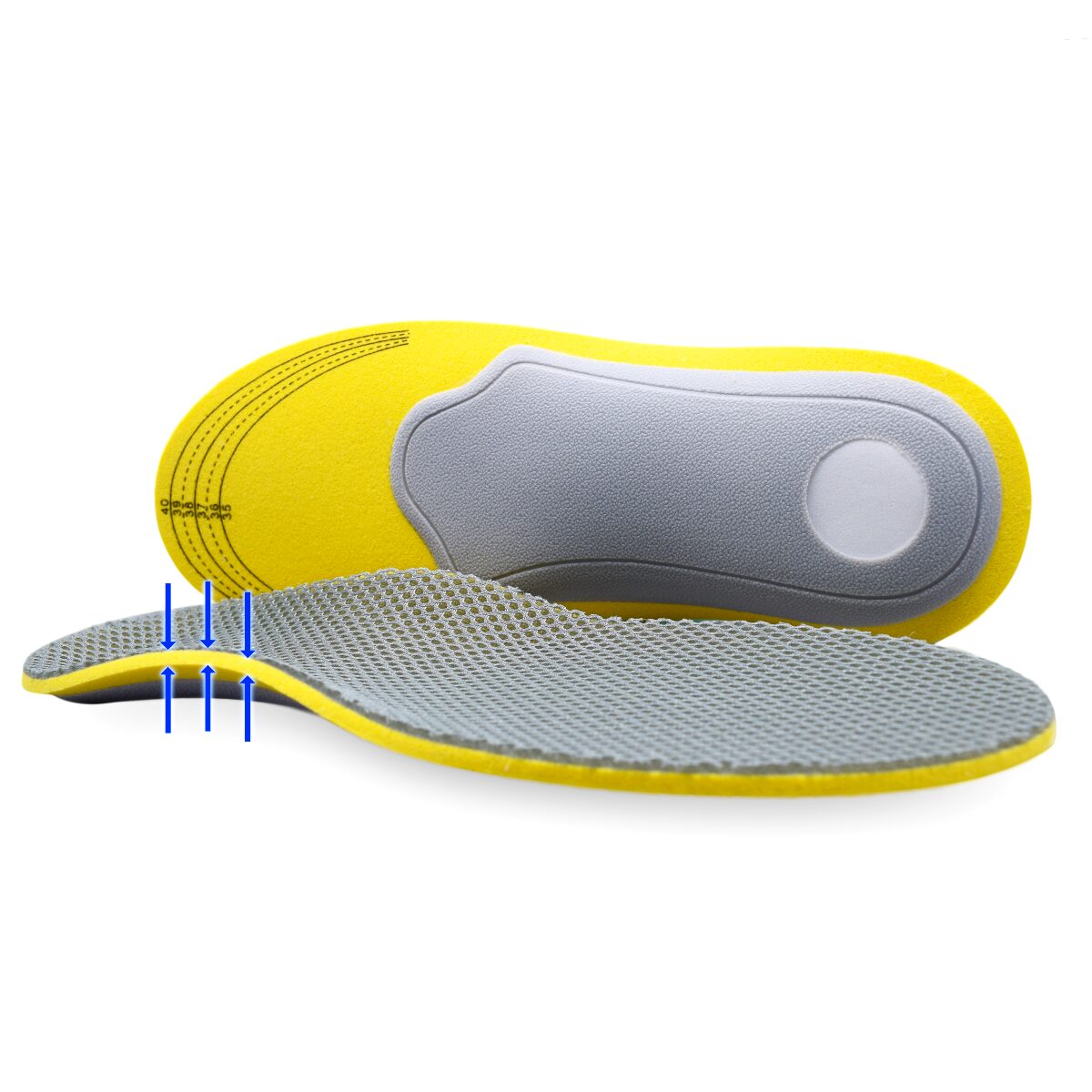
On top of the support shell is a cushioning system made from two layers. The upper layer is softer and moulds slightly to the contours of the foot for immediate comfort. The firmer layer underneath absorbs and disperses impact as the heel and forefoot meet the ground. Together, they help soften each step on hard floors and pavements.

The forefoot section uses a responsive material that gently compresses and reshapes itself with pressure. As you move, it adapts to the natural spread of the metatarsal heads, helping to share pressure more evenly across the front of the foot. This can be particularly helpful if there is a burning or bruised sensation under the ball of the foot, as in metatarsalgia or Morton’s‑type forefoot pain.

The top cover is made from a breathable material with small perforations to help move moisture away from the skin. An active carbon component is included to help manage odour and keep the in‑shoe environment feeling fresher, which also reduces the risk of rubbing from damp socks or hot spots.

Built to sit in everyday shoes and stay supportive over time

The firm shell under the arch and heel is made from a durable material that is designed to hold its shape over time, instead of squashing flat like basic foam inserts. The intention is that the arch support and heel cup keep their shape through many months of regular use, so the support you notice on day one is still there after weeks of standing and walking on hard floors, rather than quietly disappearing as the material gives way.

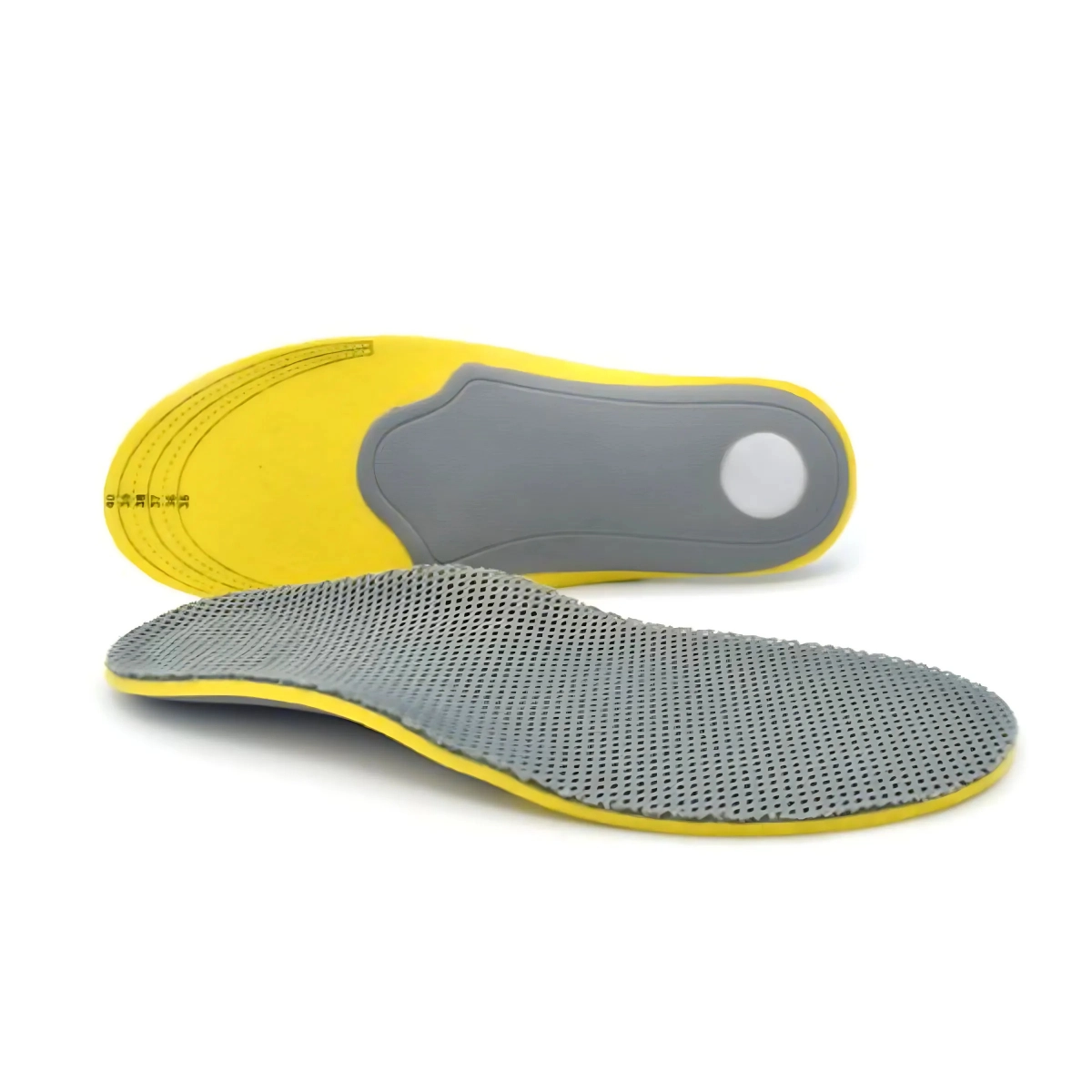
Each insole has a trim‑to‑fit outline printed on the underside. By using the original insole from the shoe as a template, you can cut the new insole to match the length and forefoot shape needed. The profile is designed to work with typical UK closed‑toe footwear – from work shoes and safety boots to trainers – once the factory insole is removed.

The balance of structure and cushioning makes these insoles suitable for everyday walking, long shifts on your feet, and many forms of light to moderate exercise. They are not specialist racing orthotics, but for most day‑to‑day and recreational activities they provide the sort of consistent support that many people find helps reduce fatigue and discomfort over time.


Who These Insoles Are Especially Suitable For

These insoles are designed for people who want more support, stability and comfort underfoot. They may be particularly helpful if any of the following sound familiar:

    • Plantar fasciitis or plantar heel pain, especially sharp heel pain when first standing and walking.


    • Flat feet or fallen arches that leave the feet and ankles feeling tired or tending to roll inwards easily.


    • High, rigid arches where every impact seems to travel straight through the heels and the balls of the feet.


    • Feet that roll in (overpronation) or roll out (supination) as you walk or run.


    • Burning or bruised sensations under the ball of the foot, or soreness around bunions or Morton’s‑type forefoot problems.


    • Aching shins, calves or Achilles discomfort clearly linked to walking or running patterns.


    • Long days on hard floors that regularly end with tired, aching feet.


    • Knee, hip or lower back aches that a clinician has linked, at least in part, to how the feet move.


The detailed condition‑by‑condition guide below explains what is going on in each of these areas and how this type of insole can help with the specific mechanical patterns involved.

For many people, these insoles are the right place to start before considering custom orthotics. If foot problems are very complex, if there are severe deformities, or if a clinician has advised that bespoke devices are needed, a podiatrist or other specialist can guide you on the most appropriate support.


How These Insoles Can Help with Common Foot, Leg and Back Problems

Problems such as plantar fasciitis, flat feet, high arches, overpronation, supination, metatarsalgia, Morton’s neuroma, heel spurs, shin splints and certain types of knee, hip and lower back pain often share a common thread: how the foot takes load and how pressure and strain build up with each step. The same core features of these insoles – contoured arch support, a deep heel cup and full‑length cushioning – interact with each of these conditions in specific ways.

The guide below explains, condition by condition, what is going on in the affected area and how this type of insole can help reduce stress on the key structures involved.

For Flat Feet

When you stand and look down, you may see very little curve along the inside of your feet, with most of the inner edge almost resting on the floor. By the end of a working day your arches and inner ankles can feel heavy and sore, and it might look as though your ankles are leaning inwards. Shoes often wear out faster on the inside. If this sounds familiar, you are probably dealing with flat feet, or low arches.

What flat feet mean in practical terms

A normal arch is not meant to stay rigid; it should flatten a little when you stand and walk, then spring back as you move off. With flat feet, the inner arch sits lower to begin with and often drops further under load. Instead of a controlled, small movement, it can feel as though the arch simply gives way when you put weight on it.

When this happens, the plantar fascia – the strong band under the foot running from heel to toes – and the posterior tibial tendon on the inside of the ankle both work harder than usual just to stop the arch collapsing completely. Over long days on firm ground, they can become irritated and tired.

How low arches can affect the rest of your leg

As the arch drops, the heel usually tips inwards. The shin tends to follow, turning in slightly, and the knee may drift towards the other leg. Over thousands of steps, that extra inward twist can change how your whole leg moves under you. For some people, this contributes to inner ankle pain, shin splints, aching at the front of the knee and even hip or lower back discomfort.

The extra sag in the arch also pulls more firmly on the plantar fascia where it attaches into the heel. Over time, that repeated tug can inflame and irritate the tissue at the heel bone. That is why flat feet and plantar fasciitis – the sharp, first‑step heel pain many people describe – often show up together.

How to tell if your flat feet are part of the problem

Plenty of people have low arches with no pain at all, so flat feet on their own are not always an issue. They become more important when they match a clear pattern of symptoms: a dragging, tired feeling in the arches by the end of the day, aching along the inside of the ankles, or recurring heel pain that fits with plantar fasciitis. If you see your ankles leaning inwards and your arches almost on the floor when you stand, and those symptoms are familiar, your flat feet are very likely contributing.

A podiatrist or physiotherapist can confirm this quickly by looking at your foot posture, watching you walk and pressing over key structures. That helps rule out other problems and shows how much your foot shape is driving your symptoms.

Day‑to‑day changes that help

Shoes with a firm heel counter and some structure through the midsole usually leave flat feet feeling better supported than very soft, completely flat footwear. Keeping the calves flexible and strengthening the small muscles that support the arch can help your feet cope better with load, especially if you stand a lot for work. But even strong muscles will struggle if the arch is allowed to drop fully towards the floor inside every shoe you wear.

A supportive insole changes the surface your foot rests on with every step, which is where the insoles described here come in.

How these arch support insoles help with flat feet

These insoles have been designed with flexible flat feet and plantar fasciitis in mind. The arch contour, heel shape and full‑length cushioning give low arches a firm but comfortable lift inside everyday UK footwear, while helping to calm the pull on the plantar fascia and inner ankle.

Giving the arch a reliable lift

Along the inner side of the insole, a shaped arch rises to meet the underside of your foot. It is firm enough to stop a flexible arch sinking right down, but rounded so it feels like solid support rather than a hard ridge. With that support in place, the plantar fascia does not have to stretch as far with each step and the posterior tibial tendon is no longer doing all the work of holding the arch up.

Over a working day, that reduction in constant effort is often what turns a deep, dragging arch ache into something far more manageable – and it helps take strain off an irritated plantar fascia at the heel at the same time.

Helping the heel sit more centrally

At the back of the insole, a deep heel cup gently steers the heel bone into a more central, upright position inside the shoe. When your heel lands, it is less able to tip sharply inwards, so the shin does not rotate in as far and the knee is not pulled so strongly towards the other leg. Your legs are still free to move naturally, but the exaggerated inward collapse that was stressing your arches and ankles is reduced.

In everyday terms, that often feels like better stability when you walk, fewer “rolling in” sensations at the ankle and less strain along the inner border of your feet and shins.

Making hard floors feel less punishing

Underneath the supportive shell, a cushioning layer runs from heel to toes. On hard surfaces this extra layer takes the sting out of each step, particularly at the heel and under the midfoot where flat feet tend to feel bruised. Combined with the arch support and heel cup, it means your feet are not just held in a better shape – they are also cushioned against the unyielding nature of modern floors.

These insoles will not change the fact that your arches are low, and they are not a substitute for proper assessment if you have ongoing pain. They do, however, offer a straightforward way to reduce how far your arches collapse, keep your heels better centred and make the day‑to‑day pull on your plantar fascia and inner ankles much more manageable.

For High Arches

If you have high arches, you may feel as though most of your weight rests on your heels and the balls of your feet, with the middle of your foot hardly touching the ground. Long days on hard floors can leave your heels and the front of your feet feeling pounded, and the outer sides of your ankles may feel vulnerable, as though they could roll without much warning.

What high arches mean for your feet

In a more typical foot, the inner arch flattens slightly when you stand and walk, then rises again as you push off. That small movement allows the foot to share load across the entire sole and absorb some shock. With high arches (pes cavus), the inner curve is more pronounced and often stays relatively rigid as you move. The arch does not lower much when you put weight on it, so the heel and the metatarsal heads under the ball of the foot take most of the force.

Because there is less natural flattening, the plantar fascia and small muscles of the foot have less opportunity to “give” and soak up impact. Instead, the soft tissues under the heel and forefoot do much of the work. Over time, this can lead to pain under the heels, soreness under the balls of the feet and callus build‑up in those areas.

Why high arches can feel unstable as well as sore

High‑arched feet are often narrower and tend to roll outwards more easily. With each step, more weight travels down the outer border of the foot. That puts extra strain on the ligaments on the outside of the ankle and on the peroneal tendons that run along that side. Many people with high arches recognise a history of ankle sprains or near‑misses on uneven ground and a general feeling of “teetering” rather than feeling planted on slopes and rough surfaces.

At the same time, because the arch is held high and rigid, impact from every heel strike is transmitted more directly up into the heel bone and lower leg. The areas under the middle toes can feel as though they are walking on bruised bones, particularly as the day goes on.

When high arches are worth acting on

Some people have high arches and never develop symptoms. The shape becomes more important when you are getting regular pain under the heels or balls of the feet, repeated ankle sprains or constant worry that your ankle will roll, and you can clearly see that the midfoot barely touches the ground when you stand. If your shoes show much heavier wear under the outer part of the heel and forefoot, and these symptoms are present, your high arches and tendency to supinate are probably contributing.

In a few cases, very high or increasingly rigid arches can be linked to underlying nerve or muscle conditions. If your arch height has changed noticeably over time, or you have weakness or clumsiness in the legs, it is important to seek medical advice to rule out or manage any underlying cause.

Simple steps that can ease high‑arched feet

Shoes with some cushioning and a stable sole are usually kinder to high‑arched feet than thin, very hard or very floppy footwear. Very high heels that pitch all your weight onto the front of the foot are best kept for short periods. Strength and balance work for the ankles and lower legs can improve stability and reduce the risk of repeated sprains. But these measures alone do not change the fact that your arch offers less natural contact and cushioning than average.

A well‑shaped insole can help by reaching up to meet the arch, cushioning the heel and forefoot, and making the whole foot feel better “seated” inside the shoe.

How these arch support insoles help with high arches

These insoles are designed to make high‑arched feet feel more supported and less punished by hard surfaces. They do this by bringing support up under the arch, cushioning the main contact points and helping the heel sit more securely inside the shoe.

Letting the arch share the load

The arch contour on these insoles rises higher than a flat liner so it can meet the raised curve on the inside of your foot. Instead of a gap between your arch and the insole, there is contact. That allows the midfoot to take part of the load rather than leaving almost everything to the heel and forefoot.

The contour is rounded and moderately firm, so it supports without jabbing into the arch. Many people with high arches describe this as feeling like their midfoot is finally contributing, rather than hanging between heel and toes.

Cushioning the main pressure points

A full‑length cushioning layer sits on top of the supportive shell. Under the heel it softens the blow of each contact, which can be a real relief if your heels have felt as though they are striking bare ground. Under the forefoot it gives the metatarsal heads a more forgiving surface to press into, so the front of the foot feels less as though it is being driven into a thin, unyielding sole.

Over the course of a day, that extra protection often means less of the bruised, burning discomfort under the heel and ball of the foot that many high‑arched people recognise.

Helping the ankle feel more secure

At the back, the deep heel cup gently cradles the heel bone and encourages it to sit nearer the middle of the shoe. When you step down, this makes it a little harder for the heel to tip suddenly outwards. For a foot that naturally wants to roll onto its outer edge, that slight steer towards the centre can make you feel more planted and can reduce some of the strain on the outer ankle ligaments and peroneal tendons.

These insoles will not change the fact that your arches are high, and they do not replace medical assessment where that is needed. They do, however, make the everyday reality of having high arches easier to live with: less concentrated pressure under two small contact points, some useful help from the arch itself, and a steadier feel at the heel in the shoes you actually wear.

For Overpronation

If your feet seem to roll inwards a lot when you walk or run, you may have been told you “overpronate”. You might see your arches flattening more than you would expect when you stand, notice your ankles caving towards each other, or find that the inside edges of your shoes wear down much faster than the outside. Over time this can leave your arches and inner ankles sore, your shins aching and your knees feeling under extra strain.

What overpronation actually is

Pronation itself is not a fault. Every healthy foot rolls in slightly and lets the arch lower a little when the heel hits the ground. That small movement helps you absorb shock and adapt to the surface. Overpronation is when that natural roll and arch drop go further than your tissues can comfortably control, and stay there for longer during each step.

In an overpronating foot, the arch sags more than ideal as you take weight, the heel bone tips further inwards, and the tissues that support the arch – particularly the plantar fascia and the posterior tibial tendon on the inside of the ankle – are held under extra stretch. Some people have this pattern because their feet are naturally quite flat or flexible. Others drift into it over years of standing and walking in unsupportive shoes on hard, unforgiving floors.

Signs that overpronation may be affecting you

You can often spot overpronation from a few everyday clues. When you stand in front of a mirror, your arches may look as though they are resting on the floor and the inner line of your ankles may bulge inwards. From behind, your heels may appear to lean in rather than sitting straight over the back of the shoe. If you line up older pairs of shoes, the inner edge of the heel and midsole may be much more worn than the outer edge.

Symptom‑wise, people commonly notice a mixture of tired, aching arches, soreness along the inside of the ankles and episodes of pain along the inner border of the shin, often called shin splints. The knees may feel as though they drift towards each other on stairs or when squatting. If you wake with a sharp, stabbing pain under the heel that eases as you take a few steps, or you feel a hot, tight band under the arch, overpronation is very often playing into plantar fasciitis as well.

What overpronation does to your plantar fascia and up the leg

The plantar fascia is a thick band running from the heel bone to the base of the toes. In a well‑controlled foot, it lengthens a little as the arch lowers and then recoils to help you push off. In an overpronating foot, it is pulled further and held under tension for longer as the arch collapses and stays low. The point where it anchors into the heel bone is tugged repeatedly.

Over thousands of steps a day, especially if you have recently increased your walking or running or spend long hours on hard floors, that extra pulling can inflame the fascia at its origin. This is one of the main routes into plantar fasciitis: sharp, first‑step heel pain in the morning or after sitting, followed by a deep ache under the heel or along the arch as the day wears on.

At the same time, as the heel tips in, the shin tends to rotate inwards and the knee can drift towards the midline. Higher up, the thigh bone and hip may also turn in slightly. This altered line through the leg can contribute to inner shin pain, certain patterns of front‑of‑knee ache and, in some people, hip or lower back discomfort that is clearly worse after a lot of walking or standing.

Who is more likely to run into trouble with overpronation

Not everyone with overpronation will develop pain. The likelihood goes up when other factors are present: very flexible or low arches, long days on hard, unforgiving surfaces in thin or unsupportive shoes, a sharp rise in walking or running volume, or previous issues such as plantar fasciitis, shin splints or inner knee pain. If those patterns sound familiar and you can clearly see your arches and ankles rolling in, it is sensible to assume overpronation is playing a significant part and to have that confirmed by a clinician.

A podiatrist or physiotherapist can look at how your feet are shaped, watch how you walk and run, and sometimes use taping or temporary supports to see how your symptoms change when the arch and heel are better controlled.

What you can change yourself

Overpronation is usually managed rather than “fixed”. Day‑to‑day footwear makes a real difference: shoes with a firm heel counter and a slightly structured midsole usually reduce inward collapse better than very soft, flat shoes or completely worn‑out trainers. Strengthening the calves, the small muscles that lift and control the arch, and the hip muscles that keep the knee tracking well can all make your legs more resilient.

Even so, if the surface inside your shoe offers no support to the arch or guidance for the heel, your feet still have to do a lot of corrective work on their own. That is where a properly shaped insole adds something you cannot achieve with exercises alone.

How these arch support insoles help with overpronation

These insoles are built to help feet that overpronate and to ease the problems that commonly come with that pattern, especially plantar fasciitis, inner ankle pain and medial shin discomfort. They support the arch so it cannot collapse as far, guide the heel so it does not tip in as much and add consistent cushioning so each step on hard ground is less abrupt. The goal is not to remove pronation completely – a small inward roll is normal and healthy – but to keep it within a range your tissues can cope with.

Supporting the arch so it does not give way

Along the inner side of the insole, a contoured arch rises to meet the midfoot. Unlike flat liners that simply squash down, this profile stays present under the arch as you stand and walk. That means the plantar fascia is not stretched as far with every step and the posterior tibial tendon has a solid surface to press the arch into, rather than trying to hold it up unaided.

As that repeated over‑stretch is reduced, the tender area where the fascia joins the heel is pulled less aggressively, and the tissues along the inside of the ankle are no longer being asked to work at their limit all day.

Helping the heel land in a better position

At the back of the insole, a deep heel cup cradles the heel bone. When your foot strikes the ground, the sides of this cup gently steer the heel so it cannot tip as far or as quickly towards the inside as it would on a flat insole. With the heel more central, the shin does not rotate in as much and the knee is less likely to drop towards the other leg.

For you, that often translates into less of the feeling that your foot is “collapsing in” and a greater sense that your ankles and knees are better supported on stairs, slopes and longer walks.

Making hard surfaces feel more forgiving

On top of the supportive structure, a cushioning layer runs the full length of the insole. This gives the heel, arch and forefoot a consistent, slightly springy surface to land on. On pavements, tiles and other firm surfaces, that can be the difference between each step feeling like a jolt through the heel and shin and feeling more like a controlled, cushioned contact.

For feet that overpronate, that cushioning does more than just add comfort. By softening each impact, it reduces the background irritability of structures such as the plantar fascia and shin muscles, making them more tolerant of the movement they still have to handle.

These insoles will not change every aspect of how you walk, and they do not replace appropriate exercises or medical care where that is needed. They do, however, give you a practical, everyday way to limit how far your arches collapse, keep your heels better centred and make walking, work and gentle exercise less likely to flare the same painful areas again and again.

For Supination (Under‑Pronation)

If you tend to wear down the outer edges of your shoes much more than the inner edges, or you often feel as though your ankles might roll outwards on uneven ground, you may have a pattern called supination, or under‑pronation. The outside of your foot and ankle may ache after longer walks, the outer heel can feel as if it is taking most of the impact, and you may be wary of rough ground or slopes.

What it means when your feet supinate too much

In a normal step, the foot rolls in slightly after heel strike (pronation) to absorb shock, then becomes firmer and rolls out a little (supination) as you push off. Supination itself is not a problem; it is part of creating a solid lever to move forwards. Difficulties arise when your foot never really gets that initial inward roll and instead stays relatively rigid and tipped towards its outer edge from landing through to push‑off.

In this pattern, the inner arch often remains high and does not lower much under weight. The heel tends to land more heavily on its outer side, and the line of force then runs up through the outer border of the foot. The peroneal muscles and tendonsalong the outside of the lower leg have to work hard to stop the ankle rolling over, and the ligaments on the outer side of the ankle are placed under repeated strain.

How oversupination shows up day to day

People with oversupination commonly notice that their shoes lean outwards when placed on a flat surface, with a distinctive wear pattern on the outer heel and outer forefoot. They may feel a bruised or sharp sensation under the outer part of the heel after walking on hard ground, and a tight, nagging ache around the outside of the ankle. Walking on grass, gravel or sloping pavements can feel especially risky, as if the ankle could “go over” with a small misstep.

Because a high, rigid arch does not flatten much, it does not help to spread load or cushion impact as effectively as a more flexible arch. The heel and outer metatarsal heads end up shouldering more of the force, which can lead to soreness and, over time, a tendency towards ankle sprains and outer foot pain, even if the arch itself never feels sore.

When oversupination is worth addressing

Some people supinate mildly and never develop pain. It becomes more important to act when you are getting regular outer ankle aches, have a history of twisted ankles, or feel particularly unstable on uneven surfaces. If the outer parts of your shoes are consistently collapsed and you recognise that combination of wear and symptoms, your natural movement pattern is likely tipping too far towards the outside edge of your feet.

A podiatrist or physiotherapist can confirm this by looking at your foot shape, checking ankle flexibility and watching you walk or run. They can also assess whether this pattern is feeding into other problems higher up the leg.

What you can do to support supinating feet

Footwear that provides cushioning and a reasonably stable sole is usually kinder to supinating feet than shoes that are very thin, very hard or excessively worn on the outer edge. Strength and balance exercises for the muscles around the outer ankle, especially the peroneals, can help you cope better with uneven ground and reduce the risk of further sprains. However, if the contact under your foot remains heavily biased towards the outer edge, the same tissues will keep being overloaded.

An insole that cushions the whole sole and brings support up to meet the arch can help your foot share load more sensibly, so the outer border is no longer doing most of the work.

How these arch support insoles help with supination

These insoles are designed to make oversupinating, often high‑arched feet feel more comfortable and more secure. They cushion the harsh impact on the outer heel and forefoot, bring the arch into contact so it can share some of the load, and gently guide the heel so it does not tip outwards as easily.

Softening impact on the outer edge

A cushioning layer runs the full length of the insole. Under the heel, this adds a shock‑absorbing surface that is particularly valuable for the outer part of the heel, where many oversupinators land first. Under the forefoot, it provides a more forgiving surface for the metatarsal heads, so the outer ball of the foot does not feel as though it is being driven straight into a hard sole.

On pavements and other firm surfaces, that extra cushioning can turn each step from a sharp jab through the outer heel and ankle into a more controlled contact your joints and soft tissues can better tolerate.

Letting the arch contribute

People who supinate often have an arch that sits high above the insole and barely touches it. The contoured arch on these insoles rises up to meet that shape, providing support along the inner side of the midfoot without trying to force the arch flat. This gives the midfoot something to lean on so it can share more of the load.

When the arch is allowed to take some weight, less pressure is left to travel down the outer border alone. The foot starts to feel as though it is resting on the insole rather than balancing on two small outer contact points.

Helping the heel sit nearer the middle

At the back, a deep heel cup cradles the heel bone and encourages it to sit closer to the centre of the shoe. As your foot strikes the ground, the sides of this cup act as gentle guides, so the heel is less able to tip abruptly outwards.

For a supinating foot, that small change in how the heel lands can make the ankle feel noticeably more secure. The outer ligaments are not being stretched to their limits with every small irregularity in the ground, and the peroneal tendons do not have to fight as hard to stop the ankle rolling.

These insoles will not remove supination altogether – a slight outward roll at push‑off is part of normal walking – but they reduce the excessive tilt and harsh impact that were making the outside of your feet and ankles bear more than their share with every step.

For Bunions

A bunion is more than just a bump at the base of your big toe. Over time, the big toe joint slowly changes position so that the big toe angles in towards the smaller toes and the joint at its base becomes more prominent. Shoes that once fitted without issue can start to rub on the side of the foot, the area may become red and sore by the end of the day, and you might notice a burning or aching pain across the ball of the foot.

What is going on when a bunion develops

The big toe joint at the base of the toe is called the first metatarsophalangeal (MTP) joint. In a bunion (hallux valgus), the long bone leading to the big toe – the first metatarsal – drifts slightly inwards towards the other foot, while the big toe itself angles towards the lesser toes. Over time, the capsule and ligaments around the joint adapt to this altered position. The inner side of the joint becomes more prominent, creating the familiar bony bump.

Where the bunion rubs against footwear, a small fluid‑filled sac called a bursa can become inflamed, adding to pain and swelling. As the big toe moves out of its ideal line, it may contribute less to push‑off, and more weight can be transferred onto the second and third metatarsal heads. These changes together help explain why both the bunion area and the ball of the foot can become increasingly uncomfortable.

Why bunions start to hurt

In the early stages, a bunion may cause little more than occasional rubbing in tighter shoes. As it progresses, several issues can appear. The bony bump is more exposed to pressure, so the skin over it can become red, sore or callused. The big toe joint itself may feel stiff or painful when you bend the toe up during walking or climbing stairs. Because the big toe is not pushing off as effectively, the load shifts towards the lesser toes, often leading to a bruised, burning feeling under the second or third toe and hard skin in that area.

Altogether, walking distances, standing for work or finding comfortable shoes can become much more challenging than they once were.

How foot type and footwear play a part

Several factors influence bunion development. Some people inherit a foot shape that is more prone to bunions, which is why they often run in families. Flat feet and overpronation can leave the first metatarsal on a less stable base, making it easier for it to drift inwards. Years of wearing very tight, narrow or high‑heeled shoes crowd the toes together and push the front of the foot forwards, increasing stress on the big toe joint in an already vulnerable position.

None of these factors alone explains every bunion, but together they help to account for why the joint gradually moves and why symptoms can worsen over time if nothing changes.

When a bunion should be assessed

It is sensible to speak to a podiatrist or orthopaedic specialist if your bunion is regularly painful, is stopping you walking as far as you would like, or seems to be progressing quickly. Increasing difficulty finding shoes that do not press on the joint, persistent pain under the lesser metatarsal heads, or skin problems such as redness, breakdown or ulcers around the bunion are all reasons to seek professional advice.

They can assess the severity of the bunion, examine how your foot functions as a whole and advise on footwear, padding, exercises and, in more advanced cases, whether surgery is appropriate. Conservative measures usually aim to manage pain and slow progression, rather than to reverse the deformity.

Everyday measures that can ease bunion discomfort

Choosing shoes with a wide, deep toe box is one of the most effective simple changes. This gives the bunion and toes room rather than squeezing them together. Avoiding very tight, pointed or high‑heeled styles reduces direct pressure and the tendency to push your weight onto the front of the foot. Soft sleeves or pads over the bunion can reduce friction where it rubs against the shoe. Gentle exercises that keep the big toe joint moving within a comfortable range can help maintain what motion is available.

Beyond this, it helps to think about how well supported the area behind the bunion is. If the arch is collapsing and the first metatarsal is dropping inwards with every step, the big toe joint is constantly being pushed into a stressed position. A properly shaped insole can improve the support under the midfoot and help share pressure more evenly across the front of the foot.

How these arch support insoles help with bunions

These insoles are not designed to straighten a bunion or replace surgery where that is needed. Their role is to make the forefoot more stable and to spread pressure away from the most sensitive areas, so that everyday walking and standing are more comfortable. They are particularly useful when paired with shoes that already have a roomy toe box, as recommended for bunions.

Giving the first metatarsal a steadier platform

By supporting the arch along the inner side of the foot, these insoles offer the first metatarsal a firmer platform to sit on. When the arch collapses less, the first metatarsal is less likely to drop and drift inwards with each step. This does not undo the bunion, but it reduces one of the daily forces that tends to push the joint further out of line.

With a more stable base behind it, the big toe joint can feel less “wobbly” and the tissues around it can be less irritated by constant movement in an awkward direction.

Sharing pressure across the ball of the foot

The cushioning and shape under the forefoot help distribute load more evenly across all of the metatarsal heads, rather than letting too much force fall on the bunion and one or two lesser joints. For someone whose big toe is no longer taking its fair share of push‑off, this spreading of pressure can reduce the burning, bruised sensation that tends to build under the second and third toes.

Instead of feeling as though you are propelling yourself mainly off one overloaded area, the front of the foot has a broader, more forgiving surface to work from.

Working best with well‑chosen shoes

These insoles are shaped to sit comfortably inside shoes that already give the toes space. In that combination, the shoe avoids squashing the bunion from above and the insole supports the arch and midfoot from below, so the joint is not constantly pushed and twisted from behind. For many people, this pairing is enough to turn routine activities – such as shopping, commuting or a day at work – from something that reliably aggravates the bunion into something their feet can cope with much more calmly.

They do not change the alignment of the joint itself, but by improving support and pressure distribution, they help the rest of the foot work in a way that is kinder to a vulnerable bunion area.

For Morton’s Neuroma

Morton’s neuroma can make it feel as though there is a small stone or a folded seam in your sock under the ball of your foot, usually between the third and fourth toes. People often describe sharp, burning or electric‑type pain in this area that can shoot into the toes. There may be tingling or numbness in the affected toes and a strong urge to take shoes off and rub the foot after standing or walking for a while.

What is happening in Morton’s neuroma

Between each pair of long bones in the forefoot (the metatarsals) runs a small nerve that supplies sensation to the toes. In Morton’s neuroma, one of these nerves – most commonly the one between the third and fourth metatarsal heads – becomes thickened and irritable. Despite the name, this is not a cancerous tumour but a benign enlargement of the nerve, usually caused by repeated compression and rubbing between the bones and a firm ligament that sits above them.

When the forefoot is squeezed or heavily loaded, the metatarsal heads can press together, pinching the nerve. Over time, the nerve and surrounding tissue thicken and become more sensitive. Once this has happened, even fairly modest pressure in the area can trigger sharp, burning or tingling pains.

Why shoes and loading patterns matter

Narrow, tight or pointed shoes are a common aggravating factor. They squeeze the toes together and increase pressure in the gap between the metatarsal heads where the nerve runs. High‑heeled footwear shifts more of your weight onto the front of the foot, again raising the stress on the nerve. Foot types that already load the ball of the foot heavily – for example, certain high‑arched patterns – can add to this pressure.

Activities that involve a lot of push‑off from the forefoot, such as brisk walking, running or sports with sudden changes of direction, can stir up a neuroma if footwear and support are not appropriate. If heel pain or other issues have already made you subconsciously avoid loading the heel, you may be unknowingly placing even more weight on the area of the neuroma.

How Morton’s neuroma feels in everyday life

The discomfort from Morton’s neuroma often follows a recognisable pattern. Pain tends to be worse when you are on your feet in shoes, particularly tighter pairs, and may ease when you get your weight off or slip your shoes off. The “stone in the shoe” feeling is typical. Some people have days when it is barely noticeable and others when it becomes very sharp after relatively short periods of walking.

Because several conditions can cause forefoot pain – including general metatarsalgia, joint inflammation, stress fractures and arthritis – it is important not to assume. A GP or podiatrist can usually distinguish Morton’s neuroma on examination, for example by squeezing the forefoot to reproduce your symptoms or feeling a small click as the neuroma is compressed.

What you can do to ease symptoms

The first priorities are usually to reduce squeezing and direct pressure over the nerve. Choosing shoes with a wider, deeper toe box and avoiding tight, pointed or high‑heeled styles can make a marked difference. Cutting back on high‑impact or high‑push‑off activities for a while can also give the irritated nerve some respite while things settle.

Some people are helped by small pads placed just behind the painful area to separate the metatarsal heads slightly and shift load away from the nerve. Orthotic insoles build this idea into a full‑length support that also looks after the arch and heel.

How these arch support insoles help with Morton’s neuroma

These insoles are designed to make the ball of the foot less punishing for a sensitive interdigital nerve. They cushion the forefoot, encourage the metatarsal heads to share load more evenly and support the arch and heel so the front of the foot is not doing more than its fair share of work.

Cushioning the painful area under the ball of the foot

A full‑length cushioning layer runs under the entire sole, including the ball of the foot. As you stand and walk, it compresses slightly and moulds around the metatarsal heads, creating a more forgiving surface right where the neuroma sits. Instead of the bones pressing straight into a hard, flat insole, they are bedded into a cushioned, gently contoured layer.

For a sensitised nerve that reacts strongly to pressure, this can make the difference between constant sharp irritation and a level of contact that is easier to live with.

Helping the forefoot share the load

Because the insole supports the arch and shapes the surface under the forefoot, it encourages weight to spread across neighbouring metatarsal heads rather than concentrating exactly at the gap that houses the neuroma. The aim here is to reduce the peaks of pressure that were making the pain feel like an electric shock with each step.

In practice, many people find that this turns the pain from a sudden stab or jolt with every footfall into a more muted discomfort that builds less quickly.

Supporting the foot behind the neuroma

By giving the arch and heel clearer support, these insoles also reduce the tendency of the forefoot to collapse and spread excessively with each step. When the arch does not flatten quite as much, the metatarsal heads move a little less towards each other, which can in turn lessen the amount of pinching on the nerve.

These insoles will not make a neuroma disappear and they do not replace medical treatments such as injections or, in persistent cases, surgery. Used in appropriate footwear, though, they can reduce the day‑to‑day pressure on the affected nerve and make walking and standing in shoes far more manageable for many people living with Morton’s neuroma.

For Heel Spurs and Heel Pain

Being told you have a “heel spur” can sound as though there is a sharp hook of bone digging into your heel with every step. In reality, many people with heel spurs never feel them, and many with severe heel pain have no spur visible on X‑ray. The pain is usually from irritated soft tissues under and around the heel, most often the plantar fascia where it attaches into the heel bone, rather than from the small bony spur itself.

What a heel spur is – and what it usually is not

“Heel spur” is a label sometimes given when an X‑ray shows a small bony outgrowth on the underside of the heel bone. On its own, that spur is often harmless. The pain most people feel around the heel is usually due to irritated soft tissues under and around the bone – most often the plantar fascia where it attaches into the heel – rather than the bit of extra bone itself.

On its own, that extra bit of bone is often harmless. The pain that most people think of as “heel spur pain” is more commonly due to plantar fasciitis: irritation and tiny tears in the plantar fascia near its heel attachment. When the fascia is overloaded and inflamed, the area around the heel spur, if one is present, is already sore and sensitive, which is why the terms are often used together even though the spur itself is rarely the main culprit.

Why the heel becomes so sore

Each time you take a step, the plantar fascia helps support the arch and control how much it flattens. As your heel lifts and your toes bend, the fascia tightens and pulls on its attachment at the heel bone. With well‑supported feet and sensible levels of activity, that system works smoothly. If your arches are collapsing more than ideal, your footwear is very flat or unsupportive, your bodyweight has increased or you have suddenly started spending much longer on hard floors, the fascia can be stretched and tugged more than it can comfortably cope with.

Over time, this leads to microscopic damage and inflammation near the heel attachment. That is why so many people describe a sharp, stabbing pain under the heel with the first steps in the morning or after sitting, followed by a deep ache under the heel or into the arch as the day goes on. If a spur has formed, it is sitting in the middle of tissues that are already irritated by this repeated strain.

When heel pain should be checked

Most heel pain improves with sensible self‑care, but you should see a GP or podiatrist if it lasts more than a few weeks despite easing back on aggravating activities, is severe enough to make you limp, affects both heels or is associated with significant swelling, warmth or bruising. Sudden, severe pain after a particular step can indicate a partial tear of the plantar fascia or another injury that needs specific management.

A clinician can examine the area, confirm whether the plantar fascia is the main source of pain and rule out other causes such as stress fractures, nerve irritation or inflammatory conditions. If imaging shows a heel spur, that information is useful, but treatment still focuses on easing the load on the plantar fascia and improving how your foot is supported, not on removing the spur itself.

Day‑to‑day steps that can help calm heel pain

Easing back on high‑impact activities, especially on hard surfaces, gives the irritated fascia some chance to settle. Gentle calf and plantar fascia stretches, carried out within comfortable limits, can reduce some of the morning stiffness many people experience. Footwear with some cushioning and a slight heel‑to‑toe drop is often better tolerated than completely flat, hard‑soled shoes or very minimalist trainers during a flare.

These measures help, but they do not change how much your arch is supported inside the shoe or how heavily you land through the heel with each step. A supportive insole can address both of those factors.

How these arch support insoles help with heel spur–type pain

These insoles are designed with plantar fasciitis and heel‑type pain in mind, whether or not a spur is present on scans. They work by lifting and supporting the arch so the plantar fascia is not stretched as far, cradling and cushioning the heel itself, and making hard surfaces feel less brutal under your feet.

Taking tension off the plantar fascia at the heel

Along the inner side of the insole, a contoured arch gives your midfoot a clear shape to rest on. When you stand and walk, this support stops the arch dropping right down towards the floor. As a result, the plantar fascia does not have to lengthen as much with each step, and the point where it anchors into the heel is not being pulled quite so hard over and over again.

For many people, this reduction in repeated tugging is a major reason why the sharp, first‑step heel pain gradually lessens and the deep ache under the arch is less prominent by the end of the day.

Cupping and cushioning a sensitive heel

At the back of the insole, a deep heel cup surrounds the heel bone so that your weight is spread across a slightly larger area rather than falling on one very sore spot. On top of this, a cushioning layer under the heel absorbs some of the initial impact when your foot hits the ground. Instead of feeling as though your heel is striking bare concrete, there is a degree of give under the sore tissues.

This combination of cradling and cushioning can be especially helpful first thing in the morning or after rest, when the heel is at its most sensitive.

Guiding the foot into a more controlled movement pattern

By lifting the arch and keeping the heel more central, these insoles also influence how the rest of your foot moves. The heel is less able to tip sharply inwards, the arch does not collapse as far and the plantar fascia and surrounding tissues are less likely to be pulled unevenly with each step. That more controlled pattern can reduce the background irritation in the heel over time.

These insoles do not remove a heel spur or replace medical treatment, but they do change the everyday forces acting on the sore tissues around the heel. For many people with plantar fascia–related heel pain, that is what allows walking, standing and getting going in the morning to become much more tolerable again.

For Metatarsalgia (Pain in the Ball of the Foot)

Metatarsalgia is a term for pain in the ball of the foot, usually under the area where the bases of the toes meet the long bones of the forefoot. Many people describe it as a feeling of walking on bruises or small stones, especially on hard floors. The discomfort tends to build the longer you are on your feet and often eases when you sit down or take the weight off.

What is going on when the ball of your foot hurts

Across the front of your foot are five long bones called metatarsals. The rounded ends near the toes – the metatarsal heads – form the main part of the ball of the foot. As your heel lifts in walking, more of your weight moves forwards onto these heads. In a well‑balanced foot with healthy soft tissues, the load is shared fairly between them and cushioned by a natural fat pad.

Metatarsalgia develops when one or more metatarsal heads is taking more than its fair share of pressure or when the protective fat pad under the ball of the foot is no longer giving enough cushioning. This may be due to subtle differences in bone length or position, tight calf muscles that keep the heel off the ground for longer, certain toe shapes, or long periods in thin, hard‑soled shoes on unyielding surfaces.

How metatarsalgia feels in everyday life

At first, you might notice a mild ache under the front of the foot after a long day. As time goes on, the area under one or more toes can start to feel distinctly bruised or burning, particularly when walking on hard floors or standing for long periods. You may see callus building up under one metatarsal head where pressure is greatest. Bending the toes upwards, as happens when you push off, can be particularly uncomfortable.

Metatarsalgia is a description of where it hurts, not a single diagnosis. Conditions such as Morton’s neuroma, joint inflammation (capsulitis), stress fractures and arthritis can cause similar pain in the same area. A GP or podiatrist can usually distinguish these on examination and advise on the most suitable treatment.

Why the ball of the foot becomes so tender

With each step, especially if the heel lifts early or footwear offers little cushioning, a relatively small area under each affected metatarsal head is asked to absorb a lot of bodyweight. The fat pad under that area can become compressed or displaced and less able to protect the bone and joint. The ligaments and capsule around the small joints near the toes can become irritated from constant loading.

Over thousands of steps, that repeated high pressure can make the involved joints feel as though they are being driven into the ground. The result is a mixture of deep ache, sharper twinges and sometimes burning or tingling, particularly after longer or faster walks.

Everyday changes that may help

Shoes with a reasonable amount of sole under the forefoot and some cushioning will almost always feel better than very thin, hard soles. Allowing enough depth and width for the toes so they are not squashed together can also reduce localised pressure. Being careful about how quickly you increase walking or running distances, especially on pavements or similar surfaces, is important while the area is sore.

Gentle stretching of the calf muscles and simple movement exercises for the toes can help the front of the foot move more freely. However, they do not by themselves solve the core issue of concentrated pressure under specific metatarsal heads. That is where a well‑designed insole can add useful help.

How these arch support insoles help with metatarsalgia

These insoles are intended to make the front of the foot feel less as though it is being driven into the ground. They cushion the ball of the foot, encourage load to be shared more fairly across the forefoot and support the arch and heel so the front of the foot does not have to do all the work.

Cushioning under the metatarsal heads

A cushioning layer runs under the entire sole, including the ball of the foot. As you stand and walk, it compresses slightly under the metatarsal heads and then springs back, absorbing some of the force that would otherwise be felt directly under the bones. Instead of those bones pressing straight onto a hard, flat insole, they are bedded into a more forgiving surface.

On hard floors, that shift from “bone on tile” to “bone on cushioned surface” often means the forefoot feels far less bruised and burning by the end of the day.

Helping the forefoot share the load

By shaping the surface under the forefoot and supporting the arch, these insoles encourage your weight to be shared across a wider area. The aim is to reduce the peaks of pressure under one or two metatarsal heads so that neighbouring areas can take more of their share. This can be particularly helpful if one metatarsal is slightly longer or sits lower than the others, as it reduces the tendency for that one joint to become the “sore spot” that does most of the work.

When pressure is more evenly spread, each step places less extreme stress on the same small patch of tissue, which is a key ingredient in allowing metatarsalgia to settle.

Supporting the rest of the foot so the forefoot is not overloaded

Because the insoles also support the arch and cup the heel, they help the whole foot share the job of supporting your bodyweight. The arch is less likely to collapse, and the heel lands in a more controlled way, so there is less tendency to drop heavily onto the ball of the foot with each step. That takes some of the relentless demand off the sore area at the front.

These insoles are not a stand‑alone cure for every cause of forefoot pain, and they do not replace professional assessment where that is needed. They do, however, offer a straightforward way to soften and spread the load under the ball of the foot in everyday footwear, which is exactly what many people with metatarsalgia need to walk and stand more comfortably.

For General Foot Fatigue

Many people finish the day with feet that feel tired, heavy and sore, even if they have no specific injury. This is especially common in jobs that involve long hours on hard floors – in shops, warehouses, factories, healthcare, education and hospitality. By the time you get home, your arches may ache, your heels and the balls of your feet may feel as if they have had enough, and each step can feel more noticeable than it should.

Why feet tire out on hard surfaces

Your feet are built to support you, but they were not designed with endless concrete, tiles and very long days in mind. With every step, a network of muscles, tendons and ligaments in the foot and lower leg works to support the arch, control the heel and smooth out impact from the ground. Over thousands of steps, especially if your footwear is very flat or very soft and offers little structure, that system can simply become overworked.

The plantar fascia and small muscles that support the arch may start the day managing well, but by late afternoon they can be struggling to stop the arch from collapsing further. The fat pads under the heel and forefoot can feel overwhelmed by repeated loading on unforgiving floors. The calf and shin muscles may also fatigue from having to do more shock‑absorbing and control work than they comfortably can.

When “tired feet” should prompt action

Some end‑of‑day tiredness is normal. It is worth paying attention, though, when a clear pattern sets in: your feet feel uncomfortably sore most evenings, take a long time to feel fresh again in the morning, or are starting to be accompanied by more specific issues such as heel pain, shin splints or knee discomfort. Those are signs that your current combination of foot type, footwear and workload is asking too much of your tissues.

If nothing changes, this background overload can tip over into clearer problems such as plantar fasciitis, metatarsalgia or tendon irritation. A podiatrist or physiotherapist can help you work out how much your foot shape, footwear and working environment are contributing and suggest changes.

Small changes that can make a big difference

Rotating between two or more pairs of supportive shoes rather than wearing the same pair every day can help, as can choosing footwear with some structure and cushioning instead of very flimsy or completely flat options. Taking short movement breaks – even just walking up and down for a minute instead of standing still – changes the pattern of loading through your feet and legs. Simple exercises for the calves and muscles within the feet can improve endurance over time.

Even with these changes, if the surface inside your shoe does nothing to support the arch or cushion the sole, your feet still have to manage every impact and every bit of support work alone. A good insole changes those baseline conditions.

How these arch support insoles help with general foot fatigue

These insoles are designed to make long days on your feet more manageable by giving your arches support, your heels a more controlled landing and your whole sole an extra layer of cushioning. They do not treat a single diagnosis; instead, they improve the conditions under which your feet have to work.

Taking some of the strain off the arch

Along the inner side of the insole, a contoured arch provides a firm, shaped surface for the midfoot. This allows the plantar fascia and small supporting muscles to lean against the insole rather than holding the arch up entirely by themselves. They are no longer working at full capacity with every step just to stop the arch flattening completely.

Over the course of a shift or a long day out, that reduction in constant effort often translates into much less of the deep, dragging ache in the arches that so many people recognise as “tired feet”.

Giving the heel a more settled landing

A deep heel cup helps to keep the heel bone centred in the back of the shoe. When you step down, your heel meets a shaped, cushioned surface rather than a flat, hard one. That improves the consistency of your foot strike and adds a layer of shock absorption under a part of the foot that takes a lot of punishment on hard ground.

With each contact softened slightly, the jolting forces travelling up through the heel into the lower leg are reduced, which can make a notable difference by the end of a long day.

Cushioning the whole sole on unforgiving floors

A full‑length cushioning layer runs from heel to toes, so every part of the sole has an extra bit of give under it. On hard surfaces, this helps spread pressure more evenly and reduces the sense of standing or walking on something unyielding.

For many people who stand or walk for work, this combination of arch support, heel control and consistent cushioning is what turns end‑of‑day foot fatigue from something that dominates every evening into something that is still there, but much more manageable.

For Achilles Tendonitis

Achilles tendonitis (more accurately, Achilles tendinopathy) is a common cause of pain and stiffness at the back of the heel or just above it. You might feel a dull ache or tightness when you first get up, pain when you walk uphill or climb stairs, and tenderness or a slight thickening along part of the tendon. Running, jumping and walking for long periods often make it worse, especially if you have recently increased your activity or spend a lot of time on hard ground.

What is happening in an irritated Achilles tendon

The Achilles tendon connects your calf muscles to your heel bone. Each time you walk, climb stairs, run or go up on tiptoe, your calf muscles contract and the Achilles transmits that force to lift your heel. When the load on the tendon is more than it can comfortably adapt to, it can become sore and reactive. This might follow a sudden jump in training, a change of footwear, a lot of uphill work or a long spell of standing and walking without enough rest.

In some people the irritation sits a few centimetres above the heel bone (mid‑portion Achilles tendonitis); in others it is right where the tendon meets the heel (insertional Achilles tendonitis). In both, the tendon fibres and surrounding tissues become sensitive to load, leading to morning stiffness, pain when you start moving and aching that lingers or worsens after activity.

How the way your foot moves can add strain

The way your foot moves underneath you can change how the Achilles is stressed. If your foot rolls in too much (overpronation), the heel bone tips inwards and the tendon can be twisted slightly with each step. That twisting near its attachment to the heel makes the lower part of the tendon work in a less efficient, more irritated position. On the other hand, if you have a very stiff, high‑arched foot that does not absorb shock well, more of the impact of each step can be transmitted straight up to the tendon and calf.

Hard, unyielding surfaces and shoes with very little cushioning can magnify these effects, particularly when combined with longer or more intense bouts of activity. Over time, the tendon can start to complain even during routine tasks that used to feel straightforward.

When Achilles tendon pain should be assessed

Mild, short‑lived stiffness after exercise can be part of normal adaptation. It is wise to seek assessment from a GP or physiotherapist, though, if your Achilles pain has lasted more than a couple of weeks, is getting steadily worse or is bad enough to make you limp. Sudden, severe pain accompanied by a “pop” or a feeling that you have been kicked at the back of the leg – especially if you cannot push off properly – needs urgent attention, as it can indicate a partial or complete tear.

A clinician can confirm whether you are dealing with Achilles tendinopathy, rule out other causes of pain and advise on an appropriate programme of exercises, load management and, where needed, other treatments. Insoles do not cure Achilles problems on their own, but they can reduce some of the mechanical stresses that keep provoking the tendon.

How these arch support insoles help with Achilles tendonitis

These insoles are designed to support the foot so the Achilles tendon does not have to cope with as much twisting and jarring on every step. They guide the heel into a more upright position, support the arch to calm excessive inward roll and soften the impact of each contact on hard ground.

Helping the heel sit more upright

The deep heel cup at the back of the insole cradles the heel bone and encourages it to sit more centrally in the shoe. When you land, this makes it harder for the heel to tip sharply inwards or outwards. For people whose Achilles problems are linked to overpronation, this more upright heel position reduces the amount of twist transmitted into the lower part of the tendon as it attaches to the heel bone.

Over many steps, that more controlled alignment means the tendon is loaded in a straighter, less irritated way.

Supporting the arch to reduce excessive inward roll

Along the inner side of the insole, a contoured arch supports the midfoot. This limits how far the arch collapses and how much the ankle and shin roll in with each step. The aim is not to stop your foot moving – some natural roll is essential – but to rein in the extra collapse that makes the tendon work in a twisted, stressed position.

With the arch better supported, the calf–Achilles unit does not have to fight quite as hard to control the foot, and the repeated strain on a sensitive tendon is reduced.

Softening impact so the tendon and calf do not absorb everything

A full‑length cushioning layer runs from heel to toes. On hard pavements and indoor floors, this adds a degree of shock absorption with every contact. For an irritated Achilles, even this modest change can help, as the tendon and calf muscles no longer have to handle such abrupt forces to the same extent.

These insoles are not a substitute for a proper exercise and rehabilitation programme, but they can make walking and gentle activity more comfortable while you work on strengthening and gradually reloading the tendon in a controlled way.

For Shin Splints (Medial Tibial Stress Syndrome)

“Shin splints” is a common term for pain along the front or inner edge of the shin, especially in people who walk or run regularly. The discomfort is often worse when you start exercising, may ease a little as you warm up and can then return afterwards. It can feel like a dull ache, a sharper pulling pain or tenderness along a strip of bone, most often on the inner side of the lower leg.

What is usually meant by shin splints

In many walkers and runners, shin splints refer to a condition called medial tibial stress syndrome. In this pattern, the muscles that attach along the inner border of the shin bone – particularly tibialis posterior and part of the soleus muscle – are repeatedly overloaded. Where these muscles pull on the lining of the bone and the bone itself, irritation and small amounts of stress can build up over time.

At first this may only cause mild discomfort at the start of a run or walk. If loading continues to outstrip recovery, the pain can become more persistent, affecting even slower walks or everyday activities. It is important to distinguish this from a stress fracture, which tends to cause more localised, severe pain and may be painful even at rest; a clinician can help tell the difference.

How foot mechanics and surfaces contribute

Several factors often combine to provoke shin splints. Overpronation, where the foot rolls in too much, is a common one. When this happens, the arch collapses further and the inner side of the foot drops, so muscles like tibialis posterior have to work harder to control the motion. That increased pull along the inner border of the tibia contributes to the familiar shin pain.

Hard, unforgiving surfaces such as pavements or indoor floors add another layer of stress, sending more impact up through the heel and lower leg with each foot strike. A sudden increase in training volume, speed or hill work, particularly in unsupportive or very worn shoes, can overload the system further. Taken together, these factors can tip tissues that were coping reasonably well into a state where they are persistently irritated.

When shin pain should be checked

Mild shin discomfort that settles after you ease back your training for a short time may not need formal assessment. It is sensible to see a GP, physiotherapist or sports medicine specialist, however, if the pain is severe, very localised to one small spot on the bone, persists at rest or overnight, or is associated with swelling, redness or a visible lump. These features can indicate a stress fracture or another condition that needs specific treatment.

Even when the picture fits medial tibial stress syndrome, professional advice is often helpful in adjusting your training plan, checking your footwear and deciding what role support such as insoles should play.

How these arch support insoles help with shin splints

These insoles are designed to reduce two of the main mechanical drivers behind many cases of shin splints: excessive inward roll at the foot and harsh impact on hard surfaces. They do this by supporting the arch, stabilising the heel and adding a layer of cushioning under the sole.

Reducing the workload on the inner shin muscles

Along the inner edge of the insole, a contoured arch gives the midfoot clear support. This limits how far the arch can collapse and how much the inner side of the foot drops with each step. The deep heel cup also helps to stop the heel tipping steeply inwards.

With the foot better supported in this way, tibialis posterior and other muscles that attach along the inner shin do not have to fight as hard to control pronation. That reduces the repeated pulling forces along the inner border of the tibia that are so strongly linked to shin splints.

Softening the impact that travels up the shin

A full‑length cushioning layer under the heel and forefoot helps absorb some of the shock of each foot strike on hard ground. Instead of every contact sending a sharp, high‑frequency jolt up through the bones of the lower leg, the impact is partly taken up by the insole.

This can make a noticeable difference for irritated shin tissues, especially when combined with sensible training changes and appropriate footwear.

Encouraging a smoother movement pattern

By guiding the heel and arch into a more supported position, these insoles help the lower leg follow a smoother path under the knee. That means fewer sudden twists and less excessive inward rotation with each step. Over time, that more controlled pattern can allow sore shin tissues to recover more easily while you gradually build your activity back up inside the limits advised by your clinician.

The insoles are not a stand‑alone cure for shin splints, but they are a practical way to tackle two of the everyday stresses – overpronation and impact – that so often sit behind the problem.

For Knee Pain (Linked to Foot Position)

Knee pain can have many causes, from previous injuries to changes in the joint surfaces with age. For a significant number of people, though, the way their feet move and how their legs line up underneath them add extra strain around the knee. If your knees ache more on stairs, hills or after long spells on your feet, and you know your feet roll inwards a lot, your foot posture is likely to be part of the picture.

How your feet can affect your knees

Each knee sits between your hip and your foot. When the foot rolls in too much (overpronation), the heel tips inwards and the lower leg (tibia) rotates inwards with it. The thigh bone (femur) can also turn in slightly. As a result, the knee may drift towards the midline and twist a little with each step, rather than moving mainly forwards and backwards in its groove.

This change in alignment can alter how the kneecap (patella) tracks in the groove at the end of the femur and can increase the load on structures on the inner side of the knee. Over thousands of steps on flat ground, and especially on stairs or slopes where joint forces are higher, that extra twist and inward drift can become uncomfortable.

Types of knee pain where foot posture often plays a role

Foot mechanics are rarely the sole cause of knee problems, but they frequently contribute to two broad patterns. One is patellofemoral pain syndrome, where pain is felt around or behind the kneecap. This often feels worse when going downstairs, squatting, running downhill or sitting for long periods with the knees bent. If the leg is rotating inwards under the patella with every step, the kneecap may be pulled slightly off its ideal path, irritating the cartilage and tissues around it.

The other is medial (inner) knee pain, where extra inward collapse of the leg increases load on the inner side of the joint and on the ligaments and capsule that support it. People may notice a dull ache or sharper twinges on the inside of the knee, especially with prolonged walking or standing, or when the leg repeatedly dips inwards during movement.

If your knee pain consistently worsens on stairs, slopes or longer walks, and you can see that your arches and ankles are dropping inwards, it is reasonable to suspect that the way your foot is moving is contributing to the strain on the joint.

When knee pain should be assessed

Any knee pain that is severe, follows a clear injury, or is associated with locking, catching, giving way or significant swelling should be assessed promptly by a GP or physiotherapist. They can investigate for ligament or meniscal injuries, arthritis and other conditions that require specific management.

Even when the problem seems more “wear and tear” in nature, an assessment can help identify how much of the issue is coming from the joint itself and how much from the way your leg is lined up. That, in turn, helps decide what role things like insoles should play alongside strengthening and activity modification.

How these arch support insoles help with knee‑related pain

These insoles are designed to give your feet – and therefore your knees – a more stable, better aligned foundation inside your shoes. They support the arch so it is less likely to collapse, guide the heel so it does not tip in as far and cushion each step so the knee is not exposed to quite as much abrupt loading on hard ground.

Reducing inward collapse from the ground up

Along the inner edge of the insole, a contoured arch supports the midfoot and helps stop it from sinking too far towards the floor. The deep heel cup encourages the heel bone to stay more upright and central in the shoe. Together, these features reduce how far the lower leg rotates inwards with each step and how much the knee falls towards the other leg.

For a knee that has been dealing with that extra twist and drift on every stride, this change can reduce the strain on the tissues at the front and inner side of the joint.

Helping the kneecap track in a more comfortable path

When the leg is moving in a better line underneath, the kneecap is less likely to be pulled to one side as you bend and straighten the knee. That means the pressure under the patella can be shared more evenly across its surface, rather than being concentrated on one area. People with patellofemoral pain often notice that stairs, slopes and squatting become more tolerable once the underlying alignment is improved in this way.

Softening the load on hard surfaces

A full‑length cushioning layer helps soften the impact of each heel strike and push‑off. On concrete, tarmac and other firm surfaces, this can reduce some of the sharp rises in force that the knee has to cope with on every step. Combined with better foot and leg alignment, this can allow an irritated knee to settle more readily as you adjust your activity and strengthen the supporting muscles.

These insoles will not fix every cause of knee pain and they do not replace targeted strength work or medical treatment where that is needed. They do, however, tackle one of the modifiable factors in many knee problems – the way the foot allows the leg to line up – which is often an important part of making everyday walking, work and exercise feel more comfortable.

For Hip Pain (Linked to Foot and Leg Alignment)

Hip pain has many possible causes, from changes in the joint itself to problems in the muscles and tendons around it. For some people, though, the way their feet and legs line up underneath them adds extra strain to an already sensitive hip. If your hips ache more after long walks, standing for work or climbing stairs, and you know your feet roll inwards a lot, your foot posture may well be part of the picture.

How what happens at your feet can reach your hips

Your hips sit at the top of a chain that begins at the ground. When your foot rolls in too much (overpronation), the heel tips inwards and the lower leg turns in with it. The thigh bone (femur) then tends to follow, rotating slightly inwards in the hip socket. As this happens step after step, the hip can end up sitting in a slightly turned‑in, dropped position instead of being well centred over the leg.

That subtle shift matters over time. The small muscles around the side of the hip are responsible for keeping your pelvis level as you walk and stand on one leg. If the leg is constantly rolling in underneath them, they have to work harder to keep things level. The joint surfaces inside the hip can also be loaded in a less comfortable way, which may aggravate underlying wear or irritation.

Patterns of hip pain where foot posture often plays a role

One common problem linked with leg alignment is greater trochanteric pain syndrome, often experienced as pain on the outer side of the hip. It can feel sharp when you press on a tender spot at the side of the hip, or aching when you lie on that side, walk on uneven ground or climb stairs. If the leg is dropping or turning in slightly with each step, the tendons and soft tissues on the outside of the hip can be tensioned and compressed more than they are happy with.

Another pattern is a more general ache in and around the hips after long periods on your feet, even without a clear hip injury. People sometimes describe a sense of “dragging” in the outer hips and lower back after a long day, particularly if they know their feet collapse inwards when they get tired.

When hip pain should be properly assessed

Any hip pain that is severe, getting worse, disturbing sleep, or linked to a fall or other injury should be assessed by a GP or physiotherapist. Symptoms such as marked stiffness, catching or locking, difficulty weight‑bearing, or pain that radiates down the leg also warrant formal assessment. A clinician can check the hip joint itself, the muscles and tendons around it, and the way your legs and feet are moving, then advise on appropriate treatment and exercises.

Once serious problems are ruled out or managed, it makes sense to look at the rest of the chain. If your foot position is adding to the load on the hip, addressing that can take some of the pressure off while you work on strength and mobility around the joint.

How these arch support insoles help with hip‑related pain

These insoles are designed to improve how your legs line up under your hips by supporting the arches, guiding the heels and cushioning each step. They do not treat the hip joint directly, but they can reduce the extra twist and drop from below that keeps aggravating the area.

Encouraging a better‑aligned leg under the hip

Along the inner side of the foot, a contoured arch helps stop the midfoot collapsing towards the floor. At the same time, a deep heel cup supports the heel bone and encourages it to sit more upright and central in the shoe. When the heel and arch are better supported like this, the lower leg rotates in less with each step and the knee tends not to fall as far towards the other leg.

Higher up, that means the thigh bone approaches the hip in a more neutral line. For the muscles and tendons at the side of the hip, this translates into a more reliable position to work from and less constant sideways drag.

Making it easier for hip muscles to keep the pelvis level

When the leg is not constantly rolling in underneath, the muscles around the outer hip do not have to fight as hard just to keep your pelvis level when you stand on one leg or walk. Their effort can be used more for moving you forwards than for correcting a collapsing base. Over time, that reduction in background strain can make long walks, slopes and stairs more tolerable for an irritable outer hip.

Softening the impact that travels up to the hip

A full‑length cushioning layer under the foot reduces the abruptness of each foot strike and push‑off, particularly on hard surfaces. That means fewer sudden jolts travelling up through the knee into the hip. When combined with better alignment through the leg, this can make the overall loading on a sensitive hip feel more manageable as you go about your day.

These insoles will not solve every cause of hip pain, and they work best alongside exercises and other treatments recommended by your clinician. They are, however, a practical way to improve the foundations your hips are standing on, so that each step places a little less unnecessary strain on already sore structures.

For Lower Back Pain (Linked to How You Stand and Walk)

Lower back pain is extremely common and can have many different contributors. In some people, the way their feet and legs line up underneath them is one of those factors. If your back aches more after days on your feet, walking on hard ground or standing still for work, and you know your arches collapse or your ankles roll in, it is possible that your foot posture is adding to the strain on your lower back.

How foot posture can influence your back

Your spine sits on top of your pelvis, which is supported by your hips, knees and feet. When your feet roll in too much (overpronation), the heels tip inwards and the lower legs rotate in with them. The thigh bones tend to follow, and the hips can drop and turn slightly as a result. Over time, this can affect the tilt and rotation of the pelvis – for example, tipping it forwards more or making one side sit a little lower than the other.

Your lower back then has to work harder to keep you upright and balanced over this less even base. The small joints in the lower spine and the muscles that support them can be repeatedly loaded in positions that are less comfortable, especially when you are standing still or walking for long periods.

Back pain patterns where your feet may be involved

Foot posture is rarely the only cause of back pain, but it can contribute to what is often called mechanical low back pain – aching and stiffness in the lower back that gets worse with time on your feet and often feels better when you sit or lie down. People sometimes notice that certain shoes or surfaces make their back noticeably worse, which can be a clue that the way their feet are being supported is part of the issue.

If you often feel as though you cannot find a comfortable way to stand for more than a few minutes without shifting your weight from side to side, or if your lower back always feels tired and tight after a day on hard floors, it is reasonable to look at what is happening under your feet.

When lower back pain should be checked urgently

Any back pain accompanied by loss of bladder or bowel control, numbness around the groin area, or significant weakness in the legs should be treated as an emergency – seek immediate medical help. You should also see a GP promptly if you have severe or worsening back pain, back pain after a fall or accident, unexplained weight loss, fever, or if you feel generally unwell along with your back pain.

For more routine, mechanical low back pain, a physiotherapist or GP can assess your spine, muscles, posture and foot mechanics, then advise on exercises and other measures. Supportive insoles are not a treatment for serious spinal problems, but they can be part of the approach for load‑related aches.

How these arch support insoles help with lower‑back‑related pain

These insoles are designed to make it easier for your back to sit on a more stable, better aligned base. By supporting the arches, guiding the heels and cushioning each step, they aim to reduce some of the unnecessary tilting and jarring that your lower back has to cope with during long periods on your feet.

Improving alignment through the legs and pelvis

The contoured arch support limits how far the inner side of each foot can drop towards the floor. The deep heel cup encourages the heel bones to stay more upright rather than tipping in sharply. As a result, the lower legs and thighs rotate in less with each step, and the hips are more likely to sit evenly under the pelvis.

With the base of support under the pelvis more level, your spine does not need to make as many constant, small corrections just to keep you upright. That can reduce some of the background muscle fatigue and joint irritation that contribute to mechanical low back pain.

Making hard surfaces feel less punishing

A full‑length cushioning layer under the feet softens the impact of walking and standing on hard floors. Instead of every heel strike sending a sharp jolt up through the legs into the lower back, a portion of that energy is absorbed in the insole. Over the course of a working day, those slightly softer contacts can add up to less cumulative stress on the structures in your lower back.

Helping you feel more steady and balanced

When your feet feel supported and level, it is easier to stand with your weight more evenly shared between both legs. You may find that you do not need to fidget or constantly shift from one side to the other to stay comfortable. That sense of being better “stacked” over your feet can make maintaining a comfortable, upright posture less of a conscious effort.

These insoles will not resolve every cause of lower back pain and they should be used alongside any exercises, stretches or treatments your clinician has recommended. They do, however, tackle one modifiable factor – the way your feet and legs are supporting your spine – which is often overlooked but can make a worthwhile difference for people whose backs clearly protest after long spells on hard ground.

For Posture and Alignment from the Feet Up

When people think about posture, they often focus on the shoulders and upper back. In reality, the way you stand and move is influenced from the ground upwards. If your arches collapse, your ankles roll in or your weight is always more on one side, your body has to make constant small adjustments higher up to keep you balanced. Over time, that extra effort can contribute to general aches and a sense that standing upright comfortably is harder than it ought to be.

How your feet affect your overall posture

When you stand, your body “stacks” itself over your feet. If your arches are well supported and your heels sit fairly upright, it is easier for your knees, hips, pelvis and spine to line up comfortably. If the arches drop and the ankles roll in, the inner side of each foot sinks towards the floor. The knees may drift towards each other, the hips can rotate and tilt slightly, and the pelvis may sit less evenly.

Your spine then has to adjust to keep your head roughly over your base of support. The muscles around your lower back, mid‑back and neck can end up working harder than ideal just to maintain a reasonably upright position. This does not always cause pain by itself, but it can make it more challenging to keep good posture going through a long day and can contribute to fatigue and discomfort in the back and shoulders.

Everyday signs that posture may be struggling from the ground up

If you find that you are slumping or leaning more by the end of the day, even when you try to “stand up straight”, your feet and legs may not be giving you the support you need. You might notice that it is easier to stand comfortably in some shoes than in others, or that certain pairs make you feel as if you are tipping inwards or outwards. Aching in the lower back, hips or between the shoulder blades after long periods on your feet can also be a sign that your posture is under strain.

Unequal or unusual wear on your shoes – for example, much heavier wear on one side of the heel – can be another clue that you are not loading both sides of your body evenly.

When postural issues should be looked at more closely

It is a good idea to see a physiotherapist or other healthcare professional if postural aches are persistent, are getting worse, or are focused in specific areas such as the neck, mid‑back or lower back. If you have been told you have a spinal curvature such as scoliosis, or if you are concerned about your alignment, professional assessment is particularly important.

An assessment can look at your spine, pelvis, hip strength and flexibility, and also at your foot posture and the way you walk. That information is then used to design a plan that may include exercises, habit changes and, in some cases, support for your feet.

How these arch support insoles help with posture and alignment

These insoles are designed to give your feet a more level, supported platform inside your shoes. By reducing excessive inward roll at the ankles, supporting the arches and cushioning your steps, they make it easier for the rest of your body to sit comfortably over your base without having to fight constant small imbalances.

Helping your feet feel level and supported

The combination of arch support along the inner side of the foot and a deep heel cup around the back helps prevent the ankles from rolling in as far with each step. Instead of feeling as though your weight is spilling towards the inside edge of your feet, you are more likely to feel evenly supported across the whole sole.

When your feet feel level and secure in this way, your knees and hips have a more consistent and predictable position to sit in above them.

Making it easier to stand upright without constant effort

With a more supportive base under your feet, your pelvis can sit more evenly, and your spine does not need to make as many ongoing corrections just to keep you upright. You may find it easier to stand “tall” without feeling as though you have to consciously hold yourself there all the time. Over the course of the day, that reduction in background muscle effort can help to reduce some of the low‑level aches associated with postural fatigue.

Reducing the jarring that encourages you to slump or fidget

A full‑length cushioning layer makes walking and standing on hard surfaces feel less harsh. When every step is slightly softer, there is less of the subtle jarring that often leads people to shift, fidget or slump in search of relief. Being able to stand and walk more comfortably makes it easier to maintain whatever postural improvements you are working on through exercises and awareness.

These insoles are not a complete solution for postural problems on their own, but they can provide a more forgiving and supportive starting point for the rest of your body. Combined with appropriate exercises and advice from a clinician, they can help your posture feel more natural and less like something you are constantly battling to maintain.

For Arthritis in the Feet and Ankles

Arthritis in the feet and ankles can turn everyday movements that used to be automatic into something you have to think about. You might feel deep aching in the midfoot, big toe joints or ankles, notice stiffness when you first get up or after sitting, and see swelling around certain joints. Hard floors, longer walks and uneven ground often make symptoms worse, and shoes that once felt fine can start to feel unforgiving.

What arthritis does to the joints in your feet

“Arthritis” simply means inflammation or wear in a joint. In the feet, the most common form is osteoarthritis, where the smooth cartilage covering the ends of the bones gradually thins. As that happens, the space between the bones can narrow, small bony spurs may form and the lining of the joint and surrounding soft tissues can become irritated.

This can affect several areas. The joints in the midfoot may become stiff and sore, making the arch feel as though it does not want to bend. The big toe joint can lose movement (hallux rigidus), making push‑off painful or restricted. The ankle joint can also be involved, leading to stiffness and aching with standing and walking. In inflammatory types of arthritis, such as rheumatoid or psoriatic arthritis, several joints can be affected at once, often with more obvious swelling and warmth.

How arthritic feet feel day to day

Commonly, joints feel stiff and sore after rest, then loosen slightly as you start moving. As the day goes on and you spend more time on your feet, the ache usually builds again. You may notice that certain movements – such as bending the big toe upwards, standing on tiptoe or walking on uneven ground – are particularly uncomfortable. Swelling can make shoes feel tight by the end of the day, and some joints may look enlarged or change shape over time.

Because your feet are your base, changes in the way the joints move can alter how you walk. You may shorten your stride or avoid pushing off through certain toes to keep pain down. These adaptations are understandable, but they can then pass extra load on to other joints in the chain, such as the knees, hips or lower back.

When arthritic foot pain should be assessed

If you have persistent pain, stiffness or swelling in your feet or ankles, it is important to discuss this with a GP, rheumatologist or podiatrist. You should seek prompt advice if joints are hot and very swollen, if you have trouble weight‑bearing, or if you notice rapid changes in joint shape. Early assessment can clarify what type of arthritis you are dealing with and which joints are involved, and can guide treatment such as exercise, medication, footwear changes and, in some cases, injections or surgery.

Insoles do not treat arthritis directly, but they can be a useful part of making day‑to‑day loading more tolerable for stiff, sore joints.

How these arch support insoles help with arthritis in the feet

These insoles are designed to give your feet a more forgiving, better supported surface to work from. They help by spreading pressure more evenly across the sole, supporting the arch so stiff midfoot joints are not forced to move as much, and cushioning the heel and forefoot so each step feels less jarring.

Spreading load away from individual sore joints

The gently contoured shape under the arch and forefoot, combined with a full‑length cushioning layer, helps to distribute pressure across a wider area rather than letting it concentrate on one or two painful joints. In the midfoot, that can mean less of the feeling that one stiff, arthritic joint in the arch is taking all the strain when you stand or push off. Under the metatarsal heads, it can reduce the sense of walking directly on sore spots at the ball of the foot.

By smoothing out these pressure peaks, the insoles can make standing and walking feel less like you are pressing directly onto one sensitive joint with every step.

Supporting a stiff, aching arch

When arthritis affects the joints in the arch, the midfoot may not move as freely as it once did. The arch support in these insoles gives that region a shaped surface to rest on, so the joints do not have to bend and flex as much with each step. Rather than the arch collapsing and forcing stiff joints to move beyond their comfortable range, the support takes on some of the work of holding up that part of the foot.

This can reduce some of the repeated irritation that comes from asking painful, stiff joints to move more than they are happy to.

Cushioning impact for stiff, sensitive joints

The full‑length cushioning layer softens heel strike and push‑off on hard surfaces. For arthritic joints, which often dislike abrupt impacts and jolts, this can make routine walking feel noticeably less harsh. When the ground itself offers very little give, having an extra layer of cushioning inside the shoe can help keep each step within a more comfortable range for sore joints.

These insoles will not reverse arthritis or remove the need for medical advice, but they can make the mechanics of everyday walking and standing kinder to affected joints. Many people find that with better support and cushioning in place, they can stay active more comfortably, which is an important part of managing arthritis well.

For Stress Fractures (During Return to Activity)

Stress fractures are tiny cracks in bone caused by repeated loading over time rather than a single, obvious injury. In the feet and lower legs, they often occur in the metatarsals, the heel bone (calcaneus) or the shin bone (tibia). They usually need a period of rest or protected weight‑bearing to heal, guided by a clinician. Insoles do not heal stress fractures, but once healing is underway and you are starting to build activity back up, they can help manage how forces travel through your feet so the same area is less likely to be overloaded again.

How stress fractures develop in the foot and lower leg

Bone is living tissue that adapts to the loads placed on it. When you increase activity gradually, the bone responds by becoming stronger. A stress fracture occurs when the bone is loaded more than it can adapt to in the time allowed. Common triggers include a sharp increase in walking or running distance, introducing high‑impact activities too quickly, training mostly on hard surfaces, or doing all of this in very worn or unsupportive footwear.

Certain foot types can add to the risk. Very high arches can transmit more impact through a smaller contact area, while marked overpronation can place uneven stress on parts of the foot or shin. If these patterns are combined with sudden training changes, a previously healthy bone can start to show microscopic damage that, if not recognised and managed, can progress to a stress fracture.

What a stress fracture tends to feel like

A stress fracture usually causes localised pain over a small area of bone. The pain typically worsens with impact or weight‑bearing and improves with rest, at least in the early stages. There may be tenderness when you press on a specific spot, sometimes with mild swelling or warmth. As the injury progresses, discomfort can appear earlier in activity and may start to linger afterwards, or even be present at rest if the bone is very irritated.

Because these symptoms can overlap with conditions such as shin splints, plantar fasciitis or tendon problems, it is important not to self‑diagnose. A GP, physiotherapist or sports medicine specialist can assess you and, if needed, arrange imaging to confirm the diagnosis and guide appropriate treatment.

When to seek medical advice

You should seek professional advice if you have a very specific, focal area of bone pain in the foot or lower leg that worsens with impact, especially if you have recently increased your activity or changed your training surface or footwear. Pain that persists or worsens despite rest, or that is severe enough to alter the way you walk, also warrants prompt assessment.

Until you have been assessed, it is best not to rely on insoles or other supports to “push through” the pain; doing so can risk worsening a stress fracture. The role of insoles is mainly in prevention and in supporting your feet during the graded return to activity once your clinician confirms that the fracture is healing.

How these arch support insoles help when returning after a stress fracture

Once your clinician is happy for you to start building up walking or running again, these insoles can help by spreading load across the foot more evenly, softening impact on hard surfaces and improving foot mechanics that may have contributed to the original problem.

Sharing load across more of the foot

The combination of arch support and full‑length cushioning encourages your bodyweight to be distributed across the heel, midfoot and forefoot, instead of focusing too heavily on one small area. If, for example, you had a stress fracture in a particular metatarsal, this more even distribution can reduce the likelihood of that bone once again taking a disproportionate share of the load as you build activity back up.

By smoothing out pressure peaks in this way, the insoles can make early walks or short runs feel less focused on a single, previously injured spot.

Softening impact on firm ground

The cushioning layer under the heel and forefoot provides a degree of shock absorption with each step, which is particularly useful if you are walking or running on pavements, tracks or indoor floors. Even when you are following a cautious, graded plan, the healing bone and surrounding tissues will cope better with a slightly softer landing compared to hitting a completely hard, unprotected surface inside the shoe.

This does not mean you can skip the recommended rest or build up more quickly than advised, but it can make the allowed activity feel more comfortable and less threatening to a recovering area.

Improving mechanics that previously overloaded one area

If your stress fracture developed in the context of overpronation, a very high arch or another identifiable mechanical pattern, the structure of these insoles can help address that. The arch support and heel cup work together to reduce excessive inward roll or to bring a high arch into better contact with the insole. This can lower the abnormal stresses that were previously being placed on particular bones or regions.

Used in this way, as part of a broader return‑to‑activity plan set by your clinician, these insoles can be a sensible tool to help you get back to walking or running more safely and comfortably, while reducing the chance of overloading the same area again.

For Diabetic Foot Protection (Pressure and Comfort)

Diabetes can affect the feet in several important ways. Over time, it may reduce sensation, alter blood supply and change how well the skin and soft tissues cope with pressure. This can increase the risk of developing callus, blisters, ulcers and infections, particularly in areas of the foot that are exposed to repeated pressure or rubbing. Good footwear and insoles are one part of protecting the feet and reducing those risks.

How diabetes changes the way your feet respond

Two main issues often affect the feet in diabetes. One is reduced or altered sensation, known as peripheral neuropathy. When this happens, you may not feel minor injuries, rubbing or pressure build‑up as clearly, so problems can develop without the usual early warning signs of pain. The other is changes in circulation, where blood flow to the feet is reduced. This can slow healing and make it harder for your body to fight infections.

On top of this, changes in foot shape, joint mobility and skin condition can occur over time. These may create areas where pressure is naturally higher – for example, under the ball of the foot, over prominent joints or along the edges of the foot. If that pressure is not identified and managed, hard skin (callus) can build up and, in higher‑risk feet, sometimes progress to ulceration.

Why pressure distribution and protection matter so much

Because sensation and healing can be altered, preventing problems is a key aim in diabetic foot care. That includes spreading pressure as evenly as possible across the sole, reducing rubbing and shear inside the shoe, and spotting early changes in the skin before they become serious. Regular foot checks, appropriate footwear and, where advised, insoles or orthoses are all used to achieve this.

People with diabetes are usually assessed and placed into risk categories depending on factors such as the presence of neuropathy, circulation problems, deformity and any history of ulcers. The higher the risk, the more tailored and protective the footwear and insoles need to be.

When to seek foot‑care advice in diabetes

If you have diabetes, you should have your feet checked regularly as part of your routine care. You should seek prompt advice from a podiatrist, diabetes nurse or GP if you notice new areas of redness, blisters, cracks, corns or callus, changes in foot shape, swelling or any break in the skin that is slow to heal. Any signs of infection – such as warmth, swelling, discharge or spreading redness – require urgent assessment.

Specialist insoles, footwear and other devices can then be prescribed if needed, based on your individual risk and the specific areas of your feet that need protection.

How these arch support insoles fit into diabetic foot care

These insoles are not a replacement for medical‑grade diabetic insoles or specialised footwear prescribed for high‑risk feet. However, for people with diabetes who have been advised that good quality prefabricated insoles are suitable for them, they can help by improving cushioning and spreading pressure more evenly across the sole in everyday shoes.

Adding a cushioned layer between your feet and the ground

A full‑length cushioning layer runs under the entire sole of the foot, including the heel, midfoot and forefoot. On hard surfaces, this helps to reduce the sharpness of impact with each step. For feet that may be less able to tolerate repeated high pressure, that extra cushioning can reduce the risk of pressure‑related skin problems over time, particularly when combined with well‑fitting shoes.

Helping pressure spread across more of the foot

The shaped surface of the insole supports the arch so that the midfoot can share more of the load, rather than leaving most weight to be carried by the heel and the balls of the feet. Under the forefoot, the cushioning and contouring help to provide a more even platform under the metatarsal heads.

By smoothing out high‑pressure points in this way, the insoles can help reduce the likelihood of isolated areas where callus and, in higher‑risk feet, ulcers might otherwise develop.

Working alongside proper footwear and regular checks

These insoles are designed to sit inside shoes that already fit well – with enough depth and width to avoid squeezing the toes or rubbing on bony areas. Used together with appropriate footwear, regular skin checks and the advice of your diabetes and foot‑care team, they can be a useful part of protecting your feet in day‑to‑day life.

If you have diabetes and are unsure whether insoles like these are appropriate for you, it is always best to check with your clinician first. They can advise on the right level of support and protection for your particular level of risk.


How to Use These Insoles for Best Results

Fitting them into your shoes

Taking a little time to fit the insoles properly will help you get the most benefit and avoid unnecessary discomfort.

    • Remove the original insole: If the shoe has a removable factory insole, take it out. This creates space and helps the new insole sit flat.
    • Use it as a template: Place the original insole on top of the new one and trace around the toe area if trimming is needed.
    • Trim gradually: Cut along the printed guide on the underside of the new insole, taking off small amounts from the toe end at a time. Check the fit in the shoe after each trim.
    • Check the position: Place the insole in the shoe and make sure it lies flat without buckling. The heel should sit comfortably in the heel cup, and the arch support should sit under the arch, not further forward under the ball of the foot.

If the shoe feels very tight or shallow once the insole is in place, try a different pair with a bit more internal depth. These insoles work best in closed‑toe shoes with some structure – such as trainers, work shoes or boots – rather than very tight dress shoes or sandals.

Building up wear time

If you are not used to firm arch support, it is important to allow your feet and legs to adapt gradually. In the first couple of days, wearing the insoles for two to three hours during lighter activities is usually enough. Over the next few days you can increase wearing time by an hour or two each day, as comfortable, aiming by the end of the first week to wear them for most of the day in your main footwear.

It is normal to feel a new awareness of the arch and heel cup at first. This should feel like firm support rather than sharp pain. If there is significant discomfort, reducing the wearing time, giving the feet a day or two to settle, and then building up more slowly is a sensible approach. If pain persists or worsens, speaking to a healthcare professional is advisable.

What you may notice over time

Everyone is different, but many people notice some common patterns. In the first few days there is often a clearer sense of support under the arch and heel and, in some cases, less of the “bruised” feeling directly under the heel when standing or walking. Over the first two to four weeks, walking and standing may start to feel less punishing, particularly first thing in the morning and towards the end of the day, as the plantar fascia and arch tissues experience less repeated strain.

Using these insoles consistently, alongside supportive footwear, simple stretching and strengthening exercises and sensible activity levels, usually offers the best chance of longer‑term improvement. If pain steadily worsens, is severe, or new symptoms such as marked swelling, redness, heat, numbness or weakness appear, use should be stopped and advice from a GP, podiatrist or physiotherapist should be sought.


Frequently Asked Questions

How are these different from basic foam insoles?

Basic foam insoles mainly add a thin layer of cushioning. They can feel softer at first but usually compress quickly and do little to change how the feet are supported. These insoles combine a shaped, supportive shell under the arch and heel with cushioning on top. The shell is designed to guide the feet towards a more neutral position, which can reduce the strain that contributes to problems like plantar fasciitis and flat feet. The cushioning then softens impact so that this support remains comfortable enough to wear all day.

Will they work for both flat feet and high arches?

They are designed to suit a wide range of arch types. For flat or low arches, the contoured support gives the foot lift that its own tissues may struggle to provide, helping to reduce overpronation and constant stretch on the plantar fascia. For high, rigid arches, the same contour helps spread pressure more evenly across the whole foot, rather than leaving most of the load on the heel and ball of the foot, while the cushioning helps compensate for reduced natural shock absorption. As with any support, not every foot responds in exactly the same way, which is why a gradual break‑in period and a clear guarantee are provided.

Can they be used for both everyday wear and sport?

In most cases, yes. They are designed to provide a balance of support and cushioning suitable for everyday walking and standing, work that involves long hours on the feet, and general fitness activities such as going to the gym, exercise classes, brisk walking and light jogging. For very high‑impact or specialist sports, some people may ultimately benefit from bespoke solutions, but many find these insoles are more than adequate for regular training and active lifestyles. It is important to ensure they are fitted properly and that footwear is appropriate for the activity.

How long do they usually last?

How long they last will depend on body weight, activity levels and how often the insoles are worn. As a rough guide, with daily use most people can expect around 6–9 months of reliable support and cushioning. Very heavy use – for example, long shifts on hard floors every day – may shorten this slightly. Signs that a replacement may be needed include the top cushioning layer feeling noticeably flattened, visible wear or damage to the cover, or original symptoms starting to creep back despite consistent use.

Is a bigger shoe size needed to use these?

In most cases a bigger shoe is not required. The insoles are designed to fit into standard closed‑toe footwear once the original insole has been removed. They tend to work best in shoes that have a removable factory insole, offer a reasonable amount of depth, and are not already very tight on the feet. If a shoe feels uncomfortably tight or shallow after fitting the insole, it may simply not be the right shoe for that level of support.

How do these compare to custom orthotics from a podiatrist?

Custom orthotics are made to the exact shape and needs of an individual and can be very useful for complex or severe biomechanical issues. They require assessment, fitting and adjustment in a clinical setting and are usually more expensive. These insoles are high‑quality prefabricated devices based on common patterns of foot mechanics seen in many people. Research suggests that for typical plantar heel pain, well‑designed prefabricated insoles can offer modest but meaningful symptom relief for many users compared with sham devices, at a fraction of the cost of bespoke orthotics. They are often a sensible first step to try. If they provide enough relief and support, custom devices may not be needed; if they do not, or if needs are complex, a podiatrist or other specialist can advise whether a bespoke orthotic would be appropriate.

What if they do not help?

Not every foot will respond in the same way to any one insole design. That is why a straightforward guarantee is offered. The insoles can be used consistently for up to a few weeks, following the fitting and break‑in guidance. If they do not provide the comfort or support described, they can be returned within the guarantee period for a refund of the product price. This allows you to find out how structured arch and heel support feel in your own shoes and daily routine without financial risk.


30‑Day Comfort Guarantee

It takes more than a few minutes of trying insoles at home to know whether they truly help in everyday life. There is therefore 30 days from receipt to test these insoles properly in usual shoes and routine.

    • Fit them carefully, following the trimming and positioning advice.
    • Build up wear time gradually over the first week to let the feet adapt.
    • Wear them consistently for day‑to‑day tasks for up to a few weeks.

If, during this period, they do not feel as though they are helping movement feel more comfortable, they can be returned for a refund of the product price. The intention is to let you judge, in your own shoes and circumstances, whether this level of arch and heel support is right for you.


Bringing It All Together

Persistent heel and arch pain from plantar fasciitis, tired flat feet that seem to collapse under you, burning forefoot discomfort and aching legs at the end of the day can all wear you down. They can make simple things – getting out of bed, standing at work, walking on hard surfaces or going for a walk or run – feel like a chore instead of something you do without thinking.

You have seen how plantar fasciitis and flat feet can overload the plantar fascia and other key structures in the feet, and how that strain can travel up into the shins, knees, hips and lower back. You have also seen how targeted arch support, a stable heel cup and full‑length cushioning can reduce the pulling forces on irritated tissues, help keep the feet in a more neutral, steady position, spread pressure more evenly and soften the impact of every step.

These orthotic arch support insoles bring those elements together in a form that can be slotted straight into everyday shoes. They are not a cure and they do not replace medical diagnosis or treatment where that is needed, but for many people with plantar fasciitis, flat feet and related problems they are a practical way to reduce everyday strain on the feet and to help walking and standing feel more manageable.

If you recognise yourself in the descriptions on this page and the goal is to ease heel and arch pain, support tired flat feet, or take some of the sting out of long days on hard floors, these insoles offer a realistic option to try. The 30‑day comfort guarantee means they can be fitted in your own shoes, worn through your normal routine and judged on whether they make a useful difference, without having to commit up front.


Responsible Use and When to Seek Professional Advice

These insoles are there to support the feet and make day‑to‑day movement more comfortable. They do not replace a check‑up when something serious is going on. They are designed as a comfort and support product for common issues such as plantar fasciitis, flat feet, general foot fatigue and related aches. They are not a medical device and are not intended to diagnose, treat, cure or prevent any disease.

A GP, podiatrist or physiotherapist should be consulted, and insoles should not be relied on alone, if any of the following apply:

    • Severe, sudden or rapidly worsening pain in the foot, ankle, leg, knee, hip or back
    • Marked swelling, redness, heat or deformity in the foot or ankle
    • Loss of feeling in the feet, known circulation problems, or a history of foot ulcers (for example, in diabetes)
    • Suspected stress fracture (very localised bone pain that worsens with weight‑bearing and may persist at rest)
    • Pain that does not improve at all after a few weeks of sensible self‑care and supportive footwear

If you have diabetes, peripheral vascular disease or significant neuropathy, any new insole should be used only after discussion with the diabetes team or podiatrist. It should be introduced gradually and the feet checked carefully for any new areas of redness, rubbing, blistering or skin breakdown. If any such changes are noticed, use should be stopped and advice sought.

Use of these insoles should be stopped and a healthcare professional consulted if:

    • Pain becomes significantly worse soon after starting to use them
    • New numbness, tingling or weakness develops in the feet or legs
    • Skin irritation, colour change or pressure marks appear that do not settle quickly after removing the insoles

Used appropriately, these insoles can be a helpful part of looking after the feet. If there is any uncertainty about whether they are suitable, or if complex medical conditions affect the feet or legs, a brief conversation with a healthcare professional can provide clarity and a plan that is tailored to the situation.

Average Rating

4.79

67
( 103 Reviews )
5 Star
83.58%
4 Star
13.43%
3 Star
1.49%
2 Star
1.49%
1 Star
0%
Add a review

Your email address will not be published. Required fields are marked *

103 Reviews For This Product

  1. 67

    by Sally Simmons

    These insoles have been great for my flat feet. I was skeptical at first, but they’re surprisingly comfortable and lightweight. They don’t make my shoes feel heavy like others I’ve tried. I trimmed them with my sharp scissors and voila, a perfect fit! My feet feel so much better. Definitely a 5-star product!

  2. 67

    by Rajesh Patel

    Unbelievable comfort! I’ve tried EVERYTHING for my plantar fasciitis. Nothing worked. Until now. These insoles are magic. The support under my arches is just perfect. I can walk for hours without a hint of pain. It’s like a miracle. If you’ve got foot pain, don’t wait. Get these insoles!

  3. 67

    by Clara Bennett

    Absolutely in love with these insoles! My job requires me to stand for hours, and plantar fasciitis was making my life miserable. These insoles? Total relief. 😍 The arch support is just what I needed!!!

Fast & Secure Checkout Through Paypal

Pay with Paypal the secure payment gateway that accepts all credit and debit cards. Paypal is free and secure and no credit or bank information is ever stored or shared with us.

Fast Dispatch

Enjoy your items soon with quick dispatch via Royal Mail First Class. Expect to have your items between 1-3 days for domestic orders. 7-10 Working days for international orders.

Return Policy – 30 Day Money Back Guarantee

We are so confident that you will just love our product that we offer a full 30 day money back guarantee. In the unlikely event, you are unhappy with your purchase you can simply return it within 30 days for a refund. Please contact us via the form on the contact us page to start your return.

To return an item please send it to: Nuova Health UK, 81 Highfield Lane, Waverley, Rotherham, S60 8AL. Please include a note with your order id so we know who to refund. Please retain your postage receipt as proof of postage. All that we ask is that the item is in the original packaging and unused.
Main Menu

Orthopaedic Arch Support Insoles for plantar fasciitis and flat feet. The Role of Orthotic Arch Support Insoles Arch support insoles are specialized orthotic devices designed to manage the way the foot functions and correct biomechanical imbalances. Properly controlling the function of your feet can be beneficial for treating certain foot conditions and alleviating pain by correcting posture and supporting the underlying muscles and tendons. Biomechanical imbalances can also contribute to injuries in other parts of the body, as certain muscles may overcompensate to achieve balance. Therefore, correcting these imbalances is crucial. How Orthotic Arch Support Insoles Can Help Treat and Prevent Plantar Fasciitis If you suffer from plantar fasciitis, arch support insoles can help reduce strain and pressure on your arches, which, in turn, helps prevent further damage to your plantar fascia and gives your feet a chance to heal. These insoles provide extra support to the arches of your feet and correct biomechanical imbalances such as flat feet or high arches, which often contribute to plantar fasciitis.

Arch Support Insoles for Plantar Fasciitis and Flat Feet

£9.99£11.99 (-17%)inc VAT

Add to cart