No products in the cart.
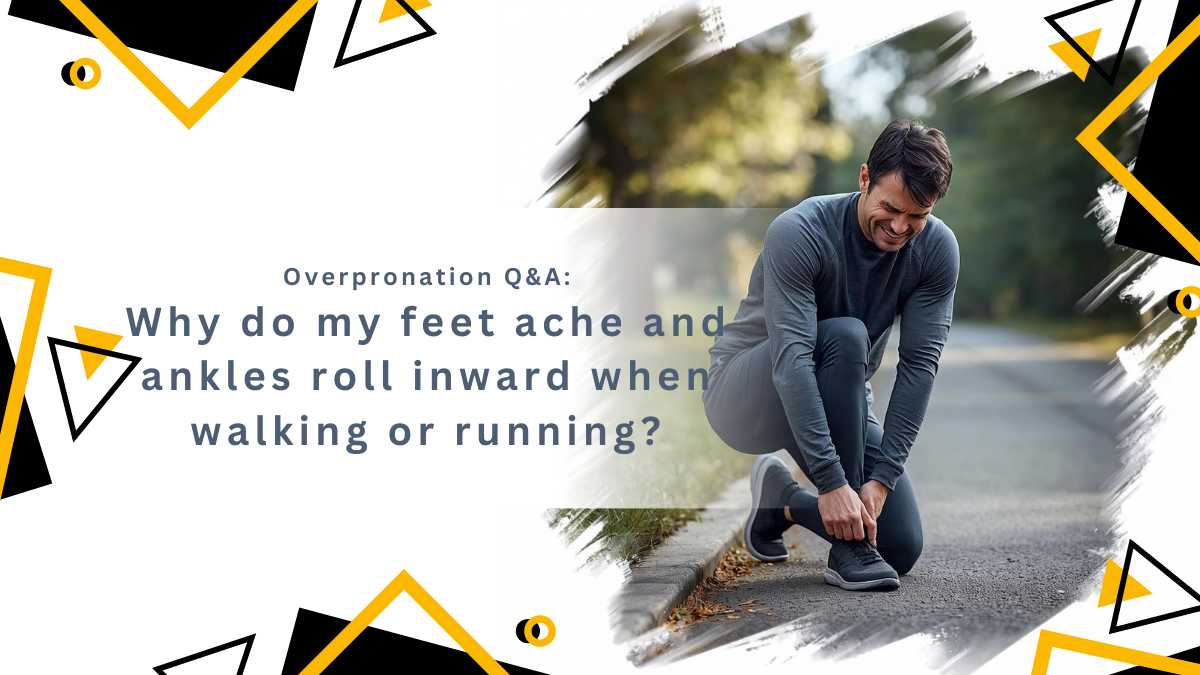
Q&A: Can overpronation insoles really help my foot and knee pain?
When your feet and knees start complaining for no clear reason
There comes a point for many people – often somewhere in their 40s – when feet and knees suddenly seem far less forgiving than they used to be. A busy day that would once have been an afterthought now ends with tired, aching arches, sore heels, a nagging pull around the inside of the ankles, and a dull, grumbling ache around the front of the knees after a longer walk.
You look down and wonder whether your feet have changed shape. A shop assistant or friend mentions “flat feet” or “overpronation”. You start reading about insoles, arch supports and orthotics, and very quickly discover a confusing mix of bold promises, conflicting opinions and technical language.
Should you be wearing insoles at all? Are “overpronation insoles” genuinely helpful or just a label? Will they ease the pain in your feet and knees, or risk making things worse if you pick the wrong type?
These are the kinds of questions people bring to NuovaHealth every week. The details differ – a long commute, an NHS shift, a new exercise routine – but the underlying worries are the same: is this just part of getting older, or is there something practical that can be done?
To give this some context, here is a recent example of the sort of message that comes into NuovaHealth – and the rest of this article is the kind of answer given to questions like this.
Hi NuovaHealth,
I’d really appreciate some advice. I’m in my mid‑40s and over the last year I’ve started getting more and more foot and knee pain, especially on days when I’m walking or standing a lot. By the evening my arches feel tired and achey, my heels and the inside of my ankles are sore, and I sometimes get a dull pain around the front of my knees after longer walks.
A shoe shop told me I have “flat feet” and “overpronation”, and that my feet roll in too much when I walk. I’ve looked online at insoles for flat feet and the best insoles for overpronation, but there’s so much conflicting information about arch support insoles, custom orthotics and cheap gel inserts that I’m completely confused.
Could this overpronation really be what’s causing my foot and knee pain, and can wearing the right insoles actually help or stop it getting worse? How do I know if I genuinely need insoles for overpronation, which type is best for my kind of flat feet, and are there other things I should be doing as well to ease and prevent the pain?
Why this question comes up so often
The message above will sound familiar to a lot of people. Someone who has never really thought about their feet suddenly finds that a full day on hard floors leaves the arches aching, the inside of the ankles sore and the knees complaining after a longer walk. A term like “overpronation” is mentioned, and a simple question – “would insoles help?” – turns into a confusing hunt through marketing claims and jargon.
If any of the following sound close to home:
- Feet that seem to roll inwards when you stand or walk,
- Arches and inner ankles that ache by the end of the day,
- Knees that start to hurt after longer walks or busy shifts,
then this guide is written with you in mind. It will walk through:
- What overpronation actually is,
- How to tell whether it is likely to be part of your pain,
- What steps usually help – including where insoles fit in,
- And how FootReviver Overpronation Insoles, available from NuovaHealth, have been put together for this kind of foot.
How your feet are meant to move – and what “overpronation” really means
Each foot has three broad regions working together:
- The heel, which usually meets the ground first,
- The midfoot and arch, which help share load and adapt to the surface,
- The forefoot and toes, which help you balance and push off.
On a comfortable step:
- You land near the heel.
- The foot rolls in slightly and the arch lowers a little. This controlled roll‑in is pronation and it helps absorb shock and keep you steady.
- Your weight moves forwards across the arch and through the ball of the foot, and you push off through the toes as the arch firms up again.
That gentle inward roll and small drop in the arch are normal and useful. Without them, every step would feel harsh and jarring.
Problems tend to start when that roll‑in becomes more than the tissues are happy to control. The heel tips further in, the arch drops more and stays dropped for longer, and the lower leg follows by rotating slightly inwards as well. That way of moving is what is meant by overpronation.
In an overpronating foot:
- The heel leans in more than usual,
- The arch flattens more and stays flatter for more of the step,
- The lower leg turns in a little more on each stride,
- The foot spends more time in a rolled‑in, collapsed position.
Early on, this may just feel like a vague sense that the feet are “lazy” or “collapsed” after a long day. As that movement repeats on thousands of steps, different structures along the chain – under the arch, around the inner ankle, along the shin, or around the knee – can start to complain.
It is worth saying clearly: overpronation is a description of how your feet move, not a diagnosis on its own. Some people roll in more and never have pain. Others, especially with long hours on hard floors, less supportive footwear, sudden jumps in walking or running, or joints that are already sensitive, find that this extra inward roll is an important part of why their feet and knees hurt.
Simple checks: is overpronation likely to be part of your problem?
You cannot diagnose everything at home, but a few straightforward checks can give a good sense of whether overpronation is likely to be contributing to your symptoms.
How your arches look sitting and standing
Sit with your feet flat on the floor and look at your arches. Then stand up, relax and look again, ideally in a mirror or with a quick photo from the side.
- If the arches look fairly normal when you sit but clearly flatten and sag when you stand, that is a strong sign your arches are flexible and tend to collapse under load.
- If they are very flat both sitting and standing, your feet may have a more permanently flat shape, but how they behave under load still matters.
- If your arches stay high and hardly move when you stand, that is a different movement pattern and usually does not fit classic overpronation.
What your heels are doing from behind
Stand in front of a mirror or ask someone to take a photo from directly behind.
- If the heel bones lean clearly inwards instead of sitting roughly upright, your heels are tipping in when they take your body weight.
- If they are upright or even lean slightly outwards, that usually points towards a different way of moving and a different kind of support.
The story your shoes tell
Take the shoes you use most, put them on a table and look at the soles.
- If the inside edge of the heel and inner forefoot are more worn than the outer edge, your feet are spending more time rolled inwards.
- If most of the wear is on the outer edge, especially at the heel, that usually fits better with an underpronating or more supinated style of walking – a separate issue with separate needs.
How your pain comes and goes
Think about your typical day and how your symptoms behave:
- Does pain build the longer you stand or walk, especially on hard surfaces such as pavements or concrete?
- Are your arches fine in the morning but tired, achy or “done” by late afternoon or evening?
- Do you get a nagging ache along the inner side of the feet, ankles or shins on busy days?
- Do your knees feel tender around the front or inner side after longer walks rather than hurting with the very first step?
- Do you feel better in more structured, supportive shoes than in very soft, floppy ones?
If much of that sounds familiar, overpronation is likely to be part of the picture. If, instead, your arches stay high and rigid, your shoes wear mostly on the outside, and your main issues are poor shock absorption, repeated outer‑ankle sprains, or feeling as though you are always on the outer edge of your feet, that typically points to a different style of movement which needs a different approach.
As a checkpoint: if by now you have noticed that your arches drop when you stand, your heels lean in and your shoes wear more on the inside edge, you are very likely in the group this article is talking about.
How “rolling in too far” shows up in everyday problems
People rarely say “I’m here because I overpronate.” They come with tired arches, sore heels, burning under the ball of the foot, complaining knees or a grumbling lower back. The way the feet roll in is often one important piece of the puzzle behind these symptoms.
Below are some of the more common ways this tends to show up. These are not formal diagnoses, but they are familiar stories that can help make sense of what you are feeling.
Arch and inner‑ankle fatigue
A very typical picture is that the arches feel fine in the morning but heavy, tired or simply “finished” by the end of a long day. When you sit down and look, the arch looks reasonable. When you stand up and take weight, it visibly flattens.
Common features include:
- A tired, aching sensation under the arch itself,
- A dull, nagging ache or mild puffiness around the inside of the ankle,
- Shoes leaning inwards over time, with more wear on the inside edge of the heel.
In this situation, the tissues under the arch and the muscles along the inner shin and ankle are working hard all day to stop the arch collapsing completely. Early on, they manage. As they fatigue, the arch rests lower for longer and the inside of the foot and ankle start to complain.
Shin, heel and sole‑of‑foot aching
Sometimes the overwork shows up more along the inner shin or under the heel and sole.
People often describe:
- A dull ache or tenderness along the inner edge of the shin that builds during a walk or run and eases with rest, even though there was no clear “injury” moment,
- A bruised, sore or tight feeling under the heel, especially after long periods standing or after getting up from sitting,
- Aching or tightness along the sole of the foot after a long day on hard floors.
Muscles such as tibialis posterior, running down the inner shin, help control how quickly the arch lowers and how far the foot rolls in. When the arch collapses more than it can comfortably handle, those muscles work harder on every step, acting like brakes. Over time, particularly after a jump in walking or running, that extra work can irritate the bone and soft tissues along the shin.
Under the heel and along the sole, the band of tissue on the underside of the foot and the structures under the heel are being asked to absorb more force, and at altered angles, as the arch drops further. It is the repetition – thousands of slightly overloaded steps – that gradually leads to persistent soreness. This is one reason long supermarket or warehouse shifts on hard floors can leave shins and heels throbbing by the time you get home.
Forefoot overload: ball‑of‑foot pain, burning and big‑toe issues
When the arch and midfoot feel less stable, the front of the foot often has to work harder to keep you balanced, especially on hard ground or in less supportive footwear. That can show up in several ways.
People commonly notice:
- Aching, burning or bruised tenderness under the ball of the foot, just behind the toes, that builds with time standing or walking,
- A “hot pebble” sensation under the ball of the foot or burning and tingling that can spread into one or two toes, sometimes with small numb patches,
- A sharp or bruised spot of pain under the big‑toe side of the ball of the foot, especially when pushing off briskly, going uphill or climbing stairs,
- Bunions that are not only visible but increasingly sore and irritated in certain shoes, prompting you to shift weight away from the area.
As the midfoot drops and the arch feels less reliable, the toes often grip and the front of the foot tries to stabilise you. Load ends up being driven through particular metatarsal heads more than others, irritating joints and the soft tissues underneath. In a narrower shoe, if a foot that rolls in also widens, small nerves between the metatarsal heads can be squeezed as the bones are pushed together, creating burning, tingling and “hot pebble” sensations by the end of the day.
If push‑off is finishing heavily through the big‑toe side because the foot is rolling in, the small bones and soft tissues under that joint take more force. Over time, this repeated extra load can make the big‑toe area tender and sore, particularly in thin‑soled or very stiff shoes. Where there is already a bunion – a structural change in the big‑toe joint – that extra strain and rubbing can make an already prominent area much more sensitive.
Knee, hip and lower‑back aches that build with distance
Not all knee, hip and back pain has anything to do with the feet. But in some people there is a clear link between how the feet move and how joints above feel.
Knee discomfort linked with overpronation is often described as:
- A dull, nagging ache around or behind the kneecap, or along the inner side of the knee,
- Pain that appears after a certain amount of walking, running or standing and then lingers, rather than sharp pain at a single moment,
- Knees that feel more settled in supportive shoes than in very soft, unsupportive ones.
When the foot rolls in further than it should, the lower leg tends to rotate a little further in as well. This can change how the kneecap tracks over the thigh bone and increase load on the inner side of the knee joint. A small extra twist, repeated on thousands of steps, can be enough for a previously quiet knee to start aching.
Higher up, some people notice that long periods standing or longer walks leave the outer hips, the tops of the thighs or the lower back feeling deeply tired and achy. As the arches drop and the heels tip in, the lower legs turn in slightly and muscles around the hips and lower back do more stabilising work to keep the body’s centre of mass over the feet. Over long days, that extra effort can add to an underlying ache in these areas, especially if they were already sensitive.
Arthritic joints in the feet can also be less tolerant of extra inward roll. Where joints are already stiff and a bit inflamed, more load through the inner side of the foot can turn manageable discomfort into something that flares much more quickly.
Achilles tendon stiffness and soreness
Achilles tendon problems often follow a familiar pattern:
- Stiffness when first getting up in the morning or after sitting a while,
- A feeling that the tendon “loosens up” as you move around,
- Soreness later, after activity or by the end of a long day,
- Tenderness when you pinch or press along a particular portion of the tendon.
If the heel is repeatedly tipping inwards, the Achilles tendon is not just being pulled straight; it is being loaded with a slight twist as well. Combined with increases in walking, running, or time spent on the feet, that extra sideways strain can nudge a previously quiet tendon into stiffness and soreness.
Again, it is the repeated way of moving – step after step – interacting with how much is being asked of the tendon.
When you should get a proper assessment
Self‑checks and pattern spotting are useful and, for many people with familiar “too much time on my feet” aches, enough to guide sensible self‑help. They are not, however, a substitute for a proper assessment when symptoms are severe, rapidly changing or unclear. Some serious problems can look like simple overuse at first.
Most people reading this will not have any of the following features, but they are important to be aware of. They can point towards fractures, serious joint issues or nerve problems that need medical attention rather than self‑management.
It is sensible to seek assessment from a GP, physiotherapist or podiatrist if you notice:
- Sudden, severe pain in the foot, ankle, Achilles, knee or hip after a twist, fall or impact,
- A clear “pop” sensation, immediate difficulty weight‑bearing, or obvious loss of push‑off strength,
- Marked swelling, redness and warmth in a joint, especially if this comes on quickly,
- Obvious deformity, a rapidly changing joint shape, or a new, pronounced lump,
- Sharp pain over a bone that you can press on with one finger and it really hurts, especially if it persists at rest or wakes you at night,
- New or worsening numbness, tingling, weakness, or changes in coordination,
- Changes in bladder or bowel control linked with back or leg symptoms,
- Pain that is severe, clearly worsening over time, or not improving at all despite sensible rest and reduced load.
If you have known conditions affecting circulation, nerves or joints, it is wise to be cautious and seek advice early rather than trying to manage things entirely alone.
For milder aches that clearly relate to time on your feet and ease when you get off them, it is usually reasonable to start with sensible changes to footwear, activity, strengthening and support, while keeping an eye on whether things are gradually improving.
What actually helps: putting the pieces in order
When overpronation is contributing to pain, the best results usually come from combining several sensible steps rather than looking for one magic fix. A good way to think about it is:
- Start with what your feet are standing in all day (shoes),
- Adjust how much you are asking of them (activity and load),
- Give the muscles a better chance (strength and control),
- Then add the right kind of support under the foot (insoles) where the way your feet move matches what they are designed for.
If things still refuse to settle after giving this a fair try, that is the point to look at more formal rehabilitation or medical care.
Footwear: the foundation under your feet
Shoes are the first line of defence. Before even thinking about insoles, it is worth looking honestly at what your feet are being asked to work in all day.
Ask:
- Do everyday shoes have a reasonably firm heel and some structure under the arch, or are they extremely soft and floppy?
- Is there enough room for toes and any bunions, or are they squeezed and rubbing?
- Is the sole so thin and flexible that every bump in the pavement is felt, or does it offer some cushioning and structure?
Extremely soft, shapeless shoes – thin pumps, worn‑out trainers, floppy canvas shoes – leave the feet doing all the stabilising work on their own. On hard floors, that extra work adds up. Many people notice that simply switching from very soft, unsupportive shoes into a more structured trainer or shoe with a firmer sole makes a clear difference by the end of the day.
Going barefoot on hard floors for long periods, especially on tiles or laminate, can also be demanding on already tired arches and heels.
Activity and load: how much you’re asking from your feet
The other obvious variable is how quickly activity has changed. Feet that have quietly coped with shorter walks can start to struggle when you suddenly:
- Increase daily step count sharply,
- Add longer or hillier runs,
- Move into a job with long shifts on concrete floors,
- Take up a new exercise programme with a lot of impact.
Rather than jumping from “hardly walking” to “walking a lot” overnight, it is kinder on tissues to build more gradually – for example, increasing walking or running by roughly 10–15% a week. If a regular walk is 30 minutes, that might mean adding five minutes rather than doubling it. The same applies at work: if a run of long shifts is coming, planning short breaks off your feet where possible can make a real difference.
Strength, control and conditioning
Muscles in the feet, calves, hips and around the middle all help to control how the legs move and how impact is absorbed. Stronger, better‑coordinated muscles make it easier to tolerate everyday walking and standing without everything flaring.
Areas often worth focusing on include:
- Calves – controlled heel raises, on flat ground and then on a step, strengthen the calf muscles that help slow pronation and support the Achilles tendon.
- Small muscles in the feet – gentle arch‑lifting drills (where you try to shorten the foot slightly without curling the toes) and simple toe‑spreading exercises can improve how the arch and midfoot support the rest of the foot.
- Hips and trunk – basic hip‑strength work (such as side‑lying leg lifts or band walks) and simple core exercises help share load away from the knees and lower back and keep legs better aligned over the feet.
These do not need to be complicated gym routines. A useful guide is that mild effort or ache during exercise, which has settled by the next day, is acceptable. Sharp pain, or a strong flare‑up that lingers into the following day, usually means too much has been done and it is worth easing back. These are general examples; any specific injury or condition may need its own tailored plan from a professional.
General health and load tolerance
General health factors also influence how well feet and legs cope with daily demands.
For example:
- Carrying more body weight increases the force through each footstep and can make arch or knee pain appear earlier in the day,
- Poor sleep and high stress can make the nervous system more sensitive and slow down recovery,
- Lower general fitness can mean muscles fatigue sooner, leaving more of the supporting work to passive structures such as ligaments and joint surfaces.
None of this is about blame. It is simply recognising that feet and legs are part of a bigger picture, and they tend to behave better when overall health is looked after.
Where insoles fit in – and what they can realistically do
Once footwear and basic activity changes are in place, insoles can be a very practical way to reduce avoidable strain from the way the feet roll in. The important thing is to be clear about what a good insole can and cannot do.
A supportive insole for overpronation is intended to:
- Reduce how far and how quickly the heel tips in and the arch drops,
- Spread load more evenly under the arch and ball of the foot,
- Give the ankle, knee and hip a more predictable base to work from, so they do not have to constantly compensate for too much roll‑in.
It should not:
- Lock the foot completely rigid,
- Replace the need for reasonable footwear and activity levels,
- Be expected to reverse structural changes such as bunions or arthritis.
Insoles are not right for absolutely everyone, but for feet with flexible, collapsing arches they are often one of the simplest, most effective changes that can be made. Think of a supportive insole as one tool: it alters how load passes through the foot and leg, helping to take stress off tired tissues while the wider picture is being addressed.
Soft insoles versus firm support – why firmness matters
For many people, the first experience of “insoles” is a very soft gel or foam insert. They often feel pleasant at first: they cushion pressure points and feel instantly different from the bare shoe.
The problem is that very soft materials tend to squash flat quite fast. After an hour or two, they have largely flattened out under body weight. The arches are doing the same amount of work as before; the heel is rolling in the same way. There is some short‑lived cushioning, but not much in the way of support or control.
At the other extreme, some very rigid devices can feel like a hard lump under the arch that the foot is constantly trying to avoid. They may control movement strongly, but if they are uncomfortable they are unlikely to be worn consistently enough to be helpful.
For a foot that clearly rolls in too far, a useful insole generally needs to strike a balance:
- Firm enough to keep its shape and genuinely share the supporting job with the arch and heel throughout a full day, rather than collapsing flat by lunchtime,
- Shaped well enough that it backs up the arch and cradles the heel, rather than jabbing into one spot and forcing an awkward position.
Support in this context does not mean extra softness. It means providing a shaped, semi‑rigid platform that helps hold the heel and arch in a better position under load, step after step. Under the arch it should feel supportive but not sharp, noticeable but not painful.
What to look for in an insole for overpronation
Labels such as “for flat feet” or “for overpronation” do not always tell you how an insole will behave in a shoe. A few key design features usually matter far more.
A firm, shape‑keeping base
The core of the insole should be supportive, not floppy. When pressed between the fingers or stood on, it should keep its basic shape rather than folding up like a sponge.
A firm base allows the insole to:
- Share the supporting job with the heel and arch,
- Resist flattening out under weight,
- Continue to offer support later in the day, not just when first putting shoes on.
A sensible, contoured arch
The arch region should meet the underside of the foot and support it under load. Done properly, this:
- Spreads pressure along the midfoot instead of concentrating it at one sore point,
- Reduces how far and how fast the arch has to drop with each step,
- Takes some strain off tissues that have been coping on their own.
The key is contouring: a firm, shaped arch that fits under the natural curve of the foot, not a random lump. Good arch support should feel like a broad backing, not a harsh ridge.
Heel cup and gentle inner‑side control
A shallow heel cup and subtle support along the inner side of the heel help to:
- Centre the heel more squarely under the leg,
- Limit how far and how quickly it tips inwards,
- Reduce the extra inward rotation passed up into the lower leg and knee.
Healthy pronation is still allowed. The aim is not to stop the heel rolling in at all, but to turn an uncontrolled collapse into a steadier, more repeatable movement.
Full‑length support platform
A full‑length insole supports the entire foot from heel to toes. This means:
- The forefoot does not suddenly drop off a raised section at the ball of the foot,
- Load is spread more evenly as weight rolls through each step,
- There are fewer abrupt changes in height that can irritate the ball of the foot.
Full‑length support is particularly helpful if there is ball‑of‑foot ache, burning into the toes, or a sense that certain parts of the forefoot are taking all the pressure.
How FootReviver Overpronation Insoles are designed
This is the point where a firmer, properly shaped insole can earn its place in your shoes. FootReviver Overpronation Insoles, available here at NuovaHealth, are one such option. They were developed with input from podiatrists and physiotherapists for people whose feet clearly roll in too far and who recognise many of the issues described above: collapsing arches, inner‑ankle strain, inner shin ache on longer walks or runs, discomfort under the front of the foot on hard ground, and knee pain that builds with distance.
They are not general‑purpose cushions. They are built to offer firm, shaped support for a foot that genuinely needs help controlling too much inward roll.
Firm, supportive shell
At the heart of each FootReviver insole is a firm base, rather than a floppy gel pad. This firm shell:
- Keeps its shape under weight over the course of a full day,
- Shares the load with the arch and heel, rather than collapsing flat,
- Continues to support even when tired and when muscles are flagging.
For people with flexible, collapsing arches and that familiar “my arches are done by the evening” feeling, this is crucial. The idea is that the insole is still providing support late in the day, not just for the first hour of wear.
Contoured arch support
The arch area of the FootReviver is shaped to sit against the underside of the foot and help hold the arch up under load. The contouring is designed to:
- Reduce how far the arch has to sink on each step,
- Spread pressure along the midfoot rather than letting it all sag onto one tender spot,
- Off‑load the tissues under the arch that have been doing all the work.
In the familiar picture of arch fatigue and inner‑ankle strain, this often turns “my arches feel completely done by the evening” into “they still feel as if they’ve worked, but they cope better with a full day.”
Heel cup and inner‑side support
The heel of the FootReviver insole sits in a shallow cup with gentle support along the inner side. This arrangement helps to:
- Centre the heel more squarely under the leg,
- Reduce how far it tips inwards as weight is taken,
- Cut down the extra inward twist that was being passed up into the shin, knee and Achilles tendon.
This directly targets the inward heel tilt often seen with inner‑shin pain on walks or runs, certain types of kneecap ache, and some Achilles problems. By improving the heel’s starting position, the muscles and joints above are not having to work as hard to correct that inward drop on every step.
Full‑length support for the whole foot
FootReviver insoles run the full length of the shoe, so the forefoot sits on the same supportive platform as the heel. This helps to:
- Spread pressure more evenly across the ball of the foot,
- Reduce localised overload under particular metatarsal heads,
- Calm down symptoms such as soreness under the front of the foot or burning into the toes when the arch and midfoot feel unstable.
Soft gel inserts have their place for short‑term cushioning, but they do not usually change how far the arch drops once they have compressed. FootReviver’s firmer shell, shaped arch and heel control are designed specifically to address the extra roll‑in and arch giving way that sit behind many of the problems described earlier.
Who FootReviver is suited for – and who it isn’t
No insole suits every foot. Being clear about who a product is for is as important as explaining its design.
When FootReviver is likely to help
FootReviver Overpronation Insoles are likely to be a good match if several of the following ring true:
- The arches look reasonable when sitting but flatten and sag clearly when standing,
- The heels lean inwards when viewed from behind,
- The inside edge of shoes, especially at the heels, wears faster than the outer edge,
- The main issues include tired arches, inner‑ankle niggles, inner shin pain on longer walks or runs, aching under the front of the foot on hard ground, burning into the toes in narrower shoes, or dull aches around the front or inner side of the knee that build with distance.
For this combination of foot features and symptoms, reducing how far the feet roll in and supporting the arch and heel more firmly usually makes a real difference to how the feet and legs feel by the end of the day. FootReviver has been built with this way of walking in mind.
When another approach may be better
FootReviver Overpronation Insoles are not the right answer for every foot type or every problem. A different approach is usually better if:
- The arches are high and barely move when standing, and shoe soles wear more on the outer edge. That typically fits an underpronating or supinated style of walking, which often needs different support and more cushioning, rather than control of inward roll.
- The main problem is a particular shoe digging or rubbing – for example, a stiff heel cutting into the back of the heel, or a very narrow toe box pressing on a bunion. In those cases, changing or adjusting the footwear is more important than adding an insole.
- Symptoms are severe, rapidly worsening or unexplained, and match any of the red‑flag features described earlier. In that situation, a proper clinical assessment should come before buying insoles of any kind.
Matching the style of insole to how the feet actually behave under load is far more effective than choosing purely on labels such as “flat foot” or “high arch”.
Getting the best from FootReviver insoles
If FootReviver Overpronation Insoles feel like a good fit for your feet and symptoms, a few practical steps will help you get more out of them and give the feet time to adapt.
Pair them with appropriate shoes
FootReviver insoles work best when placed in shoes that:
- Have a reasonably firm heel counter,
- Offer enough depth and length that toes are not cramped once the insole is in place,
- Provide some structure and cushioning under the sole, rather than being extremely soft and floppy.
If the shoe itself collapses and twists easily, the foot can still roll around the insole and undo much of its benefit. The shoe provides the frame; the insole provides the shaped support within that frame.
Build up wear time gradually
If feet have been in very soft shoes or are particularly sensitive, it can help to increase wear time over several days rather than moving straight to full‑time use.
For example:
- Start with a couple of hours of wear on the first day or two,
- Move to half a day for the next few days,
- Build up towards most of the day over the following week.
They will feel different under the arch to start with – that is normal – but they should not feel sharp or painful. Mild “new support” awareness is fine. A strong flare that lingers into the following day usually means too much has been done too quickly and it is worth easing back a step.
Combine support with sensible activity levels
Insoles like FootReviver can reduce avoidable strain from the way the feet roll in, but they cannot fully compensate for:
- Very sudden jumps in walking or running distance,
- Very long days on hard surfaces without breaks,
- Ignoring pain that is clearly signalling that tissues are not coping.
They work best as part of a bigger plan that includes pacing activity and giving the feet a chance to recover.
Add strengthening and control exercises
Simple, regular exercises for the calves, feet and hips can improve how the legs cope with everyday walking and standing.
For example:
- Controlled heel raises to strengthen the calves that help manage pronation and support the Achilles tendon,
- Gentle arch‑lifting drills and toe‑spreading exercises to improve foot control,
- Basic hip‑strength work to help share load away from the knees and lower back.
FootReviver insoles reduce the amount of excessive inward roll that muscles have to manage. The exercises then improve how well those muscles handle the remaining load. Both work best when built up gradually and when they do not provoke sharp or long‑lasting pain. The same calf and hip work mentioned earlier will complement what the insole is doing under the foot.
Bringing it all together – and a practical next step
If arches are flexible and collapsing, heels tip in, shoe wear is heavier on the inside edge, and aches in the arches, shins, knees or hips build with time on the feet, then the way the feet are rolling in is very likely to be part of the story.
The way forward is rarely about one single product. It is usually about incorporating a range of sensible steps:
- Understanding how the feet are moving and where symptoms fit,
- Choosing shoes that give the feet a more stable, structured platform,
- Using a firm, properly shaped insole to support the arch and control excessive roll‑in, where that matches what the feet are doing,
- Building strength and control in the muscles that support the feet and legs,
- Seeking professional assessment promptly if any worrying features are present, or if pain is not improving despite these measures.
FootReviver Overpronation Insoles, available from NuovaHealth, have been designed for exactly this type of foot: an arch that looks reasonable when sitting but collapses when standing, heels that lean in, inside‑edge shoe wear, and aches that build with distance rather than striking out of the blue.
The combination of a firm shell, shaped arch, controlled heel and full‑length platform is there to give the feet a more dependable base, step after step. They are not a cure‑all on their own and they do not remove the need for good footwear, reasonable activity levels and, where appropriate, professional care. But for adults with clear overpronation and the sort of aching arches, inner‑ankle niggles, shin pulls and front‑of‑knee grumbles described here, they are a sensible option built around what tends to help this kind of foot.
If you are tired of finishing the day with feet that feel as though they have given up, it is reasonable to ask whether a shaped insole might finally give them some back‑up. If much of what has been described matches day‑to‑day experience and insoles for flat feet or overpronation are being considered, FootReviver Overpronation Insoles, available from NuovaHealth, are a practical choice designed with this situation firmly in mind – as part of a broader, realistic plan to help feet and knees cope better with the demands of everyday life.