If your arches feel tired by late afternoon, if the inside edge of your shoes wears down faster than the outer edge, or if your feet clearly roll inwards when you walk, the way your feet take your weight is probably part of what keeps your arches feeling that way.
Those signs usually come from the same thing: your foot rolls in further than it can comfortably control, and stays there for longer than it should once your weight is on it.
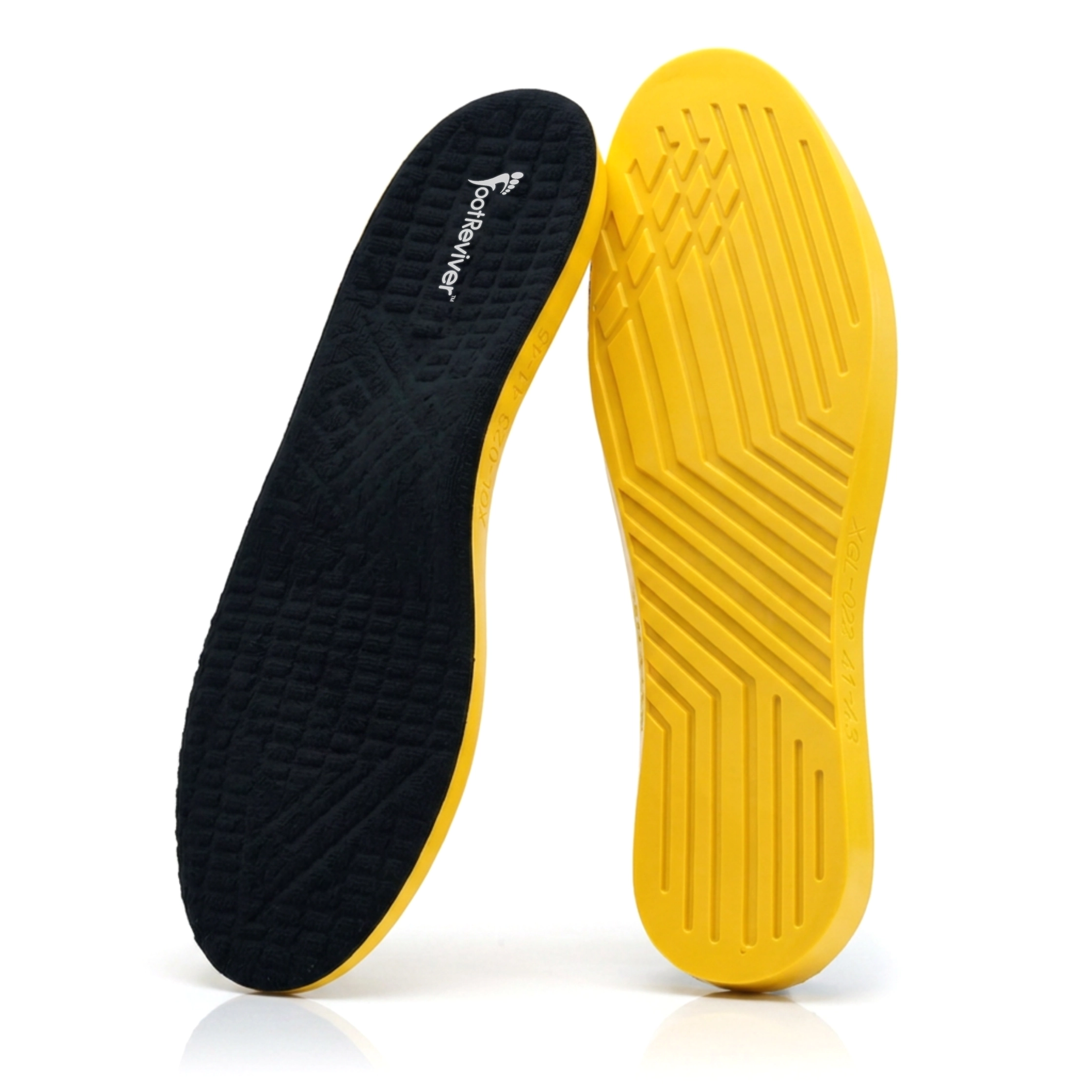
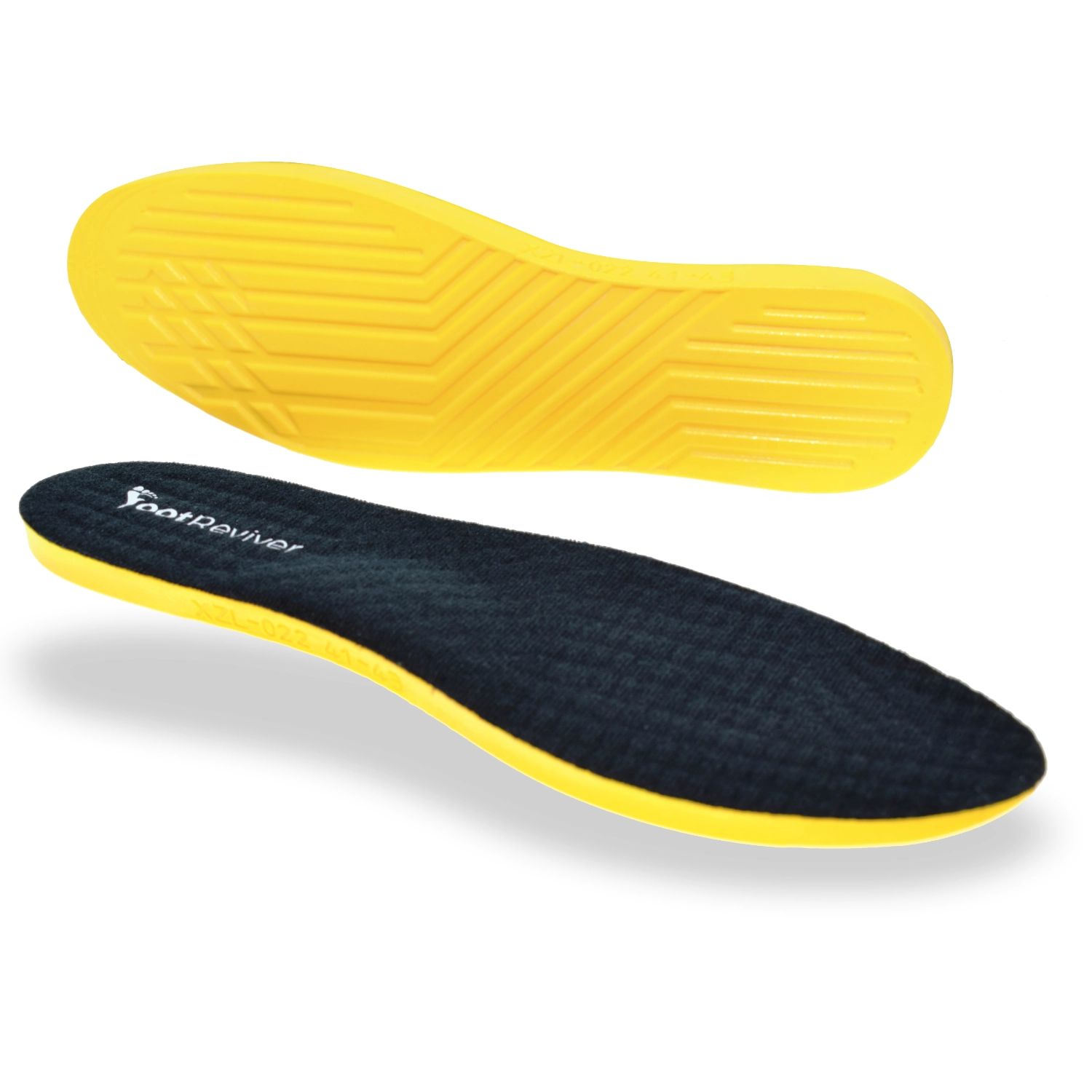
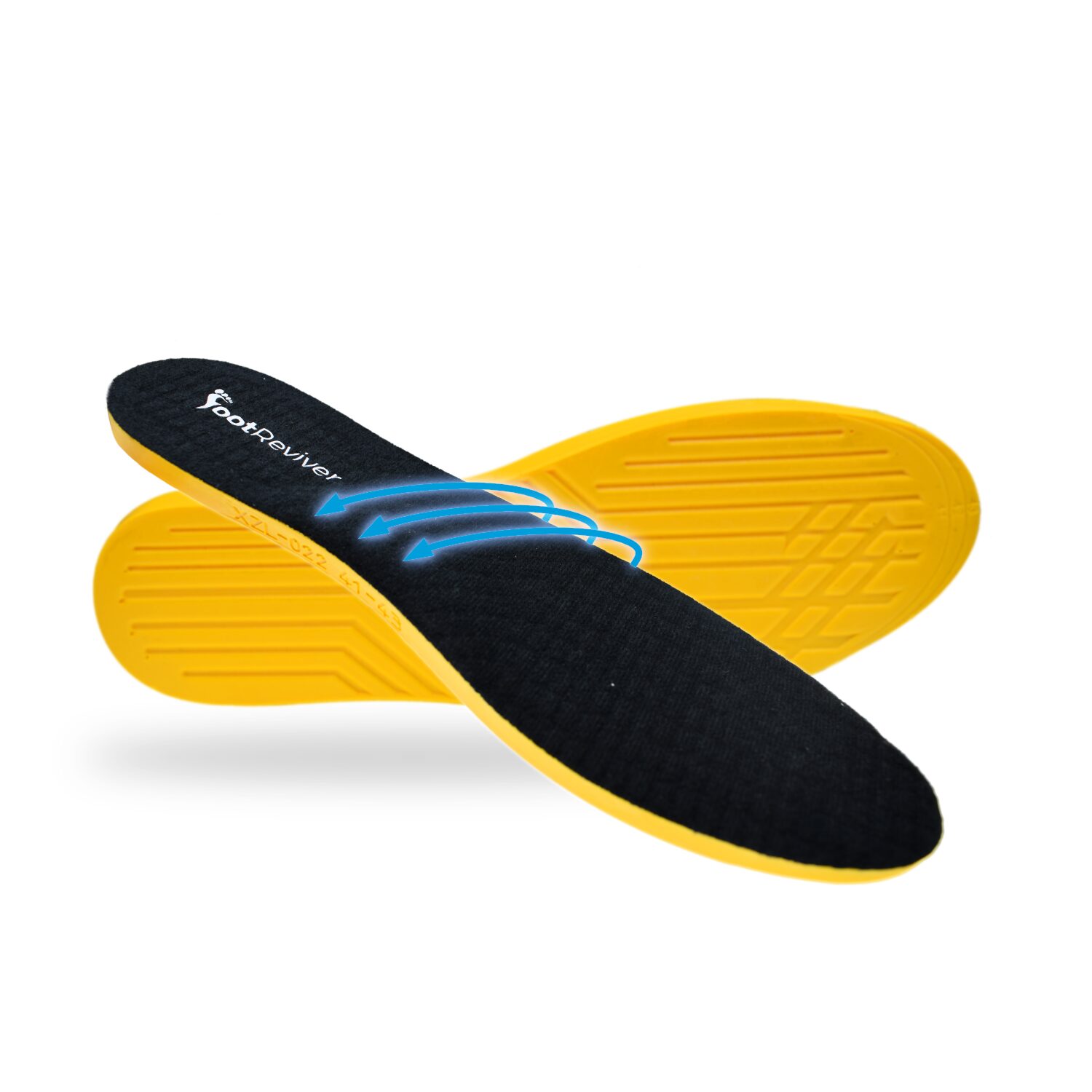
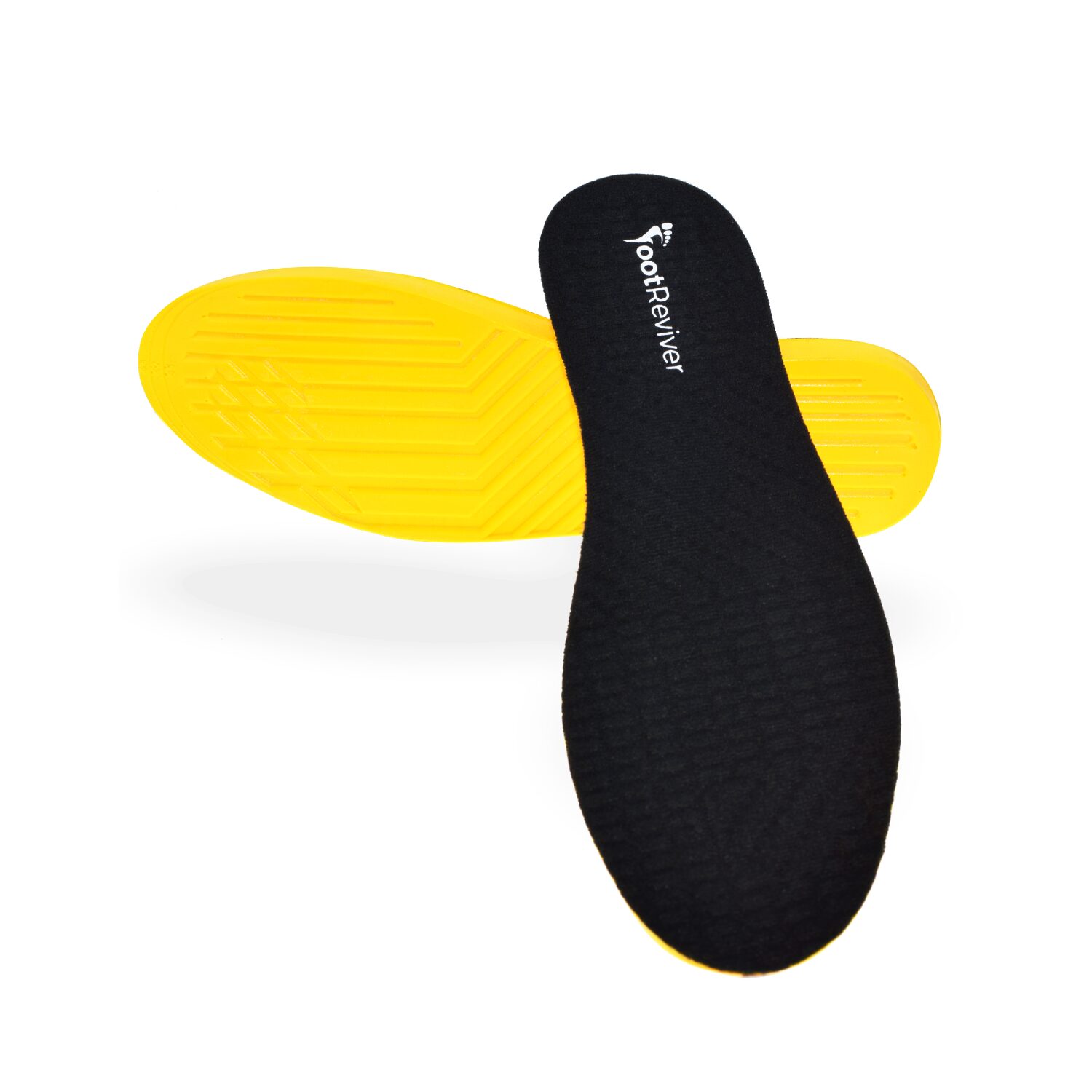
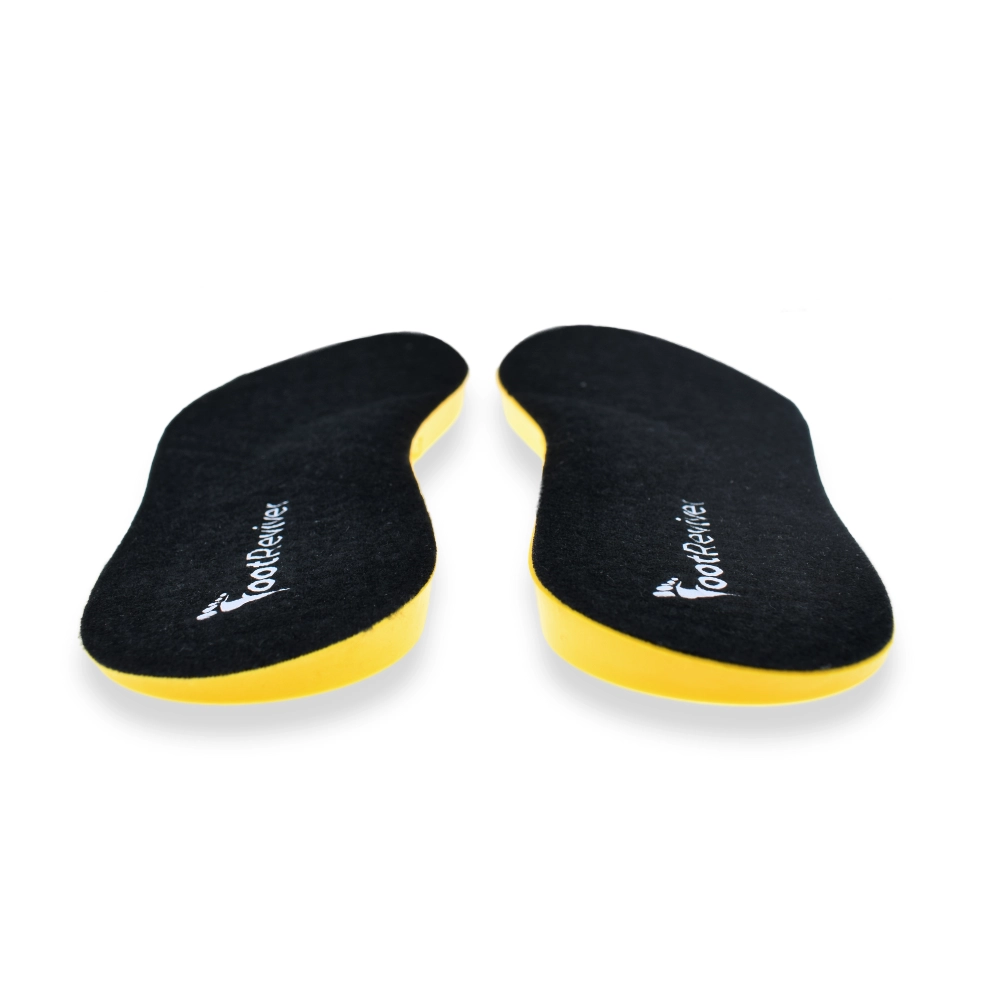
FootReviver Overpronation Insoles are built for that. They are structured, full-length insoles for adults whose feet roll in too much once they are on their feet in everyday footwear. Underneath the arch and around the heel, they are shaped to give the foot a steadier base to sit into, and to cut down the extra inward collapse that tends to show up later in the day.
They still bend as you walk. The shape guides and supports; it does not hold your foot stiff. The flex sits under the toes, where your foot needs to bend to push off. The firmness sits under the heel and arch, where the work actually happens. The result is simple: a firmer arch and heel, a slim front end so your toes are not crowded, and a top surface that stays comfortable through a full day in your shoes.
Does this sound like your feet?
People who get on well with this kind of insole usually describe the same handful of things.
Look at your shoes first. The inside edge of the heel is worn or crushed down more than the outer edge. Some people can see the whole shoe leaning inwards when it stands on its own. That lean comes from thousands of steps landing the same way.
Now stand up and look down at your feet. If your arches look noticeably flatter standing than they do when you are sitting or lying down, that is a strong clue. Your arch is not a fixed shape. It changes under load, and how much it changes is often telling.
Early in the day, things might be manageable. As the hours pass and you have stood or walked for long stretches, the familiar signs appear. Aching or tired arches. A tired, aching feeling around the inner ankle or up the inner shin. A sense that the foot is rolling onto the inside edge of the shoe. If you look at your heels from behind while standing, they may appear to tip inwards slightly.
For most people, that means trainers, walking shoes, work shoes or boots — with enough depth and width for an insole to sit properly, or a removable liner you can take out to make room.
If your shoes mostly wear down on the outer edge, or if your arches are very high and barely change shape when you stand, this kind of insole is unlikely to feel comfortable. For feet like that, a softer, cushioning-led approach usually works better.
Every step follows the same rough pattern. Your heel lands slightly towards the outside. The foot rolls in a little and the arch lowers to absorb the impact. Then, as your weight moves forward over the foot, the arch should firm up again and give you a firmer base to push off from.
That inward roll has a name: pronation. It is not a fault. It is how the foot absorbs shock and adapts to whatever surface you are walking on. Without it, every step would land as a hard impact.
Overpronation is what happens when that inward roll goes further, lasts longer, or happens faster than your foot can comfortably control once your full weight is on it. The arch sits lower for more of the step. The heel tips inwards. The soft tissues under the arch — the tendons that actively pull the arch up, and the ligaments that run along the sole of the foot — end up doing more work on every single step just to keep things steady.
Timing is what changes how this feels across a day. At the start, your feet and legs cope. After several thousand steps, especially on hard floors or in shoes that offer little support, the extra movement adds up. The arch feels tired and aching rather than sharply painful. The inner ankle or inner shin starts to ache. You become aware of the foot rolling onto the inside edge. People are often fine for hours, then feel by late afternoon that their feet have simply had enough. Nothing dramatic happened. The same extra movement simply repeated itself a few thousand more times.
What changes during a single step
Take one step from heel contact to push-off, and three things change when you overpronate.
The heel can tip inwards more quickly at landing, so the foot starts the step already tipped inwards. The arch can drop further and stay dropped for more of the time you are on that foot, which stretches the tissues underneath for longer. And the front of the foot can spread and take more pressure on the inner side as weight travels forward.
You tend to see or feel the result in the same places: at the heel, as extra wear on the inside edge and a feeling that the heel “falls in”; through the arch, as a sense that it is working harder than it should and getting tired; and at the front of the foot, as more load shifting towards the big-toe side, especially late in a long day.
For some people, the extra inward movement shows up almost entirely in the foot and ankle. For others, it is felt further up the leg.
As the foot rolls in more, the lower part of the leg turns in a little more with it. That is simply what happens when the foot it sits on keeps rotating inwards. Over a long walk or a long day on your feet, that repeated extra turn can do a few things. It can make the muscles along the inner shin work harder, which can produce inner-shin tenderness or a shin-splints-type ache. It can slightly change how the knee is loaded, step after step, especially at the front of the joint and along the inside, which can contribute to a knee ache that builds with distance. And it can ask more of the hip and lower back to keep you steady when you stand or walk for long periods, which some people feel as a tired, dull ache rather than a sharp local pain.
Many people overpronate more on one side than the other. That is why one shoe often looks more collapsed than the other, or one foot feels worse. When one foot rolls in further, the leg on that side is working in a slightly different position from the other. Over time, that side-to-side difference is one reason symptoms are often more noticeable in one shin, one knee or one hip.
None of this means every shin, knee, hip or back problem comes from the feet. But if you can clearly see your feet rolling in, your shoes show the evidence, and your symptoms build with time on your feet, it makes sense to steady the base.
Flexible arches and why the picture changes with age
Not everyone with overpronation has obviously flat feet when they are sitting in a chair.
Plenty of people have arches that look perfectly reasonable when the foot is off the ground, but drop more than they can comfortably control once they stand up. That is what a flexible arch looks like in practice: fine at rest, changing shape under load. Flexible is the key word. It is not a rigid, fixed deformity. It moves — and that is exactly why support can influence it.
Age comes into this too. The soft tissues that hold the arch up do not recover from repeated strain as readily as they once did. That is one reason patterns of overpronation often become more noticeable later in life, even in people who have always had “flat-ish” or fairly neutral-looking feet. It is rarely one dramatic event. It is more about how well those tissues cope with the same movement repeated over many days and years.
It is also why the “fine at first, worse later” pattern is so typical. The arch is not failing all at once. It is being asked to hold a position it can only just manage, and it gets tired.
Why a soft insole hasn’t changed anything
If you have tried a soft, cushioned insole before and felt no real difference, that experience makes sense. It helps to understand why before you decide anything else.
Very soft insoles and shoe liners feel pleasant at first. They add cushioning under the heel and arch, and a softer step genuinely feels nicer. The problem is what happens under load. A soft material compresses most exactly where you press hardest — under the arch and under the heel — and that is where the support needs to be. The shape flattens. The foot sinks back down into the same inward-rolling movement it was doing before.
Nothing about how the foot moves has changed. It is just happening through a softer layer.
To be fair to soft cushioning, it does help with impact, especially on hard floors. That part is real. But for feet that roll in too far, cushioning on its own is not enough. Softness changes how a step feels in the short term. Shape is what changes how far and how long the foot rolls in.
That distinction is what separates a structured insole from a plain cushion. Softness helps in the first minute. Firmness carries you through to the end of the day.
Is this the right kind of support for your feet?
This insole is designed for one clear job: reducing excess inward roll in feet that genuinely roll in too much. That means it suits some feet well and not others. It helps to know which group you are in.
Start with the arch, because that is the main matching question. This insole is shaped for arches that are low to moderate under load — the kind that look clearly arched when you are off your feet, then flatten noticeably under your full weight. It is not shaped for arches that stay high and rigid, and it is not shaped for arches that are so low they need a firmer, more controlling device.
If you are unsure where you sit, try this. Stand barefoot in front of a mirror and look at the space under the middle of your foot. Then sit down and look again, with the foot off the ground. If that space clearly shrinks once your weight is on it, you are in the range these insoles are made for. If your arch barely changes when you stand, or if you cannot see any gap under the middle of the foot at all, the match is less likely.
The feet it suits have a few things in common. They roll in visibly when you stand. Symptoms build the longer you are on your feet, rather than being constant. And the shoes you wear most days will take an insole — enough depth and width, with a removable liner if possible.
At the other end of the range are feet with high, rigid arches that hold their shape when you stand. This pattern is sometimes called underpronation. A firm insole built to control overpronation is usually the wrong choice here — the shape can be hard to tolerate under a foot that does not roll in. Cushioning and shock absorption are the better direction for those feet.
The other common mismatch is a shoe that is already tight and shallow, with toes close to the end and the upper pressing down across the top of the foot. In footwear like that, a firm, shaped arch support tends to feel like an obstacle. Very narrow, low-profile dress shoes, high heels, and anything that already feels tight before you add anything are rarely a good match. Shoes that are badly worn and leaning inwards at the heel, or very soft and collapsing through the middle, are poor partners too. They do not give the insole enough structure underneath to work with, because there is nothing solid for it to sit on.
A suitable shoe has enough depth and width, a sole that does not twist easily when you handle it, and a heel that holds your heel securely. Get those right and the insole has something to work with.
Not every foot benefits from the same kind of support. Matching the insole to how your foot behaves under load gives better comfort and better long-term results than choosing on a general label. If you are unsure whether your arch is genuinely collapsing in, or whether your problem fits better with the high, rigid arch pattern, a professional assessment can help you work out which direction of support or cushioning suits you.
FootReviver was developed with input from podiatrists and physiotherapists who see this pattern of foot movement in clinic every day. The whole design comes down to a small set of jobs: support the arch, so it is not doing all the work alone; centre the heel, so the step starts in a more controlled position; and gently limit how far the foot rolls in once you are on it.
Nothing here is designed to hold your foot in a fixed position or to force both feet into the same shape. The aim is simpler: reduce the extra inward roll, especially on the side that rolls in more, so both feet sit and move in a more similar, more controlled way across a full day on them.
A base firm enough to hold its shape
The base of the insole is firm enough to keep its profile under the arch and under the heel through a full day of wear.
That consistency is what matters here. A base that holds its shape means the support you feel in the first hour is close to what you still feel at the end of a long shift or a long walk. For people whose symptoms build with time on their feet, that consistency is what carries the foot through to the end of a shift.
It is also why people describe these as insoles that help their feet last the day, rather than insoles that feel luxurious in the shop.
A heel cup that centres the heel at landing
In a lot of people with overpronation, the step starts going wrong at the heel. If the heel tips inwards quickly and wobbles when it lands, the rest of the foot follows and the arch drops more abruptly than it needs to.
The heel cup here is shaped to cradle the heel so it sits more centrally inside the shoe and moves less from side to side. Think of it as a shallow bowl that the heel sits inside. The sides of that bowl hold the heel in place through the landing phase, when the foot is most likely to slide sideways.
People usually describe the effect as a steadier heel and less of that sense that the heel is falling in on every step, particularly late in the day, when tired legs are less able to hold things together.
Gentle inner-side support that meets the roll rather than blocking it
Some very rigid devices use a hard block on the inner side of the heel to hold the foot out. That can feel harsh or intrusive in ordinary shoes, and plenty of people cannot tolerate it.
FootReviver takes a softer approach. There is a gentle slope along the inner side of the rearfoot and midfoot — the back and middle of the foot, under the arch. Instead of blocking the roll, that slope meets the foot slightly earlier as the roll begins, and reduces how far and how long it continues. There is no new sharp pressure point on the inner edge.
The aim is that the foot feels steadied, not pushed. Your foot still moves and still adapts to the ground. It just does not collapse all the way onto the inside edge once your full weight is on it.
The arch support is contoured so the load spreads across a broader area of the midfoot, instead of sitting on one line.
This makes more difference than it sounds. Many people who roll in too much cannot tolerate a single hard ridge under the arch — all they feel is the ridge. Broader contact lets the foot settle into a supported position rather than balancing on one narrow point. It is usually where the feeling of an over-worked arch starts to ease, because the tissues underneath are no longer being stretched as far, or held there for as long, on every step.
The insole runs the full length of your foot, so you sit on one continuous surface from heel to toe, instead of on a partial insert that leaves a ledge under the middle of your foot.
At the same time, the forefoot section — the front part under your toes — is kept deliberately slim. Nearly all of the support work for overpronation happens under the heel and the arch, not under the toes, and crowded toes are the most common reason people give up on a supportive insole. So the front takes up as little room as it can, and fits more easily into everyday trainers, walking shoes and many work shoes without pressing on your toes.
There is a trade-off here to be aware of, because it affects how the insole feels. A thicker forefoot would add more cushioning under the ball of the foot, but it would also take up room in the shoe and crowd the toes. This design deliberately favours fit over extra front-end padding. If cushioning under the ball of the foot is your main problem, this is a real trade-off to weigh up before you buy.
A top cover for everyday wearability
The top cover is there to make the insole comfortable enough to keep in your shoes for hours at a time. It gives a smoother surface under your foot or sock and reduces the friction that would otherwise cause rubbing as you get used to the new shape.
It does not turn this into a soft, bouncy insert, and it is not meant to. It just makes the insole easier to live with all day, so the support underneath can keep doing its job.
What to feel for when you first hold them
Before you put them in a shoe, take a moment to look at the shape. It tells you what any structured insole is trying to do.
Press your thumb into the arch. You should feel a defined, firm contour that resists. If your thumb sinks in without much resistance, the arch support is soft and will flatten under a full day of body weight.
Run a finger around the heel cup. You should feel a rim that lifts up at the back and sides. That rim is what holds the heel. A shallow cup steadies less. A very deep cup can feel intrusive in a low-cut shoe.
Hold the insole at both ends and bend it. The bend should happen at the front, under where your toes sit. The heel and arch area should give much less. If the whole length folds easily, the support will not hold its shape through the day.
Finally, look at it from the side. The arch should sit roughly two-thirds of the way along, not at the very front or the very back. That position is what puts it under the middle of your foot once the front has been trimmed to length.
Everything else about a structured insole is there to hold that shape in place under your foot.
Where overpronation shows up — and which pattern is yours
Overpronation rarely shows up in only one place. It shows up wherever your body has had to work hardest to make up for it. The same extra inward roll that tires the arch can pull on the heel, twist the shin, load the knee, shift the ball of the foot, and ask more of the hips and lower back over a long day standing.
Each of the common patterns has its own shape: how it behaves, what is happening underneath, and what this insole can realistically do for it — along with a clear picture of the one foot type it is not built for.
Arch fatigue and 'collapsing' arches (flexible flatfoot)
A lot of people’s days follow the same pattern. Arches feel fine in the morning. By late afternoon they feel tired.
After long spells on your feet there is a tired, aching feeling under the arch, a sense that the inner ankle is working hard, and sometimes a slight unsteadiness through the middle of the foot once you are tired. Your shoes show it too, with more wear along the inside edge of the sole and heel.
Your arch does not hold itself up on its own. Two structures do most of that work. One is a tendon — the posterior tibial tendon — that runs down the back of the leg, passes behind the inner ankle and attaches to the small bones that form the arch. It contracts with every step to pull the arch up and stop the foot collapsing inwards. The other is a band of tissue called the plantar fascia, running along the sole of the foot from the heel towards the toes, giving the arch passive support — a tension line under the arch, much like the cables that hold up a suspension bridge.
When the foot rolls in further than the ankle can comfortably control, that tendon is working against a load it can only just handle. On a long day standing — a queue at the till, a hard warehouse floor, working in a kitchen, standing rather than walking — it contracts almost continuously. Early on it copes. By late afternoon it has tired, and the arch sags lower under the same body weight. The lower position stretches the band under the sole. It does not spring back as quickly between steps, so the arch spends more of the day in a position it was not built to hold for that long. The result is a tired ache filling the middle of the foot, rather than a sharp pain in one spot.
What you feel through the middle of the foot is the strain on that tendon and band, not the shape of the arch itself. What matters is not how your arch looks off your feet. It is how far it drops under load, and how long it takes to recover between steps.
What the insole does here is take over part of the supporting job. The wide arch contour spreads pressure across a broader area of the midfoot, so the tendon behind the ankle is not the only thing holding the arch up. The gentle slope on the inner side reduces how far past its comfortable range the arch is pushed each time you land. Most people with this pattern still feel their arches by the end of the day, but not as early, and not at the same level.
The firm base is what makes that last. This is not about how they feel when you first try them on. It is about whether support is still working after six hours on your feet, rather than having flattened away under you.
These insoles are only one part of looking after a flexible, collapsing arch. Very soft, worn-out or unstable shoes can undo much of the benefit by letting the foot roll in around the insole. Strengthening work for the feet and lower legs builds more capacity to control the movement.
If your arches are high and rigid and barely flatten when you stand, this insole is likely the wrong match for your feet.
Get it assessed if you notice sudden visible collapse of the arch, marked swelling, or sharp pain along the inside of the ankle, or if you have a known inflammatory or systemic condition affecting joints and soft tissues.
Heel pain with your first steps after rest (plantar heel pain)
Plantar heel pain announces itself in the morning.
The first few steps out of bed are sharp, sore, sometimes stabbing, under the front or inner part of the heel, right where the arch meets the heel bone. A few minutes of walking warms it through and it eases. A long day on hard floors leaves it irritated again by evening. It behaves like pain that flares with repeated use, not like pain from a single incident.
The structure involved is the plantar fascia — a strong band of tissue that runs along the sole from the heel bone towards the toes. It helps hold the arch up and manages load as your weight moves forward over the foot. It attaches at the inner-front corner of the heel bone, which is exactly where most people feel this pain.
Tension in that band comes from both ends at once. The heel end is fixed to the bone. The toe end is pulled forward as your toes bend back with each step. When the arch drops further than the band can comfortably tolerate, that tension rises, and the greatest pull lands right at the heel attachment. Overnight, while you sleep with the foot relaxed, the band loses some of that stretch. The first stretch of the day is the sharpest. That is why the first steps after rest are the worst.
Overpronation changes the direction of that pull, not just the amount. When the heel tips inwards as it lands, the band is being tugged on from an angle instead of straight ahead, which concentrates the load on the inner side of the attachment. If you can see your heels tipping inwards when you stand, that angled tug is very often part of what keeps the problem simmering. On concrete office floors or uneven pavements, the same irritation flares more quickly across the day.
Support under the arch and a more centred heel work on both problems at once. Backing the arch up so it does not drop as far or stay down as long reduces how much the band is stretched at the peak of each step. The heel cup holds the heel so the pull comes from straight ahead, not from an angle. Over a few weeks, that often turns “my first steps are awful and long days wreck my heel” into easier mornings and fewer big flare-ups after a busy day.
If the soreness sits directly under the centre of the heel, feels worse the longer you are on your feet, and is sore from the first step on hard ground, that is a different pattern — bruised heel pain from fat pad irritation rather than the plantar band.
Footwear does a lot of the work here. Thin, hard soles and shoes that have lost their structure keep the area irritated. A well-cushioned, stable shoe with a secure heel usually settles things more than a very soft, collapsing trainer. The insole then works best inside a shoe that already offers basic support and cushioning.
Get this assessed rather than relying on insoles alone if the pain is severe, getting rapidly worse, comes with obvious swelling, redness or heat, or makes it hard to put weight through the foot. Pain that starts after a clear injury, such as a jump or a fall, also needs checking. If you have diabetes, circulation problems, or significantly reduced sensation in your feet, take professional advice before changing the support under your foot.
Bruised heel pain on hard floors (fat pad irritation)
Where you feel this is as telling as when.
It sits directly under the centre of the heel — a deep, sore, bruised tenderness. Worst on hard floors, in thin-soled shoes, or walking barefoot on hard ground. It can be there from the very first step, and it tends to get worse the longer you stand or walk on firm surfaces, instead of easing as you move.
The structure involved is the heel fat pad. That is a cushion of fatty tissue sitting directly under the heel bone, divided into small chambers by tough fibres that stretch when your weight comes down. The chambers spread the load from body weight and stop the bone from taking pressure directly.
Two things typically go wrong with that cushion. The first is time. The pad thins with age, and years on hard floors wear away some of its spring. The same body weight then lands on less cushioning, so the surface of the heel bone underneath takes more pressure. That is why the sore point is so specific — one spot under the middle of the heel, rather than a general soreness through the foot. The second is angle. When the heel wobbles and tips inwards as it lands, the inner chambers of the pad get compressed harder than the outer ones. On a long shift standing on concrete, or walking a hard pavement route, that is the same patch being loaded step after step with no chance to recover.
Overpronation feeds into both of those. When the midfoot is collapsing inwards too, the inner part of the heel ends up bearing more than its share of your weight with each landing. For a fat pad that is already thin or sensitive, that is the same point under the heel taking a punch on every step.
The main job of the insole here is to steady how the heel meets the ground, so pressure spreads more evenly rather than spiking into one small area. The heel cup cradles the heel so it does not rock side to side at landing, keeping pressure spread across the whole pad. Under the heel, the firm base stops the foot sinking into it, so the pad is not being squashed into the same spot each time. In people who roll in too much and have this bruised-heel pattern, that can turn “every step on hard floors hurts” into something closer to how a normal step feels.
If the pain eases after a few minutes of walking and is worst on the first steps after rest rather than worse the longer you stand, that is more typically plantar-type heel pain.
Shoe choice is usually the biggest lever. Very thin, hard soles keep the fat pad irritated. A stable shoe with real cushioning under the heel is often the first change to make. The insole works best as an addition inside that more cushioned, structured shoe.
Get this looked at promptly if it comes on after a clear impact, if there is significant bruising or swelling, or if it makes it very hard to put weight through the heel. Ongoing numbness, pins and needles, or pain spreading into the midfoot or toes should also be checked.
Inner shin pain with running or walking (shin-splints-type)
Inner shin pain rarely appears out of nowhere. It almost always follows a change. More miles, more speed, more hills, more time on your feet than your legs were recently used to.
“Shin splints” is a loose term. Inner shin pain is a common lower-leg complaint in runners, and in people who have recently increased their walking or standing. It often starts as a dull ache or tenderness along the inner edge of the shin that builds as you go, not something that hits on the first step. Some people feel a broad sore area; others can trace a clearer line of tenderness. It may ease with rest, then return once you go back to similar distances, speeds or hills.
The structures involved are the muscles that run down the inner shin, and the point where they attach to the shin bone along its inner edge. Those muscles do two jobs. They point the foot down, which helps you push off. They also control how quickly and how far the foot rolls in as your weight lands on it. That second job is the one that gets them into trouble here.
When the foot rolls in further than the ankle can easily control, the inner shin muscles have to work while lengthening. That is a tough combination. Muscle is strongest when it shortens. When it has to brake an unwanted movement while being stretched, it takes far more effort and tires quickly. Over a run or a long walk, that repeated braking effort irritates the muscle itself.
The other part is at the far end, where the muscle attaches to the bone. The attachment runs along a long strip on the inner edge of the shin, and every step tugs on it. When the muscle is already working hard to control the roll-in, that tug becomes firmer and more frequent. The junction where muscle meets bone is not built for constant tension. It becomes tender to press and sore to use, which is why shin splints often ache as if the pain is on the bone itself, not just in the muscle.
The useful role of the insole here is to cut down how much and how fast the foot collapses inwards, so the inner shin does not work as hard on every landing. Centre the heel and support the arch, and the amount of lengthening-under-load the inner shin muscles have to absorb comes down. Runners and walkers with this pattern often find shin soreness starts later in a session, is less intense at the same distance, and settles more predictably afterwards.
Be clear about when this is more than simple overuse. Pain that is very sharp and focused on one small spot on the bone, especially if it stays sore at rest or at night, or comes with visible swelling along the bone, should be checked rather than being treated as ordinary shin splints.
Support under the foot is only part of managing this. Ease training back temporarily to a level the shins tolerate without flaring, avoid big jumps in distance, speed or hills, and address strength and control in the calves, hips and trunk. A practical way to use the insole is to calm things down, reduce avoidable strain from the foot rolling in too far, then rebuild gradually while watching how the shins respond.
Knee ache that builds with distance or long days
Distance or time on your feet brings the ache on.
It is not there when you set out. It builds over the course of a walk, a run or a long shift, then lingers — a dull ache around or behind the kneecap, or along the inner side of the knee. It eases with rest and returns when you go back to similar loads.
The kneecap does most of the work here. It sits in a shallow groove at the front of the thigh bone, and as you bend and straighten the knee it slides up and down that groove. That sliding depends on the leg being lined up consistently from hip to foot. When the foot rolls in and the arch keeps dropping, the lower leg turns in a little more as you stand and walk. Over thousands of steps, that extra turn changes the angle at which the kneecap is pulled by the thigh muscles, and adds load to the inner side of the joint.
Not everyone with knee pain overpronates, and not everyone who overpronates develops knee pain. But when the roll-in is clear, and the shoe wear is on the inside edge, and the knee ache clearly links to time or distance, the feet are one part of what the knee is dealing with.
A more stable base under the foot means the knee is not constantly correcting for extra inward roll from below. People with this pattern often find the ache comes on later and settles more reliably.
Strengthening for the quadriceps and hip muscles, and a gradual return to longer walks or runs, work best alongside that. Knee pain almost never has a single cause. Strength and control around the hips and thighs, overall training load, previous injuries, age-related joint changes and other health factors all play a part. Support under the foot is one piece, not the whole answer.
Get it assessed if the pain comes with significant swelling, locking, giving way, a clear recent twist or impact, night pain, or is severe enough to limit normal walking.
Pain under the ball of the foot (metatarsalgia-type)
Look at your shoes first, specifically across the front. Where they squeeze, this problem tends to sit.
Ball-of-foot pain is felt under the front of the foot, just behind the toes. People describe aching, burning, or a bruised tenderness under one or more of the metatarsal heads — the knuckles where the long bones of the foot meet the toes. Symptoms build with longer periods of standing or walking, and are worse in shoes that feel tight across the front or very thin under the forefoot. Long spells standing on hard ground in thin-soled work shoes is a very common aggravator.
The metatarsal heads sit in a row across the ball of the foot. The second and third heads, in the middle of that row, usually take the greatest share of load in normal walking. The first head, under the big toe, carries a large portion at push-off. When the foot rolls in too far, load shifts towards the inner side of the row, and those heads end up taking more of the day’s weight than they are used to.
There is a second effect too. When the midfoot is less stable, the forefoot works harder as a stabiliser to control each step — the toes grip and claw a little to keep you balanced. That extra work adds to the load already going through the ball of the foot.
Steadying the heel and arch means the forefoot does not have to act as the main stabiliser, so load travels through the front of the foot more evenly. People with this pattern often find they can stand or walk longer before the ball of the foot starts to ache.
If the feeling is burning or tingling into one or two toes rather than a bruised ache under the ball, that points towards nerve irritation between the metatarsals rather than simple ball-of-foot pain.
Shoe choice stays central. A roomier toe box and a sole with some cushioning that does not fold away under the front of the foot are the biggest practical changes. If shoes are very narrow or very thin under the forefoot, support alone is unlikely to be enough.
Get it assessed if there is obvious swelling, deformity, marked stiffness in the toes, or sharp, pinpoint pain that persists at rest.
Burning or tingling into the toes (nerve irritation between the metatarsals)
The clearest clue here is what happens when you take your shoes off. Burning, tingling, or a “hot pebble under the toes” feeling that eases within minutes of the shoe coming off is very typical.
People describe burning pain spreading into the toes, numbness in one or two toes, or the sense of a bunched-up sock under the ball of the foot. It is usually worst in shoes that are narrow or tight across the front.
The structure involved is one of the small nerves that run between the long bones of the forefoot, most often between the third and fourth toes. Those nerves sit in a narrow gap, under a tough band that holds the metatarsal heads together. Anything that squeezes the forefoot from the sides presses the heads closer together and compresses the nerve against its band.
When the arch drops and the foot rolls in too far, the front of the foot can widen slightly under load. In a shoe that is already narrow, that widening presses against the side walls and increases the compression right where the nerve sits. That is what makes the burning build through a day in the wrong shoes, and ease within minutes of removing them.
A bruised, aching feel under the forefoot without burning or tingling into the toes fits more with simple ball-of-foot pain.
Shoe fit usually decides how far things improve. A roomier front end that lets the toes spread is the first change. Support under the arch can then help by keeping the midfoot steady, so the forefoot is not constantly spreading and gripping to keep you balanced.
Get this assessed if symptoms are severe, getting worse, come with persistent numbness, or do not settle despite sensible footwear changes.
Pain under the big toe joint (sesamoid-type)
Think about the moment you push off. That is when the pain bites. Walking briskly, running, climbing stairs, pushing off to change direction.
It is felt as tenderness, bruising, or a sharp spot under the ball of the foot on the big-toe side.
Under the big toe joint sit two small bones called sesamoids, embedded in the tendon that helps the big toe push you forward. The tendon wraps around them, and they act as pulleys that let it pull the toe back through a bigger arc. That region is built to carry load, and it does so every time you step. It becomes sensitive when too much force lands on one small area of the joint.
Stairs and hills are harder than flat walking for a specific reason. Each step up asks the big toe to bend further back and push off through a steeper angle, which drives more force through those small bones across a narrower range. Sprinting raises the force per step again. Flat walking is the easiest load they take.
When the foot rolls in too far and the arch drops, the path your weight takes can shift towards the big-toe side, so the inner sesamoid carries more of that load across a day. If the midfoot is unstable too, the forefoot may grip more to control the step, which adds to it.
The insole takes some of the repeated push-off load off that area and spreads it more evenly across the forefoot. People often notice the sore spot takes longer to appear and is less sharp during everyday walking.
Shoes do a lot of the work here. A shoe with some cushioning under the forefoot, enough room for the toes, and a front that flexes sensibly is a much better partner.
Get it assessed if the pain is severe, comes on after a specific incident such as landing hard on that area, or comes with obvious swelling or bruising.
Bunion pain (hallux valgus-related discomfort)
A bunion is a change in shape, not just a sore spot. That shapes what an insole can and cannot do.
The medical name is hallux valgus. The big toe drifts towards the smaller toes, and the joint at the base of the big toe becomes more prominent on the inner side of the foot. Many people live with a bunion for years without much trouble. Others develop local pain, redness and tenderness over the bump, difficulty with certain shoes, and sometimes a more general ache across the front of the foot as they unconsciously shift weight away from the sore area.
Insoles cannot reverse a bunion or straighten the toe. The change in joint position is structural. What can be influenced is how much force reaches that joint on each step.
The joint normally bends smoothly with every push-off, letting you roll through the ball of the foot. When the toe has shifted inward, the joint no longer bends through its full travel. It moves through a smaller range with more force concentrated on the inner end. This adds up to soreness, redness and tenderness after longer spells on your feet.
In feet that roll in too far, push-off is driven through the inner forefoot more often, and that adds load to an already sensitive joint.
A more central heel and a supported arch send more of the push-off through the middle of the forefoot rather than the inner edge. People with bunion discomfort often find everyday walking becomes less provoking, with fewer sore, red “bunion days” after normal activity. The aim is comfort and shared load, not straightening.
Shoe fit has the biggest influence. A shoe with enough width and height around the forefoot so the bump is not pressed or rubbed is the first priority.
Get it assessed if the pain is severe, comes with significant redness, heat and swelling, comes on suddenly, or makes walking difficult. A bunion that is changing shape quickly, or a joint that flares with redness, heat and swelling, can be a sign of a joint condition that needs specific medical care rather than self-care alone.
Achilles stiffness and soreness
Achilles problems tend to follow a rhythm. Stiff first thing in the morning, and it eases as you move around. Sore again after activity — a run, a long walk, hills, or a long day on your feet.
The tendon itself is the focus. It connects the calf muscles to the heel bone, and it stores and releases energy with each step. The discomfort is usually in the middle of the tendon or near where it attaches to the heel. The sore area can sometimes look or feel thicker, as well as being tender to squeeze.
The Achilles is sensitive to changes in how much and how quickly it is loaded. A jump in running volume, speed work, hills, a return after a break, or more time on your feet than the tendon was recently managing can push it beyond what it was ready for. It often copes for a while, then starts to hurt when load goes up faster than it can adapt. Put simply, the tendon is being loaded more than it has adapted to cope with.
When the heel tips in and the foot rolls in too far, the tendon is pulled slightly off line and has to cope with more twist with each step. That twisting loads the tendon unevenly across its width.
Centring the heel and supporting the arch loads it in a more consistent line. People with this soreness often report everyday walking and gentle climbs feel more comfortable, with fewer evening flare-ups after routine activity.
The insoles work best alongside proper rehabilitation, not as a replacement for it. A common approach is to ease overall load back to a level the tendon tolerates, use support to reduce avoidable twist and collapse at the heel, then rebuild strength gradually with a structured calf programme.
If the soreness is at the back of the heel where the shoe rubs rather than along the tendon itself, that points towards shoe-counter irritation rather than the tendon.
Seek assessment urgently if there is sudden sharp pain, a pop sensation, clear loss of push-off strength, or marked swelling and heat.
Pain and rubbing at the back of the heel (bursitis and shoe-counter irritation)
This one is usually the clearest about what sets it off. You can point to the exact spot, and you can name the exact pair of shoes behind it.
There may be tenderness, redness, or a small swelling where the heel counter — the stiff part at the back of the shoe that grips your heel — meets the back of your heel. It usually comes down to friction and pressure. Small fluid-filled sacs called bursae sit between the Achilles tendon and the heel bone, and their job is to reduce friction as the tendon slides. Repeated rubbing or pinching by a stiff or badly shaped heel counter can inflame them.
Excess inward roll is not usually the main cause here. In some people it adds a small extra shear at the back of the heel on each step — shear being the sideways drag that happens when two surfaces slide across each other, in this case the heel sliding inside the shoe as it lands. That drag rubs the irritated area a little more with each contact.
The insole plays a supporting role: it makes heel landing more central and reduces the wobble that feeds the shear. It cannot shield an area that a stiff heel counter keeps pressing into. If the counter presses straight onto the sore point, the practical fixes are usually to change the shoe, soften the counter, or adjust how it sits against your heel.
If the soreness runs along the tendon itself rather than sitting where the shoe rubs, that points towards the tendon rather than the bursa.
Get it assessed if there is marked redness, heat, swelling or severe pain, if walking becomes very difficult, or if you notice a sudden pop, a lump higher up in the Achilles, or a clear loss of push-off strength.
Hip or lower-back fatigue with walking or standing
There is usually no sharp moment here. Just a sense that standing and walking have become more tiring than they used to be.
People describe an ache around the outside of the hips, the top of the thighs, across the belt-line, or a general feeling that long periods on their feet take more out of them than before. There are many reasons hips and backs ache: previous episodes, joint changes, long periods of sitting followed by concentrated standing, deconditioning — the loss of strength and stamina that builds up after a long spell of doing less — and sleep and stress levels. The way your feet move is usually not the only contributor, and often not the main one.
Where your feet do play a part is through the gluteal muscles — the muscles around the hip and buttock — and the small stabilising muscles around the lower back. Those muscles hold your pelvis level and keep your trunk upright over your feet. When the base under you is less steady, they fire more often and for longer just to keep you balanced. If the heels tip in and the arches drop, the lower legs turn in a little too, and every step asks a bit more of those muscles than it would on a steadier base. Over thousands of steps in a day — a long shift on your feet, a walk with shopping on an uneven pavement, standing still in a queue — that steady extra effort adds up. It shows as tiredness rather than any single sharp pain.
A steadier base under the foot eases some of that load. It will not resolve every hip or back issue, and it is important to be honest about that. Strength work for the hips and trunk, pacing of standing and walking, and varying your posture through the day usually matter more.
Get this assessed if the pain is severe, persistent or getting worse, if it comes with leg weakness or changes in sensation, if there are any changes in bladder or bowel function, or if there has been a recent fall or injury.
Arthritis-type foot discomfort and stiffness
Stiffness first thing, a deep dull ache through the day, and feet that feel every hard floor. That is the usual shape of this pattern.
Arthritis in the feet shows up as stiffness, aching, and sometimes visible changes in the shape of the joints. Sometimes there are flares with increased pain, warmth and swelling.
Those changes are structural, whether from wear, inflammation, or both. Insoles cannot reverse them. What insoles can influence is how much load the joints have to tolerate on each step.
The joints that carry load in the middle of the foot are small and closely stacked, so when the protective surface inside them has already changed, they have less room to absorb extra force. When feet roll in too far, load shifts onto the inner side of those joints.
A supported arch and a centred heel spread the load across a broader area and make each step feel more predictable. Many people with this pattern notice their feet feel less beaten-up by the evening, even if the underlying stiffness remains.
Managing arthritic feet involves more than one approach: appropriate footwear, pacing activity across the day — spacing your walking and standing more evenly instead of doing it all in one long block — strength and mobility work within comfortable limits, and your existing medical treatment plan.
Get it assessed if there is sudden marked swelling, redness and heat in a joint, a rapid change in joint shape, or pain that is severe, getting worse, or comes with fever or feeling unwell.
Rigid high arches and underpronation (when this insole is not a match)
This insole is built for one pattern of foot. If your feet do the opposite — rolling in less than usual rather than more — it helps to know that before you buy, because the two can look similar in a shoe while feeling quite different over a day.
The overpronating day is one of build-up. The arch does too much work, tires through the hours, and complains by the evening. The opposite day is one of impact. Feet that roll in too little tend to feel hard and unforgiving against the ground. There is no sense of an arch collapsing. The discomfort arrives as a jarring step, worst on hard surfaces, and shows up as soreness under the heel or the ball of the foot rather than in the arch or inner ankle. It comes back reliably after hard ground, jumping or running, and it settles with rest rather than building through the day.
Two checks tell most people which pattern they have. Stand up and look at your arch. Then look at the inside edge of your heels. An arch that flattens under your weight, with heavy inside-edge wear on the heel, is the pattern this insole is made for. An arch that holds its shape, with little or no inside-edge wear, points the other way.
If the second picture is yours, this is not the insole for you. Its support is designed to limit a roll-in your foot never makes, and in feet like that it can feel uncomfortable or tip you towards the outer side of the shoe. Cushioning and shock absorption, in footwear that follows the shape of the foot, are the better direction. If the two checks do not give a clear answer, a professional assessment is a sensible next step.
Getting them into your shoes
All of this assumes the insole is in a shoe that gives it enough room and support to work properly. Getting this right matters, because where the arch and heel sit under your foot is as important as the shape itself.
Start by checking the shoe without your foot in it. Place the insole in and look at how it sits. It should lie flat from heel to toe, with the heel of the insole fully back in the heel of the shoe, and with no curling or buckling at the front. If the original liner is removable, taking it out first is usually the simplest way to create the space you need.
Then try the shoe on. If your toes feel crowded straight away, if there is pressure across the top of the foot, or if you feel pushed up hard into the upper, that is about shoe fit, not the insole. Moving to a more roomy, structured shoe almost always gives a better result.
Trimming to fit
Trim-to-fit is there so the support ends up in the right place under your particular foot. Cutting is straightforward. Cutting the right amount is where mistakes happen.
One simple approach: take out any removable insole from your shoe and lay it on top of the FootReviver insole, aligning the heels. Use the original as a rough template and trim from the toe end only, following the printed size guide and taking off a small amount at a time. After each trim, put the insole back in the shoe and check that it still lies flat from heel to toe, with the heel fully seated at the back.
If you are between sizes, start with the larger size and trim down. Once the front end has been cut shorter than the arch position allows, you cannot move the support back. Cutting off too much is the one mistake that cannot be undone.
The arch is the part that has to sit right. After finishing a trim, feel where the arch contour sits under your foot. It should be under the middle of your arch, not out towards the toes and not pressing back under the heel. If it feels as though it is too far forward, check whether the front is still too long and pushing the insole up the shoe. If the arch feels too far back, the insole may be too short, and a larger size would fit better.
If the insole curls upwards at the front, lifts at the toe, or feels bunched, it is usually still a little too long or too wide at the front. Trim a small amount more and check again.
If, after careful trimming and seating in a shoe with enough room, the arch still feels like a hard ridge in the wrong place, the shape is probably not right for your foot, and no amount of trimming will change that. In that case, it is time to take them out and look elsewhere.
What wearing them is actually like
Structured support is not an instant fix, and it is not meant to be. It changes how your feet cope across a day. That change happens over weeks, not hours, so it helps to know what a sensible build-up looks like.
The first hour
Most people are aware of the arch contour and the heel cup when they first put them in. They feel more structured under the arch and heel than a thin, soft insert, because they are built to hold their shape. The foot should feel as though it is sitting into support through the middle of the foot and around the heel, not balancing on one hard line.
Supportive, not squishy. That is the feel to aim for.
A wear programme you can actually follow
Going from a flat or very soft insole to a shaped one changes how load is shared through your feet and legs. That is the whole purpose, but it does mean your feet need time to adjust. Going straight to a full working day is too much too soon.
Here is a build-up that most people manage comfortably.
Days one to three: wear them for an hour or two at a time, once or twice a day. Days when you are not on your feet much are ideal for this. Take them out when the time is up, even if your feet feel fine.
Days four to seven: build to around two to four hours at a stretch. A shorter walk, a trip into town, or half a shift is a sensible target. If your feet start to feel uncomfortably tired, take the insoles out and let things settle.
Week two: aim for up to half a working day, or a moderate walk. Once that feels comfortable, start wearing them for longer stretches in your main pair of shoes.
Week three: most of the day in your main footwear. Keep the odd shorter day if you have been on your feet more than usual.
Week four onwards: full days as normal. By this point they should feel like part of your shoes, not something you are aware of.
You are not breaking in the insole. You are letting your feet adapt to being supported differently. Noticing the shape under your arch and heel is normal at the start. So is a mild, general tiredness in the feet and calves as they work in slightly different positions. That kind of general fatigue is expected. It should ease as you adapt.
How long before you can judge whether they work
Give it two to four weeks of regular wear before you decide. That is long enough for your feet to adapt and for the cumulative effect to show. A single afternoon will not tell you anything useful, because what matters is what happens across many thousands of steps.
When the match between foot, shoe and insole is right, the difference usually shows up in the situations that used to set things off. End-of-day foot fatigue becomes less intense or arrives later. Busy days on hard floors feel more manageable. The inside edge of the shoe stops taking the brunt. Flare-ups after long periods on your feet tend to be fewer or milder.
That is a realistic picture. If you are expecting these to feel completely neutral from day one, you will be disappointed. If you are expecting your feet to hold up better late in the day, that is a good thing to look for.
If they don’t seem to be working
If you have followed the build-up, worn them across two to four weeks in shoes that give them room, and you are still noticing nothing, run through these checks before you conclude anything.
First, your shoes. If they are collapsing, leaning inwards at the heel, or barely holding your foot, the insole has nothing to work with. The same insole in a sturdier shoe often behaves quite differently.
Second, your wear time. Wearing them occasionally, or only in short bursts, will not show you what they do across a day. What matters is cumulative: reducing the load your feet carry across many thousands of steps.
Third, the fit. The arch support should sit under your arch, not ahead of it or behind it, and the heel should sit fully in the heel cup. If the insole is slightly too long at the front, it can shift forward and push the arch shape into the wrong place. A small extra trim from the toe usually settles it.
If all three are right and they still are not helping, the shape is probably not a good match for your particular foot. That is the point to stop.
Caring for them
The useful life of an insole like this depends on how well the arch and heel profile hold up, not on how the surface looks. If the arch starts to feel soft or the heel cup flattens out, the support has stopped doing the job it was bought for, even if it still looks fine on top. That is the moment to think about replacing them.
Between uses, a simple routine works best. Let them air out after a long day in your shoes, and wipe the surface if it needs it. Check the arch contour now and again — it should still feel like a firm, defined shape under the middle of the foot.
You can move a pair between shoes, as long as the shoes are a similar size and shape and both give the insole room to sit flat. If they sit well in one pair and curl in another, the second pair is probably too shallow or too narrow at the front.
When to seek help rather than self-managing
Most of these problems develop gradually and relate to how your feet, legs and shoes have been sharing load over time. Many respond well to sensible self-care: supportive footwear, appropriate insoles, gradual changes in activity, and basic strength and mobility work. It is sensible to try those steps for mild, familiar aches that clearly link to busier days or known triggers, as long as things are improving.
Some signs, though, should make you stop rather than push on.
Sharp, local pain that gets worse the longer you wear the insoles is a sign to stop, not to push through. So are new pins and needles or numbness, or obvious swelling, redness or heat in one area. If any of those appear, take the insoles out and get advice. Persistent pressure across the top of the foot, or toes that feel crowded straight away, usually points to the shoe rather than the insole — that is a fit problem, and it is better solved properly than tolerated.
Beyond that, it makes sense to pause and get things looked at properly if you have:
Sudden, severe pain in the foot, ankle, Achilles, knee or hip after a twist, fall or impact. A clear “pop” sensation, immediate difficulty putting weight through the limb, or marked loss of strength or movement. Obvious deformity, a rapidly changing joint shape, or a new and pronounced lump. Significant swelling, redness and heat in a joint, especially if it comes on quickly. Sharp, focused bone pain that is tender to touch and persists at rest or at night. New or worsening numbness, tingling, weakness, or changes in coordination. Changes in bladder or bowel control alongside back or leg symptoms. Pain that is severe, worsening over time, waking you at night, or not responding at all to sensible rest and load reduction.
It is also worth getting advice before relying on supportive insoles if you have diabetes with reduced sensation in your feet, known circulation problems in your legs or feet, persistent numbness or pins and needles, obvious swelling, redness or heat with severe pain, pain following a recent injury, or if you have recently come out of a cast or had surgery to the foot, ankle or lower limb.
If you already wear a prescription orthotic, one question to raise with your clinician is whether these insoles are suitable alongside it. A prescription orthotic is a custom-made device, different from an off-the-shelf insole, and the two are not usually meant to be worn on top of each other. If you have a prescription device, that is a conversation to have with the person who provided it.
In all of those situations, an assessment with a GP, physiotherapist or podiatrist is the safest way to understand what is driving your symptoms and how best to manage them, with or without insoles.
Supportive insoles like these help manage excess inward roll and arch collapse. They work best as part of a broader, sensible approach to footwear, activity and strength. They are not a substitute for medical assessment when there are warning signs like the ones above, or when pain is severe, rapidly changing, or affecting your wider health.
If you decide they’re worth a try
FootReviver Overpronation Insoles do the same kind of job as the supports clinicians reach for when repeated load is causing foot problems, but they are designed for everyday, all-day wear in typical trainers, work shoes and boots.
They are not a prescription device, and they are not trying to be. They are a shaped, structured support for one clear pattern: feet that roll in too much under load, and feel the consequences by the end of the day.
What they can offer is straightforward: the arch is not doing all the work on its own, the heel starts the step more centrally, and the inward roll is reduced a little earlier in each step than it otherwise would be. Across a full day of standing and walking, that is the difference most people notice — arches that hold up longer, and tiredness that no longer arrives quite so early.
If you recognise your own feet in any of this, and your shoes have the room, they are worth trying. Give them the build-up. Wear them across real days on your feet, in shoes that give them something to work with. Judge them on how your arches, heels and legs feel late in the day, not on how they feel in the first ten minutes. That is where their value shows up, and it is the fairest test of whether the match is right for you.

by Gary
Simple but really effective and have stopped my overpronation and foot pain 🙂
by Sharon
Bought these for my son and almost straightaway stopped the pain and discomfort he was experiencing. Purchasing more so they are in all his shoes and trainers
by Anne Ridley
Now, I’m not one for writing reviews, but these insoles, they’ve done wonders for me. Been struggling with foot pain on account of overpronation, but since I got these, it’s a different story. The support? Top-notch! Realignment? Spot-on! Plus, they fit into me boots like a charm. No fuss, no bother. They’re sturdy and don’t wear out easy either. All in all, these insoles are the bees knees! You won’t be disappointed, I promise you that.