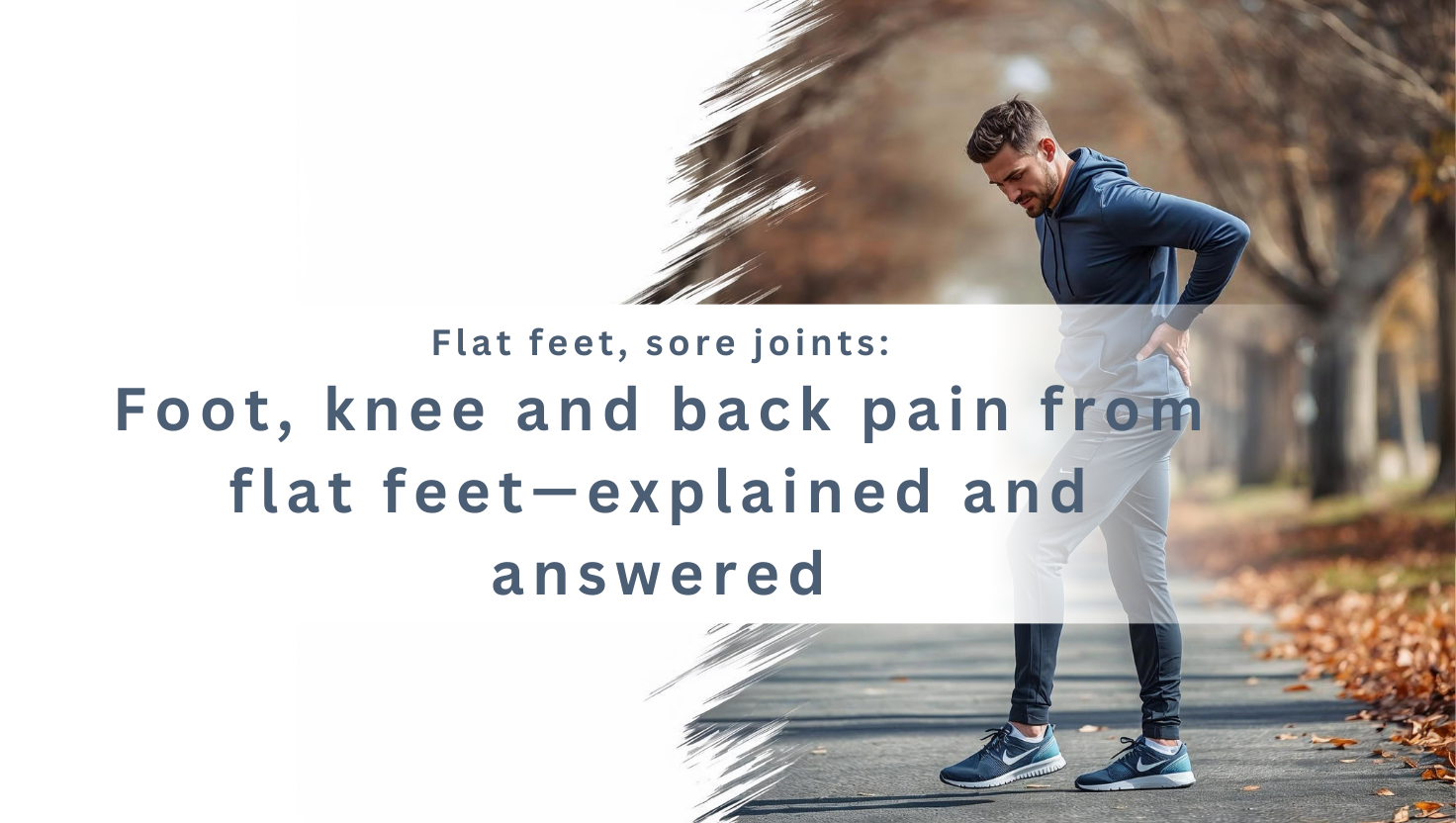
Can Flat Feet Really Cause Foot, Knee and Back Pain – And What Can You Do About It?
Many people live with flat feet for years without thinking much about them. You might notice your footprints look “full” on wet sand, or that your shoes always wear down more on the inside edge – but if nothing hurts, it’s easy to put it down as “just how I’m built”.
Things often change when life gets busier or more demanding. Long days on hard floors, a new job, a return to running, or simply getting older can turn what used to be a background quirk into a source of aching feet, sore knees and a tired lower back.
We recently heard from Christopher, whose story will sound familiar to a lot of people.
A Question from Christopher
“I’ve always had flat feet but never had them checked or diagnosed. Growing up they never really caused me any bother, so I just got on with things. Over the last year or so though, I’ve started getting more pain in my feet after work, aching around my knees (especially after a day on hard floors and when I go downstairs), and occasional twinges in my lower back when I’ve been on my feet for a long time.
I’m not sure if this is just getting older or if my flat feet are finally catching up with me. Do you think the foot, knee and back stuff could all be connected, and would arch support insoles actually help, or is that mostly marketing? Do I need to see someone first?”
Christopher’s question captures a lot of common worries:
- Is this just “wear and tear”?
- Are my flat feet really to blame?
- Are orthotic insoles actually useful, or just a buzzword?
- When is it important to see a professional?
Below is our answer to Christopher – and to anyone else who recognises themselves in that description.
Are Your Flat Feet Likely to Be Involved?
Short answer: quite possibly, yes – especially given the way your symptoms have developed.
Flat feet on their own do not automatically mean you will get pain. Many people have low arches for life and stay comfortable. Problems tend to show up when a few things start to line up:
- Flatter, more flexible feet that roll inwards
- Long hours on hard surfaces (concrete, tiles, factory or shop floors)
- Higher overall load on your feet and legs (ageing tissues, weight change, more time on your feet)
- Less strength or endurance in the muscles higher up the chain (hips, core)
When that happens, the way the foot collapses and rolls in can start to upset the mechanics of the whole leg. Your feet, knees and lower back can all feel the consequences.
That does not mean every bit of pain you feel is caused only by your flat feet. Joints and soft tissues can become irritated for many reasons. But in a story like yours – flat feet for years, now sore feet, aching knees and a tired back after long days on firm floors – your foot mechanics are very likely to be part of what is driving the problem.
The positive side of that is that mechanics are something we can do something about.
What’s Actually Going On in Your Feet, Knees and Back?
To answer your question properly, it helps to look at how the body is joined up from the ground upwards – often called the “kinetic chain”.
In Your Feet
With flat, more flexible feet, the arch along the inside of your foot tends to drop down more when you stand and walk. As it does:
- The plantar fascia (the strong band under the foot from heel to toes) is stretched more than usual.
- The tibialis posterior tendon (which runs behind the inner ankle and helps hold the arch up) has to work harder to stop the arch from collapsing completely.
- The heel usually tilts inwards, and the inner edge of the foot comes closer to the floor.
Over time, that can lead to:
- Aching along the arch or inner ankle after standing or walking
- Heel discomfort, particularly near where the fascia attaches
- A feeling that your feet “spread out” and shoes feel tighter by the end of the day
This fits well with the “my feet hurt after work” part of your story.
At Your Knees
Your feet sit directly under your shins. When the heel tilts in and the arch collapses:
- The shin bone follows the heel and rotates slightly inwards.
- The knee then bends in a position that is not quite straight over the foot – it tends to drift towards the other knee.
That can:
- Increase loading on the inner (medial) side of the knee
- Change the way the kneecap tracks in its groove at the front of the joint
- Make stairs and slopes feel more testing, especially going down
This is often why people with flat feet notice knee aching after a day on hard floors or when going downstairs – exactly as you describe.
Up at Your Lower Back
The chain continues upwards. As the knees come in and the legs twist slightly, the hips and pelvis are affected. Your spine then has to sit on top of a pelvis that is not quite as level or as stable as it could be.
To keep you upright on that shifting base:
- Muscles in your hips and lower back (particularly the lumbar extensor muscles) work harder to correct for the small imbalances with each step.
- Over a long day, these muscles can become tired, tight and sore, even if the spine itself has no major structural problem.
For many people, this explains the “fine in the morning, aching by evening” pattern – especially if they have flat feet, long days on firm ground, and not much variation in posture.
So yes: there is a clear, plausible link between your flat feet and the way your feet, knees and back feel at the end of the day.
Do You Need to See a Professional Before Trying Insoles?
There are a few situations where you should definitely seek medical advice promptly, before worrying about insoles:
- Sudden, severe pain in the foot, knee or back without an obvious reason
- Significant swelling, redness, warmth or visible deformity
- Numbness, weakness, or changes in bladder/bowel function
- Pain that wakes you at night or is not clearly linked to activity
If you recognise any of those, a GP, physiotherapist or podiatrist should be your first stop.
In a case like yours – long‑standing flat feet, gradually building mechanical pain with load, no dramatic red‑flag symptoms – it is still sensible to arrange an assessment. A professional can rule out other issues, such as:
- Inflammatory joint problems
- Nerve irritation
- More significant joint wear
At the same time, it is reasonable to start addressing the mechanics, especially if you are waiting for appointments or your job keeps you on your feet. Orthotic insoles are one of the key tools used to change how the foot is loaded and aligned with every step. They do not diagnose or cure conditions on their own, but they can take pressure off strained tissues while you work on other aspects like strength, posture and activity levels.
What Do Arch Support and Orthotic Insoles Actually Do?
You asked whether arch support insoles would help or whether that is “just marketing”. The honest answer is that it depends very much on what kind of support you choose.
Well‑designed orthotic insoles are not just pieces of foam. They are shaped and firm enough to alter how your foot sits and moves inside the shoe. For someone with flat feet and the kind of symptoms you describe, they usually help in four main ways.
1. Helping Your Arch Share the Work Again
When your arches drop fully onto a flat insole, most of your body weight is carried by the heel and the ball of the foot. The tissues under the arch are stretched and loaded more than they would be in a more neutral foot.
A shaped orthotic insole puts a gentle, firm support under the inner side of your midfoot. That does two important things:
- It stops the arch collapsing right down, so the plantar fascia and supporting tendons are not being pulled as far with every step.
- It allows the arch and midfoot to take some of the load, instead of leaving the heel and forefoot to do nearly all the work.
In your case, that means the soft tissues under the inner side of your foot are not being stretched as far or as often every time you move, which can ease that end‑of‑day ache.
2. Improving How Your Heel and Knee Line Up
When the arch collapses and the heel rolls in, the shin follows and the knee often bends inwards. That is one of the reasons your knees may ache after long days on hard floors.
A good orthotic insole for flat feet doesn’t just sit under the arch; it also:
- Cups the heel in a shaped heel cradle, so the heel bone is held more upright
- Provides a firm base under the heel so it doesn’t simply tip inwards on a soft surface
That small change at the heel reduces how much the shin twists and how far the knee drifts in. You may still roll in a little – and that’s normal – but it’s brought back into a range your joints and tissues tolerate better.
This is often when people start to notice their knees feel less as though they are “falling in” when they are tired.
3. Softening the Impact of Hard Floors – Without Going Spongy
If you are on your feet for long periods on concrete, tiles or other hard surfaces, every step sends a small jolt up through your feet and legs. If the natural fat pads under your heel and forefoot are not as thick as they once were, that jolt can feel quite sharp.
A well‑designed orthotic insole uses cushioning that:
- Sits directly under the heel and the ball of the foot
- Compresses and springs back in a controlled way, rather than simply flattening out
That means you get a softer landing without feeling as though you are sinking into a sponge. For someone with flat feet and long days on hard floors, this can make a noticeable difference to both heel/forefoot comfort and how fatigued your legs and back feel.
4. Making Your Support More Consistent Across the Day
If you move between several pairs of shoes – work shoes, trainers, casual shoes – the built‑in support can vary hugely. One pair might be mildly supportive; the next may be completely flat. Sore tissues then have to keep adjusting to a different set‑up every time you change shoes.
By fitting similar orthotic insoles into the shoes you use most, you give your feet a more predictable, supportive surface across the day. The shape under the arch, the way the heel is held, and the level of cushioning under key pressure points stay much more consistent. That consistency is often what allows irritated tissues to calm down over time.
Why Any Old Insole Won’t Do – What to Look For Instead
There is a big difference between:
- A thin, flat foam or gel insert that simply makes a shoe feel a bit softer, and
- An orthotic insole that is shaped and firm enough to change how your foot is loaded and aligned.
For the kind of story you have told – flat feet, inner ankle and knee ache, tired back – soft padding alone is unlikely to be enough.
For feet like yours that roll inwards, the key design features to look for are:
- Firmer support along the inner arch
You should be able to feel a gentle “hump” along the inside of the insole when you press with your fingers. It shouldn’t be rock‑hard, but it should have enough firmness that it doesn’t flatten easily. - A deeper, stabilising heel cup
The heel area should look and feel like a shallow cup rather than a flat pad. This helps keep the heel more central and reduces the tendency to tip in. - A full‑length insole
For flat feet, insoles that run from heel to toe tend to work better than small pads, because they support the entire foot and allow a smoother roll through each step. - Cushioning added on top of that structure
Cushioning should sit on a supportive base, not replace it. That way you get both shock absorption and controlled movement.
In our orthotic insoles range, the products designed for low or flexible arches include these features. When you read the descriptions, look for phrases such as “firm medial arch support”, “deep heel cup” and “full‑length support” – these are the combinations most often chosen by clinicians for flatter, inward‑rolling feet.
A very soft insert that squashes flat in your hand may feel pleasant when you first put it in, but it is unlikely to change the way your arch collapses or how your heel tilts. For the problems you describe, support and stability matter at least as much as cushioning.
How to Choose a Pair from Our Range if Your Story Sounds Like Christopher’s
If you decide to try orthotic insoles alongside seeking advice, it helps to make the choice as practical as possible. You can use three simple questions as a checklist.
1. Which Shoes Do You Spend the Most Time In?
Start with the footwear you wear for the longest hours:
- Work shoes with removable insoles
- Everyday trainers or casual shoes you walk in regularly
These are usually the best place to fit your first pair of orthotic insoles. Later, you can look at slimmer options for closer‑fitting or more formal shoes if needed.
2. How Do Your Feet Behave, and Where Do You Hurt?
From what you describe:
- Your feet are likely flatter and more flexible, with the inner border close to the floor and the ankles leaning in.
- Your pain is in:
- The feet (after work)
- The knees (especially after time on hard floors or going downstairs)
- The lower back (after long periods on your feet)
For feet and symptoms like that, you are generally looking for:
- Firmer support along the inner arch
- A deep, stabilising heel cup
- A full‑length, supportive insole
- Moderate, controlled cushioning under the heel and forefoot
When you browse our range, focus on insoles described as suitable for low or flexible arches, with those structural features highlighted.
3. How Should You Start Wearing Them?
Your feet and legs will need a little time to adapt to a different pattern of support. A simple approach is:
- Days 1–2: Wear the insoles for 1–2 hours at a time in your main shoes.
- Days 3–5: Increase to half a day if comfortable.
- Day 6 onwards: Build towards full‑day wear if the initial adjustment has settled.
Mild aching or a “new pressure” feeling at the start can be normal as tissues get used to being supported differently. Sharp pain, worsening symptoms or discomfort that does not start to ease after the first week is a sign to ease off and seek advice.
Quick Questions We Often Hear About Flat Feet and Insoles
Do all flat feet need insoles?
No. Many people with low arches have no pain and function perfectly well without support. Insoles are most relevant when there is a clear link between foot posture, load (for example, long days on hard floors), and symptoms like yours.
Do I need custom orthotics, or can I start with over‑the‑counter ones?
Custom orthotics can be very helpful in complex or stubborn cases. For many people with familiar patterns such as flat feet, inner ankle ache and knee discomfort, well‑designed off‑the‑shelf orthotic insoles are a sensible first step. If symptoms are severe, not improving, or you have other medical conditions, a clinician can advise whether custom devices are needed.
If my GP said it’s “wear and tear”, is there any point looking at insoles?
“Wear and tear” often includes mechanical overload – joints and tissues being asked to cope with more stress than they are comfortable with. Changing how your feet load and align your legs is one way of reducing that stress. It won’t reverse arthritis or undo damage, but it can make everyday movements easier to tolerate.
Final Thoughts – A Message Back to Christopher (and to You)
Christopher, your story is one we hear often. Flat feet that were once just an observation on a school report are now linked with:
- Feet that ache after work
- Knees that complain after time on hard floors and stairs
- A lower back that feels increasingly tired by the end of the day
The way your feet load and move is very likely playing a significant role in that picture.
You do not have to simply accept this as an inevitable part of getting older. There are two main strands to tackling it:
- Understand and, where appropriate, change the mechanics – using orthotic insoles that properly support the arch, stabilise the heel and spread load more evenly through the foot.
- Work with a professional to rule out other issues and, if needed, address strength, flexibility and activity patterns higher up the chain.
At NuovaHealth, our orthotic insoles range has been developed with input from podiatrists and physiotherapists who see this kind of foot–knee–back link every day. The pairs designed for flatter, more inward‑rolling feet use firmer support along the inner arch, deeper heel cups and full‑length structures for precisely the reasons we have discussed here.
If your story sounds like Christopher’s, use the guidance in this article to:
- Pick a pair from our orthotic insoles range that matches your arches, your main symptoms and the shoes you rely on most
- Build up wear gradually, paying attention to how your feet, knees and back feel
- Speak to a GP, physiotherapist or podiatrist if pain is severe, changing, or not improving – and feel free to bring this information with you to that conversation
Flat feet do not have to mean giving up on comfortable movement. Understanding how your feet are working – and giving them the right support – can make a real difference to how you feel at the end of the day.