No products in the cart.
Why does my elbow hurt?
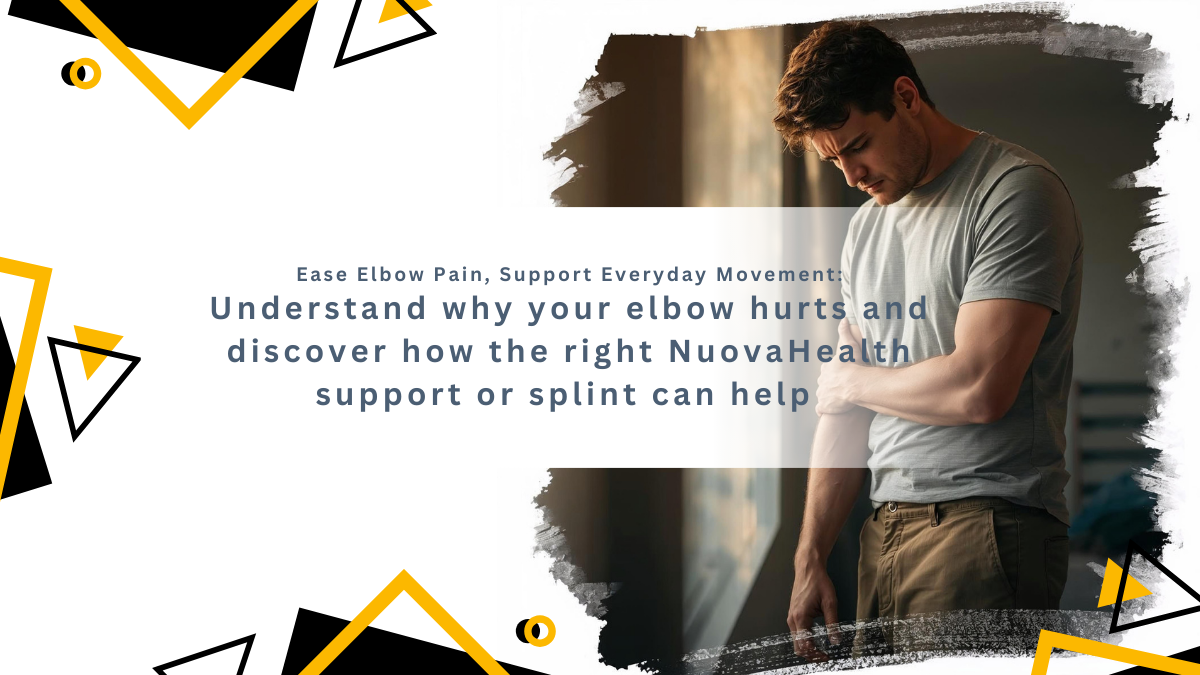
Elbow pain often shows up in the small movements you normally do without thinking. Lifting and carrying things. Turning a stiff handle. Using tools. Pushing yourself up from a chair. Reaching out to pick something up. These simple actions can suddenly leave your elbow feeling sore, tight or strangely unsteady.
It may not just be pain. Your elbow can feel stiff and awkward, especially first thing in the morning or after you have been still for a while. You might notice weakness when you try to grip, twist or carry something a bit heavier. Many people describe a sense of vulnerability, as if one sudden move might bring the pain back sharply.
How your elbow feels can change through the day. Some people notice a sharp jab when they first lift or twist something, which then fades into a dull ache. Others feel reasonably comfortable in the morning but develop a deep, tired ache after a day of gripping, lifting or leaning on the arm. After rest, the first few bends and straightens can feel stiff and awkward before the elbow loosens up again.
A “wobbly” or untrustworthy feeling is also common. If the ligaments and joint capsule around the elbow have been stretched or irritated in the past – for example after a sprain or dislocation – the joint can become a little looser. The muscles around it may hesitate to work hard, and your nervous system can interpret this as a lack of stability.
You may already have been told you have tennis elbow, golfer’s elbow, arthritis‑type changes, hyperextension, or an old elbow injury. Or you may simply have noticed that the more you use your arm, the more your elbow complains. When the same movements keep irritating the same tissues without enough recovery, they can stay sensitive for months rather than weeks.
This Q&A is designed to help you make sense of those symptoms. You will see how common types of elbow pain behave, how the joint structures are involved, and how two key NuovaHealth supports – an adjustable elbow brace and a firmer elbow splint – can help in different situations.
This information is general guidance and does not replace individual medical advice. If you have any doubts about your symptoms, it is worth speaking to a clinician such as a GP or physiotherapist.
What will I get from reading this?
As you read, you will:
- See which type of elbow pain sounds most like yours.
- Get a plain‑English picture of what is likely being irritated when your elbow hurts.
- Understand how elbow supports can help and where their limits are.
- See when the NuovaHealth adjustable elbow brace is the better choice, and when the firmer elbow splint makes more sense.
- Learn how to use these supports sensibly, what sort of improvements are realistic, and when to seek extra help.
How does the elbow work and why is it easily irritated?
Your elbow mainly lets you:
- Bend and straighten your arm.
- Turn your forearm so your palm faces up or down.
For this to happen smoothly, several structures have to work together:
- Joint surfaces – the ends of the arm bones where they meet at the elbow. These are covered with smooth cartilage and surrounded by joint fluid so they can slide over each other with very little friction.
- Ligaments – sturdy bands of tissue on the inner and outer sides of the elbow and around the joint. They act like natural straps, limiting sideways and twisting movements that would otherwise strain the joint.
- Tendons and muscles – muscles in your upper arm and forearm attach to the bones through tendons. Together they bend and straighten the elbow, turn the forearm, move the wrist and give you gripping power. Many of these tendons narrow and attach to the small bony bumps on the inner and outer sides of the elbow.
- Joint capsule and surrounding soft tissues – a sleeve of tissue around the joint that helps hold the joint surfaces in place, supports the joint and sends information back to the nervous system about joint position.
Everyday tasks like turning a key, using a screwdriver or twisting a jar lid rely on one forearm bone rolling around the other. The muscles that do this start near the elbow and their tendons attach around those small bony bumps. These are common sore spots when tendons are irritated.
When all of these structures are healthy, each one takes a fair share of the work when you grip, lift or lean on your arm. The cartilage surfaces slide easily. Ligaments hold the joint steady. Tendons cope with repeated pulling as you use your hands.
Here, “load” simply means the amount of force and tension a tissue handles when you use the arm – lifting, gripping, leaning or twisting. “Overload” happens when those forces are too strong, too frequent, or follow each other too closely without enough recovery, so the tissue becomes irritated and more sensitive.
In many people, the problems most often involve one or more of the following:
- Tendon attachments at the inner or outer bony bumps being irritated by repeated pulling.
- Joint surfaces and the capsule becoming sore and stiff over time.
- Ligaments stretched by past injury, leaving the joint a bit looser.
- Repeatedly locking the elbow fully straight or slightly beyond straight, especially under load.
Once you understand which of these structures is likely involved in your elbow pain, it becomes easier to make sense of your symptoms and see where a support might fit in.
What are the main types of elbow pain, and which sounds most like yours?
Elbow pain is not one single problem. The descriptions below outline types of pain people often report. Your own experience may not match one label perfectly; it is very common to have a mix, especially if this has been going on for a while. The aim is to notice which description sounds closest to your own elbow.
Tennis elbow – outer elbow pain when you grip or lift
Tennis elbow (lateral epicondylitis) typically causes pain and tenderness on the outer bony point of your elbow. You may feel a sharp or sometimes burning pain when you grip, twist or lift things with your palm facing down, especially if your wrist is slightly bent back. A nagging ache on the outer elbow is common after activities that use your hand and wrist repeatedly.
Everyday triggers often include lifting and carrying objects with the palm down, pouring from a heavy container, using tools, gardening, DIY tasks or racquet sports. Even a firm handshake or turning a key can be painful. Pain is often particularly sharp when you first lift or twist, then settles into a background ache that builds through a busy day.
The muscles along the top (outer side) of your forearm help keep your wrist slightly back and steady while you grip and lift. Their tendons narrow and attach to the outer bony bump at the elbow. Each time you grip or pour with the wrist slightly extended, those tendons pull firmly on a small area of bone. If you do this repeatedly without enough recovery, the tendon where it joins the bone can become irritated and slow to calm. That is why gripping, twisting and pouring can hurt even when you are not lifting something especially heavy.
Golfer’s elbow – inner elbow pain when you lift palm‑up or pull
Golfer’s elbow (medial epicondylitis) is similar in principle to tennis elbow but affects the inner side of the elbow. Typical features include pain or tenderness at the inner bony bump and a deep ache or pulling feeling there, especially when you grip strongly with your palm facing up. Sharp pain is common when you bend your wrist against resistance or lift heavier objects in a palm‑up position.
It often shows up in activities involving repeated gripping, pulling or wrist bending, such as some racquet sports, weight training (especially curls or pulling exercises), manual work with lifting and carrying, or any task where you lift with your palm facing up.
On this side of the arm, a different group of forearm muscles bends the wrist and fingers and helps with palm‑up lifting and pulling. Their tendons merge and attach to the inner bony bump. Repeated hard work with little recovery can leave this tendon attachment irritated and sensitive.
Elbow hyperextension – sharp jab at the back when you lock it straight
Hyperextension generally means your elbow straightens a little past the point most people would call “straight”. Some people naturally have this extra movement; others develop a habit of locking the elbow completely straight or slightly beyond straight when they lean or push through the arm.
You may notice:
- A sharp twinge or jarring pain at the back of the elbow when you fully straighten the arm.
- Discomfort when you push or lean on the arm with the elbow locked straight.
- A bruised or achy feeling at the back of the joint after weight‑bearing or pressing movements.
When you fully straighten the elbow, the back of the joint surfaces come into firm contact and the thin joint capsule at the back is pulled tight. In some people, the joint naturally goes slightly past straight, which increases this squeeze and stretch. If you regularly lock the elbow in this position – for example, leaning on a desk, pushing up from a chair, or repeatedly doing press‑up‑style exercises – the capsule, bone and surrounding soft tissue at the back can become irritated. That is why you get that sudden jab right at the moment the elbow locks straight.
Elbow instability – a “might give way” or wobbly feeling
After a sprain, dislocation or other injury (once checked by a clinician), the elbow can be left feeling less steady than before. You may feel:
- A sideways wobble or looseness when you put weight through the arm or push open a heavy door.
- A sense that the elbow might “give way” when you push up from a low seat, carry something at arm’s length or catch a load with the arm partly bent.
- Mild pain, tightness or tiredness around the joint after heavier use.
A significant injury can stretch or partially tear the ligaments and capsule that normally keep the elbow snug and steady. Even after pain settles, these tissues may not provide the same firm restraint. The nerves in and around the joint that tell your brain where the joint is can also be less reliable. Together, this can leave the joint a bit looser and your awareness of its position less precise. The result is both real and perceived instability.
Arthritis‑type stiffness – a stiff, achy elbow that needs warming up
Many people notice that one or both elbows feel stiff, particularly in the morning or after being still for a while. The joint may need several bends and straightens before it moves more easily. A deep ache often appears after heavier use or towards the end of the day, and you may find it harder to fully bend or straighten.
Over time, or after previous injury, the smooth joint lining can thin and small extra bony edges can form. The capsule around the joint can thicken and lose some stretch. Low‑grade inflammation can cause extra joint fluid to collect. Together, these changes mean the joint surfaces do not glide as freely and the capsule resists movement. After rest, fluid and stiffness build up, so the first few movements feel tight and restricted. Once you have moved for a while, stiffness often eases, but if you then do a lot of heavier activity the joint can become more inflamed and achy later in the day. The elbow may feel swollen or full.
Mixed or general elbow pain – a mix of aching, twinges and stiffness
It is also common to have a mixture of the types above rather than fitting neatly into one box. You might have general aching around the joint, occasional sharp twinges in specific positions, stiffness after rest and a sense of vulnerability or mild wobble in some movements.
When things are mixed like this, several structures may be involved at the same time – for example, a mildly irritated tendon, a somewhat stiff capsule, and slightly lax ligaments from an old injury. Symptoms overlap and shift depending on what you ask your elbow to do that day.
How can elbow supports help, and what are their limits?
If your pain matches one or more of the types above, the next question is whether an elbow support can actually make a useful difference.
Supports such as the NuovaHealth adjustable brace and elbow splint can:
- Provide gentle warmth, which tends to reduce stiffness and make the first movements after rest feel easier.
- Add even compression around the joint, helping to support the capsule and soft tissues and manage mild swelling that builds with use.
- Change how forces are shared through tendons and ligaments, so that repeated pulling is spread along more of the forearm rather than focused on one sore point.
- Guide the joint away from positions that repeatedly set symptoms off, such as deep bending during sleep or locking fully straight when you lean through the arm.
- Give clearer feedback about where the joint is in space, helping the muscles around it to support and control it more reliably.
There are clear limits. No support can repair torn tissues or regrow thin cartilage. It cannot reverse longer‑term joint changes. It does not replace strengthening exercises, stretching or sensible planning of your activities. It cannot fully cancel out very high loads, poor technique or constant repetition if those aspects are not addressed.
Broadly:
- The NuovaHealth adjustable elbow brace gives support while you move and use the arm.
- The NuovaHealth elbow splint gives steadier positioning when you are resting or sleeping.
The sections below look at each in turn.
NuovaHealth adjustable elbow brace – support while you move
The NuovaHealth adjustable elbow brace is designed to move with you. It suits most people whose main problem is pain, stiffness or a bit of wobble during everyday tasks, and who still need to bend and straighten the elbow through a useful range.
How is the adjustable elbow brace designed?
Key features include:
- Perforated neoprene‑blend sleeve – holds gentle warmth around the joint, which helps stiff tissues feel more elastic and can make the first movements after rest feel easier. The perforations allow heat and moisture to escape, so you are less likely to feel overheated if you wear it for several hours.
- Even compression around the elbow joint – firm but comfortable compression around the joint capsule and surrounding muscles supports the soft tissues and can help manage mild swelling that builds with use or prolonged stillness. This can make bending, straightening and reaching feel more controlled and less full or “puffy”, especially towards the end of the day.
- Targeted support zones above and below the elbow – slightly firmer zones positioned over the soft tissues just beyond the inner and outer bony bumps where key forearm tendons attach. These zones support the tendon and muscle tissue either side of those attachment points and create broader anchor regions, so pulling forces during gripping and lifting are shared along a longer length of the forearm instead of concentrating on one pinpoint area.
- Flexible side stays – along the inner and outer sides of the brace, aligned with the elbow joint. They gently resist inward and outward bending and make it harder for the elbow to lock fully straight or slightly beyond straight when you push or lean through the arm. They are flexible rather than rigid, to guide movement rather than splint the joint solid.
- Two adjustable straps – hook‑and‑loop straps, one above and one below the elbow, so you can fine‑tune how firmly the brace hugs the upper and lower forearm. You can tighten them slightly for tasks that ask more of your elbow, and ease them back for lighter activities.
- Internal non‑slip bands and shaped cuffs – to help the brace stay in place as you move and reduce rubbing or digging into the skin.
These details are chosen to give you warmth, compression, shared load and guided movement, without turning your arm into a rigid splint.
When does the adjustable brace make most sense?
The adjustable brace is usually the better option if your pain mainly appears during movement and daily tasks, such as:
- Outer elbow pain with gripping or lifting – tennis elbow‑type symptoms when you pour, carry with the palm down, use tools or shake hands. The outer support zone helps share load along the outer forearm so those tasks feel less sharp.
- Inner elbow pain with palm‑up lifting or pulling – golfer’s elbow‑type symptoms with curls, pulling exercises or palm‑up lifts. The inner support zone plays a similar role on the inner forearm.
- Sharp pain at the back when you lock the elbow straight – hyperextension‑type pain when you lean or push on a straight elbow. The flexible side stays make it harder to snap fully straight or beyond, reducing that jarring at the back of the joint.
- A wobbly or “might give way” feeling – after previous sprain or dislocation. The side stays and snug fit guide the joint in a straighter line when you push, catch or carry, which can reduce sideways wobble and help the muscles around the elbow work with more confidence.
- Stiff, achy elbows from arthritis‑type changes – where warmth and gentle compression make the first movements after rest easier and support the joint through everyday use.
- Mixed daytime symptoms – some aching, some sharp twinges, some stiffness, mainly while using the arm.
If that describes your elbow, this style of adjustable brace is often a sensible place to start.
How should I fit and wear the adjustable brace?
When fitted correctly, the centre of the brace should sit directly over your elbow joint. The side stays should run along the inner and outer sides of the elbow, and the firmer support zones should lie over the soft tissues just beyond the inner and outer bony bumps.
The sleeve should feel snug but not painful. You should be able to bend and straighten your elbow without the brace cutting in, creasing sharply or severely restricting normal movements. Your hand and forearm should not feel numb, tingly, cold or discoloured. If they do, the brace is likely too tight or incorrectly positioned and should be loosened or refitted.
With the straps, it usually works best to start with them lightly secured, then gradually increase the tension until the joint feels supported but you can still slide a finger under each strap. For tasks that ask more of your elbow – such as carrying heavier items, doing press‑up‑style exercises, or pushing up from a low seat – you might tighten them slightly to add extra support, then ease them back afterwards.
How long you wear the brace depends on your symptoms and your day. Many people:
- Put it on for activities that usually provoke pain, such as particular work tasks, housework, DIY jobs, gardening or exercise.
- Wear it for the first few hours of the day if they wake with morning stiffness and find that warmth and support help movement feel smoother.
- Prioritise wearing it later in the day if their elbow tends to swell or ache after a period of heavier use.
As symptoms settle and strength improves, many people reduce wear time for lighter activities and keep the brace mainly for heavier or more unpredictable tasks.
To look after the brace, follow the specific care instructions provided. In general, hand‑wash in cool or lukewarm water with a mild detergent, rinse thoroughly and allow it to air‑dry flat. Avoid very hot water, tumble drying or placing it on radiators, as heat can damage neoprene and elastic fibres. Make sure the brace is completely dry before wearing it again.
What improvements can I realistically expect with the adjustable brace?
An elbow brace of this kind can make a real difference, but it is important to have realistic expectations.
Early on, often within days to a couple of weeks, you may notice:
- More comfort and confidence during tasks that usually trigger your elbow – lifting, carrying, twisting lids, pushing up from a seat or using tools. Movements that once caused a sharp jab may feel more like a manageable pull.
- Less end‑of‑day aching or feeling of fullness around the joint, as the tissues and joint capsule are more evenly supported.
- That rehabilitation exercises recommended by a clinician feel more manageable, because the elbow and tendons feel less exposed while they are loaded.
Over weeks to months, with sensible use of the brace, gradual strengthening and stretching where appropriate, and spacing out heavier or repetitive tasks, many people find that the tendon or joint copes better with everyday loads. Flare‑ups tend to become less frequent or less intense, and brace use can often be reduced for lighter tasks, kept mainly for heavier or more demanding activities.
The brace will not cure the underlying problem overnight. Tendons, ligaments and joint surfaces adapt slowly. The brace will not, on its own, correct poor technique, very heavy loading or very frequent repetition without rest. Used alongside exercises and planning your more demanding activities, it does not do the work for your elbow, but it often makes that work more tolerable while you rebuild what the joint can cope with.
NuovaHealth elbow splint – steadier positioning at rest
The NuovaHealth elbow splint is designed for steadier, more controlled support when you are resting, rather than for moving around. It is firmer than the adjustable brace and is usually chosen when the problem is made worse by deep bending or direct pressure on the elbow, particularly at night or during long periods of sitting or lying.
Typical situations include:
- Night‑time or prolonged‑sitting pain from repeatedly sleeping or resting with the elbow bent.
- Ulnar nerve irritation at the inner elbow (often called Cubital Tunnel‑type symptoms), where deep bending compresses and stretches the nerve and sets off tingling or pain into the forearm and hand.
- Outer forearm nerve pain (Radial Tunnel‑type symptoms) that is aggravated by certain bend and twist positions.
- Tenderness over the point of the elbow, such as olecranon bursitis, where pressure on the tip of the elbow is particularly sore.
- Some ligament sprains, longer‑term stiffness and certain fracture‑recovery phases, when a clinician has advised limiting bending for set periods.
How is the elbow splint designed?
Key features include:
- Shaped wrap forming a stable tube – encloses the upper arm, elbow and forearm to help keep the joint aligned and spread pressure away from the point of the elbow. This can be especially important if that tip area is tender or swollen.
- Two fixed aluminium rails – running along each side of the joint to block unwanted bending and over‑straightening. These side rails stop the deep bend and “too far straight” positions that can set off sprains, hyperextension‑type injuries and nerve irritation.
- Adjustable straps at upper arm and forearm – hook‑and‑loop straps so you can secure the splint and fine‑tune how firmly it hugs the arm, balancing support, overall contact and comfort.
- Soft, padded, breathable lining – sits against the skin, with a more robust outer material. This combination aims to reduce rubbing, heat build‑up and itching, making it easier to wear the splint for the full time you are resting or sleeping.
This design is deliberately firmer than the adjustable brace. It is intended to hold the joint close to straight, rather than just guiding it, so tissues that are irritated by bending or direct pressure get a break while you are not actively using the arm.
When does the elbow splint make most sense?
The elbow splint is usually the better option if:
- Your symptoms are worst when the elbow has been bent for a long time, such as waking in the night with tingling in the ring and little fingers or inner‑elbow pain.
- You tend to sleep with your elbow tucked under you or tightly bent, and this reliably flares your symptoms.
- Direct pressure on the point of the elbow is a major problem, for example when leaning on a desk or arm of a chair.
- A clinician has advised you to limit elbow bending for set periods after an injury or operation.
In these situations, holding the elbow close to straight for blocks of time – particularly overnight – often helps irritated nerves, the bursa over the point of the elbow, or healing ligaments and joint surfaces to settle.
How should I fit and wear the elbow splint?
When fitting the elbow splint, the elbow should sit comfortably in the central bend of the splint, with the aluminium rails running along the inner and outer sides of the joint. The wrap should form a snug tube around your upper arm, elbow and forearm, and the straps at the upper arm and forearm should hold it in place without cutting in.
The splint is designed to hold the elbow close to straight, but not forced painfully straight. You should feel supported in a near‑straight position, without a strong urge to bend out of discomfort. Your hand and fingers should remain warm, with normal colour and no numbness or tingling. If you notice changes in colour, coldness, pins and needles or pain from pressure points, loosen or remove the splint and seek advice.
The splint is most often worn:
- Overnight, to stop the elbow dropping into a tightly bent position while you sleep.
- During longer spells of sitting or lying down, if you tend to rest with the elbow deeply bent or propped directly on the tip of the joint.
It is usually removed for driving, manual tasks and exercise, so that the elbow and arm still move and the muscles keep working. A clinician can advise you on how many hours per day are appropriate in your situation.
What improvements can I realistically expect with the elbow splint?
With a splint used for rest and night‑time:
- In the first few nights, many people notice they wake less often with tingling or sharp inner‑elbow pain, and that the inner side of the elbow or the point of the elbow feels less sore in the morning.
- Over several weeks, if the splint is used as advised and other factors (such as overall activity, posture and nerve irritants) are addressed, irritated nerves or bursa often settle further. Night‑time symptoms and pain after long resting positions usually reduce.
The splint is not meant to be worn all day without clinical advice. Overusing a rigid support can, over time, contribute to stiffness and weakness if movement and muscle activity are reduced too much. It is also not designed to prevent or treat blood clots. If you have circulation problems, a history of clotting problems, sudden severe symptoms, or you are unsure how long to wear a rigid splint, seek advice from a GP, physiotherapist or another appropriate clinician before using it.
Can I use the adjustable brace and elbow splint together?
Some people will only need one of these supports. Others, especially where there is both daytime pain with use and night‑time problems with bent positions or pressure, may use:
- The adjustable brace during the day for more comfortable movement and everyday tasks.
- The elbow splint at night or for longer rest periods, to control bending and pressure while they are not actively moving the arm.
That decision is best made with a clinician who knows your elbow. They can help balance your need for support at rest against the need to keep the joint and muscles moving, and advise how long and how often to use each support.
When should I stop using a support and speak to a clinician?
Most elbow pain can be managed with a mix of self‑care, activity changes, simple supports and, where appropriate, exercises. However, there are times when it is important not to rely on a brace or splint alone.
Stop using the support and speak to a GP, physiotherapist or another appropriate clinician if:
- Your elbow pain began after a significant fall, impact or sudden injury, especially if there was immediate severe pain.
- You notice obvious deformity, a marked loss of movement, or you cannot use the arm for basic tasks such as lifting a cup or getting dressed.
- Pain, swelling or weakness is getting worse despite rest and simple self‑care.
- You develop new or unexplained swelling, or the elbow or hand becomes unusually hot, cold, pale, very red or discoloured.
- You notice spreading numbness or weakness in the hand or arm.
- You feel generally unwell, or have other new unexplained symptoms that do not settle.
- The brace or splint causes significant skin irritation, numbness, tingling or colour change in the hand or forearm, even when fitted as directed.
If any of these occur, remove the support and seek advice promptly. A clinician can assess your elbow, rule out more serious problems where necessary, and help you integrate the NuovaHealth adjustable elbow brace or elbow splint into a recovery plan if they are appropriate for you.
Which elbow support is worth considering for me?
Elbow pain, stiffness and a sense of vulnerability can quietly shape far more of your day than you might expect, making you second‑guess each lift, twist and push. If your symptoms match one or more of the types described here, it is reasonable to look for support that makes using your arm feel safer and more predictable.
As a broad guide:
- The NuovaHealth adjustable elbow brace is usually the better option if your pain mainly appears during movement and daily tasks – gripping, lifting, twisting, pushing, leaning – and you want warmth, compression and guided support while you stay active.
- The NuovaHealth elbow splint is usually the better option if your symptoms are worse when the elbow has been bent or pressed on for long periods – especially at night or when sitting or lying – and you need the joint held close to straight for set periods to let irritated structures settle.
For many people, especially where there is both daytime use and night‑time bending or pressure, these supports are used together: the adjustable brace for activity in the day, and the splint for steadier positioning at rest. If you are unsure which combination fits you best, or whether either support is appropriate, discuss it with a GP, physiotherapist or another clinician who can give you personalised advice.
Medical disclaimer
The information on this page is general guidance only and is not a substitute for individual medical advice, diagnosis or treatment. It does not take the place of an assessment by a GP, physiotherapist or another appropriate clinician, and no specific outcome or improvement can be guaranteed. Products mentioned here are intended for adult use. If you have any concerns about your symptoms, or about using an elbow brace or splint, please speak to a GP, physiotherapist or another qualified healthcare professional in the UK.