Can a posture support really help my back or neck pain?
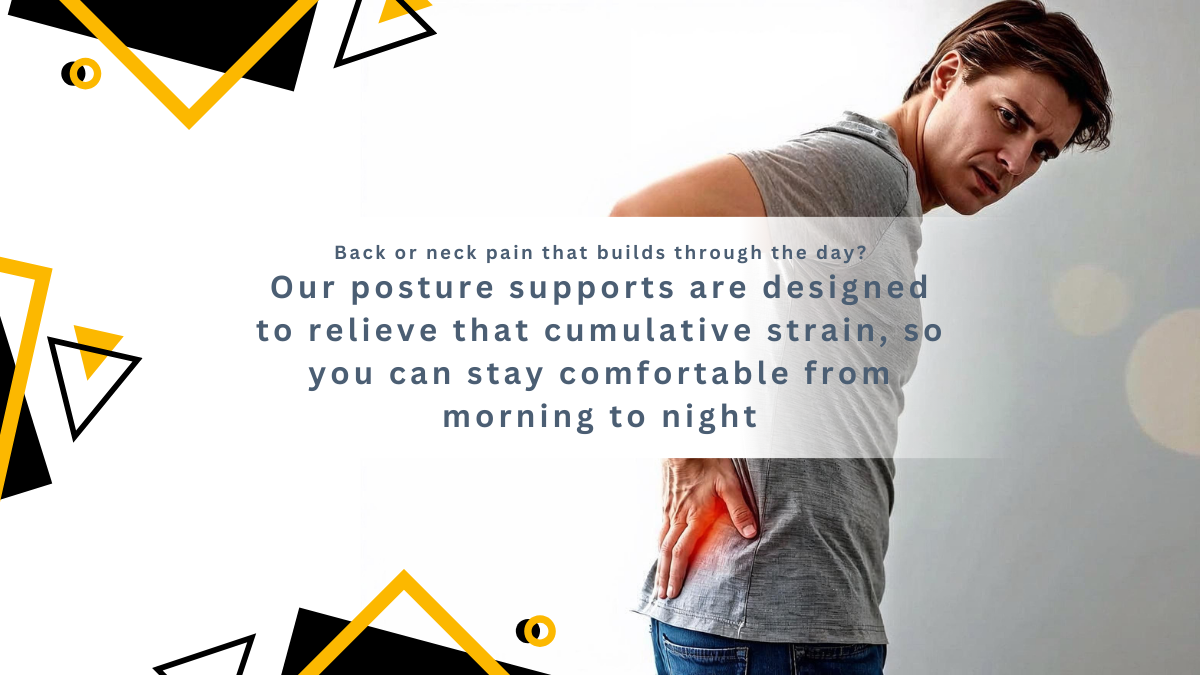
If you’ve ever stood up from a chair and felt a deep ache creep into your lower back, or sat through a long afternoon with a burning band between your shoulder blades, you’ve probably asked yourself: can a posture support really help? For many people, the answer is a qualified yes – but not as a quick fix, and not on its own.
Our posture supports are designed for exactly those situations – when your back or neck pain clearly changes with posture. The range includes upper-back supports, lower-back belts, full-length braces and chair-mounted lower-back cushions. Each one gently guides your spine away from slouching or arching too much, supports your back’s natural curves, and takes some of the strain off muscles and joints that are already working hard. With adjustable straps, contoured shaping and breathable fabrics that sit discreetly under your usual clothes, they’re made to be worn during the parts of your day that usually bring on symptoms. Used alongside simple movement and strengthening exercises, many people find these supports help them sit, stand and walk for longer with less discomfort, while they work on longer-term change.
Can a posture support really help my back or neck pain?
Often, there’s no single dramatic injury behind this kind of pain. It creeps in gradually – over months or years of long spells sitting, standing, or looking down at screens. You might start to wonder whether it’s just ‘your posture’ – and whether a support can genuinely make a difference.
Posture isn’t a fixed shape you can force yourself into and hold. It’s a moving habit, controlled by your brain and nervous system and supported by your muscles. Over time, your muscles and the tissues around them adapt to the positions and loads they meet most often, so certain slouches or arches start to feel normal. No device can permanently ‘fix’ posture on its own.
Even so, a well-designed posture support can still make a real difference. Used in the right way, it can:
- Guide your spine and shoulders away from positions that put the most strain on joints, discs and muscles.
- Cut down the time you spend in slouched or over-arched positions that irritated tissues find hard to tolerate.
- Provide gentle external support, giving tired muscles and achy joints a welcome break.
- Give you clear, gentle feedback – a mild pull or pressure – when you drift back into the postures that usually set your symptoms off.
For example, supporting the natural inward curve of your lower back while sitting reduces the stretch on the back of your spinal discs and ligaments. Standing up from a chair then feels less like a sharp ‘knife in the back’ and more like a manageable stiffness that eases as you walk.
In this guide, we’ll cover:
- How everyday posture and positions can drive back and neck pain.
- Which types of supports in our range are likely to suit you.
- How to recognise the type of pain you have.
- How to match that picture to the right type of support from our range.
- How to fit and use these supports safely, alongside movement and rehabilitation.
Our posture supports aren’t a cure for every cause of back and neck pain, and they won’t permanently change your posture on their own. But if your pain clearly shifts with position and time spent in certain postures, they can make it easier to sit, stand and move for longer with less discomfort, so you can focus on building strength, mobility and lasting change.
Which posture supports in our range are likely to suit you?
Our posture support range is for people whose back or neck pain tends to build through daily sitting, standing, walking and desk work, rather than appearing after a single injury. If that sounds like you, the right support depends mainly on where your symptoms are worst and when they flare up.
The main designs are:
- Upper-back posture supports – These gently influence how your shoulders and upper back sit. They help reduce rounded shoulders and the tendency for your head to drift forwards. People often find them useful for burning or tightness between the shoulder blades, upper-back fatigue, or neck-related headaches that get worse when slouching.
- Lower-back support belts – These wrap around the lower back and abdomen. They support the natural curve in the small of your back, give your core muscles a firmer surface to work against, and can make prolonged standing, walking or repetitive tasks feel less tiring on your lower back.
- Full-length posture braces – These run from the upper back down to the lower back. They gently guide the whole trunk away from slouching and excessive arching, and spread the load across a larger area of your spine. They are often a good option when discomfort spans your lower back, mid-back and neck together.
- Lower-back chair cushions – These shaped cushions sit in the small of your back when you are in a chair. They support the natural lower-back curve, reduce the tendency for your pelvis to tilt backwards, and can make long periods of sitting more comfortable, with less stiffness and ache when you stand up.
If your symptoms are clearly strongest in one area, a single-region support may be enough. If they spread across the whole back, a full-length brace might be a better fit. The right choice is the one that matches your main pattern.
Not every product includes every feature covered in this guide. For example, some supports have shaped padding, others use flexible support panels, and the strap arrangements differ between models. Different designs combine these features in different ways to suit different areas and needs.
How everyday sitting and standing can lead to back and neck pain
Back and neck pain can feel puzzling, especially when there has been no obvious injury. But in many cases, there is a clear thread: the positions you hold and the movements you repeat through the day. The way you sit, stand and move changes the forces on your joints, discs, ligaments and muscles. Over time, those forces can build into persistent discomfort.
How posture-linked pain usually behaves
Pain that is closely tied to posture tends to follow a pattern. You might notice that it:
- Builds gradually when you stay in one position, such as sitting at a desk or standing for long stretches.
- Feels more like an ache, burning, tightness or heaviness than a sharp, single point of pain.
- Eases, at least for a while, when you change position, walk around or lie down.
- Has crept up over weeks or months, not arrived after one clear injury.
This is a helpful sign because it suggests the pain is coming from the gradual effect of daily habits, rather than a single injured structure. If you recognise it in yourself, your posture is likely to be a major part of the picture.
For example, you might notice your lower back aches after a long drive, your shoulders burn during a video call, or your neck feels heavy towards the end of the day. These are all signs that sustained positions are catching up with you.
What is going on in the spine and the tissues around it?
Your spine is a column of small bones called vertebrae, stacked one on another. Between them are discs – tough, shock-absorbing cushions. At the back of each spinal bone are two small joints called facet joints, which guide movement. Strong bands of tissue called ligaments hold the column together, and layers of muscle support and move it.
In a comfortable middle ground – not slouched forward and not arched back too far:
- Your neck and lower back keep a gentle inward curve.
- Your mid-back has a gentle outward curve.
- Discs share pressure fairly evenly from front to back.
- The small facet joints at the back of the spine are neither compressed together nor pulled wide apart.
- Ligaments and the tissues around the small joints are not held at full stretch.
- Muscles work in a balanced rhythm, alternating between contraction and relaxation as you move.
Problems tend to develop when part of the spine is repeatedly pushed towards the end of its comfortable range and held there for long periods. Common examples include:
- Slouching forward so your lower-back curve flattens.
- Rounding your mid-back and letting your shoulders roll forward.
- Letting your head drift in front of your shoulders, then tilting it slightly back to keep your eyes level.
In these positions:
- The back of the discs and the ligaments at the back of the spine are held on stretch when you slouch.
- The facet joints can become more compressed when you arch strongly.
- Muscles on one side of a joint are held long and overworked, while those on the other side become short and tight.
Your joints, muscles and ligaments usually cope fine with brief visits to the ends of movement – reaching, bending, twisting. The difficulty comes when they are held there for long stretches, or taken there repeatedly throughout the day, without enough variety in between to let them recover. Over time, this can irritate discs, joints, ligaments or muscles, tighten surrounding muscles, and make your nervous system more sensitive to the repeated strain. That’s often why you feel fine at the start of the day, but the same posture becomes painful earlier and earlier.
How our posture supports change the strain on your back and neck
Our posture supports address these patterns in four main ways:
- Supporting the natural curves of your spine.
- Cutting down time spent in extreme slouching or arching.
- Sharing some of the workload with your muscles and joints.
- Making you more aware of your posture.
Supporting the spine’s natural curves
As we’ve seen, your spine copes best when its natural curves are roughly maintained. Our lower-back belts and cushions are shaped to help you stay there. Rather than being flat strips, they are shaped to fit the hollow of your lower back, giving the natural curve somewhere to rest. This encourages the pelvis to stay close to neutral – not rolling backwards into a slump, and not tilting strongly forward into an arch. With the lower back in a more comfortable position, the upper back and neck have a more stable base to work from. That’s often the difference between shifting in your seat after fifteen minutes and getting through a whole meeting before the ache builds.
Cutting down time at the extremes
Many posture-related pain patterns involve sitting near the very end of a joint’s movement range. For example, you might slump into the back of a chair, let your shoulders roll a long way forward, or hold your head so far forward that your upper neck tilts back slightly. Short visits to these positions are not a problem. The trouble starts when you stay there for many minutes or hours, or keep drifting back into them all day.
Supports are designed to:
- Make it harder to fall into those extreme positions without noticing.
- Gently encourage you back towards a more comfortable range when you start to drift.
- Still allow free movement within a normal, comfortable range – they don’t lock you rigid.
In practice, this means you don’t have to rely purely on willpower to ‘sit up straight’. Because the support makes extreme positions harder to fall into, your joints and muscles spend more time in the middle range where they cope best.
Sharing the work with your muscles and joints
When an area is sore or tired, the muscles around it are often working harder than they should. A support can change that. By wrapping around your torso, it provides a firm but comfortable surface for muscles to work against, which makes each contraction more effective. It also adds gentle external support, so some of the load that would otherwise fall on joints and discs is absorbed by the belt or brace. The result is often that one area of your back no longer feels as if it’s carrying everything on its own. You might notice, for example, that your lower back feels less exhausted after a long day standing, or that your whole back feels less heavy after time on your feet.
Improving your awareness of posture
Posture runs on autopilot for most of the day. When you’re concentrating, it’s easy to miss the slow drift: shoulders creeping forward, lower back sinking into a slump, head creeping towards the screen. Supports are designed to make these shifts more noticeable without being intrusive. As you move towards your usual pattern, tension in the straps or panels builds gradually. You feel a mild, clear pull that reminds you to ease back. Extra contact points around your torso also make it easier to notice when you twist, lean or round your back more than usual. Over time, that steady feedback helps you catch the pattern earlier and practise returning to a more comfortable position – without having to keep constant watch.
What our posture supports won’t do
It’s important to be realistic alongside the positives. A support can be a useful tool, but it’s not a magic solution.
- They won’t cure every cause of back or neck pain.
- They won’t reverse long-standing changes in bones or discs.
- They won’t permanently change your posture on their own.
- They can’t guarantee that pain will disappear.
What they can do is change how much work your joints, discs and muscles have to do during the day. When the support is well matched to your pain pattern, and you use it alongside movement, exercise and sensible changes to how long you stay in one position, it often helps you:
- Sit, stand or walk for longer before discomfort builds.
- Make everyday tasks – like standing at a work surface or working at a desk – feel more manageable, without that draining ache.
- Turn a strong, constant ache into a level of discomfort that’s much easier to live and move with.
In other words, a support can ease today’s strain while you build the strength, mobility and habits that give you lasting control over your posture and pain.
Which pattern of back or neck pain sounds most like yours?
Posture-related back and neck pain tends to follow a few familiar patterns. The signs depend on which part of your spine and supporting tissues are under the most strain. You might find that you recognise yourself in one or more of the pictures below.
Lower-back ache with sitting or standing
You might notice:
- A dull, nagging ache low across your back.
- Stiffness or a pulling sensation when you get up from a chair.
- Ache across the lower part of your back after long periods of sitting or standing.
- Symptoms that feel easier in the morning but build through the afternoon or evening, easing when you lie down or walk for a few minutes.
This often comes from prolonged slouching when you sit, or from standing with a pronounced arch in your lower back. The same joints and soft tissues are held at one extreme for long spells, which gradually irritates them.
Burning or tightness between the shoulder blades
You might notice:
- A band of burning, tightness or “knots” between your shoulder blades.
- Discomfort that builds during long spells of desk work or driving.
- Relief when you straighten up, roll your shoulders or walk briefly – but the symptoms return once you settle back into a rounded-shoulder posture.
A common cause is rounded shoulders and a more curved-forwards mid-back. The muscles between your shoulder blades are held long and working for too long, which is why they can feel hot, tired or knotted by the end of a working day.
Neck stiffness and heaviness with head-forward positions
You might notice:
- Ache or stiffness across the back of your neck.
- A heavy, harder-to-hold-up feeling in your head by evening.
- Tightness when turning to look over your shoulder.
- Headaches that seem to start in your neck or upper back.
This picture is often linked to forward-head posture during reading or screen use, especially if your upper back is also rounded. The small muscles at the base of your skull work constantly to keep your head up, which is why your head can feel much heavier later in the day.
Sharp or aching pain around the mid-back and ribs
You might notice:
- Sharp, catching pain near a shoulder blade or alongside your spine when you twist, reach or take a deep breath.
- A more constant ache around the mid-back that flares after time spent slouched or bent forwards.
- A “stuck” or stiff sensation when you try to straighten up after slouching.
This often follows prolonged rounded mid-back posture, combined with twisting or reaching from that slouched position. The already-stretched joints and soft tissues get pushed a bit further when you move, which can cause that sharp catch.
A general “heavy back” feeling after long days on your feet
You might notice:
- Your whole back – lower, mid and sometimes neck – feeling tired, heavy or over-worked by the end of the day.
- Relative ease in the morning, with fatigue building over hours of standing or walking.
- A strong urge to sit or lie down to “take the weight off” your back.
The usual reason is that the muscles of your back and stomach aren’t yet conditioned for long upright days, sometimes combined with standing in a way that adds extra strain to your back. The same muscles and joints have been quietly working for hours, which is why everything feels heavy even without a single sharp spot of pain.
Headaches triggered by neck and upper-back tension
You might notice:
- Tightness or ache at the base of your skull or back of your neck, spreading up over your head.
- Worsening after long spells sitting or working with your head forwards.
- A clear link between neck and upper-back tension and the start of a headache.
This pattern often goes with forward-head posture and sustained neck muscle activity, particularly when your upper back is also rounded. The small muscles at the base of your skull work hard for long periods, which can feed into some common headaches caused by muscle tension.
“Tech neck” from prolonged screen and device use
You might notice:
- Ache or stiffness in the back of your neck.
- Tension across the tops of your shoulders.
- A tired, heavy feeling in your upper back.
- Symptoms that are clearly worse after long spells looking at screens, reading, or using hand-held devices.
A common cause is screens set too low or too far away, devices held low in your lap, and few breaks from head-forward, rounded-shoulder positions. Over time, these sustained positions place extra strain on the muscles and joints of your neck and upper back.
Lingering stiffness after a minor strain
You might notice:
- A region of your back or neck that feels guarded or stiff for weeks after a minor strain or flare-up.
- A reluctance to move fully in the direction that previously caused pain.
- Muscles that “grab” or tighten if you move quickly.
- Stiffness that’s worse after rest and eases once you’ve moved around for a while.
This is often down to protective muscle tightening and cautious movement persisting after the original strain has largely healed. Your body is still trying to avoid a repeat, even though the underlying tissue may be ready to move more freely.
Pain that seems to move between lower back, mid-back and neck
You might notice:
- Lower-back ache after standing or walking.
- Burning between your shoulder blades with sitting.
- Neck heaviness or stiffness by evening.
This reflects the whole spine working as a chain. Strain in one area affects others, especially when your general conditioning is reduced and you spend long periods in demanding positions. The various regions share the load, and no single area copes well on its own.
If you recognise several of these patterns, the next step is to match them to the type of support in our range that is most likely to help.
How to choose the right support from our range
Different supports are designed with specific mechanical aims. Choosing the right one starts with three simple questions:
- Where is your pain or stiffness strongest?
- When does it tend to build – mostly sitting, mostly standing, or a mix?
- Is there one main trouble area, or do several regions play a part?
Mainly lower-back ache from sitting or standing
If your main problem is an ache across the lower part of your back that builds with sitting or standing, or stiffness and pulling when you get up from a chair, you’re dealing with a typical posture-linked lower-back pattern.
Lower-back support belt – for standing and walking
This tends to work well if:
- Ache builds across the lower part of your back with prolonged standing, walking, or work at a counter or work surface.
- You feel your lower-back muscles are working hard just to keep you upright.
A lower-back belt:
- Gives the muscles of your back and stomach a firmer, contoured surface to work against.
- Helps keep your lower back closer to its comfortable curve, making deep slumps or strong arches less likely.
- Shares some of the work of holding you upright, so your lower-back muscles and joints don’t have to do it all alone.
Many people find they can stand or walk for longer before their usual ache starts, and that the “end of day” heaviness feels less intense with a well-fitted belt.
Chair-mounted lower-back cushion – for sitting
Choose this when:
- Lower-back ache builds during long periods in a chair.
- You notice your pelvis rolls backwards and your lower back collapses into the chair.
A lower-back cushion:
- Fills and supports the natural hollow in the small of your back.
- Reduces backward pelvic roll and flattening of the lower-back curve.
- Makes it easier to sit in a more comfortable posture for longer, without constant effort.
If both sitting and standing are strong triggers, many people use a cushion when seated and a belt when they know they’ll be on their feet for long stretches.
Burning between the shoulder blades or “tech neck”-type symptoms
If burning, tightness or knots develop between your shoulder blades – especially during desk work or driving – and you know you tend to round your shoulders or poke your head forwards, your upper-back and shoulder-blade mechanics are likely to be a major driver.
Upper-back posture support
This suits people who:
- Develop a band of burning or tightness between their shoulder blades after time at a desk, steering wheel or work surface.
- Find that rounded shoulders and a curved-forwards upper back clearly make things worse.
- Get neck stiffness, head heaviness or tension-linked headaches with head-forward positions.
An upper-back support:
- Applies gentle tension across the front of your shoulders and upper back, so as you start to slump you feel a mild, clear pull reminding you to straighten.
- Encourages your shoulder blades to sit slightly closer to your spine and a little lower, reducing constant stretch on the mid-back muscles.
- Gives your neck a more balanced base, which reduces the effort needed from neck muscles.
Lower-back cushion as an extra helper for sitting
Supporting the lower-back curve while sitting helps your whole torso stay closer to a comfortable posture. Combining an upper-back support with a lower-back cushion often gives a more complete improvement in sitting posture than either alone for shoulder-blade burning and tech-neck symptoms.
Mainly neck ache, stiffness or tension-type headaches
If your main struggle is neck ache, heaviness and stiffness that build over the day – sometimes with headaches that start at the base of your skull – forward-head posture is usually a key piece of the picture.
Upper-back support plus lower-back cushion
Although our upper-back supports don’t wrap around the neck, they often help posture-linked neck pain indirectly by:
- Bringing your shoulders slightly back and your upper back out of its most rounded position.
- Reducing how far forwards your head tends to drift.
- Allowing your neck to sit closer to the middle of its comfortable movement range.
A lower-back cushion supports the lower-back curve when you sit, which reduces the way your whole torso slumps. That means your head doesn’t need to crane forwards as far to see screens or reading material. Many people with posture-linked neck and headache symptoms do well with this combination for desk and reading tasks.
Mid-back and rib-area pain, especially with twisting or slouching
If sharp or catching pain near a shoulder blade or alongside your spine appears when you twist, reach or take a deep breath, and a dull ache in your mid-back flares after time slouched forwards, the joints and soft tissues of your mid-back and ribcage are usually under strain.
Upper-back support for mid-back and rib pain
This tends to work well if:
- Mid-back or rib-area pain flares after slouching then twisting or reaching.
- Straightening up after slouching feels stiff or “stuck”.
An upper-back support can:
- Nudge your mid-back away from its most rounded position.
- Give you a more neutral starting point for twisting and reaching.
- Reduce the stretch on ligaments and joint capsules at the back of your spine and rib joints.
Full-length posture brace when several areas are involved
When mid-back pain coexists with lower-back or neck symptoms, a full-length brace can:
- Support both your lower and upper spine together.
- Help movement spread across more of your spine, so one sore area isn’t pushed to do all the work every time you twist or straighten.
“Heavy back” after long days on your feet
If your main complaint is that your whole back feels tired, heavy and over-worked by the end of the day – particularly with long periods of standing or walking – but there’s no single sharp point of pain, then muscle endurance and overall posture are usually the main issues.
Lower-back support belt
Choose this when:
- Your lower back and mid-back feel heavy and tired after prolonged standing or walking.
- You have a strong urge to sit or lie down to ease the load.
A lower-back belt:
- Wraps around your lower back and abdomen with a contoured shape.
- Gives the muscles that keep you upright a firm surface to push against.
- Supports the abdominal wall and lower spine, so these muscles don’t have to work as hard all the time.
That can make it easier to get through long, upright days with less build-up of pain and fatigue.
Full-length posture brace
When heaviness spans your lower back, mid-back and neck, a full-length brace may:
- Support both upper and lower regions.
- Encourage a more balanced overall posture, which reduces extra work for over-strained muscles.
Lingering stiffness after a minor strain
Once a clinician has ruled out serious injury and the sharpest pain has settled after a minor strain or flare-up, lingering stiffness and guarded movement are often due to protective muscle tension and fear of provoking pain again.
In this context, supports from our range can:
- Provide a sense of security during tasks that still feel vulnerable.
- Limit sudden extremes into positions that previously caused pain.
- Make it easier to move more normally again while you rebuild strength and confidence.
Supports are usually used for particular times of day or specific activities here, rather than from morning to night.
Pain in several regions – lower back, mid-back and neck
If you don’t have one clear hotspot but instead feel lower-back ache after standing or walking, burning between your shoulder blades with sitting, and neck discomfort or heaviness by the end of the day, then several regions are likely sharing the strain.
Full-length posture brace for mixed-region pain
This tends to work well if:
- Discomfort shifts between your lower back, mid-back and neck.
- Your whole spine feels as though it’s working hard to keep you upright.
A full-length brace:
- Provides contact and mild tension along a larger area of your back.
- Guides your whole posture towards a more neutral alignment, rather than only one section.
- Helps spread load between regions, so no single area is endlessly over-worked.
You can then add:
- A lower-back cushion when sitting for long periods.
- A lower-back belt during extended standing or walking.
If your symptoms are complex, don’t fit any of these descriptions, or are changing quickly, it’s sensible to discuss using a support from our range with a clinician before you rely on one.
What makes the design of our supports different in everyday use?
At first glance, many posture supports look similar. But once you try them, you quickly notice differences – not just in how they’re shaped, but in how they fit against your body and how they feel when you sit, stand or move. Our range uses a few key design features, chosen to match how posture-related back and neck pain builds up and what people can realistically wear through a normal day. Not every support uses every feature – different items combine them to suit different areas and needs.
Contoured lumbar shaping
Your lower back has a natural inward curve. A flat belt or cushion won’t match that shape – it leaves a gap and gives your back nowhere to rest. Our lumbar belts and cushions use contoured panels that:
- Fill the hollow in the small of your back instead of leaving it unsupported.
- Encourage your pelvis to stay close to a balanced, neutral posture – not tilted too far forward or back – rather than rolling backwards.
- Help you keep that gentle inward curve when you sit or stand.
In practice, this can:
- Reduce the stretch on ligaments and the back of your discs when you’d otherwise slump.
- Keep the small joints at the back of your spine away from the extremes of bending forwards or backwards.
- Turn that sharp pain when standing up from sitting into a stiffness that eases more quickly as you move.
Flexible reinforcement panels or inserts
Some of our supports include flexible reinforcement panels or stiff inserts. These are designed to:
- Bend with your body as you move through normal ranges.
- Gently resist deep slumping and strong over-arching.
- Give you a secure feeling without the rigid feel of a hospital brace.
When your spine is repeatedly pushed to the end of its comfortable range, the ligaments and the tough tissue around each joint get stretched. These panels help spread the load across different parts of your spine, so movement doesn’t keep repeatedly stressing the same sore area. That reduces strain at the end of each movement and stops sudden, strong arching that can pinch the joints at the back of your spine.
Adjustable straps and tension systems
All our supports use adjustable straps or fastenings. This lets you:
- Set how firmly the support contacts your body.
- Loosen or tighten it for different tasks – slightly firmer for long standing, slightly looser for light activity.
- Make small changes through the day as your comfort changes.
Getting the tension right means you feel supported but not restricted. You want it snug enough to take some of the strain and give you a gentle reminder when you start to slump, but not so tight that it digs in or restricts your breathing. Many people describe the ideal as a firm but comfortable hug.
Upper-back strap design
The way straps cross your shoulders and upper back changes how an upper-back support feels and works. In our range, the straps are positioned to:
- Gently draw your shoulder blades towards your spine and slightly downwards.
- Avoid concentrated pressure at the base of your neck or across the front of your shoulders.
- Leave enough freedom to reach, lift and turn without feeling trapped.
This strap path encourages your shoulder blades to sit in a balanced position, rather than letting them drift forward all day. That reduces the long, low-grade strain in the muscles between your shoulder blades – the ones that create that burning, tired feeling. It also takes some pressure off the tops of your shoulders and the base of your neck.
Breathable, slim materials
A support only helps if you actually wear it during the times you need it. So our materials are chosen to be breathable, soft and slim – making them easy to wear under everyday clothes. That means:
- Air can circulate, so you’re less likely to overheat or sweat.
- There’s less risk of rubbing over bony areas.
- The support sits close to your body without bulky seams.
Many people are surprised by how light and unobtrusive our supports feel – which makes it much more realistic to use them consistently, whether you’re at work or on the move.
Ergonomic chair integration for lumbar cushions
For sitting, how a lumbar cushion works with your chair matters as much as the shape itself. Our cushions are designed to:
- Sit securely against the back of the chair without sliding down.
- Match the natural curve of your lower spine.
- Hold that curve even when you relax back into the seat.
That stops your pelvis from rolling so far backwards that your lower back slumps. It also helps your upper back and neck sit more comfortably above your pelvis, and stops one or two lower-back joints from taking the brunt every time you get up from a chair.
How to fit and wear our posture supports comfortably and safely
A posture support is most effective – and most comfortable – when it fits well and is used sensibly.
Choosing the right size
To find the right size, measure the area specified in the product information (usually your waist or chest). Use a flexible tape over light clothing, keep it level and snug but not tight. If you’re between sizes, choose the size where your measurement falls nearest to the middle of its suggested range. A slightly larger size offers more room to adjust the fit and is often more comfortable than one that’s too small.
Getting the first fit right
When you first put it on, wear it over a thin layer of clothing to protect your skin. Position it as the product guide describes – for example, the lower edge of a lumbar belt usually sits over the top of your pelvic bones. Fasten the straps gradually, starting with light tension and tightening until it feels secure but not restrictive.
A well-fitting support should:
- Feel snug and supportive, like a firm, comfortable wrap.
- Let you take a full, easy breath.
- Stay in place as you sit, stand and walk – without riding up, rolling or digging in.
It shouldn’t cause sharp pain under any strap or panel, leave deep marks that last after you take it off, or make you feel short of breath. If it does, adjust the fit or try a different size.
How long to wear it at first
It’s usually best to start with shorter periods rather than wearing a support from morning to night straight away.
Try this approach:
- Pick a time of day or task that usually brings on your pain – for example, an hour at your desk, a supermarket shop, or an evening standing to cook.
- Wear the support for 30–60 minutes during that time.
- Notice how your symptoms behave while you’re wearing it and over the next few hours.
If it feels comfortable and your familiar symptoms are reduced or delayed, you can gradually increase how long you wear it on similar tasks. Many people find that using a support mainly for the parts of the day they struggle with most works well.
Wearing a support like this won’t weaken your muscles on its own, especially if you’re also doing simple strengthening work and staying generally active. In fact, reducing pain often lets you move more, do your exercises more regularly, and build your own supporting strength more effectively.
During exercise and sleep
For gentle walking, everyday jobs and some low-impact exercise, wearing a support may feel helpful – especially early on or when your symptoms flare easily. For more dynamic exercise that requires your muscles to control movement fully – such as demanding strength work or sports – it’s often better to let your muscles do the job themselves, unless a clinician has advised otherwise.
A practical approach many people use:
- Rely on the support for everyday tasks and light activity when pain is easily triggered.
- Aim, over time, to do structured strengthening and fitness work without the support as your confidence and control improve.
Most of our posture supports aren’t designed for use in bed. When you’re lying down, they don’t meaningfully guide posture and can create pressure points under straps or panels. If night-time pain is a concern, it’s better to review your mattress, pillows and sleeping positions with a clinician rather than wearing a support to bed.
What a correctly worn support should feel like – and when to stop
When a support from our range is fitted and used well, you should feel:
- Gentle, even support – not a rigid brace.
- That deep slumps, strong arches or full shoulder rounding are slightly harder to fall into.
- That the tasks which usually wind your back or neck up are a bit easier to get through.
You might notice that your usual pain comes on later in the day than you’re used to, or that a sharp jab now feels more like a stiffness that eases as you move.
Adjust or remove the support and seek advice if you notice:
- Sharp, unusual pain under or around the support.
- Numbness, tingling or altered sensation under or beyond it.
- Significant or persistent redness, blisters or broken skin where the support sits.
- Any sense that your breathing is restricted when the support is correctly positioned.
Where our supports fit in your longer-term plan
Supports from our range can make daily life more comfortable and easier to manage, but lasting improvement usually comes from combining them with movement, strengthening and sensible changes to how long you stay in one position.
Exercises that pair well with supports
The most useful exercises target the same areas and movements that our supports are helping with. Common themes include:
- Upper-back mobility – gentle extension movements that encourage your mid-back to move out of a rounded position and spread movement across more of your spine.
- Shoulder-blade control – exercises that strengthen the muscles holding your shoulder blades in a balanced position, reducing fatigue and burning between them.
- Core stability – work for the deep stabilising muscles and larger muscles of your back and stomach, so they can support your lower and mid-back better.
- Hip and hamstring flexibility – stretches for the fronts of your hips and backs of your thighs, making it easier to sit and stand with your pelvis in a balanced position.
A physiotherapist can turn these principles into a simple, tailored programme that fits your symptoms, strength and general health.
Small changes to seating and working positions
Your surroundings often influence your posture as much as your habits do. Helpful changes include:
- Supporting your lower back with a chair that fits you well or a lumbar cushion from our range.
- Bringing reading or work closer and higher, so you’re not constantly leaning forwards or looking sharply down.
- Adjusting arm support where possible, so your shoulders can sit relaxed rather than lifted.
- Allowing space and opportunity to stand, walk briefly or change position regularly.
Our lumbar cushions and upper-back supports can make it easier to keep these improved positions, especially when concentration would otherwise pull you into a slump.
Everyday habits that add up
Small, consistent habits can make a significant difference over time. For example:
- Stand up, walk for a minute, or do simple shoulder-blade and neck movements every 30–60 minutes.
- Do brief “check-ins” through the day – notice your head position, shoulder rounding and lower-back slump, and gently bring them back to a more comfortable place.
- Gradually increase your general activity, so you can stand, walk and move for longer without a flare.
- Use rest to calm flare-ups, but avoid long stretches of complete inactivity that allow stiffness and weakness to build.
Reducing reliance on supports over time
For many people, the aim is straightforward:
- First, use a support from our range to bring symptoms under better control.
- At the same time, build strength, mobility and better posture habits.
- Then, gradually do more without the support.
A simple way to phase this might look like:
- Early on – use the support during most tasks that typically provoke pain, while starting gentle exercises and making small changes to your posture.
- As things improve – shorten the periods you wear it, and do some easier tasks without it, saving it for tougher parts of the day.
- Longer term – keep the support for higher-demand days, longer activities you’re building up to, or occasional flare-ups, under guidance.
When back or neck pain needs more than a posture support
Most spine pain that clearly changes with posture and eases with movement can be managed with supports, exercise and activity changes. But some symptoms need more timely assessment.
Pain is more likely to be strongly linked to posture when:
- It builds gradually during the day with particular positions, such as prolonged sitting or standing.
- Changing position, gentle movement or short walks bring at least some relief.
- There was no single major injury that clearly started it.
- Pain is mainly in the back or neck, without marked spreading symptoms.
In these pictures, supports from our range, exercise and activity adjustment can be sensible parts of your management plan, provided serious causes have been considered and ruled out where appropriate.
Seek timely medical assessment if you experience:
- New or progressive weakness in your arms or legs.
- New numbness, tingling or loss of coordination.
- Changes in bladder or bowel control, or new numbness around your groin or inner thighs.
- Severe or rapidly worsening pain that doesn’t ease with rest or changing position.
- Fever, chills, unexplained weight loss, or feeling generally very unwell alongside back or neck pain.
- Back or neck pain after a significant fall, collision or other high-impact event.
- New spinal pain when you have a history of serious illness affecting your bones, nerves or general health.
In these situations, a clinician should assess what’s driving your symptoms. Don’t use a posture support instead of seeking help.
If you’re unsure whether a support is appropriate because of other health conditions, it’s safest to discuss it with a clinician who knows your medical history.
Is a posture support from our range a good option for you?
Our posture support range is designed for adults whose back or neck pain clearly changes with posture and time on their feet. If you recognise yourself in one or more of these patterns – lower-back ache that builds with sitting or standing, burning between your shoulder blades when you slump, neck stiffness and heaviness after long spells looking at screens, or a general “heavy back” after days on your feet – then the way your spine is being loaded through the day is likely to be an important part of the problem.
Supports in our range gently guide your spine and shoulders towards more comfortable, balanced positions. They help you spend less time in the deep slumps or strong arches that often provoke symptoms, share some of the workload carried by tired muscles and irritated joints, and give you clear feedback when you start drifting back into the postures that usually set off your pain.
They aren’t cure-alls, and they don’t replace the need for movement and strengthening. Used thoughtfully, though, many people find they can sit, stand and walk for longer before discomfort builds, and that familiar pain feels more manageable while they work on longer-term change.
If your symptoms fit what we’ve described and a clinician is happy for you to try a support, a practical next step is:
- Identify which description on this page feels most like your own pain.
- Use the matching guidance to decide whether an upper-back support, lumbar belt, full-length brace, lumbar cushion, or a combination from our range is the best fit.
- Introduce the support gradually into the parts of your day that usually cause most trouble, follow the fitting and wear-time advice, and notice how your body responds over a couple of weeks.
If your symptoms are more complex, don’t clearly match any of these patterns, or are changing quickly, it’s sensible to speak with a GP, physiotherapist or other appropriate clinician before deciding how best to use supports from our range.