
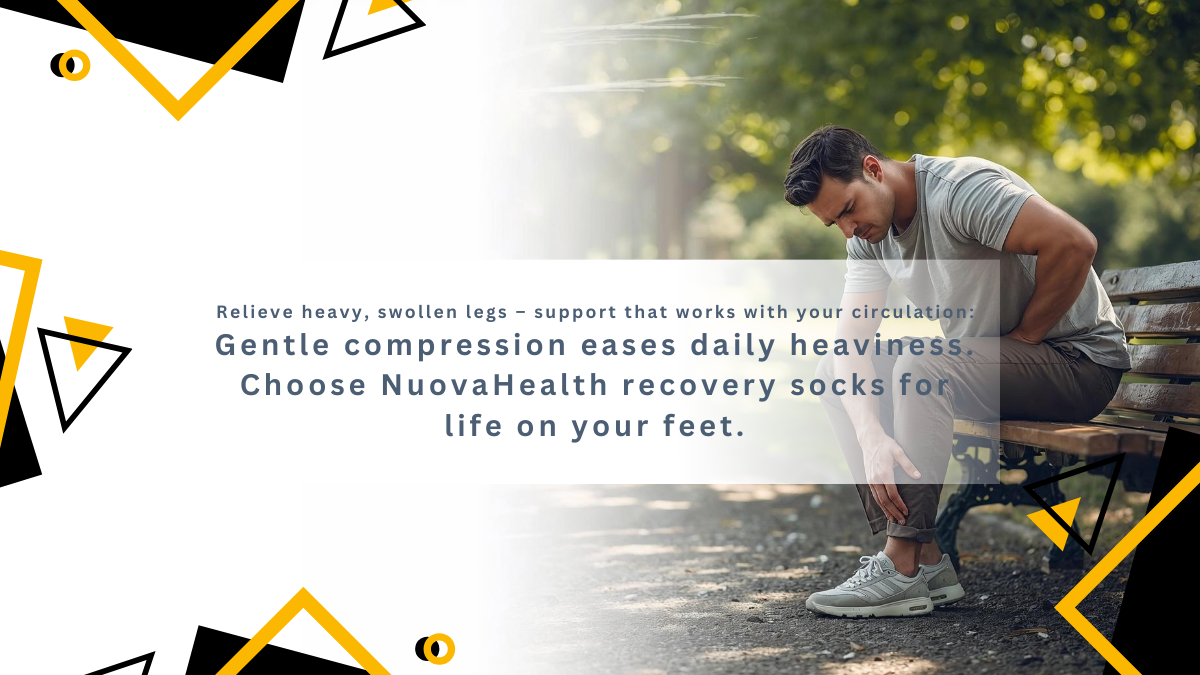
Lighten Heavy, Swollen Legs: A Guide to Compression and Nuovahealth Recovery Socks
Understand why your legs feel heavy and puffy by evening, when gentle compression can help, and how Nuovahealth compression recovery socks are designed to support you through busy days, long journeys and everything in between.
By the end of a typical day, many people notice their lower legs and feet are not as comfortable as they once were. Calves feel heavy and tight, ankles look puffier, socks leave clear grooves in the skin, and feet can feel bruised or restless when you finally sit down. You may start to plan your day around how your legs will cope.
If this sounds familiar, it is often linked to how your veins, calf muscles and the soft tissues in your lower legs are working against gravity, especially when you spend long periods standing or sitting. The good news is that there are simple ways to support this system so your legs feel lighter and more comfortable.
This guide explains why these symptoms are so common, when gentle compression can help, and how Nuovahealth compression recovery socks are designed to support your circulation, muscles and joints in everyday life. It also covers who they are suitable for, who should be cautious, and how to use them safely and comfortably.
Why do my legs feel heavy, puffy or restless by the end of the day?
Every day your legs have to do a demanding job: support your body weight, move you around and pump blood and fluid back up against gravity. When they start to complain, it is usually because one or more parts of this system are under strain.
Many people notice a familiar pattern:
Heavy, dragging calves by evening. You may start the morning with legs that feel normal and responsive, but as the day goes on they seem to “fill up”. By late afternoon or evening, the area from just above your ankles to mid‑calf can feel heavy, tight and slow to move, as if you are wearing weights around your shins or the skin is too tight. This tends to be worse on days spent on hard floors, or when you sit for long spells at a desk or in a vehicle with your knees bent and your feet on the floor.
Puffy ankles and sock marks. You may notice a ridge of puffiness just above the ankle bones, a groove where your usual sock cuff has sat, or skin over the front of the ankle and lower shin that looks stretched or slightly shiny. Shoes that went on easily in the morning can feel tight or awkward by evening. This ankle swelling is a clear sign that fluid has leaked out of small blood vessels into the surrounding soft tissue and has not yet been fully taken back up.
Aching, throbbing calves. The discomfort often feels like a deep, heavy, toothache‑like ache inside the calf muscles. It may be particularly noticeable after long periods of standing still, or when you stand up after sitting for a long time. When your calves hold you upright without much movement, they are working at a low but constant level. They use energy and produce waste products from muscle work, but because they are not going through a full squeeze‑and‑relax cycle, blood does not flush through them as efficiently. Fluid and by‑products can build up, raising internal pressure and triggering that nagging ache.
Feet that feel bruised and overused. By the end of a fairly typical day, your feet may feel as if you have walked far further than you really have. You might notice a bruised, sore sensation directly under the heel or beneath the balls of your feet, stiffness through the arch when you first stand after sitting, or a general feeling that your feet are overused and reluctant to take more weight. On hard floors there is little give, so every step sends a sharper impact into the natural cushioning pads under the heel and forefoot. Thin or unsupportive shoes do not spread this load very far, so the same small regions take the strain again and again.
Restless, unsettled legs in the evening. When you finally sit or lie down, your legs may be the part of you that cannot settle. You might struggle to find a comfortable position for your calves and lower legs, feel a strong urge to move, stretch or shake them, or notice crawling or fizzing sensations, or a deep “itchy” feeling inside the muscles. By evening, muscles and veins in your calves have had a full day of work. Fluid may have pooled in the lower legs, subtly raising the pressure in the soft tissues and making the small nerves more sensitive. Once you stop moving, you start to notice these signals more clearly, which is why walking around or stretching for a few minutes often gives temporary relief.
Visible and spider veins. Some people see fine, web‑like veins on the surface of the skin, especially around the ankles or behind the knees, or more prominent, rope‑like veins that bulge slightly and may feel tender, warm or linked to a dragging ache. The leg around these areas can feel heavy, tight or hot after you have been upright for some time. These visible changes tell you that some of the veins just under the skin are under higher and more persistent pressure.
Cold, tingling or buzzing feet. Others find their feet turn cold quickly compared with the rest of the body, react sharply when they step onto a cold surface, or tingle or buzz after sitting still for a long time, particularly in the toes and forefoot. Changes that come on gradually in both feet and are linked to long standing or sitting often fit with a broader picture of tired, sluggish circulation in the lower legs.
What is happening inside your legs?
Arteries carry blood from the heart to your legs under relatively high pressure. After blood has delivered oxygen and nutrients in the tiny capillaries, it enters the veins at much lower pressure for the return journey. Veins in the legs contain one‑way valves that open to let blood move upwards and snap shut to stop it falling back down. The thin vein walls are supported by the surrounding muscles and connective tissues, which act like a soft sleeve.
Your calf and foot muscles act as a natural pump. Each time you take a proper heel‑to‑toe step, your ankle bends, your calf muscles contract and relax, and your foot rolls forwards. When the muscles contract, they squeeze the deep veins that run between and through them, pushing blood up through the one‑way valves. When the muscles relax, the veins refill from below, ready for the next step. This “calf muscle pump” works best when you walk with a reasonable stride and change position regularly.
Modern work and travel often mean long stretches of sitting with hips and knees bent, or long periods standing in one spot. In these positions, the calf muscles are relatively inactive. At the same time, some of the major veins behind the knee and in the groin can be slightly narrowed by your posture. Gravity continues to pull blood and fluid down into the lower legs, but the route back up is less efficient. As the day goes on, pressure inside the leg veins rises. That extra pressure pushes more fluid out through tiny gaps in the vessel walls into the tissues around your ankles and shins. If your body’s own drainage system (including the lymphatic system, which is your internal drainage network) cannot keep up, fluid builds up, leading to puffiness and tight, shiny skin.
Muscles and soft tissues also respond to how you load them. Holding yourself upright without much movement means the calf muscle fibres work at a fairly fixed length. They are using energy and generating waste products, but the reduced pumping action means these are cleared more slowly. Pressure rises within the muscle compartments, stimulating pressure‑sensitive nerve endings and causing that deep, heavy, sometimes throbbing ache. In the feet, hard surfaces and thin footwear increase the shock through the heel, mid‑foot and forefoot. Over time, the natural cushioning under the heel and balls of the feet can become irritated and lose some of their spring, leading to the familiar bruised sensation.
Blood flow and nerve health are closely linked. When circulation through the small vessels in the skin is sluggish, less warm blood reaches the surface, so the lower legs and feet cool more quickly. The small nerves in the feet and toes can become more sensitive when their blood supply is less consistent, and they may send tingling or buzzing signals in response to relatively minor triggers.
Heavy, puffy or restless legs usually mean that:
- The veins and their valves are working under sustained gravitational strain.
- The calf muscle pump is not being used as effectively as it could be.
- Soft tissues in the feet and calves are dealing with repeated impact or long static positions without enough cushioning or variation.
At that stage, sensible support, regular movement and, where appropriate, compression can often make a noticeable difference.
How do I know if compression socks could help my legs?
You do not need a formal diagnosis to recognise that your legs and feet are under strain. If you recognise the pattern above – heavy, dragging calves by evening, puffy ankles, aching feet and restless legs when you finally sit down – gentle graduated compression is often used to support the veins and limit fluid collecting in the lower legs.
Compression socks give your lower legs a steady, controlled “hug”. The fabric is deliberately firmer at the narrowest part of your ankle, where pressure in the leg veins and fluid pooling are usually greatest, and then gradually eases as it rises up the calf. This pattern is called graduated compression.
For many adults with everyday leg discomfort, light‑to‑moderate graduated compression can:
- Support the vein walls and help the valve flaps meet more effectively.
- Reduce how much spare space there is in the soft tissues around the ankles and shins for fluid to collect.
- Help each calf muscle contraction push blood and fluid upwards more efficiently.
- Slow or reduce the build‑up of mild ankle and lower‑leg swelling through the day.
- Ease the feeling of heaviness, fullness and tightness towards evening.
Compression is most likely to help if your symptoms:
- Build up gradually through the day.
- Are worst after long periods of standing or sitting.
- Usually ease overnight or when you lie down with your legs raised.
- Are mainly felt as heaviness, aching, mild swelling, sock marks and tired feet.
It is less likely to be the whole answer if your symptoms are sudden, severe, very one‑sided, or linked with marked colour changes, temperature changes, or open skin. Those patterns should always be assessed by a clinician.
Nuovahealth compression recovery socks are one everyday way of using this principle. Before looking at the details, it can help to understand what they are designed to do.
What are Nuovahealth compression recovery socks and how do they work?
Nuovahealth compression recovery socks are knee‑high, close‑fitting socks that give your lower legs a steady, gentle squeeze. They use graduated compression, with the firmest support around the ankle and a gradually lighter hold as the fabric rises up your calf. They also build in extra support and cushioning under your heel, across the ball of your foot, through the arch and around the Achilles tendon.
By gently narrowing the veins, supporting the surrounding soft tissues and adding targeted under‑foot cushioning, these socks are designed to:
- Help blood and tissue fluid move from your feet and lower legs back towards your heart.
- Limit how much fluid can leak out into the tissues around your ankles and shins.
- Steady and support hard‑working muscles, tendons and joints in your feet and calves.
- Spread impact and pressure more evenly under your heels, arches and forefeet.
In practical terms, many people notice:
- Less swelling and “fullness” around the ankles.
- Calves that feel lighter and less “packed” by evening.
- Feet that feel less bruised on hard floors.
- A general sense that standing, walking and even sitting for long periods are more manageable.
They are intended to sit alongside, not instead of, any advice or treatment you already have from a GP, physiotherapist, podiatrist or other clinician.
What makes Nuovahealth compression recovery socks different?
The principles behind compression are well‑known, but not all socks apply them in the same way. Nuovahealth compression recovery socks are built to target the structures that most often struggle in tired, overloaded legs and feet, with attention to details that many generic or fashion‑led compression socks overlook.
Graduated compression focused where it matters most. These socks are deliberately snugger at the ankle, where pooling and vein pressure tend to be highest, and then gradually gentler as they rise up the calf. The knit spreads this pressure evenly all the way around the leg, rather than leaving you with one or two tight bands. For someone whose ankles usually puff up by evening, that means the area that normally swells the most is given the firmest, most consistent support.
Targeted support zones at key points. Around the ankle joint, slightly firmer knit gives subtle side‑to‑side support and guides small movements at the joint. That reduces the repeated “wobble” that makes stabilising ligaments and muscles work harder than they need to. Around the bulk of the calf, a gentle but consistent hug supports the muscle as it contracts and relaxes, helping the calf pump work efficiently. Under and around the arch of the foot, built‑in structure supports your natural arch, which plays a major role in absorbing shock and controlling each step.
Extra cushioning in hard‑working areas. Nuovahealth pay particular attention to cushioning in areas that take the most load. Extra thickness under the heel spreads the impact over a larger area and over slightly longer time when your heel strikes the ground. Under the balls of your feet, cushioning supports the heads of the metatarsal bones as they bear weight and push you forwards. Along the arch, padding helps protect tissues that can become sore when the arch has to work hard without support. Over the Achilles tendon, soft cushioning reduces rubbing from shoe collars and dampens small repetitive shocks. Many people find this directly reduces that deep, bruised feeling under the heel or forefoot on hard floors.
Breathable, skin‑friendly yarns. The yarn blend is chosen to balance breathability, temperature control and hygiene. The fabric allows heat and moisture from your skin to move out through the sock, rather than trapping them. At the same time, it holds a thin, even layer of warmth around your lower legs and feet when you are resting, which can be useful if your feet cool down quickly. Copper‑infused antibacterial fibres are included to help limit the growth of odour‑causing bacteria, so your feet feel fresher through a long day. Keeping the skin drier and less sweaty also helps reduce softening of the skin and lowers the risk of rubbing and small skin breaks.
Smooth, low‑friction construction. These socks use fine, smooth, flat seams placed away from bony points such as the tops of the toes and the fronts of the ankles. The knit stretches and moves with your skin, rather than dragging against it. Because compression socks are worn for many hours close to the skin, this low‑friction, skin‑kind finish can be the difference between something you wear happily all day and something you want to remove halfway through your shift.
A wide, stay‑put top band. The top of the sock uses a wide, soft band that spreads any tension over a larger area near the top of the calf. The stretch is distributed from ankle to calf, so the sock grips well enough to stay up without needing a narrow, aggressive band at the top. This design deliberately avoids the deep rings and rolling‑down that people often notice with tight socks that have a small top cuff. Many people find that these socks stay comfortably in place without creating sharp grooves.
Altogether, these features – the carefully graded compression, targeted ankle, calf and arch zones, reinforced heel/forefoot/arch/Achilles cushioning, breathable copper‑infused yarns and soft, stay‑put top band – make this more than a generic support sock. They reflect the kind of design details clinicians often look for when recommending everyday compression to their patients.
When in everyday life are these socks most useful?
The same forces – gravity, the way your veins and valves work, how hard your muscles and joints are working, and how much impact your feet absorb – affect most people. How they show up in day‑to‑day life will depend on your routine. These examples can help you see whether this pattern sounds like you.
Long hours on your feet on hard floors. If your work involves many hours on your feet on hard surfaces, with only short chances to sit, you may recognise a familiar run of symptoms: heels and balls of the feet that feel bruised, calves that feel as if they are packed with sand, and ankles that look rounder and more swollen when you take your shoes off. This is particularly common when you stand mainly in one area or walk only short distances, such as behind a counter, at a workbench or in a small workspace. In this situation, each step sends a sharp impact through the heel and forefoot, your calf muscles work almost constantly to hold you upright without the full movement that would flush them out best, and your veins are under continuous gravitational load.
Nuovahealth socks help here by softening each heel and forefoot impact with their reinforced cushioning, providing graduated compression around the ankle and calf to support the veins and limit end‑of‑day swelling, and stabilising the ankle and arch so small muscles and ligaments do not have to fight wobble with every step. Many people notice that by evening their legs feel less drained and their feet feel less deeply sore than on similar days without compression.
Desk‑based or home‑working days. Sitting for long spells with your hips and knees bent and your feet flat on the floor is surprisingly tough on circulation. The calf muscle pump is under‑used, while veins behind the knees and in the groin can be slightly narrowed by your sitting posture. Gravity still draws blood and fluid into the lower legs. If you regularly stand up from your desk and see puffier ankles, a feeling of tightness in your lower legs, or deep sock marks, you are seeing this effect.
Wearing Nuovahealth compression recovery socks on desk‑based days gives your veins extra support and reduces the space around the ankle for fluid to collect. When you do stand to walk to the kitchen or bathroom, each step can be more effective at clearing fluid because the calf muscles and veins are working within a supported envelope. Combined with regular standing breaks, simple ankle movements and occasional leg elevation, this can make a real difference to end‑of‑day comfort.
Longer journeys by car, coach or plane. Longer journeys tend to combine limited leg room, long spells of sitting with bent knees, warm air and fewer chances to walk properly. You might set off with slim ankles and comfortable shoes and arrive with swollen feet, tight calves and shoes that feel tighter. On a plane, the cabin is often warm and the aisle narrow. In a car, there may be little space to move your legs and you may be reluctant to stop. In both cases, your calf muscles are relatively still, major veins at the back of the knees and in the groin are bent, and warm conditions can cause surface veins to widen slightly, all of which favour fluid moving into the lower legs and staying there.
Wearing these socks during travel adds ongoing support to the veins and tissues, helping to discourage fluid from pooling too much around the ankles. When you stand to walk along the aisle or at a service station, the supported calf pump can clear more blood and fluid with each step. Because swelling is reduced, your ankles and feet often move more freely when you arrive, and your shoes are more likely to feel similar to how they did when you set off. It is still important to stand, walk and move your ankles regularly, and to follow any specific advice you have been given about clot risk. These socks are for comfort and support, not a complete clot‑prevention strategy.
After exercise. Walking, running, fitness classes and sports all place specific demands on the calves, Achilles tendons and feet. After a more intense session, you may notice tight calves, tenderness along the Achilles or soreness under the heel or forefoot. During exercise, your circulation is already more active and your muscles are working hard, so these socks are mainly aimed at the hours afterwards and at everyday activity, not as specialist performance wear.
Wearing them after exercise, during the rest of your day, can support recovery. The gentle compression around tired muscles and tendons helps the calf pump continue clearing fluid and muscle by‑products as you move. The under‑foot cushioning protects already‑loaded tissues from extra impact on hard floors. Many people feel their legs are more ready for their next session, though socks do not replace stretching, strengthening or rehabilitation if those have been recommended.
Visible or spider veins with heaviness and tightness. If you have visible or spider veins, you may notice lower legs that feel heavy, tight or hot after you have been upright for a while, swelling that eases when you raise your legs, and discomfort that worsens in warm conditions. In this case, the structure of some surface veins has already changed: their walls stretch more easily and valves do not always close fully. These socks cannot undo those structural changes. However, by supporting the vein walls from the outside, they reduce how far the veins can stretch under pressure and limit how much blood pools in each section. This in turn can reduce the amount of fluid leaking into nearby tissues and can ease the heaviness, tightness and ache that often go with visible veins.
Cold, temperature‑sensitive feet. Some people find their feet become very cold very quickly in cooler rooms, that rapid temperature changes cause pain or colour changes in the toes, or that their feet simply feel more comfortable when the temperature around them is kept fairly even. The breathable but temperature‑sensible yarns in these socks help by moving moisture away from the skin, preventing dampness that makes cold feel more intense, and by keeping a thin, even layer of warmth around the feet and lower legs. This reduces sudden temperature swings that can be uncomfortable for temperature‑sensitive feet. Marked colour changes, severe pain or clear attacks triggered by cold should still be assessed by a clinician.
Who are these socks suitable for, and who should be cautious?
Nuovahealth compression recovery socks are not a universal answer, but they are often a good option for adults with everyday leg discomfort, provided certain medical conditions are not present.
They may be suitable for you if:
- Your legs and feet feel heavy, tired or “full” by the end of a typical day.
- You notice mild swelling around your ankles that builds gradually with time on your feet and usually settles overnight.
- You spend long periods standing or walking on hard surfaces, or long spells sitting still.
- Your usual socks leave clear dents around your ankles most evenings.
- Your calves ache or throb after work, travel or light‑to‑moderate activity.
- Your feet feel bruised or deeply tired under the heel or forefoot after days on firm floors.
- You are gradually building up your activity again after being less active and want extra leg support as you adapt.
In these situations, the combination of graduated compression, targeted ankle, calf and arch support, reinforced cushioning under the heel and forefoot, and skin‑friendly construction can together make a noticeable difference to how your legs and feet feel during and after the day.
You should be cautious and speak to a clinician before using compression socks if you:
- Have been told you have poor blood flow in the arteries of your legs or feet.
- Have a history of ulcers or significant skin changes on your lower legs.
- Have heart disease, particularly if you have been told your heart’s pumping function is reduced.
- Have had blood clots in your legs or lungs in the past.
- Have diabetes with known nerve or circulation problems in your feet or legs.
- Have any condition that affects feeling in your legs or feet, making it harder to notice pressure, pain, heat or cold.
- Have significant, sudden or unexplained swelling, especially if one leg is much more affected than the other.
- Have current open wounds, ulcers or areas of fragile or broken skin on your lower legs.
- Notice new or unexplained leg symptoms – such as persistent pain, swelling, colour change or temperature change – that do not settle.
In these situations, the wrong type or level of compression can sometimes reduce blood flow, increase pressure in the wrong tissues or mask early signs of skin damage. A GP, physiotherapist, podiatrist or other clinician can examine your legs, consider your overall health and advise whether compression is appropriate for you, and if so, which level and style is safest.
These socks are not recommended for use during pregnancy. If you are pregnant or think you may be pregnant, you should seek specific advice from a clinician about safe ways to support your legs.
What should I realistically expect from these socks, and where are the limits?
It helps to be clear about what these socks are designed to change and what they cannot do. That way, you can judge your own experience fairly.
When you first put on Nuovahealth compression recovery socks, they will feel different from ordinary socks. Instead of a light covering, there is a firm, even “hug” from ankle to just below the knee, with a more noticeable squeeze at the ankle. Your calves may feel more contained and less wobbly when you walk, and you may simply be aware of the socks in the first few hours.
On days when your legs usually feel heavy or puffy by evening, you may begin to notice that this heaviness builds more slowly, or that your ankles look less swollen than you would expect. Because compression is a new sensation, it is often sensible to start with a few hours of wear on a typical day at home, rather than putting them on for the first time before a very long shift or journey. This gives you a chance to see how your legs and skin respond and to get used to the feel.
Over the following days and weeks, as you wear them regularly on your higher‑demand days – such as longer shifts, busy days out or travel days – many people find that changes in swelling and heaviness become clearer. For some, the difference is noticeable within a few days; for others, it builds more gradually over a few weeks.
Worn consistently on the days when your legs have to work hardest, these socks often lead to:
- Less ankle swelling by evening, with fewer and less deep sock marks.
- Lower legs that feel less “packed” or tight after long standing, sitting or travel.
- Feet that are less sore under the heel and forefoot, thanks to the added cushioning and better pressure spread.
- More confidence to walk at the end of the day, because your legs feel steadier and more capable.
These changes are not usually dramatic overnight cures, but moderate, meaningful gains in comfort and endurance that add up over time.
It is equally important to know what they will not do. They will not:
- Remove visible veins or fully reverse vein wall and valve changes that have taken years to develop.
- Correct serious underlying circulation disorders or heart conditions.
- Eliminate all leg symptoms when there are complex underlying problems.
- Replace movement, leg elevation, weight management, strengthening exercises or medical treatment where those have been advised.
From a mechanical point of view, they work by supporting your veins and soft tissues, helping fluid move out of your lower legs, and cushioning impact under your feet. They do not directly change the structure of your blood vessels or heart.
They work best as one part of a broader approach that might also include:
- Regular changes of position and short walking breaks during long standing or sitting.
- Simple calf and ankle exercises to help your calf pump.
- Periods of leg elevation when resting to help fluid drain.
- Strength, mobility and weight‑management strategies recommended by your clinician.
Your own response is an important guide. With the right size and correct application:
- If you feel clearly more comfortable on days when you wear the socks – for example, less swelling, less heaviness, less bruised under‑foot soreness – that suggests the support they provide suits your pattern of symptoms.
- If you experience increased pain, unusual numbness or tingling, or any significant colour changes in your feet or lower legs while wearing them, you should remove the socks and check your legs. If the socks were creased, twisted or the top band had rolled and created a tight strip, putting them on smoothly may solve mild local discomfort. If symptoms persist or are more widespread, you should stop using them and seek advice before wearing them again.
Sharing your experience with a clinician can be useful, as it gives them extra information about how your legs respond to load and support and may guide further management.
How do I choose the right size and know if they fit properly?
Compression only works well if the fit is right. Socks that are too loose cannot provide effective graduated pressure; socks that are too tight can be uncomfortable or, in some situations, unhelpful.
To choose a size, you will need:
- Your usual shoe size (for foot length).
- A measurement around the widest part of your calf, usually at mid‑calf.
You then match both to the size ranges provided. If your shoe size and calf measurement both sit comfortably within the same size bracket, that size is likely to be suitable. If you are between sizes, or your calf measurement is close to the upper limit of a range, it is often safer to choose the larger size, especially if you have fuller calves. The top of the sock should sit just below the crease at the back of your knee. If the sock would sit much higher or much lower, it may be worth asking for individual fitting advice.
A correctly fitted Nuovahealth compression sock should:
- Feel snug and supportive all the way from ankle to just below the knee.
- Be clearly tighter at the ankle and gradually less tight as it approaches the knee, without any sudden pinched areas.
- Lie flat against your skin without wrinkles, folds or twisting.
- Allow you to slide a finger under the top band with some resistance but without sharp pain or a sense that the band is cutting into the skin.
- Give your toes room to move freely; they should not be bent, squeezed together or pushed back by the sock.
When you remove the socks, you may see light impressions on the skin, particularly where there are natural indentations. These marks should soften and disappear within about half an hour to an hour.
Signs that the fit or level of compression may not be right include:
- Localised pain or sharp pressure in one small area under the sock.
- Tingling, burning, pins‑and‑needles or numbness in your feet or toes that does not quickly improve when you change position.
- Deep grooves or sharp lines in the skin that persist for a long time after the sock is removed.
- Areas of skin below the top of the sock that look unusually pale, blue or mottled and do not quickly improve.
If you notice these changes, remove the socks and check how they were applied. Look for folds, twisted fabric or a rolled top band that could have created a narrow, very tight strip. If smoothing these out still leaves you feeling that the sock is too tight, or if symptoms do not settle, avoid further use and seek advice on size and suitability, especially if you have any underlying circulation or nerve problems.
It is common for one leg to be slightly larger than the other, particularly around the calf. The stretch in these socks is designed to accommodate small differences and everyday fluctuations in swelling. One sock may feel a little tighter than the other; that can be normal. If one leg is clearly more swollen or larger than the other and this is new or unexplained, you should be assessed by a clinician before using compression.
How and when should I wear Nuovahealth compression recovery socks?
Once you have the right size, the way you put the socks on and the times you choose to wear them will influence how comfortable and effective they are.
For most people, it works best to put compression socks on in the morning, when your legs are at their least swollen and the tissues are relatively “empty”. This lets the socks help prevent or limit fluid build‑up, rather than trying to move fluid out of tissues that are already very swollen. Many people wear them through their main working hours or other long periods of standing or sitting. Others use them on specific higher‑demand days such as travel, events or busier shifts.
Because the knit is firm, putting on compression socks is different from pulling on ordinary socks. A simple method is:
- Sit somewhere you can comfortably reach your feet.
- Slide your hand into the sock and hold the heel pocket from inside.
- Turn the sock inside‑out down to the heel, leaving the foot section the right way out.
- Place your foot into the foot part, making sure your toes are flat and your heel is lined up with the heel area.
- Gently pull the sock up over your heel and ankle, unrolling it up your calf rather than tugging from the top edge alone.
- Smooth out any wrinkles or folds with your hands, working from the ankle upwards, so the fabric is evenly spread.
- Adjust the top band so it sits flat and straight just below the crease at the back of your knee. Do not fold or roll the top band down, as that creates a narrow strip of high pressure.
Keeping toenails smooth and not too long, and filing down rough patches of skin that might catch, can make it easier to put the socks on and reduce local rubbing.
For most adults without complex medical conditions, it is reasonable to wear Nuovahealth compression recovery socks through the day and take them off in the evening or before bed, allowing your skin to air overnight. Overnight wear is usually not needed for everyday use and can increase the risk of skin becoming damp and softened if socks are kept on continuously. If you are new to compression, you might start with half‑day wear and build up to a full day as you become used to the sensation and are happy that your skin is tolerating it well.
Each time you remove the socks, especially at first, it is sensible to look at the skin around your ankles, heels and toes for any redness that does not fade, areas of rubbing or any small blisters. This is particularly important if you have any degree of reduced sensation or known circulation problems.
These socks are designed to be slim enough to fit inside most everyday shoes. If your footwear is already very tight or narrow, any extra layer may feel constrictive. Ideally, your shoes should be supportive but not tight; they should not add extra pressure where the sock is already providing compression. It can be helpful to try the socks with your main shoes at home for a short period before wearing them for a full work day or long journey, so you can adjust laces or consider slightly roomier footwear if needed.
How should I wash and care for my Nuovahealth socks?
Looking after your socks helps them maintain their compression, cushioning and comfort.
Most people will wash compression socks after each full day of wear, especially if they have been in closed shoes or you have been on your feet a lot. Freshly washed socks are usually more comfortable against the skin, and the elastic fibres recover better if they are not worn for several days without a break. If you wear them only for a short period and they still feel fresh, you may choose to wash them every second wear.
To preserve the stretch and structure:
- Use a gentle wash cycle with cool or warm water, not very hot water.
- Use a mild detergent and avoid bleach or fabric softeners, which can weaken elastic fibres.
- If washing them with clothes that have zips or hooks, place the socks in a small laundry bag to reduce snagging.
- Air‑dry the socks flat or hanging from the toes, away from direct high heat.
High‑temperature tumble‑drying or placing them directly on very hot radiators for long periods can damage the elastic and shorten their effective life.
Even with good care, compression socks gradually lose some of their original firmness and spring. Over time you may notice that they feel looser around the ankle and no longer give the same “hug”, they are noticeably easier to pull on, the fabric looks thinner in certain areas, or the top band no longer sits flat and starts to roll or flare. These changes suggest the socks are no longer giving the same level of support they did when they were new. With regular use and appropriate care, many people find a pair maintains effective support for several months. Having at least two pairs and rotating them can reduce wear on each and mean you always have a clean, dry pair ready.
Are these socks safe for me, and when should I seek medical advice?
Nuovahealth compression recovery socks are designed for everyday comfort and support, but there are times when you should not use them or should seek medical advice.
You should remove the socks and seek prompt medical advice from a GP, urgent care service or other clinician if, while wearing them or shortly afterwards, you notice:
- Sudden, severe pain in one leg that you cannot explain.
- Marked swelling, redness, heat or tenderness in one calf or thigh.
- Sudden, clear colour changes in a foot or leg – such as very pale, blue or mottled skin – that do not quickly improve.
- New ulcers, blisters or areas of skin breakdown that do not heal.
- New, persistent numbness, tingling or loss of normal feeling in a foot or leg.
- Any new unexplained symptoms in a leg that worry you and do not settle.
These patterns can indicate serious underlying problems that need prompt assessment. Do not assume that wearing more compression or keeping the socks on will solve new or severe symptoms.
You should also discuss the use of compression socks with a GP, physiotherapist, podiatrist or other clinician before starting if you:
- Have been told you have poor blood flow in the arteries of your legs or feet, or have a history of leg ulcers or marked skin changes.
- Have had blood clots in your legs or lungs in the past.
- Have heart disease, particularly heart failure, where moving fluid around the body needs careful management.
- Have diabetes, especially if you have been advised that you have reduced sensation or circulation problems in your feet.
- Have neurological conditions that affect sensation or muscle control in your legs or feet.
- Have current open wounds, ulcers or fragile skin on your lower legs.
In these situations, compression may still be appropriate, but the pressure level, sock length and overall plan should be chosen and monitored by a clinician to avoid unwanted effects on blood flow, fluid balance or skin health.
Nuovahealth socks are designed for general comfort, support of mild swelling and gentle support for everyday circulation. They are not medical‑grade compression stockings and are not intended to be used as the main treatment for diagnosed vein disease or complex circulation problems. They are also not tested or licensed as a stand‑alone method for preventing blood clots.
Blood clots are more likely to form when blood flow is very slow or stagnant, for example during prolonged immobility, some illnesses or after operations. To reduce this risk, clinicians usually recommend regular movement, calf and ankle exercises, adequate fluid intake and, in higher‑risk situations, specific medicines or prescribed compression garments. If you have been told you are at increased risk of clots, or have been prescribed particular stockings, you should follow that advice.
Whatever your starting point, you should arrange a medical review if you notice leg symptoms that are new and unexplained and persist beyond a few days, a clear change in the pattern or severity of your usual symptoms – such as swelling that appears earlier in the day or is much worse than before – or any symptom pattern that concerns you and does not settle with rest, leg elevation and simple measures. While you are waiting for assessment, it is generally sensible to stop using compression if you suspect it is making symptoms worse, unless a clinician has advised you to continue.
What guarantee do I have, and are these socks worth trying for me?
Choosing how to support your legs and feet matters, especially if you have already tried other options or feel cautious about compression. To make that decision easier, Nuovahealth compression recovery socks come with a 30‑day comfort guarantee. If you try them and find they do not fit as expected, are not comfortable for you, or do not provide the support you hoped for, you can return them within 30 days for a full refund.
That gives you space to wear them with your usual shoes, on your typical work, home or travel days, and pay attention to how your ankles, calves and feet feel – in terms of swelling, heaviness, soreness and skin comfort – without feeling committed if they are not right for you.
If you recognise yourself in the descriptions above – heavy, tired calves by evening, puffy ankles, aching heels and forefeet on hard floors, or restless lower legs when you finally sit down – and you do not have a medical reason to avoid compression, these socks are a practical, everyday way to support your legs. By supporting the veins in your lower legs, gently limiting the space available for fluid to build up, and softening repeated impact under your feet, they tackle several of the main pressures that drive common leg symptoms.
Used alongside regular movement, simple leg‑elevation habits and any exercises or treatments you have been advised to do, Nuovahealth compression recovery socks can become a straightforward but valuable part of looking after your legs, helping you move, work, travel and rest with more comfort and confidence. If you are unsure about your symptoms, or if you have known heart, circulation or nerve problems, your next step should be a conversation with a GP, physiotherapist, podiatrist or another appropriate clinician, who can help you decide how best to use compression as part of your overall plan.
Medical disclaimer
The information above is general guidance about Nuovahealth compression recovery socks and common patterns of leg discomfort. It is not a substitute for personalised medical advice, diagnosis or treatment. It does not take the place of an assessment by a GP, physiotherapist, podiatrist or other qualified clinician, and it should not be used to make decisions about starting, stopping or changing any medical treatment.
Compression socks can support comfort and everyday circulation but they do not treat or prevent serious circulation problems or blood clots on their own, and no specific outcomes are guaranteed. If you have any doubts about whether these socks are suitable for you, or if you notice new, changing or unexplained symptoms in your legs or feet, you should seek advice from an appropriate clinician.
This content is intended for adult readers in the UK.