No products in the cart.
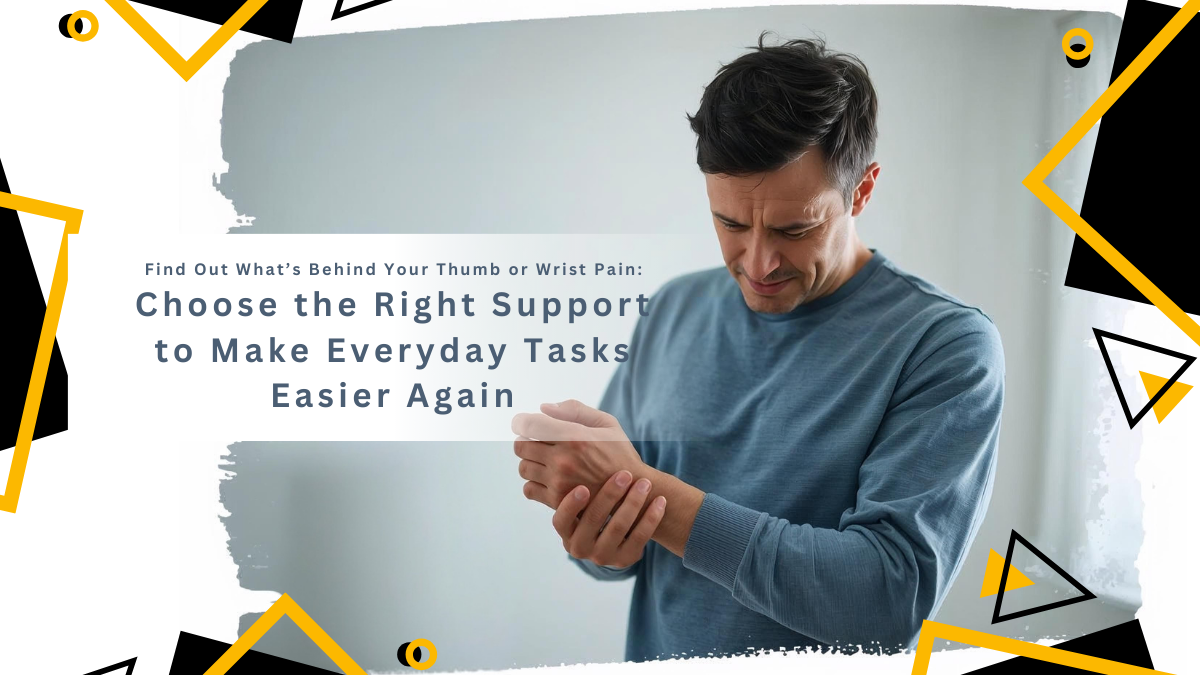
Thumb and wrist pain: causes, treatment and when to use a brace
Why does my hand, thumb or wrist hurt doing everyday things?
Pain in the hand can feel very unfair. Simple things that used to be automatic – turning a key, opening a jar, lifting a pan, typing, or using a phone – can suddenly feel sharp, aching or weak. It’s not always obvious whether the problem is in the thumb, in the wrist, or “somewhere in the hand”, because discomfort often spreads.
For many people, this kind of pain is linked to how the joints, tendons and nerves around the thumb and wrist are being loaded. Problems are more likely when these structures are:
- held in a very bent or twisted position, such as a fully bent wrist,
- kept in one position for a long time without a break,
- or asked to cope with strong or repetitive gripping and twisting without enough recovery.
The main parts involved are:
- the small joint near where the thumb joins the hand (the thumb CMC joint), which allows the thumb to pinch, grip and twist,
- the cluster of small bones, ligaments and tendons that make up the wrist joint,
- and the median nerve at the front of the wrist, which runs through a narrow tunnel and carries sensation and strength to the thumb‑side fingers.
This page explains how different types of thumb and wrist pain usually behave, what is often happening inside the joints, tendons and nerve, and where our NuovaHealth thumb spica splint and our NuovaHealth wrist support brace can sensibly fit into managing these problems – alongside pacing, exercises and professional advice.
The focus is on patterns where the thumb or wrist are the main source of trouble, rather than pain limited to the palm or middle fingers.
Why does my thumb hurt when I grip or pinch things?
If you feel pain mainly around the thumb joint close to the wrist when you grip or pinch – for example when:
- turning keys,
- opening jars,
- wringing out cloths,
- holding something firmly between thumb and finger –
that often means the small joint at the base of the thumb and its supporting tissues are under strain.
This joint has a wide range of movement so the thumb can oppose the fingers. In a healthy joint, a smooth layer of cartilage covers the bone ends so they glide, and snug ligaments and joint capsule hold everything steady while still allowing plenty of movement. Over years of use, or after an injury, the cartilage can thin and roughen, the joint lining can become inflamed, and the ligaments can be stretched.
When you pinch or grip:
- a lot of force is carried through this relatively small joint,
- roughened cartilage surfaces can grind instead of sliding smoothly,
- stretched ligaments may allow a little extra sideways “wobble”.
That’s why something as small as turning a key or opening a jar can suddenly hurt much more than you’d expect. The movement hasn’t really changed – but the joint’s ability to cope with that pinch and twist has.
Later on, we look at how reducing these painful pinch and twist movements with our NuovaHealth thumb spica splint can help protect this joint during everyday tasks.
What does it mean if I have a sharp pain in my wrist when I twist it?
A sharp pain in the wrist when you twist – such as turning a door handle, opening a jar or turning a tap – often points towards strain in the ligaments and joint surfaces that connect the small wrist bones.
The wrist is not a single hinge but a cluster of bones held together by ligaments. When you twist or bend the wrist strongly:
- some ligaments are stretched close to their limit,
- certain joint surfaces are compressed and sheared more than usual.
A sudden twist, fall, or repeated twisting can:
- overstretch ligaments (a sprain), causing tiny tears and swelling,
- irritate the lining of the small joints,
- produce a painful “catch” when you move back into that same position.
If the pain is intense after an obvious injury, or you see major swelling, deformity or cannot move your fingers properly, you should seek urgent medical assessment in case of a fracture or serious sprain.
If the pain is milder but keeps coming back whenever you twist or bend the wrist in particular ways, that suggests the tissues are still irritated by those strongest bends and twists. Our NuovaHealth wrist support brace is designed to reduce exactly those deep bends and twists; we explain how later in more detail.
Why is the area where my thumb meets my hand so tender and swollen?
Tenderness and swelling around the base of the thumb, close to where it meets the wrist, usually mean the tissues there are inflamed. Common reasons include:
- joint irritation or arthritis at the thumb base, where the smooth cartilage has become thinner and rougher and the joint lining is inflamed,
- a recent sprain of one of the supporting ligaments around the thumb, with tiny tears prompting a protective swelling response,
- irritation of tendons that pass close to the thumb base from repeated gripping or lifting.
When this region is inflamed:
- extra fluid and inflammatory chemicals build up,
- pressure increases in the small spaces around the joint and tendons,
- nearby nerves become more sensitive.
That’s why even gentle touch or resting the hand on a surface can hurt and the area feels “full” or stiff.
If swelling is significant, getting worse, or accompanied by heat and redness, you should see a clinician. When swelling is linked to arthritis, a sprain or tendon overload, one part of treatment is to reduce the day‑to‑day strain on the area so that irritation has a chance to calm. Steadying the thumb base with a brace, rather than letting it repeatedly move into painful positions, is one way to do this.
My wrist feels weak and achy after work – is that normal?
A tired, aching feeling in the wrist by the end of the day is common, especially if your work involves:
- long periods of typing or mouse use,
- frequent lifting, gripping or twisting,
- leaning your weight through your hands for tasks.
The muscles, tendons and ligaments that control the wrist are being asked to produce force again and again, often in similar positions. If they are doing more work than they can comfortably recover from between bouts – either too hard, too often or without enough variety – they can become overloaded.
That overload often shows as:
- a dull ache across the wrist,
- a sense of weakness or “giving way” late in the day,
- stiffness after rest.
Many people feel as though their wrist has done far more work than the amount of typing or lifting they actually remember. That usually reflects tired, irritated tissues rather than sudden new damage, but it still deserves attention. Changes in how you use your hands, and sometimes temporary support with a wrist brace for the hardest parts of the day, can help. Sudden weakness, dropping objects, or new numbness should be discussed with a clinician.
Why does the pain sometimes shoot from my wrist up my forearm?
Pain that starts at the wrist and seems to run up into the forearm is often due to:
- tendons that run from forearm muscles, across the wrist, into the hand being irritated near the wrist,
- discomfort from the wrist joint being felt a short distance along shared nerve pathways.
When you grip or lift, those tendons are pulled through their sheaths. If they are inflamed where they cross the wrist, you may feel the line of pulling a little way up the arm. When the wrist joint or its ligaments are inflamed, the nervous system can sometimes “project” some of that pain along the arm.
Ache that tracks a short way up the forearm and clearly ties in with wrist use is common in problems like sprains and tendon overload. More widespread, constant or unexplained pain – especially if it is associated with numbness or weakness – should be assessed to rule out nerve or other causes.
Later sections explain how tendon and joint overload develop and how supports can reduce some of the movement patterns that drive this discomfort.
How can I tell whether my hand pain is coming from my thumb, my wrist, or somewhere else?
When the hand hurts, it is not always obvious where the main trouble is. Pain can spread, and the thumb, wrist and fingers work closely together in most tasks. A helpful first step is to notice:
- where the pain feels worst most of the time,
- which movements or activities most reliably bring it on.
This is a guide, not a diagnosis, but it can help you see whether thumb‑ or wrist‑focused advice and supports are likely to be relevant, or whether your symptoms sit more outside this page’s scope and need a different focus.
What clues suggest my pain is mainly around the thumb joint close to the wrist?
Your problem is likely to be mainly about the thumb if you notice several of these:
- The most painful and tender area is around the thumb joint close to the wrist.
- Pain increases clearly with pinch and grip – turning keys, opening jars, wringing cloths, holding objects between thumb and finger.
- You sometimes feel grinding, catching or “wobble” at that thumb joint when you load it.
- The joint looks or feels slightly swollen or bony, and is sore to press.
- You struggle most with tasks that need firm pinch, rather than those that mainly use the fingers.
This type of thumb pain is especially common from middle age onwards, in people who have done a lot of pinch and grip work over the years, or after a sprain or fracture involving the thumb.
It is often seen in:
- arthritis at the thumb CMC joint,
- De Quervain‑type tendon irritation focused near the thumb,
- later stages after a thumb sprain or stable fracture.
In these thumb‑led problems, it is the thumb base joints and nearby tendons that need most help. Our NuovaHealth thumb spica splint, which directly steadies the CMC and MCP joints, is designed for this pattern.
What clues suggest my pain is mainly in the wrist joint?
Your pain is more likely to be centred on the wrist joint if most of the following apply:
- The main ache or sharp pain sits across the front or back of the wrist, rather than at the thumb joint.
- Bending the wrist up or down, twisting, or weight‑bearing through the hand are the strongest triggers.
- The wrist feels weak or as if it could give way when you load it.
- Stiffness and ache by the end of the day sit across the wrist rather than just at the thumb base.
- The thumb itself is relatively comfortable compared with the wrist.
This kind of wrist pain often comes from:
- wrist sprains and ligament strains,
- tendon strains and repetitive strain injury (RSI) around the wrist,
- arthritis affecting the central wrist joints.
It is common in people with a history of falls onto the hand, manual work, or long periods of typing or tool use. In these situations, supporting and limiting motion at the wrist itself makes more difference than targeting the thumb. Our NuovaHealth wrist support brace is built for this role, with splints at the front and back of the joint and wide straps to control wrist bend and twist.
What if I have numbness or tingling in my thumb, index and middle fingers?
Numbness, tingling, burning or “pins and needles” in the:
- thumb,
- index finger,
- and middle finger,
especially if:
- symptoms are worse at night,
- or they appear when your wrist has been bent for a while (for example when reading, using a phone or cycling),
are often seen when the median nerve is under pressure in the carpal tunnel at the front of the wrist.
In this situation, the nerve shares space with several tendons in a tight tunnel made of bone and ligament. When:
- the wrist is held bent for a long time,
- the tendon sheaths inside the tunnel are swollen,
- or the ligament roof is thickened,
pressure on the nerve increases. The nerve responds with altered sensation (tingling, numbness, burning) and sometimes weakness in pinch and grip. This is why many people find:
- night‑time symptoms worse,
- symptoms easing when they shake the hand or straighten the wrist.
Similar sensations can, less commonly, come from pressure on the nerve higher in the arm or neck, which is another reason why persistent or severe symptoms should be assessed.
Because wrist position is such a key factor here, a wrist‑focused support is usually more appropriate than a thumb‑only splint. Our NuovaHealth wrist support brace is designed to keep the wrist nearer straight, particularly at night, and can play a part in managing carpal tunnel–type symptoms as part of a plan agreed with a clinician.
What if my pain is mainly in my palm or fingers, not at the thumb or wrist?
If your discomfort is:
- mainly in the middle of the palm,
- focused on one or more finger joints,
- or several finger joints are swollen and stiff while the thumb base and central wrist are relatively spared,
then thumb‑ or wrist‑centred braces are less likely to be the main answer.
Pain patterns like this can arise from:
- pulley or tendon problems in the fingers,
- conditions that favour the finger joints,
- nerve issues higher in the arm or neck.
These often need individual assessment to decide on the right approach. In some cases, a wrist or thumb brace may still have a supporting role if the thumb or wrist are also involved, but it would not usually be the main treatment for palm‑ or finger‑only pain.
If this sounds more like your pain, it is sensible to speak to a GP or physiotherapist, and possibly a hand specialist. The rest of this page will be most relevant if you also recognise one of the thumb‑ or wrist‑centred patterns described above.
Could this be arthritis, tendon problems, or something like carpal tunnel?
Once you have a sense of where your symptoms are centred, the next question is often “what might this be?”. Without an examination, no article can tell you exactly what you have, but certain ways that pain and stiffness behave are often seen in particular joint, tendon and nerve problems.
Understanding what is happening in these structures helps make sense of why thumb and wrist supports, exercises and other strategies are used later on.
Is my thumb pain a sign of arthritis near where my thumb joins my hand?
Arthritis around the thumb joint close to the wrist is common, especially from middle age onwards. It often affects the carpometacarpal (CMC) joint, where the thumb meets the wrist. If your thumb pain is worse with pinch and grip in that area, a common reason is wear and arthritis at this CMC joint.
In a healthy thumb CMC joint:
- a smooth layer of cartilage covers the bone ends so they glide easily,
- a snug joint capsule and ligaments hold the joint steady while still allowing a wide range of movement.
In arthritis at this joint:
- the cartilage is thinner and rougher,
- the joint lining can be inflamed and swollen,
- the ligaments may be stretched, so the joint is a little less stable,
- the body may form small extra ridges of bone around the joint edges.
When you pinch or twist:
- more of the force is carried through smaller, roughened areas of cartilage,
- the inflamed lining is squeezed,
- the joint can slide a little more than it should.
That combination often produces the sharp, catching pain and deep ache many people notice when they use the thumb for anything that needs firm pinch or twist. That’s why turning a key or opening a jar can feel far sharper and more grinding than it used to, even though the movement itself seems the same.
These changes tend to build up over years. Once they are present, the joint is generally more sensitive over the long term. The aim then is to manage how much stress it faces in everyday tasks and to keep it working as well as possible, rather than expecting it to go back to how it once was.
What does base-of-thumb (CMC) arthritis actually mean?
When a clinician says you have “CMC arthritis”, they are usually describing:
- wear‑and‑tear (osteoarthritic) changes at the thumb CMC joint,
- sometimes with some looseness of the joint capsule and ligaments.
In a healthy joint here, the cartilage and ligaments allow good freedom of movement while keeping the joint surfaces in the right place. In arthritis, the combination of rough cartilage and looser ligaments means:
- the joint is more likely to “catch” or feel as though it shifts slightly under load,
- the surrounding muscles have to work harder to keep things steady,
- repeated everyday movements can cause more irritation than they used to.
That’s why arthritis at the base of the thumb often shows itself first as:
- pain and weakness when you turn keys, open jars or wring out cloths,
- a sense that the thumb joint is not as firm as it once was.
It’s understandable to feel worn down by this kind of daily thumb pain, especially when it affects so many simple tasks. These are some of the reasons why supports that stabilise the thumb base and limit the most stressful movements are commonly used for this type of pain.
What is De Quervain-type tendon irritation, and could it match my pain?
De Quervain‑type problems affect the tendons that lift and extend the thumb as they pass over the thumb‑side of the wrist through a tight tunnel of tissue.
Typical features include:
- pain along the thumb‑side of the wrist, not just right at the thumb joint,
- pain brought on by lifting or twisting with the thumb leading – for example lifting a baby, carrying shopping or wringing an object,
- soreness when you press over the tendon region just above the wrist on the thumb side,
- sometimes creaking or catching as the thumb moves.
In a healthy state, these tendons slide smoothly in their sheath through the tunnel. When they are pulled through this tight space again and again under load:
- the tendon fibres can become irritated and thickened,
- the sheath and tunnel lining can swell,
- there is less room for the tendon to move.
Each time you then use the thumb in the same way, the thickened tendon has to rub through a narrowed, sensitive tunnel. That is why the same movements keep bringing the pain back. If this is the problem, it often feels like the same lifting or wringing movement “catches” in the same spot every time, no matter how careful you are.
If this is recognised early and you change how much and how you use the thumb and wrist – and, in some cases, use a brace that restricts the most aggravating thumb‑leading movements – the irritation is more likely to settle. Continuing with the same thumb‑led lifts and grips for months without change can make it more stubborn and slower to improve.
Our NuovaHealth thumb spica splint wraps both the thumb and the thumb‑side of the wrist, cutting down exactly the thumb and wrist angles that tend to aggravate these tendons.
How do I know if my wrist and hand symptoms could be carpal tunnel–type?
Carpal tunnel–type symptoms arise when the median nerve is compressed in the narrow tunnel at the front of the wrist. The tunnel is formed by wrist bones underneath and a strong band of tissue over the top, with tendons and the nerve sharing a small space inside.
Common features include:
- numbness, tingling, burning or “pins and needles” in the thumb, index and middle fingers,
- symptoms that are worse at night, often waking you and improving when you shake or straighten the hand,
- tingling or numbness brought on by holding the wrist bent for a long time, such as while reading or using a phone,
- weakness or clumsiness in pinch and grip.
Inside the tunnel, several things can raise pressure:
- swelling in the tendon sheaths,
- fluid retention,
- thickening of the ligament roof,
- or simply keeping the wrist bent forwards or backwards for long periods.
The median nerve is sensitive to this pressure. In earlier stages, changing wrist position and reducing time spent with the wrist bent can ease symptoms. If compression continues unchecked over many months, the nerve can become more persistently affected, with more constant numbness and weakness. That is why it is important not to ignore clear carpal tunnel–type symptoms.
These problems are more common in people who:
- perform a lot of wrist‑bending tasks,
- are pregnant,
- have certain medical conditions such as diabetes or thyroid disease,
- or tend to retain more fluid.
Keeping the wrist nearer to straight, especially overnight, is a practical way to reduce pressure on the nerve. Many people are surprised that a simple change – keeping the wrist nearer straight at night – can cut down how often they wake with tingling or numbness. Our NuovaHealth wrist support brace was developed with this in mind, using dual splints to limit wrist bend while leaving the fingers and thumb usable.
What’s the difference between a sprain, a strain, and tendon irritation in the wrist?
These terms describe which tissues in and around the wrist have been overloaded or injured:
- A sprain involves a ligament – the strong band that connects bones and helps stabilise a joint. In the wrist, a sprain may follow a fall or twist that pushes the joint beyond its usual range. Tiny tears in the ligament and bleeding into the tissues cause pain and swelling, especially when you move back into the position that stressed it.
- A strain refers to excessive loading of muscles or their tendons. In the wrist and forearm, strains often develop from repeated lifting, gripping or weight‑bearing. The muscle‑tendon unit is asked to generate more force, or work for longer, than it can comfortably handle and recover from. You may feel aching with use that settles with rest.
- Tendon irritation (often still called tendonitis) is a particular kind of strain where the tendon tissue shows signs of inflammation and, over time, longer‑term structural change. Repeated small overloads can make a tendon thicker and more easily irritated by the same activities.
A one‑off sprain that is given time, some protection and changes in how you use the wrist often improves relatively quickly. If the same high‑strain movements continue day after day without change, ligaments and tendons have less chance to repair between uses and can become harder and slower to settle. That is another reason why, in some sprain and strain situations, it makes sense to use a brace for a while to keep the wrist or thumb away from the most aggravating positions while tissues recover.
Can repetitive actions at work really cause long-term thumb or wrist problems?
Yes, repetitive actions at work can contribute to long‑term thumb and wrist problems, especially when they involve:
- the same thumb or wrist position held or repeated for much of the day,
- strong gripping forces or heavy lifting,
- little opportunity to vary tasks or take short movement breaks.
Examples include:
- long runs of typing or mouse use with the wrist held in one posture,
- frequent lifting and twisting tasks, such as handling stock or using tools,
- regular pushing and pulling where weight is borne through the hands.
Over time, this way of working can:
- strain ligaments and joint surfaces around the wrist and thumb,
- irritate tendon sheaths and the tendons themselves,
- increase swelling around the carpal tunnel, adding pressure to the median nerve.
If nothing about how long and how hard you load these structures changes, early, short‑lived aches and twinges can, over time, become a more persistent problem that is slower to settle.
The answer is not to avoid all use but to adjust how you use the hand: varying tasks, adjusting wrist and thumb position, reducing unnecessary force and, in some cases, using supports that limit the worst positions while you work on these changes. The braces in the NuovaHealth range have been developed with input from clinicians to reflect these common ways thumbs and wrists are strained in everyday work.
What should I try first for a sore thumb or wrist?
Before considering a brace, it is sensible to look at simple measures you can take yourself. Early steps usually focus on:
- easing symptoms in the short term,
- keeping joints and tendons moving within a comfortable range,
- and reducing the amount of strain that builds up during the day.
Should I use ice or heat for thumb or wrist pain?
Both cold and warmth can help, but in different situations.
Cold (a wrapped ice pack or cool compress) is often more useful when:
- pain started suddenly, for example after a twist or knock,
- the area looks hot, red or swollen,
- moving the joint feels sharply painful.
Cooling the area:
- reduces blood flow for a short time, which may help limit swelling,
- slightly dulls nerve sensitivity in the skin and tissues.
After 10–15 minutes applied through a cloth, the area may feel less angry and the next few movements may be less sharp. The effect is short‑lived and should be combined with other measures.
Heat (a warm compress or warm water) can be more helpful when:
- pain has been present for longer,
- the joint or tendon feels stiff and achy,
- it tends to feel better after you have moved it a little.
Warmth can relax muscles, improve comfort and make it easier to move the joint gently. Many people find a warm bath or compress before doing light movement exercises useful.
If you have reduced sensation in your skin, or conditions that affect your circulation, be cautious with hot or cold treatments and consider asking a clinician for advice before using them.
Are there simple exercises that can help with thumb joint or wrist stiffness?
Gentle movement within your comfortable range can help reduce stiffness and keep joints and tendons healthy. It can help to think in two stages:
- early movement – small, controlled exercises to keep things moving,
- later strengthening – heavier work to build support once pain is under better control.
For the thumb, early movements might include:
- slowly moving the thumb away from and back towards the palm,
- touching the thumb to each fingertip without pushing into sharp pain,
- tracing small circles or arcs with the thumb.
For the wrist, early movements might include:
- gently bending the wrist up and down through a small, comfortable arc,
- slowly turning the palm up and down,
- making small circles in the middle of the range.
These movements:
- keep joint surfaces sliding,
- stop muscles and tendons becoming too stiff,
- reduce the “rusty hinge” feeling after rest.
Strengthening work, such as resisted thumb movements or wrist curls, can be very helpful later on, but is best added with guidance from a physiotherapist or hand therapist once the joint is calmer.
How can I change the way I work to ease strain on my hands?
If your work or home routines involve a lot of hand use, changing how and how long you load the thumb and wrist can make a real difference.
Helpful changes include:
- Varying tasks and positions
Try not to keep the wrist or thumb in the same posture for long stretches. Switching tasks and taking brief movement breaks stops the same structures being stressed in the same way for hours. - Improving wrist position
When typing or using devices, aim to keep the wrist in a comfortable middle position rather than strongly bent up or down. A wrist that is held bent over a keyboard for hours presses more on the front of the joint and tightens the roof of the carpal tunnel, so tendons and the nerve are under more pressure. - Reducing unnecessary force
Many of us grip or pinch harder than we need to. Lightening your grip where it is safe to do so reduces pressure through the thumb base and wrist. - Sharing work between both hands
Use both hands where you can, rather than always asking the same side to do the heaviest or most awkward jobs.
These habits are part of what clinicians call pacing: spreading demand across the day with shorter bouts and breaks, rather than very long unbroken periods. Bracing, where used, fits in as an extra way of keeping the joint away from its most strained positions whilst you put these habits into practice.
Will resting my hand completely make the pain better, or can that backfire?
A short spell of cutting back on the worst tasks after a flare or injury is reasonable. What usually helps is changing which tasks you do and how you do them, rather than stopping all use. In practice this means:
- easing off the tasks that clearly cause sharp pain,
- avoiding heavy loads or extremes of movement for a while,
- still moving the joint gently within a comfortable range.
Keeping the hand almost completely still for long periods can backfire:
- joints can stiffen,
- muscles and tendons can lose some strength and flexibility,
- when you do eventually move, it may hurt more because tissues are no longer used to working.
So the aim isn’t to stop using your hand – it’s to stop over‑loading it in the same way again and again.
A brace can help by:
- blocking the movements that most often set your pain off during necessary tasks,
- allowing you to keep up gentler, safer activities without constantly aggravating the area.
If pain remains very high despite reducing activity, or movement feels unsafe or severely painful, you should speak to a clinician rather than relying on rest alone.
When should I think about seeing a GP or physiotherapist about my hand pain?
Self‑care has limits. You should seek advice from a GP, physiotherapist or other appropriate clinician if:
- Pain is severe and followed a clear injury such as a fall or twist, or you notice:
- obvious deformity,
- marked swelling,
- or difficulty moving the thumb or fingers.
These features raise concern about a fracture or major soft‑tissue injury.
- Symptoms have not improved at all after a few weeks of changes to how you use your hand, or are steadily getting worse.
This suggests a more persistent problem that needs assessment. - You have numbness, tingling or weakness in the hand, especially in the thumb‑side fingers, or are waking at night with these sensations.
This raises concern about nerve involvement, such as carpal tunnel–type symptoms. - Several joints in your hand are swollen and stiff and you feel unwell in yourself.
This may point towards a more general inflammatory condition affecting several joints.
Each of these patterns has different likely causes – fractures, progressive nerve compression, inflammatory disease – which bracing alone cannot diagnose or treat. A clinician can examine you, confirm what is most likely happening, and advise whether a brace, exercises or other treatments are appropriate.
When is it worth trying a thumb or wrist brace?
Braces are not usually the first thing to try, but they can be very useful when:
- your symptoms follow a clear, repeatable movement pattern,
- you have already tried basic changes and early exercises,
- and you need a way to protect irritated joints, tendons or nerves while still using your hand.
The supports in the NuovaHealth range have been developed with these aims in mind, to limit the movements that most often set symptoms off, while leaving as much useful hand function as possible.
Is a simple elastic bandage enough support for wrist or thumb pain?
A soft elastic bandage or sleeve can feel comforting. It offers:
- light compression,
- a little extra warmth,
- a reminder of the area.
This may help with very mild aches. However, it usually does not:
- stop the thumb joint near the wrist moving into strong pinch or twist positions,
- keep the wrist out of the deep bends that strain ligaments, tendons or the nerve tunnel,
- reliably limit the exact movements that bring your pain on.
It can feel like “support”, but it does not significantly change how the joint moves.
Splinted braces use firmer elements placed over specific joints. These are designed to:
- resist movement into painful positions,
- guide the joint into a safer working range,
- and spread load over a wider area.
That’s the difference between a bandage that simply feels supportive, and a brace that actually stops the joint moving into the positions that set your pain off.
How is a splinted brace different from a soft sleeve?
A splinted brace has rigid or semi‑rigid stays integrated into the fabric. These splints are shaped and positioned to influence certain movements.
Compared with a soft sleeve, a splinted brace can:
- Limit end‑range movement
- A thumb spica splint reduces how far the thumb base can move into the strong pinch and twist angles that grind arthritic joint surfaces or strain healing ligaments.
- A splinted wrist brace holds the wrist nearer straight, so it cannot bend as far forwards or backwards on each movement.
- Control direction of movement
- Along the thumb, the splint reduces sideways wobble at the CMC and MCP joints, so the thumb moves more in line with the hand.
- Across the wrist, front and back splints resist twists and sudden bends that pull on strained ligaments and tendons.
- Reduce bending stress on sore areas
- By keeping the wrist straighter during lifting or pushing, the brace shortens the effective lever through which forces act, so less bending force reaches the most painful part of the joint.
Splinted braces are therefore better suited than soft sleeves when certain joint positions are the problem – such as end‑range pinch in arthritis at the base of the thumb or deep wrist bend in carpal tunnel–type symptoms.
Our NuovaHealth thumb spica splint and NuovaHealth wrist support brace have been designed with this in mind, with contoured metal splints and adjustable straps placed where physiotherapists and hand therapists most often want to limit movement.
Can a brace really help with arthritis pain in the thumb or wrist?
A brace cannot undo arthritic changes, but it can often make the day‑to‑day effect of arthritis more manageable by changing the movements that hurt.
In arthritis, affected joints are less tolerant of:
- strong compression,
- twisting at the extremes of movement,
- long periods in awkward positions.
A well‑chosen brace can:
- Reduce painful joint movement
- At the thumb base, a spica splint steadies the CMC and MCP joints so they do not slide as far into the pinch and twist angles that produce sharp grinding pain.
- At the wrist, a splinted brace prevents the joint from bending as deeply, so arthritis‑affected surfaces are not pushed again and again into the positions that make them ache.
- Help out stretched ligaments
- As arthritis progresses, ligaments may do a poorer job of holding bones firmly. The brace’s structure takes on some of this work, helping the joint feel less unstable when you load it.
- Allow more comfortable function
- With end‑range, high‑stress movements reduced, many everyday tasks can be done with less peak pain, or for longer before pain reaches the same level.
Because arthritis is a long‑term condition, bracing is usually one part of how you manage thumb and wrist arthritis pain day to day, alongside pacing, exercise and any medical treatments a clinician advises. Our NuovaHealth thumb spica splint and wrist support brace have been designed with these arthritic patterns in mind.
Could a support help prevent re-injury after a sprain has mostly healed?
After a thumb or wrist sprain, there is often a stage where:
- the worst pain and swelling have improved,
- the ligaments and surrounding soft tissue are still regaining strength and stiffness,
- the joint feels vulnerable with certain movements.
At this point, an unexpected twist or heavy load can deliver more force than the healing tissues can safely handle, risking a setback.
A brace can help by:
- Stopping sudden, extreme movements
It acts as a physical stop against the bend and twist positions that originally caused the sprain. - Making it easier to trust the joint again
Knowing there is a mechanical limit in place can make it easier to start using the hand more normally, instead of holding it very stiffly out of fear. - Reducing accidental overload
Everyday slips and bumps are less likely to exceed the healing tissues’ capacity if movement is limited.
Our NuovaHealth thumb spica splint and wrist support brace are often used at these stages between a full cast and no support at all, but only when a clinician has confirmed that a rigid cast or splint is no longer needed.
Is it safe to brace a joint, or will it make it weak or “lazy”?
It is reasonable to worry that supporting a joint might make it “lazy”. It is a very common concern, especially if you have heard that supports can make joints “depend on them” in the past.
Problems are more likely when a brace is:
- worn almost all the time for many weeks or months,
- used instead of any movement or strengthening work,
- relied on in place of medical assessment when symptoms are severe or unusual.
Used in a planned way, bracing is generally safe. It can:
- reduce strain on irritated or healing joints and tendons,
- allow you to continue using the hand in safer ways,
- make it easier to stay active overall.
Tissues adapt to what they are asked to do. If they are never moved or challenged, muscles can lose strength and joints can stiffen. If they are moved gently and gradually strengthened while a brace protects them from the worst movements, they are more likely to remain or become healthier. What usually causes lasting weakness is pain stopping you from using the hand at all, not the support itself.
That is why later sections focus on combining braces with exercises and on gradually cutting back use once things improve.
What does a thumb spica brace actually do, and who is our NuovaHealth thumb spica splint for?
A thumb spica brace is used when pain is mainly around the thumb joint close to the wrist, often worse with pinch, grip and twist. Our NuovaHealth thumb spica splint is designed to:
- hold the thumb base joints (CMC and MCP) in a safer, more stable position,
- limit small but painful movements at those joints,
- leave the palm and fingers free enough for many everyday tasks.
This section explains how it works and when this style of support is commonly chosen.
What is a thumb spica brace, in simple terms?
In simple terms, a thumb spica brace is a support that:
- wraps around the wrist and thumb,
- contains a semi‑rigid splint along the thumb,
- leaves the palm open and the other fingers free.
Our NuovaHealth thumb spica splint is shaped so that:
- a contoured metal stay runs along the thumb‑side of the hand and wrist, covering the CMC and MCP joints,
- straps around the wrist and thumb allow you to set firm but comfortable support,
- the palm and fingers are free to grip and move within limits.
The purpose is to steady the thumb base and cut down strong pinch, twist and sideways wobble that typically provoke pain in arthritis around the thumb CMC joint, De Quervain‑type irritation and later‑stage sprains or post‑fracture phases.
How does the splint in our NuovaHealth thumb spica splint help the base of my thumb?
The semi‑rigid splint in our NuovaHealth thumb spica splint is contoured to follow the line of the thumb and sit directly over the key joints at its base – the CMC and MCP joints. This has several effects:
- Limiting end‑range movement
The splint resists the thumb moving fully into the pinch and twist angles that cause grinding in an arthritic CMC joint or strain healing ligaments. Instead of those joints sliding right to the end of their range with each pinch or twist, they move in a smaller, safer arc. - Reducing sideways wobble
When the ligaments around the CMC and MCP joints are stretched or have been injured, the thumb can drift slightly sideways when you press or pinch. The splint acts as a firm guide, keeping the base of the thumb moving more in line with the hand, so it feels less unstable when you put force through it. - Shifting some load away from the sore spot
As you grip or press, some of the force that would normally go straight through the sore joint margins is taken up by the splint and by the brace around the wrist. That reduces the peak pressure on the most sensitive part of the joint.
All of this is aimed at the same problems described earlier in arthritis at the base of the thumb and thumb sprain patterns: repeated grinding, a sense of giving way, and sharp pain with pinch and twist. By changing how far and how firmly the base joints move, the splint can make those thumb‑based tasks feel more controlled and, for many people, less painful.
Can our NuovaHealth thumb spica splint help after a thumb fracture once the cast is off?
After a stable thumb fracture has been treated in a cast, there is usually a stage where:
- the bone has healed well enough that a rigid cast is no longer needed,
- the joint, ligaments and surrounding soft tissues are still stiff and vulnerable,
- the thumb feels painful or weak during everyday use.
At this point, clinicians often move from a cast to a removable thumb spica splint. Our NuovaHealth thumb spica splint is intended for this in‑between stage:
- it continues to protect the healing area from sudden, high‑force movements,
- it controls how far the thumb base can bend and twist,
- it allows a gradual return to lighter activities while still reducing the risk of re‑injury.
It is not a replacement for a cast in the early stage of a fracture. It should only be used in this way when a clinician has confirmed that the fracture is stable enough for lighter, removable support.
Because it can be taken on and off, you can:
- remove it at specific times to perform exercises prescribed by a clinician,
- check and care for the skin,
- put it back on for heavier or awkward tasks where you are less sure how the thumb will cope.
How can our NuovaHealth thumb spica splint help with arthritis around the thumb base?
In arthritis at the base of the thumb, the CMC joint is particularly sensitive to strong pinch and twist and to being used through its full range many times a day.
Our NuovaHealth thumb spica splint can help by:
- Reducing grinding and shear
By holding the thumb base in a more neutral, stable position, the brace stops the joint from sliding as far into the angles that produce grinding of irregular joint surfaces. This can reduce the sharp pain you feel when you pinch or twist. - Backing up stretched ligaments
The combination of splint and straps takes over some of the role of stretched or weakened ligaments, so the joint feels more solid when you put weight through it. - Making daily tasks more manageable
With the thumb base steadier, many people find they can manage light to moderate tasks – such as holding a book, using cutlery or carrying lighter objects – with fewer sudden pain spikes.
You are trading some movement at the thumb base for extra stability and comfort. For many people, that is a reasonable compromise in day‑to‑day life. The open‑palm, free‑finger design of our brace is chosen specifically so you can still use the rest of the hand while the thumb base is supported.
Can our NuovaHealth thumb spica splint help with De Quervain-type tendon irritation?
In De Quervain‑type tendon irritation, the tendons that lift and extend the thumb are repeatedly pulled through a tight tunnel at the thumb‑side of the wrist. When those tendons and the tunnel lining are inflamed, each strong movement creates friction and strain.
Our NuovaHealth thumb spica splint can help by:
- Limiting the thumb positions that hurt most
It restricts how far the thumb can move into the lifted and outwards positions that put the most tension on the inflamed tendons. - Reducing aggravating wrist positions
Because the brace also wraps around the thumb‑side of the wrist, it discourages certain wrist angles that compress the tendon tunnel while the tendons are being pulled through it. - Encouraging the tendons to rest and recover
By making the worst movements mechanically harder, it naturally steers you away from repetitive actions that keep the tendons irritated.
Fewer high‑strain passes of an already sore tendon through a tight tunnel give the tendon fibres and tunnel lining a better chance to settle, especially when combined with changes in how you lift and grip and any exercises a clinician suggests.
Will our NuovaHealth thumb spica splint feel bulky or get in the way?
Any brace adds some bulk, but our NuovaHealth thumb spica splint has been designed to give firm support without feeling like a cast.
Key comfort features include:
- a slim, lightweight construction so it can often be worn under clothing,
- padding over the splint to soften contact with the skin,
- a breathable, moisture‑managing fabric to reduce sweat build‑up and skin irritation during several hours of wear.
Because the palm is open and the fingers are free, you can still:
- spread and curl your fingers,
- hold lighter objects,
- carry out many household and desk‑based tasks.
You will notice that:
- very wide thumb movements,
- and strong pinch in extreme positions,
are limited. Those are exactly the movements that tend to aggravate the joint or tendons and are the ones the splint is intended to reduce.
Many people appreciate that the open‑palm, free‑finger design of our NuovaHealth thumb spica splint makes it easier to keep using the hand for light tasks while the thumb base is supported.
Can I still use my phone or type while wearing your NuovaHealth thumb spica splint?
The open‑palm, free‑finger design is intended to let you continue many light tasks, such as:
- holding a phone in the supported hand and using the other hand to tap or swipe,
- typing on a keyboard, as the fingers can still press keys and the brace helps stop the thumb moving into painful positions on the space bar,
- preparing food, folding laundry or other light household jobs.
You may find that:
- very fine thumb movements,
- and rapid thumb‑based typing,
are restricted or feel different. Many people adapt by relying more on the other hand or on other fingers.
If any task feels unsafe, or you feel you cannot grip securely enough, it is better to pause and rethink how you are doing it or seek advice. For tasks that demand very fine thumb control, your clinician may suggest removing the brace briefly and then putting it back on for heavier or riskier activities.
We do not present driving as a routine example because driving in any brace is a safety‑sensitive situation. If you are considering driving while wearing a support, speak to your clinician and make sure you can fully control the vehicle and follow any relevant medical and driving rules.
Can I adjust your NuovaHealth thumb spica splint with one hand?
Many people need to put the brace on and adjust it using only the other hand. Our NuovaHealth thumb spica splint is designed with this in mind:
- hook‑and‑loop straps can be gripped and pulled with the unaffected hand,
- the brace can be slid into place and then tightened strap by strap.
This allows you to:
- line the splint up along the thumb,
- set the wrist and thumb straps to a secure but comfortable tension,
- make small adjustments through the day if swelling changes.
Being able to manage the brace yourself is important, particularly if you live or work alone. It also makes it easier to remove it for skin checks, cleaning and exercises, then put it back on without help.
What does a splinted wrist brace do, and when is our NuovaHealth wrist support brace better than thumb-only support?
A splinted wrist brace is most useful when the wrist joint or the median nerve around the carpal tunnel is the main issue, rather than the thumb base. Our NuovaHealth wrist support brace:
- uses splints along the front and back of the wrist to keep it nearer to straight,
- limits how far the joint can bend forwards or backwards,
- leaves the fingers and much of the thumb free to move.
This section explains how it works and when it makes more sense than a thumb‑only support.
When is our NuovaHealth wrist support brace more useful than a thumb brace alone?
Our NuovaHealth wrist support brace is usually the better choice when:
- your main pain or weakness is across the wrist joint, not at the thumb base,
- bending the wrist up or down, twisting, or weight‑bearing through the hand are the strongest triggers,
- you have numbness or tingling in the thumb‑side fingers, especially at night.
This fits situations such as:
- wrist sprains and ligament strains,
- tendon irritation and RSI around the wrist,
- arthritis affecting the central wrist joints,
- carpal tunnel–type symptoms, where wrist position affects nerve pressure.
In these situations, changing how far and how often the wrist bends or twists has the biggest impact on the joints, tendons and nerve. A thumb‑only brace leaves the wrist largely free to move, so it will not have the same effect. For thumb‑dominant problems, our NuovaHealth thumb spica splint remains the more suitable support.
How do the dual splints in our NuovaHealth wrist support brace help the joint?
Our NuovaHealth wrist support brace contains two metal splints:
- one along the palm side of the wrist,
- one along the back.
These splints are shaped to follow the natural curve of the wrist and forearm. They help by:
- Limiting forwards and backwards bend
When you try to bend the wrist forwards or backwards, the splints resist that movement beyond a certain point. This stops the joint from going into the deep bends that:- pull on ligaments that are still healing,
- increase compression on painful joint surfaces,
- and raise pressure inside the carpal tunnel.
- Keeping the wrist nearer to a middle position
With splints aligned with the forearm, the brace naturally encourages the wrist to settle in a middle, comfortable position – not fully bent and not fully straight. This is generally easier on joints, tendons and the nerve. - Reducing bending stress on the sore area
By holding the wrist straighter when you lift or push, the brace shortens the effective lever through which forces act, so less bending force reaches the most painful part of the joint.
The splints are housed in a padded, breathable sleeve with wide straps. This lets them control movement without digging into the skin, and allows you to adjust how firmly they guide the joint.
Can our NuovaHealth wrist support brace help with carpal tunnel–type symptoms at night?
Carpal tunnel–type symptoms often worsen at night because:
- many people naturally sleep with the wrist curled forwards or backwards,
- that position increases pressure in the carpal tunnel for several hours at a time,
- the median nerve is compressed for longer than during short daytime tasks.
Our NuovaHealth wrist support brace is often used at night to:
- hold the wrist closer to straight,
- discourage it from sagging forwards or backwards while you sleep,
- keep the brace in place with wide straps even if you turn over.
Keeping the wrist nearer a middle position usually lowers the pressure peaks that trigger night‑time tingling, numbness or burning. Many people notice they wake less often with these sensations when they wear a splinted wrist brace consistently at night.
Night‑time bracing mainly addresses the position of the wrist. It does not directly treat other factors that can contribute to carpal tunnel–type problems, such as fluid retention or certain medical conditions. If symptoms are severe, spreading, or affecting your hand function during the day, you should discuss them with a GP or other clinician rather than relying on a brace alone.
Broken sleep from hand symptoms can be very draining, so it makes sense to look for simple, practical changes that ease that pattern.
Is our NuovaHealth wrist support brace suitable for tendon irritation and repetitive strain from work?
For many people with tendon irritation or repetitive strain around the wrist, our NuovaHealth wrist support brace can be helpful, particularly when:
- specific wrist positions used at work or home reliably bring on pain,
- symptoms build over the day during typing, tool use, lifting or manual tasks.
When people talk about “repetitive strain injury” (RSI), they usually mean that:
- the same muscles, tendons and joints are being used repetitively, often under load,
- there is not enough variation or recovery between periods of demand.
Over time, tendons and their sheaths:
- experience repeated friction,
- are loaded at angles that stress them,
- may become swollen and more sensitive.
Our brace can:
- Limit the worst positions
It stops the wrist bending as far into the positions that create the highest friction and tension in the sore tendons. - Encourage safer alignment during tasks
Keeping the wrist nearer straight while you type or handle objects reduces peak stress on irritated tissues. - Act as a cue to moderate effort
Simply feeling the brace on your wrist can help remind you to ease back on force, take breaks and vary tasks.
Our design offers firmer control than a soft sleeve while still allowing hand use, which matches what many physiotherapists and hand therapists look for when they want more than light compression. It should not be used to justify carrying on with clearly excessive loads, but as one part of a plan that also involves pacing and, where possible, adjusting how you work.
Will a wrist brace with a thumb loop stop me moving my thumb completely?
The thumb loop on our NuovaHealth wrist support brace is there mainly to:
- help anchor the brace,
- keep the splints reliably positioned over the wrist joint.
It is not intended to fully immobilise the thumb. With this brace:
- the thumb loop sits near the base of the thumb and secures the brace,
- the thumb tip and middle joints can still move,
- most everyday thumb movements remain possible, though some may feel slightly different because of the material.
You should still be able to:
- hold light objects,
- use cutlery and simple tools,
- perform many routine tasks.
If your main difficulty is at the thumb base and you need stronger control over thumb movement, our NuovaHealth thumb spica splint is more appropriate. The thumb loop on the wrist brace is primarily about keeping wrist support stable, not bracing the thumb base.
Can I still grip or type while wearing your NuovaHealth wrist support brace?
Our NuovaHealth wrist support brace is built around the idea of steadying the wrist but leaving your fingers and most thumb movement available, so you can keep using the hand.
In practice, you can usually:
- Grip light to moderate objects
Your fingers can curl, and the thumb can oppose them. The wrist will not bend as far, so some grips feel different, but many everyday tasks remain possible. - Type and use devices
As finger movement is unaffected, you can type and use a mouse. The brace may actually help by keeping the wrist out of deep flexion or extension, which often contributes to strain during long typing sessions. - Carry out light household tasks
Activities like preparing food, folding laundry or gentle cleaning are typically manageable within the brace’s range, provided you avoid very heavy loads or awkward positions.
Driving is not used here as a routine example because, in any brace, driving is safety‑sensitive and must comply with medical and driving rules. If you are unsure whether it is safe or appropriate to drive in your situation, it is best to ask your clinician.
Is a splinted wrist brace too much for mild wrist pain?
If your wrist pain is:
- very mild,
- short‑lived,
- and clearly settles with a few days of lighter use and simple changes,
a splinted wrist brace may not be necessary. In those situations, small adjustments such as reducing repetitive tasks, improving wrist position and doing gentle movement exercises may be enough.
A splinted brace becomes more appropriate when:
- pain or weakness is persisting or recurring despite sensible self‑care,
- the wrist feels unstable after a sprain or twist,
- you have a carpal tunnel–type pattern with numbness or tingling tied to wrist bend,
- a clinician has advised you to use a firmer support rather than a soft sleeve alone.
In those cases, a brace is not “too much”; it is one practical way of keeping the joint away from the movements that hurt most. If you are unsure, you can always discuss the decision with a GP or physiotherapist.
How do I decide whether I need our NuovaHealth thumb spica splint or our NuovaHealth wrist support brace?
You have seen how different ways that thumb and wrist pain behave often point towards the thumb base, the wrist, or the nerve in the carpal tunnel. The support that is most likely to help is the one that matches your main pattern.
How can I tell if my problem is mainly at the thumb joint close to the wrist?
Your pattern is likely to be mainly at the thumb joint near the wrist if:
- the most painful and tender spot is around that joint,
- strong pinch and grip are the most reliable triggers,
- you sometimes feel grinding, catching or “wobble” there under load,
- there is visible fullness or bony change there,
- wrist movements without much thumb activity are relatively tolerable.
This is typical of:
- arthritis at the thumb CMC joint,
- De Quervain‑type tendon irritation focused near the thumb,
- later stages after a thumb sprain or stable fracture.
In these situations, steadying the thumb base makes a bigger difference than controlling the wrist. Our NuovaHealth thumb spica splint is shaped and strapped for this pattern.
How can I tell if my problem is mainly in the wrist joint?
Your pattern is more likely to be centred on the wrist joint if:
- the main ache or sharp pain is across the front or back of the wrist,
- wrist bend, twist and weight‑bearing through the hand are the main triggers,
- the wrist feels weak or as if it could give way when you load it,
- end‑of‑day stiffness and ache sit across the wrist, not at the thumb base,
- the thumb itself is not the biggest problem.
This fits with:
- wrist sprains and ligament strains,
- tendon strains and RSI patterns around the wrist,
- central wrist arthritis.
In these patterns, controlling wrist bend and twist is more important than supporting the thumb. Our NuovaHealth wrist support brace is the better match.
What if my pain runs from the thumb into the wrist – which brace then?
Pain often seems to run from the thumb into the nearby wrist region because:
- tendons and ligaments cross both areas,
- irritated structures can cause pain that is felt a short distance away from where the main problem actually is.
If your pain feels mixed:
- Press on the thumb joint near the wrist and on the central wrist separately. Where is it most tender?
- Think about the single worst movement:
- If it is strong pinch or thumb‑led twist, that points more towards the thumb base → our NuovaHealth thumb spica splint.
- If it is bending or twisting the wrist, or weight‑bearing, that points more towards the wrist → our NuovaHealth wrist support brace.
In some people, both joints are significantly involved. Those more complex situations – for example arthritis at both the thumb and wrist, or long‑standing inflammatory conditions – benefit from individual advice. You may eventually use both types of support at different times, but which one to start with is best decided with a clinician.
If I have arthritis, does that change which support I should pick?
Arthritis can affect the thumb base, the wrist, or both. Which brace is more useful depends on which joint is causing you more difficulty in practice.
- If your arthritis is known to affect the thumb CMC joint, and your worst pain is with pinch and grip at the thumb base, our NuovaHealth thumb spica splint is designed for that pattern.
- If your arthritis mainly affects the wrist joints, and your worst pain is with bending, twisting and loading the wrist, our NuovaHealth wrist support brace is more appropriate.
If arthritis has been identified at both joints but one clearly causes more difficulty in everyday activities, supporting that joint first usually makes sense. For more complex arthritis affecting several joints, seeking advice from a physiotherapist or rheumatologist is particularly helpful before deciding on supports.
If my main problem is numbness and tingling, which brace is more likely to help?
If your main problem is numbness, tingling or burning in the:
- thumb,
- index finger,
- and middle finger,
and these:
- are worse at night,
- or appear when your wrist is bent for some time,
your symptoms may be consistent with pressure on the median nerve in the carpal tunnel.
In that case:
- the position of the wrist is crucial,
- keeping the wrist nearer to straight reduces pressure on the nerve,
- controlling wrist bend is more important than supporting the thumb base.
A wrist‑focused brace is therefore more likely to help than a thumb‑only brace. Our NuovaHealth wrist support brace is designed to hold the wrist in a safer middle position, especially at night.
Our NuovaHealth thumb spica splint, although it wraps part of the wrist, is aimed at controlling thumb base movement and does not control wrist flexion and extension in the same way. If numbness and tingling are frequent, worsening or associated with weakness, you should also seek medical assessment.
What makes a thumb or wrist support one of the “best” options for you?
When people search for the “best thumb support” or “best wrist brace”, what they really need is not a single winner for everyone, but the support that:
- matches the way their pain behaves,
- actually changes the movements that irritate the joint, tendon or nerve,
- and is comfortable enough to wear during real life, not just for a few minutes.
The points below can help you judge whether a thumb splint or wrist support is likely to be one of the best options for you, rather than just looking at a list of features.
How do I choose the best thumb support or thumb spica splint for my pain?
The best thumb support for you is usually the one that fits both your pain pattern and your day‑to‑day life, rather than just the firmest splint you can find.
Some things to look for when choosing a thumb brace or thumb spica splint:
- Does it match where your pain is?
- For arthritis or sprains around the thumb joint close to the wrist, the best thumb splints usually have a shaped stay that sits directly over the CMC and MCP joints.
- For De Quervain‑type tendon irritation, supports that wrap the thumb and the thumb‑side of the wrist, limiting the lifted and outward thumb positions, are often more helpful.
- Does it limit the movements that hurt you most?
A good thumb brace will:- reduce strong pinch and twist at the thumb base,
- cut down sideways wobble when you press or grip,
- still let your fingers move freely.
- Is it practical for daily use?
The best thumb support for you is one you can actually wear:- breathable fabric to reduce sweating and irritation,
- padding over the splint so it is not digging into the skin,
- straps you can adjust with the other hand, even if the painful thumb is sore or stiff.
Our NuovaHealth thumb spica splint was designed with these points in mind: a contoured stay over the key thumb joints, an open palm and free fingers, and adjustable straps so you can find a balance between control and comfort. That combination is what makes it a strong option if you are looking for the best thumb brace for arthritis at the base of the thumb, De Quervain‑type irritation or later‑stage sprains.
What should I look for in the best wrist support or wrist brace?
The best wrist support for you depends on:
- where your symptoms sit around the wrist,
- whether you need help mainly with joint strain, tendon overload or carpal tunnel–type symptoms,
- and which tasks you want to keep doing while you wear it.
Key things to look for in a wrist brace:
- Splint design and placement
- For many people with wrist pain or carpal tunnel–type symptoms, the best wrist braces use splints along both the palm side and the back of the wrist.
- This dual‑splint design helps keep the wrist nearer to straight and limits deep bends forwards and backwards, which are often the positions that strain joints and tendons or increase pressure in the carpal tunnel.
- Enough support without blocking finger use
A good wrist support should:- control bend and twist at the wrist joint,
- still let you move your fingers and most of your thumb so you can grip, type and carry light objects.
- Comfort and adjustability
The best wrist support for day‑to‑day use is:- made from breathable, padded material to reduce rubbing and sweat build‑up,
- fitted with wide, adjustable straps so you can set a snug but not overly tight fit,
- easy to put on and take off with your other hand.
If you are looking for the best wrist brace for carpal tunnel–type night pain, it is especially important that the brace can hold your wrist nearer straight comfortably for several hours, without cutting in or slipping. Our NuovaHealth wrist support brace uses dual splints, wide straps and breathable padding for exactly this reason, while keeping the fingers free enough for everyday tasks.
Is the “best” brace always the firmest one?
It can be tempting to think that the best thumb brace or best wrist support must be the stiffest, most restrictive one you can find. In practice, the most helpful brace is usually the one that:
- stops the specific movements that set your pain off,
- gives you enough control to feel supported,
- still allows you to use your hand for the activities that matter to you.
A very rigid brace that you can only tolerate for a few minutes a day is unlikely to be the best choice in the long run. A well‑designed support that you can wear for the parts of the day when your thumb or wrist usually struggles – at work, during housework, or at night for carpal tunnel–type symptoms – will often do more for you.
When clinicians talk about a “good” or “best” brace for someone, they are usually thinking about this balance between:
- control (does it limit the right movements?),
- comfort (can you actually wear it?),
- and match (does it fit your particular thumb or wrist problem?).
Our NuovaHealth thumb spica splint and NuovaHealth wrist support brace were developed with those three points in mind, to offer firm, targeted support that still works in real life, not just in theory.
How do I choose the right size and fit, and how long should I wear a brace?
Once you have chosen between our NuovaHealth thumb spica splint and NuovaHealth wrist support brace, the next steps are practical:
- selecting left or right,
- choosing an appropriate size,
- setting strap tension,
- planning when and how long to wear the brace,
- and looking after it so it stays effective and comfortable.
How do I know if I need a left or right-hand brace?
Both the NuovaHealth thumb spica splint and the NuovaHealth wrist support brace come in left and right versions.
You should:
- choose a right‑hand brace when supporting a right thumb or wrist,
- choose a left‑hand brace when supporting a left thumb or wrist.
The splints inside each brace are contoured to sit over specific parts of the joints:
- in the thumb spica, over the thumb‑side CMC and MCP joints,
- in the wrist brace, along the front and back of the wrist.
Wearing a brace on the wrong hand places the splints away from where they are needed, so the support will not act on the correct structures. If you have problems on both sides you may eventually wish to have one of each, but each brace should still be fitted to the appropriate side.
How do I choose the correct size for a thumb or wrist support?
Sizing affects how well a brace can do its job. If it is too large:
- the splints may not line up properly with the joints,
- the brace may twist or slip.
If it is too small:
- straps may dig in,
- you may not be able to fasten it comfortably enough to keep it in place.
Most wrist supports, including our NuovaHealth wrist support brace, are sized by wrist circumference. You measure around the narrowest part of the wrist, just above the bony prominence, and choose the size that best matches the guidance.
Our NuovaHealth thumb spica splint is designed to fit most adult hand sizes, with the main adjustment provided by the straps. If your hands and wrists are particularly small or large, it may be worth checking the size guidance carefully or asking a clinician for help.
If you fall between two sizes:
- and your wrist is fairly slim and straight, the smaller size often gives more precise control,
- if you have very prominent bones or very sensitive skin, the larger size may be more comfortable.
Both our NuovaHealth supports come with a 30‑day try‑it period, so you have time to check the fit and support through your usual days at work and at home. If, despite careful fitting, a brace clearly does not suit your wrist or thumb, you can return it in original condition.
How tight should I fasten a thumb or wrist brace?
A brace should feel:
- snug enough that it does not slip out of place,
- but not so tight that it causes pain, pins and needles or swelling below the brace.
In practice:
- you should be able to slide a fingertip comfortably under the strap edges,
- you should not see marked bulging of skin around the brace.
If the brace is too loose:
- the splint may move away from the joint it is meant to support,
- the brace may bunch and rub,
- it will not do much to limit the movements that set your pain off.
If it is too tight:
- it can reduce blood flow or compress nerves,
- you may notice numbness, tingling or colour change in the hand or fingers.
Our NuovaHealth braces use multiple hook‑and‑loop straps so you can:
- set the wrist straps firmer and the thumb straps slightly looser, or the other way round,
- adjust tension over the course of the day if swelling changes.
If you have reduced sensation or any circulation problems in your hands, it is especially important to check regularly for signs of excessive pressure and to follow any advice your clinician has given about safe use.
How long each day should I wear a support for it to be useful?
There is no single rule for everyone, but a few broad principles can help:
- Wear the brace during the parts of the day that usually stress your thumb or wrist most – for example, work shifts, heavier household jobs, or hobbies you know tend to trigger symptoms.
- Wear it for blocks of time, rather than constantly from morning to night, unless your clinician has advised otherwise.
- Take it off at intervals for gentle movement, skin checks and any exercises you have been shown.
For carpal tunnel–type symptoms, night‑time use of our NuovaHealth wrist support brace is often an important part of the plan, because the wrist might otherwise stay bent for several hours while you sleep.
For arthritis or post‑sprain situations, our braces are often used more during flares or high‑demand tasks and less during quieter times when symptoms are low.
As a rough guide:
- for more recent sprains or flares, you may notice a difference over days to a couple of weeks of targeted use,
- for longer‑term arthritis or nerve‑related problems, it may take several weeks of consistent, appropriate wear to see clearer changes in comfort and function.
Our 30‑day try‑it period is intended to allow a good try in your usual routine so you can judge whether the brace is making a worthwhile difference.
Can I sleep in a wrist or thumb support?
Sleeping in a brace can be helpful in some situations, but it is not always necessary.
Situations where night‑time use is often considered include:
- Carpal tunnel–type symptoms
Wearing our NuovaHealth wrist support brace at night can help keep the wrist straighter while you sleep, reducing the long, unbroken periods of bend that tend to increase pressure on the median nerve. - Early post‑injury phases
In some thumb or wrist sprains, a clinician may advise wearing a brace overnight for a short period to protect healing tissues from sudden, awkward movements while you sleep.
Situations where night‑time bracing may add less:
- mild overuse aches that are clearly linked to daytime activities,
- when a brace feels too bulky or uncomfortable to sleep in.
If you do sleep in a brace:
- make sure it is not tighter than during the day, as your circulation and swelling patterns change when lying down,
- check in the morning for any unusual numbness, tingling or colour change and remove the brace and seek advice if these appear.
Always follow specific instructions given by your clinician, particularly after injuries or surgery.
How do I clean and look after a brace so it lasts?
Looking after your brace helps it stay comfortable and effective:
- Cleaning
- Wipe the fabric and straps from time to time with a damp cloth and mild soap, if advised in the care instructions, to remove sweat and oils.
- Rinse lightly and gently squeeze out excess water without twisting.
- Drying
- Let the brace air‑dry away from direct heat.
- Avoid very hot water, radiators and tumble dryers, as these can distort the splints or damage the fabric and padding.
- Checking splints and straps
- From time to time, check that the metal splints are still straight and sitting properly in their channels.
- Make sure the hook‑and‑loop fasteners are clear of fluff and still holding well.
- Caring for the skin
- Take the brace off daily to check the skin underneath, particularly over bony points.
- If you see persistent redness, soreness or any broken skin, adjust the fit or discuss it with a clinician. A very thin, smooth under‑layer can sometimes help reduce rubbing if it does not make the brace too tight.
Our NuovaHealth braces are built for repeated daily use. If you are relying on a brace and notice that it has become deformed, very loose or uncomfortable despite correct fitting, it is worth replacing it so you still get the intended support.
Will using a brace make my hand or wrist weaker over time?
It is reasonable to worry that supporting a joint might make it “lazy”. Whether muscles and tissues weaken depends on how much you still use them, not simply on whether a brace is present.
Used sensibly, with movement and strengthening alongside, our NuovaHealth braces are not likely to cause harmful weakness. In many cases they can make it easier to keep using your hand without constantly aggravating it.
Can bracing make the muscles around my thumb or wrist switch off?
Muscles respond to how much they are used over time. A brace:
- takes over some of the job of ligaments in controlling joint position,
- limits certain ranges of motion.
It does not automatically make muscles stop working. You still:
- use forearm muscles to move the fingers and thumb within the supported range,
- use shoulder and elbow muscles to position the arm,
- use grip muscles when you hold objects.
Muscles can become weaker if:
- pain leads you to avoid using the hand and wrist almost completely,
- you wear a brace for most of the day for many weeks without any movement or strengthening work.
Used in the ways described above – during higher‑strain tasks, with breaks for movement and exercise, and with gradual reduction in use as symptoms improve – a brace is more likely to support you in staying active than to cause de‑conditioning.
How can I use exercises and movement alongside a brace?
Bracing and exercise work best together when each is used for its right role.
- During higher‑strain tasks
You might wear our NuovaHealth thumb spica splint or wrist support brace while doing the activities that usually set your symptoms off – such as heavier housework, longer shifts, or repetitive tasks. The brace then reduces the most stressful movements and protects irritated tissues. - During quieter times and planned exercise sessions
You take the brace off to:- perform gentle movement exercises as described earlier,
- and, if advised, do gradual strengthening exercises for the thumb, wrist and forearm.
This pattern:
- protects painful structures when they would otherwise be under heavy strain,
- still gives joints and muscles enough movement and gradually increased challenge to maintain or improve their function.
If a physiotherapist or hand therapist has given you a specific programme, follow their instructions on when to wear your brace and when to remove it for exercises.
When is it sensible to start weaning off a support?
It is usually time to think about reducing reliance on a brace when:
- your pain has settled noticeably,
- the thumb or wrist feels more secure,
- you can manage key activities with fewer or less intense symptoms.
Weaning is best done gradually. For example:
- Begin by taking the brace off for the lightest tasks, such as short spells of typing or reading, while still using it for heavier jobs.
- If those light tasks remain comfortable, you can:
- extend time without the brace,
- test slightly heavier tasks without it, keeping an eye on how your symptoms respond.
- Over time, the aim is to use the brace mainly:
- during occasional flares,
- or for specific high‑demand activities (such as DIY, gardening or longer manual work days).
If every attempt to reduce use leads to a marked increase in pain or instability, it may be a sign that you need more support from a physiotherapist, a different exercise plan, or a review of your diagnosis.
What if the brace I try does not fit well or does not help my pain?
Even when a brace is well‑designed, not every support is right for every person or pattern of symptoms. It is important to know:
- how to respond if it feels uncomfortable,
- how long to try it before deciding,
- what to do if symptoms worsen,
- and when to seek further help.
What should I do if a brace feels uncomfortable or rubs?
A new brace can feel unfamiliar, but it should not cause:
- ongoing pain from pressure,
- deep red marks that do not fade,
- or any broken skin.
If it feels uncomfortable:
- Check the strap tension
Loosen and re‑fasten the straps so they are firm enough to keep the brace in place, but not so tight that they bite into the skin. You may need slightly different tensions for the wrist and thumb areas. - Check the position
Make sure the splints are lying over the joints they are intended to support:- along the thumb‑side base joints in our NuovaHealth thumb spica splint,
- along the front and back of the wrist in our NuovaHealth wrist support brace.
The brace should not be twisted so that seams or strap edges press into bony areas.
- Consider a thin, smooth under‑layer
A very thin, smooth layer under the brace can sometimes help reduce rubbing, as long as it does not make the brace too tight or alter how the splints sit.
If, after adjustment:
- the brace continues to cause pain or skin problems,
- or you have to fasten it so loosely that it no longer offers support,
it may not be the right size or shape for you. In that case, it is better to stop using it, use our 30‑day try‑it period to return it in original condition, and seek advice about alternative options.
How long should I give a brace before deciding if it helps?
You are unlikely to know whether a brace is helpful after only a few minutes. A week or two of wearing it for the things that usually bother your hand gives a clearer picture.
For most patterns, a reasonable approach is to:
- wear the brace during the tasks that usually set your symptoms off – such as your normal work shifts, regular housework, or particular hobbies – for at least several days to a couple of weeks,
- pay attention to whether:
- you can do the same task for longer before pain builds,
- the peak pain level during the task is lower,
- there are fewer sudden sharp twinges,
- night‑time waking with tingling or aches is less frequent (in nerve‑type patterns).
Both our NuovaHealth thumb spica splint and NuovaHealth wrist support brace come with a 30‑day try‑it period so you have enough time to see if they make a worthwhile difference. If, after a good try:
- there is no real change in comfort or confidence,
- or certain movements clearly feel worse in the brace,
then that particular support is unlikely to be the best fit, and you should consider returning it and asking a clinician for further guidance.
What if my pain gets worse, or new symptoms appear while using a brace?
If your symptoms worsen or change significantly after starting to use a brace, do not simply carry on and hope for the best.
Stop using the brace and seek medical advice promptly if you notice:
- sudden, severe pain in the thumb, wrist or hand after an injury, or any obvious deformity or major swelling,
- new or worsening numbness, tingling, weakness, or colour/temperature change in the hand or fingers that does not quickly improve when you remove the brace,
- increasing weakness in grip or pinch, or frequent dropping of objects over time.
These changes can signal:
- a fracture or significant soft‑tissue injury that needs specific treatment,
- a nerve or circulation problem that must be assessed,
- or that the brace is unsuitable or too tight for you.
A brace is not a treatment for serious problems such as blood clots, infections, major nerve damage or significant joint injuries. Any new unexplained swelling, colour change, severe pain or systemic symptoms (such as fever or feeling very unwell) should be assessed promptly by a clinician.
Are your NuovaHealth thumb and wrist braces commonly recommended by physiotherapists?
Thumb and wrist braces of these types are regularly used in clinical practice as part of wider treatment for:
- arthritis at the base of the thumb,
- De Quervain‑type tendon irritation,
- wrist sprains and ligament strains (once more serious injury has been ruled out),
- tendon overuse and RSI,
- carpal tunnel–type symptoms.
Physiotherapists, hand therapists and other clinicians will:
- consider whether a thumb‑focused or wrist‑focused brace is likely to help most,
- advise on when to wear it (for which tasks, during flares, at night),
- combine it with exercises, pacing and other treatments.
Our NuovaHealth thumb spica splint and NuovaHealth wrist support brace have been developed to reflect the types of supports clinicians often ask for in these situations:
- contoured splints placed over the key joints,
- open‑palm, free‑finger designs to preserve function,
- breathable, padded fabrics for comfort over several hours,
- adjustable straps to set a level of support that suits the individual.
Clinicians and users often tell us that this combination makes the braces practical for day‑to‑day use, not just for short periods.
Can I rely on a brace instead of seeing a GP or physiotherapist?
A brace can be a very helpful option, but it is not a replacement for medical assessment when:
- pain is severe or follows a clear injury,
- symptoms are not improving despite changes and a good try with bracing,
- there are nerve‑related symptoms such as numbness, tingling or weakness,
- several joints in the hand or elsewhere in the body are involved and you feel generally unwell.
Using a brace without understanding the underlying problem can:
- delay diagnosis and treatment of conditions that need specific care,
- allow joint or nerve problems to progress,
- and lead to disappointment if you expect more from the brace than it can reasonably provide.
The information on this page is general guidance. It does not replace an assessment by a GP, physiotherapist or relevant specialist. Our NuovaHealth thumb spica splint and NuovaHealth wrist support brace are designed to:
- change how forces act on the thumb and wrist,
- reduce some of the movements and positions that commonly aggravate these areas,
- and help everyday tasks feel more manageable.
They are one part of managing thumb and wrist pain. If you are in any doubt about what is causing your symptoms or how best to manage them, speaking to a clinician is the safest next step.
What should you do next about your thumb or wrist pain?
Thumb and wrist pain often come down to how much and how often small joints, tendons and the median nerve are asked to cope with strong grip, twist and awkward positions.
You have seen how:
- pain around the thumb joint near the wrist often flares with pinch and grip,
- wrist‑centred pain tends to worsen with bending, twisting and weight‑bearing through the hand,
- nerve‑type symptoms around the carpal tunnel are closely tied to how the wrist is held, especially at night.
Those same movements and loads also explain why supports can help. By:
- steadying the thumb base joints and cutting down extreme pinch and twist,
- keeping the wrist nearer to straight and limiting deep bend,
- and sharing some of the strain away from the sorest spots,
a well‑chosen brace can make certain tasks less painful and day‑to‑day life more manageable.
Our NuovaHealth thumb spica splint and NuovaHealth wrist support brace have been developed with these thumb and wrist movement problems in mind, and with input from clinicians who see these issues regularly. They are shaped and strapped to act on the specific joints and movements that matter in these common conditions, while aiming to leave as much useful hand function as possible.
If your symptoms behave like those described here, it may be worth:
- considering which of the two braces best fits your situation,
- using our 30‑day try‑it period to see how they feel during your normal days,
- and, where possible, discussing your plan with a GP, physiotherapist or hand specialist – especially if you have other medical conditions or more complex joint problems.
Used in this way, alongside advice from your clinician, sensible changes in how long and how hard you use your hand, and the right exercises, these supports can be a practical part of keeping thumb and wrist pain under better control.
Important information and safety
- The information on this page is general guidance about thumb and wrist pain and supports. It does not take account of your full medical history or individual circumstances.
- It is not a substitute for an assessment, diagnosis or treatment plan from a GP, physiotherapist, hand therapist or other qualified clinician.
- Braces can change joint position and load in helpful ways, but they do not treat or prevent serious conditions such as blood clots, infections or major nerve damage. Any new, unexplained swelling, colour change, severe pain, fever or feeling very unwell should be assessed promptly by a clinician.
- No specific outcome can be guaranteed. Many people find supports like these helpful as part of an approach that includes pacing, exercises and, where needed, medical treatment, but individual responses vary.
- These NuovaHealth thumb and wrist supports are designed for adult use. If someone under 18 has thumb or wrist pain, they should be assessed directly by an appropriate healthcare professional.
- If you are unsure whether a brace is suitable for you, or you have other health conditions that may affect your joints, nerves or circulation, please seek personalised advice from a GP, physiotherapist or relevant specialist before relying on any support.