

Wrist Support Brace
£13.99inc VAT
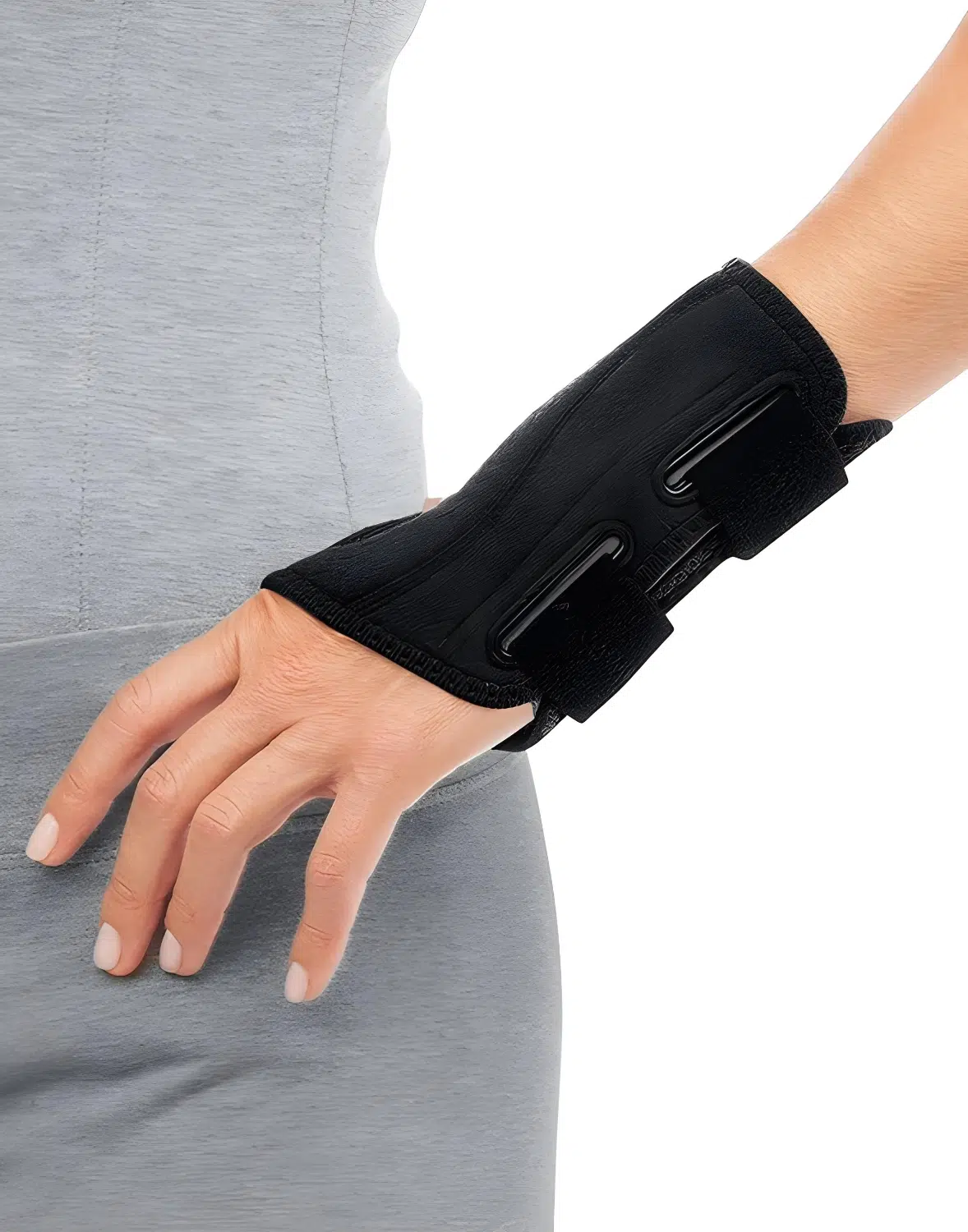
- Rigid wrist brace with dual aluminium splints that hold your wrist straighter and stop the extreme bending that triggers pain.
- For carpal tunnel syndrome, wrist sprains, tendonitis, arthritis, and post-injury recovery—when you need firmer support than a soft wrap provides.
- Reduces pain by limiting the movements that compress nerves, strain ligaments, and irritate tendons while still allowing mid-range wrist movement for daily tasks.
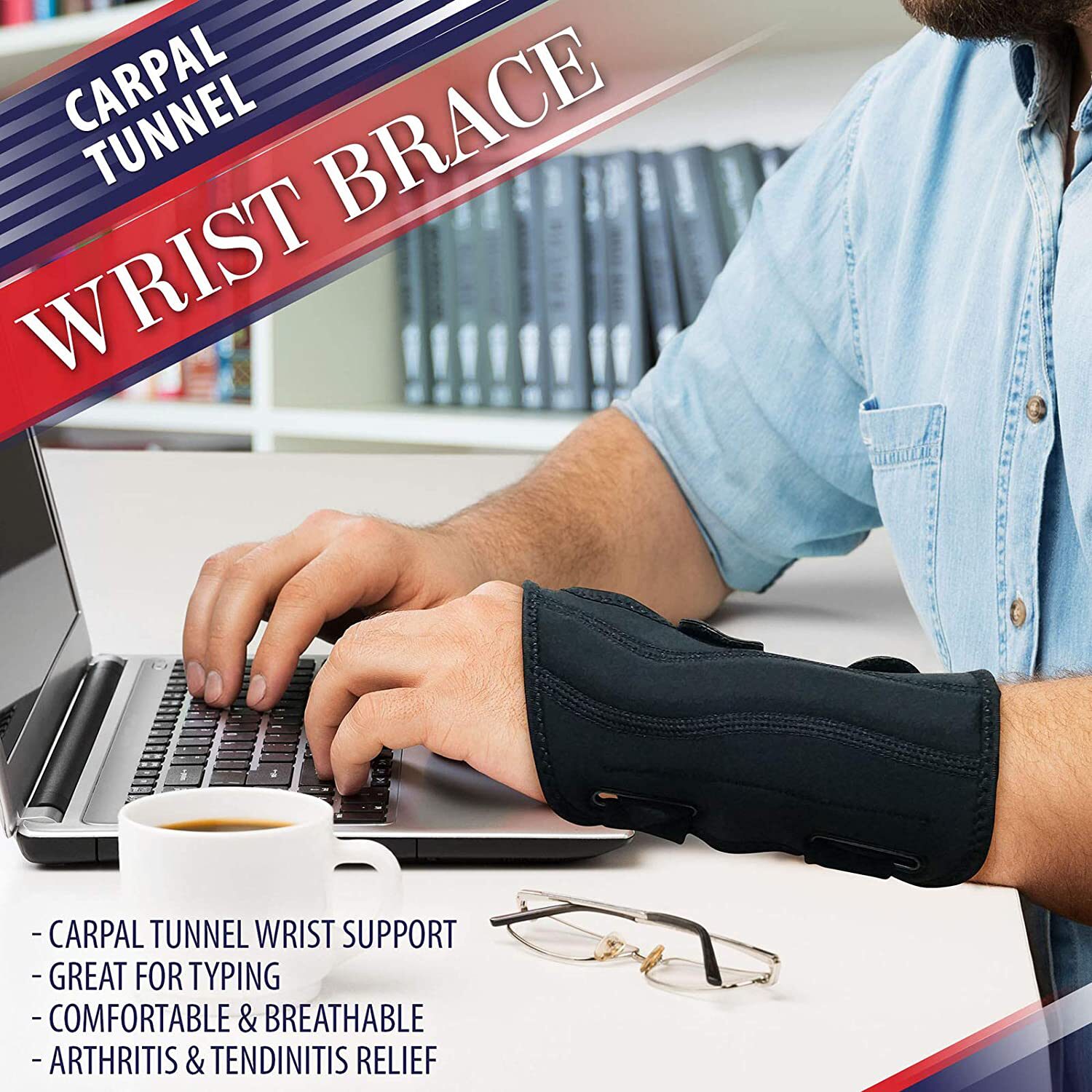
- Your fingers stay completely free—you can type, grip, drive, and handle objects while your wrist is supported.
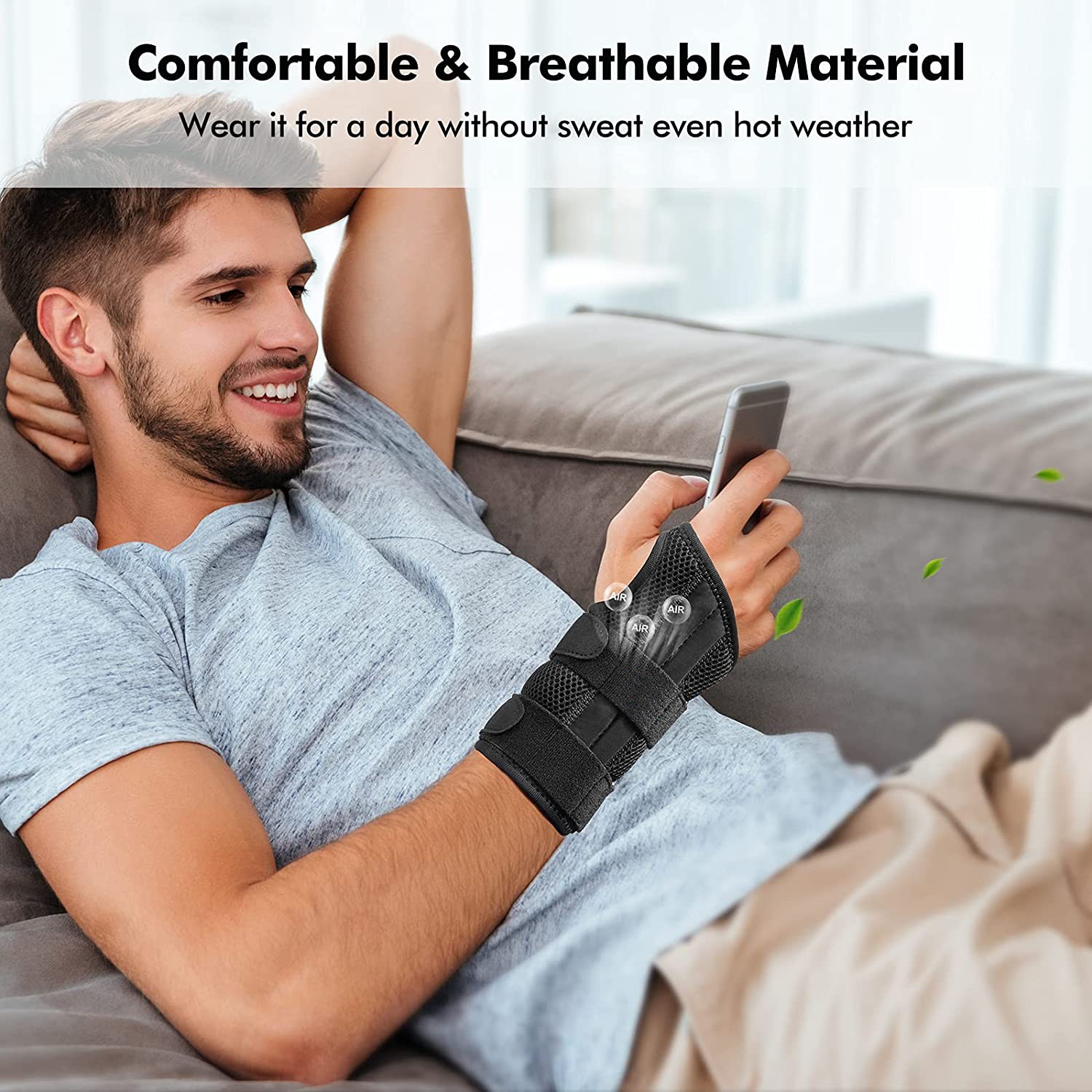
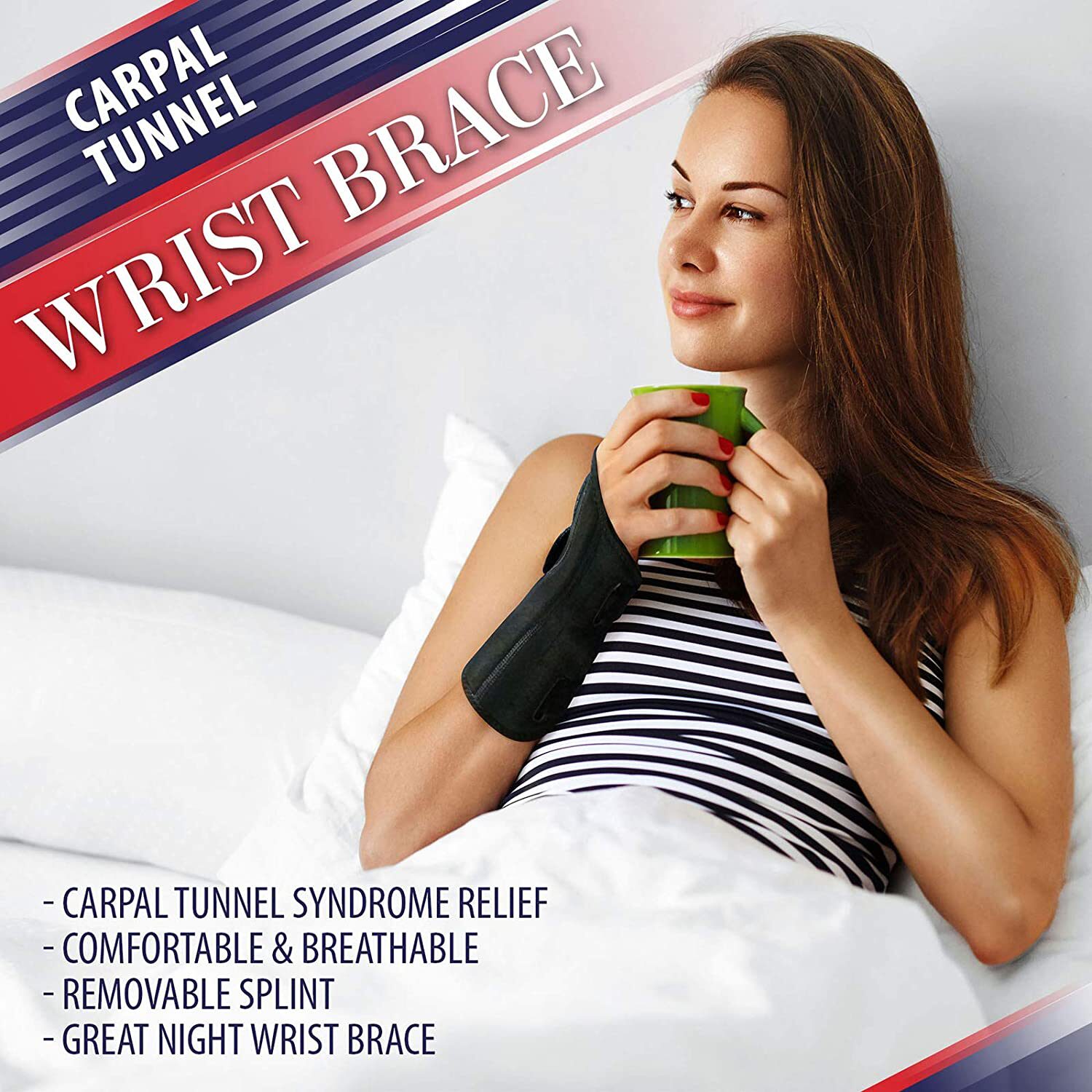
- Breathable neoprene with adjustable straps—wear during activities that stress your wrist, overnight if symptoms are worse at night, or both.
- Available in left and right versions, two sizes—measure your wrist circumference and refer to the sizing guide to select the correct size and hand.
- Not suitable for suspected fractures, open wounds, or active infection—seek medical assessment first if you have severe pain, visible deformity, or inability to move your wrist.
- 30-day try-it period—wear it through your usual days and return for a full refund if it doesn’t ease your symptoms or suit your wrist.
Rigid wrist brace with dual aluminium splints
When your wrist hurts with every grip, every keystroke, every time you push yourself up from a chair, you need more than a soft wrap that provides gentle squeezing. You need rigid splints that physically stop your wrist bending to the positions that trigger your symptoms—extreme flexion that compresses nerves, extreme extension that strains ligaments, twisting that grinds inflamed joints.
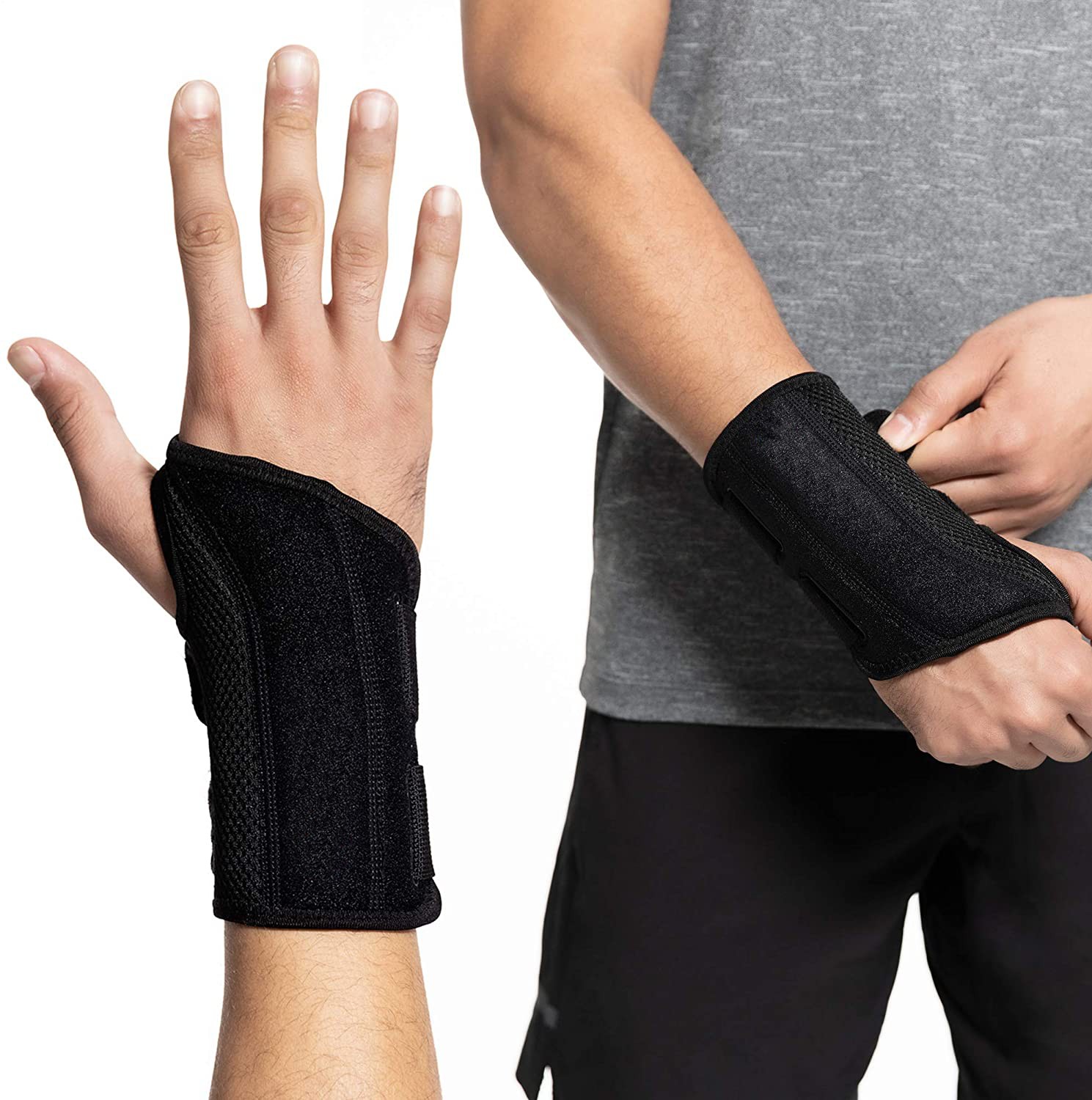
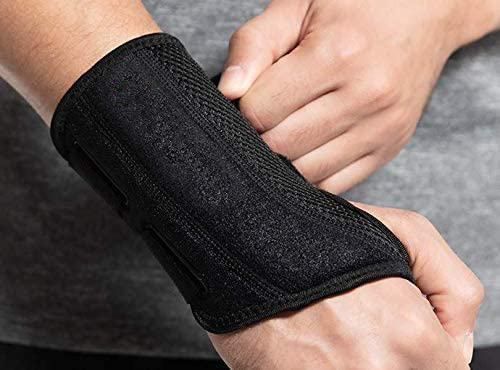
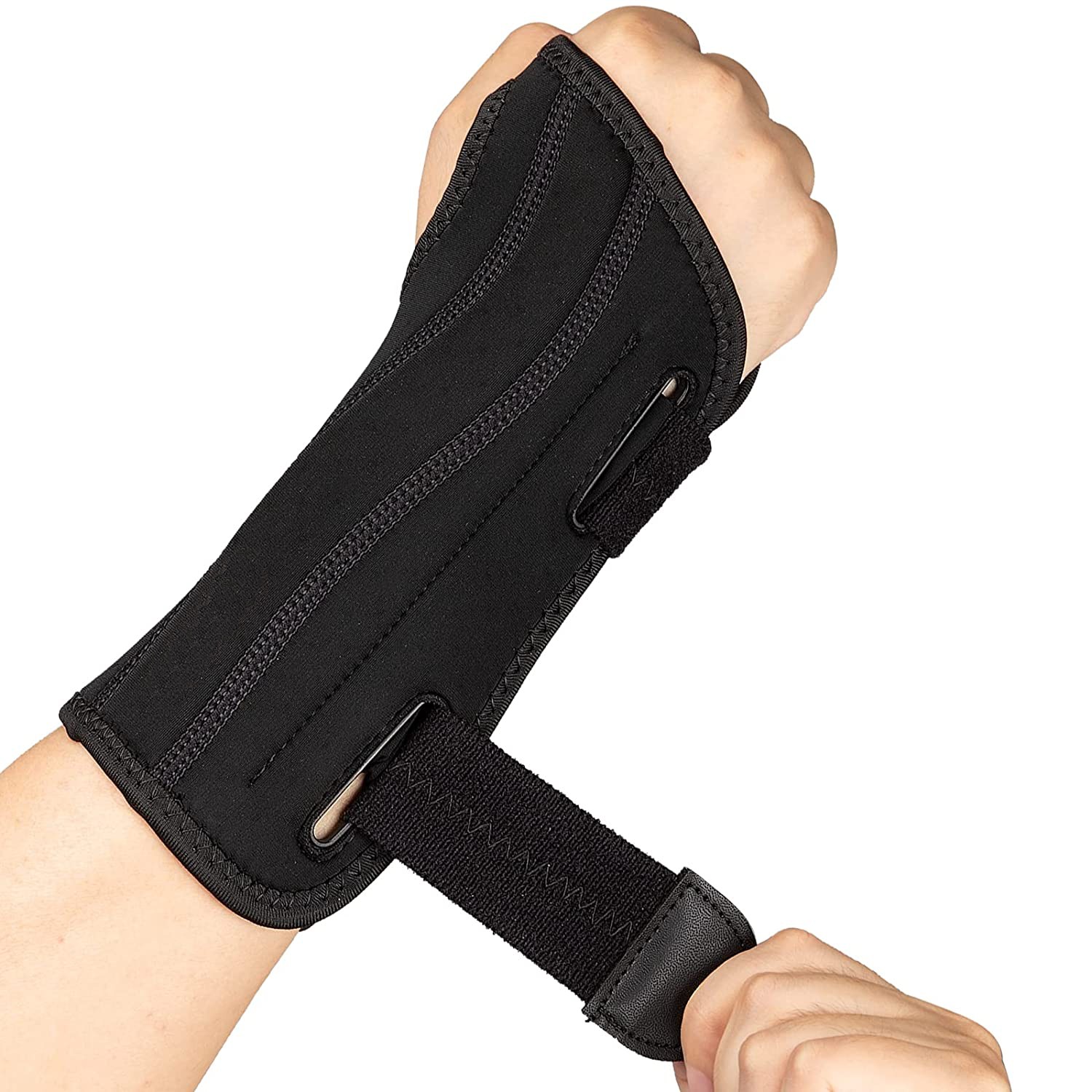
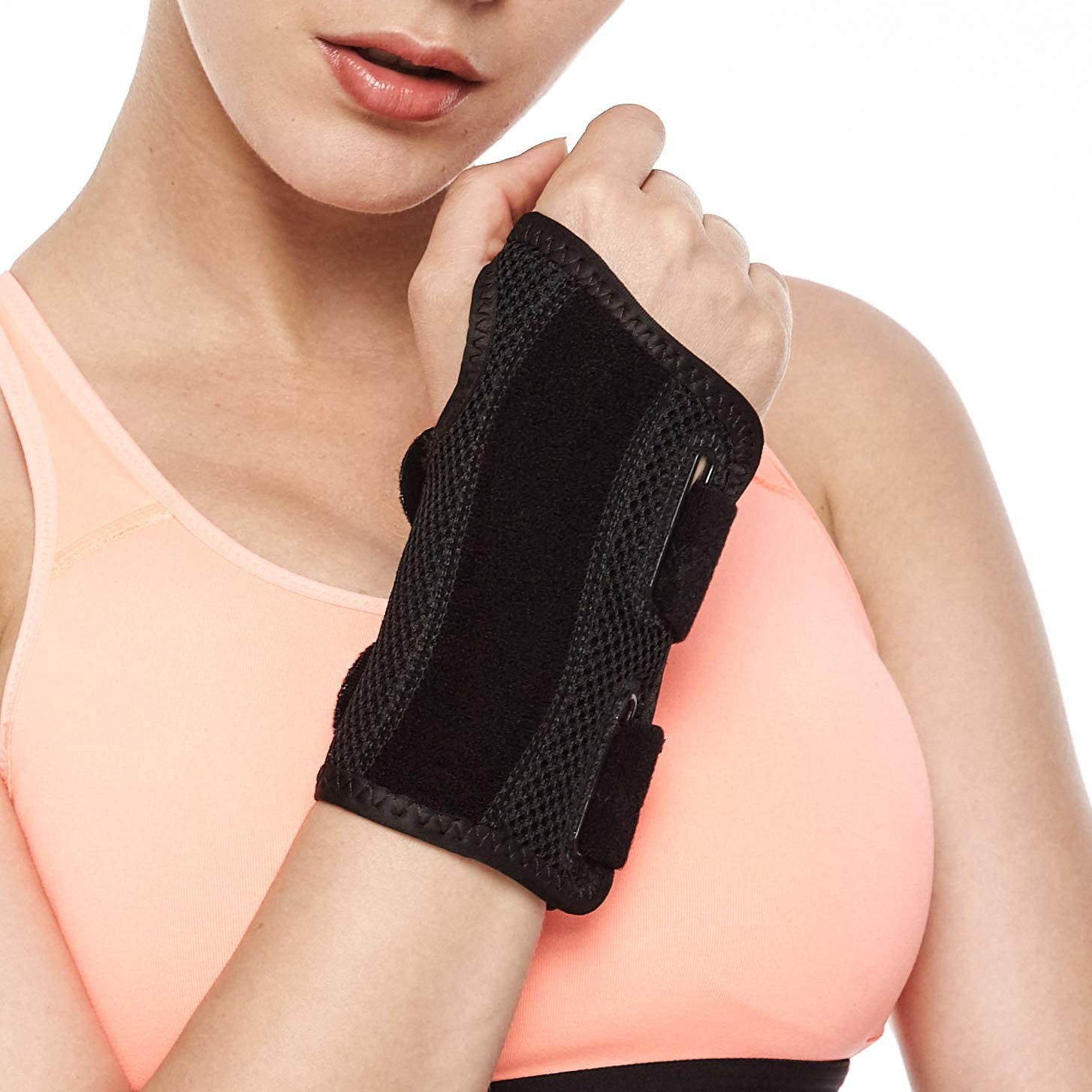
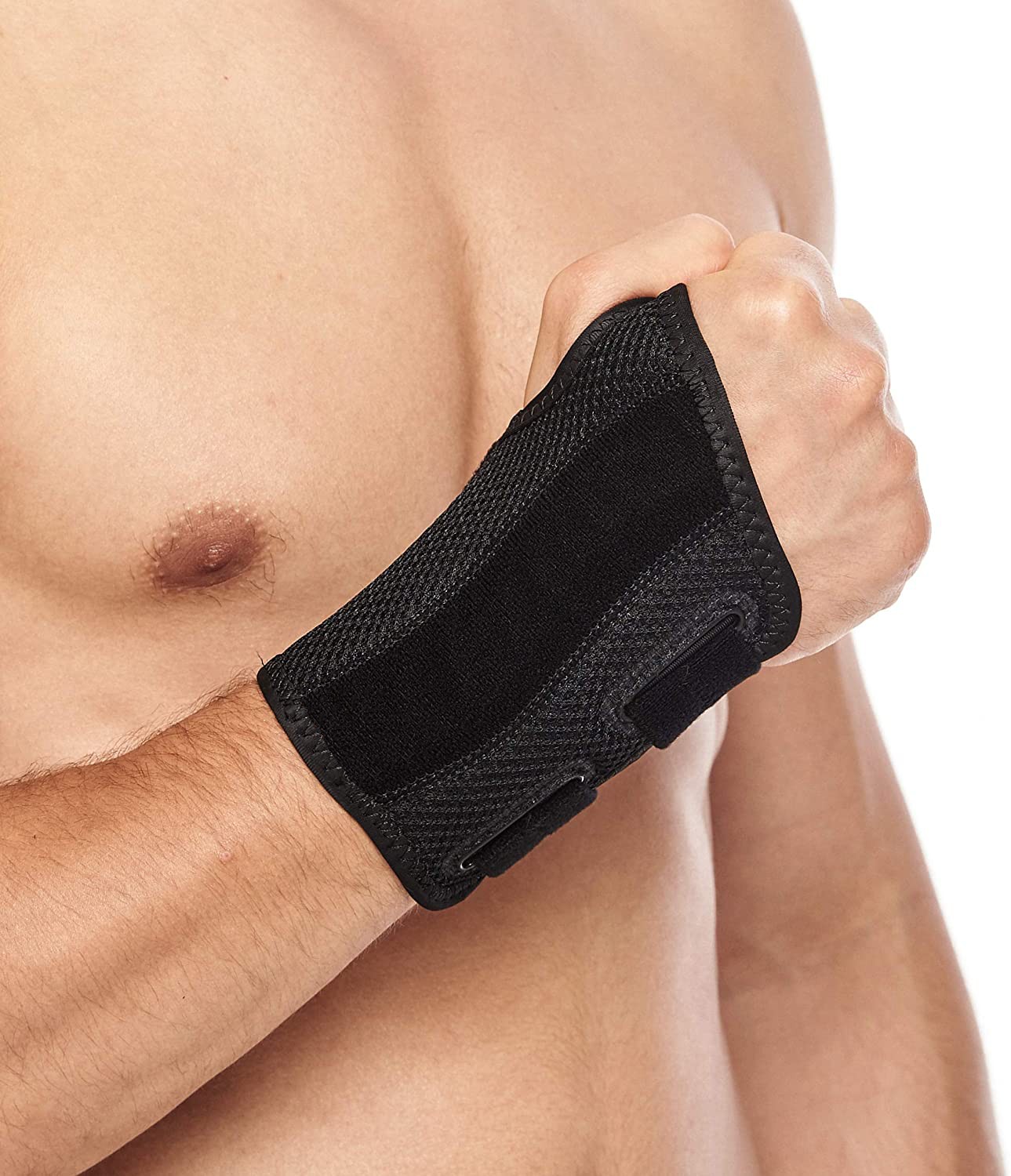
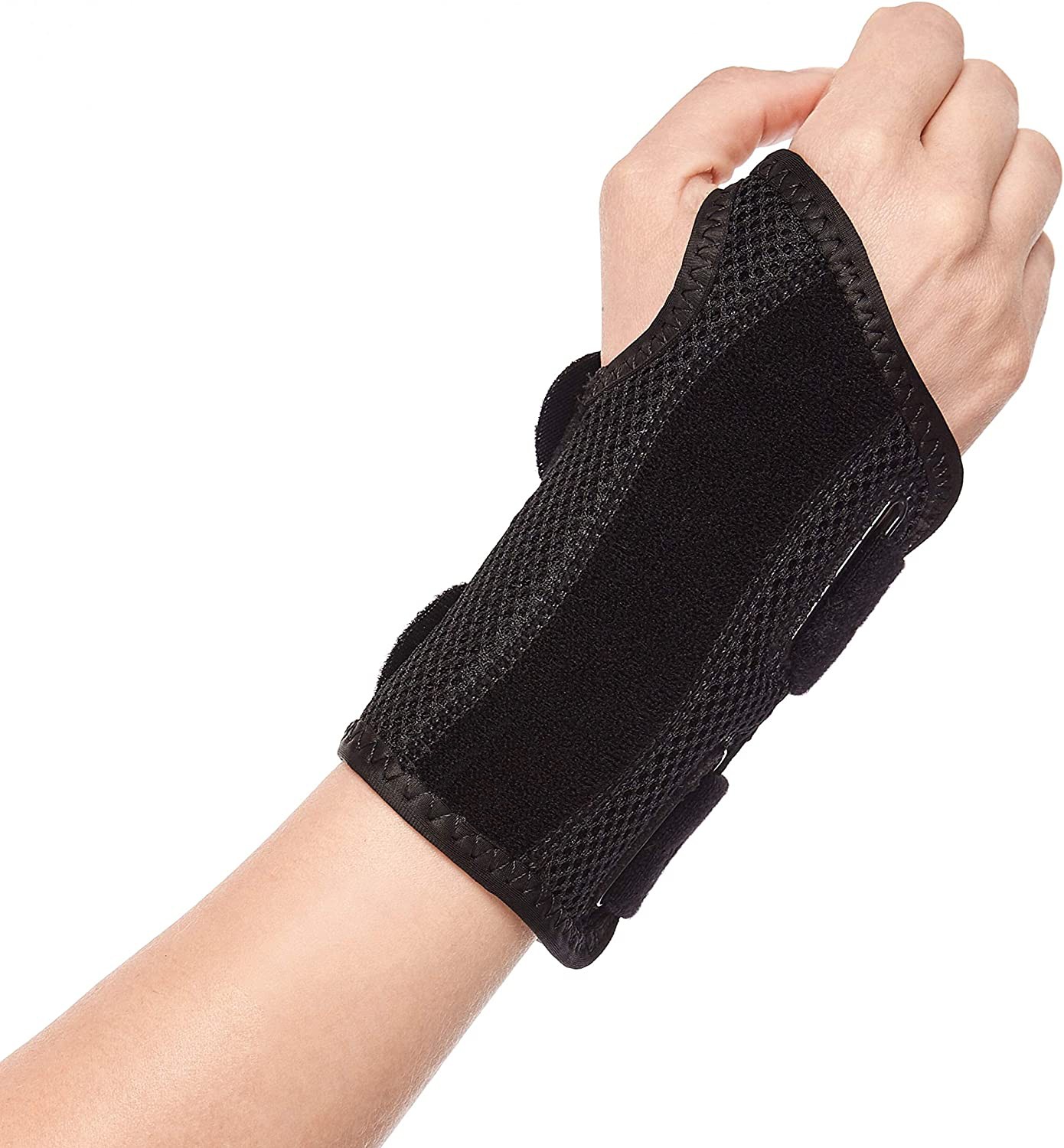
This wrist brace holds your wrist in a straighter, more neutral position using shaped aluminium splints along your palm and the back of your forearm. The splints are firm and won’t bend during use. Two wide adjustable straps let you control how snug the fit feels, and the open-finger design leaves your thumb and fingers free to grip, type, and handle objects while your wrist is supported.
It’s designed for conditions where extreme wrist bending triggers or worsens symptoms: carpal tunnel syndrome, wrist sprains, tendonitis, arthritis, and post-surgical recovery. You’ll wear it during activities that stress your wrist—typing, lifting, gripping, manual work—and overnight if symptoms are worse at night. Remove it several times daily for gentle movement and exercises to prevent stiffness.
The brace can reduce pain, protect healing tissues, provide external support when ligaments are weakened, and help you stay active while you recover. It can’t treat underlying inflammatory disease, heal severe structural damage, or replace the exercises you need to rebuild strength and control. It works best when combined with activity changes and, in some cases, medical treatment.
NuovaHealth offers a 30-day try-it period. Wear the brace through your usual days and see whether it eases your symptoms and feels comfortable during real-world use. If it doesn’t help or doesn’t suit your wrist, return it for a full refund.
Should you try bracing or seek assessment first?
You can try bracing first if your symptoms fit a clear pattern—tingling and numbness in specific fingers that’s worse at night (carpal tunnel syndrome), pain after a recent wrist injury that’s improving gradually (mild sprain), or wrist pain and stiffness that’s worse with activity and better with rest (arthritis or tendonitis). These conditions often respond to bracing, activity changes, and exercises, and you can try these measures for two to four weeks before seeking assessment.
If symptoms improve, continue with the measures that helped. If symptoms don’t improve or get worse, see your GP or physiotherapist—you may need a formal diagnosis, additional treatment, or a different approach.
Get it checked first if you have severe pain that’s not settling with rest, visible deformity, inability to move your wrist, or inability to bear weight through your hand. These symptoms suggest a fracture, complete ligament rupture, or other serious injury that needs urgent medical attention.
Seek assessment if your symptoms don’t fit a clear pattern—pain that’s difficult to describe, symptoms that move around, or symptoms that don’t match any of the conditions described below. You may have an unusual condition, a combination of problems, or something that needs investigation.
Get advice if you have red flags—fever, unexplained weight loss, night sweats, severe swelling that doesn’t respond to elevation, spreading redness or warmth, or symptoms that are getting rapidly worse. These can indicate infection, inflammatory disease, or other serious problems that need medical attention.
What makes your wrist vulnerable
Your wrist is a complex joint where eight small bones sit between your forearm and hand, held together by ligaments and moved by tendons that run from your forearm muscles. Three major nerves pass through narrow tunnels at your wrist, carrying signals to and from your hand. This compact arrangement allows the precise movements you need for gripping, typing, and manipulating objects, but it also makes your wrist vulnerable when you bend it to extremes, hold it in awkward positions for long periods, or load it repeatedly.
When you bend your wrist fully forward (flexion) or backward (extension), the space inside the wrist narrows. Nerves get compressed, tendons are forced to change direction sharply, and ligaments stretch. If you hold these positions briefly—reaching for something, pushing a door open—your wrist tolerates it. If you hold them for hours—typing with your wrists dropped, sleeping with your hand curled under your pillow—or repeat them thousands of times a day, the structures inside your wrist become irritated, inflamed, or damaged.
Injuries add another layer of vulnerability. A fall onto an outstretched hand can tear ligaments, fracture bones, or damage cartilage. Even after the acute injury heals, your wrist may remain unstable or painful because the ligaments haven’t regained their normal tension or the bones don’t sit in their usual positions. Arthritis—whether from wear and tear over decades or from immune system dysfunction—gradually erodes the cartilage that cushions your wrist bones, leaving bone rubbing on bone and causing pain, stiffness, and swelling.
How this brace works
Dual splint design
The brace uses two shaped aluminium splints—one along your palm from the base of your thumb down towards your wrist crease, and one along the back of your forearm. These splints hold your wrist in a straighter, more neutral position, preventing the extreme bending that triggers your symptoms. The splints are firm and won’t bend during use, so your wrist stays supported even when you’re gripping, lifting, or putting weight through your hand.
The palm splint sits in the hollow of your palm and extends down to your wrist. It stops your wrist bending fully forward (flexion), which is the position that compresses the median nerve in carpal tunnel syndrome and increases friction inside tendon sheaths in tendonitis. The back splint runs along the back of your forearm and stops your wrist bending fully backward (extension), which is the position that strains ligaments in sprains and grinds inflamed joint surfaces together in arthritis.
Together, the splints create a rigid frame that limits extreme movement while still allowing mid-range wrist motion. You’re not immobilised—you can still move your wrist enough to do daily tasks—but you can’t bend it to the positions that cause pain.
Adjustable squeezing
Two wide straps wrap around your wrist and forearm, fastening with hook-and-loop closures. You can adjust each strap independently to control how snug the fit feels. The straps provide gentle squeezing (compression) that helps manage swelling by encouraging fluid to move out of the tissues and back into circulation. Squeezing also provides sensory feedback that can reduce pain—your brain receives pressure signals that compete with pain signals, making the pain feel less intense.
The wrist strap usually provides the firmest squeeze and support. The forearm strap holds the back splint in place and should be firm but comfortable. You can adjust the straps throughout the day as swelling changes or as you move between rest and activity.
Thumb loop and open fingers
A thumb loop anchors the brace in place and prevents it sliding down your forearm during use. Your thumb slides through the loop, which sits comfortably at the base of your thumb without restricting thumb movement. Your fingers remain completely free—no straps, splints, or fabric covering them—so you can grip, type, use tools, and handle objects while your wrist is supported.
This open-finger design is important because most wrist problems don’t require finger immobilisation. Your fingers need to move freely to maintain dexterity and prevent stiffness. The brace supports your wrist while allowing your hand to function normally.
What it can and can’t do
The brace can reduce pain by limiting the movements that trigger your symptoms. It can protect healing tissues after injury or surgery by preventing extreme positions that stress damaged structures. It can provide external support when ligaments are weakened by injury or arthritis. It can help manage swelling through gentle squeezing. It can help you stay active during recovery by supporting your wrist during higher-demand tasks.
The brace can’t treat underlying inflammatory disease—conditions like rheumatoid arthritis need medication that controls the immune process. It can’t heal severe structural damage like complete ligament tears or advanced arthritis—these may need surgery. It can’t prevent all re-injury if you return to the activities that caused the problem without modifying them. It can’t replace the exercises you need to rebuild strength, control, and endurance.
What makes this different from other wrist supports
Soft wrist supports and compression sleeves
Soft wrist supports and compression sleeves provide gentle squeezing and warmth, which can help manage mild swelling and provide a sense of support. They don’t limit wrist movement, though. If your symptoms are triggered by extreme wrist bending—typing with your wrists dropped, gripping with your wrist cocked back, sleeping with your hand curled under your pillow—a soft support won’t stop those movements. You need rigid splints that physically prevent your wrist bending to the positions that trigger your symptoms. This brace provides that control.
Rigid immobilisation braces
Rigid immobilisation braces hold your wrist completely still, preventing almost all movement. These are used after fractures, surgery, or severe ligament injuries when complete rest is needed for healing. They’re not suitable for conditions where you need to maintain some movement to prevent stiffness—carpal tunnel syndrome, tendonitis, mild sprains, arthritis. This brace sits between soft supports and rigid immobilisation: it limits extreme bending but allows mid-range movement, so you can use your hand for daily tasks while your wrist is protected.
Thumb spica braces
Thumb spica braces support both your wrist and your thumb. They’re used for conditions where thumb movement contributes to symptoms—De Quervain’s tenosynovitis, thumb arthritis, scaphoid fractures. If your symptoms are mainly in your wrist and aren’t triggered by thumb movement, a thumb spica brace is unnecessarily restrictive and will limit your hand function more than needed. This wrist brace leaves your thumb free, so you can grip, pinch, and use your hand normally while your wrist is supported.
Custom-made splints
Custom-made splints are moulded to your exact wrist shape by a hand therapist or orthotist. They provide a precise fit and can be tailored to your specific condition and movement needs. They’re more expensive and require specialist assessment and fitting, though. For most common wrist problems—carpal tunnel syndrome, sprains, tendonitis, arthritis—an off-the-shelf splinted brace like this one provides effective support at a lower cost and without the need for specialist fitting. If you’ve tried an off-the-shelf brace and it doesn’t fit comfortably or doesn’t provide adequate support, speak to a physiotherapist or hand therapist about whether a custom splint would be more suitable.
Does bracing actually work?
Yes—and here’s what the research shows. For carpal tunnel syndrome, studies consistently find that wearing a splinted brace overnight reduces tingling and numbness in people with mild to moderate symptoms. The brace holds your wrist in a position that takes pressure off the nerve, and many people notice improvement within a few weeks. Night-time bracing is particularly effective because it prevents your wrist curling into extreme flexion during sleep, which is when many people experience their worst symptoms. Bracing is often recommended as a first-line treatment before considering surgery.
For wrist sprains, bracing is a standard part of recovery. The brace provides external support while ligaments heal, reduces pain during movement and weight-bearing, and allows people to return to light activities sooner than complete rest alone. The evidence supports short-term bracing (typically four to eight weeks) combined with exercises and gradual return to activity, rather than prolonged immobilisation which can cause stiffness.
For post-surgical recovery, removable braces are commonly recommended after procedures like carpal tunnel release, ligament repair, and some fracture fixations. The brace protects healing tissues while allowing removal for exercises and wound care. The specific protocol—how long to wear the brace, when to remove it, which exercises to do—varies by procedure and surgeon preference.
For arthritis, the response varies between individuals. Some people find bracing reduces pain during activities and improves hand function, while others find it restrictive and prefer other management strategies. Bracing is generally considered one tool among many for arthritis management, alongside medication, exercises, activity changes, and joint protection strategies.
For tendonitis and repetitive strain injury, bracing is commonly used in clinical practice. The rationale is that limiting extreme wrist positions reduces friction and strain on inflamed tendons, allowing inflammation to settle. Bracing needs to be combined with activity changes and exercises to address the underlying causes of tendon overload.
Overall, splinted wrist braces are most effective when used as part of a broader treatment approach that includes activity changes, exercises, and in some cases medical treatment. Bracing alone is rarely enough to resolve wrist problems completely, but it can be a valuable tool for managing symptoms, protecting healing tissues, and allowing people to stay active while they recover.
Who this helps and condition-specific guidance
The brace works for several types of wrist problems. Below, they’re grouped by what’s actually going wrong inside your wrist—nerve compression, ligament damage, tendon overload, or arthritis.
Nerve compression
Carpal tunnel syndrome
You have tingling, numbness, or pins and needles in your thumb, index, middle, and ring fingers. Symptoms are often worse at night or first thing in the morning, and you may wake with your hand feeling numb and painful. You might shake your hand to relieve the tingling, or notice weakness when gripping objects. Carpal tunnel syndrome happens when the median nerve gets compressed as it passes through a narrow tunnel at your wrist. The tunnel is formed by wrist bones on three sides and a thick ligament across the front. Anything that narrows the tunnel or increases pressure inside it—swelling, inflammation, extreme wrist bending, wrist bone shape—can compress the nerve.
Limiting extreme wrist flexion reduces pressure on the nerve. Many people find overnight bracing particularly helpful because it prevents their wrist curling into flexion during sleep. You’ll also need to modify the activities that caused the problem—adjust your keyboard position so your wrists stay straighter during typing, take more frequent breaks during repetitive tasks, avoid gripping with your wrist bent. Combine bracing with nerve gliding exercises that help the nerve move more freely through the tunnel. Most people notice improvement within two to four weeks. If symptoms persist or worsen despite consistent use, see your GP—you may need nerve conduction studies and discussion about other treatment options including surgery.
Ulnar nerve compression at the wrist
You have tingling, numbness, or weakness in your little finger and the ring-finger side of your hand. Symptoms may be worse when you lean on your wrist or grip objects. Ulnar nerve compression at the wrist (Guyon’s canal syndrome) happens when the ulnar nerve gets compressed as it passes through a tunnel on the little-finger side of your wrist. Causes include direct pressure from leaning on your wrist, swelling, ganglion cysts, or fractures.
The brace can reduce symptoms by limiting extreme wrist positions and providing padding that reduces direct pressure on the nerve tunnel. You’ll also need to avoid leaning on your wrist—use padded grips on tools, adjust your workstation, take breaks during activities that put pressure on the little-finger side of your wrist. If symptoms don’t improve within a few weeks, arrange an assessment—you may need imaging to check for cysts or other structural problems, and in some cases surgery to release the nerve.
Ligament injuries and instability
Wrist sprain (mild to moderate)
You’ve injured your wrist—fallen onto an outstretched hand, twisted it during sport, or strained it lifting something heavy. Your wrist is swollen, painful, and tender to touch, and you have pain when you move it or put weight through your hand. A sprain means you’ve stretched or partially torn one or more of the ligaments that hold your wrist bones together. Mild sprains involve stretching with microscopic tears. Moderate sprains involve partial tearing of ligament fibres.
The brace provides external support while the ligaments heal, reduces pain during movement and weight-bearing, and allows you to do light activities without aggravating the injury. Wear it during activities that stress your wrist and remove it several times daily for gentle wrist movements to prevent stiffness. Avoid heavy lifting and high-impact activities for the first two to four weeks. As pain and swelling settle, gradually increase your activity while continuing to wear the brace during higher-demand tasks. Most sprains improve over four to eight weeks. If pain persists or your wrist feels unstable after this time, get it examined—you may have a more severe ligament tear that needs different treatment.
Chronic wrist instability
Your wrist feels loose, weak, or like it might give way during activities. You may have clicking, clunking, or a sense that your wrist bones aren’t sitting in the right position. This often develops after a previous wrist injury where ligaments didn’t heal with their normal tension, leaving your wrist bones able to move more than they should. Chronic instability can also develop gradually in people with ligament laxity or arthritis.
The brace provides external support that compensates for weakened ligaments, reducing pain and improving confidence during activities. It can’t restore normal ligament tension, though. You’ll also need strengthening exercises that build muscle control around your wrist to compensate for ligament laxity. If instability is severe or affecting your daily life significantly, speak to a hand specialist—you may need imaging to assess ligament damage and discussion about whether surgery to tighten or reconstruct ligaments would help.
Tendon problems and overuse
Wrist tendonitis
You have pain along the thumb side or little-finger side of your wrist that’s worse with gripping, twisting, or lifting. The pain may be sharp during movement and achy at rest. You might have swelling along the tendon path and tenderness when you press on the area. Tendonitis means the tendons that move your wrist and fingers have become inflamed and painful, usually from repetitive movements, sustained gripping, or a sudden increase in activity.
Limiting extreme wrist positions reduces friction inside the tendon sheaths (the tunnels the tendons slide through), allowing inflammation to settle. You’ll also need to modify the activities that caused the problem—reduce repetitive gripping, adjust your technique, take more frequent breaks, use tools with padded grips. Combine bracing with gentle tendon loading exercises that gradually rebuild tendon capacity. Most cases improve over four to eight weeks. If pain persists, see a physiotherapist—you may need a more detailed assessment of your movement patterns and a tailored exercise programme.
De Quervain’s tenosynovitis
You have pain on the thumb side of your wrist that’s worse when you grip, pinch, or move your thumb. The pain may shoot up your forearm or down into your thumb. You might have swelling and tenderness along the thumb side of your wrist, and a test where you tuck your thumb into your palm and bend your wrist towards your little finger reproduces the pain sharply. De Quervain’s tenosynovitis is inflammation of the tendons that move your thumb, where they pass through a tight tunnel at your wrist. It’s common in people who do repetitive thumb and wrist movements—texting, gaming, lifting babies, gardening.
This wrist brace can help by limiting wrist movement, but because thumb movement is a major trigger, a thumb spica brace that supports both your wrist and thumb may be more effective. Speak to a physiotherapist or hand therapist about which type of brace would work better for you. You’ll also need to reduce the activities that trigger symptoms—modify your grip, use voice-to-text instead of typing, take breaks during repetitive thumb movements. If symptoms don’t improve with bracing and activity changes, see your GP—you may benefit from a corticosteroid injection or, in persistent cases, surgery to release the tendon tunnel.
Intersection syndrome
You have pain on the back of your forearm, a few centimetres above your wrist. The pain is worse with gripping and wrist movement, and you might feel or hear creaking or squeaking when you move your wrist. Intersection syndrome is inflammation where two sets of thumb tendons cross over each other on the back of your forearm. It’s common in people who do repetitive wrist and thumb movements—rowing, weightlifting, racquet sports, manual work.
The brace can reduce pain by limiting the wrist movements that cause the tendons to rub against each other. You’ll also need to reduce or modify the activities that triggered the problem. Rest, ice, and anti-inflammatory medication can help settle acute inflammation. If symptoms persist, arrange an assessment—you may need physiotherapy or, in some cases, a corticosteroid injection.
Arthritis and joint degeneration
Osteoarthritis
Your wrist is stiff, achy, and swollen, especially after activity or first thing in the morning. You might have reduced range of movement, weakness with gripping, and pain when you put weight through your wrist. Osteoarthritis is wear and tear of the cartilage that cushions your wrist bones. Over time, the cartilage thins and roughens, leaving bone rubbing on bone. It’s more common in people who’ve had previous wrist fractures or ligament injuries, people who’ve done heavy manual work for years, or people with a family history of arthritis.
Limiting extreme wrist positions reduces pain by preventing the worn joint surfaces pressing together hardest. The gentle squeezing helps manage swelling. Wear the brace during activities that trigger pain and remove it during rest. Continue with gentle wrist movements and exercises to maintain mobility—arthritis stiffness often eases with movement. As flares settle, reduce wearing time gradually, keeping the brace handy for occasional use during higher-demand activities or future flares. Combine bracing with other arthritis management strategies—anti-inflammatory medication if suitable for you, heat or cold therapy, activity pacing. If symptoms are severe or affecting your daily life significantly, speak to your GP about other treatment options.
Rheumatoid arthritis and inflammatory arthritis
Your wrist is painful, swollen, and stiff, often affecting both wrists symmetrically. Stiffness is usually worse in the morning and lasts for more than 30 minutes. You may have other joints affected as well. Rheumatoid arthritis and other inflammatory types of arthritis are caused by your immune system attacking the lining of your joints, causing inflammation, pain, and over time, joint damage.
The brace can help manage pain and provide support during flares, but inflammatory arthritis needs medication prescribed by a rheumatologist to control the underlying immune process and prevent joint damage. Bracing is an add-on to medical treatment, not a replacement for it. Wear the brace during activities that trigger pain and during flares when your wrist is particularly swollen and painful. Continue with gentle exercises to maintain mobility and strength. If you haven’t been diagnosed with inflammatory arthritis but your symptoms fit this pattern, see your GP urgently—early treatment can prevent permanent joint damage.
Post-traumatic arthritis
You have wrist pain, stiffness, and swelling that developed months or years after a wrist fracture or severe ligament injury. Post-traumatic arthritis develops when previous injury has damaged the cartilage or changed the way your wrist bones sit together, causing uneven wear over time.
The brace can help manage symptoms by limiting painful movements and providing support, but it can’t reverse the underlying joint damage. Treatment is similar to osteoarthritis—bracing during activities that trigger pain, exercises to maintain mobility and strength, anti-inflammatory medication if suitable, activity pacing. If symptoms are severe, speak to a hand specialist about other options including injections or, in some cases, surgery.
Other structural problems
Ganglion cyst
You have a visible lump on your wrist—usually on the back, sometimes on the palm side—that may be soft or firm, and may change size. The lump itself may not hurt, but you might have pain, weakness, or clicking when you move your wrist, especially if the cyst is pressing on a tendon, ligament, or nerve. A ganglion cyst is a fluid-filled sac that develops from the joint lining or a tendon sheath. The cause isn’t always clear, but they’re more common after wrist injuries or in people with arthritis.
The brace can reduce pain and provide support if the cyst is causing mechanical symptoms—pain with movement, weakness, or instability. The brace won’t make the cyst disappear, though. Many ganglion cysts resolve on their own over months to years. Treatment options include draining the fluid with a needle (aspiration) or surgical removal if the cyst is causing significant symptoms or keeps coming back. Speak to your GP or hand specialist if the cyst is painful, growing, or affecting your wrist function.
Kienböck’s disease
You have wrist pain, stiffness, and swelling that’s developed gradually, often without an obvious injury. The pain is usually on the thumb side of your wrist and worse with gripping or weight-bearing. Kienböck’s disease is a condition where one of the small wrist bones (the lunate) loses its blood supply and begins to break down. It’s more common in people who’ve had wrist injuries or whose wrist bones are shaped in a way that restricts blood flow to the lunate.
The brace can reduce pain by limiting movements that load the damaged bone, but Kienböck’s disease needs specialist assessment and monitoring. Treatment depends on the stage of the disease and may include bracing, surgery to improve blood flow, or procedures to unload the lunate. If you suspect this condition, see a hand specialist. They’ll arrange X-rays or MRI to assess the bone and advise on treatment.
Post-surgical recovery
You’ve had wrist surgery—carpal tunnel release, ligament repair, fracture fixation, arthroscopy—and your surgeon or physiotherapist has recommended a removable brace as part of your recovery. The brace protects healing tissues by limiting movements that could stress the surgical site, while still allowing you to remove it for exercises, wound care, and personal hygiene.
Your surgeon or physiotherapist will give you specific instructions on when to wear the brace, when to remove it, and which exercises to do. Follow their guidance closely. Wearing the brace too much can cause stiffness, but removing it too soon or during high-risk activities can stress healing tissues and delay recovery. Most people need to wear the brace for several weeks after surgery, gradually reducing wearing time as healing progresses and strength returns.
If you develop increasing pain, swelling, redness, warmth, or any signs of infection around the surgical site, contact your surgical team immediately.
How people use this brace
Office worker with carpal tunnel syndrome
You work at a computer for most of the day and you’ve developed tingling and numbness in your thumb, index, and middle fingers. Symptoms are worse at night and first thing in the morning, and you’ve started waking with your hand feeling numb and painful. You’ve tried adjusting your workstation and taking more breaks, but symptoms persist.
Wear the brace overnight to prevent your wrist curling into flexion during sleep. This often reduces night-time tingling and improves sleep quality. During the day, wear it during long typing sessions or when symptoms flare, and remove it during breaks and low-demand tasks. Adjust your keyboard position so your wrists stay straighter during typing—the brace will encourage this by limiting extreme bending. Combine bracing with regular breaks, wrist stretches, and nerve gliding exercises. Most people notice improvement within two to four weeks. If symptoms persist or worsen despite consistent use, arrange an assessment—you may need nerve conduction studies and discussion about other treatment options.
Manual worker with wrist sprain
You’ve sprained your wrist lifting a heavy box at work. Your wrist is swollen, painful, and weak, and you’re struggling with tasks that involve gripping or weight-bearing. You’ve rested it for a few days but you need to return to work.
Wear the brace during work tasks that involve lifting, gripping, or weight-bearing, and remove it during rest breaks. The brace will reduce pain and provide external support while the ligaments heal, allowing you to do light duties without aggravating the injury. Avoid heavy lifting and high-impact activities for the first two to four weeks. As pain and swelling settle, gradually increase your activity while continuing to wear the brace during higher-demand tasks. Remove the brace several times daily for gentle wrist movements to prevent stiffness. Most sprains improve over four to eight weeks. If pain persists or your wrist feels unstable after this time, get it examined by a physiotherapist.
Person with wrist arthritis during a flare
You have osteoarthritis in your wrist and you’re going through a flare—your wrist is stiff, achy, and swollen, and tasks like opening jars, wringing out cloths, and pushing up from a chair are painful. You know the flare will settle eventually, but you need to manage symptoms while staying as active as possible.
Wear the brace during activities that trigger pain—household tasks, gardening, carrying shopping—and remove it during rest. The brace will reduce pain by limiting the extreme wrist positions that press worn joint surfaces together hardest, and the gentle squeezing will help manage swelling. Continue with gentle wrist movements and exercises to maintain mobility—arthritis stiffness often eases with movement. As the flare settles, reduce wearing time gradually, keeping the brace handy for occasional use during higher-demand activities or future flares. Combine bracing with other arthritis management strategies—anti-inflammatory medication if suitable for you, heat or cold therapy, activity pacing.
Post-carpal tunnel surgery recovery
You’ve had carpal tunnel release surgery and your surgeon has recommended a removable brace for the first few weeks of recovery. You need to protect the surgical site while still being able to remove the brace for wound care, exercises, and personal hygiene.
Wear the brace most of the time during the first two weeks after surgery, removing it only for wound care, gentle exercises as instructed by your surgeon or physiotherapist, and personal hygiene. The brace will protect healing tissues by limiting movements that could stress the surgical site. As healing progresses and your surgeon or physiotherapist advises, gradually reduce wearing time, using the brace during higher-demand activities while allowing your wrist to move freely during rest. Follow your surgeon’s specific instructions on when to wear the brace, when to remove it, and which exercises to do. Most people can stop wearing the brace entirely by six to eight weeks after surgery, once the wound has healed and strength has returned.
Repetitive strain injury from new hobby
You’ve taken up a new hobby—knitting, gaming, playing an instrument—and you’ve developed wrist pain and aching that’s gradually worsened over a few weeks. The pain is worse during and after your hobby, and you’re starting to notice discomfort during other tasks as well.
Wear the brace during your hobby and during other activities that trigger pain. The brace will reduce the strain that adds up over time by limiting extreme wrist positions. You also need to modify your technique or reduce the time you spend on the activity—take more frequent breaks, adjust your wrist posture, build up gradually rather than doing long sessions. Remove the brace several times daily for gentle wrist stretches and strengthening exercises. If symptoms don’t improve within two to four weeks of bracing and activity changes, arrange a physiotherapy assessment. A physiotherapist can identify contributing factors—poor technique, muscle imbalance, postural issues—and provide a tailored exercise programme.
Getting the right fit
Sizing
The brace is available in two sizes based on wrist circumference. Measure around your wrist at its narrowest point, just above the wrist crease where your hand meets your forearm. Use a flexible tape measure or a piece of string that you can measure afterwards. Don’t pull the tape tight—wrap it comfortably around your wrist as if you were fastening a watch strap.
- Size Small/Medium: Wrist circumference 14–18 cm
- Size Large/X-Large: Wrist circumference 18–22 cm
If your measurement falls on the boundary between sizes (exactly 18 cm), consider whether you prefer a snugger or looser fit. A snugger fit provides firmer support but may feel restrictive during long wearing periods. A looser fit is more comfortable for all-day wear but may provide less support. If you have significant swelling, choose the larger size—you can always tighten the straps, but you can’t make a too-small brace larger.
The brace is designed specifically for left or right wrists. The splints and thumb loop are positioned to match the anatomy of each hand, so the brace sits correctly and provides support where your wrist needs it. A left brace won’t work properly on your right wrist, and the other way round. Make sure you select the correct hand when ordering.
How to fit the brace
Slide your thumb through the thumb loop. The loop should sit comfortably at the base of your thumb without digging in or restricting thumb movement. Position the palm splint in the hollow of your palm, running from the base of your thumb down towards your wrist crease. The splint should sit flat against your palm, not twisted or angled to one side. Position the back splint centrally along the back of your forearm, running from just above your wrist up towards your elbow. The splint should sit flat against your forearm, not pressing into the sides of your wrist.
Once the splints are positioned correctly, fasten the wrist strap first. Wrap it around your wrist and fasten it snug but not tight—you should be able to slide one finger between the strap and your skin. The wrist strap usually provides the firmest support. Then fasten the forearm strap, wrapping it around your forearm and fastening it firm enough to hold the back splint in place but comfortable enough that it doesn’t dig in or restrict blood flow.
Check your fingers. They should stay warm, pink, and able to move freely. Wiggle your fingers, make a fist (as much as the brace allows), and check that you can feel light touch on your fingertips. If your fingers turn pale, blue, or cold, or if you lose sensation, the straps are too tight—loosen them immediately.
Common fitting mistakes
The most common mistake is fastening the straps before positioning the splints. If you fasten the straps first, the splints often end up twisted, angled, or sitting too high or too low. Always position the splints correctly first, then fasten the straps.
Another common mistake is fastening the straps too tight. Tighter doesn’t mean better support—the splints provide the support, not the straps. The straps just need to hold the splints in place and provide gentle squeezing. If the straps are so tight that your fingers turn pale or you lose sensation, you’re restricting blood flow and nerve function, which can cause more problems than the brace solves.
Some people position the brace too high on the forearm, leaving a gap between the palm splint and the base of the thumb. The palm splint needs to sit in the hollow of your palm to support your wrist effectively. If it’s too high, it won’t limit wrist flexion properly.
Some people try to wear the brace over thick clothing or bandages. The brace is designed to sit directly against your skin or over a thin layer of clothing. If you wear it over thick fabric, the splints can’t provide effective support and the straps won’t hold the brace in place properly.
How to wear the brace
When to wear it
Wear the brace during activities that stress your wrist or trigger your symptoms—typing, gripping, lifting, manual work, household tasks, sports. Wear it overnight if symptoms are worse at night or first thing in the morning, which is common in carpal tunnel syndrome. Remove it during rest periods and low-demand activities when your wrist isn’t under stress.
You don’t need to wear the brace 24 hours a day. Your wrist needs to move regularly to prevent stiffness and maintain the muscle activity that supports joint health. Aim to remove the brace for at least 15–20 minutes every few hours during the day to do gentle wrist movements and exercises.
How long to wear it
Most people need the brace for a few weeks to a few months, depending on their condition and how quickly symptoms improve. Recent injuries and acute flares often improve within four to eight weeks. Long-standing conditions may need longer-term on-and-off use—wearing the brace during flares or higher-demand activities and removing it when symptoms are well controlled.
Give it one to two weeks of consistent use before deciding whether it’s helping. Some people notice improvement within a few days, but most conditions take at least a week or two to respond. If symptoms haven’t improved after six to eight weeks of consistent use, arrange an assessment—you may need a different approach or additional treatment.
Removing for movement and exercises
Remove the brace several times daily for gentle wrist movements. Move your wrist slowly through its comfortable range—bend it forward and back, side to side, and rotate your forearm so your palm faces up and down. Don’t force movement into painful ranges, but do move through the ranges that feel comfortable. This prevents stiffness and maintains the mobility you’ll need once you stop wearing the brace.
If you’ve been given exercises by a physiotherapist or hand therapist, do them consistently with the brace removed. Exercises are essential for rebuilding strength, control, and endurance. The brace can reduce pain and protect healing tissues, but it can’t rebuild the muscle function you need for long-term recovery.
Adjusting throughout the day
You can adjust the straps throughout the day as swelling changes or as you move between rest and activity. Swelling is often worse first thing in the morning or after periods of activity, so you may need to loosen the straps slightly at these times. As swelling reduces during the day or after rest, you may be able to tighten the straps for firmer support.
If the brace feels uncomfortable or restrictive, check that the splints are still positioned correctly—they can shift during movement. Reposition them if needed, then refasten the straps.
What to expect
First few days
The brace will feel unfamiliar for the first few days. Your wrist is used to moving freely, and the splints will restrict some of that movement. This is normal. You may need to adjust how you do certain tasks—typing, gripping, lifting—because you can’t bend your wrist to the positions you’re used to. This adjustment period usually lasts a few days.
Some people notice immediate pain relief when they first wear the brace, especially if their symptoms are triggered by extreme wrist positions. Others notice gradual improvement over the first week or two as inflammation settles and tissues begin to heal. Don’t expect instant results for all conditions—healing takes time.
How quickly symptoms improve
This depends on your condition, how severe it is, and how long you’ve had symptoms. Recent injuries and acute flares often improve within a few weeks. Long-standing conditions may take longer and may not resolve completely—the goal is to reduce symptoms to a manageable level and prevent them worsening.
Carpal tunnel symptoms often improve within two to four weeks of consistent overnight bracing. Sprains typically improve over four to eight weeks. Tendonitis may take four to twelve weeks, depending on severity. Arthritis symptoms may improve during flares but are unlikely to resolve completely—the goal is to manage pain and maintain function.
If symptoms worsen
If your symptoms get worse while wearing the brace, stop and check the fit. Make sure the splints are positioned correctly and the straps aren’t too tight. If the fit is correct but symptoms are still worsening, remove the brace and arrange an assessment. Worsening symptoms can indicate that the brace isn’t suitable for your condition, the diagnosis is wrong, or you need additional treatment.
Weaning off the brace
As your symptoms improve, gradually reduce how much you wear the brace. Start by removing it during low-demand activities—sitting at rest, light household tasks, short walks. If you can do these activities without significant pain, progress to removing it during slightly higher-demand tasks—longer periods of typing, light lifting, gentle exercise. Continue wearing it during the highest-demand activities until you can do those without significant pain as well.
This gradual approach allows your wrist to adapt to increasing loads without triggering a flare. If symptoms return when you reduce wearing time, go back to wearing the brace more often for another week or two, then try reducing again.
Keep the brace handy even after you’ve stopped wearing it regularly. Many conditions can flare occasionally—after a period of higher activity, during cold weather, or without obvious trigger. Having the brace available means you can manage flares quickly without waiting for symptoms to become severe.
Care and maintenance
Hand wash in cool water with mild soap or detergent, rinse thoroughly, and air dry away from direct heat. Don’t machine wash, tumble dry, or iron—heat can damage the neoprene and distort the aluminium splints. If the brace becomes damp with sweat during wear, remove it and allow it to dry fully before wearing it again.
Check the splints regularly to make sure they haven’t bent or distorted. The splints should remain flat and firm. If they’ve bent, you can carefully reshape them by hand, but if they’ve cracked or broken, the brace should be replaced.
Check the hook-and-loop fasteners regularly. They can lose their grip with repeated use, especially if they get clogged with lint or fabric fibres. Pick off any debris and press the fasteners together firmly to restore grip. If they no longer hold securely, the brace should be replaced.
With proper care, the brace should last several months of regular use. Most people need the brace for a few weeks to a few months, so one brace is usually enough for a full course of treatment.
30-day try-it period
NuovaHealth offers a 30-day try-it period. You can wear the brace through your usual days—work, home, exercise—and see whether it eases your symptoms and feels comfortable during real-world use. If it doesn’t help or doesn’t suit your wrist, return it for a full refund. You can test whether a splinted brace actually helps your wrist before you commit to keeping it.
Summary checklist
- Choose the correct size and hand using the sizing guide and ensuring you select left or right to match your affected wrist.
- Position the splints correctly before fastening the straps—palm splint in the hollow of your palm, back splint centrally along the back of your forearm.
- Fasten the straps snug but not tight—your fingers should stay warm, pink, and able to move freely.
- Wear during activities that stress your wrist and overnight if symptoms are worse at night.
- Remove several times daily for gentle movement and exercises to prevent stiffness.
- Modify the activities that triggered your symptoms—adjust your workstation, improve your technique, take more frequent breaks.
- Do your exercises consistently if you’ve been given them, or arrange a physiotherapy assessment if symptoms aren’t improving.
- Give it one to two weeks of consistent use before deciding whether it’s helping.
- Arrange an assessment if symptoms haven’t improved after six to eight weeks, or if you develop new symptoms, increasing pain, or signs of infection.
- Wean gradually once you can do low-demand activities without significant pain, keeping the brace handy for occasional use during flares or higher-demand activities.
Common questions about fitting, wearing, and caring for the brace
Can I wear this overnight?
Yes. Many people wear the brace overnight to prevent their wrist curling into extreme positions during sleep, which can trigger or worsen symptoms—especially carpal tunnel syndrome. If you wake with tingling, numbness, or pain in your hand, wearing the brace overnight often helps. Make sure the straps aren’t too tight before you go to sleep, and check your fingers are warm and pink when you wake.
Can I wear this during exercise or sport?
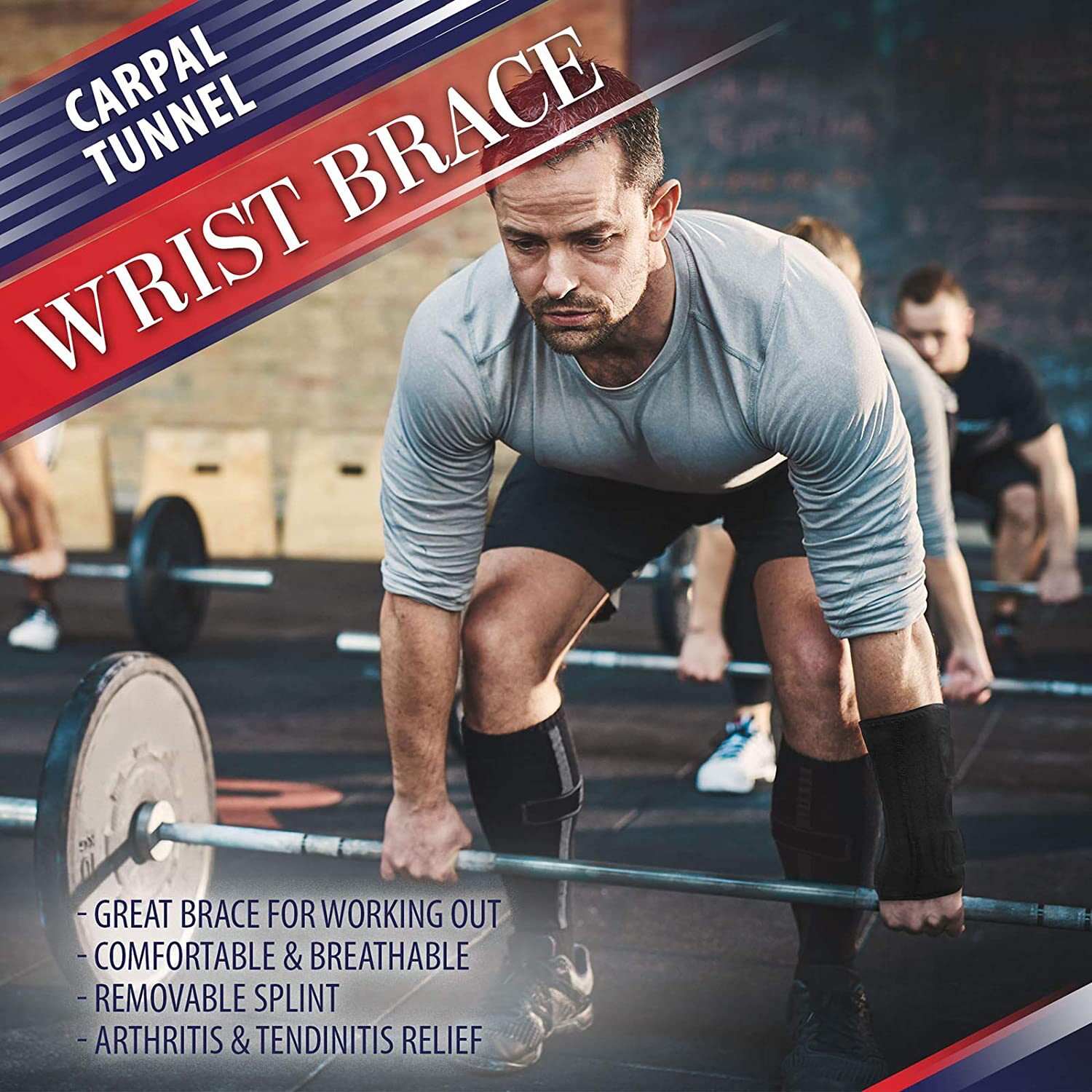
You can wear the brace during light exercise and activities that don’t require full wrist movement—walking, cycling on a stationary bike, light resistance training with your wrist supported. It’s not suitable for activities that require full wrist bending, twisting, or impact—press-ups, heavy weightlifting, racquet sports, contact sports. These activities either can’t be done safely while wearing the brace, or they place forces on your wrist that exceed what the brace can protect against. Speak to a physiotherapist or hand specialist about when it’s safe to return to higher-demand sport and exercise.
Can I type while wearing this?
Yes. Your fingers remain free, so you can type, use a mouse, and handle objects while your wrist is supported. The brace limits extreme wrist bending, so you may need to adjust your keyboard position or wrist posture to keep your wrists straighter during typing. This is actually beneficial—it encourages better wrist posture and reduces the strain that contributes to repetitive strain injury and carpal tunnel syndrome.
Can I drive while wearing this?
You can drive while wearing the brace if you can grip the steering wheel comfortably, operate the controls safely, and react quickly in an emergency. The brace limits extreme wrist bending but allows mid-range movement, so most people can drive safely while wearing it. If the brace restricts your movement so much that you can’t control the vehicle safely, don’t drive. You’re legally responsible for ensuring you can control your vehicle safely, and you should inform your insurance company if you’re wearing a brace while driving.
Do I need a left or right version?
Yes. The brace is designed specifically for left or right wrists. The splints and thumb loop are positioned to match the anatomy of each hand, so the brace sits correctly and provides support where your wrist needs it. A left brace won’t work properly on your right wrist, and the other way round. Make sure you select the correct hand when ordering.
Can I wash this?
Yes. Hand wash in cool water with mild soap or detergent, rinse thoroughly, and air dry away from direct heat. Don’t machine wash, tumble dry, or iron—heat can damage the neoprene and distort the aluminium splints. If the brace becomes damp with sweat during wear, remove it and allow it to dry fully before wearing it again.
How long will this last?
With proper care, the brace should last several months of regular use. The neoprene may lose some elasticity over time, and the hook-and-loop fasteners may lose their grip with repeated use. If the brace no longer holds securely or feels less supportive, it should be replaced. Most people need the brace for a few weeks to a few months, so one brace is usually enough for a full course of treatment.
Can I wear this on both wrists at the same time?
You can wear braces on both wrists if both are symptomatic, but this will significantly limit your hand function. You’ll struggle with tasks that require two hands working together—fastening buttons, preparing food, personal care. If both wrists are painful, consider wearing the brace on your more symptomatic wrist during the day and alternating to the other wrist overnight, or wearing both overnight and removing them during the day for activities. Speak to a physiotherapist if both wrists are affected—you may need assessment to identify why both sides are symptomatic and whether there’s an underlying condition that needs treatment.
Will this cure my condition?
The brace is a tool to manage symptoms and protect your wrist while tissues heal or while you rebuild strength and control. It can help conditions improve by reducing mechanical strain and allowing healing, but it can’t cure underlying structural damage, inflammatory disease, or nerve compression that needs surgery. Whether your condition improves, stays stable, or progresses depends on what’s causing it, how severe it is, and what other treatment you receive alongside bracing. Most recent injuries improve with bracing, activity changes, and exercises. Long-standing conditions may need ongoing management.
Is this suitable during pregnancy?
Yes. Carpal tunnel symptoms are common during pregnancy due to fluid retention and hormonal changes that increase pressure on the median nerve. The brace can help manage symptoms by holding your wrist in a position that reduces nerve compression, especially overnight. Symptoms often settle after delivery as fluid retention reduces. If symptoms are severe or persist after delivery, speak to your GP or midwife.
Can I wear this if I have diabetes?
You can wear the brace if you have diabetes, but you need to be more cautious about checking your skin and circulation. Diabetes can reduce sensation in your hands and feet (peripheral neuropathy) and can affect blood flow (peripheral vascular disease). Check your fingers regularly while wearing the brace to make sure they stay warm, pink, and able to move freely. Check your skin for any signs of pressure, redness, or irritation. If you notice any problems, loosen the straps or remove the brace and speak to your GP or diabetes nurse.
What if the brace doesn’t help?
If your symptoms haven’t improved after two weeks of consistent use, or if they’re getting worse, stop and arrange an assessment. The brace may not be suitable for your condition, the diagnosis may be wrong, or you may need additional treatment—medication, injection, physiotherapy, or surgery. NuovaHealth offers a 30-day try-it period, so if the brace doesn’t help, you can return it for a full refund.
Product specifications
- Material: Neoprene fabric with aluminium splints and hook-and-loop fasteners
- Splints: Two shaped aluminium splints (palm and dorsal), non-removable, firm and non-bendable during use
- Fastening: Two adjustable hook-and-loop straps (wrist and forearm)
- Design: Open-finger design with thumb loop, leaves thumb and fingers free for gripping and typing
- Sizes: Small/Medium (wrist circumference 14–18 cm), Large/X-Large (wrist circumference 18–22 cm)
- Hand-specific: Available in left and right versions—select the correct hand when ordering
- Colour: Black
- Care: Hand wash in cool water, air dry away from direct heat, do not machine wash or tumble dry
- Intended use: External wrist support for carpal tunnel syndrome, wrist sprains, tendonitis, arthritis, and post-surgical recovery
Safety and when to seek help
Stop wearing the brace immediately if:
- Your fingers turn pale, blue, or cold: This indicates the straps are too tight and restricting blood flow. Loosen the straps immediately. If your fingers don’t return to normal colour and warmth within a few minutes, remove the brace and see your GP urgently.
- You lose sensation in your fingers: If you can’t feel light touch on your fingertips, or if numbness spreads beyond the areas that were already numb before you started wearing the brace, the straps are too tight and compressing nerves. Loosen the straps immediately. If sensation doesn’t return within a few minutes, remove the brace and arrange an assessment.
- You develop severe pain that’s worse with the brace on: The brace should reduce pain, not increase it. If pain gets significantly worse when you wear the brace, stop and arrange an assessment. This can indicate that the brace isn’t suitable for your condition, the diagnosis is wrong, or you have a complication that needs investigation.
- You develop skin irritation, redness, blistering, or a rash: Remove the brace and check your skin. If you have pressure marks that fade within 15–20 minutes, the straps were too tight—loosen them next time. If you have persistent redness, blistering, or a rash, you may have an allergic reaction to the neoprene or an infection. Don’t wear the brace again until the skin has healed. If symptoms persist or worsen, see your GP.
Seek medical advice if:
- Symptoms haven’t improved after six to eight weeks of consistent use: Most conditions that respond to bracing show some improvement within this timeframe. If you’ve worn the brace consistently, modified your activities, and done your exercises, but symptoms haven’t improved, you need assessment. You may need a different diagnosis, additional treatment, or a different approach.
- New symptoms develop: If you develop new pain, numbness, weakness, or other symptoms that weren’t present before, arrange an assessment. This can indicate that your condition is progressing, you’ve developed a complication, or there’s a second problem that needs investigation.
- Swelling is increasing rather than settling: Some swelling is normal in the first few days after injury, but it should gradually reduce over the first week or two. If swelling is getting worse, or if it’s severe and doesn’t reduce when you elevate your hand above heart level, arrange an assessment. This can indicate infection, blood clot, or other serious problems.
- You develop signs of infection: Increasing pain, spreading redness, warmth, swelling, discharge, red streaks tracking up your arm, fever, or feeling generally unwell. Infections need antibiotic treatment and can become serious quickly if left untreated. See your GP urgently or attend A&E if symptoms are severe or rapidly worsening.
- Your wrist feels unstable or gives way: If your wrist feels loose, like it might give way during activities, or if you have clicking or clunking that wasn’t present before, arrange an assessment. This can indicate ligament damage that may need different treatment.
Do not use this brace if:
- You suspect a fracture: If you’ve injured your wrist and have severe pain, visible deformity, inability to move your wrist, or inability to bear weight through your hand, seek urgent medical assessment before using any brace. Fractures need proper diagnosis and treatment, and using a brace without medical guidance can delay healing or cause complications.
- You have open wounds or broken skin: Don’t wear the brace over open wounds, cuts, grazes, or broken skin. The brace can trap moisture and bacteria against the wound, increasing infection risk. Wait until the skin has healed, or speak to your GP or practice nurse about suitable wound dressings that allow you to wear the brace safely.
- You have an active infection: If your wrist is red, hot, swollen, and painful, and you have fever or feel unwell, you may have an infection in the joint or surrounding tissues. Don’t wear the brace—seek urgent medical assessment. Infections need antibiotic treatment, and wearing a brace can trap heat and moisture, worsening the infection.
- You have severe circulatory problems: If you have severe peripheral vascular disease, a history of blood clots, or other circulatory problems that affect your hands and arms, speak to your GP before using compression on your wrist or forearm. The brace provides gentle squeezing, which can restrict blood flow in people with compromised circulation.
- You have known allergy to neoprene: If you have a known allergy to neoprene or latex, don’t use this brace. You may be able to wear a thin cotton or moisture-wicking sleeve underneath to create a barrier, but if you develop skin irritation, redness, itching, or a rash, stop using the brace and seek advice.
Special precautions:
- Diabetes: If you have diabetes, check your fingers regularly while wearing the brace to make sure they stay warm, pink, and able to move freely. Check your skin for any signs of pressure, redness, or irritation. Diabetes can reduce sensation in your hands (peripheral neuropathy) and affect blood flow (peripheral vascular disease), so you may not notice problems as quickly as someone without diabetes.
- Blood clot history: If you have a history of blood clots (deep vein thrombosis or pulmonary embolism), speak to your GP before using the brace. The gentle squeezing can affect blood flow, and you may need monitoring or advice on how long to wear the brace safely.
- Pregnancy: The brace is safe to use during pregnancy for managing carpal tunnel symptoms, which are common due to fluid retention. If you develop severe swelling, sudden onset of symptoms, or symptoms that don’t fit the typical carpal tunnel pattern, speak to your midwife or GP—these can occasionally indicate pre-eclampsia or other pregnancy complications that need assessment.
- Children and adolescents: This brace is designed for adult wrist dimensions. Children and adolescents with wrist pain or injury need assessment by a GP or paediatric physiotherapist to identify the cause and recommend suitable treatment.
Understanding your diagnosis and when to seek further help
The guidance above covers common wrist conditions where a splinted brace can help. Your symptoms may fit one of these patterns clearly, or you may have a combination of problems. If you haven’t had a formal diagnosis, the information below can help you decide whether to try the brace or seek assessment first.
When you need assessment
Your GP, physiotherapist, or hand specialist will ask about your symptoms—when they started, what makes them better or worse, whether you’ve had previous wrist problems or injuries. They’ll examine your wrist, checking for swelling, tenderness, range of movement, strength, and stability. They may perform specific tests to identify which structures are damaged or which nerves are compressed.
Depending on what they find, they may arrange investigations—X-rays to check for fractures or arthritis, ultrasound to look at tendons and ligaments, MRI for detailed imaging of soft tissues, or nerve conduction studies to assess nerve function. Not everyone needs investigations—many wrist problems can be diagnosed based on symptoms and examination alone.
Treatment recommendations will depend on your diagnosis, how severe your symptoms are, and how much they’re affecting your daily life. Options may include bracing, physiotherapy, medication, injections, or in some cases surgery. Your clinician will discuss the options with you and help you decide on the best approach for your situation.
Closing guidance
This wrist brace is a tool to manage symptoms and protect your wrist while you recover. Use it during activities that stress your wrist, remove it for movement and exercises, and combine it with activity changes. If it helps, keep it handy for future flares. If it doesn’t help after a few weeks, arrange an assessment. Questions? Visit our contact page or email our customer service team.
2 Reviews For This Product
Fast & Secure Checkout Through Paypal
Pay with Paypal the secure payment gateway that accepts all credit and debit cards. Paypal is free and secure and no credit or bank information is ever stored or shared with us.
Fast Dispatch
Enjoy your items soon with quick dispatch via Royal Mail. Expect to have your items between 1-3 working days for domestic orders. 7-10 Working days for international orders.
Return Policy – 30 Day Money Back Guarantee
In the unlikely event, you are unhappy with your purchase you can return it within 30 days for a refund. Please contact us via the form on the contact us page to start your return.
To return an item please send it to: Nuova Health UK, 81 Highfield Lane, Waverley, Rotherham, S60 8AL. Please include a note with your order id so we know who to refund. Please retain your postage receipt as proof of postage. All that we ask is that the item is in the original packaging and unused.
by Mark Mcclelland
Very good! Iv been needing something to strengthen my wrist after breaking it a couple months back and has never being quite the same since. Anyways this brace does a great job and supports my hand, wrist and whatever really well! 🥳
by Irina Brusova
GrEAT item. Easy to put on, gives a lot of support to my wrist and works really well.