Raynaud’s Explained: Questions on Symptoms, Causes and Treatment
Raynaud’s is often mistaken for simply having cold hands or feet. It is more specific than that. In Raynaud’s, the small blood vessels in the fingers, toes, and sometimes a few other exposed areas narrow too sharply in response to cold or emotional stress. When that happens, less blood reaches the skin for a time. The result can be obvious colour changes, numbness, tingling, discomfort, and sometimes pain.
For some people, Raynaud’s is a nuisance that comes and goes and can be managed well with a few practical changes. For others, it is a sign that another condition is affecting the blood vessels and needs proper medical attention. That difference matters because it affects what doctors look for, how they treat it, and whether you need follow-up over time.
This article explains Raynaud’s step by step, starting with the basics and moving through symptoms, causes, diagnosis, treatment, and newer developments. If you have recently noticed symptoms yourself, are helping someone else, or want a clear overview of the condition, the aim is simple: to give you information that is accurate, easy to follow, and useful in everyday life.
Questions and Answers About Raynaud’s
1. What is Raynaud’s disease?
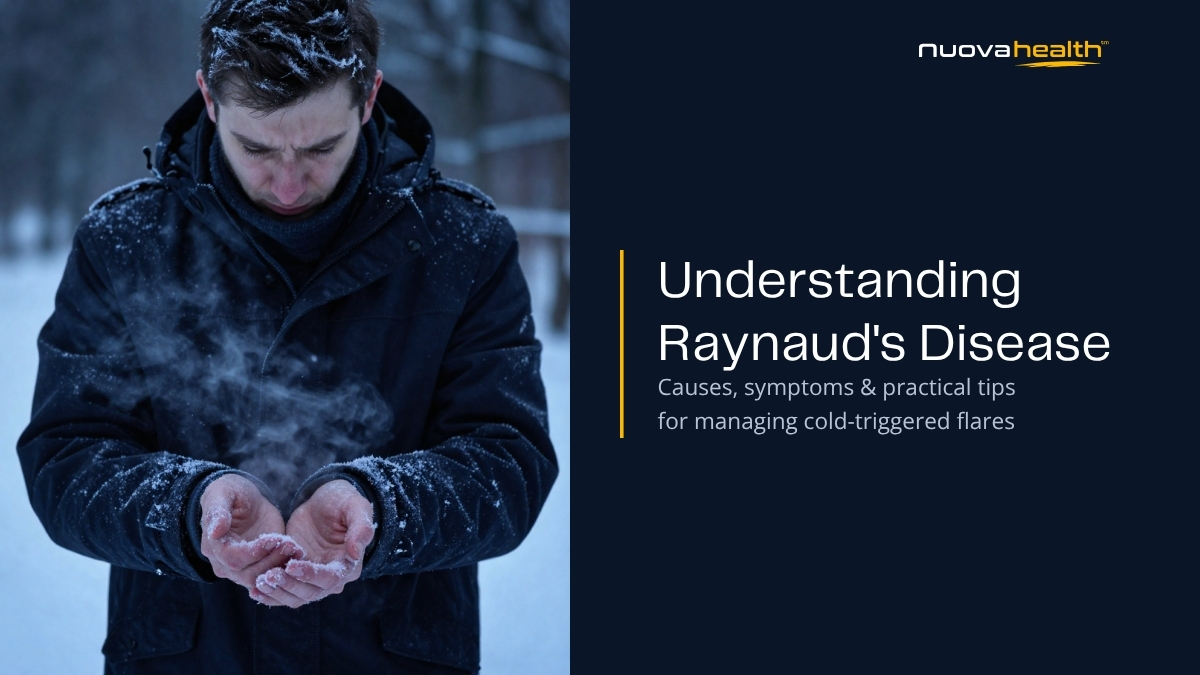
Raynaud’s disease is a condition in which the small blood vessels supplying the skin narrow more sharply than they should. This usually affects the fingers and toes. Cold temperatures and emotional stress are the main triggers. When the blood vessels tighten, less blood reaches the skin for a short time, and that is what causes an attack.
During an attack, an affected finger or toe may turn white because the blood supply drops suddenly. If the blood flow stays low for longer, the skin may then turn blue or purple. As the blood vessels relax and blood returns, the area often turns red. At that point, you may feel tingling, throbbing, burning, or aching as normal warmth and feeling come back.
Doctors usually use the term primary Raynaud’s when the condition happens on its own and is not caused by another illness. This is the most common form and is usually the less severe one. Secondary Raynaud’s, sometimes called Raynaud’s phenomenon, happens when another condition is affecting the blood vessels. This is often linked to autoimmune diseases such as scleroderma or lupus, and it is more likely to cause severe pain, fingertip sores, or damage to the skin at the ends of the fingers.
Raynaud’s was first described in the nineteenth century by the French doctor Maurice Raynaud. The name has remained, but the explanation is now clearer. The main problem is that the small blood vessels in the affected area tighten too easily and too strongly when exposed to cold or stress.
2. Who is most likely to get Raynaud’s?
Raynaud’s is more common in women than in men, and the primary form often begins in the teens, twenties, or early thirties. It can run in families, so some people find that a parent, brother, sister, or close relative has had similar symptoms in their fingers or toes.
Where you live can make a noticeable difference. People in colder climates tend to have more frequent symptoms because the blood vessels are challenged more often by low temperatures, wind, and repeated changes between warm indoor spaces and colder outdoor air. Even when the weather is not severe, regular exposure to cold can still be enough to trigger attacks if you are prone to them.
Some forms of work and repeated physical exposure can also increase risk. Jobs that involve hand-arm vibration, repeated use of vibrating tools, or long periods in cold conditions can contribute to blood vessel problems in the fingers. Smoking raises the risk too. Nicotine narrows blood vessels, so it can make attacks more likely and can also make them harder to settle once they start.
The age when symptoms begin is often useful when doctors are deciding whether Raynaud’s is likely to be primary or secondary. If symptoms start young, affect both hands in much the same way, and do not lead to skin damage, primary Raynaud’s is more likely. If symptoms begin later, are more painful from the start, or affect one hand or one finger more than the other, doctors look more closely for another cause.
3. What are the first signs of Raynaud’s?
The first thing many people notice is a sudden colour change in one or more fingers or toes. A fingertip may go very pale, sometimes almost white, and the edge between the pale skin and the normal skin can look surprisingly clear. In some people, the whole finger changes colour. In others, it is only the tip or the skin beyond the middle finger joint.
At the same time, the affected finger or toe often feels different. It may become cold, numb, stiff, or difficult to move normally for a short while. Some people say the fingertip feels as if normal feeling has dropped away. If the reduced blood flow lasts a little longer, the skin may turn blue or purple before it warms up and becomes red again.
Early attacks are sometimes easy to brush off because they settle on their own. Even so, they often feel distinct from simply having cold hands. The change tends to come on quickly, looks quite marked, and then eases once the area warms up or the trigger passes. That combination of colour change and altered feeling is often what leads someone to realise this is more than ordinary sensitivity to cold.
4. Which parts of the body does Raynaud’s usually affect?
The fingers and toes are the main areas affected in Raynaud’s. In most people, symptoms begin there and remain centred there. The fingertips are often the most obvious site because that is where the blood supply is furthest from the body’s core and where colour changes are easiest to see.
Other exposed areas can be affected as well. Some people notice episodes in the ears, the tip of the nose, or the nipples. These are all places where small blood vessels near the skin surface can tighten in the same way. Nipple Raynaud’s can be especially painful and may be noticed during or after breastfeeding, when the nipple turns pale and then becomes sharply painful as blood flow returns.
The tongue is affected only rarely, and most people with Raynaud’s will never experience symptoms there. When doctors and patients talk about Raynaud’s in routine practice, they are nearly always talking about the fingers, the toes, or both.
5. How does a typical Raynaud’s attack feel?
A typical attack usually starts with the affected finger or toe feeling suddenly cold. That cold feeling is often followed by numbness. As the blood flow drops, the skin may look pale or waxy, and the finger can feel awkward or less useful for fine movements while the attack is happening.
If the episode lasts longer, the colour may deepen from white to blue or purple. Not everyone sees every stage clearly, but many people notice that the finger or toe no longer feels normal. It may feel wooden, stiff, or hard to judge properly when picking up objects or fastening clothing.
When blood flow returns, the finger or toe often becomes red and warm. This part can be uncomfortable. You may feel tingling, throbbing, burning, or a prickling sensation as feeling returns. For some people this is mildly unpleasant. For others, especially if attacks are frequent or severe, it can be painful.
The length of an attack varies. Some settle within a few minutes once the hands or feet are warmed. Others last much longer. In general, longer and more painful attacks raise more concern, especially if the skin is slow to recover fully afterwards.
6. What usually triggers a Raynaud’s attack?
Cold is the main trigger. It does not have to be extreme cold. A drop in temperature that would barely register for someone else can be enough to trigger an attack in a person with Raynaud’s. The small blood vessels in the affected fingers or toes tighten too quickly, and the change in blood flow can happen within minutes or even seconds.
Emotional stress is another common trigger. Stress activates the body’s automatic stress response, which includes narrowing of blood vessels in the skin. In Raynaud’s, that response is stronger than it needs to be, so the fingers or toes may lose colour and feeling even when the temperature has not changed much.
Smoking can make attacks more likely because nicotine narrows blood vessels directly. Some medicines can do the same, including drugs that affect blood pressure or migraine treatment, depending on the person and the drug involved. Repeated hand vibration can also contribute, particularly when symptoms affect the fingers and there has been long-term use of vibrating tools.
One useful step is to pay attention to what happens just before your own symptoms start. That is often more helpful than thinking in broad categories. If your attacks come on after cold air hits your fingers, after stress, or after handling cold objects, that helps you act earlier and avoid some episodes altogether.
7. What is the difference between Raynaud’s disease and Raynaud’s phenomenon?
The difference is mainly about cause. Raynaud’s disease is usually used to mean the primary form, where the blood vessels tighten too easily but there is no separate illness causing that problem. Raynaud’s phenomenon is more often used for the secondary form, where another condition is driving the attacks.
That difference affects what doctors need to look for. Primary Raynaud’s is usually milder, often starts earlier in life, and rarely causes damage to the skin. Secondary Raynaud’s is more likely to be painful, to affect one side more than the other, or to lead to ulcers or sores on the fingertips.
In everyday use, the terms are sometimes mixed together. The important point is not the label itself but whether the Raynaud’s is happening on its own or as part of another condition. That is what changes the level of concern and the type of treatment needed.
8. Is Raynaud’s disease the same as poor circulation?
Not in the usual sense. Raynaud’s is caused by brief episodes in which the small blood vessels in the fingers or toes tighten sharply and then relax again. Between attacks, blood flow may be normal, particularly in primary Raynaud’s. Your fingers may look and feel entirely normal once the episode has passed.
When people use the phrase “poor circulation”, they often mean a more constant reduction in blood flow, usually from narrowing in larger blood vessels. That tends to cause ongoing symptoms rather than sudden colour changes that come and go. Raynaud’s is different because the blood flow drops quickly, the colour change is often obvious, and then the skin recovers.
There can be overlap in secondary Raynaud’s, especially if another condition has already damaged the blood vessels. Even then, the attack itself still has the same basic feature: a temporary drop in blood flow to the affected finger, toe, or skin area.
9. Can emotional stress cause a Raynaud’s attack?
Yes, it can. Emotional stress triggers the part of the nervous system that prepares the body to respond quickly. One effect of that response is narrowing of small blood vessels near the skin. In Raynaud’s, the fingers or toes can react more sharply than they should, so blood flow falls enough to cause an attack.
That is why some people have episodes even when they are not especially cold. If you notice your fingers losing colour during stress, anxiety, pressure, or a tense situation, that still fits with Raynaud’s. The trigger is different, but the blood vessel response is the same.
This also explains why reducing stress can help some people. The aim is not to eliminate ordinary stress completely, which would not be realistic. It is to reduce how strongly your body reacts to it, so the blood vessels in the fingers or toes are less likely to tighten so abruptly.
10. What colour changes happen during a Raynaud’s attack?
The classic sequence is white, then blue, then red. The affected finger or toe first turns white because the small blood vessels tighten and less blood reaches the skin. If that reduced blood flow continues, the skin may then turn blue or purple because the tissues are receiving less oxygen.
When the blood vessels relax, blood returns to the area and the skin often turns red. At that point, the finger or toe may feel warm, tingly, sore, or throbbing. The colour change can look quite sharply outlined, especially in the fingers, with a clear boundary between the affected skin and the unaffected skin nearby.
Not everyone sees all three colour changes every time. Some people mainly notice whiteness followed by redness. Others notice a blue colour more than a pale one. The exact sequence varies, but visible colour change together with numbness, coldness, or pain strongly points towards Raynaud’s.
11. How long does a Raynaud’s attack usually last?
Many attacks last somewhere between 15 minutes and an hour, but there is no single fixed duration. A short episode may settle within a few minutes if the affected fingers or toes are warmed quickly and the trigger stops. Other attacks last longer, especially if the cold exposure continues or the blood vessels are slow to relax.
The length of the attack matters because it gives some idea of severity. Brief episodes that settle without much pain are common in milder primary Raynaud’s. Longer episodes, especially if they are painful or leave the skin sore afterwards, deserve closer attention.
If an affected finger or toe stays pale, blue, or painful for a long time, that should not be ignored. A prolonged drop in blood flow raises the risk of damage to the skin and tissues, particularly in secondary Raynaud’s.
12. What is the difference between primary and secondary Raynaud’s?
Primary Raynaud’s happens on its own. There is no separate disease causing the blood vessels to tighten too much. It often begins at a younger age, usually affects both hands in a similar way, and does not usually damage the skin. Between attacks, the fingers or toes generally return to normal.
Secondary Raynaud’s has another cause behind it. In many cases, that cause is an autoimmune condition such as scleroderma, lupus, or mixed connective tissue disease. In this form, attacks are often more painful, may affect one hand or one finger more than the other, and are more likely to lead to fingertip ulcers, small pits in the skin, or lasting tissue damage.
This distinction shapes almost everything that follows, from testing to treatment. It is one of the main reasons doctors look carefully at how the symptoms started, how severe they are, and whether there are other signs of illness.
13. Which conditions are linked to secondary Raynaud’s?
The condition most strongly linked to secondary Raynaud’s is systemic sclerosis, also called scleroderma. Raynaud’s is very common in people with that condition and is sometimes one of the earliest symptoms they notice. Other autoimmune conditions linked to secondary Raynaud’s include lupus, rheumatoid arthritis, Sjögren’s syndrome, dermatomyositis, and mixed connective tissue disease.
There are non-autoimmune causes as well. These include an underactive thyroid, disease affecting the larger blood vessels, some blood disorders, nerve compression problems, and long-term exposure to vibration affecting the hands. Certain medicines can also trigger or worsen Raynaud’s if they narrow blood vessels or make the vessels more likely to tighten.
Doctors do not rely on a list alone when they are looking for a cause. They also look at the age when symptoms began, how severe they are, whether one side is worse than the other, and whether there are other signs such as joint pain, skin thickening, rashes, fatigue, or skin ulcers on the fingers.
14. How do doctors diagnose Raynaud’s?
Diagnosis starts with what you describe. A doctor will usually ask what happens to your fingers or toes, what the colour change looks like, what seems to bring it on, how long it lasts, and whether both sides are affected in a similar way. Those details are often very helpful because the symptoms of Raynaud’s are quite distinctive when described clearly.
The examination does not stop at the fingers or toes. A doctor will also look for signs that may point to another cause, such as skin changes, fingertip sores, nail changes, joint problems, or signs of connective tissue disease. In straightforward cases of primary Raynaud’s, the history and examination may already make the diagnosis fairly clear.
If there is any concern that the Raynaud’s may be secondary, further tests are often needed. One of the most useful checks is to look closely at the tiny blood vessels at the base of the fingernails. Changes there can help show whether the condition is more likely to be primary or part of a wider illness.
15. What tests help tell primary and secondary Raynaud’s apart?
Blood tests are often used when doctors need to look for signs of an autoimmune cause. One common test is the ANA, or antinuclear antibody test. A positive ANA does not by itself prove that someone has a connective tissue disease, but it can be an important clue when it appears alongside Raynaud’s and other symptoms.
If needed, doctors may request more specific antibody tests to look for conditions such as scleroderma, lupus, Sjögren’s syndrome, or mixed connective tissue disease. Blood tests that look for inflammation may also be used, although they are less specific and do not diagnose Raynaud’s on their own.
Another important test is nailfold capillaroscopy. This means examining the tiny blood vessels at the base of the fingernails under magnification. In primary Raynaud’s, these blood vessels often look normal. In secondary Raynaud’s, they may be enlarged, distorted, reduced in number, or interrupted. Doctors do not read these tests in isolation. They look at them alongside your symptoms, your skin changes, and any other signs that may point to a cause.
16. Is Raynaud’s serious, and can it affect internal organs?
For most people with primary Raynaud’s, it is not dangerous, although it can be uncomfortable and disruptive. The main problems are usually pain, numbness, inconvenience, and the effect repeated attacks can have on daily life. Primary Raynaud’s does not usually damage internal organs.
Secondary Raynaud’s needs more attention because the attacks may be one sign of a condition that affects blood vessels more widely. That does not mean everyone with secondary Raynaud’s will develop major complications, but it does mean doctors need to look beyond the fingers and toes and check for signs of disease elsewhere in the body.
What matters most is the overall picture. If Raynaud’s is severe, starts later in life, becomes increasingly painful, affects one side more than the other, or causes fingertip ulcers, it deserves proper assessment rather than reassurance alone.
17. What are the most common complications if left untreated?
In primary Raynaud’s, serious complications are uncommon. The main difficulty is that repeated attacks can interfere with comfort, work, and day-to-day tasks. People may avoid cold conditions, struggle with hand use during attacks, or find that symptoms make ordinary activities more difficult than they should be.
In secondary Raynaud’s, the risks are greater. Repeated drops in blood flow can damage the skin at the fingertip or toe tip. Painful ulcers can form, the skin may heal slowly, and infection becomes more likely if the skin barrier is broken. In severe cases, the tissue at the end of the finger or toe may be damaged by lack of blood supply.
There is also a second risk: missing the condition causing the Raynaud’s. If secondary Raynaud’s is not recognised, the illness behind it may continue without the right treatment or monitoring.
18. How does cold trigger a Raynaud’s attack?
Cold is detected by nerves in the skin. Those nerves send signals through the nervous system that help the body conserve heat by reducing blood flow near the skin surface. In someone without Raynaud’s, that response is kept within a normal range. In someone with Raynaud’s, the response is stronger than it should be.
The small blood vessels in the affected finger or toe tighten quickly, so less blood reaches the skin. The finger may then turn white, lose warmth, and become numb. If the blood flow stays low, the skin can turn blue before it finally reddens as the blood supply returns.
This is why keeping your whole body warm matters, not just your hands or feet. If your body senses cold overall, it continues to reduce blood flow to the skin in order to protect core temperature. That makes attacks more likely in the fingers and toes.
19. What is happening in the blood vessels during Raynaud’s?
The basic problem is that the small blood vessels in the affected area tighten too easily and stay narrowed for longer than they should. In primary Raynaud’s, this seems to be mainly due to an overactive narrowing response in the blood vessel wall and the nerves that control it. When cold or stress triggers that response, the vessel wall contracts too strongly and less blood reaches the skin.
In secondary Raynaud’s, there is often more than one problem at work. The thin inner layer of the blood vessel wall may not release enough of the substances that normally help the vessel stay relaxed. At the same time, the vessel wall itself may be damaged or thickened, making it harder for the blood vessel to open fully once it has narrowed. Changes in the blood can also contribute by making flow through already narrowed small vessels less smooth.
Several changes can act together: stronger narrowing signals, weaker relaxing signals, physical changes in the blood vessel wall, and, in some conditions, inflammation or scarring. This helps explain why secondary Raynaud’s is often more painful, lasts longer, and is more likely to damage the fingertips or toes.
20. Are there blood markers linked to secondary Raynaud’s?
Yes. One of the common blood tests used when doctors suspect secondary Raynaud’s is the antinuclear antibody test, usually shortened to ANA. A positive result does not automatically mean that a person has an autoimmune disease, but it can be an important sign when it appears alongside Raynaud’s and other features such as joint pain, rashes, fatigue, skin thickening, or ulcers on the fingers.
Doctors may then look for more specific antibodies, depending on the symptoms and examination findings. Certain antibody results are more closely linked to conditions such as systemic sclerosis, lupus, Sjögren’s syndrome, or mixed connective tissue disease. These tests help doctors work out whether Raynaud’s is happening on its own or as part of a wider autoimmune illness.
Blood tests for inflammation may also be used, but they are only one part of the assessment. Doctors look at the results alongside your symptoms, any skin changes, and any other signs that may point to an underlying cause.
21. How can you manage Raynaud’s at home?
At home, management is mainly about reducing the chance of an attack starting in the first place. The first step is to keep your whole body warm, because cold in the body as a whole encourages the small blood vessels in the fingers and toes to tighten. Layers, warm outer clothing, dry socks, and suitable footwear all help, especially in colder weather.
It also helps to protect the hands and feet before they become cold rather than trying to recover from an attack once it has already started. If you know that cold air, chilled objects, or stress tend to set your symptoms off, acting early is useful. Once a finger has turned white and numb, it often takes longer to settle than it would have taken to prevent the episode.
Small day-to-day steps can reduce how often attacks happen. Stopping smoking is one of the most important because nicotine narrows blood vessels directly. Regular physical activity can help by supporting how well the blood vessels work overall. Stress reduction techniques can also help some people, especially if attacks often happen during tension or anxiety. The aim is to lower the number of attacks and make the ones that do happen easier to control.
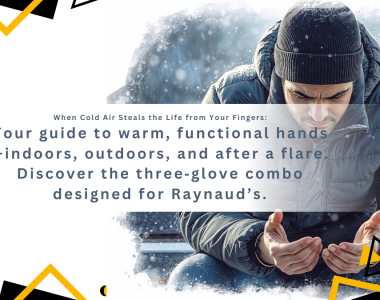
22. Which gloves are best for Raynaud’s?
The right gloves can prevent a lot of attacks. Which type works best depends on when your hands get cold, how severe the symptoms are, and whether you need help mainly indoors, outdoors, or both. The main point is to keep the fingers warm without making the glove so tight that it adds pressure or restricts blood flow.
Thermal gloves are designed to hold in body heat and protect the hands from cold air. They are often the best choice for outdoor use or for anyone whose fingers quickly become cold in winter conditions. Materials that trap warmth well, such as fleece, wool, or other insulating linings, are usually the most effective. Mittens often work even better than fingered gloves because the fingers share warmth when they are kept together. If damp weather is a problem, a water-resistant outer layer is useful because wet fabric draws heat away from the skin more quickly.
Compression base layer gloves are thinner, closer-fitting gloves usually worn under another pair or on their own in mildly cool indoor settings. Their main job is not heavy insulation. It is to keep a light layer of warmth close to the skin and reduce heat loss from the fingers. Some people find them helpful in air-conditioned rooms or while working in environments where bulkier gloves are not practical. They should feel close-fitting but not tight. If the glove squeezes the fingers or leaves marks on the skin, it is too restrictive.
Heat therapy gloves add heat from the glove itself rather than relying only on the warmth already in your hands. These can be especially helpful if your attacks are frequent, if you spend long periods outdoors, or if standard insulated gloves are not enough to keep the fingers warm. The heat needs to be steady and comfortable rather than intense. Sudden excess heat is not necessary and may feel unpleasant on numb fingers.
The fit matters as much as the material. A glove that is warm but too tight around the fingers, palm, or wrist can work against you. For people with very sensitive fingertips, skin cracks, or ulcers, soft inner linings and fewer seams inside the glove can reduce rubbing on sore areas.
Many people do best with more than one pair: a thinner pair for indoor use, a warmer pair for outdoors, and a heated pair for prolonged exposure to cold if needed. Gloves work best when you put them on before your fingers become cold. Once the attack has started, gloves still help, but prevention is usually easier than reversal.
23. What medicines can reduce Raynaud’s attacks?
If practical measures are not enough, doctors may prescribe medicines to reduce how often attacks happen and how severe they are. The medicines doctors usually try first are calcium channel blockers. These help the small blood vessels relax, so they are less likely to narrow so sharply during cold exposure or stress.
If symptoms are still frequent or severe, doctors may consider other treatments that widen blood vessels by different mechanisms. In more severe secondary Raynaud’s, especially when fingertip ulcers or tissue risk are present, treatment may need specialist input and stronger medicines than those used in the primary form.
The choice depends on how often attacks happen, how painful they are, whether the skin is being damaged, and whether the Raynaud’s is primary or secondary. The aim is not simply to reduce colour change. It is to reduce pain, protect the skin, and lower the risk of more serious complications.
24. How do calcium channel blockers help Raynaud’s?
Calcium channel blockers are one of the standard treatments for Raynaud’s because they help the muscles in the blood vessel wall relax. When those muscles are less tense, the small blood vessels in the fingers and toes are less likely to clamp down so abruptly in response to cold or stress.
For many people, these medicines reduce both the number of attacks and how intense they feel. They do not cure Raynaud’s, and they do not work equally well for everyone, but they are often the first medicine used when symptoms are disrupting daily life or causing pain.
As with any medicine, side effects can happen. Some people notice flushing, headache, ankle swelling, or light-headedness. Even so, they remain a common starting point because they are familiar to doctors and often helpful when simple warming measures are not enough.
25. Are there surgical options for severe Raynaud’s?
Yes, but they are usually reserved for severe cases, especially when secondary Raynaud’s is causing ulcers, severe pain, or a real risk of tissue loss. Surgery is not a routine treatment for primary Raynaud’s.
One option is sympathectomy, a procedure that interrupts some of the nerve signals that make the blood vessels narrow. In selected cases, injections around the affected area may also be used to reduce pain and help the blood vessels stay more relaxed. These approaches can improve blood flow in some people, but the benefit is not always permanent.
Because these procedures carry risks and are used in more serious situations, they are usually considered by specialist teams after standard treatment has not been enough.
26. How can Raynaud’s affect daily life and work?
Raynaud’s can affect daily life more than people expect, especially when attacks are frequent. If your fingers go numb or painful in the cold, simple tasks can become awkward while the attack is happening. Fine finger movements may be harder, grip may feel less reliable, and the discomfort can be distracting even after the colour has returned.
The effect can be greater at work if your job involves cold environments, repeated exposure to low temperatures, or tasks that depend on precise hand use. Repeated hand-arm vibration can make matters worse in some people, particularly if the symptoms are already established in the fingers.
There is also the strain of not knowing exactly when an attack will start. Some people begin to plan around the condition, avoid situations that trigger symptoms, or feel less confident using their hands in cold conditions. Good symptom control, suitable protective clothing, and practical adjustments at work can make a clear difference.
27. Can Raynaud’s improve over time?
Primary Raynaud’s often remains fairly stable, although symptoms can be worse at some times than at others. Some people find attacks become less troublesome as they get older, while others continue to have episodes for many years but learn how to manage them more effectively.
Complete resolution can happen, but it is not something to count on. It is better to focus on keeping symptoms under control than expecting them to disappear entirely. In many cases, that is enough to make the condition much easier to live with.
Secondary Raynaud’s is less likely to improve on its own because its course depends largely on the condition causing it. If that condition is treated well, the Raynaud’s may ease as part of that improvement, but it usually still needs its own attention.
28. What lifestyle changes help prevent Raynaud’s attacks?
The most useful changes are the ones that reduce avoidable triggers and keep the body warm more consistently. Warm clothing matters, but the emphasis should not be on the hands alone. If your body is cold overall, blood flow is pulled away from the fingers and toes more easily, so keeping your core warm is an important part of prevention.
It also helps to avoid sudden cooling of the hands or feet when you can. If handling cold items reliably brings on symptoms in your fingers, using protection before contact is sensible. If your toes are often affected outdoors, better insulation in socks and footwear may help reduce attacks.
Stopping smoking is one of the clearest steps you can take because nicotine directly narrows blood vessels. Regular movement and exercise can also help by supporting circulation. If stress plays a part in your symptoms, learning ways to reduce your body’s stress response may also lower attack frequency. These changes are simple, but they are not minor. For many people, they are the basis of good control.
29. What have doctors learned recently about how Raynaud’s works?
Doctors now understand more clearly that Raynaud’s is not just a matter of “bad circulation” or cold sensitivity. It involves stronger-than-normal narrowing signals in small blood vessels, along with reduced ability of those vessels to relax at the right time. In secondary Raynaud’s, the blood vessel wall itself may also be damaged or thickened, which makes normal opening and closing more difficult.
There is also better understanding of the substances that control vessel narrowing and relaxation. If the balance shifts too far towards narrowing, blood flow to the fingers or toes drops too easily. In some forms of secondary Raynaud’s, inflammation and scarring add further difficulty by physically altering the blood vessel wall.
This helps explain why one person may improve with simple warming measures while another needs stronger treatment. It also helps explain why some newer treatments aim not only to widen blood vessels temporarily but to act on the specific processes that are keeping them too narrow.
30. How do treatments differ for primary versus secondary Raynaud’s?
Primary Raynaud’s is usually managed first with practical measures: keeping warm, avoiding triggers, stopping smoking, and using medicines if symptoms are frequent or painful. The main aim is to reduce attacks and make daily life easier.
Secondary Raynaud’s needs a broader plan. Doctors still treat the attacks themselves, but they also need to identify and treat the condition causing them. If that underlying disease is not addressed, symptoms in the fingers or toes may remain difficult to control and the risk of skin damage stays higher.
Follow-up is also more important in the secondary form. The focus is not only comfort. It is also prevention of ulcers, protection of fingertip tissue, and monitoring for signs that the wider illness is changing.
31. What newer treatments are being explored for severe Raynaud’s?
When Raynaud’s remains severe despite standard treatment, doctors may look at newer or more specialised options. Some treatments under study aim to widen blood vessels through more specific mechanisms than older medicines. Others are being explored because they may reduce pain, improve blood flow to the fingertips, or help protect tissue in people with severe secondary disease.
There is also growing interest in non-drug approaches, including devices designed to provide steady warmth or to help support blood flow in the hands. These are still being developed and assessed, but they reflect a more practical approach to symptom control in people who do not respond well to standard measures.
Not all of these options are widely available, and not all will prove equally useful. Even so, that is encouraging for people whose symptoms remain difficult to control. As the mechanism becomes clearer, treatment is becoming more precise and more focused on the parts of the process that are going wrong.
What to Remember About Raynaud’s
Raynaud’s can be mild in one person and much more serious in another. For many people, it is an uncomfortable but manageable problem triggered by cold or stress. For others, it is a sign that another condition is affecting the blood vessels and needs proper medical attention.
The key question is whether the Raynaud’s is primary or secondary. Primary Raynaud’s is more common, usually less severe, and often improves with sensible trigger avoidance, warmth, and, if needed, medication. Secondary Raynaud’s calls for closer assessment because it may be linked to autoimmune disease, blood vessel disease, or another medical problem that needs its own treatment and monitoring.
If you notice repeated colour changes in your fingers or toes, especially with numbness, pain, or clear triggers such as cold and stress, it is worth getting them checked properly. A clear diagnosis helps guide treatment, lowers the chance of missing an underlying condition, and reduces the risk of skin damage later on. With the right steps, most people can improve symptom control and better protect their fingers and toes over time.
Important Medical Note
This information is general guidance only and is not a substitute for individual medical advice, diagnosis, or treatment. If you develop repeated colour changes in your fingers or toes, numbness, pain, skin ulcers, or other symptoms that may suggest Raynaud’s, you should speak to a qualified healthcare professional for an individual assessment.
This is especially important if symptoms begin for the first time in adulthood, are becoming more severe, affect one side more than the other, or are accompanied by joint pain, rashes, fatigue, skin thickening, or poor healing. These features may suggest secondary Raynaud’s and may need further investigation.
Do not rely only on self-treatment, warming products, or non-prescription measures if symptoms are persistent, painful, or getting worse. A proper diagnosis matters because treatment, prognosis, and the need for monitoring depend on the underlying cause. No guarantee of outcome is stated or implied.