



Footbed Insoles for Fallen Arches (Flat feet)
£9.99£11.99 (-17%)inc VAT
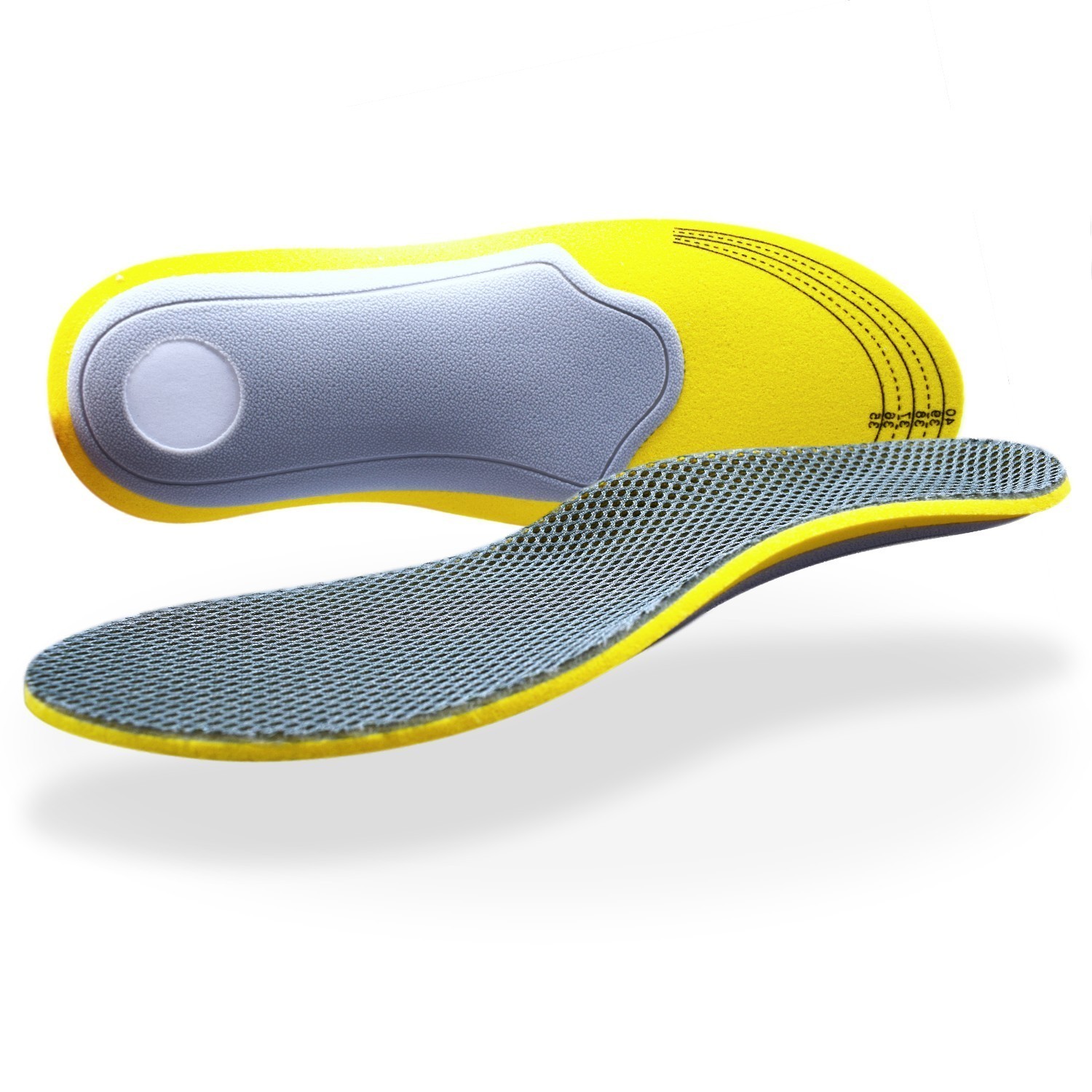
Orthotic insoles for plantar fasciitis, flat feet, and high arches. Firm arch support reduces strain on the plantar fascia. Deep heel cup stabilises the heel and limits overpronation. Two-layer cushioning softens impact on hard floors. Fits most enclosed shoes. Start gradually and build up wear time over one to two weeks.
- Orthotic arch support insoles designed for plantar fasciitis, flat feet, and high arches
- Available in two size ranges: 3-7 and 7-11, suitable for both men and women
- Firm arch support lifts and stabilises collapsed arches, reducing strain on the plantar fascia
- Deep heel cup cradles the heel, limits excessive inward roll (overpronation) and outward roll (supination), and spreads pressure evenly
- Two-layer cushioning system softens impact on hard floors and pavements
- Lightweight carbon-fibre shell holds its shape through months of regular use
- 3/4-length design fits most enclosed shoes – trainers, work shoes, boots
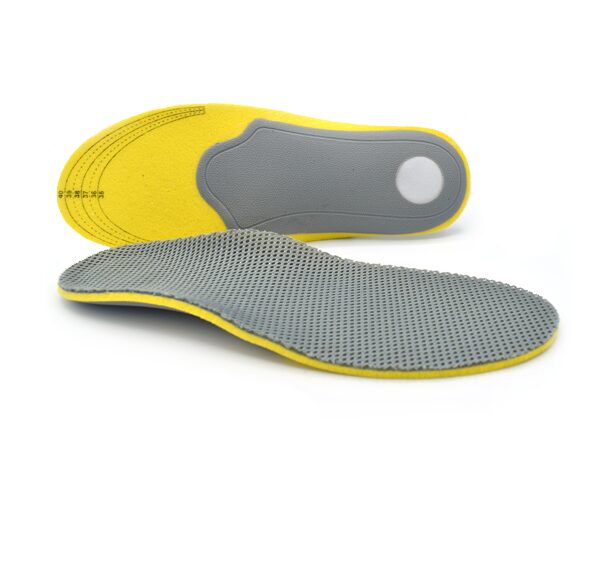
- Trim-to-fit with size markings on the underside for easy customisation
- Breathable top cover with antibacterial and moisture-wicking properties helps reduce odour and keep feet dry
- May help reduce sharp heel pain, arch fatigue, ball of foot pain (metatarsalgia), and discomfort after long periods on your feet
- May also help with bunions, Morton’s neuroma, heel spurs, heel bursitis, ankle sprains and strains, arthritis, and shin, knee, hip, and lower back pain linked to poor foot alignment
- Start gradually – wear for a few hours on the first day, build up over one to two weeks
- Not suitable for use during pregnancy or if you have diabetes, neuropathy, or circulatory problems without checking with a clinician first
- If pain worsens, or if you notice new numbness, tingling, or skin changes, stop wearing the insoles and see a podiatrist or physiotherapist
- 30-day money-back guarantee if you’re not satisfied
Do you have fallen arches?
Persistent foot pain after a long day standing or walking is often the first sign. You may have what’s commonly known as fallen arches – or flat feet – where the arches along the inside of your feet flatten or collapse, so that when you stand, the entire sole of your foot comes into contact with the ground.
Fallen arches can develop for several reasons. Some people are born with naturally flatter arches, while others find their arches gradually drop over time due to ageing, injury, or repeated strain on the feet and ankles. Certain conditions – such as posterior tibial tendon dysfunction (where the tendon that supports the arch becomes weakened or damaged), arthritis, or diabetes – can also contribute. Around 1 in 4 people have flat feet to some degree. For many, it causes no trouble at all. But for others, it can lead to discomfort, fatigue, and a cascade of problems that reach well beyond the feet themselves.
Why fallen arches affect more than just your feet
The arch of your foot acts like a shock absorber and a lever, helping to distribute your weight evenly across the sole and control how your foot moves with each step. When that arch collapses, the mechanics of your entire lower body can shift.
As your arch drops, your heel tends to roll inward – a movement called overpronation. This inward roll twists your shin bone, which in turn rotates your knee and hip slightly out of their ideal alignment. Instead of forces travelling straight up through your leg in a balanced, vertical line, they now spiral and twist, placing uneven strain on joints, ligaments, and tendons all the way up the chain.
Your plantar fascia – the thick band of tissue that runs along the sole of your foot from your heel bone to the base of your toes – is one of the first structures to feel the strain. This band supports the arch and helps your foot work as both a shock absorber when you land and a firm lever when you push off. When your arch flattens, the plantar fascia is stretched and pulled with every step, like an elastic band held under constant tension. This is why plantar fasciitis is so common in people with flat feet. The fascia is being asked to do more work than it can comfortably manage, and over hundreds or thousands of steps a day, small areas of irritation build up near where the fascia attaches to the heel bone. Over time, this repetitive tension can also contribute to the development of heel spurs – small bony growths that form at the heel attachment point as the body tries to reinforce the area.
The altered weight distribution can also shift pressure forward onto the ball of your foot, leading to pain and discomfort in that area – a condition known as metatarsalgia. When your arch isn’t doing its job of spreading load evenly across the sole, certain areas – particularly the heads of the metatarsal bones under the ball of the foot – end up bearing more than their fair share. This can feel like a burning, aching sensation under the front of your foot, especially after you’ve been standing or walking on hard surfaces for a while. In some cases, this uneven pressure can also contribute to bunions or Morton’s neuroma (a sharp, burning pain between the toes, often caused by a compressed nerve).
But the knock-on effects can reach much further. The altered alignment can strain your Achilles tendon – the strong cord at the back of your ankle that connects your calf muscles to your heel bone. When your heel rolls inward repeatedly, the Achilles tendon is pulled at a slight angle rather than straight up and down, which can irritate the tendon fibres over time. The twisting forces travelling up your shin can irritate the muscles and tendons along the front and inside of your lower leg, leading to shin splints – a dull, aching pain along the shin bone that’s common in people who walk or stand for long periods on hard floors. The rotated position of your knee can increase stress on the inside of the knee joint, where the cartilage and ligaments are compressed more heavily on one side than the other. Your hips and lower back may also compensate for the imbalance, often resulting in discomfort or pain in those areas too, as your pelvis tilts slightly to keep your upper body balanced over your feet.
Over time, this uneven load distribution can accelerate wear on joint surfaces, particularly in the knees and hips. When load is no longer spread evenly across the cartilage – the smooth, slippery tissue that cushions the ends of bones in a joint – certain areas are compressed more heavily with every step, while other areas are barely loaded at all. This uneven wear can contribute to the gradual breakdown of cartilage, which is one of the factors in the development of osteoarthritis in later life.
Arch support and heel stabilisation may help if you’ve noticed increasing foot, knee, hip, or back pain after long days on your feet, if you’re returning to activity after an injury and want to reduce strain on your feet and legs, if you’ve been told by a clinician that you overpronate or have flat feet, or if you’ve developed plantar fasciitis, Achilles tendonitis, shin splints, metatarsalgia, bunions, Morton’s neuroma, heel spurs, heel bursitis, ankle sprains and strains, or arthritis affecting your feet, ankles, knees, hips, or lower back.
What about high arches?
High arches create a different set of problems. Instead of the arch collapsing and the plantar fascia being stretched, a high arch doesn’t flatten enough to absorb shock properly. More impact is driven straight into the heel and ball of the foot with each step, which can lead to heel pain, metatarsalgia, and stress fractures in the bones of the foot.
The firm arch support in these insoles helps fill the gap under a high arch, which allows your weight to be distributed more evenly across the sole of your foot. This reduces the peak pressure under the heel and ball of the foot, and can make walking and standing more comfortable. The deep heel cup also helps stabilise the heel and ankle, which is particularly important for people with high arches, as the foot can be less stable and more prone to rolling outward (supination) or twisting on uneven ground.
If you have high arches and you’re experiencing heel pain, ball of foot pain, or frequent ankle sprains, these insoles may help by improving how your foot absorbs shock and distributes load. Start gradually and build up wear time over one to two weeks to allow your feet and legs to adapt.
What’s happening in plantar fasciitis and flat feet
The plantar fascia is a strong band of tissue running along the bottom of your foot from the heel bone to the base of the toes. It supports the arch and helps your foot work as both a shock absorber when you land and a firm lever when you push off. When you’re standing, the fascia is under tension, holding the arch up against the weight of your body. When you walk, it stretches slightly as your arch flattens on landing, then recoils to help propel you forward as you push off.
How plantar fasciitis develops
Plantar fasciitis develops when this band is repeatedly strained, usually near where it attaches to the heel. The attachment point is a relatively small area that has to cope with very high forces every time you take a step. Long days on your feet, sudden increases in walking or running, hard surfaces, less supportive footwear, and certain foot shapes can all contribute. Small areas of irritation build at the heel attachment, the local nerves become more sensitive, and what should be a normal step starts to feel sharply painful – especially after rest or first thing in the morning.
When the plantar fascia is repeatedly overloaded, tiny areas of strain develop near its attachment on the heel bone. The body responds with an inflammatory-type process and local tissue changes. Blood flow increases to the area, bringing repair cells and fluid, which can cause swelling and tenderness. Nearby nerve endings become more sensitive – a process called sensitisation – which is why normal movements like standing up or taking a few steps can trigger that sharp, stabbing heel pain. In longer-standing cases, the fascia near the heel can become thicker and less organised, showing signs of chronic overload rather than simple inflammation. The tissue structure changes: instead of neat, parallel fibres, the fascia develops areas of disorganised, weaker tissue.
Why is the morning pain so sharp?
Overnight or after rest, the plantar fascia and calf muscles shorten slightly. The body’s repair processes are active while you sleep, and any local inflammation can build around the irritated area. When you stand up, the shortened fascia is suddenly stretched as your arch lowers under your body weight. The irritated area near the heel attachment is placed under tension, and sensitive nerve endings send a strong pain signal. This is why the first few steps in the morning – or after sitting for a while – can feel so sharp and stabbing.
As you move, the tissue warms, becomes more flexible, and blood flow increases. The fascia gradually lengthens, and the nerve endings become slightly less reactive. This is why the pain often eases after a few minutes of walking, only to return later if the foot is overloaded again. By the end of a long day on your feet, the fascia has been stretched and pulled thousands of times, and the irritated area at the heel attachment is inflamed and sore again.
How flat feet contribute to plantar fasciitis
When your arch sits low and collapses further under load, the plantar fascia and supporting ligaments are held under extra stretch with every step. Instead of the arch holding a gentle curve that shares load across the foot, the arch flattens, and the fascia is pulled taut from heel to toes. The heel often rolls inwards, which twists the fascia where it joins the heel bone. This twisting adds a rotational stress on top of the lengthwise stretch, concentrating strain at the attachment point. Over hundreds or thousands of steps a day, that extra stretch and twist keeps the tissue under strain, never giving it a chance to settle.
How it affects the way you move
Beyond local heel and arch pain, plantar fasciitis often changes how you walk and stand without you realising. To avoid landing on the sore area, you might shorten your stride, land more on the front or outer edge of your foot, turn your foot out slightly, or favour one leg over the other.
Because the body works as a connected chain, these changes can shift stress to other areas. If you’re landing more on the outside of your foot to avoid heel pain, the muscles and tendons along the outside of your ankle and lower leg have to work harder to control that movement. If you’re shortening your stride, your hip flexors and lower back muscles may tighten up to compensate. Over time, this altered gait can contribute to shin pain, knee discomfort, or hip and lower back aches as posture and leg mechanics adapt to protect the sore heel.
Why rest alone rarely solves heel and arch pain
Rest, ice, and gentle stretching can ease things for a while. The problem is that many people find the pain returns as soon as they go back to their usual level of walking or standing. That’s because the way your foot bears weight hasn’t actually changed.
If your arches still collapse further than they can comfortably tolerate, the plantar fascia is still being pulled under the same strain, and your heels are still taking the same impact on hard surfaces. The same tissues calm down during rest, then flare again as soon as you’re back on your feet. Pain may ease on days when you’re less active, only to return when work, family life, or exercise pick up again.
To break that cycle, you need to tackle both sides of the problem. Calming the irritated tissues with sensible rest, stretching, and self-care gives them a chance to settle. At the same time, you need to reduce the strain that keeps setting them off. Stretching the calf muscles and Achilles tendon can help. Strengthening the muscles in your feet and lower legs can improve how your foot controls movement and absorbs load. Choosing supportive footwear instead of very flat shoes or worn-out trainers makes a difference. Limiting time on hard surfaces where possible, or breaking up long periods of standing with short rests, can reduce cumulative strain.
Orthotic arch support insoles fit into this plan by changing how the foot is supported and how pressure is spread under the heel and arch with each step. They don’t replace rest, stretching, or strengthening, but they can help ensure that progress holds when you’re back on your feet as usual.
FootReviver insoles: designed for fallen arches
Arch support and plantar fascia relief
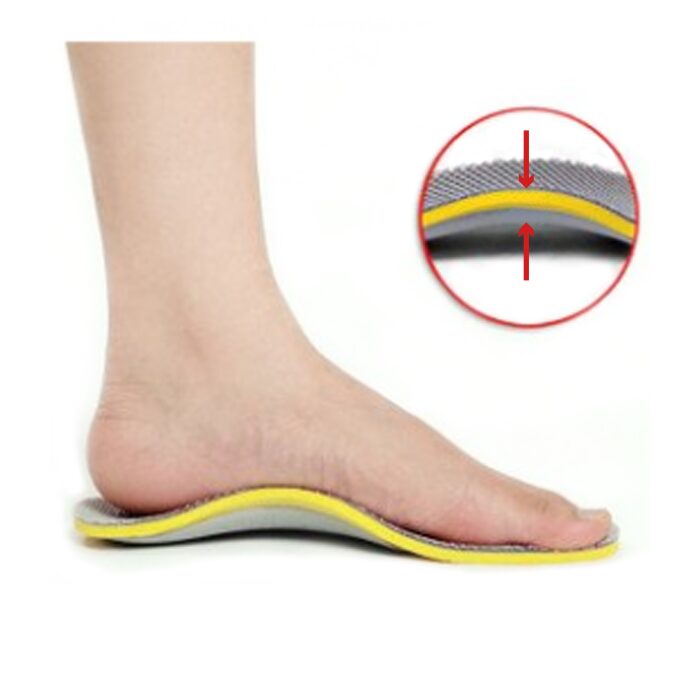
The insole provides firm support along the arch of your foot – the area that’s collapsed or flattened in people with fallen arches. This support lifts the middle of your foot slightly, which reduces the stretch and tension on your plantar fascia. Instead of the fascia being pulled taut with every step, the arch support shares the work, taking some of the load off the fascia and reducing the repetitive strain at the heel attachment where irritation and pain typically build.
By supporting the arch, the insole also helps your foot maintain a more stable shape as you move. When your arch is unsupported, it can flatten and collapse under load, then spring back up when you lift your foot – a repetitive cycle that stretches and strains the fascia and other supporting structures. The firm support underneath the arch limits how far the arch can drop, which means the fascia doesn’t have to stretch as far with each step. This is particularly helpful during activities that involve a lot of walking or standing – commuting, working on your feet, or moving around the house – where the cumulative effect of thousands of steps can keep the fascia under constant strain.
The arch support also helps reduce the excessive flattening and rolling that can strain other structures in your foot and lower leg. When your heel rolls inward, it twists the plantar fascia at the heel attachment and rotates your shin bone inward, which can irritate the posterior tibial tendon (the tendon that runs along the inside of your ankle and helps support the arch) and the muscles along the inside of your shin. By limiting how far your arch can collapse under load, the insole reduces these twisting forces, which may help ease discomfort not just in the heel and arch, but also along the inside of the ankle and lower leg.
For people with high arches, the arch support works differently: instead of preventing collapse, it fills the gap under the arch, allowing weight to be distributed more evenly across the sole. This reduces the peak pressure under the heel and ball of the foot.
Heel cup: stabilisation and alignment
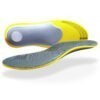
The insole features a deep, contoured heel cup that cradles your heel and holds it steady. This is a 3/4-length design, meaning the insole supports your arch and heel but leaves the forefoot area free, so it fits comfortably in most enclosed shoes – trainers, work shoes, boots – without feeling bulky or taking up too much room in the toe box.
The heel cup does three main jobs:
Reduces excessive movement. When your heel is held in a stable, neutral position, it’s less likely to wobble side-to-side or roll excessively inward (overpronation) or outward (supination) as you walk. This reduces the twisting forces that travel up your shin, knee, and hip, and helps protect the ligaments and tendons around your ankle – particularly your Achilles tendon. The Achilles tendon is designed to pull straight up and down, from your calf muscles to your heel bone. When your heel rolls inward or outward, the tendon is pulled at a slight angle, which concentrates stress on one side of the tendon and can lead to irritation and pain over time. By holding your heel in a more neutral position, the heel cup helps the Achilles tendon work in a straighter line, which may reduce strain during activities like walking, climbing stairs, or standing for long periods. This stability is also important for preventing ankle sprains and strains, particularly if you have high arches or a history of ankle instability.
Spreads pressure more evenly. The contoured shape of the heel cup means your weight is distributed across a larger surface area of your heel, rather than concentrated in one small spot. This reduces peak pressure and can help prevent the soreness and discomfort that builds up after long periods of standing or walking. If you’ve noticed a bruised feeling under your heel, or a tender spot that’s painful to press, this more even pressure distribution can make a real difference. The heel’s natural fat pad – a cushion of fatty tissue under the heel bone that absorbs impact – can become compressed and less effective over time, especially in people who spend a lot of time on hard floors. By spreading load more evenly, the heel cup reduces the peak forces that compress this fat pad, which may help it function more effectively. This can be particularly helpful if you have heel bursitis (inflammation of the fluid-filled sac under the heel bone) or heel spurs, where concentrated pressure can worsen pain and inflammation.
Keeps the heel in place. The depth of the cup – with rounded, comfortable edges that don’t dig into your ankle bones or rub the sides of your heel – means your heel sits securely in the insole and doesn’t slide around inside your shoe. This stability is the foundation for everything else the insole does: if your heel is moving unpredictably, shifting forward or rolling side-to-side with each step, the arch support can’t work effectively. A stable heel allows the arch support to control how your foot moves through the step, from the moment your heel strikes the ground to the moment you push off with your toes.
The heel cup is made from a firm shell rather than soft foam, so it provides consistent, reliable control. Soft foam can compress and lose its shape over time, especially under the repeated impact of walking and standing. A firm shell holds your heel in place more effectively, maintaining the same level of support and stability over weeks and months of use, rather than gradually flattening out and becoming less effective.
Cushioning and materials
On top of the supportive shell sits a two-layer cushioning system. The upper layer is softer and moulds slightly to the contours of your foot for immediate comfort. The firmer layer underneath absorbs and disperses impact as your heel and forefoot meet the ground. Together, they cushion every step – especially on hard floors and pavements – which can make a noticeable difference if much of your day is spent walking or standing on concrete, tile, or other unforgiving surfaces.
The forefoot section uses a responsive material that gently compresses and adapts to your step. As you move, it adjusts to the natural spread of the metatarsal heads – the bony prominences under the ball of your foot – helping to share pressure more evenly across the front of the foot. This can be particularly helpful if there’s tenderness or soreness under the ball of the foot, as in metatarsalgia or Morton’s neuroma. Instead of all your weight concentrating on one or two metatarsal heads, the cushioning spreads the load, reducing the burning or aching sensation many people notice after long periods on their feet.
The supportive shell underneath the arch and heel is built from a lightweight carbon-fibre material. This provides firm support without adding bulk or weight to your shoes. The shell is rigid enough to hold your arch and heel in the right position, resisting the forces that try to flatten your arch and roll your heel inward or outward, but light enough that you won’t feel like you’re carrying extra weight with each step. Importantly, this material holds its shape through months of regular use, instead of squashing flat like basic foam inserts. The arch support and heel cup you notice on day one are still there after weeks of standing and walking on hard surfaces.
The top layer is covered with a breathable fabric that has small perforations to help move moisture away from the skin. This moisture-wicking property helps keep your feet drier and more comfortable, especially during longer periods of wear or in warmer conditions. An antibacterial treatment helps reduce odour and keeps shoes fresher, which also lowers the risk of rubbing from damp socks or hot spots developing where moisture builds up.
How to use your FootReviver insoles
Fitting and trimming
The insoles come with size markings printed on the underside. They are available in two size ranges: 3-7 and 7-11, suitable for both men and women. To get the right fit, place the insole next to your existing shoe insole (or inside your shoe if there’s no removable insole) and check which size line matches the length and shape of your shoe.
Trim carefully along the line that corresponds to your shoe size, using a sharp pair of scissors. It’s worth trimming conservatively – you can always take a little more off if needed, but you can’t add material back. Cut smoothly and steadily to avoid jagged edges, which can create pressure points or rub against the sides of your foot.
The insoles are designed to fit most enclosed footwear – trainers, work shoes, walking boots, and similar styles. They work best in shoes with a bit of depth and structure, where there’s enough room to accommodate the arch support and heel cup without the shoe feeling too tight across the top of your foot. They may not fit well in very tight-fitting shoes, ballet flats, or sandals, where there isn’t enough space for the insole’s contoured shape.
Getting started: breaking in your insoles
When you first start wearing the insoles, your feet and legs will need time to adapt to the new support and alignment. It’s normal to feel a bit of pressure or awareness under your arch, or a slight change in how your feet sit in your shoes – this is the insole doing its job, supporting your arch and guiding your heel into a more neutral position.
Start gradually. Wear the insoles for a few hours on the first day – perhaps during a short walk or while you’re at home doing light tasks. Over the next week or two, gradually build up the wear time until you’re comfortable wearing them all day. This gradual approach gives the muscles, tendons, and ligaments in your feet and lower legs time to adapt to the new alignment without being overloaded.
If you jump straight into wearing them for a full day – especially a day that involves a lot of walking or standing – your feet and lower legs may feel tired or achy as the muscles and tendons adjust to working in a more supported position. The muscles that support your arch, which may have been working overtime to try to hold your arch up, can feel fatigued as they adapt to sharing the load with the insole. This is usually temporary and settles within a few days, but it’s easier on your body to build up slowly.
A sensation of gentle pressure under your arch, or a feeling that your heel is sitting slightly differently in your shoe, is normal and should settle within a few days. Your feet may feel a little tired at first as the muscles adapt to working in a more supported position. You might also notice that your shoes feel slightly tighter across the top of your foot, especially if your shoes don’t have much depth – this is because the insole is taking up some of the space inside the shoe. If this is uncomfortable, you may need to loosen your laces slightly or try the insoles in a different pair of shoes with more room.
If you experience sharp pain, increased discomfort, or pain that gets worse rather than better after a few days, stop wearing the insoles and see a podiatrist or physiotherapist. Insoles should feel supportive, not painful. Sharp pain, numbness, tingling, or new areas of soreness that don’t settle within a few days may indicate that the insoles aren’t the right fit for your feet, or that you need a different level of support.
What to expect over time
Most people notice immediate support and cushioning when they first put the insoles in – the arch feels lifted, the heel feels cradled, and the cushioning softens the impact of each step. Over the following days and weeks, as your feet and legs adapt to the better alignment, you may find that pain and fatigue start to reduce – particularly if your symptoms were linked to overpronation, supination, or poor arch support.
Insoles support your arches and guide your heels into a better position while you’re wearing them, but they don’t permanently rebuild your arches or change the structure of flat feet or high arches. They work by changing how your feet interact with the ground, which can reduce strain and discomfort, but the support is there only when the insoles are in your shoes. If you take the insoles out and walk barefoot, your arches will still flatten or remain high and your heels will still roll inward or outward in the same way they did before. The insoles are a tool to manage symptoms and reduce strain during everyday activities, not a cure that changes the structure of your feet.
If you have long-standing pain or complex foot problems, insoles are often one part of a broader approach that might also include strengthening exercises for the feet and lower legs, stretching for the calves and Achilles tendon, footwear changes, or hands-on treatment from a physiotherapist or podiatrist. Used as part of that wider plan, they can make a significant difference to how comfortable you feel during everyday activities – walking, standing, climbing stairs, carrying shopping – and may help reduce the risk of symptoms dragging on or returning.
When to seek advice
Insoles can be very helpful for managing the symptoms of fallen arches, high arches, and plantar fasciitis, but they’re not suitable for everyone, and they’re not a substitute for professional assessment if your symptoms are severe, new, or unexplained.
Check with a clinician first if you have:
Diabetes, neuropathy, or circulatory problems. Changes in sensation or blood flow to your feet mean you may not notice pressure points, rubbing, or skin damage as easily. Reduced sensation means you might not feel a blister forming or an area of skin breaking down until it’s already quite advanced. Reduced blood flow means that any damage to the skin takes longer to heal and is more likely to become infected. Have any insoles or footwear changes checked by your GP, podiatrist, or diabetes specialist nurse before use, so they can assess whether the insoles are appropriate for you and advise on how to monitor your feet for any signs of problems.
An acute injury or recent trauma. If you’ve recently injured your foot, ankle, or leg – for example, a sprain, fracture, Achilles tendon rupture, or severe strain – insoles should only be used as part of a guided rehabilitation plan. In the early stages after an injury, the tissues are healing and may be quite sensitive to changes in load or alignment. Introducing arch support or heel stabilisation without guidance could place stress on healing structures in ways that slow recovery or cause further irritation. Speak to a physiotherapist or your treating clinician first.
Arthritis affecting your feet, ankles, knees, hips, or lower back. Insoles may help reduce the uneven loading that can worsen joint pain and stiffness, but it’s worth checking with your GP, rheumatologist, or physiotherapist first. They can assess whether the level of support in these insoles is appropriate for your joints, and whether any adjustments to your footwear or activity levels would also help. In some cases, custom orthotics or specialist footwear may be more suitable, particularly if your arthritis has caused significant joint deformity or if you have very specific support needs.
Unexplained new swelling or pain. If your foot pain or swelling has appeared suddenly and you’re not sure why, get it checked before assuming it’s related to fallen arches or high arches. There are other causes of foot pain – stress fractures, nerve compression (such as tarsal tunnel syndrome), inflammatory conditions (such as rheumatoid arthritis or gout), or infections – that need different management. If the pain is severe, came on suddenly, or is accompanied by significant swelling, redness, warmth, or fever, see a GP or visit an urgent care centre.
Pause and seek help if you notice:
Pain that worsens with the insoles. Some initial awareness or mild fatigue is normal as your feet adjust, but sharp pain or discomfort that gets worse over several days is not. This could indicate that the insoles are placing pressure on an area that’s already irritated, or that the level of arch support or heel control is too aggressive for your feet. Stop wearing the insoles and see a podiatrist or physiotherapist, who can assess your foot mechanics and advise on whether a different type of insole, or a lower level of support, would be more appropriate.
New numbness, tingling, or pins and needles. This could suggest pressure on a nerve or a circulation issue. Nerves can be compressed by pressure from the insole – for example, if the arch support is pressing on the inside of your foot where a nerve runs close to the surface, or if the insole is too tight in your shoe and compressing the top of your foot. Remove the insoles and get it checked. If the numbness or tingling doesn’t settle within a few hours of removing the insoles, or if it’s accompanied by weakness, pain, or changes in skin colour, see a clinician promptly.
Skin changes that don’t settle. Redness, blisters, sores, or areas of hard skin that develop after you start wearing the insoles may indicate a pressure point or rubbing. Some mild redness or a small area of tenderness in the first day or two can be normal as your feet adjust, but if it doesn’t settle quickly, or if it gets worse, stop using the insoles and see a podiatrist. They can check whether the insoles are the right size and shape for your feet, and whether any adjustments are needed.
Symptoms are severe or getting worse despite support. If your pain is severe – for example, if it’s stopping you from walking, waking you at night, or significantly affecting your daily life – or if it’s getting progressively worse even with insoles, rest, and sensible activity management, you need a proper assessment. There may be other factors at play that need addressing, such as a stress fracture, a more significant tendon injury, or an inflammatory condition. A podiatrist or physiotherapist can carry out a full assessment, including checking your foot mechanics, testing your strength and flexibility, and ruling out other causes of pain.
When professional assessment is helpful
If you’re not sure whether fallen arches or high arches are the main cause of your pain, or if you have complex foot problems – for example, bunions, hammertoes, arthritis, or previous foot surgery – it’s worth seeing a podiatrist or physiotherapist for a full assessment. They can check your foot mechanics, identify any other contributing factors, and advise on whether insoles are the right approach for you, or whether you’d benefit from custom orthotics (insoles made specifically for your feet, based on a mould or scan), exercises, or other treatment.
Custom orthotics are usually more expensive and require a clinic appointment, but they may be more appropriate if you have very specific needs – for example, if your feet are an unusual shape, if you have significant deformities, or if prefabricated insoles haven’t provided enough relief. For many people, a good prefabricated insole like these is a practical and effective first step, and you can always move on to custom orthotics later if needed.
Conclusion
Fallen arches change the way your whole body carries load. When your arches flatten, your heels roll inward, twisting your shins, knees, and hips out of alignment and increasing strain on joints and soft tissues all the way up the chain. For many people, plantar fasciitis develops because the plantar fascia is held under constant stretch and twist with every step. High arches create a different problem: the foot doesn’t absorb shock properly, driving more impact straight into the heel and ball of the foot.
FootReviver insoles are designed to support your arches, guide your heels into a more neutral position, and reduce the twisting forces travelling up your legs. The firm arch support takes tension off your plantar fascia if you have flat feet, or fills the gap under your arch if you have high arches. The structured heel cup holds your heel steady and limits excessive inward roll (overpronation) or outward roll (supination). The cushioning system softens impact on hard floors and spreads pressure more evenly under your heel and forefoot.
If you have fallen arches or high arches and you’re experiencing foot, knee, hip, or back pain after standing or walking, or if you’ve developed plantar fasciitis, metatarsalgia, bunions, Morton’s neuroma, heel spurs, heel bursitis, Achilles tendonitis, shin splints, or ankle sprains and strains, and rest alone hasn’t been enough, these insoles may help. Check the sizing guide and fitting instructions above, and remember to start gradually to give your feet time to adapt.
If you’re unsure whether fallen arches or high arches are the cause of your pain, or if your symptoms are severe, getting worse, or accompanied by swelling, numbness, or skin changes, speak to a podiatrist or physiotherapist for a proper assessment.
We back these insoles with a 30-day money-back guarantee. Give your feet the support they need, and see if better alignment makes a difference to how your whole body feels.
30-day money-back guarantee
If you’re not satisfied with your FootReviver insoles for any reason, you can return them within 30 days of purchase for a full refund. No quibble, no hassle – just get in touch and we’ll sort it out.
Disclaimer
The information on this page is general guidance only and is not a substitute for individual medical advice, diagnosis, or treatment. It’s designed to help you understand how fallen arches, high arches, and plantar fasciitis develop, and how arch support insoles may help manage symptoms, but it cannot replace a proper assessment by a qualified clinician.
If you’re unsure whether these insoles are right for you, or if you have diabetes, neuropathy, circulatory problems, arthritis, recent injuries, or complex foot conditions, speak to your GP, podiatrist, or physiotherapist before use. If your symptoms are severe, getting worse, or accompanied by new or unexplained changes such as swelling, numbness, skin changes, or fever, seek professional advice promptly.
While many people find that insoles help reduce pain and improve comfort during everyday activities, we cannot guarantee specific outcomes. Everyone’s feet, symptoms, and circumstances are different, and what works well for one person may not work the same way for another.
4 Reviews For This Product
Fast & Secure Checkout Through Paypal
Pay with Paypal the secure payment gateway that accepts all credit and debit cards. Paypal is free and secure and no credit or bank information is ever stored or shared with us.
Fast Dispatch
Enjoy your items soon with quick dispatch via Royal Mail. Expect to have your items between 1-3 working days for domestic orders. 7-10 Working days for international orders.
Return Policy – 30 Day Money Back Guarantee
In the unlikely event, you are unhappy with your purchase you can return it within 30 days for a refund. Please contact us via the form on the contact us page to start your return.
To return an item please send it to: Nuova Health UK, 81 Highfield Lane, Waverley, Rotherham, S60 8AL. Please include a note with your order id so we know who to refund. Please retain your postage receipt as proof of postage. All that we ask is that the item is in the original packaging and unused.


by Margaret Sullivan
My flat feet have always been troublesome, but these arch support insoles have made a significant difference. It took a little time to get used to them, but once I did, they’ve been nothing short of fantastic. They fit snugly into my running shoes and the difference is noticeable right away. The insoles provide a cushioning effect that absorbs shocks and jolts, which is perfect for someone like me who’s always on the go. In addition, they’ve helped spread pressure evenly underneath my feet, eliminating those painful pressure points that used to plague me. However, it’s only fair to mention that they might take some time getting used to. Patience was indeed a virtue in this case, but the comfort provided once settled in was worth the wait. Hands down, one of the best decisions I’ve made for my feet!
by Tim
I’ve been dealing with Achilles tendonitis for some time, and it was affecting my daily activities. I was on the lookout for a solution and found these arch support insoles. Took a little time to get used to them, but once I did, it was a tremendous difference. The insoles are slim and lightweight, fitting well into my running shoes. I felt the stability returning to my ankles, it gave me confidence to get back on my regular jogs. In addition, they absorb shock incredibly well, making each step much more comfortable. I stand for long hours due to my job, and the insoles helped distribute pressure evenly under my feet. This reduced the formation of pressure points, a big plus for me. Overall, these insoles are an effective way to deal with foot-related injuries and pain. The only reason for the 4 stars is the initial discomfort while breaking into them. But once past that, they are genuinely great!
by Mark
I am thoroughly impressed with these arch support insoles. The quality and comfort are excellent, and their effectiveness in relieving plantar fasciitis is amazing. At a mere £9.99, their value is unbeatable. The design is also impressive, and I found them easy to use. I had a good experience with their customer service too with prompt responses to all my pre-purchase questions.
by Lisa Houghton
Okay, let me just say, these insoles are amazing! I deal with arthritis and flat feet, so foot pain is like my middle name. I’ve tried so many insoles but these were the only ones that gave me the relief I needed. At first, they took a while to get used to, but once I did, it was like walking on clouds. They fit perfectly in my shoes, and are so light, I barely notice them! My feet are now in the right position and I must say the pain has subsided significantly. They also absorb shock well which helps with my arthritis. Overall, excellent product!