



Roll over image to zoom in
Elbow Immobilizer
£10.99inc VAT
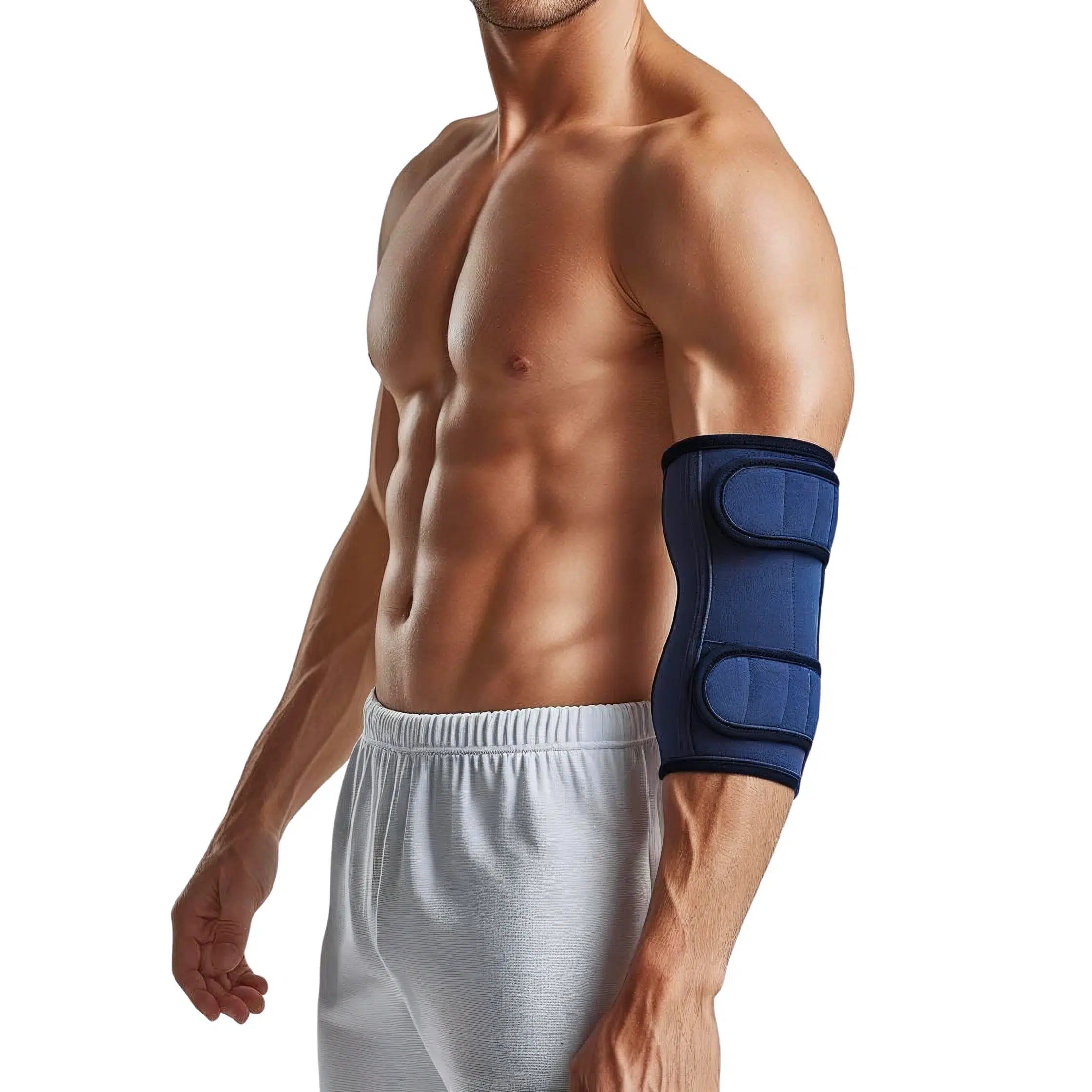
- Rigid straight‑arm elbow splint for adults – designed to hold your elbow near straight during rest and sleep, so deep bending, sudden snapping into straight and direct pressure over the tip of the elbow are limited while you are not fully in control of your position.
- Helps calm night‑time pain, tingling and stiffness – often used when discomfort around the elbow and forearm is worse after sleep or long rests with the elbow curled in. This includes patterns seen in cubital tunnel‑type ulnar nerve irritation, radial tunnel‑type outer forearm pain, tennis or golfer’s elbow, olecranon bursitis, and selected ligament sprains, stable fractures or elbows recovering after a dislocation under clinical guidance.
- Full‑length aluminium rails for firm control at the elbow – two long metal strips run along the arm to limit how far the elbow can bend or straighten. They help protect irritated tendons and ligaments, worn joint surfaces and healing fractures from repeated end‑range jolts during the night, without clamping the wrist.
- Shaped padded wrap to steady the joint and protect sore points – the contoured, cushioned sleeve wraps around the upper arm, elbow and forearm to keep the joint centred and spread pressure away from the bony tip and bursa, which is especially important if the tip of the elbow is swollen or tender.
- Wide, stretchy straps to keep the splint in place – broad, adjustable straps above and below the elbow secure the splint so it stays aligned with the joint through the night. You can quickly tighten or ease them to match your arm size and comfort, helping to balance stability with a comfortable fit.
- Soft, breathable materials for extended wear – a smooth inner lining, rounded edges and small breathable holes in the outer material are chosen to reduce rubbing, heat build‑up and sweating, making it more realistic to wear the splint for several hours at a time.
- Designed for rest and sleep, not daytime activity – because the brace keeps the elbow straight and blocks normal bending, it is generally worn at night or during planned rest periods, not for driving, manual work, or tasks that require free use of the arm.
- Adult‑only design and fitting – made to suit a typical adult arm. If your arms are very small or very large, or if you have recent surgery, a fracture, circulation problems or other medical conditions affecting the arm, seek advice from a GP, physiotherapist or other clinician before using this type of rigid splint. It is not designed for use during pregnancy.
Living with elbow pain can turn ordinary tasks into something you have to think about every time you use your arm. You might feel a nagging ache when you pour a drink, a sharp pull when you reach for something, or a very tender sore spot if you rest your elbow on the arm of a chair. Typing for a while, carrying shopping, or repeatedly lifting light objects can all bring the discomfort back. It is understandable if you start planning movements around your elbow or feel wary every time you reach out your hand.
Night‑time can be even more frustrating. Many people find their arm naturally curls up as they sleep, or they tuck a hand under the pillow, leaving the elbow bent for hours. You may wake with tingling in your fingers, a throbbing joint that takes time to ease, or a deep soreness over the tip of the elbow that makes it hard to lie on that side. By the evening, the elbow can feel tired and sore, with pain that builds through the day and then flares again overnight.
When this keeps repeating – aggravated by bending, leaning or heavier use, and never getting a proper chance to settle – the tissues around the joint can become increasingly sensitive. To understand why a straight‑arm rest splint like this one is often recommended, it helps to look at what is happening inside the elbow and how it is put under strain over the day and night.
Inside the elbow – key structures and why they start to hurt
The elbow is a hinge‑type joint where the upper arm bone (humerus) meets the two forearm bones (radius and ulna). It lets you bend and straighten the arm and, together with the forearm, turn the hand palm‑up and palm‑down. Several main structures can become painful if the movements and forces they face are more than they can comfortably cope with.
Tendons at the inner and outer elbow
Tendons are thick cords that attach muscles to bone. Around the elbow, the wrist and finger extensor muscles anchor into the bony bump on the outer side (lateral epicondyle), and the flexor muscles attach to the bump on the inner side (medial epicondyle). When you grip, lift or twist, these muscles tighten and pull through their tendons onto those small bony areas.
If this pulling is too frequent, too forceful, or the tendon’s ability to repair is reduced, tiny areas of damage can build up faster than they are repaired. Over time, the collagen fibres become less well organised and the tendon slightly thicker and more sensitive. This pattern is often labelled tennis elbow (outer side) or golfer’s elbow (inner side). Pain is usually felt when you grip, lift or twist, and can be sharp when you first start using the arm or after heavier use later in the day.
The more these tendons are irritated, the less they tolerate repeated tugging and awkward angles. If the elbow is bent deeply for long periods, the tendons and their sheaths can be held at uncomfortable lengths or rubbed in ways that keep them irritated and sensitive, even when you think you are resting.
Ligaments and joint capsule – the “check‑reins” of the joint
A tough sleeve called the joint capsule surrounds the elbow, and several ligaments reinforce it on the inner, outer, front and back of the joint. These help keep the bones aligned and limit movement into unsafe ranges. A sudden force that drives the elbow beyond straight (hyperextension), a fall, or a twisting injury can overstretch or tear parts of the capsule and ligaments.
In the short term, the joint often feels sore, swollen and easily “caught out” if it straightens or bends suddenly. In some people, repeated smaller sprains or naturally looser ligaments mean the elbow feels less secure when it is nearly straight, so quick movements are painful or worrying. In those situations, sudden end‑range movements, especially at night when you roll over or push on the bed without thinking, can keep re‑irritating healing tissues.
Nerves running close to the joint
Important nerves pass around the elbow in narrow spaces. The ulnar nerve, which gives the “funny bone” sensation, runs behind the inner bony bump of the elbow in a small groove and tunnel (cubital tunnel). The radial nerve passes across the outer forearm through tight muscular and connective‑tissue channels (radial tunnel). These nerves slide and stretch slightly as you move, and they rely on a good blood supply and enough space around them.
When the elbow is held bent for long periods, the ulnar nerve is stretched and the cubital tunnel narrows, increasing tension and local pressure. Repeated bending, direct leaning on the inner elbow, or thickening of nearby tissues can all irritate it. Symptoms often include tingling, numbness or burning in the forearm, ring and little fingers, or weakness in some hand movements. Similar changes can affect the radial nerve on the outer side, leading to a deep, aching pain along the outer forearm, sometimes with weakness when lifting the wrist or fingers. These nerve‑type pains are often worse with positions you stay in for a long time (for example, prolonged elbow bend while using a device, reading or sleeping) and can be particularly noticeable at night or on waking.
Because you cannot easily control how much your elbow bends while you are asleep, this long, unbroken stretch and squeeze on sensitive nerves is a key target for change – and it is exactly what a straight‑arm rest splint is designed to limit.
The olecranon and its bursa – pressure points at the tip of the elbow
The olecranon is the point of bone you feel at the back of the elbow. Sitting over it is a small fluid‑filled sac called a bursa. The bursa acts as a cushion and allows the skin to glide smoothly over the bone when you rest your elbow on a surface or bend and straighten the arm.
If you often lean on the point of the elbow, bump it repeatedly, or have certain underlying inflammatory conditions, this bursa can become irritated and fill with extra fluid. The area can swell, feel warm or tender, and develop a soft lump that hurts whenever you lean on it. If that pressure continues, the bursa wall can thicken, making it more prone to flaring again with even minor pressure.
For this kind of problem, one of the most effective changes is to stop the bony tip being the main contact point when you rest. A rigid splint with shaped padding can help by taking the load through the brace instead of straight onto the bursa, especially at night.
Joint surfaces and cartilage – deep aching and stiffness
The ends of the humerus, radius and ulna are covered with smooth cartilage that allows the bones to glide with low friction. A thin lining inside the capsule (synovium) produces fluid to lubricate and nourish the joint. With age, previous injury or certain conditions, the cartilage can thin and the joint lining can become irritable. As the smooth surface wears, load is transferred more directly to the underlying bone.
This can cause deep aching, stiffness after rest, and pain if the elbow is pushed to the extremes of bend or straightening. People often notice a combination of morning stiffness, pain at the very end of movement, and a background ache that worsens with heavier use.
If the joint surfaces are already sensitive at the ends of movement, repeated snapping into full straightening or forcing into deep bend during sleep can keep aggravating them. A straight‑arm splint that limits how far you can bend or straighten during long rest periods can reduce those repeated end‑range nudges so the joint has a calmer spell in a more comfortable middle position, rather than being pushed right into full bend or full straightening.
Across all of these structures, how far and how often the elbow bends and straightens, how much you lean or press on the tip of the elbow, how much gripping and twisting work the forearm has to do, and how well the tissues recover between periods of use all shape how sore the joint feels.
Who tends to be affected – and why some elbows struggle more
Elbow problems like these can affect a wide range of adults, but certain patterns do crop up repeatedly.
People whose work or hobbies involve repetitive gripping and lifting with the elbow partly bent, such as using hand tools, racquet sports or gym work, place repeated load on the forearm tendons where they attach around the elbow.
Those who spend long periods at a keyboard or handling hand‑held controls with the elbow flexed and the wrist slightly extended may not be lifting heavy loads, but the muscles and tendons are held in a low‑level contraction for many hours, and the nerves are held in fixed positions that can become uncomfortable.
Individuals who frequently lean on the point or inner edge of the elbow, for example against armrests or table edges, repeatedly compress the bursa and nearby nerves and skin.
People with previous injuries, such as a past elbow sprain, hyperextension event or fracture, may be left with more sensitive tissues or a joint that feels less stable, making them more vulnerable if similar loads are repeated.
Ageing tissues, certain medical conditions, smoking, poorer general fitness and some medicines can all reduce how quickly tendons, ligaments and other soft tissues repair. The same level of daily stress may then tip the balance from repair to ongoing irritation more easily.
In these situations, “load” simply means the amount of force or stretch a structure has to cope with over a day or week. A healthy tendon, nerve or joint can tolerate quite a lot of load, as long as there is enough variation and recovery. Problems tend to appear when the same structures are stressed in the same way over and over, there is not enough quality rest between bouts of use, and tissue capacity is reduced by age, previous injury or general health.
How elbow symptoms change over the day – and why nights matter
The way elbow pain behaves over a typical day often follows recognisable courses, depending on which structures are most involved.
Tendon‑related pain
Tendon pain often feels stiff or sore when you first start using the arm after a rest, then eases slightly as the tissues “warm up”, before building again into an ache or throb after repeated loading. For example, lifting a kettle first thing might feel sharp, become more manageable for a while, then leave a heavy ache by evening if you have done a lot of gripping or lifting.
If that tendon is then tugged and twisted again all night because your elbow is curled in or pressed against the bed, it never really gets a period of rest in a more neutral position. That is one reason some people wake feeling as if their elbow has done a full day’s work before the morning has even begun.
Nerve‑related symptoms
Nerve irritation tends to flare with positions you hold for a long time rather than single movements. Holding the elbow bent for a long time while reading or using a device, or resting the inner elbow on a hard surface, can bring on tingling, numbness or burning sensations in the forearm, ring and little fingers, or the back of the hand. Many people notice these symptoms ramp up in the evening and become especially troublesome at night or on waking, because the arm naturally curls and stays bent without conscious control.
If the elbow is bent deeply for hours in your sleep, the ulnar or radial nerve can be held on stretch and squeezed in its tunnel for most of the night. Changing that resting position is one of the simplest ways to reduce the strain on irritated nerves.
Bursa and bony point discomfort
Bursitis and direct bony tenderness are particularly aggravated by pressure. Leaning the elbow on a hard surface for even a short period can set off aching, and a swollen bursa can be more obvious and sore by the end of a day of leaning or resting on that side. Symptoms usually ease when that pressure is taken away, but then return quickly with the next episode.
At night, pillows and bedding can shift, and you may roll onto the sore elbow without realising. Without some form of protection, the swollen bursa can be pressed repeatedly through the night, even when you thought you were resting it.
Arthritic and deep joint aching
Arthritic‑type changes tend to give a mixture of morning stiffness, pain at the ends of movement and a dull background ache that worsens after heavier use or long‑held positions. People often describe the elbow as “rusty” when they first move it after rest, more comfortable mid‑morning, and then achier again after a day of higher demand.
When the joint surfaces are sore, the last part of straightening or bending can be particularly uncomfortable. Sudden end‑range movements as you change position at night can keep provoking this deep ache.
Across all of these, what happens over the full 24 hours matters. During the day, you may be trying to spread tasks out, vary positions and follow exercise or rehabilitation advice. At night and during longer rest periods, however, the elbow often ends up in positions you would not choose if you were fully awake – deeply bent and tucked under a pillow, pinned under your body, or pressed into the bed. These positions keep tendons and ligaments at the edges of their comfortable range, narrow nerve tunnels and increase tension on sensitive nerves, and repeatedly press on the bony tip and bursa.
If this happens for hours most nights, the elbow tissues are not truly resting, even though you are asleep. The strain that has built up during the day is then topped up overnight. Short‑term problems can settle if loads are reduced and spread more sensibly. If they are not, pain can become more persistent. Tissues may heal on the inside but remain sensitive, or they may adapt by thickening or stiffening in ways that make them more prone to repeat flare‑ups. Without realising, you may then change how you move, perhaps overusing the shoulder or wrist to avoid “upsetting” the elbow, which can create new areas of discomfort.
It is understandable to feel worn down when, despite trying to rest, you wake with tingling or aching and feel as though the elbow has never really been “off duty”. This is why changing what your elbow is allowed to do during those long, uncontrolled rest periods often makes more difference than you might expect.
Why changing elbow position at rest makes sense
Given this cycle – repeated daytime use followed by unhelpful positions at night – it often makes sense to change what happens when you are not actively thinking about your elbow, as well as what you do when you are awake.
A rigid straight‑arm splint such as this one is designed around that idea. By holding your elbow near straight during your main rest periods, particularly at night, it aims to:
- Reduce the pull and compression on irritated tendons, ligaments and joint surfaces by keeping the elbow away from its most bent and most straight positions, in a more comfortable middle position.
- Limit the stretch and squeeze on nerves that are sensitive to prolonged elbow bend or awkward positions, especially in the cubital and radial tunnels.
- Spread pressure away from sore bony points and bursae, so the swollen area is not taking the full force when you rest that side.
Because it keeps the elbow straight and blocks bending through the brace, the arm cannot be used in a usual way while it is on. This is very much a rest and sleep device, not something to wear while you drive, work, prepare food, or carry out everyday tasks. You can think of it as a way of giving the elbow a protected block of steady rest in a safer part of its movement, while during the day you continue to move, strengthen and use the arm in a more controlled way under guidance.
If you recognise that bending and pressure are clear triggers for your pain or tingling, especially at night, a straight‑arm rest splint is often one of the main things a clinician will look at alongside exercise and activity changes.
How this rigid elbow splint supports your elbow while you rest
This rigid elbow immobiliser is a straight‑arm rest splint for adults. It combines full‑length aluminium rails, a shaped padded wrap, wide stretchy fastening straps and skin‑friendly, breathable materials to hold your elbow near straight during rest and sleep, while working to minimise rubbing, heat build‑up and skin irritation.
Because it holds the elbow straight and blocks bending through the brace, you will not be able to use that arm in a usual way while it is on. It is intended for night‑time and planned rest periods, not for continuous all‑day wear during activities such as driving, lifting, or manual work.
Clinicians often favour this kind of firm, predictable support when deep elbow bend, sudden snapping into straight, or direct pressure over the bony tip are clear triggers for pain or tingling.
Full-length aluminium rails – limiting deep bend and over‑straightening
Two straight aluminium strips run the length of the splint, one on each side of the elbow. They are long enough to span the back of the upper arm and upper forearm, which gives a solid frame around the joint. The rails are long enough to control movement at the elbow without clamping the wrist, which helps keep the hand and wrist a little freer while the elbow is protected. Depending on how you position the splint, the rails can sit more towards the inner and outer sides, or more front and back, but in all cases they act together to brace the joint and resist unwanted movement.
These rails:
- Limit how far the elbow can bend, so it cannot curl up into tight positions that stretch the ulnar nerve, tighten forearm tendons at their attachments, or pinch soft tissue at the front of the joint. This links directly to the nerve and tendon mechanics described earlier and can make cubital tunnel‑type symptoms and tendon irritation less likely to worsen repeatedly while you sleep.
- Reduce sudden snapping into full extension. After a hyperextension injury or ligament sprain, a quick straightening movement can feel sharp and unstable. The rails prevent the elbow overshooting into that range, protecting sensitive ligaments and the front of the joint capsule.
- Hold the elbow close to straight for prolonged periods, so structures at the inner and outer elbow, including worn joint surfaces, sit in a safer mid‑range position, not pushed right into full bend or full straightening. This can be especially relevant if pushing up from the bed or rolling onto the arm usually causes a sharp end‑range pain.
In some stages of recovery after certain stable fractures, when a clinician has agreed that brace‑level support is appropriate, these rails can also help keep the healing parts of the bone better aligned during rest, reducing small movements that might otherwise aggravate pain. They are not a substitute for casts or dedicated fracture braces where those are needed, but they provide a firm, reassuring structure at the point where heavy casting is no longer required.
Shaped padded wrap – steadying the joint and softening pressure
The main body of this splint is a padded wrap that curves around the upper arm, elbow and upper forearm. It is cut and stitched to follow the contours of the arm, rather than being a simple flat sheet. When fastened, it forms a stable sleeve around the arm, keeping the elbow centred between the aluminium strips.
This shaped wrap:
- Helps keep the joint aligned. By wrapping around both the upper arm and forearm, it limits small side‑to‑side shifts or twists at the elbow that might unsettle healing ligaments or sensitive joint surfaces, particularly when you turn in bed.
- Spreads pressure over a wide area. Instead of pressure focusing on the bony tip of the elbow or a narrow edge, the padding distributes contact across a broader area. This is particularly important in olecranon bursitis, bruising or after removal of a cast, when direct pressure on bony points is very uncomfortable.
- Supports soft tissues evenly. The wrap gently follows the contour of the arm, so muscles, tendons and the bursa are kept in the same supported position within the splint, reducing localised sore spots where a less carefully shaped brace might dig in.
The position of the seams and the depth of padding are chosen to avoid the inner elbow crease and bony edges, which are common rubbing points with simpler rigid braces, especially when they are worn overnight. Because the padding runs past the elbow onto both the upper arm and forearm, it also makes it physically harder to lean on the bare tip of the elbow or inner edge. The splint, rather than the bony point, takes the load, making it easier to break aggravating leaning habits during rest.
People with very fragile or thin skin need to be particularly careful: even well‑padded supports can cause irritation or pressure marks if worn too tightly or for too long without checks. In those situations, extra padding, a thin soft sleeve underneath, or shorter wear periods may be sensible, guided by a clinician.
Wide stretchy straps – anchoring the splint and fine‑tuning the fit
Stretchy strap panels wrap around the upper arm and forearm and fasten with hook‑and‑loop ends onto the body of the splint. On this design, the straps are relatively wide and sit over padding, which helps to spread pressure.
These straps:
- Anchor the splint securely. By gripping the arm above and below the elbow, they reduce the chance of the brace twisting or sliding out of position overnight. This helps keep the rails aligned with the joint and the padded wrap protecting the right areas.
- Allow fine‑tuning of how snug it feels. You can gently increase or decrease the tension to match your arm size and comfort. A firmer fit gives more control and a sense of stability; a slightly looser fit may be preferred if there is mild swelling that fluctuates.
- Provide firm, even pressure around the arm. This can help reduce small, unwanted movements in the soft tissues and support mildly swollen areas without creating a sharp pressure line. When correctly adjusted, this should feel like steady, even pressure rather than a tightly cinched band.
Using wide, stretchy straps rather than narrow bands helps reduce cutting‑in at the edges, which can be a problem with some basic designs when they are worn for several hours. It is important not to overtighten the straps, especially if there is existing swelling or any circulation concerns. Signs such as increased tingling, unusual coldness, marked colour change, or a strong pulsing sensation under the straps should prompt you to loosen the brace or remove it and seek advice if they do not resolve quickly.
Skin‑friendly build – soft lining, smooth edges and breathable holes
Because this splint is intended to be worn for full rest periods, its build has been chosen with skin comfort in mind. A soft, smooth inner lining lies against the skin, reducing friction and chafing. This is especially important over the inner elbow, where the skin can be delicate, and around bony areas.
Smooth, rounded edges and carefully placed seams help to minimise rubbing. Seams are positioned away from the most sensitive points, and rounded edges reduce the chance of the splint cutting in when you roll onto it or move your arm slightly.
Small breathable holes in the outer material allow air circulation and give moisture a way out. This can reduce heat build‑up and sweating under the splint, lowering the risk of itching, softening of the skin and irritation. The breathable design is included because many people find rigid braces uncomfortably hot; improving air flow makes it more realistic to keep the splint on through the night.
If you do have sensitive skin, a thin, smooth sleeve between your skin and the splint can sometimes help, as long as it does not bunch or create extra pressure points. A clinician can advise on this if needed.
Using this immobiliser – when, how, and what to expect
This rigid straight‑arm immobiliser is designed for adults and should be used mainly during rest and sleep, rather than throughout the day.
When to use it
A common pattern is to put the splint on shortly before going to bed, once evening activities that need elbow movement are finished. It is then worn through the night to limit deep bending and direct pressure, and removed in the morning before washing, dressing and normal daytime activities. Some people also use it during planned daytime rest periods, such as lying down to rest the arm after heavier use, or sitting quietly for extended stretches when they do not need to bend the elbow.
Because it prevents normal elbow bending, you will be relying mainly on your other arm for most tasks while it is on. It is not generally suitable for driving, preparing food, manual work or lifting, or most household tasks that require the use of both hands. Unless a clinician has specifically advised otherwise, it is safer and more practical to remove this brace for active periods. In some cases, lighter, more flexible elbow supports are used during the day so the joint can move under control and the surrounding muscles stay engaged, with this rigid splint reserved for the times when the elbow is most likely to bend deeply or be pressed on without you realising, such as at night.
Fitting the splint
Place your arm into the open splint so that the padded section wraps around the back and sides of your upper arm, elbow and forearm. Position the elbow so the joint line sits roughly midway between the two aluminium strips.
You can position the rails more along the sides of the arm or more towards front and back; both positions can work, but they should sit evenly and feel stable.
Wrap the padded body of the splint snugly around your arm so the edges meet comfortably, without buckling or digging in. Fasten the stretchy straps around the upper arm and forearm using the hook‑and‑loop ends. Start with a moderate tension and adjust until the splint feels secure but not constricting.
Check your hand and fingers after a few minutes. They should feel warm and normal in colour, with no new tingling, marked throbbing, or sense of pulsing under the straps. If you notice any of these, loosen the straps slightly and reassess.
If you have had surgery, a fracture, or any open wounds in the area, only apply the splint in the way and at the time a clinician has advised. It should not be placed directly over fresh wounds or dressings without professional guidance.
What to expect
When used in the right way, many adults report less night‑time bending of the elbow and fewer episodes of waking with pins and needles, numbness or sharp pain around the joint. Sharp “catching” pains that usually occur when the elbow suddenly bends or straightens from an awkward position can reduce. Sore tendons or bursae may feel calmer in the morning because they have had several hours with less pull and pressure. There is often a greater sense of protection and confidence during the early phase after a sprain or certain fractures, when accidental movements during sleep can otherwise feel worrying.
Many people feel more confident simply knowing the elbow cannot suddenly bend or snap straight in the night, especially in the early weeks after a painful injury or flare‑up.
At the same time, it is important to be realistic about what this kind of splint can and cannot do. It does not cure underlying arthritis, heal fractures on its own, or reverse severe tendon or nerve damage. It is one supportive tool alongside appropriate medical assessment, rehabilitation exercises, activity changes and, where needed, other treatments. Some stiffness is normal after wearing any immobiliser for several hours. Gentle, pain‑limited movement of the elbow after removing the splint (within what your clinician has advised) can help ease this. Changes are often gradual. It may take several nights or weeks of consistent use, combined with daytime management, before you notice a clear difference in how symptoms behave.
Over time, and particularly as tissues heal and strengthen, a clinician may advise gradually reducing how many nights you use the splint, so the elbow does not become overly reliant on rigid support.
Where this brace fits in your overall plan
This straight‑arm immobiliser sits at the firmer end of elbow support. It is usually considered where deep bending and pressure are clear triggers of symptoms and where there is a need for the joint to be closely controlled during rest while still allowing some movement at other times.
That means it may be used to:
- Give irritated nerves at the inner or outer elbow several hours of lower tension and compression overnight.
- Allow overloaded tendons at the inner or outer elbow a period of rest in a more neutral position, alongside exercise and activity modification.
- Reduce pressure on an inflamed bursa over the tip of the elbow by spreading load over the splint rather than through the bony point.
- Protect healing ligaments, capsule and, in some cases, stable fractures or elbows recovering after a dislocation from sudden, uncontrolled movements at night, under professional guidance.
It does not replace a full assessment by a GP, physiotherapist or appropriate specialist, particularly where pain is severe, onset was sudden, or there are worrying features. It does not remove the need for daytime rehabilitation exercises and sensible activity changes, or for specific devices prescribed for particular fractures or post‑operative protocols where those are indicated.
You can think of it as changing one important part of your daily routine: what your elbow is allowed to do during long rest periods. That gives the work you and your clinicians do in the day a better chance to help.
This product is designed for adults only and is not suitable for use during pregnancy. If you are pregnant or unsure, speak to a clinician before considering this type of immobilisation.
Safety – warning signs, clot risk and when to seek help
Many adults can use this type of brace safely as part of wider management, but there are situations where you should pause and seek further advice.
Stop using the splint and get prompt assessment from a GP, physiotherapist or other appropriate clinician if:
- You develop sudden, severe elbow pain after a new injury, especially with a clear deformity, inability to move the joint, or a cracking or popping sensation at the time.
- Swelling, redness or heat around the elbow or forearm appears rapidly, worsens quickly, or is significantly more than you would expect.
- Your hand or fingers on the splinted side become unusually cold, very pale, very dark, or noticeably different in colour from the other side.
- You notice new or worsening numbness, weakness, or difficulty moving the hand or arm that is not simply due to mild stiffness after rest.
- There are signs of infection under the splint, such as increasing redness, local warmth, discharge from wounds, or feeling generally unwell.
- You have any open wounds or recent surgical incisions under the area the splint would cover, unless a clinician has specifically advised using it.
Regarding blood clots and circulation, prolonged immobilisation of a limb, particularly when combined with other risk factors such as recent major injury, surgery, certain medical conditions or reduced mobility, can contribute to the risk of developing a blood clot in some people. This elbow splint does not treat or prevent blood clots and should not be relied upon for that purpose. If you have known clotting problems, have been advised you are at higher risk, or develop symptoms such as unexplained swelling in the whole arm, marked colour change, sudden shortness of breath, chest pain or other new unexplained symptoms, seek urgent medical help.
This information is general guidance for adults and does not replace personalised assessment. A clinician who has examined your elbow and, where appropriate, reviewed scans or X‑rays is best placed to say whether this level of immobilisation is suitable and how long it should be used.
Bringing it together – is this splint worth considering?
Elbow pain, stiffness and nerve‑type symptoms that flare with deep bending and pressure are often driven by the way forces act on sensitive structures over a full day and night. Tendons at the inner and outer elbow, the ulnar and radial nerves, the olecranon bursa and the joint surfaces themselves can all be stressed by repeated gripping and awkward postures in the day, then held in unhelpful positions for hours while you sleep.
This straight‑arm rest splint is designed to change what happens to your elbow at night. The full‑length aluminium rails limit deep bending and sudden snapping into straight, the shaped padded wrap spreads pressure away from sore bony points and bursae, and the wide, adjustable stretchy straps and breathable construction make firm control more tolerable for extended rest. For many adults with patterns like those described – especially night‑time nerve symptoms, tendon irritation or pressure‑sensitive bursitis, or certain post‑injury situations under specialist care – using a rigid splint like this at night, alongside daytime rehabilitation and sensible activity changes, can make symptoms more manageable over time.
If the descriptions on this page sound familiar, and a clinician has confirmed that your elbow is suitable for this level of support, this type of brace is a reasonable option to consider as part of your wider plan. A GP, physiotherapist or relevant specialist can help you decide how it fits with other treatments, how long to use it, and how to adjust use as your elbow recovers.
Disclaimer
The information on this page is general guidance for adult readers in the UK. It does not replace individual medical advice, diagnosis or treatment. Elbow pain and related problems can have many causes, and similar symptoms may behave differently in different people.
This product does not guarantee pain relief, cure any condition, or prevent complications such as blood clots. It should not be used as an alternative to medical assessment where symptoms are severe, changing quickly, or associated with concerning features such as marked swelling, changes in colour or temperature, spreading numbness or weakness, or other new unexplained symptoms.
If you are unsure whether this splint is suitable for you, if you are pregnant, or if you have other medical conditions that affect your bones, joints, nerves or circulation, speak to a GP, physiotherapist or other appropriate clinician before using it.
2 Reviews For This Product
Fast & Secure Checkout Through Paypal
Pay with Paypal the secure payment gateway that accepts all credit and debit cards. Paypal is free and secure and no credit or bank information is ever stored or shared with us.
Fast Dispatch
Enjoy your items soon with quick dispatch via Royal Mail. Expect to have your items between 1-3 working days for domestic orders. 7-10 Working days for international orders.
Return Policy – 30 Day Money Back Guarantee
In the unlikely event, you are unhappy with your purchase you can return it within 30 days for a refund. Please contact us via the form on the contact us page to start your return.
To return an item please send it to: Nuova Health UK, 81 Highfield Lane, Waverley, Rotherham, S60 8AL. Please include a note with your order id so we know who to refund. Please retain your postage receipt as proof of postage. All that we ask is that the item is in the original packaging and unused.

by Margaret Welsh
This looked great but to long for my arm otherwise I would have kept it great quality.
by Adam
Works very well and gives a lot of support!