
No products in the cart.


Roll over image to zoom in
Ankle Splint Foot Brace & Post-Op Cast Support for Ankle Sprains, Fractures, Achilles Tendonitis & Drop Foot
£14.99inc VAT
- What it is: A semi‑rigid ankle–foot brace from FootReviver. It holds your ankle and foot in a safer position, cuts down on twisting and supports you while you walk, stand and get back on your feet after injury or with longer‑term problems.
- Suitable for sprains, strains, tendon pain, arthritis‑related stiffness, drop foot and for the post‑fracture phase when your doctor or therapist recommends moving on from a cast or boot.
- Helps limit sudden inward and outward ankle rolls that can re‑sprain ligaments or unsettle a healing joint.
- Applies gentle compression around the ankle and lower leg to help manage swelling and ease that heavy, tight feeling by the end of the day.
- Universal design that can be worn on either left or right foot, with multiple adjustable buckled straps so you can set the support and fit you need.
- Lightweight, breathable and padded around key bony areas so it is more comfortable to wear in suitable footwear during everyday activities.
- Available in three UK sizes (Small 3–5, Medium 5–8, Large 8–11) with a 30‑day money‑back guarantee.
Living with ankle and foot problems
Pain, stiffness, weakness or loss of control around the ankle and foot can quickly affect how you move. You may find you walk more cautiously, think more about where you place your feet, or feel less confident on certain surfaces or stairs. For some people the main issue is sharp pain when they first stand; for others it is a dull ache that builds the longer they are on their feet, or concern that the ankle might give way or the foot might not lift as it should.
It is understandable to feel frustrated or anxious about putting weight through your ankle again, especially if it has already been injured once. No one likes feeling they have to think about every step.
In many of these situations, the ligaments, tendons, joints or nerves around the ankle and foot are either healing from a clear injury or coping with longer‑term wear and tear or nerve and muscle problems. When they are sore, stretched or not working as well as they should, putting full movement and body weight through the area can be uncomfortable and sometimes unsafe. A foot‑and‑ankle brace like this FootReviver design is there to support those tissues by limiting risky movement, helping to manage swelling and giving the joint steadier support while you work on recovery and longer‑term management. The aim is not to stop you moving, but to help you move in a safer, more supported way.
Why the ankle and foot start to hurt
Key tissues around the ankle and foot
The ankle joint joins the shin bones (the tibia and fibula) to the foot. Ligaments around the joint keep it from rolling too far inwards or outwards. When the ankle suddenly twists, these ligaments can stretch or tear, especially on the outside of the joint, leaving pain, swelling and bruising. Repeated twists can leave these ligaments a little looser and the ankle more likely to roll again.
Muscles in the lower leg control how your foot moves, and their tendons attach into the bones around the ankle and foot. The Achilles tendon at the back of the ankle links the calf muscles to the heel bone. It helps with every step when you push off and when you lower your heel down under control. If you walk or run more than you are used to, or change activity suddenly, small areas in these tendons can become irritated and sore.
Under the sole of the foot is a strong band called the plantar fascia. It runs from the heel bone to the toes and helps support the arch. Longer periods of standing on hard floors, changes in footwear, extra body weight, or sudden increases in walking or running can put more strain through this band, especially near its attachment at the heel. This often leads to sharp heel pain with first steps after rest and an ache that builds with activity.
The joint surfaces themselves can also wear over time. In arthritis, the smooth cartilage that covers the ends of the bones thins and roughens, and the joint lining can become inflamed. The ankle may then feel stiff and sore, especially after rest or long periods of standing or walking.
For some people, nerve or muscle problems mean the front of the foot does not lift properly. This is often called drop foot. Toes can catch on the ground, leading to trips and falls and forcing the rest of the leg to move differently to clear the foot, which can be tiring and place extra strain on other joints.
How an ankle–foot brace can help
A brace that supports both the ankle and the foot can help in several clear ways.
It reduces how far and how quickly the ankle rolls or bends into positions that tend to hurt or re‑injure tissues. Keeping the ankle closer to the middle of its range puts less strain on healing ligaments and on parts of the joint that are already sore.
It adds an extra source of stability from the outside. That means the muscles around the ankle do not have to work as hard every second just to keep the joint centred. This can help if your ankle feels “wobbly” on uneven ground or after time in a cast when muscles are weaker.
It provides gentle, even compression around the ankle and lower leg. This can help reduce excessive swelling and the feeling of tightness that often makes movement uncomfortable. When swelling is better controlled, the joint usually moves more freely within a comfortable range.
When the front of the foot does not lift fully, holding the foot closer to a right angle with the lower leg can support better toe clearance when the leg swings forwards. That reduces the risk of catching the toes and makes each step feel more secure.
None of this replaces exercises, footwear changes or medical treatment where those are needed. The brace makes those steps easier by giving you a more stable, supported joint to work with.
What this FootReviver brace is designed to do
Structure and alignment
The FootReviver Ankle Splint Foot Brace & Post‑Op Cast Support has a firm frame around the lower leg and ankle with a stable base under the foot. It comes up to around mid‑calf and, when the front section is used, it covers the ankle from all sides.
Inside the fabric are flexible aluminium splints: two along the outer side of the ankle, two along the inner side, one in the detachable front section and one running up the back over the Achilles. The side and back splints are already shaped to follow the lower leg and ankle, and you would not normally need to bend them. The front splint sits in a removable panel that you can gently mould so it follows the front of your shin more closely when you first fit the brace.
These splints are firm enough to resist sudden or excessive movement, but they still give a little as you move, so the brace does not feel like a rigid cast.
The frame and splints are shaped to keep the ankle and foot nearer to a straight‑ahead position. The side bars help limit the inward roll that often contributes to sprains on the outside of the ankle, and outward roll that stresses the inner side. The front and back bars add extra control to forward and backward bend at the ankle, while still allowing you to walk. The brace extends to around mid‑calf so that control of the ankle is taken from higher up the leg, which gives the splints more leverage to resist unwanted motion while spreading pressure over a larger area for comfort. The frame and strap layout is based on the way ankles usually sprain and then recover, and on what physios and podiatrists see every day in their clinics. By guiding the joint through a safer arc as you stand and walk, the brace aims to protect healing ligaments and reduce pressure on irritated joint surfaces.
Straps and adjustability
Several buckled straps run across the foot, around the ankle and up the lower leg. These allow the brace to be drawn snugly around the limb so it moves with you, rather than slipping or rubbing.
Because the straps are separate, you can tighten some a little more and others a little less. For example, you may want firmer support around the ankle joint itself when you are going for a longer walk, and slightly gentler tension when you are moving around the house. This helps you match the level of support and compression to what you are doing and to changes in swelling through the day. The strap arrangement has been designed so that most people can manage it themselves or with minimal help.
Compression and swelling control
The brace provides steady, comfortable compression around the ankle and foot. This pressure helps limit excessive swelling and can reduce the feeling of heaviness and tightness at the end of the day.
When swelling is under better control, there is usually more room for the ankle to bend and straighten within a comfortable range. That makes it easier to move early on, when the joint is stiff, and supports the aim of combining protection with gradual return to movement as advised by your doctor or therapist.
Positioning and movement
A key job of this brace is to hold the foot closer to a right angle with the lower leg and to control side‑to‑side roll. The flexible splints along the sides, front and back help resist sudden twists and extreme bend, while still allowing normal walking movements. That reduces strain on tissues that do not tolerate sudden or extreme movement well.
If your ankle tends to roll inwards after a sprain, the side supports in this FootReviver brace are there to resist that roll. If you have had sprains or feel the ankle might give way, this positioning helps cut down sudden inward or outward twists, especially on uneven or sloping surfaces. After fractures or a spell in a cast, the splints and frame can make the ankle feel more secure when you first return to normal weight‑bearing. In drop foot, helping to hold the foot up makes it easier for the toes to clear the ground and may reduce tripping. The rear splint over the Achilles region also helps limit very strong pointing of the foot downwards, which can be uncomfortable when the tendon or post‑surgical area is sensitive, while still allowing a normal push‑off during walking.
Comfort and wearability
The brace is made from lightweight, breathable materials and has a relatively slim profile. Air can move around the skin and moisture is less likely to build up compared with heavier, more enclosed boots. Padding around the ankle bones and heel is designed to spread pressure and reduce rubbing over these bony points, especially when the brace is worn for longer periods. That reduces the chance of skin irritation when you wear the brace for long spells on your feet.
Because it is not bulky, many people can wear it inside suitable footwear, such as trainers or walking shoes that have some extra depth and adjustable fastenings. Being able to use the brace in everyday shoes, once your doctor or therapist agrees this is appropriate, means you can benefit from its support at home, outdoors and at work. Many people, and the clinicians who look after them, value that this brace can fit into common footwear rather than needing a separate, rigid boot.
Durability and care
The brace is built for regular use during recovery and for ongoing support where needed. The frame and straps are intended to cope with being put on and taken off daily and with the normal movements of walking and standing.
It is still worth checking it now and again. Look for any fraying straps, loose stitching or fastenings that no longer hold as they should. Wiping the brace if it becomes damp with sweat, allowing it to air dry away from direct heat, and making sure it is fully dry before you wear it again will help keep it comfortable and in good condition.
Getting the fit right
Choosing a size
This brace comes in three sizes based on UK shoe size:
- Small: UK 3–5
- Medium: UK 5–8
- Large: UK 8–11
Choosing the right size matters. A brace that is too small may dig in and cause sore spots or restrict circulation. One that is too large may not control movement properly and could slip. If you are between sizes, know that your foot swells a lot, or are unsure, it is worth checking with a doctor, physio or podiatrist who knows your ankle and foot, and thinking about the socks or clothing you plan to wear under the brace. The design is universal, so the same brace can be worn on either the left or right foot as long as the size is correct.
If you are between sizes, think about how much your foot and ankle tend to swell and whether you plan to wear a thicker sock or compression sock. In borderline cases, a slightly larger brace may be more comfortable, provided the straps can still be tightened enough to control movement.
Putting the brace on
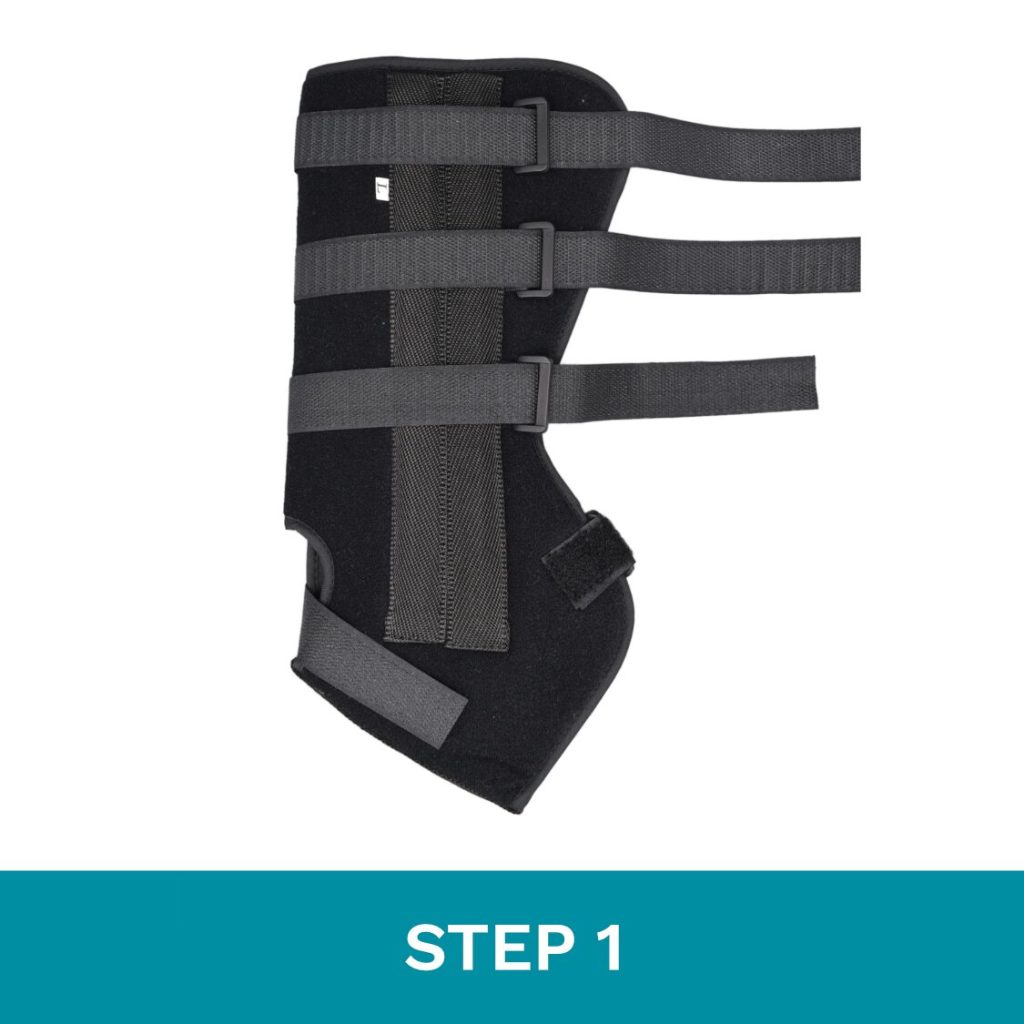
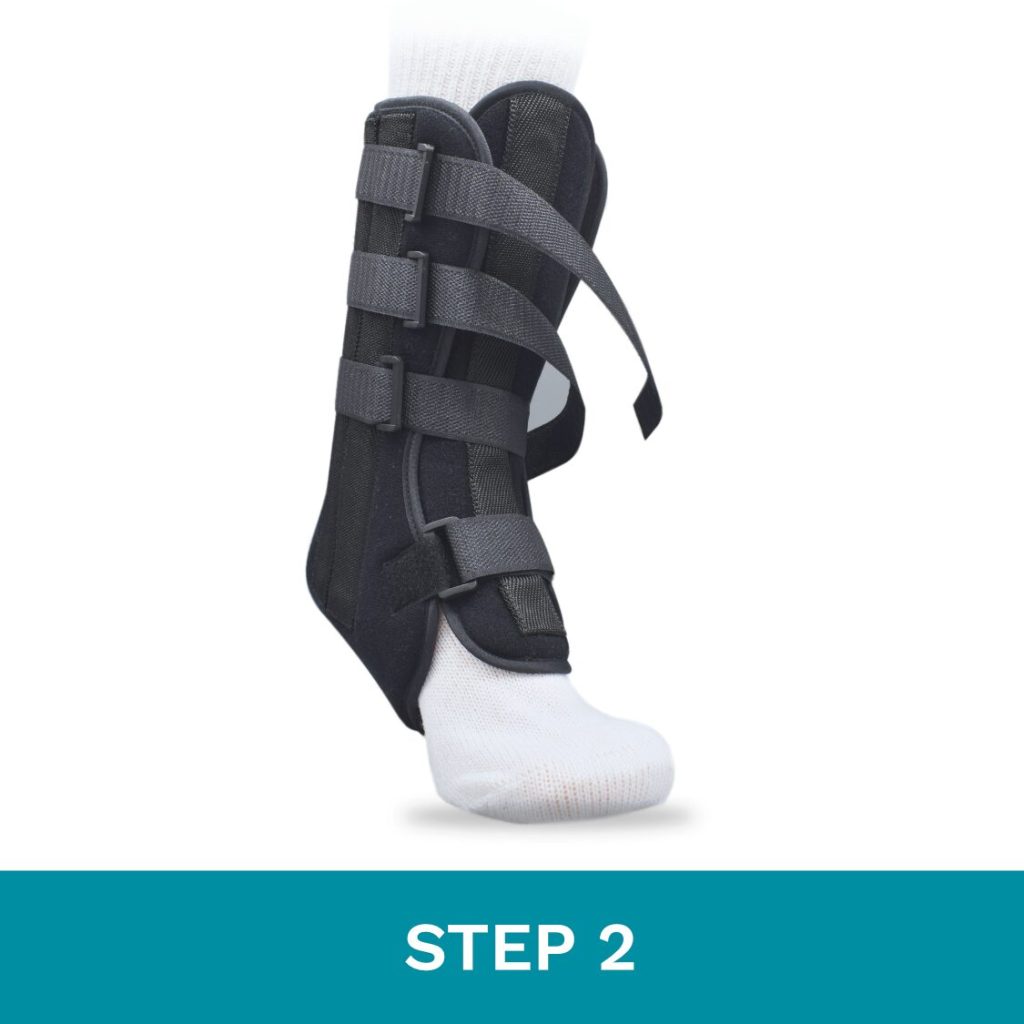
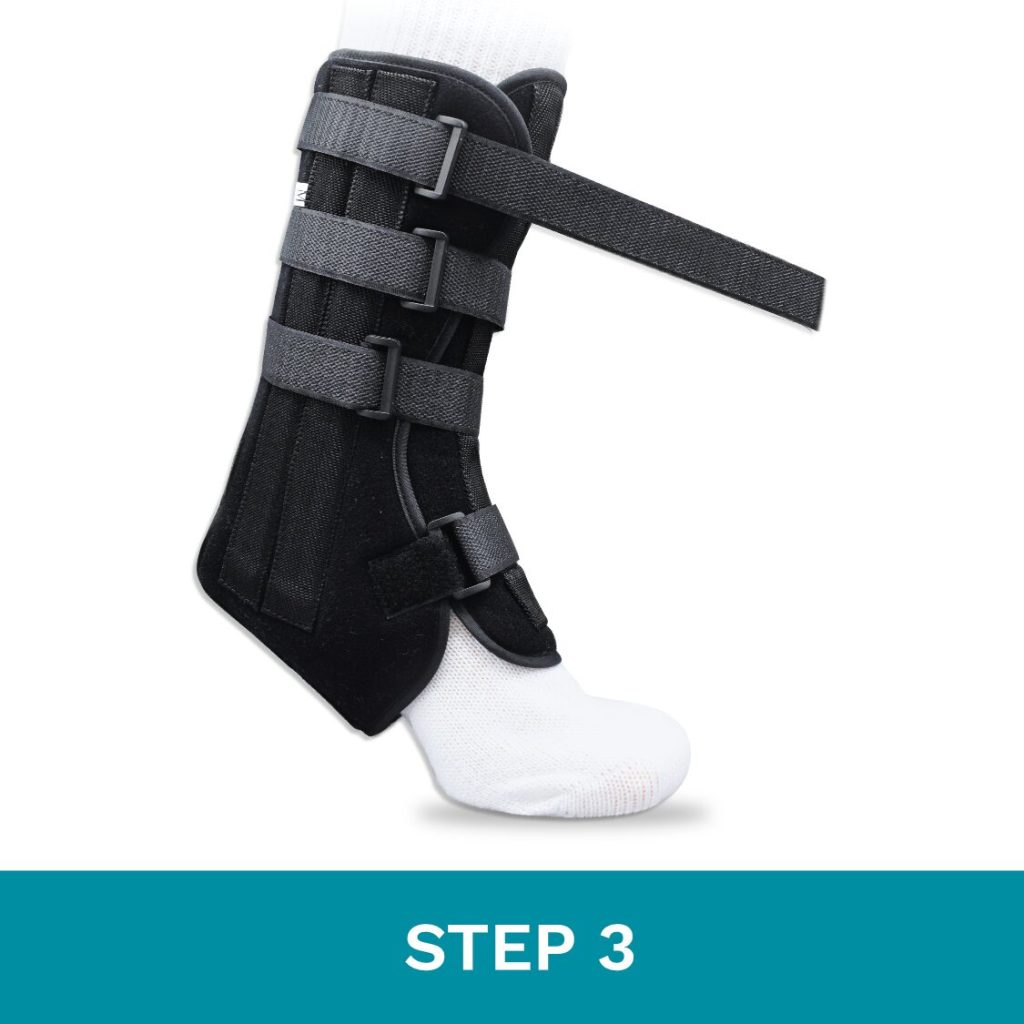
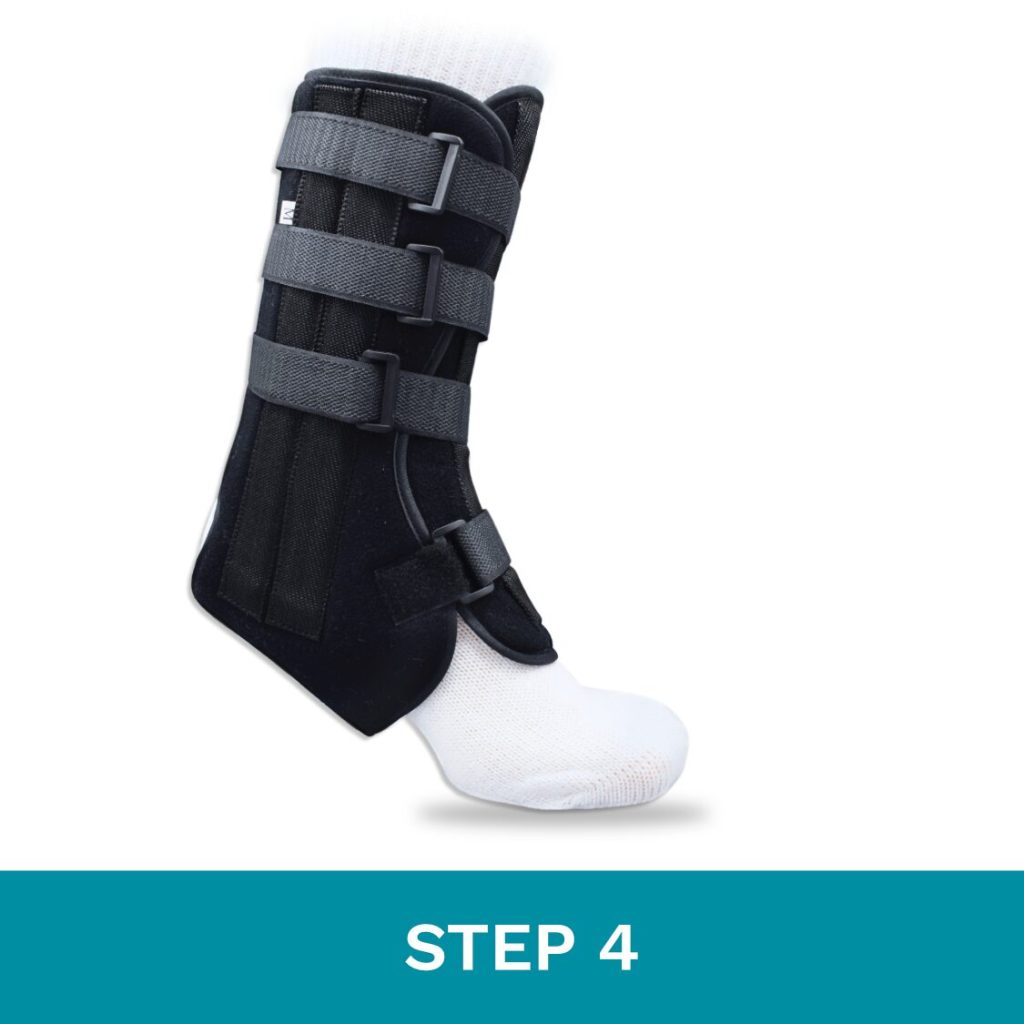
To get the most benefit, the brace needs to be positioned correctly before you tighten the straps. Your heel should sit right back in the heel section, and your foot should rest flat on the base so the ankle is roughly at a right angle.
Straps are usually fastened starting near the ankle joint and then moving up the leg and along the foot. Each strap should be firm enough that you feel supported but not so tight that you develop pain, pins and needles, or that your toes change colour. The first couple of times you use the brace, it is normal to need a few attempts to find the most comfortable and secure arrangement, especially if your ankle is still swollen. Many people find it easier once they have seen it done step by step.
The front panel can be gently bent so it follows the front of your shin more closely before you tighten the straps over it. It is usually best to wear a thin sock or compression sock under the brace to protect the skin and improve comfort, as long as the brace and footwear still fit without feeling tight.
How it should feel
With a good fit, the ankle should feel better held, especially in the directions that used to feel weak or painful. You should feel a firm, even squeeze from the brace rather than sharp pressure at one point. Your toes and the part of the foot beyond the brace should stay warm, with normal feeling.
You should still be able to move the ankle within the safe range your doctor or therapist has advised for your stage of recovery. Early on, the brace may feel a little unfamiliar because it is guiding your movement differently. That often settles as you adjust to it. If it cuts in, slips, or does not seem to limit the movements you are concerned about, the fit or size may need to be reviewed.
Common fitting problems and checks
If your heel is not fully back in the brace, the ankle will not be held as securely and rubbing is more likely. If straps are much tighter in one area than another, pressure points can develop. After you have worn the brace for a few minutes of standing or walking, it is sensible to check how it feels and, if needed, make small adjustments.
If your ankle and foot swell more at certain times, such as later in the day, you may need to loosen or re‑tighten the straps slightly. Any redness that does not fade after the brace is removed, blisters, sore areas or new numbness or tingling are signs you should speak to a doctor, physio or podiatrist.
How and when to use the brace day to day
Early after injury or surgery
In the first days and weeks after a sprain, fracture or operation, the main aim is to protect healing tissues. During this time, your doctor or therapist will usually set clear limits on how much weight you can put through the foot and how much you can move the ankle.
If they recommend a brace like this, you may be asked to wear it whenever you are standing or walking, to help keep the ankle in a safer position and give extra support while you begin to put weight through it again. It can help you move from more rigid support, such as a cast or boot, towards more natural walking. It should not be used to go beyond any weight‑bearing or activity limits your medical team has set.
Rehabilitation phase
As pain and swelling improve and movement becomes easier, attention usually turns to rebuilding strength, flexibility and control. During this phase, the brace can still be useful while you start to increase what you do.
You may be advised to wear it during longer walks, on rougher ground, or for particular exercises that challenge the ankle. In safer situations, such as controlled exercises on flat ground or short tasks at home, you might spend brief periods without the brace, so your muscles and joint can learn to cope again without constant external support. The right balance between time with and without the brace will depend on your progress, and your physio or doctor can help you decide when to rely on the brace and when to try short spells without it.
Long‑term use for instability and arthritis
For longer‑term problems such as chronic instability or ankle arthritis, the brace may have a place in day‑to‑day management. Many people in this position choose to wear it on days when they expect to be more active, when symptoms are worse, or for jobs they know are likely to bring on pain or a feeling that the ankle might give way.
On lighter days, or for very short, low‑demand tasks at home, some manage without the brace, using supportive footwear, any insoles that have been recommended, and sensible planning of how they spread their activity through the day. How often you use the brace and in which situations is something to work out with a doctor, physio or podiatrist who understands your ankle and your wider health.
Sport and higher‑risk activities
With the agreement of your medical team, the brace can sometimes be worn during sports or other activities that involve running, jumping or sudden changes of direction. Its structure and straps can help reduce the chance of a sudden roll or twist in these settings.
The brace is not designed for unrestricted high‑impact twisting sports or very deep ankle movements until your doctor or physio feels you are ready. It is best seen as added protection within a sensible progression, not as a way to skip rehabilitation. A safe return to sport usually depends on healed tissues, good strength and control, and a gradual increase in training load. The brace is there to support that process, not replace sport‑specific rehabilitation.
When to wear it and when to take it off
Most people will wear this type of brace when they are on their feet and the ankle is taking weight, or when they are doing activities that test their balance or stability. When you are resting with your leg up, or sitting or lying for a longer spell, there is often less need for the brace, and it can be helpful for your skin and soft tissues to have some time without pressure.
For most people, that includes overnight. This type of brace is usually not meant to be slept in unless your specialist has clearly advised it. At night your ankle is not taking weight, and the skin and circulation benefit from a break from straps and compression. This is especially important if you have diabetes, circulation problems, a history of blood clots or reduced sensation in your feet.
Wearing any brace for very long periods without breaks, especially if you are not moving much or overnight, can increase the chance of rubbing and pressure problems. This is particularly important for people who have reduced feeling in their feet or known circulation problems, such as some people with diabetes. If you use compression socks or insoles with the brace, take care that footwear is not too tight around the foot and ankle, as this can restrict blood flow, especially if you have reduced feeling or circulation problems. If you are unsure, check with a doctor or other health professional. Unless you have been clearly advised to wear it at night or for very long stretches, it is usually wise to remove the brace at intervals, check your skin, and allow the area to air before putting it back on.
Who this brace is suitable for
When this brace is often used
This ankle–foot brace is commonly used for:
- Support during recovery after ankle sprains and strains, once serious injury has been excluded.
- Extra protection and reassurance after fractures, when a doctor or specialist recommends moving from a cast or boot into a brace.
- Ongoing instability, when the ankle feels as if it may give way, especially on uneven or sloping ground.
- Problems affecting the Achilles tendon and other tendons around the ankle.
- Flare‑ups of plantar fascia‑related heel or arch pain, by influencing how the ankle and foot move during walking.
- Ankle arthritis, to ease some of the mechanical stress, particularly during longer walks or periods of standing.
- Drop foot, to improve walking safety when lifting the front of the foot is difficult, under specialist guidance.
- The post‑operative phase, to provide extra protection when this has been recommended by the treating team.
Many people with these problems will also benefit from using supportive or shock‑absorbing insoles or heel lifts, such as those available in the NuovaHealth range, alongside the brace where shoe space allows.
When to speak to a clinician before using it
If you have recently injured your ankle or foot and have very severe pain, notice that the joint looks out of place, cannot put any weight at all through the foot, or develop very rapid swelling, you should seek urgent medical assessment before using a brace. These signs can indicate a fracture or another serious injury that calls for specific treatment.
If you notice sudden new weakness, marked numbness or tingling, changes in skin colour or temperature in the foot, or general signs such as fever or spreading redness, you should also speak to a doctor promptly. In conditions such as drop foot, assessment by a doctor and, where appropriate, a specialist service is important to understand the cause and consider all treatment options.
When this brace is an extra, not the main treatment
In conditions such as plantar fascia‑related heel pain or ankle arthritis, other measures usually do most of the work. These might include supportive footwear, insoles to help position the foot, exercises to improve strength and flexibility, spreading activity more evenly through the day, weight management and medicines where needed.
In these situations, an ankle–foot brace can still be useful as extra support in particular circumstances, such as during flare‑ups or for tasks you know tend to bring symptoms on. It is unlikely to be the only or main treatment. A doctor, physio or podiatrist can advise you on how best to combine bracing with these other approaches. If you are already using compression socks or insoles as part of your care, they can also advise on how best to combine them with this brace.
Special situations
People with conditions that affect circulation, skin health, feeling in the feet or wound healing need to take extra care. If you have open wounds, fragile skin, reduced sensation in the foot or leg (for example due to diabetes or other nerve problems), or known circulation problems, it is especially important to speak to a doctor or specialist before using a brace that applies compression and covers a large area of skin.
In these cases, careful fitting, shorter initial wear periods, regular skin checks and clear advice on how long to wear the brace at a time are all important. Your clinician can help you decide if this brace is suitable for you, when to wear it, and what early warning signs to watch out for.
More detail on common ankle and foot problems
The sections below give more detail on ankle and foot problems where this type of brace is often used. If one of these descriptions sounds similar to your experience, you can open that section to read more about what may be happening and how the brace can play a part in managing it.
Safety, warning signs and driving
Acute injury warning signs
If you have recently injured your ankle or foot and notice very severe pain, see that the joint looks out of place, cannot put any weight at all through the foot, or develop very rapid swelling, you should seek urgent medical assessment before using a brace. These signs can point to a fracture or another serious injury that needs specific care.
In the first days after a significant injury, pain and swelling are expected but should start to ease with appropriate management. If pain remains very high and does not improve at all with rest, or if pain and swelling are clearly worsening over time instead of settling, you should be reviewed by a doctor. Relying on a brace alone in these circumstances can mean important treatment is delayed.
Circulation, nerve and skin issues
While wearing the brace, keep checking the skin and soft tissues underneath. If you see redness that does not fade after removing the brace, blisters, broken skin, or any sign that the skin is being damaged, the fit may need to be adjusted and you should seek advice.
Changes in skin colour below the brace, such as the foot becoming unusually pale or blue, a marked change in temperature, or new numbness or tingling can be warning signs that circulation or nerve function is being affected. If you notice these, remove the brace and get medical advice promptly.
Nerve‑related and general health warning signs
If difficulty lifting the foot appears suddenly, especially if it comes with other symptoms such as weakness in other parts of the limb, changes in feeling, slurred speech, facial changes or a sudden loss of balance, you should seek urgent medical assessment. These signs can indicate serious underlying conditions that require immediate attention.
More general health changes such as fever, feeling very unwell, or spreading redness and warmth around the ankle or foot may indicate infection or another health problem. In these situations, it is sensible to contact a healthcare professional without delay.
Driving and this brace
Driving relies on being able to move your ankle freely, quickly and accurately to control the pedals. This brace is designed to limit ankle movement and hold your foot in a more fixed position. Because of that, it can interfere with how quickly and precisely you can press and release the pedals.
For safety, you should not drive while wearing this brace. Doing so may slow your reactions and increase the risk of an accident that could harm you and others. When you are considering driving again after an ankle or foot problem, it is important to discuss this with your doctor and to follow any legal or licensing guidance. Driving should only be resumed when you are able to control the pedals safely without the brace and have been advised it is appropriate to do so.
General guidance
This is general information. It does not replace an assessment or diagnosis from someone who has examined you in person. This brace is one part of supporting and protecting the ankle and foot. Decisions about using it, and about your activity levels while wearing it, should take account of your diagnosis, any other health conditions and any treatments you are receiving. If you are unsure, it is always reasonable to speak with a doctor, physiotherapist or podiatrist who can advise on your particular situation. No brace can guarantee a cure or a specific outcome, but used in the right way it can help to make movement more manageable and safer while other parts of your treatment are in place. If in doubt, it is always safer to pause and ask.
Quick recap: what this brace offers
- A semi‑rigid ankle–foot brace from FootReviver, made to support and control the ankle and foot rather than completely immobilise them.
- Designed to support adults with ankle and foot problems such as sprains, strains, post‑fracture recovery, tendon issues, arthritis, drop foot and post‑operative needs.
- Firm frame with a stable base, aluminium splints along the sides, front and back that help hold the ankle and foot in a straighter position, reducing sudden twisting and rolling that can strain ligaments and joint surfaces.
- Multiple fully adjustable buckled straps that secure the brace and let you set the level of support and compression to match your activities and stage of recovery.
- Compression around the ankle and lower leg to help manage swelling, ease the feeling of fullness and tightness, and support healing tissues.
- Positioning support that assists with toe clearance and more controlled steps in conditions such as drop foot and long‑standing instability.
- Lightweight, breathable, non‑bulky materials and padding around key bony points for more comfortable wear, with the option to use the brace with suitable footwear once your doctor or therapist advises this is safe.
- Available in three sizes (Small UK 3–5, Medium UK 5–8, Large UK 8–11) to fit a range of foot sizes.
- Can be used in the early days after certain soft‑tissue ankle injuries, where a doctor has recommended protection and compression, to help protect and support the area.
- Includes a 30‑day money‑back guarantee.
This FootReviver design aims to offer more control than a simple elastic sleeve, while being easier to live with day to day than a full rigid boot.
Bringing it all together
The ankle and foot work hard every day and are exposed to many different stresses. A sudden twist can strain ligaments on the outside of the ankle. Repeated loading can irritate tendons such as the Achilles and the plantar fascia under the heel. Wear‑and‑tear changes in the joint can lead to stiffness and aching. Nerve or muscle problems can alter how the foot is lifted and placed, raising the risk of trips and falls. Any of these can make walking, standing and getting back to normal activities feel like a real challenge.
The FootReviver Ankle Splint Foot Brace & Post‑Op Cast Support is designed to help in these situations by supporting the ankle and foot in a more controlled position, helping to manage swelling, and adding an extra layer of stability when you move. For example, if your ankle tends to roll inwards after a sprain, this brace’s side supports are there to help stop that roll. If your toes are catching when you walk, its foot support helps keep the foot lifted enough to clear the ground. By limiting the extremes of twist and bend that often provoke pain, and by holding the foot closer to a right angle to improve control and toe clearance, it can make many everyday tasks feel more secure and more manageable when used as part of a wider treatment plan.
If the patterns of pain, stiffness or instability described here sound familiar, and a doctor, physio or podiatrist has suggested that an ankle–foot brace is appropriate for you, this FootReviver brace is one option to consider. It is a good idea to discuss it with the person overseeing your care so you can decide together how best to use it alongside exercises, footwear changes and any other treatments, to support both your recovery and your longer‑term ankle and foot health.
5 Reviews For This Product
Fast & Secure Checkout Through Paypal
Pay with Paypal the secure payment gateway that accepts all credit and debit cards. Paypal is free and secure and no credit or bank information is ever stored or shared with us.
Fast Dispatch
Enjoy your items soon with quick dispatch via Royal Mail First Class. Expect to have your items between 1-3 days for domestic orders. 7-10 Working days for international orders.
Return Policy – 30 Day Money Back Guarantee
We are so confident that you will just love our product that we offer a full 30 day money back guarantee. In the unlikely event, you are unhappy with your purchase you can simply return it within 30 days for a refund. Please contact us via the form on the contact us page to start your return.
To return an item please send it to: Nuova Health UK, 81 Highfield Lane, Waverley, Rotherham, S60 8AL. Please include a note with your order id so we know who to refund. Please retain your postage receipt as proof of postage. All that we ask is that the item is in the original packaging and unused.
by Elizabeth
Worth every penny! Gives a very good level of support and compression and has eased my sprained ankle a lot better than the brace I got from the NHS which was just painful to wear.
by Nick Lord
First hill walk for years without acute debilitating Achilles tendon pain So pleased. Had to give up Mountain Rescue because of the pain after a few hundred metres of walking. Will try again today further and steeper
by aneesa
is it good for sprain foot and the pain
by Paul
After twisting my ankle during a football game, I needed something to take the edge off. This little gem has been nothing short of fantastic – it’s durable, comfortable, and has made a world of difference. I’d give it a solid 10/10.
by TJ
really good 🙂