No products in the cart.
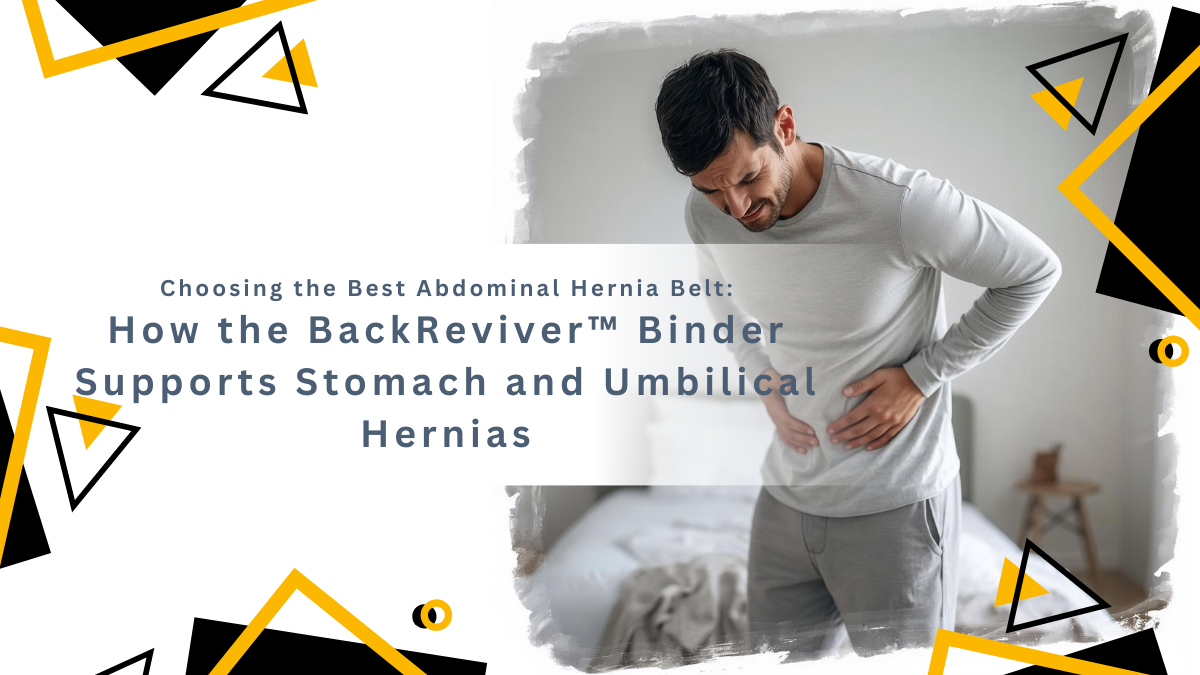
Abdominal hernia support – clear answers and how the BackReviver™ abdominal hernia belt can help
If you have noticed a new lump, ache or pulling feeling across the front of your abdomen, it is understandable to feel concerned and to want clear, straightforward information. You may be wondering whether this is a hernia, how serious it might be, and whether an abdominal hernia belt would make any real difference.
This Q&A is designed to guide you through those questions in a calm, practical way. It explains:
- what stomach and umbilical hernias are,
- why they behave as they do,
- when they need urgent attention,
- and how a structured abdominal hernia belt can change the strain on your abdominal wall.
NuovaHealth stocks the Abdominal Binder & Hernia Recovery Belt by BackReviver™ specifically for adults with central abdominal hernias or lower abdominal incisions. As you read, you will see how its deeper front panel, back‑anchored straps and internal metal stays link directly to the way a hernia behaves and to the symptoms you feel when you stand, walk, bend or cough.
This information is general guidance. It does not replace medical advice about your own situation, but it should help you understand your symptoms and see clearly where this kind of belt can fit into your overall care.
1. What is a stomach or umbilical hernia?
The front of your abdomen is built from a few key layers that work together:
- the skin and a layer of fat on the outside,
- a strong sheet of connective tissue (fascia),
- and the abdominal muscles underneath that help hold everything in place.
Together, these layers form the abdominal wall. They keep the contents of your abdomen in place, support your posture, and help you cope with changes in pressure when you move, lift, cough or strain.
In a stomach or umbilical hernia, there is a weak spot or small gap in the fascia and sometimes the underlying muscle. Through this opening, fat or a loop of bowel can push forwards, creating a soft lump or bulge under the skin.
These hernias usually appear:
- around or just above the navel (umbilical hernia),
- in the midline between the navel and the lower ribs,
- or near a previous surgical scar on the front of the abdomen (incisional hernia).
When you lie flat and relax, pressure inside the abdomen falls and the tissue may slide back through the gap, so the lump may become smaller or vanish. When you stand up, brace, lift or cough, pressure rises and more tissue can push forwards, so the bulge and pulling sensation often become more obvious.
2. How can I tell if this lump is likely to be a hernia?
Only a clinician can diagnose a hernia, but there are patterns many people recognise. You might find there is:
- a soft lump near your navel, or near a scar on the front of your abdomen, that seems to push forwards more when you stand and settle back when you lie down,
- an ache, dragging or pulling across the front of your abdomen that builds as the day goes on,
- sharper twinges when you stand up, bend forwards, cough or sneeze.
Some people can gently ease the lump back in when they are lying flat and relaxed. Others notice mainly pulling and aching with only a modest visible bulge. All of these can fit with a hernia.
Other things can also cause lumps in this area, such as fatty lumps or cysts, and some more serious conditions can present with abdominal symptoms. A new or changing lump, or persistent pain, should always be checked by a GP rather than managed solely with a belt.
3. My main symptom is a pulling feeling rather than a big lump – could it still be a hernia?
Yes. A hernia does not always look dramatic on the surface. In some people, especially earlier on, the visible bulge is modest but the sensations are very noticeable.
You may feel:
- a tight, pulling band across the front of your abdomen when you stand up straight,
- a dragging feeling around the navel or a previous scar,
- discomfort that settles when you lie down and returns when you have been on your feet for a while.
These sensations can come from stretching and irritation of the fascia and surrounding tissues at the weak area, even if the amount of tissue that moves forwards is not large. It still needs proper assessment, because the underlying problem – a weak point in the abdominal wall – is the same.
4. Why does the lump seem to come and go through the day?
It is very common for a hernia lump to seem to come and go. That change is mainly down to how much pressure is inside your abdomen at different times of the day. Pressure inside your abdomen simply means how firmly the organs and tissues are pressing outwards against the abdominal wall when you brace, lift, cough or strain.
When you are:
- standing or walking for longer spells,
- tightening your abdominal muscles to move or lift,
- straining on the toilet,
- or coughing or sneezing,
pressure inside the abdominal cavity rises. At strong sections of the abdominal wall, that extra pressure is spread over a wide area of tissue and usually does not cause any trouble. At a weak opening, much more of that force is concentrated on the ring of the gap (the rim of fascia and muscle around the opening), and tissue can be pushed forwards through it.
When you lie flat and relax, muscle activity falls and gravity no longer pulls the abdominal contents downwards in the same way. Pressure at the front of the abdomen is lower, and tissue that has moved forwards can slide back. The lump may then shrink or briefly disappear.
If you have been wondering why the lump seems smaller in the morning and larger by evening, this pressure pattern explains it.
5. Why have I developed a hernia – and are some people more at risk?
A weak point in the abdominal wall can be present from birth or can develop over time. You may be more likely to develop a hernia if you have:
- had previous abdominal surgery, which leaves a line of weaker tissue along the scar (incisional hernia),
- gained weight around the middle, putting more constant outward pressure on the wall,
- worked in roles that involve repeated heavy lifting for many years,
- had a long‑term cough,
- or frequently strained on the toilet.
As we get older, the fascia can also lose some of its strength, so it does not resist stretching as well as it once did. Umbilical hernias are particularly common in adults who carry more weight centrally or who have had previous surgery near the navel.
Over months or years, repeated pressure pushes against the same patch of fascia and muscle. The fibres can slowly stretch and separate, and the opening can widen. As it does, more tissue can move through it and the bulge and ache tend to become more noticeable, especially towards the end of the day.
If a hernia is left entirely unmanaged, it may continue to enlarge and affect more aspects of your movement. This does not mean it will always become dangerous, but it is a reason to take advice and consider sensible support rather than ignoring it indefinitely.
6. If my hernia lump is small, does that mean it’s less serious?
Not always. A smaller lump does not automatically mean a low‑risk hernia, and a larger lump is not always more dangerous.
What clinicians look at is:
- how wide the opening in the fascia is,
- whether tissue moves easily in and out or tends to get stuck,
- how your symptoms behave – for example, whether pain is mild and intermittent or severe and constant,
- and your general health.
A relatively small opening that traps a piece of bowel can be more dangerous than a wider opening where tissue moves more freely. Most hernias never reach the emergency stage, but because size, symptoms and risk do not always match neatly, a proper examination and a clear description of your symptoms matter more than the apparent size of the lump alone.
7. When is a hernia an emergency, and when is it something my GP can plan with me?
Many stomach and umbilical hernias are uncomfortable but can be discussed calmly with your GP. They will usually:
- examine the area,
- confirm that it is a hernia,
- talk through your general health and any risk factors,
- and, if needed, refer you to a surgeon to talk about repair in a planned way.
A hernia becomes an emergency if tissue that has pushed through the opening becomes trapped and starts to swell, so it can no longer slide back as it did before. This can reduce or cut off its blood supply and is sometimes called a strangulated hernia.
Warning signs that need urgent hospital care include:
- sudden, much stronger pain at the hernia site,
- a lump that becomes hard, very tender and no longer goes back as it used to,
- feeling sick or vomiting,
- difficulty passing wind or stool.
These signs suggest the hernia may be trapped. That needs urgent hospital care.
If these signs appear, you should:
- not put on an abdominal hernia belt,
- not tighten any belt already in place,
- and go to hospital immediately.
Most hernias will not reach this stage, but knowing these signs helps you act quickly if they do.
8. Why does my hernia feel worse with certain movements and by the end of the day?
You might notice your hernia most when you:
- stand up from a chair,
- have been on your feet – standing or walking – for longer periods,
- lift or carry something and brace through your middle,
- or cough, sneeze or strain.
All of these briefly raise pressure inside your abdomen. At stronger parts of the wall, that pressure is spread out and tolerated well. At a weak spot, it tends to:
- push more tissue forwards into the gap,
- pull more firmly on the rim of the opening,
- and irritate nearby tissues.
As the day goes on, especially if you have been standing or walking a lot, it is common for the area to feel heavier and fuller, and more likely to give you that pulling sensation when you move. This is why you often notice the hernia most when you first stand up, after time on your feet, or during a cough or sneeze. That pattern is one of the main reasons people begin to think about using an abdominal hernia belt.
9. At what point do people usually start thinking about using an abdominal belt?
People often begin considering an abdominal hernia belt when:
- the lump and pulling sensation are affecting confidence with standing, walking or simple tasks,
- they find themselves automatically putting a hand over the area before they cough or stand up,
- a GP has confirmed that the lump is a hernia and that it can be managed in a planned way.
The usual sequence is:
- notice symptoms,
- see a GP to confirm the diagnosis and discuss options,
- then, if advised, use an abdominal binder as one part of making movement more comfortable while the hernia is being monitored or a repair is being planned.
You do not have to cope with this entirely on your own while you wait for review, but getting a clear diagnosis first is important.
10. Is it ever too early to start using an abdominal belt if my hernia is small?
If your hernia has not yet been properly assessed, it is better to see a GP before you rely on an abdominal hernia belt. That way:
- you know you are dealing with a hernia rather than something else,
- other causes for your symptoms can be ruled out,
- and you can agree together whether a binder is sensible for you at this stage.
For a confirmed, smaller hernia that still causes discomfort when you stand or move, a belt can be reasonable to use, if your clinician agrees. The key is to understand that the belt is there to support the weak area and make daily movement more comfortable. It does not prevent all enlargement and does not replace surgery where that is recommended.
11. What can an abdominal hernia belt actually do for me – and what can’t it do?
A well‑designed abdominal hernia belt, such as the BackReviver™ abdominal binder supplied by NuovaHealth, can:
- support the section of abdominal wall where there is a weakness,
- limit how far tissue at the hernia can push forwards when pressure rises,
- reduce how sharply the edges of the opening are pulled apart,
- and give your trunk a firmer surface to brace against so your lower back does not have to work as hard just to keep you upright.
It cannot:
- close or repair the gap in the fascia or muscle,
- make heavy, straining activities safe if you have been advised to avoid them,
- or take the place of a proper medical assessment or delay surgery where that has been clearly recommended.
The belt is there to support the weak area and make everyday movements feel less sharp and more manageable. It does not repair the gap itself, but by reducing how far that gap is pulled open during daily movements, it can still make a noticeable difference to how you feel.
12. How does wearing an abdominal belt change what happens at the weak spot in my abdominal wall?
When you stand up quickly or cough, your abdominal muscles tighten and pressure inside your abdomen rises. That extra pressure is transmitted outwards in all directions.
In a healthy part of the abdominal wall, that pressure is spread out over a wide area of strong tissue, so it usually does not cause any trouble. At a weak opening, the ring of tissue around the gap takes more of the strain, and tissue can be pushed forwards through it. That is often when you feel a sharp pull or push at the lump.
The Abdominal Binder & Hernia Recovery Belt by BackReviver™ changes this by:
- bringing the abdominal wall into firm contact with a deep front panel,
- spreading the pulling and pressure over a larger section of fascia and muscle instead of letting it focus on one small gap,
- slowing and limiting how far tissue can move forwards during each pressure rise.
Those same movements then tend to cause:
- a smaller change in the shape of the hernia,
- less stretching of the edges of the opening,
- a more contained, supported feeling at the front of your abdomen.
The belt should feel like steady support, not like you are being squeezed. If it feels hard to breathe or sharply uncomfortable, it is too tight.
13. Will wearing a belt affect how my GP or surgeon examines the hernia?
During an examination, your GP or surgeon will usually want to look at and feel the lump, and see how it behaves when you stand and lie down. For that reason, you should remove the belt before they examine you.
Between appointments, once a hernia has been confirmed and a belt has been agreed as appropriate, wearing one does not interfere with their ability to review you, as long as you take it off when asked. It is helpful to tell them that you are using the BackReviver™ Abdominal Binder & Hernia Recovery Belt from NuovaHealth, so they understand the type and level of abdominal hernia support you are getting.
14. I’ve tried a basic elastic belt and it rolled or didn’t help – why might this BackReviver™ belt be different?
Many basic elastic supports are:
- a single narrow band,
- made from stretchy fabric without internal structure,
- prone to rolling into a thin strip at the waist,
- and hard to adjust precisely.
When they roll or dig in, they can end up pressing into the hernia itself or moving away from the area altogether.
The BackReviver™ abdominal hernia belt supplied by NuovaHealth is different because it:
- uses a deeper front panel shaped to cover the central and lower abdomen where stomach and umbilical hernias usually sit,
- has two straps anchored at the back that you pull forwards to adjust support around your waist rather than relying on a single fixed panel,
- contains slim metal stays at the back and sides to help it stand upright and resist rolling,
- and is lined with softer, breathable materials with reinforced stitching so it can keep its shape and level of support with regular use.
For you, that means the belt is more likely to stay where you put it, spread the pull over a wider area, and give a level of support you can adjust to feel firm but comfortable.
15. Why has NuovaHealth chosen this BackReviver™ abdominal binder for stomach and umbilical hernias?
NuovaHealth focuses on structured abdominal supports that match how a weakened central abdominal wall behaves, rather than basic single‑panel wraps. This BackReviver™ abdominal hernia belt has been chosen because it offers:
- a deep front panel that covers the region around and below the navel and many lower abdominal incision lines, supporting the fascia and muscle above and below the opening;
- a two‑strap, back‑anchored system that lets you draw the belt in evenly around your waist and, if needed, give slightly more support to the side where your hernia or scar is most noticeable;
- internal metal stays that help keep the belt upright and provide a firmer surface for your lower back muscles to work against;
- and breathable, soft‑lined materials so it is more practical to wear the belt for the parts of the day when you most need support.
Its layout reflects the movements clinicians pay most attention to in abdominal hernia care – standing from sitting, steady walking, early post‑surgical walks and controlled lifting. Within NuovaHealth’s range, this is the belt aimed specifically at central abdominal hernias and lower abdominal incisions, not groin (inguinal) hernias, which usually sit lower and are often supported differently.
16. How does the wide front panel help support the hernia and the tissues around it?
In many stomach and umbilical hernias, the weak area involves a short stretch of the midline fascia above and below the navel, not just one point. The tissues just above and below the visible lump are also under strain.
A narrow strap that crosses only one line can:
- dig directly into the lump,
- leave the surrounding fascia less supported,
- and move up or down as you sit and stand.
The wider front panel on the BackReviver™ abdominal hernia belt:
- extends from below the lower ribs down towards the top of the hips (depending on your build),
- covers both the weak spot and neighbouring tissues that share the load,
- and supports many lower abdominal incision lines, such as C‑section scars.
Because the panel covers the area just above and just below the hernia as well as the lump itself, it can spread the pulling forces over a wider area instead of letting them all focus on one small gap. That matters because it reduces how much the rim of the opening is pulled apart each time you stand or brace. For you, that can mean a smaller bulge, less pulling, and a more stable feeling across the front of your abdomen when you move.
17. What do the back‑anchored straps allow me to adjust that a single‑panel belt cannot?
The belt is fastened in two stages:
- You wrap the main body of the belt around your abdomen and secure it at the front, setting a base level of snugness.
- You then take each strap from the back, bring it forwards and attach it to the front panel, tightening until the support feels right for you.
Because the straps start at the back and come forwards, they:
- draw the belt in around your whole mid‑section, not just at one line at the front,
- allow you to angle them slightly up or down to follow your shape,
- and let you give a little more support on one side if your hernia or scar is slightly off‑centre.
With many single‑panel belts, you either have them too loose to help or so tight that they dig in at one edge. The back‑anchored straps on this BackReviver™ belt make it easier to set a level of support that feels firm when you are on your feet and can be eased off slightly when you are sitting or resting, if that suits you and your clinician’s advice.
18. What are the slim metal supports at the back and sides for?
The slim metal supports (stays) inside the back and side panels of the belt:
- help the belt hold its shape against your lower back and sides,
- make it less likely to roll, fold or dig into your waist when you sit, stand or bend,
- and provide a more stable surface for the muscles alongside your lower spine to work against.
In normal circumstances, the abdominal muscles and fascia share the job of holding you upright with the muscles in your lower back. When the front of your abdomen is sore, weak or healing, it may not do its usual share of this work. The abdomen can drift forwards, the pelvis can tilt and the curve in the lower back can increase. The small joints and ligaments in the lower back (lumbar spine), and the muscles that support them, then have to work harder for longer.
Over time this can lead to a dull, tired ache across the lower back, especially after periods of standing or walking. By holding the front and back of your trunk more firmly, the belt means your lower‑back muscles do not have to work quite as hard just to keep you upright. It also helps keep the belt in the right place over the hernia area, instead of creeping away from it.
19. How do the breathable, soft‑lined materials help in day‑to‑day use?
If you need to wear an abdominal hernia belt for several hours, how it feels against your skin matters. This BackReviver™ belt uses:
- ventilated, breathable fabric to let air circulate and help sweat evaporate, which reduces heat build‑up and the chance of irritation under the belt,
- a softer inner surface to reduce friction against sensitive skin or healing scars,
- relatively slim materials so it can usually be worn under everyday clothing without obvious bulk.
For you, that means it is more realistic to wear the belt at the times of day when you feel most vulnerable – for example, when you are out of the house or on your feet for longer spells – without the belt becoming uncomfortably hot or rough.
20. How should this belt feel when it’s fitted properly?
When the BackReviver™ abdominal hernia belt is fitted properly, you should notice:
- a firm, steady hug around your mid‑section,
- a sense that the area around your hernia or scar is held rather than moving freely,
- less obvious bulging when you stand up from a chair,
- fewer sharp pulls at the hernia site when you cough or sneeze,
- a more supported feeling in your lower back when you are on your feet.
It should not:
- cause sharp pain,
- pinch,
- or make it hard to take a deep breath.
You should be able to slide a few fingers under the edge of the belt and breathe comfortably. If you are unsure whether you have the tension about right, building up use gradually and starting slightly looser usually works best. If tightening the straps increases your pain, makes you feel light‑headed or short of breath, or creates strong discomfort, you should loosen or remove the belt and seek advice.
21. How do I choose the right size and position the belt over my hernia or scar?
To choose a size:
- measure around the area where the belt will sit, usually the widest part of your abdomen,
- compare your measurement with the size ranges given for the belt,
- if you fall between two sizes, most people find the larger option more comfortable, then use the straps to bring the belt in to a snug fit.
If you are in the early weeks after abdominal surgery and still have swelling, ask your surgeon how much change they expect and how that should influence your size choice.
To position the belt:
- place the back section across your lower back,
- wrap the front panel around your abdomen so that it covers the area around your navel and the hernia or incision,
- in most people, the top edge will sit below the lower ribs and the bottom edge above the tops of the hip bones,
- fasten the main belt at a comfortable snugness,
- bring each strap forwards from the back and attach it to the front panel, tightening until the support feels firm but not restrictive.
If your hernia lies close to a previous scar, the panel should usually cover both the scar and the tissue just above and below it. Your GP, surgeon or physiotherapist can show you the ideal position for your situation.
22. What should I expect in the first week of wearing this belt?
In the first week or so, most people notice a definite “held” feeling around the front of the abdomen and lower back. Standing up or walking often feels more controlled, even if you are still aware of the hernia.
It is usually best to build up use gradually – for example, starting with an hour or two at the times of day you feel most vulnerable, and only increasing if it continues to feel helpful and comfortable.
A steady awareness of gentle pressure is normal. You should seek advice if you notice:
- increasing pain under the belt,
- numbness, tingling, unusual coldness or colour change in the skin under or below the belt,
- feeling light‑headed or short of breath in a way that seems linked to wearing the belt.
Most people decide whether the belt is helpful by noticing how it affects their comfort during these key moments, rather than expecting it to remove all awareness of the hernia.
23. How long at a time is it sensible to wear the belt, and should I sleep in it?
The BackReviver™ abdominal hernia belt is usually most useful:
- during periods of standing and walking,
- when doing lighter tasks at home or at work,
- and when you are out of the house and want the area to feel more protected.
You can generally wear the belt for several hours at a time when you are up and about, loosening it slightly or taking it off when you are resting if that is more comfortable and fits with your clinician’s advice.
When you lie down, your abdominal muscles are working less, gravity is not pulling the abdominal contents downwards in the same way, and pressure on the front of the abdomen is lower. For that reason, unless your clinician has given specific instructions to wear it in bed, it is usually not necessary to sleep in the belt. Removing it at night allows your skin to rest and lets you breathe and move freely in your sleep.
24. Is it comfortable to sit for longer periods while wearing the belt?
Sitting for longer periods places different demands on the belt than standing and walking. When you sit, your hips flex, your waist may crease slightly, and some supports tend to roll or dig in.
The deeper front panel and slim metal stays in this BackReviver™ abdominal hernia belt are designed to help the belt stay upright rather than folding into a narrow strip, and to keep the support spread across your lower back and abdomen rather than concentrating in one tight line.
If you notice that longer sitting actually feels worse with the belt, rather than better, it is worth easing the straps slightly for those periods or taking the belt off, as long as that fits with the advice you have been given. Avoid very tight waistbands over the top of the belt, as these can create extra pressure and rubbing.
25. How can I look after my skin under the belt if I’m wearing it most days?
Looking after your skin helps you use the belt comfortably over time. It is sensible to:
- keep the skin under the belt clean and dry,
- check regularly for any signs of rubbing, redness or sore areas, especially around the edges of the belt,
- allow your skin short breaks from the belt during the day if you are wearing it for many hours,
- consider wearing a thin, smooth vest under the belt if your skin is particularly sensitive.
If you notice persistent redness that does not fade when the belt is off, broken skin, blisters, or an itching rash that seems linked to the belt, you should review how tightly and how long you are wearing it, and seek advice if the problem continues.
26. Can this belt help while I’m waiting for hernia surgery?
If your hernia has been assessed and a repair has been recommended, there is often a period of time before the operation. During this period, the aim is usually to stay as comfortable and mobile as reasonably possible, without over‑straining the hernia.
While you are waiting, this BackReviver™ abdominal hernia belt from NuovaHealth can, once your clinician agrees it is appropriate:
- limit how far the lump pushes forwards each time you stand or walk,
- lessen the pulling sensation when you cough or clear your throat,
- help you feel more secure when you are out of the house or on your feet for longer.
Most people still need to shop, work and manage everyday tasks while they wait, and it is reasonable to want that to be as comfortable as possible. You will still need to avoid heavy lifting and strong straining as advised, and to keep track of any changes in the size, shape or behaviour of the lump. You should tell your GP or surgeon about any new or worsening symptoms, even if the belt seems to be helping.
27. Can this belt support me in the early weeks after abdominal surgery – and how?
After abdominal operations such as C‑section, hernia repair or other abdominal procedures, the front of your body is healing from cuts through the skin, the layer of fat and the fascia, and sometimes through parts of the muscle. While these layers are healing, they are not as strong as they will be later.
In the early weeks it is very typical to find that:
- moving from lying to sitting or from sitting to standing causes a sharp pull along the incision,
- the front of the abdomen feels heavy or vulnerable when you first stand up,
- your lower back aches from taking more of the work of holding you upright.
It is also common to worry about “pulling something” when you first start getting out of bed, standing up, or moving more freely again after abdominal surgery. Often, this worry is about pulling on the stitches or the deep repair. If your surgical team recommends an abdominal binder, a belt like this BackReviver™ design can hold the area around your scar for you, so getting out of bed, standing up and taking those early walks puts less sudden pull on the healing tissue. Knowing the area is held more firmly from the outside can make those first movements feel less exposed.
Surgeons often encourage early walking after abdominal surgery because it helps reduce the risk of blood clots and stiffness. A belt cannot replace that advice, but it can make those early walks feel more tolerable at the front of the body.
You should not wear the belt directly over open, undressed wounds, over areas of skin or scars that are very red, hot, swollen or producing unusual fluid, or over drains or bulky dressings unless your surgical team has arranged everything to work with a binder. If you notice increasing redness, heat, swelling, unusual fluid from the wound, a fever, or a sudden change in pain, you should contact your surgical team promptly.
28. What if I’ve been advised not to have surgery – can I rely on a belt longer term?
Some people are advised that surgery is not needed at present, or that the risks of surgery outweigh the benefits for them. In those cases, an abdominal hernia belt may be part of longer‑term management.
For longer‑term use, it is important that:
- you have a clear plan with your GP or specialist about activity limits and monitoring,
- you understand that the belt is there to support the weak area and improve comfort, not to cure the hernia,
- you check in periodically about whether your symptoms or the size of the hernia are changing.
Choosing not to have surgery, or being advised against it, can feel like a significant decision. In that context, having something practical you can use day to day to support the area can be reassuring. For many people in this position, using a structured abdominal binder from NuovaHealth when they are on their feet, combined with sensible limits on heavy straining and attention to posture, allows them to remain more comfortable and active than they would otherwise be.
29. Will wearing a belt stop my abdominal muscles from getting stronger again?
While you are wearing the belt, it is doing some of the work that your abdominal muscles would normally do. That does not mean it should be avoided altogether. The key is how you use it over time.
Often the most sensible approach is to:
- use the belt when you most need support – for example, when standing, walking, shopping or doing light tasks,
- follow any advice you have been given on gentle exercises to improve abdominal and trunk strength when this is safe,
- review belt use over time with your clinician and adjust it as your confidence and muscle strength improve.
For some people, particularly those not going on to have surgery, a belt may remain part of their routine longer term. For others, it is mainly used during a recovery or waiting phase. In both situations, it should sit alongside, not replace, any strengthening and movement work that has been advised.
30. Why does my lower back ache when I have a stomach or umbilical hernia?
In normal circumstances, the abdominal muscles and fascia share the job of holding you upright with the muscles in your lower back. When the front of your abdomen is sore, weak or healing, it may not do its usual share of this work. The abdomen can drift forwards, the pelvis can tilt and the curve in the lower back can increase. The small joints and ligaments in the lower back (lumbar spine), and the muscles that support them, then have to work harder for longer.
Over time this can lead to a dull, tired ache across the lower back, especially after periods of standing or walking. Many people also adopt protective postures, such as leaning forwards or holding themselves very stiffly, which can increase strain on the lower back further. If you find that your back aches after a relatively short time on your feet since the hernia started, that link is very common.
31. How can this belt help ease that lower‑back ache when I stand and walk?
By wrapping around both the abdomen and lower back, the BackReviver™ abdominal hernia belt can:
- support the front of your abdomen, discouraging it from sagging forwards,
- give the muscles alongside your lower spine a more stable surface to work against,
- help you stay closer to a balanced, upright posture without needing to think about it constantly.
For you, that may mean:
- less build‑up of ache across the lower back as the day goes on,
- fewer shifts into very slumped or over‑arched positions to cope with discomfort at the front of the body,
- a greater sense that your trunk is supported from both sides rather than your lower back doing most of the work alone.
This belt is not a specific treatment for disc problems, nerve compression or other defined spinal diseases, and it should not be used to delay assessment for those. It is aimed at the muscular ache and mechanical strain that often accompany a weak abdominal wall.
32. Is it safe to exercise while wearing this belt, once I’ve been cleared to be active?
If you want to keep active with a hernia or after abdominal surgery, it is important that any exercise plan is agreed with your clinician first. Once they have said what is safe for you, an abdominal hernia belt can be used to support that plan – not to stretch the limits of it.
Exercise that usually places high strain on the abdominal wall includes:
- heavy lifting that makes you brace and hold your breath,
- repeated high‑impact running or jumping,
- contact or twisting sports where sudden blows or twists to the abdomen are likely.
If your clinician has advised against activities like these because of your hernia or recent surgery, wearing a belt does not change that advice.
For exercise that has been approved for you, such as steady walking or gentle cycling, the belt can help you feel more contained and maintain a more upright trunk position. Holding your breath (bracing very firmly) while lifting increases pressure in your abdomen much more than breathing steadily, which is why it can pull more strongly on a weak spot. The belt is there to support you within the limits you have been given, not to let you go beyond them. It should remain snug but allow you to take deep breaths, and it should not be used to ignore new or worsening symptoms. If your pain increases, the hernia changes, or you feel unwell, you should stop and seek advice.
33. If my back pain changes or starts spreading into my legs, is the belt still appropriate?
If you notice:
- back pain that becomes severe or constant,
- pain that spreads into one or both legs,
- weakness, numbness or tingling in your legs,
- or changes in bladder or bowel control,
these can be signs of a back problem that needs specific assessment, because they may indicate pressure on nerves that help control movement, feeling and some body functions.
In that situation:
- you should seek medical advice promptly,
- the belt should not be used as the main way of managing symptoms,
- and decisions about using or stopping the belt should be made alongside that assessment.
For straightforward, posture‑related backache linked to a weak abdominal wall, the belt can be helpful. For more complex back conditions, it should not be used instead of proper investigation.
34. Who should be cautious or avoid using this BackReviver™ abdominal belt?
This abdominal hernia belt is intended for adults only. You should not use it:
- over open, undressed wounds,
- over areas of skin or scars that are very red, hot, swollen or producing unusual fluid,
- directly over surgical drains or bulky dressings unless your surgeon has confirmed it is appropriate,
- during pregnancy (this belt is not designed for pregnancy support).
If you have significant heart, lung or circulation problems, you should speak to a clinician before using any firm abdominal support, as changes in abdominal pressure can sometimes affect breathing patterns and how blood returns from the legs.
You should stop using the belt and contact a clinician if you notice:
- new or worsening pain under or around the belt,
- numbness, tingling, unusual coldness or colour changes in the skin under or below the belt,
- feeling light‑headed, short of breath or generally unwell while the belt is on.
35. What are the key signs that I should stop using the belt and seek medical help?
You should seek urgent hospital care if you already know you have a hernia and you develop:
- sudden, severe pain at the hernia site,
- a lump that becomes hard, very tender and no longer goes back as it did before,
- feeling sick or vomiting,
- difficulty passing wind or stool.
These signs suggest the hernia may be trapped. Do not use the belt to try to push the hernia back in or to delay going.
You should also contact a clinician promptly if, while using the belt, you notice:
- increasing redness, heat, swelling or unusual fluid from a surgical wound,
- a fever or feeling generally unwell,
- new or clearly changing symptoms that have not been assessed.
The belt is there to support you. It is not a substitute for medical assessment when symptoms change significantly.
36. What should I tell my GP about my hernia and how I’m using this belt?
When you speak to your GP or another clinician, it can be useful to be ready to describe:
- where the lump is and how big it looks at different times of the day,
- when you notice pain or pulling most (for example, standing, lifting, coughing, after meals),
- what makes symptoms better or worse,
- whether the lump still goes back in when you lie down,
- if you have been using this BackReviver™ abdominal hernia belt from NuovaHealth: how often you wear it, how firmly you fasten it, and what difference you have noticed when it is on.
This kind of information helps them understand how the hernia is behaving and how the belt fits into your current routine. They can then advise more precisely on ongoing belt use, activity and whether, and when, surgery should be considered.
37. How does this BackReviver™ belt fit into my overall plan for managing a hernia?
Managing a stomach or umbilical hernia usually includes:
- a clear diagnosis and plan from your GP, and, if needed, a surgeon,
- sensible limits on heavy lifting and strong straining, to avoid repeated large pressure spikes on the weak area,
- attention to posture and the way you move from sitting to standing and bending, so the front of the abdomen is not stretched unnecessarily,
- in some cases, work on weight, long‑term cough or constipation, so the abdominal wall is under less constant pressure,
- and, where appropriate, a structured abdominal binder (a firm, multi‑panel belt with internal stays and adjustable straps designed to support the front of your abdomen) to support the weakened section of the abdominal wall when you are upright.
The BackReviver™ Abdominal Binder & Hernia Recovery Belt from NuovaHealth sits alongside those other parts of your care. Its role is to:
- support the region of the abdomen where your hernia or incision lies with a deeper front panel,
- reduce how far the hernia can bulge forwards when you stand, walk or cough, by using the two‑strap system to apply even support,
- lessen the pulling at the edges of the opening,
- and share some of the work of supporting your upper body with your lower back through the built‑in stays.
Hernias tend to bulge and pull most when you are upright and bracing. A belt that supports the front of the abdomen during those moments can be particularly useful. It does not take the place of assessment or surgery where those are needed. It is there to make daily life with a weakened abdominal wall more comfortable and manageable, within a plan agreed with your clinician.
38. Is this BackReviver™ abdominal hernia belt from NuovaHealth the right choice for me?
The best abdominal hernia belt for you is the one that:
- matches the site and type of your hernia or incision,
- gives firm, steady support without making it hard to breathe,
- stays in the right place when you sit, stand and walk,
- can be worn under the clothes you normally use,
- and fits with the advice you have been given by your GP or surgeon.
If your hernia has been assessed and you recognise that standing, walking and coughing all seem to pull on the same weak spot at the front of your abdomen, this is exactly the pattern this BackReviver™ abdominal hernia belt from NuovaHealth is made to support. Its deeper front panel, back‑anchored straps and internal stays are all chosen to match the way the central abdominal wall and lower back behave when there is a weakness at the front.
If your main worries have been the bulging, pulling and extra back ache described earlier on this page, this is the sort of situation this belt is designed to help with. If your situation is similar and you are considering an abdominal hernia support, NuovaHealth can help you choose a suitable size for this BackReviver™ belt so you can see what difference this level of support makes when you stand, walk and manage your usual tasks.
This page provides general information for adults in the UK living with stomach or umbilical hernias. It is not a personal diagnosis or prescription. If you are unsure about your symptoms or how to use this belt, speak to a GP or another healthcare professional for advice.