
MCL Knee Brace
£15.49inc VAT
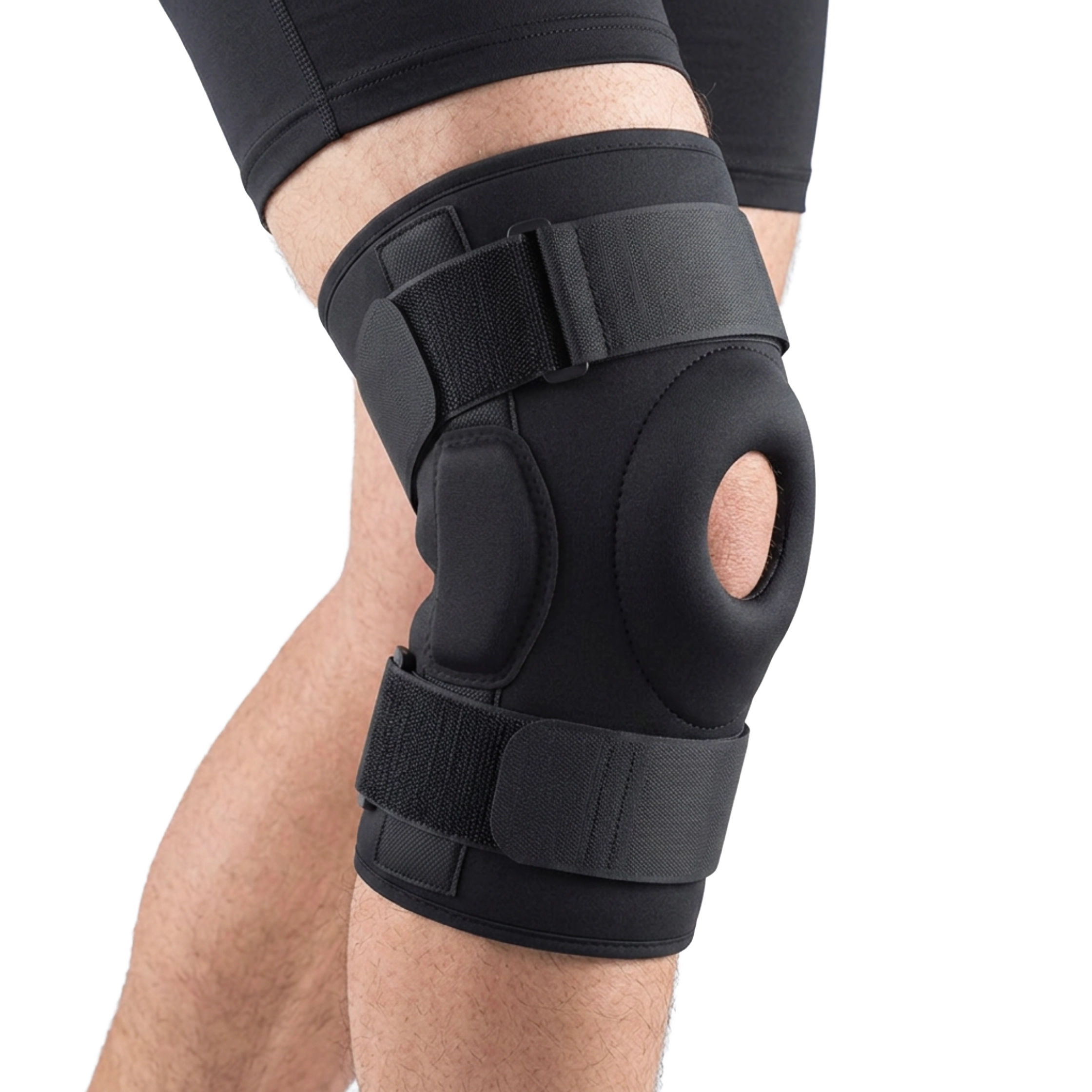
- Built for inner‑knee pain and “wobbly” knees:
Designed by NuovaHealth for adults whose knees feel painful or unsafe on stairs, slopes or uneven ground, especially when the knee dips inwards or feels as if it might give way. - Hinged side supports for inward‑dip control:
Slim metal hinges on each side line up with the knee joint to resist inward buckle and sideways wobble when the knee is bent and bearing weight, reducing strain on the medial collateral ligament (MCL) and inner joint line. - Open‑patella gel ring for front‑of‑knee comfort:
A contoured silicone gel ring around the kneecap (slightly deeper at the lower edge) helps guide the kneecap centrally and cushions the patellar tendon just below it – often a sore spot after MCL injuries and front‑of‑knee problems. - Firm, breathable support you can wear for longer:
Perforated neoprene panels provide consistent compression and gentle warmth without feeling like a heavy, non‑breathable bandage. Anti‑slip bands and smooth finishes are chosen to help the brace stay in place through walking, work and light sport. - Wrap‑around, adjustable fit:
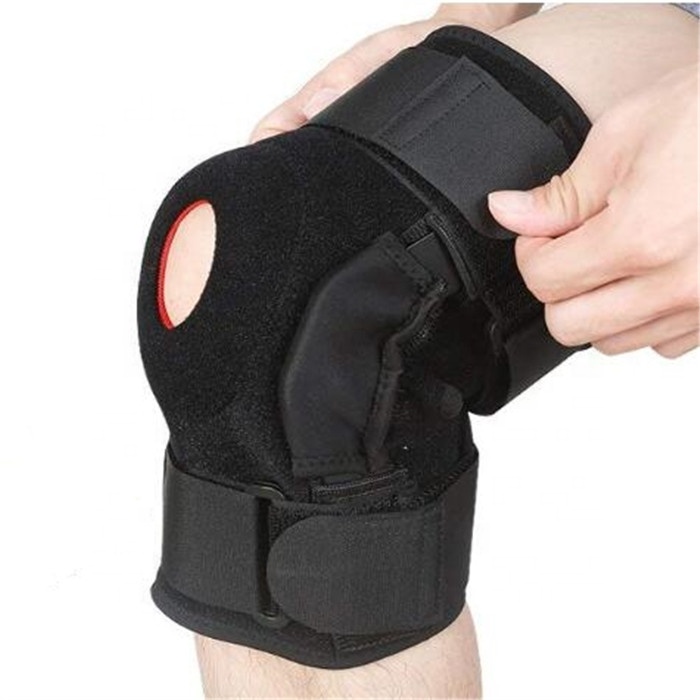
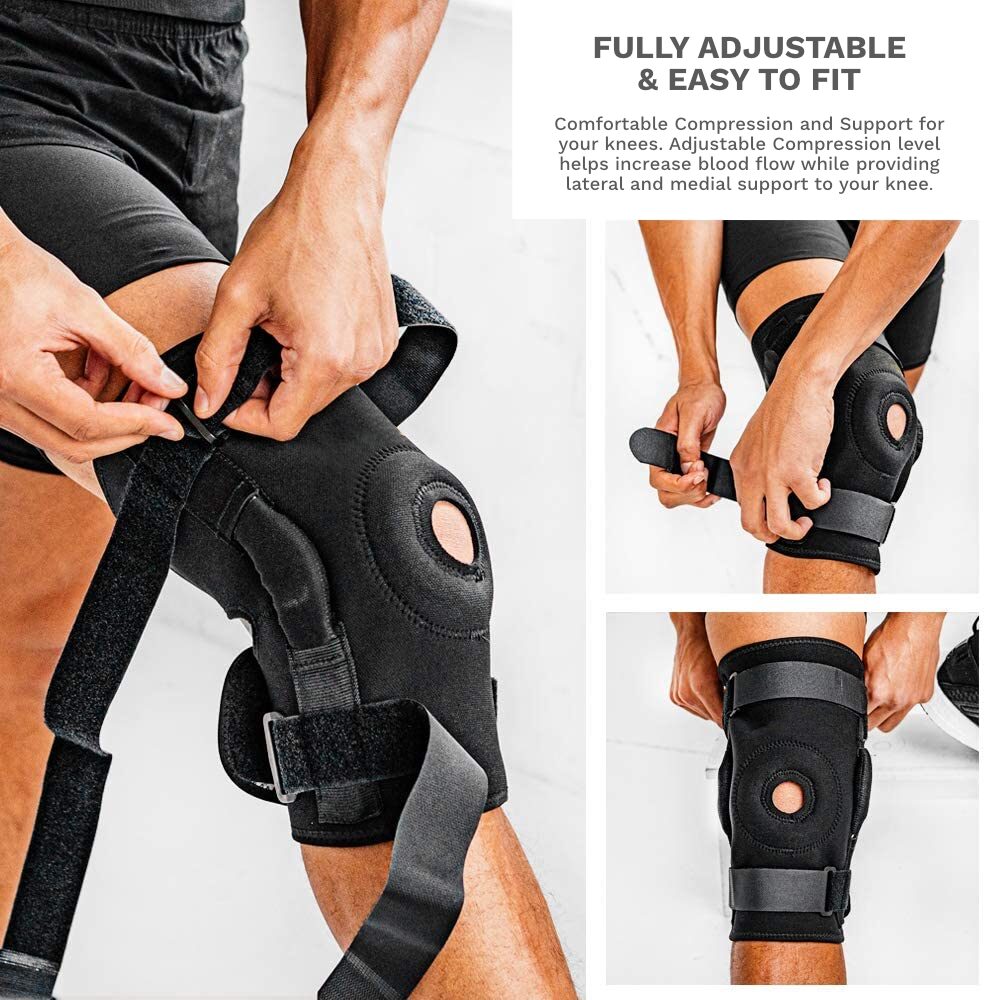
The brace opens fully so you can wrap it around the knee rather than pulling it up over the foot. Upper and lower straps let you fine‑tune compression for a secure, comfortable fit over painful or swollen knees and a range of leg shapes. - Removable hinges to match your stage of recovery:
Hinges in for stronger side‑to‑side control when your knee feels vulnerable; hinges out when you just need contoured compression and warmth for lower‑risk days. - Works on either leg:
Symmetrical hinge and patella design allows use on the left or right knee – the key is aligning the hinges with the inner and outer joint lines and centring the patella opening. - Adult sizing and fit:
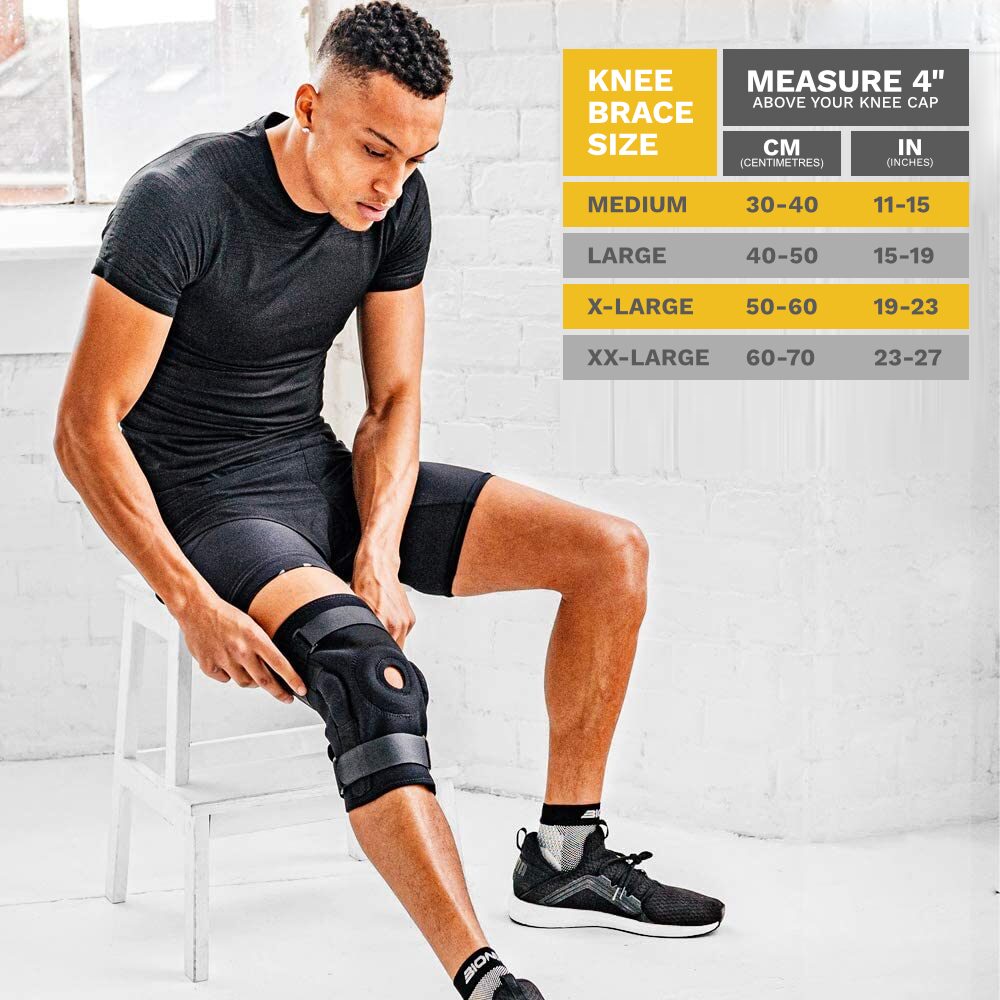
Available in adult sizes from Medium to XXL. Sizing is based on thigh circumference measured around 4 inches (about 10 cm) above the kneecap, with shaping designed for real‑world legs, including fuller thighs and calves. - Best suited to inner‑knee problems with inward dip or twist:
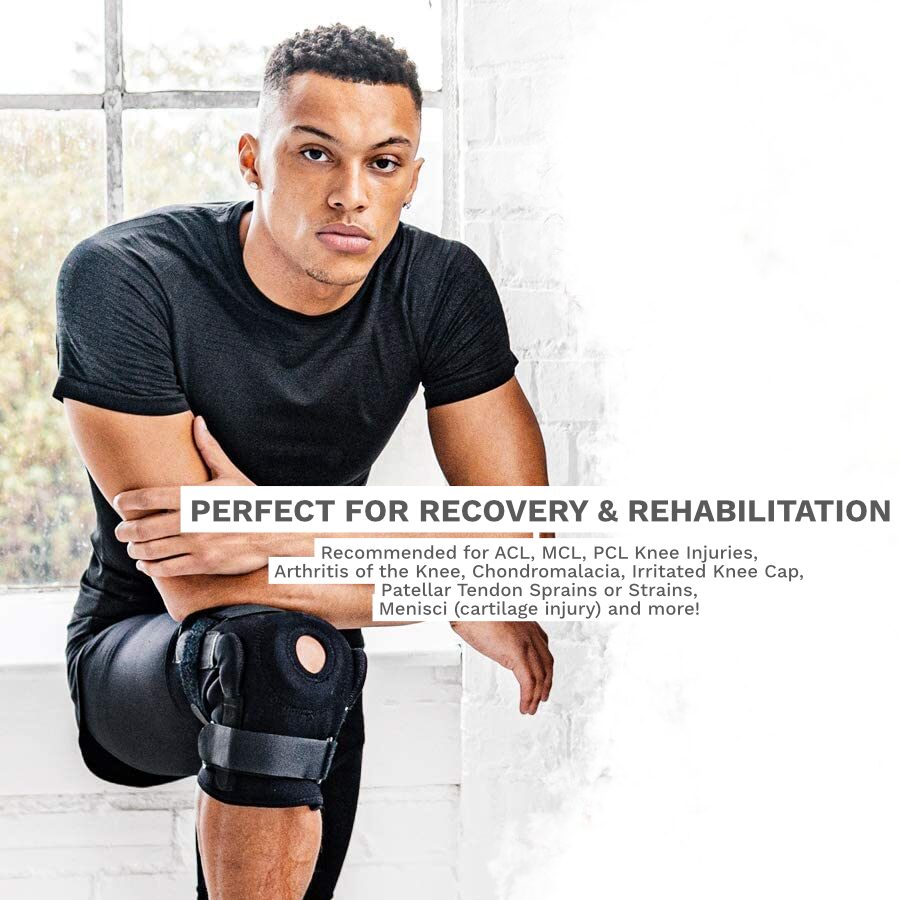
Often used for MCL sprains and longer‑term laxity, inner‑knee strain combined with medial meniscus issues, patellofemoral pain with inward drift, patellar tendon pain, and arthritis that mainly affects the inner side of the knee. - Designed to work alongside rehabilitation:
Intended to be used with strengthening, movement retraining and sensible activity planning, not instead of them. Many clinicians choose NuovaHealth hinged braces to help people move and exercise more comfortably and confidently.
Inner knee pain and MCL injury: how the NuovaHealth hinged brace can help you feel safer on your feet
If the inner side of your knee has started to hurt or feel “unsafe”, it can quickly change how you move and what you feel confident doing. You might find yourself testing a step before you trust that leg, hesitating on stairs, or avoiding quick turns and side‑steps in case the knee “gives way”. Getting up from a low chair, turning in a tight space, stepping off a kerb or walking on uneven ground can bring a sharp pull or deep ache on the inside of the joint. After a day on hard floors or slopes, the whole knee may feel tired, swollen or less trustworthy.
In all these situations, the knee is slightly bent, taking your weight, and is subject to inward buckle and twisting forces. When the inner ligament of the knee – the medial collateral ligament (MCL) – has been sprained or torn, it cannot resist these forces as well as it used to. The inner joint gap opens slightly more than it should, the ligament fibres are stretched, and other deep structures at the inner joint line are squeezed or sheared. Movements that used to feel automatic can start to feel as if they might make the knee “go”.
The NuovaHealth hinged MCL knee brace is built to interrupt that pattern. By limiting how far the knee can buckle inwards, guiding it into a more controlled bend‑and‑straighten path, and providing firm, even compression and front‑of‑knee support, it reduces extra strain on healing tissues and helps everyday movement feel more predictable. The aim is not to lock the joint straight, but to block the extremes that keep re‑irritating the inner knee – for example, that sudden inward dip when you step off a kerb – while still allowing you to walk, bend and straighten for daily tasks.
Many people notice an immediate change in how secure the knee feels when they stand and walk with the brace on, particularly on stairs or uneven ground where it previously felt as if the knee might “drop in”. To understand why that difference is so noticeable, it helps to look at what the MCL usually does and how this NuovaHealth brace has been designed around that job.
What an MCL injury actually means for your knee
Where the MCL sits and how it usually protects your knee
The medial collateral ligament (MCL) is a strong, flat band of tissue on the inner side of the knee. It runs from the inner end of the thigh bone (femur) to the inner top of the shin bone (tibia), crossing the joint line. In simple terms, it acts like a strap along the inside of the joint that tightens when the knee bends slightly under load, stopping the inner side of the joint from opening too far when you stand, walk or turn.
In a healthy knee, as you walk, the thigh bone and shin bone roll and glide smoothly on one another. The MCL automatically resists any tendency for the knee to drift into a knock‑kneed position when your weight comes over the leg. Small side knocks, changes of direction and uneven ground are absorbed without you noticing; the MCL, other ligaments and the joint capsule share the strain and keep the joint surfaces sitting closely together.
Its main jobs are to prevent the knee buckling inwards, help control side‑to‑side wobble in a slightly bent, weight‑bearing position, and work with deeper ligaments like the anterior cruciate ligament (ACL) to keep the joint surfaces aligned as you move. You usually only become aware of it when it is damaged and no longer doing its job quietly in the background.
How MCL injuries usually happen
MCL injuries typically occur when the inner side of the knee is pushed further than the ligament can safely control. A common example is a blow to the outer side of the knee from a tackle that drives the joint inwards. Another is planting the foot on uneven or slippery ground and twisting the body sharply, so the knee caves in and rotates while it is bent and bearing weight. A missed step down stairs or off a kerb, where the knee drops inwards as you land, can create a similar effect.
In all these situations, the lower leg and foot are relatively fixed, the knee is bent, and body weight or an external force pushes the joint into an inward and twisting position. The MCL fibres are suddenly stretched. If the force is mild, they are overstretched but not torn. With stronger forces, more fibres tear; in the most severe cases, the ligament may tear completely, sometimes along with the ACL (a deeper ligament inside the joint) or the medial meniscus (the inner C‑shaped cartilage pad between the bones).
Straight after an injury like this, many people feel sharp inner‑knee pain with local tenderness, sometimes a feeling of “giving way” or a “pop”, followed by swelling and stiffness over the next hours.
Why ordinary walking and standing can keep it sore
Once the first sharp pain has settled, it is common to find that everyday activity still irritates the area. Each time the knee dips slightly inwards when you walk, turn on the spot, step down from a stair, stand on one leg to dress or reach, the healing fibres are tugged again.
These small inward dips of the knee can come from a few things working together:
-
- A slight knock‑kneed posture when you are tired, such as standing with the knees drifting closer together.
-
- The hip on that side dropping or rolling inwards.
-
- The arch of the foot flattening more when you load the sore leg.
Individually these movements may feel minor, but repeated hundreds of times a day they are enough to keep the ligament and nearby tissues irritated. You may notice that the knee feels stiff and awkward first thing in the morning, “warms up” a little as you start walking, then the inner ache or sharp twinges build again later in the day, especially after time on slopes, stairs or uneven ground.
Different grades of MCL injury and what they feel like
Clinicians often describe MCL injuries in three grades, based on how many fibres are damaged and how much extra “give” there is at the joint.
In a mild sprain (Grade I), the ligament is overstretched but not torn through. The inner knee feels tender along the joint line and there may be some swelling. Walking in a straight line on level ground is usually possible, but quick turns, uneven surfaces, squats or kneeling can trigger a sharp pull at the inner joint. Structurally, the ligament still holds the joint, but irritated fibres are more sensitive to any extra stretch.
In a moderate sprain or partial tear (Grade II), a larger portion of fibres has torn. Pain and swelling are more noticeable, and the ligament is looser. The inner side of the joint can open slightly more when weight is taken, so many people describe a wobbly or “untrustworthy” feeling in the knee when they turn, step sideways or push off strongly. A day of walking on uneven ground or standing at work tends to bring on aching and a sense that the knee has “done too much”.
In a severe sprain or complete tear (Grade III), most or all of the ligament fibres are disrupted. There may be significant swelling and bruising. The knee can feel very unstable, especially with side‑to‑side forces, and turning or putting full weight through it is very difficult. These injuries usually need prompt specialist assessment, as the joint can gap markedly with inward forces. A brace like the NuovaHealth hinged MCL design is more often used later on, once a clear plan is in place and you are rebuilding activity, rather than in the very first phase.
Across all grades, a frequent picture is that gentle straight‑line walking on flat ground is more manageable, while side‑steps, turning, stairs, slopes or uneven surfaces are much more provocative. Straight‑line walking mainly involves bending and straightening with modest side forces. Side‑steps, slopes and turns add inward buckle and rotation, which specifically stress the MCL and neighbouring structures.
How MCL problems become long‑term if the knee keeps dipping inwards
The MCL sits under low‑level tension in many normal movements. After injury, several factors can keep it irritated:
-
- The ligament fibres are healing and reorganising, and they do not yet tolerate full stretch.
-
- Each inward dip or twist tugs on those fibres and on the joint capsule.
-
- If hip and thigh muscles are weak or slow to respond, they cannot prevent the knee dropping in.
-
- Other tissues at the inner joint line, such as the meniscus and cartilage, may also be sensitised.
Over weeks and months, repeated small strains can slow down how the ligament heals and how its fibres line up. The ligament and surrounding tissue can thicken and stiffen. You feel this as a knee that never quite settles, is easily stirred up again by a busy day, and feels less reliable when you are tired or on uneven ground. A guarded, protective walking style can then overload other parts of the same knee or the other leg.
Some people end up in a cycle where they protect the knee so much that muscles weaken, yet still have episodes where the joint feels as if it might buckle when challenged. Repeatedly pushing into movements that strongly stress the inner knee – such as sudden sideways twists or heavy landings – without enough stability or strength can stretch the new fibres and leave the ligament permanently laxer. That can mean a persistent feeling that the knee is less trustworthy sideways, ongoing tenderness at the inner joint line, and a tendency to avoid certain movements, which may weaken the leg further.
Reducing excessive inward and twisting motion means the ligament and inner joint do not have to cope with such sudden or repeated stretching. That is one of the reasons clinicians often advise using a hinged brace alongside strengthening and movement retraining for MCL‑type problems.
Why a NuovaHealth hinged MCL brace is often recommended
Because the MCL is mainly stressed when a bent, weight‑bearing knee buckles inwards or twists, a support that simply squeezes the joint evenly is rarely enough. You need something that actively resists those specific movements, while still letting you bend and straighten for normal walking and sitting.
In simple terms, the NuovaHealth hinged MCL knee brace is built to do three main jobs for your inner knee:
-
- Limit the movements that overload the MCL – especially inward collapse and uncontrolled twist when the knee is bent and taking weight.
-
- Support the joint within a safer, more comfortable movement range for everyday tasks such as walking, standing at work and using stairs, without locking it straight.
-
- Provide firm, even compression around the joint to help manage swelling, improve awareness of knee position and give a “held together” feeling that makes it easier to avoid awkward angles.
The three main stress patterns this brace is deliberately shaped to influence are:
-
- Inward collapse, where the inner joint gap opens and the MCL is stretched.
-
- Twisting on a planted foot, where the thigh bone and shin bone rotate too much on each other, shearing the ligament and meniscus.
-
- Concentrated pressure at the front of the knee, particularly under and around the kneecap and at the patellar tendon, which can be aggravated by altered walking and squatting after injury.
A simple elastic sleeve offers warmth and a mild feeling of support, but it cannot meaningfully resist inward gapping or control rotation when you land from a step or take a sideways load. This NuovaHealth brace adds structured side elements and a shaped front support so that, when you land, twist or turn, some of the force is physically taken up by the brace instead of by damaged tissue.
When NuovaHealth developed this hinged MCL design, the aim was to give physiotherapists and other clinicians a support that genuinely controls inward dip and twist without feeling like a rigid shell. The result is a brace that many people describe as making the knee feel more “under them” rather than drifting off to one side when they move.
How the NuovaHealth hinged MCL knee brace is put together – and what each part does
This NuovaHealth brace is built specifically around the ways inner‑knee structures are stressed in day‑to‑day life. Its main elements work together to change how hard each step pulls on the inner side of the joint, particularly in situations that commonly trigger pain.
Several details go beyond a basic hinged sleeve: slim metal hinges aligned with the natural joint line, a fully opening wrap‑around body for precise positioning, a contoured silicone gel ring that is deeper at the lower edge to cushion the patellar tendon, and perforated neoprene panels chosen to balance firm support with breathability. These are the kinds of details physiotherapists and other clinicians often look for when they choose a brace for inner‑knee ligament support, rather than a simple “one‑size” sleeve.
Hinged side supports – taking some of the strain off the inner joint
On each side of the NuovaHealth brace sits a slim, single‑axis metal hinge, positioned to line up with the natural hinge line of the knee. When you bend and straighten, they flex with you. When a sideways or twisting force is applied, they resist it.
If you step off a kerb and your knee tends to fall inwards, or if you are bumped from the side in a crowded space, some of the load that would otherwise stretch the MCL and joint capsule is taken by these side bars. This can reduce how much the inner joint gap opens and lessen the pull on the healing ligament and the compression on the inner meniscus.
On uneven ground or sloping pavements, where the leg has to cope with side‑to‑side tilting, the hinges help keep the knee more centred over the foot rather than letting it drift in. Many people notice fewer sharp twinges along the inner joint line and less deep ache and swelling building up later in the day when this side‑to‑side control is added.
Because the hinges are built into a flexible brace body rather than a rigid shell, they provide meaningful control without completely encasing the leg. The knee can still bend and straighten for walking, sitting and getting in and out of cars, while excessive sideways and twisting movements are moderated. In practice, that means you can go about daily activities more naturally but feel less worried that a sideways nudge or uneven surface will make the knee “go”.
Removable hinges – matching support to the stage of recovery
Early after an injury, or when returning to activities that involve more twisting and side loads, the healing ligament fibres only tolerate modest strain. At that stage, firmer external control is often helpful to avoid sudden gapping or rotational jolts. As time passes and the tissue strengthens, it needs gradually increasing exposure to normal movement, so muscles and deeper tissues can take over more of the stability work.
In this NuovaHealth design, the side hinges can be removed when appropriate. With them in place, the brace offers strong side‑to‑side control and more resistance to inward collapse and twist. That may be particularly helpful in the earlier stages of recovery from a moderate or severe sprain, during sports that involve jumping and quick changes of direction, or for long walks on uneven terrain or physically demanding jobs.
Without the hinges, the neoprene body acts more like a contoured compression sleeve. You still get warmth, support for swelling and improved awareness of knee position, but with greater freedom of movement and less bulk. This can suit lower‑risk days when you want some support and comfort but do not need as much rigid control, such as shorter errands, light gym sessions or days when the knee is feeling more settled.
NuovaHealth deliberately made the hinges removable so you and your physiotherapist can tune the level of support rather than being fixed to a single setting. Adjusting how you use the hinges is usually best done with advice from a clinician, particularly after more severe injuries or surgery. In practice, many people start with the hinges in place for most weight‑bearing tasks, then gradually move towards wearing the brace without hinges for simpler activities as strength and control improve.
Contoured neoprene – compression, warmth and awareness
The main body of the brace is made from medium‑weight neoprene panels that are shaped to follow the contours of the thigh and calf and curve in round the back of the knee. When you fasten it, it applies a consistent, elastic pressure around the joint.
Gentle compression can help limit excess fluid build‑up after activity by supporting the veins and soft tissues, which may reduce that tight, “full” sensation that often comes on after a busy day. Less swelling in turn usually makes bending and straightening feel easier.
Neoprene also retains some heat, which many people with ligament injuries or arthritis find takes the edge off stiffness, especially when first getting moving after sitting.
Because the material sits close to the skin, it gives your nervous system more feedback about where the knee is in space. You may notice this as a clearer sense of how far the knee is bent and when it is beginning to drift inwards as you move. This improved joint position sense can help you automatically avoid the most extreme inward or twisted positions when you change direction or adjust on uneven ground.
To reduce the common complaint that solid neoprene feels hot or clammy, this NuovaHealth brace uses perforated neoprene rather than a solid sheet, and an inner lining chosen to move sweat away from the skin. That makes it more comfortable to wear through a work shift, a long walk or a training session without having to remove it early because of heat or irritation. People often find they get most benefit when they wear the brace at times their knee is under more strain, such as longer walks, busier work days or sport.
Open‑patella gel ring – supporting the kneecap and patellar tendon
At the front, the brace has a circular opening over the kneecap (patella), edged by a contoured silicone gel ring. This ring cups the kneecap and helps guide it centrally in the groove at the end of the thigh bone as you bend and straighten, rather than letting it drift to one side. It also spreads pressure into the tissues around the kneecap instead of allowing the brace to press directly on the most sensitive cartilage.
In this NuovaHealth brace, the gel ring is slightly deeper at the lower edge, so there is extra cushioning over the patellar tendon where it attaches just below the kneecap. That area is a common sore spot in front‑of‑knee problems after MCL injury and in patellar tendon pain, and this small detail can make kneeling or landing feel less sharp.
If you have pain at the front of the knee, particularly when going downstairs, squatting or kneeling, this support can make those movements feel more manageable. The front support works alongside the hinges. By helping to keep the knee better aligned front‑to‑back, the hinges reduce inward drift that would otherwise pull the kneecap slightly to one side. The gel ring then encourages the kneecap to glide centrally within that controlled alignment. Together, they aim to reduce both inner‑joint and front‑of‑joint pain.
Wrap‑around panels, straps and anti‑slip details – keeping support where it is needed
The NuovaHealth brace opens fully so you can place it around the knee rather than pulling it over the foot and up the leg. The main panels above and below the knee wrap from front to back and fasten, forming a snug sleeve. You then tension the upper and lower straps to achieve a firm but comfortable level of compression.
This wrap style allows easier fitting if the knee is stiff or painful, more accurate placement of the patella opening over the kneecap, and careful alignment of the hinges directly over the inner and outer joint lines where the MCL and lateral collateral ligament (LCL) sit. NuovaHealth chose this fully opening design because many people with acute inner‑knee pain find pulling a tight tube up over a swollen joint very difficult.
If hinges sit too far forwards or backwards, their ability to control inward gapping is reduced and the brace may feel awkward. You may notice this as the brace digging in or not giving the firm sideways “stop” you expect. Getting them lined up is therefore more than a comfort detail; it directly affects how well the inner knee is supported.
Anti‑slip bands at the top and bottom help the brace hold its position as you walk, climb stairs or run. The bands in this NuovaHealth design use a grippy inner texture rather than a single strip of rubber, to spread pressure and reduce skin irritation. This matters because if the brace slides down or twists around the leg, the hinge and gel ring will no longer be acting on the structures they are intended to support. By reducing this movement, the brace can offer more consistent support from the first steps of the day to the last, without you frequently needing to readjust it.
Smooth seams placed away from the areas where the knee and leg flex most, and rounded cuff edges that spread the pressure at the top and bottom of the brace, make it more comfortable against the skin. That reduces rubbing and pressure points that might otherwise force you to take it off early. The more comfortable it is, the more likely you are to wear it at the times when your knee is under most strain, which is when the mechanical help is most valuable.
Sizing and why fit matters
The NuovaHealth hinged MCL knee brace comes in adult sizes from Medium to XXL, with sizing based on the circumference of the thigh measured around 4 inches (about 10 cm) above the kneecap. The larger sizes are not simply scaled‑up versions; they are specifically shaped to accommodate a fuller thigh and calf, aiming to provide enough compression around the joint to be supportive, but enough width at the top and bottom to avoid excessive squeezing. NuovaHealth designs these braces with real‑world leg shapes in mind, not just idealised diagrams.
If the brace is too loose, it will not grip the leg firmly enough to resist inner‑knee collapse or rotational wobble. If it is too tight, it may be uncomfortable, dig in at the edges or compromise circulation. Taking a moment to measure and choose the closest appropriate size makes a real difference to how secure and comfortable the brace feels. Many clinicians will measure thigh circumference as a standard part of fitting this type of support for exactly that reason.
Who the NuovaHealth hinged MCL knee brace is most likely to help
This hinged brace is designed for adults whose inner‑knee structures need extra mechanical support while they heal or cope with ongoing strain.
If you have had a recent MCL sprain or tear and want to stay as active as you sensibly can, the brace can reduce gapping and twist at the joint each time you stand, walk or turn. That can make short outings, daily tasks and early rehabilitation exercises feel more manageable and less worrying.
If you have had inner‑knee sprains before and now feel intermittent twinges along the inner joint line, a sense that the knee might give way on rough ground, and swelling or aching after more demanding days, you may be having repeated small strains. Using the brace during activities that challenge the knee most – such as sport, longer walks, walking up and down slopes or hills, or more physical work – may reduce the frequency and intensity of these episodes and help you feel more secure.
People with combinations of ligament and cartilage problems – for example, MCL changes alongside an ACL sprain or reconstruction, a medial meniscus tear, or inner‑knee arthritis – often have knees that are particularly sensitive to side‑to‑side and rotational forces. In such cases, a NuovaHealth hinged brace used alongside tailored clinical guidance can give these structures more predictable movement, reducing the number of sharp “moments” and flare‑ups in day‑to‑day life.
For people with arthritis predominantly affecting the inner side of the knee, the brace can make walking and standing more tolerable by limiting repeated inward dipping and offering warmth and support. It will not reverse joint changes, but for some it is the difference between having to stop an activity early and being able to continue at a manageable level.
How the NuovaHealth hinged MCL brace fits with common inner‑knee diagnoses
MCL injuries – from first incident to longer‑term stability
An MCL injury often starts with a very clear moment: a tackle to the outer knee, a twisting slip, or a missed step off a kerb. In the days that follow, the inner side of the knee is tender and swollen, bending and straightening may be limited, and bearing weight can feel uncertain, particularly when the leg is slightly bent.
In the first few weeks, the ligament fibres are in the early phases of healing. The priority is to let them settle while keeping as much safe movement and muscle activity as possible. Repeated inward bending and twisting at this stage risks pulling on fragile fibres and setting back progress. A hinged brace can cut down those extremes, letting you move more freely within a safer range.
Over the next few months, the body reorganises and strengthens the healing tissue. However, the MCL may still be weaker and less stiff than before the injury, and your hip and thigh muscles may not yet have regained their full strength and timing. You may find that simple walking on flat ground is fine, but quick changes of direction, uneven surfaces or carrying loads quickly remind you that the ligament is not completely back to normal.
If, during this phase, you repeatedly push into movements that place high strain on the inner knee without enough stability or strength, you can stretch the new fibres and leave the ligament permanently laxer. That can mean a persistent feeling that the knee is less trustworthy sideways, ongoing tenderness at the inner joint line, and a tendency to avoid certain movements, which may weaken the leg further.
A NuovaHealth hinged MCL brace can help by providing side‑to‑side control and compression while you rebuild strength and movement. Using a hinged brace in a planned way – more in earlier stages and for higher‑demand activities, less as the knee becomes stronger and control improves – can help protect against repeated setbacks while you build the muscle strength and control the joint needs. Many physiotherapists will use a brace like this in parallel with a strengthening programme, then gradually reduce brace use for simple tasks as confidence returns.
If, despite time and rehabilitation, the knee remains very unstable, frequently gives way, or continues to be very painful, a review with a GP or physiotherapist is important to check for additional damage or the need for different interventions.
ACL sprains and tears – rotation control in higher‑demand situations
An ACL injury usually happens with a twist, sharp turn or landing where the body’s momentum carries on but the lower leg is planted. People often report a popping sensation, rapid swelling and a sense that the knee is unreliable, particularly with twisting or sudden stops.
The ACL’s main role is to restrain forward slide and rotation of the shin under the thigh bone, especially in sports that involve jumping, sudden changes of direction and twisting on a planted foot. Whether surgery is recommended depends on how unstable the knee is, your activity demands and what else has been injured.
A hinged brace such as the NuovaHealth design is not a substitute for surgical decision‑making or for any specific post‑operative brace that may be prescribed. It is usually most useful in later stages of non‑surgical management, when you are rebuilding strength and agility, or after appropriate surgical healing, if a clinician suggests additional support for certain activities.
In those settings, the side hinges and compression can help calm some of the unwanted rotation and side‑to‑side wobble during quick changes of direction and slowing down, while you work on the muscle strength and control needed for long‑term stability. Physiotherapists who are familiar with NuovaHealth braces sometimes choose this hinged MCL model when someone has mainly inner‑knee and mild rotational symptoms rather than very obvious, gross instability. Any decision to use this brace for ACL‑related issues should be taken with a clinician who understands your case, as it will not be suitable for every pattern of ACL injury.
Medial meniscus problems – reducing catching and flare‑ups
The medial meniscus is a C‑shaped cartilage pad on the inner side of the knee that spreads load and helps the joint move smoothly. When it is torn or worn, part of it can be pinched between the bones as you bend and twist. People often describe sharp, catching or pinching pain on the inner side of the knee with certain squats or turns, followed by swelling that builds over the rest of the day.
The chance of this increases if you have already had ligament injuries that leave the joint a little looser, if your work or sport involves frequent kneeling or squatting, or if you are middle‑aged or older, when the tissue is less forgiving. If the tearing and pinching continue, the joint can become prone to repeated flares of swelling and stiffness, and you may gradually avoid movements or activities that you used to take for granted.
In this situation, the NuovaHealth hinged MCL brace can help by reducing uncontrolled inward gapping and rotational wobble that can trap the torn portion more often, and by making the joint’s path more predictable when you walk on uneven ground or turn in a tight space. This can help you carry out necessary tasks and rehabilitation exercises with less fear of sudden catching.
The brace cannot repair the meniscus, and persistent true locking, large or repeated swellings or severe pain still need assessment. But for many, reducing the number of sharp “pinch” moments in a day with a hinge‑supported brace like this makes symptoms and activity much more manageable.
Patellofemoral pain – front‑of‑knee pressure and tracking
Patellofemoral pain tends to show up in a “stairs and sitting” pattern: pain around or behind the kneecap when going downstairs or downhill, and ache after sitting for long periods with the knees bent. Deep squats, kneeling and lunges can also be uncomfortable.
The kneecap acts as a pulley for the thigh muscles and runs in a groove at the end of the thigh bone. When the knee is bent and bearing weight, pressure builds between these surfaces. If the kneecap is not gliding centrally – often due to a combination of hip and thigh muscle control and inward knee drift – that pressure can concentrate on one side of the joint, irritating the cartilage and surrounding tissues.
You are more at risk if you climb many stairs, squat frequently, do a lot of running on slopes or hills, or sit for prolonged periods. Over time, if pain is ignored and activity is simply cut back rather than managed, the thigh muscles can weaken, control can worsen, and symptoms may be triggered more easily.
Here, the NuovaHealth hinged MCL brace helps in two main ways. The gel ring cups and gently nudges the kneecap towards a more central path and spreads pressure into less sensitive areas, which can reduce the sharpness of pain when you load a bent knee. The side hinges and compression reduce inward drift at the knee, improving the line of pull on the kneecap so it is less likely to track to one side. Together, these changes can make stairs, slopes and moderate squats more tolerable, giving you room to carry out strengthening and movement retraining that address the underlying muscle and control issues.
Patellar tendon pain – managing loading while the tendon adapts
Patellar tendon pain is usually felt just below the kneecap, particularly when jumping, landing, running or doing deep loaded squats. Symptoms often ease a little once you have warmed up, then ache later the same day or the following morning. Pressing just below the kneecap tends to be sore. When the tendon is irritated, every jump, step or squat can feel like a sharp jab in that area.
The tendon connects the kneecap to the shin bone and transmits the force of the quadriceps muscles. Tendons adapt slowly to repeated high loads. If training volume or intensity rises too quickly, or if there is not enough recovery between sessions, the tendon can become sensitised and remain painful for a long time if not managed.
People who do a lot of jumping and landing sports, have recently increased training sharply, or are carrying more weight are more prone to this pattern. If pain is ignored and strain continues unchanged, the tendon can become a persistent limiter, flaring regularly with activity and leading to reduced participation or changes in technique that stress other parts of the body.
The NuovaHealth hinged MCL brace does not fix the tendon, but by cushioning the area around its bony attachment and improving knee alignment, it can take some of the edge off peak loads during key activities. The slightly deeper lower part of the gel ring in this design is aimed precisely at that sensitive tendon area. That may make it easier to complete a progressive loading programme prescribed by a clinician, without pain spiking so much that you are forced to stop.
Medial knee osteoarthritis – managing daily load and flares
When osteoarthritis mainly affects the inner side of the knee, many people describe mornings where the first few steps feel stiff and sore at the inner joint line, followed by some easing as they get going. As the day goes on, particularly with longer periods of standing or walking on hard surfaces or slopes, a deep, tired ache returns. On some days, the knee swells and feels hotter; on others, it feels relatively calmer.
Inside the joint, cartilage on the inner side has thinned and roughened, so force is transmitted more directly to the underlying bone and joint lining. Even small inward dips with each step can increase pressure on these sensitised areas. Previous injuries, years of manual or impact work and higher body weight all increase the chances and impact of these changes.
If pain and stiffness are repeatedly ignored and activity is not adjusted, it is common to see a cycle of doing a lot on good days, then being very restricted on bad days, with an overall drift towards lower activity and fitness.
A brace cannot reverse joint changes, but by firming up the inner side of the joint, reducing repeated inward dipping and offering warmth and support, the NuovaHealth hinged MCL brace can help smooth out some of the worst highs and lows you feel over a working day. The hinged inner support and contoured fit are particularly suited to knees that object to slopes and longer standing. This can extend the distance or time you can manage before pain builds, and pairing it with strengthening and sensible spreading of activity through the day may help keep you active more consistently.
Inner‑knee pain without a clear label – what your symptoms may suggest
Many people with inner‑knee pain have not had scans or a precise diagnosis. They may have been told they have a “sprain” or “wear and tear” and left to work out the rest. In that situation, the way symptoms show up in daily life is often the best guide to what is being stressed.
If your main symptoms are localised tenderness at the inner joint line, sharper pain when the knee is pushed sideways, and worries about giving way on uneven ground, the picture is more like an MCL‑type problem. If the main features are deep inner‑joint catching or pinching with twisting or squatting, followed by swelling and stiffness that build over hours, a meniscus‑type issue is more likely. If stiffness on first getting up, ache with longer standing or walking, and good and bad days without a single clear incident dominate, the situation leans more towards arthritis‑type change.
These descriptions do not give you a definite diagnosis – only a proper assessment can do that – but they can help you make sense of what you feel. The NuovaHealth hinged MCL brace is designed mainly to control inward collapse and reduce side‑to‑side wobble, so it tends to be most relevant where those kinds of movements aggravate symptoms. If your main problems fit that description and you have already been checked for major injuries, a brace like this can be a sensible part of self‑management. If symptoms are severe, worsening, associated with large or unexplained swelling, or follow a significant trauma, a fresh assessment with a GP or physiotherapist is important before relying on any brace.
Choosing the right size and putting the NuovaHealth brace on
To get the most from the NuovaHealth hinged MCL brace, it needs to be both secure and comfortable.
To measure, stand with your leg relaxed. Find the centre of your kneecap and measure around 4 inches (about 10 cm) up your thigh from that point. At that level, wrap a flexible tape measure around your thigh so it is snug but not digging in, and note the circumference. Use this to select the size that most closely matches the upper limit in the size guide. If measuring is awkward alone, asking someone to help you keep the tape level can make it easier. Measuring and fitting with the knee slightly bent reflects the position your knee is in when you stand and walk, helping the hinges line up with the joint.
To fit the brace, sit with your knee slightly bent. Position the opening over your kneecap so the gel ring encircles it evenly. Bring the upper panel around your thigh and fasten it, then bring the lower panel around your upper calf and fasten that. Check that the hinges sit along the inner and outer sides of the knee, roughly over the joint line rather than far forwards or backwards. Finally, wrap and secure the upper strap, then the lower strap, adjusting the tension so the brace feels firmly supportive but does not cause numbness, tingling, marked colour change or increasing discomfort below it. If it does, ease off the tension or consider whether a different size is needed.
It is normal to adjust the straps once or twice when you first wear the brace until it feels “just right”. A moment spent aligning the brace well pays off in better control and comfort once you are up and moving.
How to use the NuovaHealth brace alongside exercises and other supports
The NuovaHealth hinged MCL brace is intended to work with, not instead of, the usual building blocks of knee recovery: strengthening, movement retraining and sensible spreading of activity through the day.
Exercises that strengthen the muscles around the hip, thigh and calf, and that practise balance and single‑leg control, help your body take over more of the stability work from the ligaments. The brace can make these exercises and everyday movements less painful and less worrying by softening the impact of sudden inward or twisting forces. Over time, you would usually aim to rely more on your own muscular control and less on the brace for lower‑risk tasks, while still using it strategically for more demanding situations if needed. Physiotherapists who recommend this NuovaHealth brace usually see it as a way to make key exercises and daily walking more tolerable, not as a replacement for rehabilitation.
Cold therapy is sometimes helpful after heavier activity or during flare‑ups. If you use an ice pack, remove the brace and apply the cold pack on bare skin or over a thin cloth, following any timing advice you have been given. Let the skin return towards normal temperature before refitting the brace, so you can accurately sense fit and comfort.
Some people choose to wear a thin, smooth compression sleeve under the brace to make it feel softer against the skin or to use the sleeve alone on very low‑risk days. If you combine supports, check that the overall grip is not so tight that it restricts movement or circulation.
Safety, red flags and when to seek advice
Most people can use a NuovaHealth knee brace safely, but there are some situations where speaking to a clinician is more important than simply adding a support.
You should arrange prompt assessment with a GP, physiotherapist or urgent care service if you have:
-
- A sudden severe knee injury with rapid, marked swelling.
-
- Inability to bear weight on the leg.
-
- Obvious deformity of the knee or leg shape.
-
- Locking, where the knee will not fully bend or straighten and feels mechanically blocked.
-
- Repeated giving‑way episodes that cause you to fall or nearly fall.
New or significant calf symptoms – such as unexplained pain or tenderness in one calf, noticeable swelling compared with the other side, or warmth and redness that were not present previously – require urgent medical advice, as they can sometimes reflect circulation problems. In these circumstances, a brace should not be used instead of assessment and specific treatment.
Firm local compression around the knee, as provided by this brace, is different from full‑leg compression garments used for vein support, and it does not treat or prevent blood clots. If you have a history of deep vein thrombosis, pulmonary embolism, a known clotting disorder or significant vascular disease affecting the legs, you should check with your GP or specialist before using any firm knee brace or additional compression.
If you have complex injuries affecting more than one major ligament, have recently had or are awaiting major knee surgery, have pronounced deformity or persistent large swellings from arthritis, or have been advised to avoid leg compression in the past, it is wise to discuss brace use with a clinician who knows your case before relying on it as your main support. NuovaHealth braces are designed to support recovery and symptom control, not to replace appropriate medical assessment when something more serious may be going on.
If you notice new or unexplained symptoms that do not settle – such as increasing pain, significant new swelling, changes in skin colour or temperature around the knee or lower leg, spreading numbness or weakness, or any other concerning change – stop using the brace and seek advice from a GP, physiotherapist or relevant specialist.
Frequently asked questions
Is this brace suitable for all grades of MCL injury?
It can play a role across mild, moderate and more severe MCL injuries by limiting inward gapping and twist while you move. In higher‑grade injuries or more complicated patterns where several ligaments are affected, its use should be part of a plan agreed with a clinician. In some very unstable cases, alternative or more rigid bracing, or surgical reconstruction, may be needed, especially in the early phase.
How do I know if this is the right brace for my MCL injury?
If your main problems are pain and tenderness along the inner side of the knee, a feeling that the knee might give way on stairs, slopes or uneven ground, and discomfort when the knee dips inwards or twists, then a hinged MCL brace like this NuovaHealth design is often the most appropriate style. The side hinges are built to limit that inward buckle and twist, and the open‑patella gel ring supports the front of the joint, which is where many people feel extra strain after an MCL injury.
If you have had a very severe injury, major deformity, or more than one ligament involved, it is worth checking with a GP or physiotherapist whether this level of support is right for you or whether a more rigid, specialist brace is needed in the first phase.
What makes this one of the better options for MCL support?
Many basic supports are simple elastic sleeves that give warmth and a mild feeling of support but do not actually resist the inward gapping that stresses the MCL. The NuovaHealth hinged MCL knee brace combines:
-
- Metal side hinges that are aligned with the joint line to take some of the sideways load.
-
- A wrap‑around, adjustable fit rather than a one‑piece tube, so you can position it accurately over the inner joint line and kneecap.
-
- A contoured silicone gel ring around the patella, with a slightly deeper lower edge to cushion the patellar tendon.
-
- Perforated neoprene panels to give firm compression without feeling like a heavy, non‑breathable bandage.
These are the details that physiotherapists and other clinicians often tell NuovaHealth they look for when they recommend a brace for inner‑knee ligament support, rather than a basic “one‑size” sleeve.
Which leg is this brace for – left, right, or both?
The hinge and patella design are symmetrical, so this brace can be used on either the left or the right knee. The key is to line the hinges up correctly with the inner and outer joint lines for the leg you are using it on, and to position the patella opening so it sits evenly around the kneecap. The wrap‑around style makes it straightforward to switch sides if needed.
How long should I wear an MCL knee brace each day?
There is no single number of hours that suits everyone. As a guide, it usually makes most sense to wear the brace for:
-
- Activities that put more strain on the inner knee, such as walking longer distances, using stairs frequently, working on uneven ground or doing sport.
-
- Rehabilitation exercises where you know the knee is being challenged but you want to keep the strain on the MCL under control.
You do not usually need to wear it every minute of the day. Many people start with it on for most weight‑bearing tasks, then gradually reduce brace time for simple, low‑risk activities (for example, moving around the house) as confidence and strength improve, while still using it for busier or higher‑demand days. If you are unsure, a physiotherapist can help plan how to phase brace use in and out.
Can I sleep in this knee brace?
Most people do not need to sleep in an MCL brace. The joint is under much less strain at night, and wearing a fairly firm support in bed can be uncomfortable and may affect circulation if it rides up or rolls. In general, this NuovaHealth brace is designed for when you are on your feet, walking, or doing exercises.
If a clinician has specifically advised you to wear a brace at night after certain operations or injuries, follow their instructions and check with them whether this particular design is appropriate for that purpose.
Is this a good brace for walking and everyday use?
Yes. The NuovaHealth hinged MCL brace is designed to be worn during everyday activities such as walking, standing, using stairs and light to moderate work. The hinges allow normal bending and straightening while reducing inward dip and twist, and the perforated neoprene helps manage warmth and moisture so it is more comfortable for longer wear.
If you regularly walk on uneven ground, slopes or hard surfaces, this kind of structured support is often more effective for inner‑knee pain than a simple elastic sleeve. It is one of the NuovaHealth designs commonly chosen when people need reliable support for walking, work and day‑to‑day life.
Is this MCL brace suitable for running or sport?
Many people use this brace when returning to running or sports that involve jumping, sudden changes of direction or twisting on a planted foot, once their initial healing phase has passed and a clinician has cleared them for that level of activity. The hinges help control the sideways and twisting forces that can unsettle the inner knee during direction changes, and the open‑patella support helps manage front‑of‑knee symptoms that often appear once you start loading the knee more.
It is important to introduce it in a graded way: start with shorter, lower‑intensity sessions and drills, and build up as strength, control and confidence improve. The brace is there to support that process, not to replace the strengthening work.
How does this brace compare to a simple neoprene sleeve?
A plain neoprene sleeve can feel warm and slightly supportive, but it does not provide genuine side‑to‑side control. When you land from a step, are jostled in a crowd or walk on a cambered pavement, the MCL is stressed by the knee dipping inwards. A sleeve does not meaningfully resist that motion.
The NuovaHealth hinged MCL brace adds metal side hinges, a patella‑centring gel ring and a wrap‑around closure system. These features let it control inward buckle and twist much more effectively, which is what most people with MCL‑related inner‑knee pain actually need.
Can I use this brace after knee surgery?
That depends on the type and timing of surgery. Immediately after an operation, surgeons often have very specific brace requirements, including fixed‑angle or range‑limited devices. Those are different from this kind of hinged, soft‑shell support.
Where the NuovaHealth hinged MCL brace is more likely to fit in is later on, once surgical healing has progressed and a surgeon or physiotherapist wants you to have some extra mechanical support for walking, work or sport while you continue rehabilitation. Always check with the surgeon or physiotherapist responsible for your care before swapping from a post‑operative brace to this design.
Will this brace help if I have both ACL and MCL damage?
If the main day‑to‑day problem is inner‑knee soreness and a feeling that the knee might buckle inwards on slopes, uneven ground or quick turns, this brace can often help by limiting those particular movements. The hinges and snug fit around the joint also offer some support against rotation, which is relevant to ACL‑type symptoms.
However, combined ligament injuries vary widely. In some cases, a more rigid or custom‑made brace is needed, especially early on. If you have both ACL and MCL involvement, it is best to ask your physiotherapist or specialist whether this specific NuovaHealth hinged brace is suitable for your stage of recovery and activity goals.
Can this be the “best MCL knee brace” for everyone?
No single brace is the best for every knee and every situation. What makes this NuovaHealth design a strong option for many MCL‑related problems is the combination of:
-
- Hinged, side‑to‑side control specifically aimed at inner‑knee stability.
-
- An open‑patella gel ring to look after the front of the joint and patellar tendon.
-
- A wrap‑around, adjustable fit that works for a range of leg shapes, including larger thighs.
-
- A balance of firm support with materials chosen to be wearable for longer periods.
For some people, that combination is exactly what they need; for others with very severe or unusual injuries, a different style may be better. If you are unsure, taking the brace to a physiotherapy appointment and asking them to check the fit and level of support is often helpful.
How long will it take before I feel a difference when wearing it?
Many people notice a change in how secure the knee feels as soon as the brace is fitted correctly and they stand or walk. The knee often feels less wobbly on stairs or uneven ground straight away. Pain and swelling patterns are more variable. You may notice that the knee aches less by the end of the day when you have worn the brace for busier periods, or that sharp twinges happen less often.
Long‑term improvement still depends on the ligament healing and the muscles around the hip, thigh and calf getting stronger. The brace supports that process; it does not replace it.
Can I drive while wearing it?
Safe driving depends on being able to control the pedals quickly and accurately, especially in an emergency. If your knee is painful, stiff or unstable, or if the brace restricts how quickly you can press and release the pedals, it is safer not to drive. You should only consider driving once you can move the knee freely and respond reliably, with or without a brace, after taking any advice given by your GP, physiotherapist or specialist, and checking any relevant legal or insurance guidance.
Will it fit under clothing?
The brace is medium‑weight and can usually be worn under looser trousers or sportswear, or over a thin base layer. With tighter trousers, wearing it over clothing or choosing looser garments is often more practical. Being able to wear the brace under everyday clothing can make it easier to maintain support during work or when out for longer periods.
How should I care for it?
Hand‑washing in cool or lukewarm water with a mild detergent, followed by air‑drying away from direct heat, is usually best for this type of support. Allow the brace to dry fully before wearing it again, so the materials maintain their shape and the fit remains consistent.
Summary and next steps
Inner‑knee pain and instability often reflect extra strain on the medial collateral ligament (MCL) and neighbouring structures such as the inner meniscus, joint surfaces and the area around the kneecap. Everyday movements like turning in a small space, stepping off a kerb, walking on uneven ground or standing for long spells can repeatedly stress these tissues through inward collapse and twisting, maintaining pain and swelling and undermining confidence.
The NuovaHealth hinged MCL knee brace responds with firm side‑to‑side support that limits inward gapping and helps control rotation when the knee is bent and bearing weight. It offers contoured compression and warmth that support the joint and help with swelling and stiffness, supports and cushions the kneecap and patellar tendon through an open‑patella gel ring, and stays in the right place with wrap‑around panels, adjustable straps, anti‑slip features and comfortable finishes that make extended use realistic.
Used alongside strengthening, movement retraining and sensible spreading of activity, this brace can make daily tasks, work and sport feel more manageable for many people with inner‑knee problems. If your symptoms and experiences sound similar to what is described here, and you are looking for a strong, clinician‑grade, MCL‑focused brace, the NuovaHealth hinged MCL knee brace is designed for exactly that role. If you are unsure how it fits with your particular diagnosis or stage of recovery, a discussion with a GP or physiotherapist can help you decide the best way to use it as part of your overall plan.
Medical information disclaimer
The information on this page is general guidance about inner‑knee problems and the NuovaHealth hinged MCL knee brace. It is not a substitute for individual medical advice, diagnosis or treatment. How well any brace suits you depends on your specific symptoms, medical history and examination findings. You should speak to a GP, physiotherapist or other appropriate clinician for personalised assessment and recommendations. NuovaHealth does not guarantee any particular outcome from using this product. This content is intended for adult readers and reflects clinical practice in the UK.
Fast & Secure Checkout Through Paypal
Pay with Paypal the secure payment gateway that accepts all credit and debit cards. Paypal is free and secure and no credit or bank information is ever stored or shared with us.
Fast Dispatch
Enjoy your items soon with quick dispatch via Royal Mail. Expect to have your items between 1-3 working days for domestic orders. 7-10 Working days for international orders.
Return Policy – 30 Day Money Back Guarantee
In the unlikely event, you are unhappy with your purchase you can return it within 30 days for a refund. Please contact us via the form on the contact us page to start your return.
To return an item please send it to: Nuova Health UK, 81 Highfield Lane, Waverley, Rotherham, S60 8AL. Please include a note with your order id so we know who to refund. Please retain your postage receipt as proof of postage. All that we ask is that the item is in the original packaging and unused.
Reviews
There are no reviews yet.