
Lower Back Lumbar Support Belt for Posture Correction
£12.49£14.99 (-17%)inc VAT
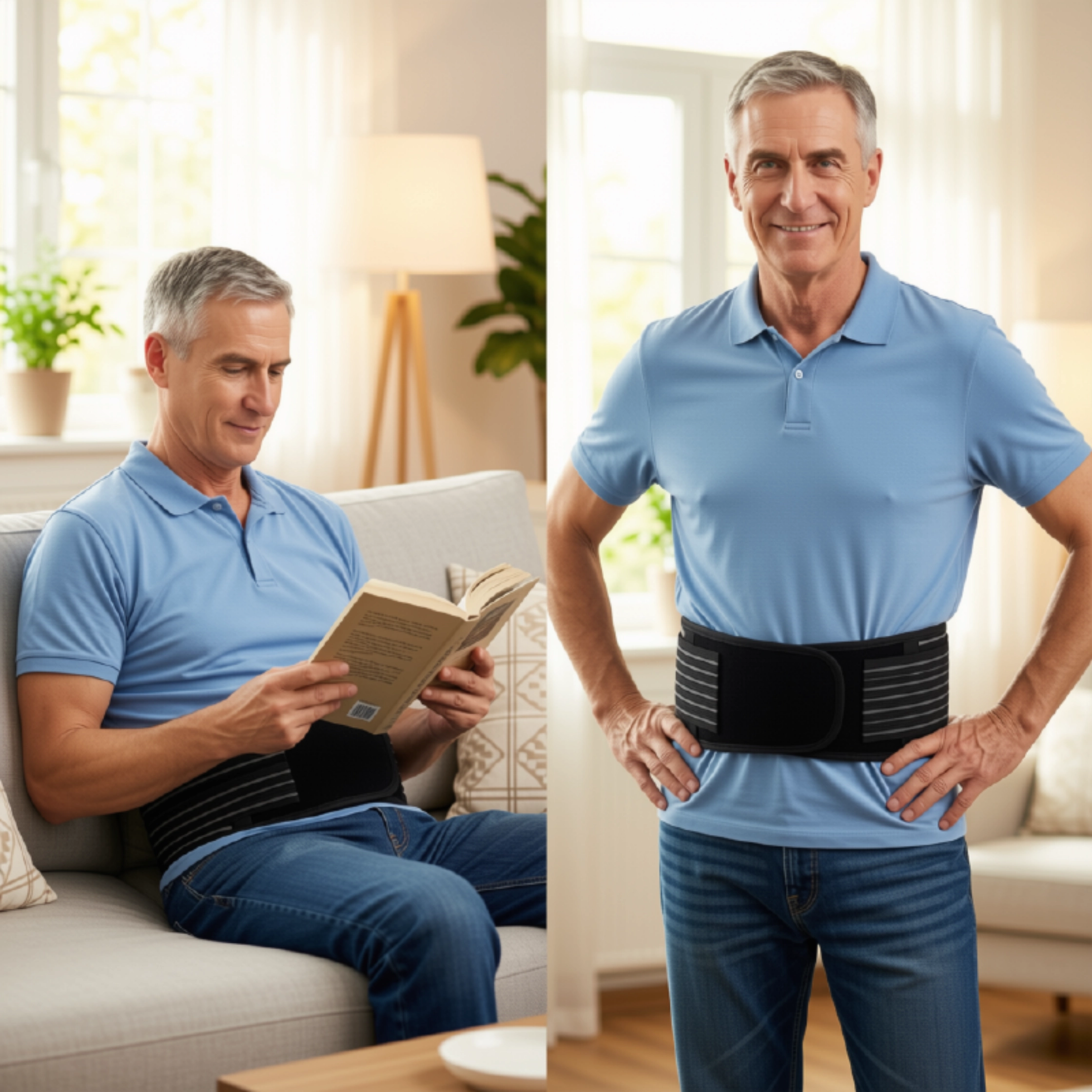
- Designed for adults whose lower back pain tends to build during the day – with standing, sitting, bending, lifting, walking, driving, or fatigue.
- Most useful when the back aches, tightens, feels strained, or becomes less steady with ordinary daily movement.
- Best suited to pain that clearly changes with posture, time on your feet, sitting, repeated bending, lifting, or a busy day, rather than pain that feels unexplained.
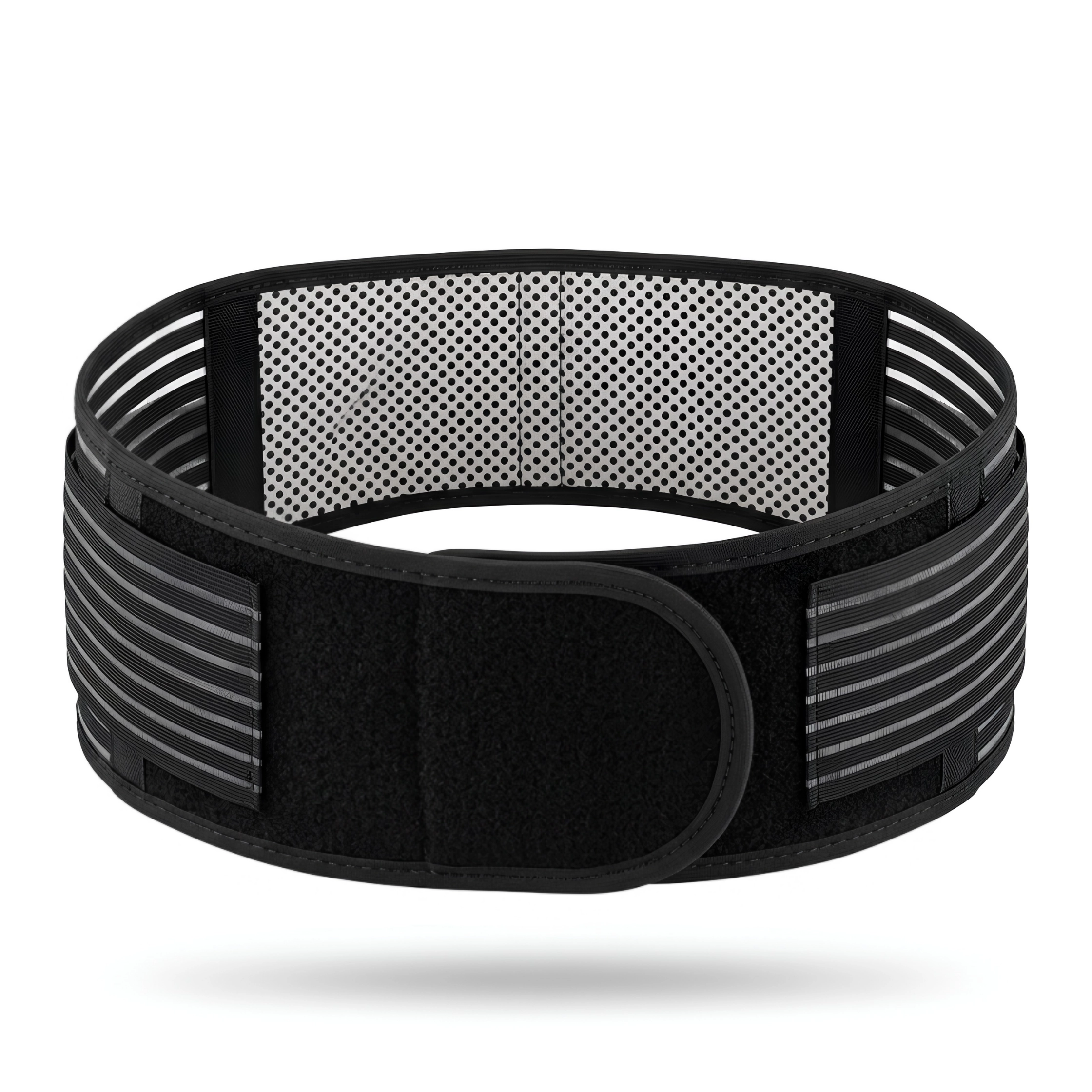
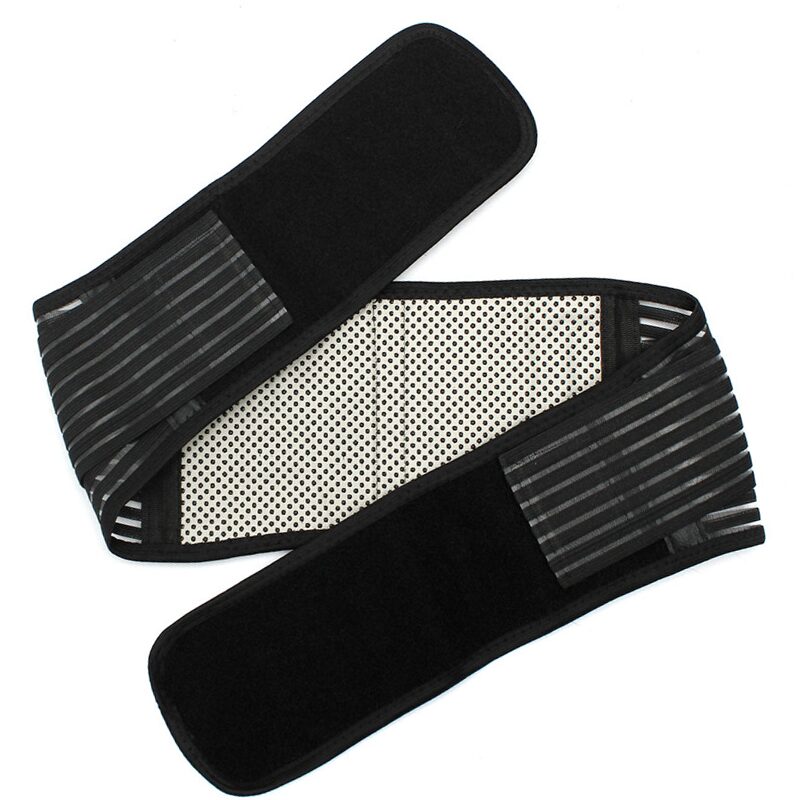
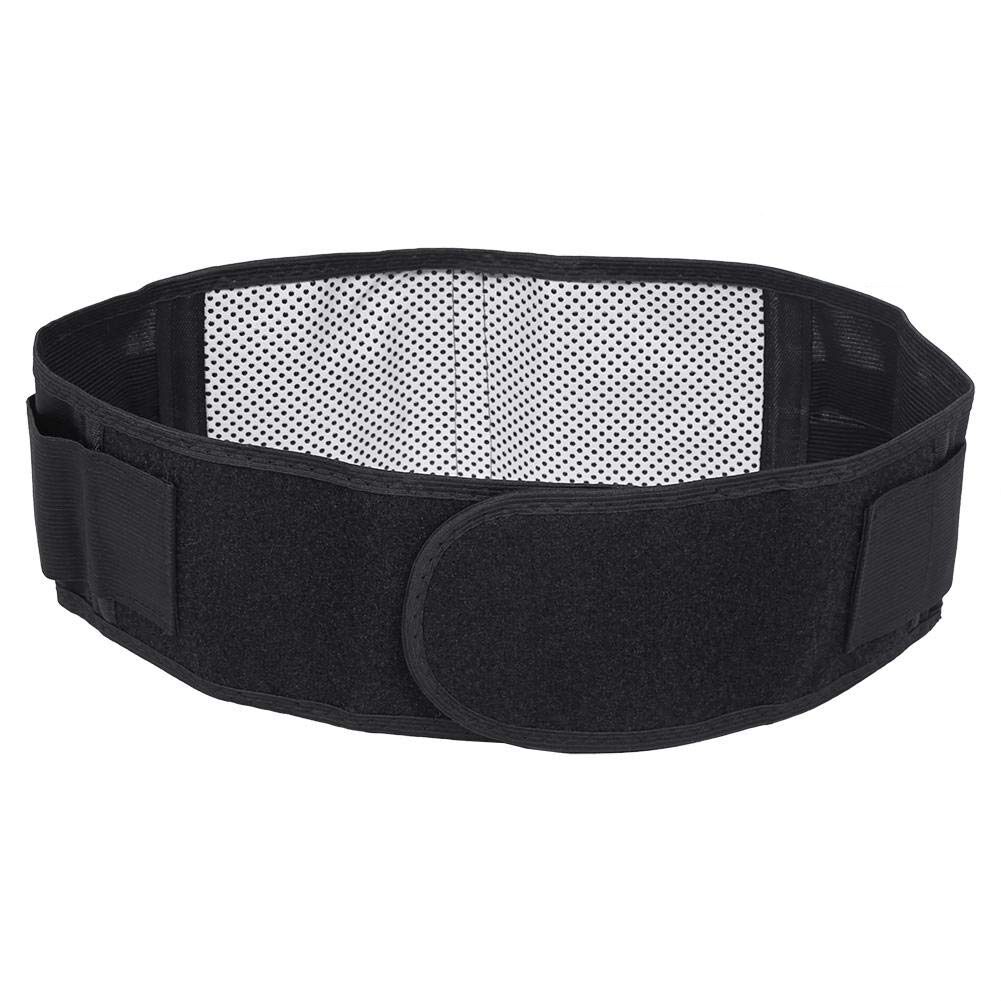
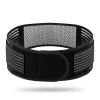
- Broad contoured back panel supports more of the lower back at once instead of pressing into one narrow strip.
- Three curved semi-rigid stays help the belt keep its shape once sitting, standing, and walking begin.
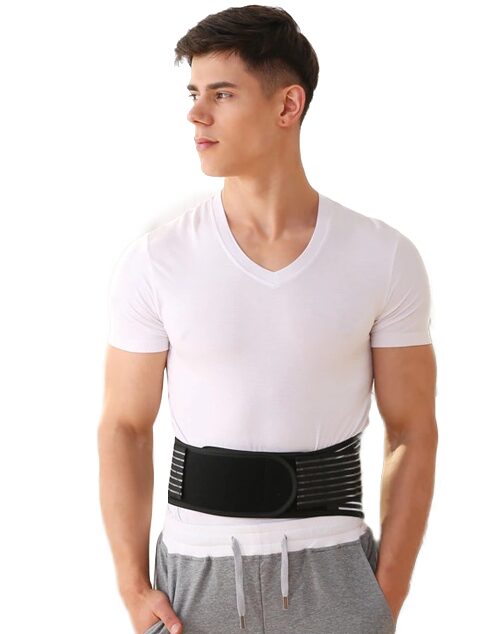
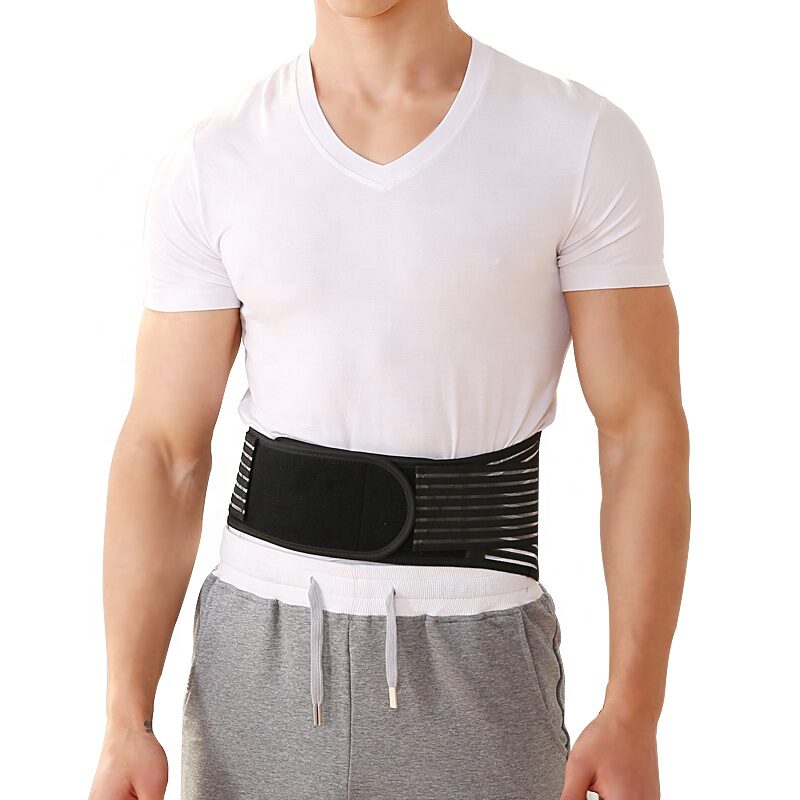
- Wraparound compression supports the lower back and lower abdomen together, which can make standing, walking, carrying, and changing position feel more controlled.
- Adjustable double-pull straps let you tighten the belt for more demanding tasks and ease it for lighter activity.
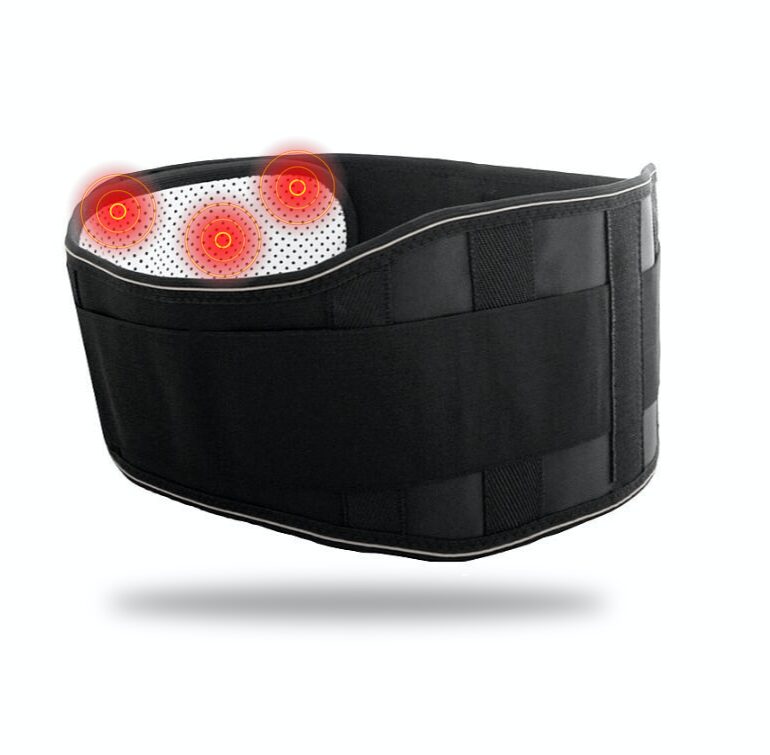
- Padding traps warmth from your body, which can help tight muscles and stiff ligaments feel less sore.
- Back panel contains fixed magnets, though these are not the main source of benefit – the support and warmth do the practical work.
- This is the sort of lumbar belt that often suits people who need more than a basic elastic wrap, but do not need a rigid brace.
- Often most useful during known trigger times such as prolonged standing, desk work, travel, lifting, repeated bending, or the unsettled stage after a back strain.
- Should feel firm and secure, not painfully tight, restrictive, or uncomfortable to breathe in.
- Suitable for men and women.
Sizes
- Medium: 74–86cm waistline (29–33 inches)
- Large: 86–100cm waistline (33–39 inches)
- Extra Large: 100–113cm waistline (39–44 inches)
- XXL: 113–119cm waistline (44–47 inches)
- For the best fit, measure around your abdomen at the level where you’ll wear the belt, allowing a little room for the Velcro fastening to overlap comfortably.
- If you are between sizes, a firmer fit may suit some people better, while others may prefer a little more room and then fine-tune the support with the straps.
Important
- Not suitable for every cause of back pain, and not a substitute for individual clinical assessment where that is needed.
- If you have any implanted device that could be affected by magnetic fields, including a pacemaker, do not use this belt.
- If you are unsure, speak to a GP or physiotherapist before using it.
Lower back pain and how this belt can help
Lower back pain often builds gradually. It may start as a dull ache after standing for a while, a catch when you bend forward, or a stiffness that appears later in the day. Sometimes it comes on suddenly, after a particular movement or a heavy lift. However it begins, it tends to change how you move. Simple tasks like getting out of a chair, reaching down to a low drawer, or standing at a worktop can start to feel like more of an effort than they should. If that sounds familiar, you’re not alone. The lower part of your spine carries a great deal of your body’s weight and is involved in nearly every movement you make. When the joints, discs, and muscles there are already irritated or tired, the demands of daily life can make things worse. This BackReviver magnetic lumbar support belt is designed to take some of that strain off your lower back, while still allowing you to move freely through your day.
The purpose of this page is straightforward: to help you understand what might be happening in your lower back, why a support belt can help, and what this particular belt does differently. You don’t need a medical degree to follow it, and you don’t need a formal diagnosis to decide whether it’s worth trying. You just need to recognise some of the patterns described here.
What’s happening in your lower back
The lower part of your spine is called the lumbar region. It’s made up of five vertebrae – the bony blocks that stack on top of each other – with discs between them. Each disc has a soft jelly-like centre and a tougher outer ring. This structure allows your spine to bend and twist while absorbing force. Between the vertebrae, at the back of your spine, are the facet joints. These small paired joints guide how the vertebrae move and stop them from sliding too far. Ligaments hold the bones together, and muscles wrap around the whole area to support it and control movement.
Below the lumbar spine sits the sacrum, a wedge-shaped bone at the base of the spine. On each side, the sacrum meets the pelvis at the sacroiliac joints. These joints don’t move much – they’re built for stability rather than mobility – but they play a vital role in transferring weight between your upper body and your legs whenever you stand, walk, or shift position.
Because the lower back is so involved in everyday movement, it takes a lot of repetitive load. That’s not a problem in itself. The spine is designed to handle it. But when one of the structures is already irritated, sensitive, or worn, certain movements become more demanding than they should be. How your spine moves in each direction matters, so it’s worth looking at that more closely.
When you bend forwards from the waist, the front edges of the vertebrae move closer together. This compresses the front of the discs and pushes their soft inner material backwards, towards the spinal canal. At the same time, the ligaments at the back of the spine stretch. If a disc is already bulging or weakened, this position increases pressure on it and can push it further against nearby nerve roots. These nerve roots are the short branches that leave the spinal canal and join together to form the larger nerves that travel down into your legs. That’s why bending can sometimes trigger pain not just in your back, but down one buttock, into the thigh, or even as far as the calf and foot.
When you lean backwards, or stand with an exaggerated sway in your lower back, the opposite happens. The facet joints at the back of the vertebrae are pressed together. These joints are designed to guide movement, not to take heavy, repeated compression. If they’re already arthritic or strained, standing for long periods or walking on hard ground can make them feel sore, stiff, and tender.
Twisting the trunk adds another type of load. Instead of the spine simply bending, the vertebrae rotate slightly against each other. This produces a shearing force – a force that tries to slide one vertebra sideways against the one below it, rather than just compressing it. If you combine twisting with lifting, even lifting something light, the demand increases sharply. That’s why many people report that their back “went” while turning and reaching, rather than during a heavy lift.
Prolonged positions also matter. When you sit slumped, the discs and ligaments at the back of the spine are held on stretch for a long time. When you stand still, the muscles around your lower back have to work constantly to hold you upright. Both can leave you with a deep, tired ache across the belt line. Once these tissues have become irritated, the same movements that caused the problem tend to keep re-triggering it.
Why a lumbar support belt makes sense
A lumbar support belt works by wrapping your lower back in a firm, even layer of support. That pressure acts like a gentle cue: when you move into a harmful position, you feel the belt tighten and you naturally pull back. It doesn’t lift you or hold you up — it simply gives your back a stable surface to feel safe against, which helps distribute the load and reduce strain on sensitive structures.
It improves how your core muscles work. When you wrap a firm belt around your lower back and abdomen, it provides gentle but consistent compression. That compression gives your deep core muscles something to pull against. The more efficiently those muscles work, the more evenly they share the load across a wider area — instead of leaving one or two irritated joints or discs to take the brunt of every bend, lift, or straightening. Everyday tasks like standing up from a chair, reaching into a low drawer, or carrying a shopping bag can feel less demanding on the area that hurts.
It discourages extreme end-of-range movements. A well-fitted belt doesn’t lock your spine into place. But it does make it harder to move into the positions that most often provoke pain: deep forward bending, rapid twisting, and excessive arching. The semi-rigid panel acts as a physical reminder to stop short of those extremes. By keeping your spine closer to a neutral, comfortable position, the belt reduces the chance of that sudden sharp twinge from pushing your back too far.
It provides steady contact and warmth. The sensation of being held around your lower back can reduce the urge to brace or guard your movements. Many people with back pain instinctively tense up whenever they move, as if waiting for something to catch. That constant guarding adds fatigue and stiffness. The reliable, even contact of the belt helps ease this pattern, and the warmth under the padding helps tight muscles and ligaments feel looser and more ready to move.
None of this is a cure. But it can change how you move through your day, and that makes a real difference when your back is already sensitive.
How this BackReviver magnetic belt is designed to help
There are many simple elastic wraps on the market, and they can offer a short-term sense of support. But most don’t have the structure needed to actually restrain harmful movements. This belt is designed differently. It brings together a firm back panel, adjustable compression, breathable materials, and a shaped fit, so that it works with your body during real activities, rather than just squeezing your waist.
A curved back panel with three semi-rigid supports
At the centre of the belt is a firm panel that sits over the lower part of your spine and the top of your pelvis. It has a gentle curve that mirrors the natural inward arch of your lower back. This means it lies flat against you, distributing pressure evenly rather than digging into one spot.
Inside the panel are three semi-rigid supports. One runs along the midline of your spine, and one runs along each side. Their job is to give the panel body and structure. When you bend to reach a low shelf, these supports resist excessive forward curling of the lower spine. When you turn to lift something from a work surface, they resist rapid twisting. It’s not a rigid cast – you can still move freely – but the supports create a firm boundary that helps you stay within a more comfortable range of movement.
Because the pressure is spread across the entire width of the panel, no single sore spot has to take all the force. This is a key difference from simple elastic wraps, which can bunch, roll, or dig into the sides of your back.
The height of the panel is also carefully chosen. It extends from just above the top of the pelvis up into the lower lumbar vertebrae. This covers the junction where your spine meets your pelvis – an area that takes a great deal of strain when you walk, stand, or shift weight from one leg to the other. Supporting this junction helps the pelvis and spine move as a more controlled unit.
Double-pull tension straps for adjustable compression
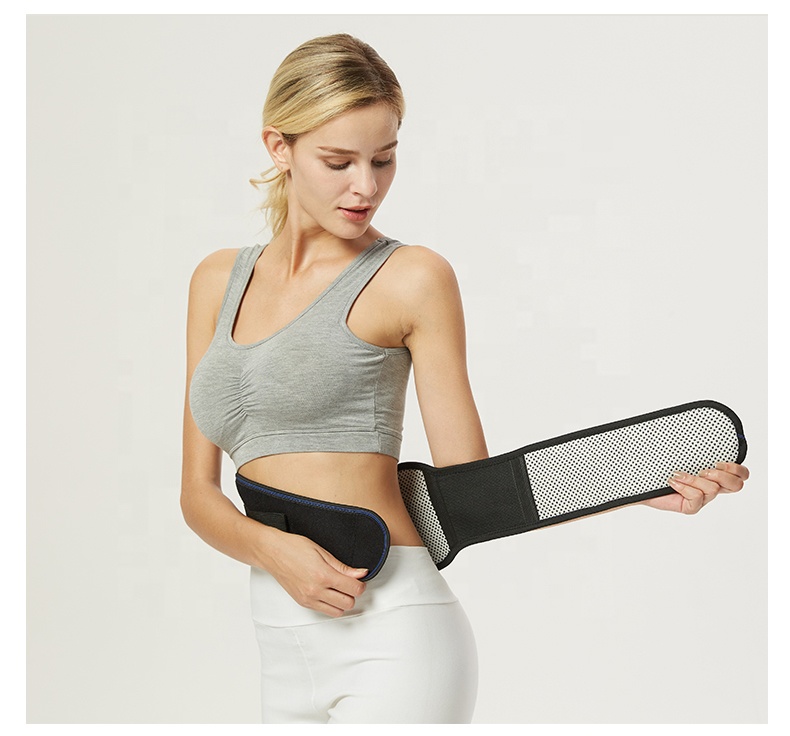
The belt fastens in two stages. First, you bring the main body around your waist and secure the front closure. This positions the back panel correctly over your lower spine and provides a comfortable baseline level of support. Then you pull the side straps, which are anchored at the back, forwards across your body. You can adjust each side independently to get a balanced and personalised fit.
This two-stage system matters because your back’s needs change through the day. For light activity around the house, a moderate tension is usually enough. If you then need to lift, carry, or stand for a long period, you can draw the straps tighter for a firmer hold. Being able to fine-tune the tension means the belt can provide more support when you need it most, then ease off when you don’t.
The compression also encourages a better lifting pattern. When your abdomen is held snugly, it’s more natural to bend through your hips and knees rather than folding through your lower back. This is one of the simplest ways to reduce strain on discs and joints during everyday lifting tasks.
A warm padded inner panel with fixed magnets
Inside the back panel is a smooth, padded layer that sits directly against your skin. It contains several fixed permanent magnets, but it’s important to be clear about what these magnets do. They aren’t the main mechanism of the belt. They don’t create any special healing effect on their own. The practical benefits come from the consistent contact of the padded panel, the gentle compression it provides, and the warmth your body generates beneath it.
The padding traps body heat, which helps the lower back stay warm. This can be soothing for tight muscles and stiff ligaments. The steady, full-surface contact also provides sensory feedback to your brain, which can help you feel more aware of your posture without having to think about it consciously.
If you have any implanted medical device that could be affected by magnetic fields – such as a pacemaker or defibrillator – you must not use this belt. If you’re unsure whether this applies to you, speak to a clinician before wearing it.
Breathable sides and a slim, shaped fit
The back panel is deliberately firm, but the sides and front use a more ventilated fabric. This helps air circulate, so heat and moisture can escape. That makes a noticeable difference if you’re wearing the belt for several hours at a time. It reduces the likelihood of feeling hot, sticky, or irritated under the belt, which is one of the main reasons people stop using lumbar supports.
The belt is shaped to follow the natural contours of your lower back and waist. The edges are rounded and the seams are kept flat, so there’s no harsh pressure over bony points like the top of your hip. It’s also slim enough to be worn under everyday clothing. That means you can use it during normal activities without having to explain yourself or feel self-conscious.
All of these elements work together. The belt gives firm, structured support exactly where it’s needed, allows you to adjust the level of hold, stays comfortable during long wear, and fits discreetly under your clothes.
Condition-specific guidance
You don’t need a formal diagnosis to use this belt. But if you’ve been given a label for your back pain, the overviews below may help you understand what’s happening in your body and why this type of support could fit alongside the plan you already have. Each condition has its own pattern, its own mechanism, and its own reason why a lumbar support belt can help.
Finding the right size
For a support belt to work properly, it needs to sit in the right place and fit closely, but not so tightly that it restricts your breathing or movement. This belt is designed to wrap around your lower back and abdomen, with the back panel centred over your lumbar region and the top of your pelvis. Getting the size right is the first step to making it effective.
Measuring for your size
To choose the correct size, you need a simple tape measure. Measure around your abdomen at the level where you expect to wear the belt. For most people, this is just above the hip bones, across the lower belly and around the small of the back. Stand in a relaxed, upright posture while measuring. Don’t hold your breath in, don’t suck your stomach in, and don’t slouch. Just breathe normally and let the tape sit snugly against your skin or light clothing.
If you’re measuring yourself, it can help to do it in front of a mirror, or ask someone to help you, especially if you find it awkward to reach around. The measurement you get is your waistline for the purpose of this size guide.
Size guide
Use your measurement to select the size that matches:
- Medium: 74–86cm waistline (29–33 inches)
- Large: 86–100cm waistline (33–39 inches)
- Extra Large: 100–113cm waistline (39–44 inches)
- XXL: 113–119cm waistline (44–47 inches)
If your measurement falls between two sizes, many people find that choosing the larger size is more comfortable. You can always use the double-pull straps to increase compression and achieve a firmer hold. A belt that’s slightly too large and cinched in with the straps is generally easier to tolerate than a belt that’s too small and can’t be closed fully without digging in or restricting your breathing.
Checking the fit
When the belt is on, you should feel firm, even pressure around your lower back and abdomen. You should not feel any sharp edges, pinching, or concentrated pressure on bony points. You should still be able to breathe and talk comfortably, and you should be able to move through your normal range of motion without feeling that the belt is cutting you in half. The belt should stay in place as you bend and straighten, not ride up or slide down.
Remember that your waistline can change slightly through the day, and can also change with weight fluctuations. If you’re between sizes, think about when you’re most likely to wear the belt – for example, after a meal or at the end of the day, when you might be a little larger – and choose accordingly.
How to wear it day to day
How you put the belt on is as important as how often you wear it. If the position is wrong, the support won’t land where you need it, and you may not get the benefit. It’s worth taking the time to get this right.
Step 1: Position the back panel
Start by placing the back panel over the centre of your lower back. The bottom edge of the belt should sit just above the top of your pelvis. This usually means the panel covers the area where a trouser waistband would sit, extending upwards to support the lower lumbar vertebrae. It’s easy to put the belt on too low or too high, so it helps to check in a mirror the first few times. You want the panel to feel like it’s wrapping around the small of your back, not sitting over your buttocks or up near your ribs.
Step 2: Fasten the front closure
Hold the belt ends around your abdomen and secure the main front closure. It should feel snug but not tight. This step positions the belt and provides a comfortable baseline level of support. Don’t pull it so hard that you feel squeezed; you just want the belt to be in contact with your body all the way around.
Step 3: Adjust the tension straps
The belt has side straps that are anchored at the back. Once the front is fastened, pull these straps forwards, one at a time, to increase compression. You can adjust each side independently, which helps you get a balanced, even hold. Tighten them to the level of support you need for what you’re about to do. For light activity, a moderate tension is enough. Before lifting, carrying, or standing for a long time, you can draw them tighter for a firmer hold.
Step 4: Check comfort
The belt should feel firm and reassuring, not pinching. You should be able to breathe and talk normally. If you feel any sharp pressure, loosen the straps slightly. It’s better to wear the belt a little looser and be comfortable than to have it so tight that you’re constantly aware of it and want to take it off.
Getting used to the belt
During the first few days, start with shorter periods of wear – around an hour or two at a time – and see how your back responds. Build up gradually if you find it comfortable and helpful. This gives your skin and muscles time to adapt. It also helps you avoid becoming dependent on the support, because you’re giving your own muscles a chance to work while you’re not wearing it.
When to wear it
Most people find it works best to wear the belt during activities that usually bring on their back pain, rather than all day without breaks. For example, you might put it on for:
- Longer periods of standing, such as when cooking, ironing, or standing at a workbench
- Walking distances or on hard floors
- Tasks that involve repeated bending, lifting, or carrying, such as shopping, gardening, or light DIY
- Times when you know your back is likely to be under extra demand, like a busy day out or a long car journey
If your day involves moving between sitting and standing, wearing the belt for those stretches can help support your lower back through the extra load. It’s not necessary to wear it when you’re resting at home, sitting still, or sleeping.
Time without the belt
It’s also important to have time each day without the belt, so your trunk muscles continue to work and you don’t rely on external support for everything. The belt is a tool to help you through demanding activities, not a replacement for your own muscles. If you wear it constantly, your core muscles can become deconditioned over time, which may leave you more vulnerable to future problems.
What to wear underneath
You can wear the belt directly against your skin or over a thin layer of clothing. If you have sensitive skin, or you’re prone to irritation from contact materials, a light cotton top or vest under the belt may be more comfortable. Avoid wearing it over rough or bulky clothing, as this can affect how well it sits and how evenly the pressure is distributed. And never wear it over broken skin, significant rashes, or areas where the skin is already inflamed.
Adjusting through the day
You don’t have to keep the same tension all day. If you start with a light activity and then move on to something more demanding, you can tighten the straps a little. If you’re settling into a period of rest, you can loosen them or take the belt off altogether. The belt is designed to be adjusted easily, so don’t feel you need to set it once and leave it.
Safety and when to seek advice
This belt is intended for adults with lower back pain linked to movement and loading of the spine. It is not designed for children, and it should not be used during pregnancy. If you’re pregnant, your body is going through significant postural and hormonal changes, and a tight support belt around the abdomen may not be appropriate.
About the magnets
The back panel of this belt contains fixed permanent magnets. These are embedded within the padding and do not need to be removed or handled separately. However, because they are magnets, the belt is not suitable if you have any implanted medical device that could be affected by magnetic fields. This includes pacemakers, defibrillators, and some other implants. If you have any implant, or you’re unsure whether it might be affected, speak to a clinician before using this belt. It’s better to check first than to take a risk.
The magnets are not the main mechanism of the belt. The support, compression, and warmth are the primary benefits. If you’re hoping for a specific “magnetic therapy” effect, we’re not going to claim one. The magnets are simply part of the design.
Skin and sensitivity
Do not wear the belt over broken skin, rashes, or active skin conditions in the area it would cover. If you notice any new or unusual skin changes, redness, blistering, numbness, tingling, or colour changes under or around the belt, remove it and speak to a clinician. Some people are more prone to skin irritation from prolonged pressure and heat, so it’s wise to check the area periodically, especially if you’re wearing the belt for long stretches.
If the belt causes increased pain
The belt should feel supportive and comfortable. If it causes increased pain or discomfort despite sensible adjustment, it may not be right for you. Stop using it and seek advice. There are many different causes of back pain, and a support belt isn’t the right answer for every one of them. It’s not a sign of failure if it doesn’t work for you; it’s simply a sign that your particular situation needs a different approach.
When to seek professional advice
A lumbar support belt is not a substitute for a full assessment or treatment plan. It’s one tool that can help manage symptoms, and it works best alongside specific exercises, posture advice, and other strategies recommended by a physiotherapist, GP, or specialist.
You should also speak to a GP or physiotherapist promptly if:
- Your back pain came on suddenly after a fall, heavy impact, or accident
- Your back pain is severe and getting worse quickly
- You notice new or unexplained symptoms alongside your back pain, such as changes in leg strength or sensation, difficulties controlling your bladder or bowel, or feeling generally unwell without clear reason
- You have pain, tingling, or weakness that is spreading or getting worse
These can indicate pressure on important nerves or other underlying problems that need direct assessment. Don’t delay seeking help if any of these apply to you.
Looking after your belt
Taking care of the belt keeps it working well and extends its life. The materials are designed to be durable, but they do need proper handling.
Cleaning
For cleaning, hand wash the belt in cool or lukewarm water with a mild detergent. Gently work the soap through the fabric, paying particular attention to the areas that touch your skin. Rinse thoroughly to remove all soap residue. Then gently press out excess water with a towel – don’t wring or twist the belt, as this can damage the internal supports and the hook-and-loop fastenings. Lay it flat or hang it to air dry completely before wearing it again.
What to avoid
- Do not machine wash the belt. The motion and spin can damage the semi-rigid panel, the magnets, and the fastenings.
- Do not tumble dry, iron, or place the belt on direct heat sources such as radiators or heaters. High heat can distort the panel and damage the fabric.
- Do not use bleach, fabric softeners, or harsh detergents, as these can break down the materials.
The magnets and stays are built into the panel, so there’s no need to try to remove them for cleaning. Just be gentle when handling the belt, especially when it’s wet.
Storing
Store the belt flat or loosely rolled, rather than tightly folded. Folding it sharply can create creases in the back panel and affect how well it sits against your body. Keeping it flat or loosely rolled helps preserve its shape and keeps the edges and seams in good condition.
Maintenance
Check the fastenings from time to time. Lint, dust, or fabric fibres can build up on the hook-and-loop areas, which reduces how securely they grip. You can remove this build-up with a soft brush or by gently picking it off with your fingers. Keeping the fastenings clean will help maintain a secure fit over the long term.
Try it in your own day-to-day life
Choosing a back support belt for lower back pain takes some trial and error. A quick try-on in the hallway doesn’t tell you how it feels by mid-afternoon, or through a few hours of standing and moving. It’s only when you wear it during your actual daily activities that you’ll know if it’s right for you.
That’s why this belt comes with a 30-day money-back guarantee. It gives you the time to try it in the real situations where your back actually bothers you. You can wear it during a day out, while doing household tasks, at work, or on a longer walk. You can test how it feels when you sit, stand, bend, lift, and move through the activities that usually trigger your pain.
During this period, you can decide:
- Whether the belt sits comfortably without slipping, bunching, or digging in
- Whether it supports you in the positions and activities that usually cause your symptoms
- Whether the adjustable compression gives you the level of control you need
- Whether it fits easily into your day, and whether you’re actually likely to use it
If, within this time, you find that it simply doesn’t work for you, you can contact the retailer to discuss a refund within their stated policy. That gives you time to make an informed decision based on your everyday experience, without any promises about specific symptom outcomes. It’s a low-risk way to find out if a lumbar support belt is genuinely helpful for your situation.
Is this belt right for you?
Lower back pain often comes down to the way everyday forces move through the lower part of the spine and the joints that connect it to the pelvis. When you understand what’s happening in your body, you can make an informed choice about what kind of help you need.
This belt doesn’t fix the underlying issue. It changes how load and movement affect your lower back while you go about your day. It gives you a firm, adjustable layer of support that gently guides you away from the movements that tend to set off symptoms. It provides steady, comfortable pressure that can help you feel more confident and less guarded. It adds warmth that can ease tight, tired muscles.
It isn’t a cure. It won’t replace the need for a proper assessment, specific exercises, or the advice of a clinician where those are needed. But used wisely, and as part of a broader approach, it can make the daily demands of standing, walking, bending, and lifting feel more manageable.
If the patterns described on this page sound familiar – if you recognise the ache after standing, the catch when you bend, or the stiffness that limits your day – then the next step is practical. Check your size, think about when in your day your back needs the most support, and decide whether a belt like this fits with the way you live and work. If you have more complex symptoms, or you’re unsure whether it suits your situation, a conversation with a GP or physiotherapist can help you make a safe and informed choice.
If you do decide to try it, give yourself a few days to get used to the feel of it. Wear it for the activities that make your back work hardest, adjust the tension to suit each task, and keep it as one part of a broader approach to looking after your back. Do that, and it’s more likely to earn its place in your daily life.
Disclaimer
The information on this page is general guidance and is not a substitute for individual medical advice, diagnosis, or treatment. Back pain can have many different causes, and the descriptions here may not match your symptoms exactly. If you are unsure whether this product is suitable for you, or if you have new, persistent, or more complex symptoms, you should speak with a GP, physiotherapist, or another appropriate clinician for personalised advice. No specific outcomes can be guaranteed from using this belt.
Fast & Secure Checkout Through Paypal
Pay with Paypal the secure payment gateway that accepts all credit and debit cards. Paypal is free and secure and no credit or bank information is ever stored or shared with us.
Fast Dispatch
Enjoy your items soon with quick dispatch via Royal Mail. Expect to have your items between 1-3 working days for domestic orders. 7-10 Working days for international orders.
Return Policy – 30 Day Money Back Guarantee
In the unlikely event, you are unhappy with your purchase you can return it within 30 days for a refund. Please contact us via the form on the contact us page to start your return.
To return an item please send it to: Nuova Health UK, 81 Highfield Lane, Waverley, Rotherham, S60 8AL. Please include a note with your order id so we know who to refund. Please retain your postage receipt as proof of postage. All that we ask is that the item is in the original packaging and unused.
Reviews
There are no reviews yet.