


Hinged Knee Brace For Men & Women – For Sprains, Strains, ACL, MCL, PCL, and Meniscus Knee Injuries
£15.49inc VAT
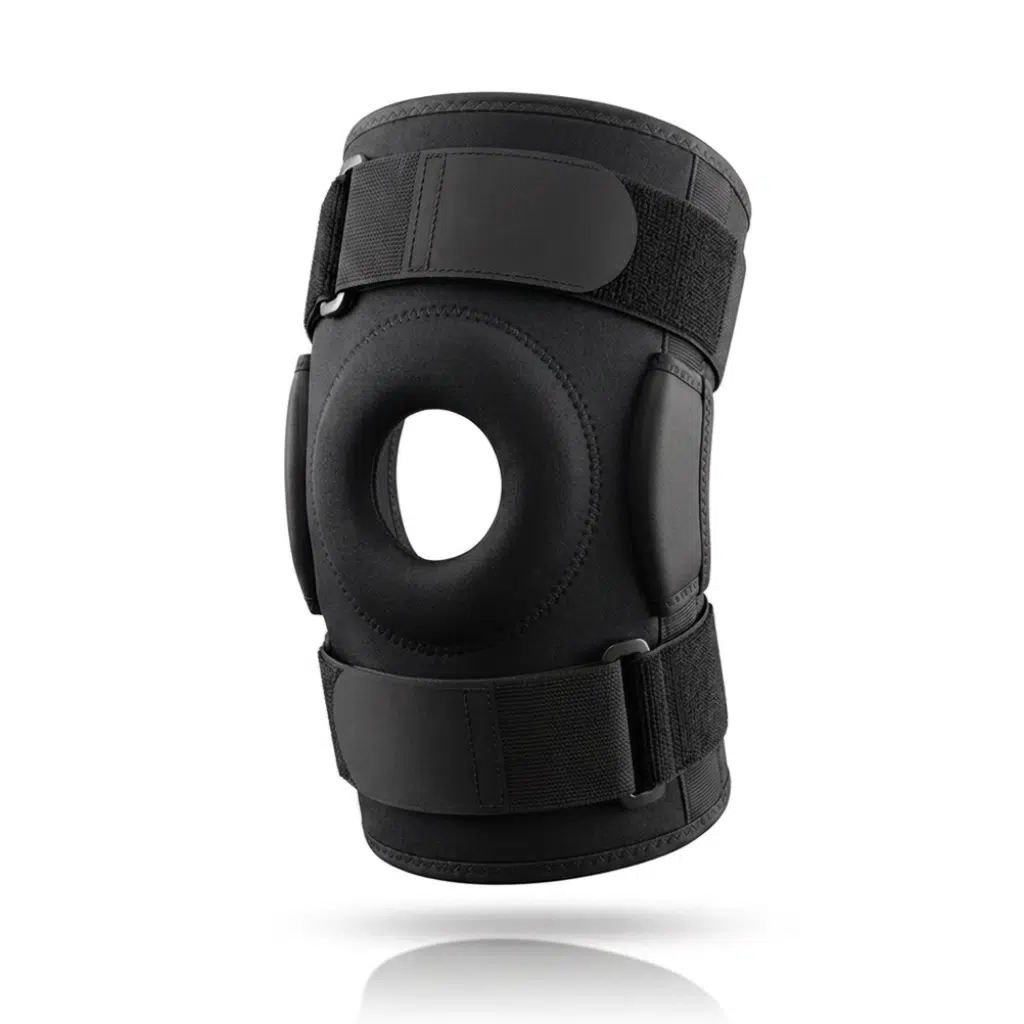
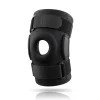
- 1x Hinged Knee Brace for Men & Women – designed to support injury rehabilitation and recovery from sprains, strains, ACL, MCL, PCL and meniscus injuries.
- Available in sizes Medium, Large, XL & XXL – with adjustable straps to fit maximum thigh circumferences of 40cm, 50cm, 60cm and 70cm respectively.
- Provides firm, soothing compression to help ease pain and reduce swelling around an injured knee.
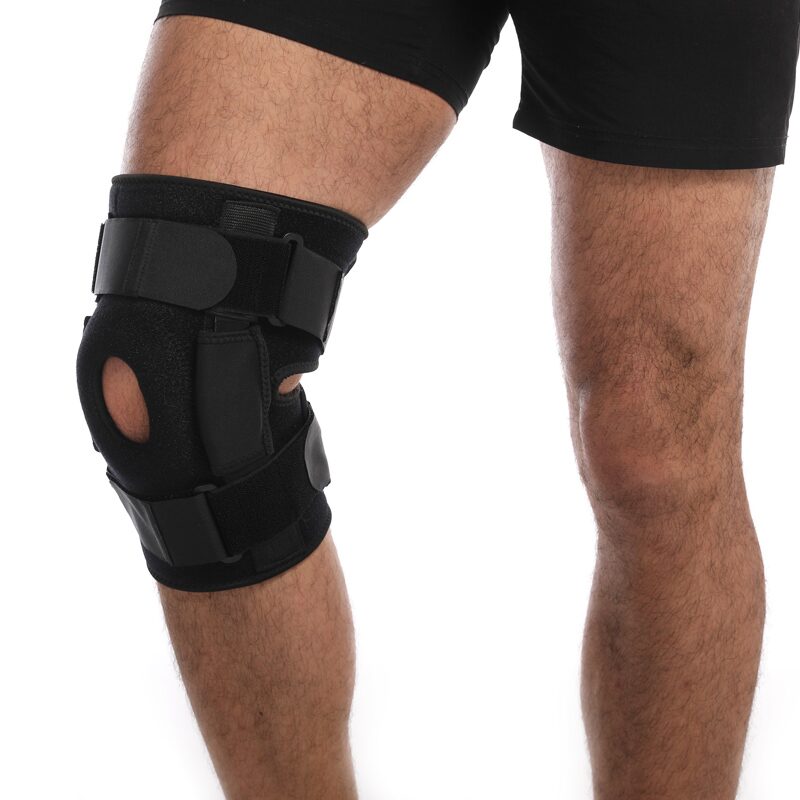
- Features 2 removable metal hinges on either side of the brace to stabilise the joint and limit twisting movements that can strain healing tissues.
- The ergonomic open patella design includes a cushioned gel silicone ring to reduce pressure on the kneecap and improve airflow for all-day comfort.
- Helps support and stabilise the knee during everyday activities – walking, using stairs, standing for long periods, and light exercise.
- Suitable for a range of knee problems including sprains, strains, arthritis, tendonitis, meniscus tears, fractures, dislocations, ACL, MCL and PCL injuries.
- Can be worn when running or playing sports such as football, rugby and basketball for added confidence and protection.
- Sturdy, secure strapping keeps the brace firmly in place during movement, so you are not constantly adjusting it.
- Includes a 30-day money-back guarantee.
Dealing with knee pain that flares up when you walk, run, or even rest? Struggling with instability after a sprain, strain, or sports injury? That persistent ache, the fear of your knee buckling, or the sharp twinge when you pivot — it’s more than just discomfort. It can sideline you from the activities you love and slow your recovery. Whether you’re rehabbing an ACL tear, managing arthritis, or bouncing back from a meniscus injury, your knee needs reliable support to heal and stay protected.
That’s where a hinged knee brace comes in. Designed for both men and women, it provides targeted stabilisation and pain relief. No more wondering whether your joint is safe during movement. This brace delivers firm, structural support with a focus on comfort, helping you move confidently again — whether you’re recovering, exercising, or just getting through the day.
What’s happening in your knee
Your knee is the largest joint in your body, and it’s doing two jobs at once. It has to be stable enough to carry your full body weight on every step, and flexible enough to let you bend, straighten, twist and pivot. That’s a demanding combination, which is why the knee relies on a network of structures working together:
- Bones — the thighbone (femur), shinbone (tibia) and kneecap (patella)
- Ligaments — four main bands (the ACL, PCL, MCL and LCL) that connect bone to bone and hold the joint in place
- Tendons — tough cords that connect muscle to bone, including the patellar tendon below the kneecap
- Cartilage — smooth tissue covering the ends of the bones, plus the two C-shaped menisci that act as shock absorbers between the thighbone and shinbone
- Muscles — the quadriceps at the front of the thigh and the hamstrings at the back, which power the joint and act as an active support system
When any of these structures is damaged — whether from a sudden injury or gradual wear — the knee’s ability to move smoothly is affected. You might feel pain, swelling, stiffness, or a sense that the joint is “giving way.” And here’s the problem: when your knee feels unstable, you naturally start to avoid certain movements. Your muscles begin to weaken. The weaker your muscles become, the more strain every daily movement puts on the damaged tissue. It’s a cycle that can turn a straightforward injury into a long-term problem.
Think of it this way: your knee is designed like a door hinge. It swings smoothly back and forth because the hinge pin — the joint surfaces and ligaments working together — keeps the door perfectly aligned. If that pin is loose or damaged, the door starts to wobble and catch. Every swing puts extra stress on the parts that are still holding on. A knee brace doesn’t replace the hinge pin, but it acts like a second hand steadying the door, keeping it tracking straight while the damaged parts repair.
This is why support matters. A knee brace works with your body’s own stability systems, not against them. It won’t repair torn tissue on its own — but it can create the conditions for healing by controlling movement and reducing strain on vulnerable structures.
Why a hinged knee brace makes sense
There are many types of knee supports, and they’re not all doing the same job.
A simple elastic sleeve hugs the knee and provides mild compression, which can help with mild swelling and stiffness. A patellar strap applies pressure to a specific tendon. But for significant instability — the feeling that your knee can’t be trusted, particularly during movement — neither of these can provide the structural control that’s needed.
A hinged brace is different. It has rigid supports on each side of the joint, aligned with the natural pivot point of your knee. This design does two important things:
- It allows normal bending and straightening — so you can walk, sit, climb stairs and go about your day
- It blocks sideways and rotational forces — the movements that strain injured ligaments and overstress damaged cartilage
That combination is why hinged braces are so widely recommended for knee problems ranging from ligament sprains and tears, to meniscus injuries, arthritis, and recovery after fractures or dislocations.
The brace also does something more subtle. By providing constant, consistent feedback to your nervous system about the position of your knee, it supports what physiotherapists call proprioception — your body’s ability to sense where a joint is in space. After an injury, that sense is often impaired. You lose the automatic “feel” of where your knee is, and your muscles react a fraction slower as a result. The brace helps restore that feedback, so your own muscles can work more effectively to hold the joint steady.
In plain terms, a hinged brace is the difference between hoping your knee will hold, and knowing it will.
How this hinged knee brace is designed to support you
The hinges: giving your knee back its stability
At the heart of the brace are twin metal hinges on the inner and outer sides of the joint. These are aligned to the natural pivot of your knee, so that when you walk, sit or climb stairs, the brace moves with you. What it resists is the sideways and twisting movement — the sort of abrupt, rotational force that injures ligaments and compresses cartilage.
This matters most at the moments when your knee is most vulnerable: when you change direction quickly, when you step off a kerb at an angle, or when you turn while carrying weight through one leg. At those moments, the hinges act like a protective barrier, stopping the joint from being forced into positions it can’t safely hold.
The hinges are removable, which makes the brace more versatile. Early in recovery, when your knee needs its fullest protection, keep the hinges in place. As you gain strength and confidence, you can continue wearing the brace with the hinges removed for lighter support — and reattach them when you’re returning to higher-risk activities, such as sport.
An adjustable fit that works with your body
The brace uses four flexible straps, each adjustable around the thigh and calf, to hold the support securely in place. That’s important for two reasons.
First, a brace that moves around on your leg is a brace that isn’t supporting you. The straps prevent the brace from slipping, so the hinges stay aligned with your joint through a full range of movement.
Second, the compression itself supports healing and comfort. Firm but comfortable pressure can help reduce swelling and stiffness around the knee, encourages circulation, and gives your muscles useful sensory feedback. The straps use strong double-velcro closures designed to stay put during movement — so you’re not constantly stopping to re-tighten them.
If the brace feels too tight, loosen the straps slightly. You should feel supported, not squeezed.
Open patella design: comfort exactly where you need it
The opening around the kneecap is a deliberate design choice, and it does three jobs:
- It takes pressure off the patella itself. After surgery, with arthritis, or with patellar tendon problems, even light pressure on the kneecap can be uncomfortable. The circular opening means the sensitive area sits free while the surrounding tissue is supported.
- The soft gel silicone ring around the opening provides cushioning, holding the brace comfortably in place without digging into the skin.
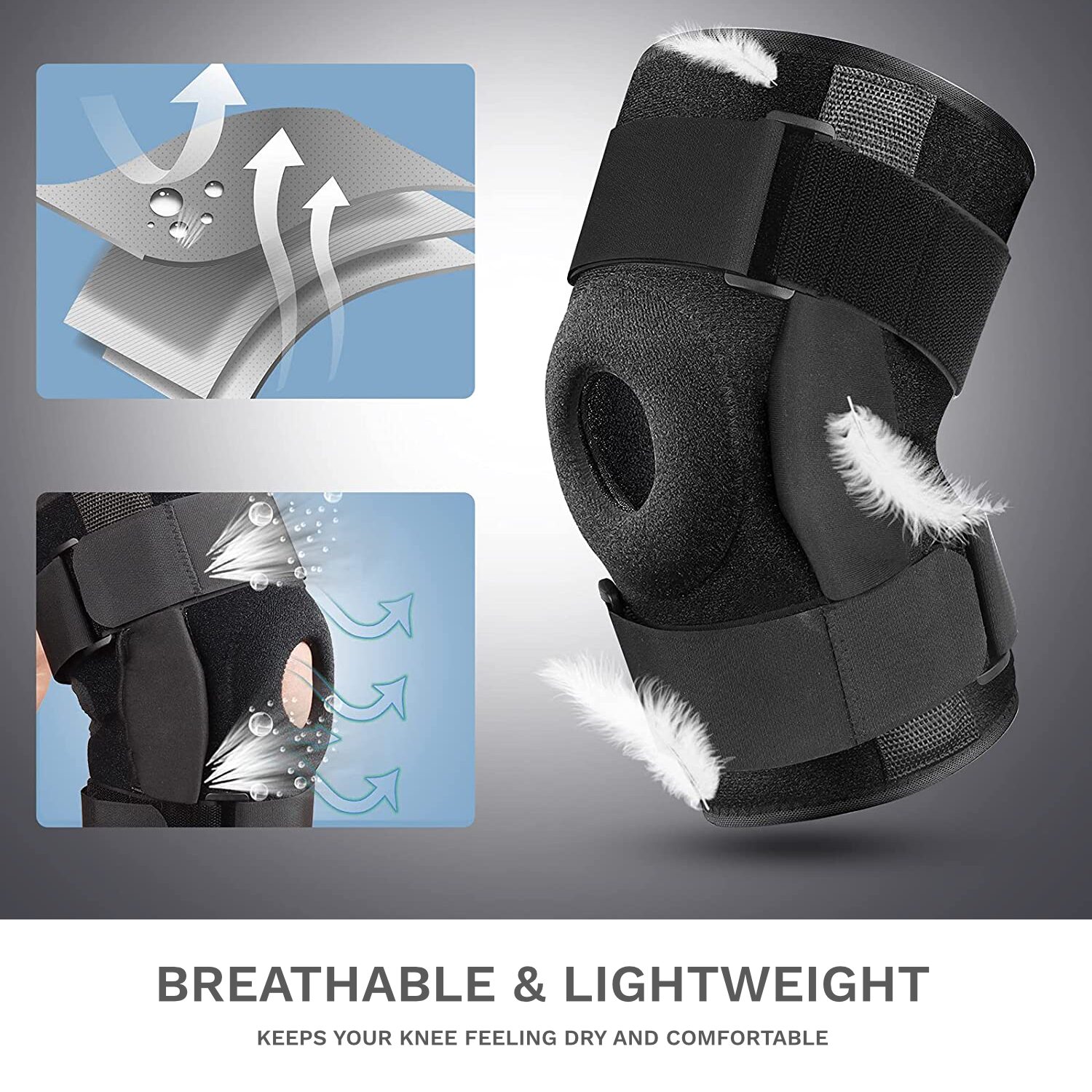
- It improves airflow around the front of the knee, which helps keep the area cooler and reduces skin irritation during longer wear.
Designed to move naturally with your leg
A brace only works if you can wear it. The overall shape has been designed to follow the natural contours of the knee.
The back of the brace is cut away in a curved contour, stopping fabric from bunching behind the knee when you bend it. Bunching is a common cause of pressure points and sore spots in cheaper knee supports. The side panels follow the curve of the leg rather than sitting flat against it, so the brace stays in place and doesn’t dig in.
The edges are softly finished to avoid chafing, and the materials have been chosen with temperature in mind. The inner layer wicks moisture away from the skin, helping keep the area dry during activity, and strategically placed perforations allow air to reach the joint even after hours of wear.
Built for the realities of recovery
A knee brace used for rehabilitation needs to cope with ordinary day-to-day wear — and it has to be comfortable over weeks, not just for a single session. The reinforced stitching and durable fasteners are designed for that. The materials hold their shape and tension over time, and the overall construction is lightweight enough that wearing the brace through your day doesn’t tire you out.
The fabric also includes an antimicrobial treatment, which helps prevent the odour that can build up when a support is worn through activity. It keeps the brace fresher for longer, which makes consistent wear far more pleasant.
Knee problems this brace can help with
The value of a hinged brace is best understood through the specific problems it addresses. Here’s how this brace supports different knee conditions — and why the mechanics of each injury matter.
Ligament injuries
Sprains: when your knee gives way
If your knee has ever buckled when you stepped off a kerb or landed awkwardly, you’ve felt what a ligament sprain does. Ligaments are strong but slightly elastic bands that connect bone to bone. When a sudden force — a twist, an impact, an awkward landing — stretches a ligament past its limit, the result is a sprain, ranging from a minor over-stretch to a partial or complete tear.
Even walking transfers your full body weight through the knee, and it’s the ligaments that stop the bones sliding and twisting out of position. When a ligament is damaged, it can no longer take its share of that load. The surrounding structures have to work harder — and that extra work often becomes small, repeated strains that delay healing.
The degree of instability you feel usually reflects how much damage has occurred. A mild sprain may just feel sore and swollen for a few days. A more significant sprain leaves the knee feeling loose, or “giving way” under you when you put weight on it. That sensation isn’t just unpleasant — it’s your ligament signalling that it can no longer control the joint on its own.
A hinged brace works because it takes over part of the job the damaged ligament can no longer do. The side hinges block the sideways and twisting forces that pull on healing tissue, while allowing you to keep moving. The compression helps control swelling and gives your nervous system useful feedback about where your knee is in space.
Alongside bracing, the standard early approach to a sprain remains RICE — Rest, Ice, Compression, Elevation. A brace supports this approach by providing the compression element while keeping you mobile. For the best outcome, it’s worth having a professional confirm the severity of your sprain — mild sprains and complete tears need very different treatment plans.
ACL injuries: protecting the knee’s key anti-sliding ligament
The ACL (anterior cruciate ligament) runs diagonally through the centre of the knee, connecting the thighbone to the shinbone. Its primary job is to stop the shinbone from sliding forward beneath the thighbone. It also plays a central role in controlling rotation — which is why ACL injuries are so common in sports involving pivoting, jumping and sudden stops.
An ACL injury often leaves a distinctive sensation of instability. It’s not always dramatic pain — it’s more a feeling that the knee is “moving on its own” during everyday actions like walking downstairs or turning. The joint simply doesn’t feel as though it’s tracking correctly. That’s because the ACL is densely packed with nerve endings that constantly report the knee’s position to your brain. When it’s damaged, you lose that internal feedback along with the physical restraint.
This is where the brace’s proprioceptive effect becomes so valuable. The firm compression of the straps against your thigh and calf effectively “wakes up” the skin and muscle sensors on the outside of the leg, giving your brain a second stream of position information to compensate for what the damaged ACL is no longer reporting. Combined with the physical restriction of the hinges against rotational forces, the brace gives you back a sense of control that the injury took away.
A hinged brace addresses the mechanical problem directly. The side hinges prevent the shinbone from shifting too far forward or rotating excessively at the extremes of movement, reducing the forces that would stress a healing or reconstructed ACL. If you’re rehabbing after ACL surgery, a hinged brace is often a key part of the recovery plan. It doesn’t replace physiotherapy, but it protects the healing graft while you gradually rebuild strength.
MCL injuries: supporting the knee’s inner stabiliser
The MCL (medial collateral ligament) runs along the inside of the knee. It connects the thighbone to the shinbone and resists forces that push the knee inward. The classic mechanism for an MCL injury is a blow to the outside of the knee — a rugby tackle, a football collision, a fall onto the side of the leg — forcing the joint to bend inward.
What makes MCL injuries distinctive is where you feel them: along the inner side of the knee, often with tenderness directly over the ligament itself. You might notice it most when you’re walking on uneven ground, where the surface can subtly push your knee inward with every step. That repetitive inward stress, even after the initial injury has settled, is what keeps the ligament irritated and slow to heal.
That inward movement is exactly what a hinged brace is designed to resist. The inner hinge physically blocks the knee from collapsing inward, which protects the healing ligament from the specific force that damaged it. At the same time, the compression and overall support help you move with more confidence — important because staying active, within safe limits, is what keeps the surrounding muscles from weakening during recovery.
PCL injuries: the quieter form of knee instability
The PCL (posterior cruciate ligament) is less discussed than the ACL, but just as important. It runs from the back of the thighbone to the back of the shinbone and prevents the shinbone from moving backwards. The most common cause of injury is a direct impact on the front of a bent knee — the classic “dashboard” injury in a car accident, or a fall directly onto the knee.
PCL injuries can be more subtle than ACL tears. There may be no dramatic “pop” or rapid swelling — just a vague ache behind the knee. That makes the injury easy to walk off, which is precisely the danger. Without support, the damaged PCL is stretched every time you bend your knee, which prevents it from healing properly and can leave you with lasting instability.
The activity that most exposes PCL weakness is descending stairs or slopes. When you bend your knee to step down, gravity pushes your shinbone backwards against the PCL. If that ligament is damaged, this everyday movement becomes the thing that re-irritates it day after day. You might also notice a sense of the knee feeling “unstable” when you go from sitting to standing, particularly from a low chair.
A hinged brace helps because it limits how far the shinbone can drift backward when you bend your knee. This gives the PCL a protected environment to heal, and it allows your own muscles — particularly the quadriceps, which act as an important secondary stabiliser — to strengthen safely while the ligament repairs.
LCL injuries: the knee’s outer shield
The LCL (lateral collateral ligament) runs along the outside of the knee, connecting the thighbone to the smaller bone in the lower leg (the fibula). It resists forces that push the knee outward. Injury usually comes from a blow to the inner knee, or from violent twisting.
The LCL has a poorer blood supply than the other knee ligaments, which means it heals more slowly. That makes protecting the area during recovery particularly important. You’ll typically feel LCL pain on the outer side of the knee, sometimes with a sense of the joint feeling “loose” when you move — particularly when you walk on uneven ground or change direction.
A hinged brace provides the outer support that stops the knee bending too far outward, giving the ligament time to repair without being repeatedly re-damaged by ordinary daily movements. The compression also helps support the outer knee structures, and the hinges prevent the rotational stresses that can strain the LCL’s attachment points.
Muscle and tendon problems
Strains: giving overstressed tissue a chance to recover
Some knee problems affect the soft tissue around the joint rather than the joint structures themselves. A strain occurs when a muscle or tendon is overstretched or overloaded — suddenly, through a sprint or heavy lift, or gradually, through repeated activity that outpaces the tissue’s ability to recover.
The difference between a strain and a sprain comes down to what’s injured: muscles and tendons in a strain, ligaments in a sprain. The symptoms can feel similar — pain, tenderness, weakness — but the mechanism is different, and so is the most helpful kind of support.
When a muscle or tendon is strained, the tissue becomes inflamed and irritable. It needs a period of reduced load to settle, but it also needs movement to prevent it from becoming stiff and weak. That’s a fine balance. If you rest completely, the tissue weakens further. If you stay fully active, you keep irritating it.
A brace helps a strain by reducing the load on the affected tissue. The compression spreads forces across a wider area of the knee rather than letting them concentrate at the point of injury, and the firm fit provides support that lets you stay active while the tissue heals. The hinges also limit how far the knee can bend into the positions that most heavily load the muscles and tendons around the joint — for example, deep knee bends or sudden deceleration when walking downhill.
Patellar tendinopathy: when the knee’s power cable is strained
The patellar tendon connects the kneecap to the shinbone. It transmits the powerful forces generated by the quadriceps muscles — straightening the knee for walking, running, jumping and climbing stairs. When this tendon is repeatedly overloaded, as it is in sports that involve a lot of jumping and sudden acceleration or deceleration, small areas of damage can accumulate. This is the condition commonly known as “jumper’s knee.”
The pain is usually felt at the lower edge of the kneecap: an ache after activity, stiffness after sitting, or pain when you land, push off, or descend stairs. The tendon becomes less tolerant of load, and pushing through the pain risks worsening the damage.
What’s happening at tissue level is important to understand. A healthy tendon is made up of tightly packed collagen fibres that glide past each other when you move. When the tendon is overloaded, those fibres become disorganised and irritated. The tendon thickens, and its capacity to handle force drops. The discomfort you feel isn’t just “wear and tear” — it’s the tendon telling you it can’t currently manage the loads you’re asking of it.
A hinged brace helps by reducing the strain on that tendon pathway. The open patella design keeps direct pressure off the sore point, while the side hinges limit how far the knee can extend under force — which means the tendon has to handle less tension when you move. That gives the tissue an opportunity to settle, while you keep using the knee enough to maintain strength and movement.
It’s worth knowing that a tendon problem like this responds best to a structured loading programme — typically guided by a physiotherapist. The brace supports the tendon during daily activity, but restoring its capacity requires progressive, appropriate exercise over several weeks or months.
IT band syndrome: easing the outer knee’s friction burn
Iliotibial band syndrome is one of the most common causes of outer knee pain in runners and cyclists. The iliotibial (IT) band is a thick band of fascia running from the hip, down the outside of the thigh, to the shinbone. As the knee bends and straightens, this band slides over a bony prominence on the outer edge of the knee. When the band becomes tight, or the movement patterns of the leg change, that sliding becomes friction — and friction becomes inflammation.
The pain is often very predictable: it starts at a certain point in a run or ride, and it eases when you rest. It’s a sharp, burning ache on the outer knee, sometimes enough to force you to stop.
The mechanism is worth understanding clearly. Each time your knee bends and straightens — every stride when running, every pedal revolution when cycling — the IT band rubs across that bony edge. Normally this friction is well tolerated. But if the band is tight, if the muscles around the hip are weak, or if you’ve suddenly increased your mileage, the repeated friction overwhelms the tissue’s tolerance. It becomes inflamed, swollen, and painful.
A hinged brace can help by supporting the outer side of the knee and limiting the range of motion — which in turn reduces how much the IT band grinds over the bone during repetitive movement. The compression around the knee also provides gentle warmth and support to the area. That helps settle the acute discomfort. But for long-term resolution, the underlying causes need attention: tight hips, weak gluteal muscles, or poor movement patterns that put extra tension through the band. A physiotherapist can help identify which of these is driving your symptoms.
Cartilage problems
Meniscus tears: protecting the knee’s shock absorbers
Between the thighbone and shinbone sit two C-shaped discs of cartilage called the menisci. They act as shock absorbers, spreading your body weight across the joint so the bones don’t grind directly against each other. They also help to stabilise the knee during twisting movements.
A meniscus tear can happen suddenly — a twist while the knee is weight-bearing, often in sport — or it can develop gradually as the cartilage becomes less resilient with age. Either way, torn meniscus cartilage has a limited capacity to heal on its own, because its blood supply is poor.
The hallmark signs of a meniscus tear are a “catching” or clicking sensation in the knee, a feeling of something moving inside the joint, or an inability to fully straighten the leg. These symptoms understandably make you want to protect the knee — but stopping moving entirely causes the muscles to weaken and the joint to stiffen.
What’s actually happening mechanically is that the torn edge of the meniscus is getting caught or pinched between the bones as the knee moves. When you twist or pivot on a weight-bearing leg, the force compresses the meniscus between the femur and tibia. If there’s a tear, that compression can shift the torn fragment, causing pain, catching, or that alarming sensation of the knee “locking.”
A hinged brace helps by limiting the rotational stresses that compress the torn meniscus. Because it prevents the knee from twisting to the extremes of its range, it protects the damaged cartilage from aggravating forces while still allowing you to walk and move. That not only eases symptoms, it keeps the rest of the knee — the muscles, the healthy cartilage — as active as possible during recovery.
In some cases, particularly with certain types of meniscus tears, surgery may be recommended. Your GP or orthopaedic specialist can advise whether your specific tear needs that level of intervention.
Osteoarthritis: managing a knee that’s wearing down
Osteoarthritis is the most common joint condition in the UK. It develops when the smooth cartilage covering the ends of the bones gradually thins and roughens. Instead of gliding smoothly against each other, the bones begin to rub — and over time, the joint’s shape and alignment can change. The knee is one of the most commonly affected joints.
The symptoms are familiar to many people: morning stiffness that eases as you move, pain on stairs, a grating or crunching sensation when you bend the knee, and a feeling of instability on uneven ground. The condition develops gradually, driven by a combination of age, previous injury, load over time, and genetic factors.
Understanding why the knee becomes painful with arthritis helps explain why a brace makes a difference. As cartilage thins, the joint becomes less able to absorb and distribute load evenly. Areas of the joint surface that were designed to bear weight comfortably now receive concentrated pressure. The bone underneath responds by becoming thicker and developing bony spurs. The joint capsule — the tough envelope around the knee — becomes tighter and less flexible, which is why the knee feels stiff. And the muscles around the knee, which have to work harder to control a joint that’s now slightly irregular, fatigue more easily.
A hinged brace helps people with knee osteoarthritis in two distinct ways. Most importantly, the side hinges provide a degree of stability that a worn knee can no longer guarantee. That stability matters far more than people expect — it’s the difference between avoiding stairs and using them, between limiting your walking and getting out regularly. Staying active is essential for managing arthritis well, and a brace can be the thing that makes that possible.
The compression also helps the knee feel supported, and many people find it eases the stiffness that builds up after sitting. The open patella design keeps pressure off the kneecap, which is often tender in arthritis.
Bone injuries
Fractures: supporting the knee through the recovery phase
A fracture around the knee — the kneecap, the lower end of the thighbone, or the upper end of the shinbone — is a serious injury. It’s usually managed either surgically or by immobilising the leg in a cast while the bone heals.
But once the bone has healed enough to move, the knee faces a new challenge. After weeks of being held still, the surrounding muscles have weakened, the joint has stiffened, and the normal “feel” of movement has been lost. Every step feels unfamiliar. The muscles that normally protect the joint — the quadriceps especially — are no longer strong enough to control the knee reliably.
This is where a hinged brace becomes valuable. The hinges allow the knee to begin moving through controlled, safe ranges, while the rigid sides protect against the sideways and twisting forces that could disrupt fragile bone healing. The brace provides the stability that the weakened muscles can’t yet provide, reducing the risk of a fall or awkward movement setting recovery back. It’s a transitional tool — use it alongside the exercise programme your orthopaedic team or physiotherapist prescribes, and you’ll gradually rely on it less as your knee rebuilds its own strength.
Knee dislocations: rebuilding stability after a major injury
A knee dislocation is one of the most severe injuries a knee can sustain. It happens when the bones of the knee joint are completely forced out of alignment — most often from high-energy accidents such as car collisions, or a violent twist in sport. A dislocation tears multiple ligaments at once, and can also damage the nerves and blood vessels around the knee.
Emergency treatment focuses on putting the knee back into alignment and assessing for any damage to blood vessels or nerves. That’s the immediate medical priority — and no brace replaces it.
Brace support enters the picture during the long recovery that follows. Once the knee has been surgically repaired or stabilised, a hinged brace is commonly used to protect the healing structures. The rigid hinges keep the knee from moving to the sideways and rotational extremes that a multi-ligament-injured knee cannot control — while still allowing a safe, controlled range of motion for rehabilitation.
In this context, the brace is fundamentally a protective device. It keeps the joint within safe boundaries while the body repairs, and it gives you a dependable foundation on which to rebuild strength and confidence.
Finding your size and fitting the brace
Measuring for the correct size
The brace comes in four sizes. To find your fit, measure around your thigh at a point 4 inches (about 10 cm) above the centre of your kneecap. This is where the top strap will sit, and it gives the most reliable indication of which size will hold the brace securely.
| Size | Thigh Circumference (cm) | Approximate Inches |
|---|---|---|
| Medium | 30–40 cm | 11–15 inches |
| Large | 40–50 cm | 15–19 inches |
| XL | 50–60 cm | 19–23 inches |
| XXL | 60–70 cm | 23–27 inches |
If your measurement falls on the boundary between two sizes, sizing up is generally the safer option. A brace that’s too tight can restrict circulation; one that’s slightly roomier can be snugged into place with the straps.
Fitting the brace correctly
Take a few seconds to get the positioning right — it makes a real difference to comfort and support.
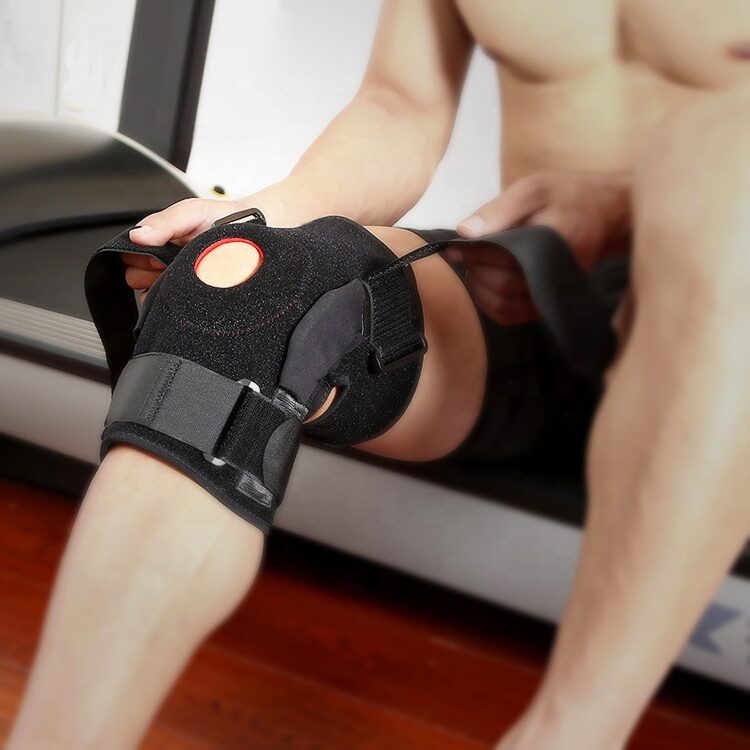
- Put the brace on while sitting, with your knee slightly bent (around 10–15 degrees).
- Position the opening of the brace so your kneecap sits right in the centre of the cut-out.
- Check that the hinges on both sides are aligned with the natural pivot point of your knee — you should feel them sitting alongside the joint itself, not in front or behind.
- Fasten the straps from the bottom up, adjusting each so the brace is secure but not restricting. A good guide: you should be able to slide two fingers under the strap. If you feel pins and needles, numbness, or throbbing, it’s too tight.
How long to wear it
There’s no single “correct” wear time — it depends on your injury, your activity level, and the stage of your recovery. A practical approach is:
- During early recovery: wear the brace for any weight-bearing activity — walking, standing, stairs. Take it off when you’re resting at home and letting the knee breathe freely.
- As healing progresses: you may find you need it mainly for longer walks, sport, or work tasks that put more demand on the knee.
- Consider taking it off to sleep unless a clinician has advised otherwise. At night, the knee isn’t weight-bearing, and the skin will benefit from a break.
The guiding principle is simple: the brace is there to support you during activities that stress the knee. When you’re stationary, it isn’t doing much work.
What to expect while wearing it
A knee brace can feel unfamiliar at first. The sensation of the hinge against the side of your leg, the firmness of the straps — most people take a few days to adjust. That’s completely normal.
It also helps to be realistic about what the brace is and isn’t. It doesn’t repair tissue — it creates the conditions under which tissue can repair. Some people feel an immediate sense of relief, simply because the knee no longer feels as though it might give way. That’s a genuine benefit: when you trust your knee, you move more naturally, and movement is what keeps muscles working and healing on track.
At the same time, the underlying pain and weakness take weeks — sometimes months — to improve, depending on the injury. This is not a sign the brace isn’t working. It’s how musculoskeletal healing works. The brace holds the joint steady while the body does its slower, deeper work of repairing tissue and rebuilding strength.
If the brace causes new pain, numbness, or leaves marks that don’t fade, stop using it and seek professional advice.
When to seek professional help
A knee brace is not a substitute for a diagnosis. If you’ve injured your knee and aren’t sure how serious it is, it’s always worth having a GP or physiotherapist assess you first. This is especially important if:
- You heard a pop or a snap at the moment of injury
- You can’t put weight through the knee without significant pain
- Your knee is visibly swollen, or looks different compared to your other knee
- Your knee locks, or won’t straighten fully
- The knee feels extremely unstable, or gives way repeatedly
- You have new or unexplained symptoms that aren’t settling with rest and support
These signs suggest the injury may need more than conservative support. A professional can identify what’s actually going on and direct you to the appropriate treatment — whether that’s a management plan built around bracing and exercise, physiotherapy, or further investigation.
If you’re already under a clinician’s care, follow their advice on how to integrate the brace into your rehabilitation. The brace supports healing; it doesn’t replace the strengthening and movement work that brings you back to full function.
Moving forward
Your knee carries you through every step of your day. When it doesn’t feel reliable, everything else becomes harder — daily tasks, training, the activities that keep you healthy and connected to the things you enjoy.
A hinged knee brace won’t undo an injury overnight, and it won’t replace skilled assessment and rehabilitation. What it does is provide dependable, structural support while healing happens: taking strain off damaged tissues, giving you confidence to keep moving, and protecting the knee from the forces that would set recovery back.
The right size, the right fit, and consistent, sensible use — that’s the path back to stable, pain-free movement.
Disclaimer
This information is general guidance and is not a substitute for individual medical advice, diagnosis, or treatment. If you are unsure about your symptoms, have a more complex injury, or notice new or unexplained symptoms that do not settle, speak to a GP or physiotherapist. Results vary from person to person, and no guaranteed outcome is implied.
2 Reviews For This Product
Fast & Secure Checkout Through Paypal
Pay with Paypal the secure payment gateway that accepts all credit and debit cards. Paypal is free and secure and no credit or bank information is ever stored or shared with us.
Fast Dispatch
Enjoy your items soon with quick dispatch via Royal Mail. Expect to have your items between 1-3 working days for domestic orders. 7-10 Working days for international orders.
Return Policy – 30 Day Money Back Guarantee
In the unlikely event, you are unhappy with your purchase you can return it within 30 days for a refund. Please contact us via the form on the contact us page to start your return.
To return an item please send it to: Nuova Health UK, 81 Highfield Lane, Waverley, Rotherham, S60 8AL. Please include a note with your order id so we know who to refund. Please retain your postage receipt as proof of postage. All that we ask is that the item is in the original packaging and unused.
by Josh
Took a little bit of adjusting to get it to fit right but this is definitely a quality knee brace that has provided me a lot of much needed support!
by Naved Siddi
Great product! However the description states the (max) circumference of a medium is 48cm… but Iv found it to be a bit less than that up to a max of 37-38cm although I might be putting it on wrong. The knee brace itself fits rather comfortably and the opening behind the knee does allow for easy bending of the knee. Overall a very good knee brace that provides plenty of support and compression.