
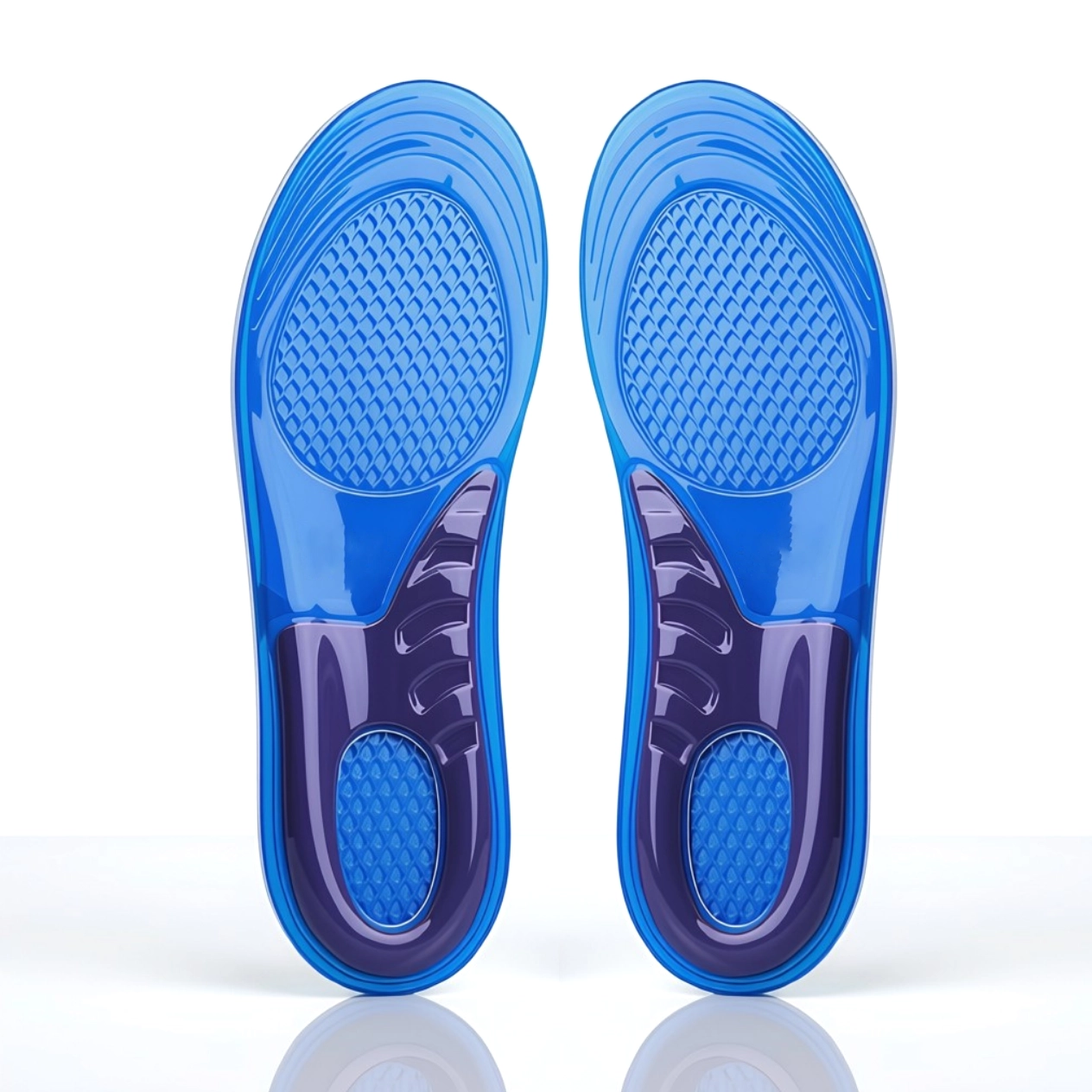
Gel insoles for flat feet
£10.99inc VAT
- Full-length silicone gel insoles for heel pain, arch ache, and the bruised feeling under the ball of your foot.
- Made for the pattern that is worst on the first steps of the morning and eases as you move, and for feet that roll too far inward or too far outward.
- They hold a collapsing arch up while you stand, or cushion the landing if your arch is already high and rigid. Either way they keep your heel centred, and spread pressure across the whole front of your foot.
- Silicone gel instead of foam, because gel springs back. The cushioning in month six is close to day one, where soft foam flattens within weeks and supports nothing.
- Two unisex sizes, trimmed to fit with scissors. The cut line is printed on the toe of each insole.
- Fits anything with a flat inside: trainers, work boots, safety boots, dress shoes, hiking boots. Not open footwear, and not over a moulded footbed.
- Start with an hour or two and add roughly an hour a day. Most people are wearing them for full shifts within two weeks.
- Wear them daily, not only on the bad days, and give it three weeks before you judge it.
- Check with a clinician first if your pain is worse when you are off your feet rather than on them, if it wakes you at night, if it started suddenly after an injury, or if you have diabetes, reduced feeling in the feet, poor circulation or inflammatory arthritis.
- Full-length silicone gel cushioning
- Medium-firm gel: holds its shape under a standing foot, still gives on impact
- Semi-rigid support shell under the arch, heel to just behind the ball of the foot
- Moderate-depth heel cup that keeps the heel centred and the ankle in line with the shin
- Honeycomb gel under the heel, compressing further than a solid block
- Soft suede-style top cover, comfortable against bare skin
- Low profile, grips the inside of the shoe on its own, no adhesive needed
- Trim-to-fit toe, with the size guide printed on each insole
- Check with a clinician first if: your pain is worse when you are off your feet rather than on them, if it wakes you at night, or if it started suddenly after an injury.
What these insoles are, and who they suit
Gel insoles for adults, made for feet that hurt when your weight is on them. They’re thin enough to go into shoes you already own, so you can wear them in the footwear you have rather than buying something new before you know whether they’ll help.
If your heel is sore, your arch aches after a long stand, or the ball of your foot feels bruised, that’s the kind of pain they’re built for. So is a foot that rolls too far inward with every step — the arch giving way under your weight and staying down — or the opposite, a foot that barely rolls inward at all and ends up taking its load along the outside edge. Both put a narrow part of the foot under more load than it handles well, and both ease when that load is shared out differently.
For most adults there’s nothing to sort out before buying a pair — you can wear them and judge for yourself over a few weeks. A handful of situations are different, and those are worth a clinician’s view first: if anything has reduced the feeling in your feet or the circulation to them, or if you’ve had foot surgery or a foot ulcer, have the foot checked before you start.
How it starts, and what it starts to take
The first steps of the day
The first steps out of bed are usually the worst. You put your heel down and something sharp and hot shoots up through the arch. Many people walk on the outside edges of the foot until it eases. By the time you reach the bathroom, most of it has gone.
Sharp pain that fades is easy to put down to how you slept. That’s part of why so many people leave it alone for a year, then two, before ever getting it looked at. The quick fading feels like proof it’s clearing up. It isn’t. The first few steps have stretched the tissue out again, and the same shortened band will meet the same stretch tomorrow morning.
As the day goes on
Once the morning has passed, the pain shifts. The sharpness goes. What turns up in its place is a heavy ache under the heel and across the middle of the foot. It often arrives partway through the day, and you notice it most when you catch yourself shifting your weight from one leg to the other. A long stand in a queue, a spell on your feet around the house, a walk around a supermarket on a hard floor — these are what bring it on, rather than the first hour out of bed. Stairs going up are often fine; it’s coming down that hurts, when your full weight goes through the foot as it lowers you onto the step below. By evening your feet feel swollen even when they don’t look it, because fluid gathers in them over a long day on your feet. Taking your shoes off helps for about ten minutes, and then the ache reappears somewhere slightly different.
The reason it builds rather than arriving with the first step is the length of time under load, not any single step. A handful of steps puts a small tug through the heel. A whole day of them, with the arch never coming back up between them, leaves the tissue carrying weight hour after hour with no real chance to reset.
What it starts to take
Longer walks get cut short. You turn down a day out because you know the first hour will be fine and the third will not. You find yourself wanting to sit down more and more as the day goes on. And shoes become a problem of their own: the pair that fitted in the morning feels tight by evening, because the foot has swollen through the day. And the next size up just rubs somewhere else.
None of this is dramatic on its own. What changes is how much walking a day can take.
The planning around it
Then there’s the planning. How much walking is in today? Can the shopping be done in one outing, or is it easier split into two shorter ones? Stairs or lift? Do you need the shoes that look better today, or the ones that are kinder to your feet? None of it takes long, and it rarely comes up in conversation.
You can keep arranging your day around the pain, or you can work out what your foot is actually doing and change it.
Why your foot hurts
Before you decide what to put in your shoes, it helps to know what your foot is doing with every step it takes.
What happens with every step
Take a normal step and four things happen in order. Your heel lands, and your foot rolls inward a little to absorb the impact. Your arch — the curve that runs along the inside of your foot — flattens under your weight. Your foot stiffens into a platform to push off from. Then your heel lifts, your toes bend at the joints where they meet the foot, and your foot leaves the ground. The whole sequence repeats thousands of times a day.
Most of the work in that sequence belongs to your arch, and it isn’t a fixed shape. It’s a group of bones held together by ligaments and tendons — ligaments binding bone to bone, tendons joining muscle to bone. Both stretch and spring back. The arch is built to change shape under your weight and then come back up, and it’s those cords that do it: they store energy as the arch flattens and release it as the foot pushes off. That’s a large part of why walking is normally comfortable.
The give and return is the whole point. Your arch takes the landing so the rest of the foot doesn’t have to, then returns the energy as you push off, which lowers the cost of the step. When that cycle works properly, your heel, your arch and the ball of your foot each take their turn under load and pass it on. No one spot carries it long enough to become sore.
The plantar fascia and the arch
A thick band of tissue called the plantar fascia runs along the underside of the foot, from the heel bone forward to the base of the toes. It holds the arch under tension, stretching and recoiling in the same rhythm as the tendons around it.
It does something else at the end of each step. As your toes bend back before the heel lifts, they wind the band a little tighter, and that tightening firms the middle of the foot so it can take your weight as you push off, rather than letting it give way. So at that moment the band is doing two jobs at once: holding the arch up, and stiffening the middle of the foot for the push-off.
When the arch works properly, the fascia takes the weight for a fraction of each step and then releases. Short bursts are what it’s built for.
Not every arch holds up equally well. Some feet are built low from the start. In others, the arch holds fine for years and then slowly loses height under decades of standing and walking. Either way, the mechanics are the same once the arch stops holding through the stance phase — the part of each step when your foot is flat on the ground and taking your full weight. That’s what people mean by flat feet: not a single condition, but the point at which the arch stops holding under load.
When the arch stops holding
When the arch doesn’t hold, the step goes wrong at that second stage. Your foot keeps rolling inward past the point where it should stop. The bones in the middle of your foot drop, and stay dropped for the whole of the stance phase. Your arch lengthens and the middle of your foot sits lower. Neither comes back up between steps, so each new step begins with the arch already lowered.
With the arch no longer holding the foot up, the plantar fascia and the ligaments that bind the bones of the arch together carry more than they comfortably can. They stay under tension for hours instead of fractions of a second, and tissue that carries weight without a break doesn’t recover the way it does between steps. The band also ends up stretched in one direction rather than keeping its give-and-return rhythm, and that steady pull gathers under the heel end of it, where the tissue is fixed to bone. Irritation builds through the day instead of clearing. That’s irritation rather than injury — the tissue is being asked for more than it can comfortably give, not torn.
Why mornings are worst
This is what makes those first steps the hardest. Overnight the foot sits still for six or seven hours. The arch relaxes, the fascia shortens, and the tissue loses some of its stretch. The first step of the day pulls on it before it’s warmed up, and that’s the sharp pain. Extra time in bed doesn’t change it; the first step tomorrow will feel much like the first step today.
Why hard floors make it worse
Where you walk changes this as much as how far. Concrete and tile give almost nothing back, so the landing force goes into your foot instead of the ground. Your heel takes that force first, every time, and your arch has to absorb it on top of holding you up. On a softer surface, some of that force is taken by the ground under you; on tile, none of it is. By late afternoon it shows up as heaviness rather than a sharp pain.
How it travels up the leg
The inward roll doesn’t stop at the foot. Your foot rotates inward, and your lower leg rotates with it, turning your knee slightly with it. That pulls the kneecap a little off its usual track. Higher up, your thigh turns with the leg and your pelvis tilts, so your lower back takes the strain. Many people with flat feet end up with knee ache, tight hips, or a lower back that stiffens by the afternoon. Those areas are taking the strain from the rotation, not showing a problem of their own — it starts at the foot, and everything above it follows.
It’s the same walk done day after day that builds this over months. Your lower leg returns to its usual position once your foot leaves the ground, so your leg isn’t left rotated when the step ends. What builds is the repetition — the same pull on the same structures, thousands of times a day, over months and years.
Where it hurts, and why it lasts
Why the heel hurts first
The heel is the first part of the foot to meet the ground on every step, and it takes the whole of your body weight at a moment when nothing else is carrying any of it. That’s the steady, general soreness, rather than the sharp stab of the morning’s first step.
It’s also where the fascia is anchored, and where it’s pulled hardest. With your arch dropped, every step tugs on that attachment at the base of the heel bone, on the inner side of the heel. That tug, repeated thousands of times a day across the same spot, is what keeps the ache under the heel rather than somewhere further forward.
Why the ball of the foot hurts next
The fat pad under the ball of your foot is what takes the pressure off the front of the foot. It sits beneath the ends of the long bones that run down your foot to your toes — the metatarsal heads — sharing load between them. When your arch drops, those bones splay wider than the pad can cover, so the joints underneath take the weight directly instead of through the pad. That’s the burning, bruised feeling.
It also explains why standing still can hurt more than walking. Walking moves the weight from foot to foot; standing leaves it where it is. In a queue or on a long shift, the same small area under the ball stays loaded for the whole stretch.
Why it keeps coming back
None of this clears up on its own, though most people expect it to. Tissue adapts to the load it’s under, but the load doesn’t change on its own, and the foot doesn’t correct its own position with rest. Instead, the foot and leg fall into a different way of moving — onto the outside of the foot, or with the toes turned out. Each adjustment takes strain off one spot and puts it onto another, so the soreness shifts around rather than easing in one place.
The irritation itself is the part that comes and goes. Irritated tissue calms down with rest — an evening off your feet, a quiet weekend — which is why the pain can disappear for a while and feel like it’s on the mend. What rest doesn’t do is change the weight going through your foot. The same irritation returns as soon as you’re back on your feet that long.
When the foot barely rolls inward
If your feet have always been high-arched, the soreness shows up in different places. It tends to sit along the outer edge of the foot, under the heel from repeated hard landings, or it climbs the outside of the ankle. Nothing about it feels like the foot might give way. The foot feels stiff, and it doesn’t give much on landing. It hurts in a way that builds quietly rather than stabbing first thing.
With this kind of foot, the arch stays high and rigid right through the step. Instead of flattening to take the landing, it keeps its shape and passes the force straight on. The outer edge of the foot carries most of the weight, and the heel lands hard, because nothing on the way down is giving.
A high arch flexes less, so it absorbs less. The impact that a springier foot would have soaked up and returned arrives with nothing taking the edge off it, again and again with every step. On a hard pavement or a sloping path — going downhill especially, where the load pushes forward and out towards the outer edge — the foot gets even less chance to soften the landing. That’s why the soreness crops up where it does.
This isn’t the same problem as a collapsed arch. Nothing needs lifting, because the middle of the foot is already high. What’s missing is give — the arch isn’t doing its share of cushioning the landing, so the impact arrives at the heel and the outer edge at full force.
So the load ends up in the wrong place for opposite reasons. One foot gives way and can’t come back; the other stays put and lets the landing pass straight through. Support helps both, but each leans on a different part of it. A dropped arch needs holding up. A high, rigid arch doesn’t need holding up at all — it needs the landing softened and the heel kept steady as it comes down.
What good support has to do
Four things make the difference between an insole that helps and one that doesn’t. How much each one counts depends on your foot. If your arch has dropped, the most important thing is holding the arch up. With a high, rigid arch, the two that count most are absorbing the impact at the heel and keeping the heel steady.
Holding the arch up comes before padding it. Cushioning under a collapsed arch does nothing, because the problem is position, not hardness. Something firm has to sit under the arch and fill the gap, so the middle of your foot can’t keep dropping. Without that, you’re softening the symptom and leaving the cause alone.
Holding the heel in place comes next. A heel that’s free to roll side to side takes the whole foot with it, and the inward roll carries on no matter what’s under the arch. Your heel needs to sit in a shaped cradle, so it stays where it’s put and your ankle stays in line with the shin above it. Hold the ankle steady and your lower leg has no reason to rotate, which means nothing above it gets pulled along either.
Then there’s absorbing impact at the heel. Your heel meets the ground first and hardest on every step. Whatever sits under it has to give and spring back rather than pass the force straight up your leg. What absorbs the force is the material springing back, not the material being soft. A pad that goes flat and stays flat has nothing left to spring back with.
Finally, there’s the weight going through the ball of the foot. The ball needs something under it that spreads pressure across the whole width, instead of letting it concentrate under two or three points. Without that, the pain simply moves forward and one set of sore spots replaces another.
How the other options compare
Soft foam compresses flat within weeks and does nothing to hold the foot in place, so it can’t lift an arch or hold a heel — the two things that make the biggest difference.
A plain cushioning insert with no structure underneath does the same, and often adds a problem of its own by lifting the heel without supporting the arch. That changes the angle of the foot without doing anything about the collapse.
A rigid orthotic — a firm, moulded insert built to hold the foot in a fixed position — does control position, but with no give at all. It feels unyielding under the arch, and plenty of people can’t wear one for a full day.
A custom orthotic comes from a podiatrist, the clinician who specialises in the feet and lower limbs. It’s made from a cast of your feet, so it’s shaped to them exactly, in a way no off-the-shelf pair — bought ready-made rather than made for you — can match. It costs time as well as money: an appointment, a wait, and a price several times higher. For a foot that’s gone markedly out of shape it’s often the right choice, and off-the-shelf support won’t be enough. For a mild to moderate flat foot, or a foot that rolls too far inward or outward, an off-the-shelf pair that meets those four requirements is a fair compromise: less exact, but much cheaper and available now.
How these insoles do it
This pair is built to cover all four jobs, with each part doing its own share — and one part doing a different kind of job altogether.
The gel that cushions and holds
The core material is a silicone gel, and it sits in the middle of the firmness range. A very soft gel feels fine for the first week and then flattens under the weight of a standing foot, so you end up with nothing between your foot and the shoe. A very firm gel supports but doesn’t cushion, and feels hard underfoot. This one is firm enough to keep its shape under a standing load, and soft enough to give on impact. That balance is what lets one material cushion the landing without losing its shape.
Silicone does something most foams can’t. Squeeze it and it comes back to its original shape; foam crushes down and stays crushed. That’s what keeps the cushioning working between steps, and it’s why the cushioning in month six should be close to the cushioning on day one.
The gel runs the full length of the insole as a single layer, rather than sitting in separate cushioning points. Nothing is glued on top of it or slotted in underneath, so there’s nothing that could work its way out of position. The support under the ball of the foot is the gel itself, shaped to spread load across the whole front of the foot instead of concentrating it under one spot. A wider contact area eases the burning, because pressure is shared across the front of the foot rather than landing on a few of the bones. On a shift where you’re mostly standing still — a counter, a checkout, a factory line — that wider contact keeps working for every hour you’re on your feet, not just for the steps.
Over the first few days, your body heat and your weight let the gel flow slightly, so it takes the imprint of your foot under load and springs back to its own shape when the weight comes off. That’s why the fit improves with use without the insole wearing out.
If your arch is high and rigid, there’s nothing to prop up — the middle of the foot isn’t dropping. What the arch isn’t doing is absorbing the landing, and the gel takes that on instead, spreading the impact across a wider surface than a rigid foot manages on its own. The heel cup does the other half, keeping the ankle from drifting as it lands.
The shell that holds your arch
Underneath the gel is a semi-rigid plastic shell, and this is what holds the foot in position. It keeps its shape under your weight instead of flattening, which gives the arch something firm to sit against. With that support underneath, the plantar fascia isn’t stretched and left that way all day; it gets its slack back between steps, which is how it’s meant to work.
The shell extends from the heel forward to just behind the ball of the foot. It follows the inside line of the arch instead of sitting as a flat plate across the full width. That’s the shape that supports the arch, rather than simply cushioning beneath it.
The three-quarter length changes what happens at push-off. Because the shell stops behind the ball of the foot, the toes bend at the joint where the foot normally flexes as the heel lifts and you roll forward. A full-length shell would hold that whole section rigid. Under the ball of the foot the gel carries on alone, so the front of the foot gets cushioning without being locked in place.
The heel cup and the shock pad
The heel area works in two ways. The first is holding the heel still. The cup is shallow enough to stay comfortable through a long shift and deep enough to keep the heel in one place, and the gel around it moulds to the shape of your heel, so the heel sits cradled rather than resting flat.
A deeper cup wraps higher around the heel, and its rim ends up against the sides of the heel, where there’s only a thin layer of tissue over bone. Held there for a full shift, with the foot moving slightly inside the shoe on every step, that patch turns sore. This one holds the heel in place without pressing in at the sides.
The second is impact absorption. A honeycomb structure in the silicone gel sits under the heel, made of the same material and the same thickness as the rest of the insole. The cell pattern gives the gel more room to compress and spring back than a solid block would, so more of the shock from the landing is absorbed and a little energy returns to the step instead of travelling up your leg. Some people notice a soft give under the heel with each step for the first few minutes, then stop feeling it. Because the pad sits flush with the surrounding gel, there’s no raised platform under the heel, and the height your heel sits at inside the shoe doesn’t change. The shoe fits the way it did.
The top cover where your foot sits
The top cover isn’t one of the four jobs. It’s the surface your foot rests on — the layer you see and touch when you take the insole out of the shoe. It does nothing to hold the arch, steady the heel or spread load. What it does is make the pair comfortable enough to keep in your shoes, and that’s the difference between an insole that works and one that stays in the box.
The surface is a soft suede-style fabric. It feels comfortable against bare feet, so you can wear the insoles without socks. It reduces friction, which is a large part of what causes hot spots — the sore, hot patches that come up before a blister — and blisters over a long day, particularly if you’re walking rather than sitting. It also breathes, which stops the foot sitting against a sealed surface for hours. Over a long shift that difference is felt: a foot held against something that doesn’t breathe stays warm and damp, and damp skin softens and rubs more easily than dry skin. Because the layer is breathable, the foot underneath stays cool rather than warm.
A cover you notice, or a shape that presses somewhere, is the usual reason a pair ends up left at home.
Which shoes hold them properly
Before you trim anything, work out which shoes the insoles can go in. Sorting that first means no pair gets cut for a shoe that won’t take them.
The insole needs a flat surface inside the shoe, and no existing arch support underneath it. If your shoes have removable insoles, take them out first; leaving them in place raises the foot and squeezes it. If the inside is already flat, the insoles will sit correctly as they are. If there’s a built-in arch bump, or a moulded footbed — the shaped insole that comes fixed inside many trainers — the insole won’t sit flush and that shoe isn’t suitable.
They work in enclosed footwear: trainers and walking shoes, work boots, safety boots, casual shoes, loafers, dress shoes and hiking boots — anything with a flat interior and enough structure to hold the insole in place. Open footwear isn’t suitable, because there’s nothing to keep the insole positioned, and shoes with very little depth or a steeply raised heel won’t hold them properly.
Getting the fit right
Two unisex size ranges are available. Because foot length and shoe width vary so much, the insoles arrive slightly oversize and are trimmed to fit. A size guide is printed on the toe area of each insole, showing where to cut.
Put the insole into a shoe you’ve already confirmed will take it, and check where your toes sit against the printed guide. Cut along the line that matches your size, using sharp scissors. Check the fit, then trim again if needed, a small amount at a time. Trim the toe only; leave the heel end as it is. Any trim is permanent, so cut a little, test the fit and cut again, instead of cutting to the line in one go. You can trim again later if you change shoes or find a better fit.
Because the insoles are thin, they add almost nothing under the foot, and a shoe that already fits well keeps fitting well. The silicone gel grips the inside of the shoe by itself, so there’s no adhesive to apply and nothing to peel. They don’t slide forward, bunch up or shift during the day. If only one foot is painful, you can wear a single insole, though most people find wearing them in both keeps your weight balanced between the two feet.
Where they help most
With the right shoes sorted, the situations where they make the most difference have three things in common: long spells on your feet, a lot of walking, and a hard surface underfoot. A hospital corridor covers all three. So does a shift on a hard floor in a large building — a lobby, a shop, a warehouse. Long days in safety boots, or hours on a factory floor with nowhere to sit, build the same load through the day. What makes a day heavy is the number of hours on your feet as much as the distance covered. A long shift can build more load through the day than a short walk does.
Away from work the same load builds on a long walk, a hike, or a full day out with a lot of time on your feet. Running works with them too — the same support and shock absorption apply, just with more force arriving through the heel and the ball of the foot on each stride. Cycling loads the foot through the pedal rather than the ground, but the support under the arch still does its job.
Starting to wear them, and what to expect
On any single step the change is small. The load arrives and leaves much as before, except that it lands on a surface that gives slightly and holds the middle of the foot up. That’s why the first step in a new pair can feel like nothing has changed. You aren’t adding cushioning to a foot that’s coping fine; you’re taking load off structures that have been carrying too much of it. The difference shows up over a day, and then over weeks.
Across a day it adds up. Without support, load builds from morning to evening and the next morning starts stiff. With the arch held, every hour is an hour of less load, the evening arrives with less to carry, and the morning is easier to start.
None of that happens instantly. A heavy day still leaves the foot more tired than a light one.
Some people put them in and forget about them. Others need a short adjustment period, because the arch is being held higher than the foot is used to. Nothing is being forced, but the position is different from what your foot has been doing.
Start with an hour or two on day one and add roughly an hour a day after that. By the end of the first week you should be managing most of a normal day, and by the end of the second, full days including work shifts.
Some people feel a difference within the first few hours, particularly in the heel. Others notice it at the end of the day instead of the start, as feet that are tired, not painful. Both are normal, and noticing it at the end of the day is often the better sign, because it means the whole day is being handled differently, not just the first moment of it.
Two things adapt at different speeds — the gel and your foot. The gel takes on the shape of your foot fairly quickly, usually within the first week, and that part is done. Your foot takes longer, because tissue that’s been under constant load needs several weeks of reduced load before it starts to calm down. That’s what makes the first steps easier.
Give it three weeks of regular wear before deciding whether it’s working, and judge it by the week as a whole rather than by any one morning.
If the discomfort is more than just getting used to the arch sitting higher, take them out, cut the hours back and build up more slowly. If the discomfort continues after that, stop and get the foot looked at.
If you stop wearing them
The support lasts as long as you keep them in. Take them out and the foot goes back to the load it was under before, so the symptoms that eased tend to return over the following weeks.
Some people find they only need them on heavy days, standing shifts or long walks, and can go without on lighter ones. Either approach works, but the improvement you noticed lasts as long as you’re wearing them.
Looking after them
They can be moved from one pair of shoes to another, which is useful if you have one pair for work and one for everything else. Pull them out, put them in the next pair, and they grip the same way. Left and right are marked on each insole, so the pairing is straightforward.
Rinse them by hand with warm water and a mild soap, using a cloth or a soft brush. Don’t put them in a washing machine or a dryer. After washing, pat them dry and let them air dry away from direct heat, sunlight or a radiator, since heat will distort the shell and degrade the gel. Overnight is usually enough.
How long they last
Like all insoles, they wear over time, and the gel slowly loses some of its spring. Silicone holds up far better than foam, but no insole lasts forever. How long a pair lasts depends on your weight and how many hours a day they’re in a shoe.
Replace them when they stop feeling supportive, or when the arch starts to feel flat under your foot again. Most people leave them in their shoes, which keeps them where they should be. If you do take them out, keep them flat and cool, not folded or squashed under anything.
When to check with someone first
These insoles are a foot care product, not a medical device, and they’re no substitute for a diagnosis. They address mechanical load — the physical forces passing through the foot with every step — which is behind a large share of everyday foot pain. When the cause is something other than mechanical load, an insole isn’t the right answer, and wearing one can put off the assessment that would help.
Two questions are worth settling before you buy. Are you the right person to manage this at home, or would it be better to have the foot looked at first? And is what you’re feeling the kind of pain that responds to support, or something else?
The situations worth checking all come down to one thing: how reliably the foot can tell you when something is going wrong. When the feeling in your feet is reduced, a problem can develop without you noticing it, and it helps to know what the foot looked like before you start managing it at home. Poor circulation works the same way — tissue without a good blood supply doesn’t heal the way it should, so a small problem is worth catching early. A foot that’s had surgery or an ulcer on it has less margin for error than one that hasn’t.
None of this means the insoles are likely to do harm on their own. It means the foot is worth assessing before you decide how to look after it. The same applies if you take medication that affects the feet, or if you have inflammatory arthritis, such as rheumatoid arthritis.
Whether the pain responds to support usually comes down to how it behaves. Pain that’s worse on the first steps and eases as you move is what you’d expect when the problem is mechanical, and that’s exactly what this product is designed for. Pain that behaves differently — worse when you’re off your feet, worse at night, or starting suddenly after an injury — needs assessment, not an insole.
Stop using the insoles and speak to a podiatrist or GP if you develop a wound, blister or sore that isn’t healing, or if you notice new numbness or tingling. Do the same if you lose feeling in any part of the foot, or if pain that was in the foot has clearly moved into the ankle, knee or hip. If you’ve been wearing them consistently and nothing has changed, or things are worse, treat that as a sign to get the foot assessed rather than trying different insoles.
If you’re already under the care of a podiatrist or physiotherapist, mention these insoles to them. They can be worn alongside most other foot treatments, and in many cases the combination works better than either on its own. Your clinician can tell you whether what you’re feeling is the kind of problem support would be expected to help with, or something that needs a different approach.
What to do now
Put the insoles in, trim them to size, and wear them through the shift, the walk or the long stand.
The people who get the most out of them put them in every morning rather than saving them for the bad days. Consistency is what changes things — a pair worn through the good days and the bad ones takes the load off far better than a pair kept back for the worst of them.
Important information
This is general guidance about how the foot and the structures around it typically behave, and what an insole of this type can and can’t do. It isn’t a substitute for individual medical advice, diagnosis or treatment. If you’re unsure whether these insoles are right for you, or if you have new, unexplained or more complex symptoms, speak to a GP, physiotherapist or podiatrist for advice that fits your situation. No specific outcome is guaranteed.
3 Reviews For This Product
Fast & Secure Checkout Through Paypal
Pay with Paypal the secure payment gateway that accepts all credit and debit cards. Paypal is free and secure and no credit or bank information is ever stored or shared with us.
Fast Dispatch
Enjoy your items soon with quick dispatch via Royal Mail. Expect to have your items between 1-3 working days for domestic orders. 7-10 Working days for international orders.
Return Policy – 30 Day Money Back Guarantee
In the unlikely event, you are unhappy with your purchase you can return it within 30 days for a refund. Please contact us via the form on the contact us page to start your return.
To return an item please send it to: Nuova Health UK, 81 Highfield Lane, Waverley, Rotherham, S60 8AL. Please include a note with your order id so we know who to refund. Please retain your postage receipt as proof of postage. All that we ask is that the item is in the original packaging and unused.
by James
Just what I was looking for! Helped sort out my feet, good quality and were fast to deliver 🙂
by Sammy
These are very good quality and great for easing foot pain. Thanks!
by Phillip
Started wearing these insoles because I was getting pain in my shins. Since wearing them both my shins and feet feel great no matter how long im stood around on my feet for