
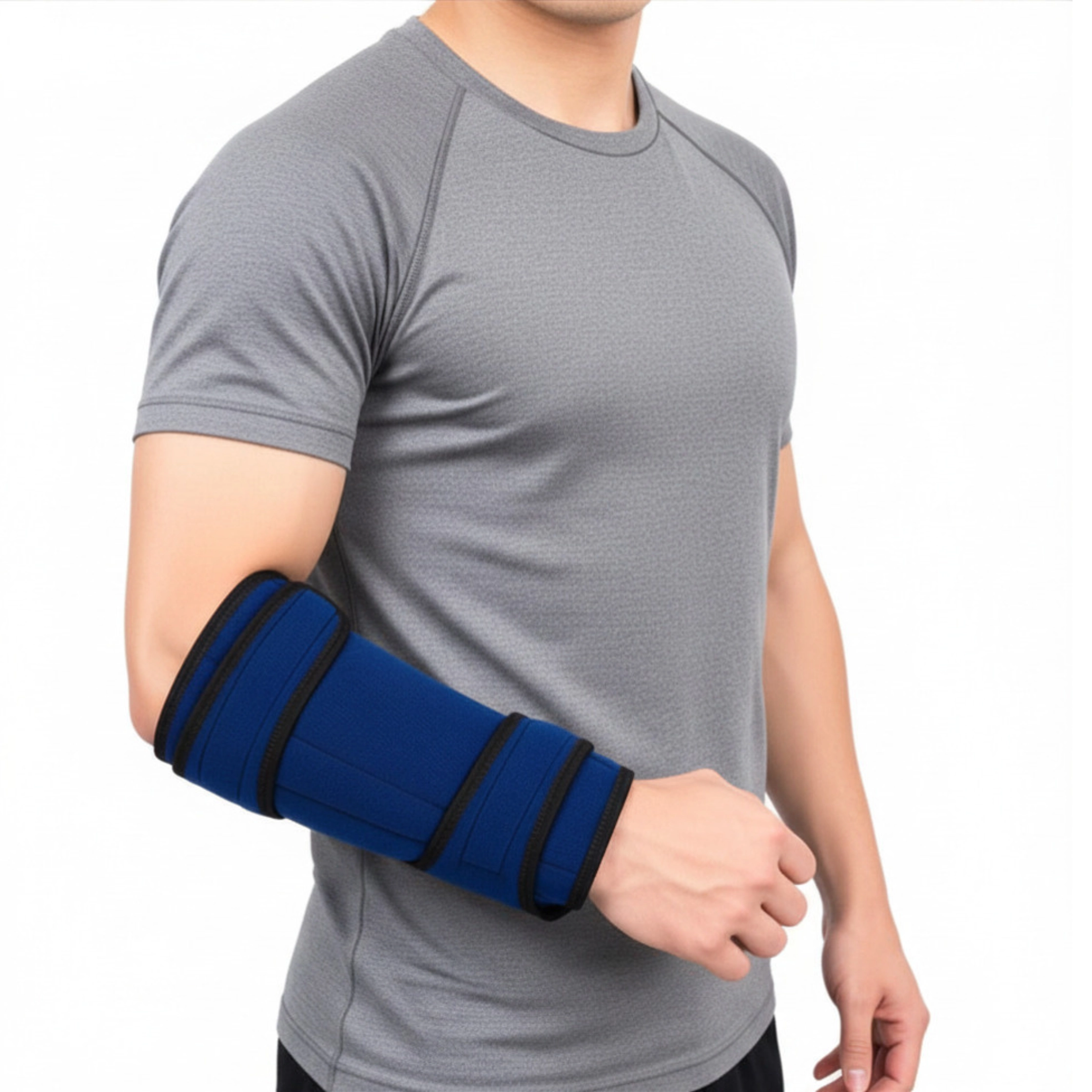

Forearm Brace
£10.99inc VAT
- Long NuovaHealth forearm brace designed to support forearm, wrist and some elbow‑related problems by limiting painful bending and twisting and providing firm, even compression.
- One size fits most adults (brace length approx. 23 cm), suitable for left or right arm, with two adjustable hook‑and‑loop straps to hold it securely in place.
- Rigid dual splints on both sides help steady the wrist, forearm, and, when positioned higher, the elbow, protecting sore or healing tissues during work, sport, daily activities, and post‑cast or post‑operative phases.
- Commonly used to help manage forearm and wrist sprains and strains, longer‑term tendon and joint problems (including patterns often called tennis elbow and golfer’s elbow), and nerve‑related issues around the wrist and elbow such as Carpal Tunnel Syndrome and Ulnar Tunnel Syndrome.
- Provides firm, comfortable compression to help control mild swelling, support soft tissues, and give a stable, “held” feeling that can make everyday tasks and rehabilitation exercises more manageable.
- Made from lightweight, padded, skin‑friendly and breathable materials with moisture‑wicking properties, so it can be worn for several hours at a time at work, during training, or overnight, as advised.
- Can be positioned closer to the wrist, centred on the forearm, nearer the elbow, or spanning the elbow (when recommended by a clinician) to target support where you need it most.
- Backed by NuovaHealth’s 30‑day money‑back guarantee.
Forearm Pain: What’s Happening and When Support Helps
Pain in the forearm can make simple hand and wrist movements surprisingly difficult, and over time that can be understandably frustrating. Whether you’re opening a jar, typing for long periods, or playing a racket sport, that persistent ache or sharp pain can turn everyday arm movements into something you have to think about.
There are several common reasons the forearm area becomes painful — from overuse and minor strains to tendonitis, carpal tunnel syndrome, or arthritis. If you notice a combination of aching, sharp pain with certain movements, or numbness that wakes you at night, the sections below explain what may be happening and how a forearm brace can support recovery.
Problems affecting the forearm, wrist, or elbow usually fall into three main groups: repeated use that strains muscles and tendons, a single injury affecting bone, ligaments, or soft tissue, and underlying joint or nerve issues that make the area more sensitive.
Each structure in the forearm produces a characteristic type of pain, which helps explain why it hurts and how the right support can make daily movement more comfortable.
How Forearm Pain Feels in Daily Life
Many people notice:
- A dull ache or tightness along the front or back of the forearm that worsens with use.
- Sharp pain near the elbow or wrist, especially when gripping or turning the palm.
- Discomfort or fatigue during repetitive hand or wrist tasks such as typing, using tools, or sports that rely on gripping.
- Stiffness or aching after periods of rest that eases slightly when you start moving, then builds again with heavier use.
- Tingling, numbness, or burning in the thumb, fingers, or along the little‑finger side of the hand, particularly at night or when the arm is bent.
Generally, different sensations often point to different structures:
- A deep, localised ache and stiffness often relate to joints and cartilage.
- Pulling or tight pain with movement usually comes from muscles or tendons.
- Shooting or electric pain, numbness, or weakness often suggest nerve irritation or compression.
Inside the Forearm: How the Structures Work Together
There are two main bones in the forearm — the radius and the ulna — running from the elbow to the wrist. At the elbow they meet the upper arm bone (humerus); at the wrist they connect with the small wrist bones. The joints between the radius and ulna, called radioulnar joints, allow the bones to rotate against each other so the palm can face up or down.
These joints allow three main types of movement:
- Bending and straightening at the elbow.
- Bending the wrist up and down and slightly side to side.
- Turning the forearm so the palm faces down (pronation) or up (supination).
Surrounding the bones is a thick layer of muscle:
- On the front and inner side are the flexor and pronator muscles (such as flexor carpi radialis, flexor carpi ulnaris, and flexor digitorum superficialis). They bend the wrist and fingers and turn the forearm inwards.
- On the back and outer side are the extensor and supinator muscles (such as extensor carpi radialis, extensor digitorum, and brachioradialis). They lift the wrist and fingers and help turn the forearm outwards.
A tendon connects muscle to bone and transmits the pull of the muscle to move a joint. Many forearm tendons run towards the wrist and into the hand, both on the palm side (flexors) and on the back (extensors). Near the elbow, several tendons come together to form:
- A common extensor tendon on the outer (lateral) elbow.
- A common flexor tendon on the inner (medial) elbow.
A ligament is a strong band that connects bone to bone and helps stabilise joints. Ligaments around the elbow, forearm, and wrist help prevent excessive movement and keep joints aligned under load.
Three main nerves travel through the forearm:
- The median nerve passes through a narrow space at the front of the wrist (the carpal tunnel) into the thumb, index, middle, and part of the ring finger.
- The ulnar nerve runs behind the inner elbow (the “funny bone”), then through a canal on the little‑finger side of the wrist into the little finger and part of the ring finger.
- The radial nerve runs along the back and outer side of the forearm, helping to lift the wrist and fingers and supplying part of the back of the hand.
These nerves travel through narrow passages and around bone. Swelling of tendons or joint linings, or keeping the wrist or elbow bent for long periods, can narrow these spaces and increase pressure on the nerves.
Blood vessels run alongside the nerves, supplying oxygen and nutrients. All these structures are enclosed within a firm layer called fascia. As the fascia stretches very little, any extra fluid or bleeding inside the forearm or wrist can quickly raise pressure and irritate nerves, muscles, and tendons.
Why Strain, Overuse or Injury Lead to Ongoing Pain
Forearm pain often develops when the tissues are asked to do more than they can comfortably recover from.
Repeated use
Many jobs, sports, and hobbies involve frequent gripping and wrist movement. The flexor and extensor muscles contract repeatedly, and their tendons transmit that pull to the bones. Each period of activity places small stresses on the forearm muscles and tendons. With enough rest, the tissues repair and adapt. But if the workload is greater than the time available for recovery, small areas of tendon fibre damage and irritation build up faster than the body can repair them.
At first, this may cause short‑term tendon inflammation. If the overload continues, the tendon’s internal structure can change. The collagen fibres, which normally run in parallel, lose their alignment, and the tendon may thicken (tendinopathy). In this state, even simple gripping or lifting tasks can trigger discomfort sooner than before.
Sudden overload
A fall onto an outstretched hand, a direct blow to the forearm, or lifting or catching something unexpectedly heavy can place large forces through the radius and ulna, the elbow and wrist joints, and the surrounding ligaments and soft tissues. This can result in:
- Sprains – overstretching or tearing of ligaments that support joints such as the wrist or elbow.
- Strains – damage to muscle fibres or their tendons.
- Fractures – breaks in one or both forearm bones.
These injuries usually cause sharp pain at the time, followed by swelling and often bruising. Movement at the wrist, forearm, or elbow may become extremely painful or temporarily impossible. The body reacts with inflammation and swelling, and the muscles may tighten to protect the area.
Twisting and rotation
Activities that involve frequent or forceful forearm rotation — such as using tools, turning stiff handles, or swinging a racket or club — place strain on the radioulnar joints and the pronator and supinator muscles and tendons. Repeated or forceful rotation can:
- Stress the joints between the radius and ulna.
- Place pulling forces on the common extensor tendon at the outer elbow and the common flexor tendon at the inner elbow.
- Irritate ligaments that stabilise the forearm and wrist.
Over time, this repeated strain can contribute to conditions such as tennis elbow or golfer’s elbow.
Inflammation, swelling and nerve irritation
Inflammation brings extra fluid into the soft tissues of the forearm and wrist. Because these spaces are narrow, pressure can rise quickly, compressing nearby nerves in passages such as the carpal tunnel, Guyon’s canal, or cubital tunnel, which can also reduce blood flow to nearby tissues.
Why Forearm Pain Often Returns
Once tissues or nerves are irritated, the pain signals can become more sensitive. Movements and loads that were once comfortable may now cause discomfort much sooner. The forearm is used in almost every hand movement, so complete rest is difficult. Even routine movements such as gripping, lifting, or rotating the wrist can repeatedly strain the same irritated tissues.
Previous injuries can leave muscles weaker and slower to respond, joints stiffer, and nerves more sensitive. If work, sport, or hobbies continue to place similar demands on the area without changes in technique, workload, or support, symptoms often flare again. This is why forearm problems often take time to settle unless daily use or support is adjusted.
Because the forearm is constantly in use and under frequent strain, irritated tissues often benefit from both load management and targeted support. Reducing movements that trigger symptoms, easing repeated strain on sore tissues, and providing gentle compression all help recovery. A well‑fitted forearm brace provides this kind of support, and the long NuovaHealth forearm brace is designed specifically for that role.
When To Seek Professional Advice Before Using A Forearm Brace
Before considering any brace, it’s important to be sure that the problem is suitable for the kind of support a forearm brace provides.
Some situations require urgent medical attention instead of a forearm brace. Seek immediate medical help before using a brace if:
- You have sudden, severe pain in the forearm, wrist, or elbow after a fall, accident, or direct blow.
- The arm looks deformed or unusually bent.
- There is rapid swelling or extensive bruising.
- You notice sudden, significant numbness, tingling, or weakness in your hand or fingers.
- Your hand or forearm suddenly changes colour or temperature compared with the other side.
- You have severe, worsening pain with a tight, “solid” feeling in the forearm, pain when you try to gently stretch your fingers, and changes in hand colour or temperature.
These signs may indicate fractures, major soft‑tissue injuries, serious nerve or blood vessel problems, or conditions such as compartment syndrome. In these situations, a soft or semi‑rigid forearm brace is not an appropriate first treatment.
If pain has lasted for more than a few weeks, is affecting your daily life, or is accompanied by milder tingling, stiffness, or weakness, a GP or physiotherapist can assess the area, rule out serious causes, and advise on treatment.
Once serious problems have been ruled out or treated and a clinician has confirmed that the bones and soft tissues are stable, a forearm brace can be one of the tools used later in recovery to support healing and make everyday movement more comfortable.
Is the Forearm Brace Right for You – and How It Fits Into Daily Life
When the Forearm Brace May Help
The NuovaHealth forearm brace is designed for adults with forearm, wrist, or elbow‑related symptoms where extra support and movement control may be helpful. It is designed as one size to fit most adult arms, suitable for either the left or right arm, and long enough to cover most of the forearm so you can choose where along the arm it sits.
The brace is particularly helpful if any of the following apply:
- You have forearm or wrist pain linked to repeated gripping and wrist use at work, during sport, or with certain hobbies.
- You are in the later stages of recovery after a fracture or significant soft‑tissue injury and have been told a rigid cast or splint is no longer needed.
- You experience tendon or joint flare‑ups around the forearm or elbow, such as conditions often called tennis elbow or golfer’s elbow.
- You have nerve‑related symptoms around the wrist or elbow that worsen with certain hand, wrist, or elbow positions.
- Specific tasks – such as longer desk sessions, repetitive manual work, or some training sessions – reliably bring on your symptoms and you want extra support during those times.
When the brace is positioned correctly and the straps are fastened, it should stay in place rather than sliding up or down. To support a different part of the arm, remove the brace, reposition it, and fasten it again.
Using the Brace at Work and During Repetitive Tasks
Work‑related forearm pain is often linked to tasks that involve repeated gripping, lifting, or precise hand control. Prolonged periods of keyboard or tool use, or handling items repeatedly, can all place ongoing strain on the forearm muscles and tendons.
It can be helpful to wear the brace during the longest or most demanding parts of your working day – for example, during prolonged typing or tool use – and remove it for lighter tasks or breaks. When the brace covers the lower forearm and wrist, it can:
- Help keep your wrist near a comfortable mid‑range position – not fully bent forwards or backwards – reducing extreme angles that pull on tendons and ligaments.
- Support the forearm muscles so each contraction happens through a slightly smaller movement range, lowering the strain on their tendons with each repetition.
- Provide firm compression and a sense of stability, which many people find makes longer tasks more manageable.
It works best when combined with simple changes such as:
- Breaking work into shorter blocks with brief rests.
- Varying how you position your hands, wrists, and forearms.
- Gradually building strength and endurance in the forearm muscles.
Using the Brace for Sport and Higher‑Demand Activities
Sports and exercise can place high loads on the forearm, especially those involving repeated or heavy gripping and wrist movement, such as racket sports or using weights or gym equipment where you hold a bar or handle for multiple sets.
Positioning the brace over the forearm and, where appropriate, nearer the elbow can:
- Limit deep and rapid wrist movements and some twisting of the forearm when the brace covers the lower forearm and wrist.
- Support the flexor and extensor muscle groups along the forearm, so the tendon attachments at the elbow do not have to cope with such high strain each time you grip or lift.
- Soften sudden twists and jolts that would otherwise be absorbed directly by sore muscles, tendons, or joints.
The brace can be worn during sessions or drills that tend to set symptoms off and removed afterwards. It should complement your training and strengthening plan, not replace it. As control and strength return, you can gradually shorten the time you wear the brace in sport or reserve it for the most demanding sessions.
Using the Brace Overnight or During Flare‑Ups
Night‑time symptoms can be particularly troublesome if you have forearm, wrist, or nerve‑related problems. Sleeping with the wrist or elbow bent for long periods, or lying on the arm, can narrow nerve tunnels and increase tension on sensitive tissues. Many people wake with tingling or numb fingers, or with a heavy, aching forearm.
Wearing the brace overnight can help keep the forearm – and, if positioned closer to the wrist, the wrist itself – in a comfortable mid‑range position rather than fully bent or straight. If the brace is placed to cover both sides of the elbow region, it can also limit how much you bend the elbow in your sleep.
Maintaining these steadier positions can:
- Reduce pressure on nerves that are easily irritated by bent joints.
- Reduce the number of times the arm moves into positions that usually disturb your sleep.
- Allow tendons and joints to rest in a more neutral position overnight.
Controlling strain during the day can also help night‑time symptoms, as tissues that have not been repeatedly overloaded are less likely to be painful at rest. During short flare‑ups – for instance after a particularly heavy day – wearing the brace more regularly for a few days can help things settle. As discomfort improves, reduce brace time gradually rather than stopping all at once.
Using the Brace After Injury as Part of Protection and Compression
After a recent injury to the forearm, wrist, or elbow, early care usually focuses on protecting the area from further harm, resting or modifying activity, and using ice and elevation to help with pain and swelling.
In more significant injuries, such as fractures or major ligament damage, a rigid cast, splint, or other specific support may be needed first. That decision should be made by the clinicians treating you.
When clinicians confirm that bones or soft tissues have healed enough to move more freely and no longer need a full cast or rigid splint, the forearm brace can often take over part of the protective role. At that stage it can:
- Protect healing tissues from sudden movements or knocks while you begin to use the arm again for light tasks.
- Provide ongoing compression to help keep any remaining swelling under control.
- Allow a controlled range of movement so joints and muscles begin to work again without being exposed to full strain.
This usually allows enough movement for washing, dressing, and the gentle exercises your clinician has given you, but not enough to pull hard on a healing area.
In all cases, the timing and duration of brace use after injury should follow advice from your treating team and be used alongside appropriate exercises. The brace is a useful step between a rigid cast and no support, not a replacement for your rehabilitation plan.
When the Brace May Not Be Enough by Itself
A brace of this type can be very helpful, but it is rarely the whole answer by itself. In most cases, long‑term improvement depends on:
- Adjusting the tasks, loads, and postures that have irritated the area.
- Following a programme of stretching and strengthening to increase what your forearm can comfortably tolerate.
- Managing any wider health factors that affect healing.
The brace should not be placed directly over open wounds or obvious skin infection, as pressure over infected or broken skin can aggravate symptoms. It should not be used as the main initial treatment for a suspected fresh fracture or major injury that has not been checked. People with significant circulation problems in the arm, a history of serious vascular disease or clots in the limb, or severe nerve conditions should speak to a clinician before using a firm, compressive brace.
If, despite using the brace appropriately and adjusting your activity, your symptoms remain severe, are getting worse, or are causing significant difficulty in daily activities, seek further assessment from a GP, physiotherapist, or other clinician.
How Our Forearm Brace Works
Firm Compression With Two Adjustable Straps
The brace provides firm, even support for the arm. To apply it:
- Lay it flat under the part of the arm you want to support, with the splints running along each side.
- Wrap the brace around the arm and fasten the two hook‑and‑loop straps, one near each end.
Once in place, the compression helps to:
- Control mild swelling by applying gentle pressure to the soft tissues.
- Give a steady sense of support, helping the arm feel more stable and secure.
- Make you more aware of your wrist and forearm position, making it easier to avoid moving into wrist positions that tend to cause pain.
Each strap wraps fully around the arm and can be tightened or loosened to adjust how firm the compression feels and how securely the brace sits. It should feel snug and supportive but never painful. As a simple check, your hand and fingers should stay warm, with normal colour and sensation. If you notice tingling, numbness, or your hand looks unusually pale or blue, the straps are too tight and should be loosened or the brace removed. It’s normal to need a few tries to find the right level of snugness.
Inside, a porous, moisture‑wicking fabric helps draw sweat away from the skin. Together with the breathable outer layer, this reduces dampness and friction and lowers the risk of rubbing or chafing when the brace is worn for longer periods. The edges are smooth and rounded, and the padding and finishing prevent any sharp points from pressing into the skin when the arm rests on a surface.
It often surprises people how much forearm position affects wrist comfort. Once the brace is fitted comfortably, the splints take on the main role in controlling movement.
Rigid Dual Splints To Control Painful Movement
The NuovaHealth forearm brace contains two slim metal splints that run along its length on both sides. They are fixed in place and cannot be removed. When the brace is wrapped around the arm and the straps are fastened, these splints form a firm frame along the section of the arm they cover.
The effect of the splints depends on where the brace is positioned:
- Closer to the wrist, over the lower forearm and wrist
- The side splints help keep the wrist near the middle of its movement range and resist deep bending forwards or backwards.
- They limit sudden or excessive turning of the forearm, which can otherwise irritate the radioulnar joints and attached tendons.
- They support the tendons crossing the wrist, reducing sudden strain on these structures during gripping and lifting.
- Centred on the middle of the forearm
- The splints support the shafts of the radius and ulna, helping them move together and reducing independent bending or twisting.
- The forearm muscle–tendon units work through a more controlled range, reducing sudden changes in tension through the irritated or healing area.
- Closer to the elbow, over the upper forearm below the elbow
- The splints support the upper parts of the extensor and flexor/pronator muscles, near where they join the common extensor and flexor tendons at the elbow.
- They limit how far and how quickly the arm moves into positions that place the greatest strain on these tendon origins. This is particularly helpful for conditions such as tennis elbow or golfer’s elbow.
- Spanning the elbow region
- When the brace extends from the lower upper arm to the upper forearm, it can significantly limit elbow bending and straightening as well as forearm rotation.
- This can be useful for certain elbow‑related problems or after some operations when a clinician has advised keeping the elbow within a narrower range for a period.
- Keeping the elbow completely still for long periods is not usually desirable, so this position should only be used under clinical guidance and for a limited time.
By reducing the extremes and speed of movements that most often trigger pain – deep wrist bending, forceful twisting, or repeated high‑load elbow bending – the splints lower strain on sore or healing tissues. After positioning and fastening the straps, the brace is intended to stay in that place until you remove or reposition it. That’s the main reason the splints matter: they keep movement within a safer, more comfortable range.
Padded, Breathable Construction For Longer Wear
For a brace to be effective, it must be comfortable enough to wear when support is most needed. Comfort matters — if a brace isn’t comfortable, it won’t be worn when it’s most needed. The design includes soft padding between the rigid splints and your skin to:
- Distribute pressure from the splints and straps, so one small area is less likely to become sore.
- Cushion the arm against minor bumps or knocks that are hard to avoid during everyday movement.
- Prevent harder edges from pressing into the skin when the arm rests on a surface.
The breathable outer layer and porous inner fabric help keep the skin under the brace drier and cooler. This makes it more comfortable to wear for several hours at work, during training, or overnight if needed, and helps to reduce skin irritation for most users.
Positioning the Brace To Target Sore Areas
Where you place the brace changes what it supports. Because the brace is long enough to cover most of the forearm, you can choose where along the arm it sits, depending on where symptoms are felt:
- Centred on the forearm
- Covers much of the area between the wrist and elbow.
- Helpful for general overuse of the forearm muscles and tendons, mid‑forearm sprains and strains, and diffuse aching from repeated gripping or lifting.
- Closer to the wrist
- Covers more of the lower forearm and wrist, with less coverage towards the elbow.
- Helpful for wrist sprains, ligament injuries, some wrist‑centred tendon problems, and nerve compression symptoms affected by wrist position.
- Closer to the elbow (without fully spanning it)
- Covers more of the upper forearm.
- Helpful for pain or irritation near the common extensor or flexor tendon origins, such as tennis elbow and golfer’s elbow, and some elbow‑region pain.
- Spanning the elbow
- Covers part of the lower upper arm and part of the upper forearm.
- Helpful for certain elbow‑region injuries or post‑operative phases where limiting elbow flexion and forearm rotation has been specifically advised.
- This more restrictive position is usually for short‑term, clinician‑directed use.
If you’re unsure, your clinician can help you decide the best position. Choose the position with guidance if needed, wrap the brace around that part of the arm, and fasten the straps. Once fastened, it should stay in that position rather than being slid around, which helps keep the splints correctly aligned and reduces rubbing. With the right fit and position, the brace can make daily movement feel steadier and less painful.
Design Informed By Clinical Principles
When clinicians look for a brace to support forearm, wrist, or some elbow‑related problems, they typically want:
- Enough length to influence the area under strain, not just a narrow strip.
- Rigid elements to limit the movements that most commonly aggravate symptoms.
- Adjustable, firm compression to help manage swelling and provide a supported feel.
- Materials that are comfortable enough to wear when support is most needed.
The NuovaHealth forearm brace has been developed with these points in mind, drawing on physiotherapist input to balance control and comfort. The dual splints on both sides of the forearm and the longer design mean it can help control not only wrist movement but also forearm and elbow movement when needed. The brace is not a cure by itself or a substitute for proper assessment, but it includes the features many clinicians look for when choosing forearm support. With consistent use and guidance, most people find movement becomes easier and less painful.
Safety, Important Information, and When to Seek Help
The brace is designed for adult use. It provides external support and compression but does not replace medical assessment or treatment. It’s designed to support recovery, not replace professional care.
When you first use the brace, movements may feel a little different as the splints guide your arm and the compression supports the tissues. It should feel snug and supportive — never tight or uncomfortable. Your hand and fingers should remain warm and keep their normal colour and sensation.
While most people use the brace without difficulty, stop using it and contact a GP, physiotherapist, or another suitable clinician if you notice any of the following:
- Pain or swelling becomes noticeably worse while wearing the brace or soon after taking it off.
- New or increasing numbness, tingling, or weakness develops in your hand or fingers while the brace is on.
- The skin beneath or around the brace becomes sore, blistered, broken, or looks infected.
- The hand becomes unusually cold, red, or changes colour compared with the other side while the brace is on.
These signs are uncommon but important to recognise early.
Avoid placing the brace directly over open wounds or obvious signs of infection, as pressure on broken or infected skin can aggravate the problem. In some cases, it can be worn over padded dressings, but only on the advice of a clinician who has examined the area. Do not use the brace as the first response to a suspected fresh fracture, major injury, or very severe, tightening pain with colour or temperature change in the hand or forearm — these symptoms need urgent medical attention.
Certain health conditions need extra care. People with known circulation problems in the arm, a history of serious vascular disease or clots affecting the limb, or severe nerve conditions should speak to a healthcare professional before using a firm, compressive brace. If you are pregnant, or have other conditions that may affect your circulation or soft tissues, it’s advisable to check with a clinician first.
It’s normal to notice the brace more at first, but it should not cause pain, numbness, or tingling. If discomfort continues, adjust the fit or speak with a clinician. Used correctly, the brace is safe and well tolerated for most people.
This information is general and intended to help you understand the brace and the forearm‑related problems it is often used for. It is not a personal diagnosis or prescription. No brace can guarantee complete relief or prevent all injuries. If you’re unsure whether the brace suits your condition or stage of recovery, or if your symptoms are severe or changing, speak with a healthcare professional. If in doubt, check — it’s always better to be cautious with new symptoms.
Conditions and Injuries the Forearm Brace May Help With
If you already have a diagnosis, you may find the section below helpful. Each overview explains how the condition develops and how the brace can fit into its management.
Bringing It All Together: When It’s Reasonable to Try Our Brace
Forearm, wrist, and elbow pain often develop when the tissues in this busy area are asked to cope with more than they can comfortably manage – whether that’s from repeated use, a single injury, or longer‑term joint or nerve problems. Because the forearm is involved in so many everyday movements, these problems can be slow to settle unless the way the area is supported and used is adjusted.
The long NuovaHealth forearm brace is designed to help by providing firm, adjustable compression and using rigid dual splints to limit the deep bending and twisting that most often trigger symptoms. Depending on where you position it, the brace can support the wrist, forearm, or elbow region and help reduce strain on sore or healing tissues, making daily tasks and rehabilitation exercises feel more manageable.
So, when is it reasonable to try the brace? That’s often the key question. If your symptoms and circumstances match the kinds of problems described above, and serious issues have been ruled out, it’s sensible to use the brace at the times of day when your arm is working hardest – such as during longer work periods, heavier tasks, or key training sessions – and notice whether your usual activities feel easier. Keep your GP or physiotherapist involved if you have any doubts, or if symptoms are severe or changing.
1 Review For This Product
Fast & Secure Checkout Through Paypal
Pay with Paypal the secure payment gateway that accepts all credit and debit cards. Paypal is free and secure and no credit or bank information is ever stored or shared with us.
Fast Dispatch
Enjoy your items soon with quick dispatch via Royal Mail. Expect to have your items between 1-3 working days for domestic orders. 7-10 Working days for international orders.
Return Policy – 30 Day Money Back Guarantee
In the unlikely event, you are unhappy with your purchase you can return it within 30 days for a refund. Please contact us via the form on the contact us page to start your return.
To return an item please send it to: Nuova Health UK, 81 Highfield Lane, Waverley, Rotherham, S60 8AL. Please include a note with your order id so we know who to refund. Please retain your postage receipt as proof of postage. All that we ask is that the item is in the original packaging and unused.

by Debbie McFarlane
I already wrote a review on this brace and mentioned i was struggling to get it on, on my own however i have now managed it so feel i can write a better review. It’s very good does stop me bending my forearm, which causes so much pain. So based on the effectiveness of this brace i am very happy with it. It’s also very good quality too and i would definitely recommend.