
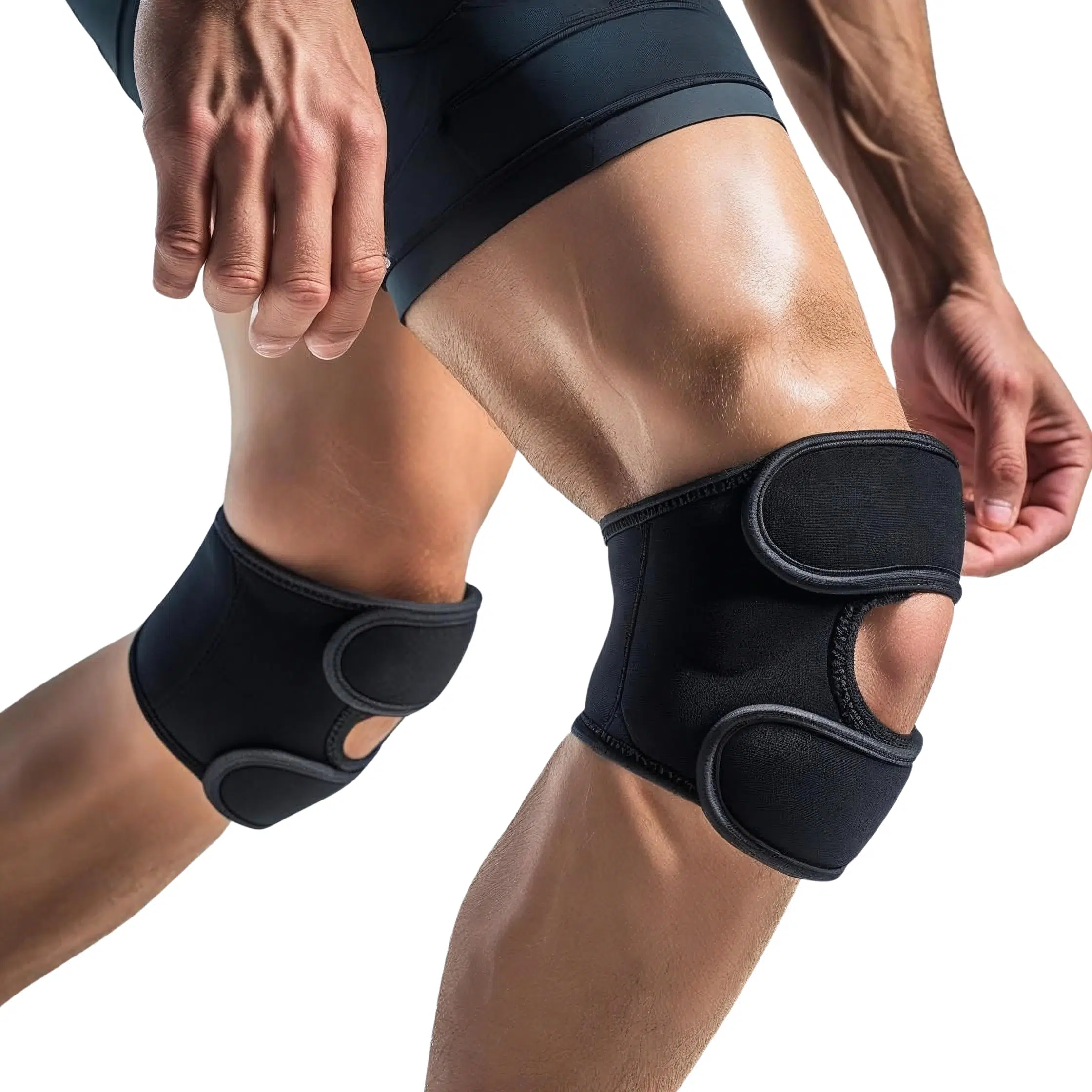
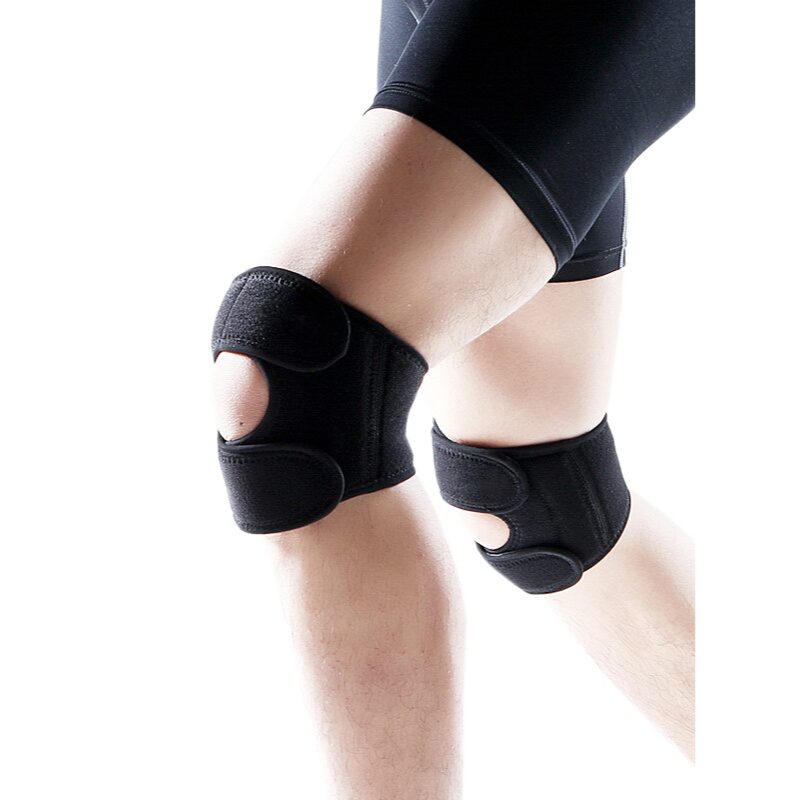
1x Pair of ITB Strap Knee braces for Iliotibial Band Syndrome
£16.99£19.98 (-15%)inc VAT
- 2 x adjustable ITB strap knee braces for targeted support on the outer side of the knee
- Designed for adults looking for support often chosen for Iliotibial Band Syndrome, also known as ITBS
- Pair supplied for left and right knee use, or for keeping a spare support ready when needed
- Focused compression is designed to support the iliotibial band area near the outer knee
- Commonly worn during running, cycling, walking, gym training, hiking and other repetitive lower-body activity
- Lightweight, breathable and lower-bulk design for easier wear during exercise and day-to-day movement
- Adjustable fastening helps you alter the fit to suit comfort, support needs and activity level
- Made for targeted outer-knee support rather than general compression across the whole joint
- May help the outer knee feel more settled during stairs, slopes, longer walks and repeated bending
- Suitable for men and women
- One size fits most, with a snug fit intended for focused support
- The brace should feel secure but not tight enough to cause pinching, numbness or obvious discomfort
- If outer knee pain is severe, worsening, or not settling, it is sensible to speak to a GP or physiotherapist
- Includes a 30-day money-back guarantee
ITB Strap Knee Brace Pair for Iliotibial Band Syndrome Support
This pair of ITB strap knee braces is designed for adults who want more specific support on the outer side of the knee, especially during activities where the leg is repeating the same movement again and again. If your knee feels manageable at first but then starts to burn, tighten or become sore on the outside during a run, a ride, a longer walk or a set of stairs, this is the kind of support many people look for.
Unlike a full knee sleeve, which gives broad compression around the whole joint, an ITB strap is made for a more local problem. It sits around the outer knee region to support the area where the iliotibial band often becomes irritated as the knee repeatedly bends and straightens. That more focused design makes sense when the discomfort is not around the kneecap or spread through the whole joint, but clearly sits on the outside of the knee.
This listing is for 2 x ITB strap knee braces. That gives you the flexibility of having support available for either knee, using both if needed, or keeping one spare for regular training, work or day-to-day use.
Why it often starts after you have been moving for a while
One of the more recognisable features of Iliotibial Band Syndrome is that it often does not stop you straight away. Many people begin a run, cycle, walk or gym session feeling reasonably comfortable, then notice the outer side of the knee becoming more obvious as the movement repeats. The leg may feel fine at the start, then become the reason you slow down, shorten the session or stop altogether.
The discomfort is often described as sharp, burning, sore or tight on the outside of the knee. Some people notice it most on downhill sections or when coming down stairs. Others find it appears after a certain distance, a certain amount of time, or during sessions that involve repeated bending under load. In plain terms, the problem is often less about one single movement and more about what happens when the same area has to cope with the same demand again and again.
For many adults, this is also why the problem can drag on. If the outer knee keeps getting irritated before it has settled between sessions, the pain may start earlier, take less to bring on, and begin to interfere with more ordinary activity as well. That is often when more targeted support starts to feel worthwhile.
What the IT band does and why it gets irritated
The iliotibial band, usually shortened to the IT band, is a thick band of tissue that runs down the outer side of the thigh from the hip towards the outside of the shin. Its job is to help steady the leg during movement, especially when you are loading one leg at a time during walking, running, cycling or climbing stairs.
It helps to think of it as more of a firm supporting band than a muscle that simply tightens and relaxes. It helps guide and steady the outer side of the leg as the knee bends and straightens. Most of the time, you are not aware of it. Trouble tends to start when the same motion is repeated often enough, especially under load, that the outer knee region becomes irritated.
That is why ITBS so often behaves like an overuse problem rather than one clear injury event. Many people cannot point to one exact moment when something went wrong. Instead, symptoms build because the outer side of the knee keeps dealing with the same demand stride after stride, pedal turn after pedal turn, or stair after stair. Once the area is irritated, it often becomes more reactive to the same movement that brought it on in the first place.
The sore spot is usually not the whole knee. It is more often a fairly local area on the outside, where the IT band is being stressed repeatedly as the knee bends and straightens. That local pattern is one of the main reasons a targeted support often makes more sense than a broad brace.
Why stairs, slopes and repetition often make it worse
IT band pain often becomes most obvious in tasks where the knee has to keep controlling your body weight through the same bend-and-straighten movement. Coming down stairs is a common example. Walking downhill or running on a slope can do the same. Cycling for long enough can also bring it on, because the outer side of the knee is working through repeated pedal turns with very little variation.
This is why the pain can feel oddly specific. You may be able to stand, walk short distances or start an activity without much trouble, but once the outer knee has to keep doing the same job over and over, that one area starts to complain. For some people, it is stair descent that makes the pattern obvious. For others, it is the point in a run where the outside of the knee suddenly becomes the limiting factor.
When that happens, the issue is often not that the whole knee is struggling. It is that one strip of tissue on the outside of the leg is becoming irritated by repeated control work. That detail matters because it helps explain why a smaller, more focused support can feel more appropriate than a full-knee brace.
Why a general knee sleeve is not always specific enough
If the pain is sitting on the outer side of the knee, a broad sleeve does not always give the most useful kind of support. General compression can feel reassuring, but it may also spread pressure too evenly across the whole joint when the irritated area is actually quite local.
That is where an ITB strap can be a better fit. Rather than covering everything, it focuses support on the outer knee region where symptoms often build. For people whose discomfort is tied to repeated running steps, cycling turns or stair descent, that more localised pressure often makes better sense than a full-knee support that treats the whole joint as though it were equally involved.
It is also a practical choice if you do not want extra bulk behind the knee or over the kneecap. Many people with ITBS are not looking for all-round knee compression. They are looking for something smaller and more specific that addresses the part of the knee that actually hurts.
How these ITB straps support the outer knee
These braces are built for targeted support rather than broad coverage. They sit around the outer knee area to apply focused pressure where the iliotibial band is often most sensitive. During repetitive activity, that may help the area feel less exposed and more manageable, particularly when symptoms usually appear as the session goes on rather than right at the start.
The adjustable fastening allows you to alter the fit to suit both comfort and activity. A firmer fit may feel better for running or more demanding exercise, while a slightly gentler feel may be enough for walking or ordinary day-to-day use. That matters because IT band symptoms are often linked to how much repeated strain the area is dealing with. The support needs to feel secure enough to stay where you want it, but not so tight that it becomes uncomfortable in its own right.
The lightweight, breathable design is part of what makes this style practical. When support feels bulky or awkward, it is often the first thing people leave behind. A lower-bulk ITB strap is easier to wear under ordinary clothing or sportswear, which makes it more realistic for regular use during the activities that usually trigger the problem.
Commonly chosen for ITBS symptom patterns
This pair is mainly aimed at adults looking for support with symptoms often linked to Iliotibial Band Syndrome. That usually means pain on the outside of the knee that becomes more obvious with repetition, particularly during running, cycling, longer walks, stairs or downhill movement.
Many people describe the pain as arriving after a period of activity rather than from the first few steps. It may start as a small irritation, then sharpen or burn enough to make you change your stride, shorten a session or avoid certain routes. Others notice that the outer knee feels sore afterwards, even if the main pain settled once they stopped.
That pattern helps explain why a pair of targeted straps can be useful. If your symptoms are tied to repeated lower-body activity, it can help to have support available when you need it most, rather than relying on a larger brace that may feel excessive for a fairly local problem.
Made for running, cycling and repeated leg work
This type of strap is especially relevant for activities where the leg is doing the same job repeatedly. Running is an obvious example, because the knee is going through the same bend-and-straighten pattern stride after stride. Cycling can do something similar, especially over longer distances or harder efforts, where the same outer-knee area is being asked to cope with repeated pedal turns without much variation.
Stairs, slopes and brisk walking can be just as relevant. Coming down stairs or walking downhill often brings symptoms out because the outer knee has to manage repeated control under load. For some people, that is the point where the pain becomes unmistakable. For others, it is not sport at all, but a busy day involving lots of walking, stair use and time on their feet.
That is one reason the pair format makes practical sense. You may need support on one side more often than the other, or want a second brace ready for regular use rather than having to rotate a single support between sessions. It is a simple detail, but for people managing recurring outer-knee pain, having a pair available can make everyday use more straightforward.
Why many people prefer this style of support
If the discomfort is clearly on the outer side of the knee, a smaller targeted strap often feels more sensible than a full sleeve. It is lighter, less enclosing and more specific to the problem area. That can be especially helpful during exercise, when too much material around the whole knee can feel unnecessary or distracting.
For many adults, the appeal is straightforward. They do not want to brace the whole knee if the issue is local to one strip of tissue on the outside. They want something that is easy to wear, easy to adjust and better matched to the way IT band pain usually behaves.
That does not mean a full sleeve is never useful. It simply means that for this particular symptom pattern, a focused ITB strap often feels closer to the problem you are actually trying to manage.
Fit, feel and day-to-day comfort
These ITB strap knee braces are suitable for men and women and are designed as one size fits most. The fastening allows you to adjust the fit until it feels secure and supportive. The strap should sit snugly enough to stay in place and apply useful pressure, but not so tightly that it causes pinching, numbness or obvious discomfort.
As with most targeted supports, comfort depends on getting the position right. If the strap is too loose, it may shift during movement and feel less helpful. If it is too tight, it may become irritating quite quickly. A secure, balanced fit is what you are aiming for, particularly if you are wearing it during running, cycling or other repetitive activity.
Because this is a pair, you also have more flexibility in how you use them. That may mean wearing one on the side that is currently most bothersome and keeping the second as a spare, or having both available if support is needed on either side at different times.
How to wear the ITB strap
Position the strap around the outer knee area so that it sits where support feels most useful on the outside of the joint. Fasten it securely and adjust the tension until it feels supportive but comfortable.
Start with a moderate level of pressure rather than fastening it as tightly as possible. Walk a little, bend the knee and see how it feels. If you are wearing it for running, cycling or gym work, it is worth checking the fit before you get fully into the activity so you can make small adjustments early on if needed.
If the strap causes numbness, tingling, excessive pressure or obvious discomfort, loosen it and check the position again. The aim is to support the outer knee, not to restrict normal movement.
What to expect
An ITB strap is best thought of as a support aid rather than a quick fix. You may notice that the outer side of the knee feels more settled during activity, especially if symptoms usually build with repetition. For some people, the benefit shows up most clearly during running, stair descent or cycling. For others, it is simply that the outer knee feels less exposed during the day.
It helps to keep expectations realistic. This kind of strap may improve comfort and support, but it does not replace sensible decisions if the area is already irritated. If your outer knee pain is being stirred up by repeated activity, it often makes sense to adjust how much you are doing while the area settles rather than relying on support alone to carry on exactly as before.
Used in that way, a targeted strap can be a practical part of staying active while giving the outer knee a bit more help.
When to get further advice
If the pain on the outside of your knee is severe, if there is marked swelling, if the knee feels as though it is giving way, or if symptoms are not settling, it is worth speaking to a GP, physiotherapist or another appropriate clinician. The same applies if the problem is new and unexplained, or if it is stopping you from getting through normal daily activity.
It is also sensible to get further advice if the pain keeps returning in the same way despite cutting back on the activities that trigger it, or if it starts to come on earlier and earlier during exercise or walking. That often suggests the area needs a more individual plan around movement, loading and recovery.
A practical option for outer knee support
If your symptoms are mainly on the outer side of the knee, a targeted ITB strap often makes more sense than a broad, full-knee support. This pair is designed to focus support where Iliotibial Band Syndrome usually causes the most trouble, while staying light, adjustable and practical for regular use.
For adults dealing with that familiar outer-knee pain during running, cycling, walking or stairs, this style of support is a sensible option to consider. The pair format gives you extra flexibility for regular wear, whether that means support for either side or simply having a second brace ready when needed. Check the fit carefully, use the support in a way that feels comfortable, and if you are unsure whether IT band irritation is really the issue, speak to a GP or physiotherapist for individual advice.
Supplied as 2 x ITB strap knee braces, with a 30-day money-back guarantee.
Disclaimer
This information is general guidance only and is not a substitute for individual medical advice, diagnosis or treatment. If you are unsure whether these supports are suitable for you, or if you have new, unexplained or more complex symptoms, speak to a GP, physiotherapist or another appropriate clinician. No support can guarantee a particular outcome, and results will vary from person to person.
Fast & Secure Checkout Through Paypal
Pay with Paypal the secure payment gateway that accepts all credit and debit cards. Paypal is free and secure and no credit or bank information is ever stored or shared with us.
Fast Dispatch
Enjoy your items soon with quick dispatch via Royal Mail. Expect to have your items between 1-3 working days for domestic orders. 7-10 Working days for international orders.
Return Policy – 30 Day Money Back Guarantee
In the unlikely event, you are unhappy with your purchase you can return it within 30 days for a refund. Please contact us via the form on the contact us page to start your return.
To return an item please send it to: Nuova Health UK, 81 Highfield Lane, Waverley, Rotherham, S60 8AL. Please include a note with your order id so we know who to refund. Please retain your postage receipt as proof of postage. All that we ask is that the item is in the original packaging and unused.
Reviews
There are no reviews yet.