
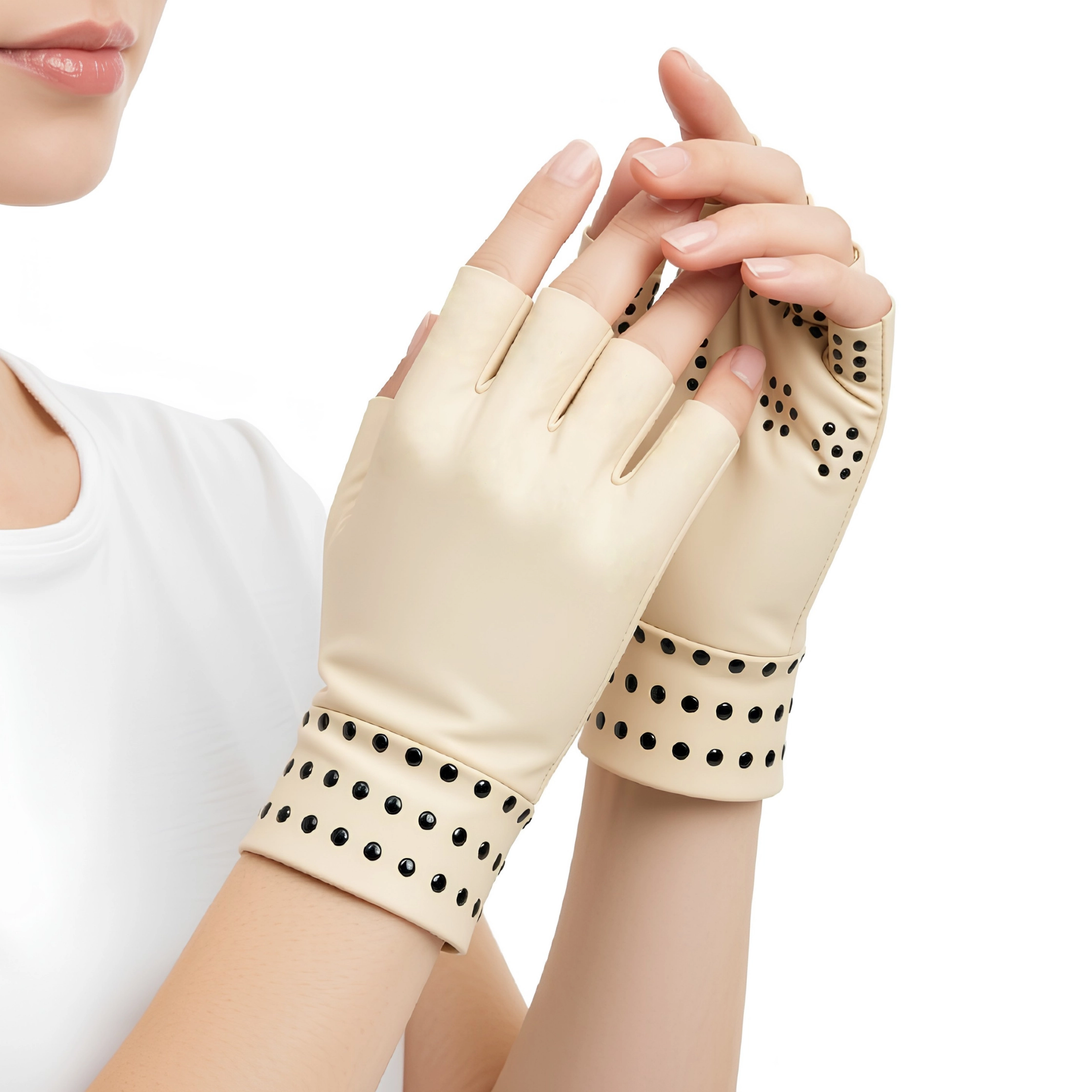
Magnetic Infra-red ray Compression Support Gloves for Arthritis
£9.99inc VAT
- Half-finger magnetic compression gloves for adult hands. One-size stretch fit, either glove fits either hand, in beige.
- For adults with hand arthritis, Raynaud’s, carpal tunnel symptoms, or hands that ache, stiffen, and turn cold.
- Soft, breathable fabric. The close fit applies gentle, even pressure across the wrist, palm, thumb, and finger bases.
- Fingertips stay uncovered, so you keep full feeling and can use a touchscreen without taking the gloves off.
- Warmth helps stiffness loosen, and may reduce how often cold weather sets off an episode.
- Magnetic dots may give a gentle, comforting sensation for many wearers, and add a textured non-slip grip.
- Light support through the wrist, which may help keep it out of its most bent position, especially overnight.
- Light enough to wear for hours at a time. Start with an hour or two and build up.
- A comfort and support product, not a cure or a treatment.
- Contains magnets. Do not use if you have a pacemaker, an implanted defibrillator, or any other implanted medical device that could be affected by magnets.
- Check with your GP first if you have reduced sensation in your hands. See a GP or physiotherapist if your symptoms are new, worsening, or unexplained.
Support for Hands That Ache, Stiffen, or Turn Cold
Hands are easy to take for granted until something in them changes. A jar lid that once opened without a thought now needs a firm grip and a second attempt. Fingers feel stiff first thing and take a few minutes to straighten. Cold weather leaves the fingertips white and numb. Or you wake in the night with pins and needles in your thumb and first two fingers, and you have to shake your hand out before you can settle again.
None of this is unusual, and all of it has a physical cause. Adults across the UK look for help with their hands for all sorts of reasons, whether that means a splint, a brace, or a pair of compression gloves. These half-finger magnetic compression gloves are made for that group: adults living with arthritis, Raynaud’s, carpal tunnel symptoms, or simply hands that feel tired, achy, and cold more often than they used to. The fabric keeps your hands warm and applies even pressure across the wrist and palm. For hands that are sore, stiff, or cold, that is often enough.
What You May Be Dealing With
Most people arrive at a pair of compression gloves from one of a few directions. It helps to be clear about which one sounds most like your hands, because the reason they feel the way they do shapes what you should reasonably expect from any support you wear. The table below sets out the common signs in short. Each row points to one of the sections directly beneath it, where you can read the detail.
| What you notice | Where it shows | When it is worst |
|---|---|---|
| Stiff, sore joints | Thumb base, knuckles, fingertips | On waking, and after sitting still |
| Colour change and numbness | Fingertips, both hands | In the cold, or after a temperature change |
| Tingling, pins and needles | Thumb, index, middle finger | At night, or after long periods of hand use |
| Tired, heavy hands | Whole hand, often no specific joint | End of a busy day |
Stiff, sore joints that have crept up over time
Hands that are stiff first thing in the morning, sore by the end of the day, and sore within a few seconds of a firm grip are the usual picture of arthritis in the hands. It is one of the most common reasons adults look for a supportive glove. Morning tends to be the worst of it, though the same stiffness returns after any long spell of sitting still. Movement loosens things up, and then a day of use tires them again. The ache sits deep in the joint, with stiffness layered on top, and it sharpens into a short, local pain when you grip or twist. Grip strength drops, and the tasks you notice most are the small ones that need a pinch or a twist.
The joints affected first are usually the base of the thumb, the middle knuckle of each finger, and the joint nearest the fingertip. One of two names is likely to have come up. Osteoarthritis is the wear-and-tear type, and it settles into those spots over the years. Rheumatoid arthritis is inflammatory, and it tends to affect the same joints on both hands at once, with a particular pull toward the knuckles at the base of the fingers and the wrist.
Fingers that lose colour and feeling in the cold
Raynaud’s is a circulation condition rather than a joint one. It causes episodes: short periods when the blood supply to the fingers drops away and then returns. An episode usually starts at the fingertips and spreads back along the finger. The fingertips go white first, then often blue, then red and throbbing as the blood comes back. They feel numb to begin with, then painful, and an episode can last anywhere from a few minutes to well over half an hour. Afterwards the hand often feels heavy and tender for a while. The same fingers on both hands tend to be affected at once. Cold rooms and cold handles are common triggers, and so is any sudden change in temperature, or a stressful moment.
Tingling, numbness, and night-time hand waking
Carpal tunnel syndrome is a nerve problem, and the first signs usually appear at night. You wake with the hand numb or buzzing in the thumb, index finger, middle finger, and half of the ring finger. Hanging it over the side of the bed or shaking it out brings quick relief. During the day the symptoms are milder: a dull ache in the wrist, tingling in those same fingers, a grip that feels weaker than it used to, or a habit of dropping things. Sometimes the ache runs up the forearm.
Hands that are tired and heavy, without a clear diagnosis
Plenty of people have no formal diagnosis at all, and their symptoms do not fit any of the three above. There is no joint, vessel, or nerve problem anyone has identified. Hands ache at the end of a busy day spent typing, gardening, crafting, cooking, or carrying. They feel cold easily, recover slowly, and are stiff in the morning without being painful enough to investigate. The symptoms track use: heavy days are worse, quiet days are better. That is enough to warrant a supportive glove, and a good reason to have the symptoms looked at if they start to change, because hands that are simply tired can occasionally be the first sign of something else.
What Is Happening Under the Skin
Knowing roughly what happens inside the hand explains why a compression glove is a reasonable thing to reach for, and why it is not a treatment in itself.
Joints stiffen when they are held still
A joint is where two bones meet. The ends of the bones are covered in smooth cartilage, wrapped in a capsule, and lined with a thin membrane that produces a small amount of lubricating fluid. In osteoarthritis, the cartilage thins over the years, so the joint copes less well with load and the bones sit closer together than they should. In rheumatoid arthritis, the problem starts in the lining itself: the immune system attacks it, the lining becomes inflamed, and the whole joint swells.
Either way, fluid collects, the capsule tightens, and that tightness is what you feel as stiffness. A second factor matters here. The fluid that lubricates the joint is thicker when the joint is cold and still, and it flows more freely once the joint warms up and starts moving. That is why hands loosen as the day goes on. Anything that keeps the joint warm, supported, and gently compressed helps that fluid move more freely.
Small blood vessels react strongly to temperature
Your fingers have a large surface area for their size, so they lose heat quickly. To protect your core temperature, the blood vessels near the surface of the skin narrow readily in the cold, sending less blood to the extremities. In most people the response is proportionate. In Raynaud’s, it overshoots. The vessels narrow too far and take too long to relax, so the fingertip is starved of blood for a while, then flushes red when the vessels finally open again.
Nerves are sensitive to pressure and to position
Nerves carry signals, and they need a decent blood supply of their own. Squeeze one, or stretch it, and it stops conducting properly. That is what you feel as tingling, numbness, or a strange dead feeling in the fingers. The median nerve supplies feeling to the thumb, index finger, middle finger, and half of the ring finger, and it also controls some of the small muscles at the base of the thumb. It runs through a narrow tunnel on the palm side of the wrist, alongside the tendons that bend your fingers. Those tendons run inside their own thin sheaths, and it is the swelling of that tissue, not the bone, that crowds the tunnel. The tunnel has very little spare room, and its roof is a band of tough tissue. Bend your wrist fully forward or backward and the tunnel narrows, because that band tightens over the nerve. A small amount of swelling, or a wrist held in a bent position for hours, can be enough to set symptoms off.
What the three problems share
Three different problems, and three things help: warmth, support, and gentle steady pressure. A joint that is warm and lightly supported feels less stiff. A hand kept warm has fewer circulation episodes. A wrist held closer to straight gives an irritated nerve a better chance to settle. That is why compression gloves help across so many different hand complaints.
Why Compression Gloves Make Sense
Compression garments are nothing new. They are common on legs for travel, or on ankles after a sprain. The principle is the same wherever they sit: a close-fitting, stretchy fabric applies gentle, consistent pressure to the tissues underneath.
Warmth on its own is only half of it. A heated glove or a thick winter glove keeps the hand warm, but it does nothing about the swelling that builds through a day of use, and nothing about the position the wrist rests in overnight. Even compression adds the second part. It holds the tissue under steady, low-level pressure, which limits how much fluid pools in the hand after activity, and it gives the wrist a comfortable position to rest in without taking the movement away. That combination of warmth and even pressure is what makes a compression glove different from simply putting on a pair of gloves.
The pressure itself does three things. It gives the hand a feeling of support, and for a painful or swollen joint, that steadiness can reduce the sense that the joint is vulnerable. People tend to move their hands more freely when they are not holding them still in case it hurts. Covering the hand also keeps warmth in, which is the main thing that helps a hand loosen up on a cold morning.
When the support is on counts as much as what it is. A soft compression glove stays on through cooking, typing, driving, and sleeping. The main advantage is simply that it stays on: the support is there when you need to open something, rather than sitting in a drawer.
How These Gloves Are Designed to Help
These are half-finger gloves. The fabric covers your palm, the back of your hand, your wrist, the base of each finger, and your thumb, while your fingertips stay uncovered. That single design choice shapes almost everything else about how they feel to wear.
Even, consistent compression
The fabric is a medium-stretch knit, and it is cut so the tension is similar across the wrist, palm, thumb, and finger bases. It does not clamp in one place and go slack in another. The pressure is light rather than heavy, so it supports without squeezing so hard that it becomes uncomfortable after an hour.
A firm band across one point would risk pinching, and spreading the grip broadly keeps the pressure even rather than concentrated. That is why the fabric is made to give as the hand swells. Hands change size slightly through the day, and a glove with a little give in it keeps the same level of pressure in the morning and the evening, rather than building tighter hour by hour.
Half-finger coverage and bare fingertips
Leaving the fingertips free matters for more than comfort. You can feel what you are touching, so buttons, keys, coins, and zips stay manageable. The fingertips are the most sensitive part of the hand to pressure, so exposing them removes the risk of the glove feeling tight or clammy exactly where you would notice it most. The openings are cut straight across the finger at the joint nearest the fingertip, which keeps the fabric clear of the joint that bends most. With the tips uncovered, you can also use a touchscreen without taking the gloves off, which is often what decides whether the gloves get worn at all.
Magnetic dots placed across fingers, palm, and wrist
Small magnets are set into the fabric at points across the fingers, the palm, and around the wrist. They sit inside the knit rather than on top of it, so they lie flat against the skin and register as even, light contact rather than a prickle or a hard edge. Plainly put, the dots give a gentle, comforting sensation to many wearers. Other magnetic products make stronger claims. We do not.
The dots also change how the fabric feels to grip. They sit slightly proud of the fabric and are set at regular intervals, so the grip is spread evenly across the palm and fingers. If you are opening a jar, carrying a pan, or holding a tool, that surface grips better than smooth fabric would, which means less force through the joints.
Breathable, moisture-wicking fabric
The material is deliberately light and breathable. It draws moisture away from the skin rather than trapping it, so your hands do not end up hot, damp, and sweaty after an hour of wear. Seams are stitched flat and sit against the outer surface rather than against your skin. It feels soft against the skin and stays comfortable for long stretches, including overnight. A glove you can only tolerate for twenty minutes is a glove you will stop wearing, so how the inside feels against your skin shapes how much use you get from it.
Stretch fit for adult hands
They stretch to fit a wide range of adult hand sizes and mould to the shape of your hand. They are not left- or right-handed, so either glove goes on either hand. They suit both men and women.
What These Gloves Cannot Do
These gloves are a comfort and support tool, and within those limits they work well. They make the hands you have easier to use through the day: warmer, a little more supported, a little less sore after a long spell of gripping or typing.
They do not reverse joint damage, unblock a trapped nerve, or stop Raynaud’s from existing. They do not treat or prevent blood clots, and they must not be relied on for that. They work alongside whatever else you are doing to manage your hands, not instead of it. If you are looking for a cure, this is not it.
Safety: Who Should Not Use These Gloves
Read this before you decide, because the magnets in these gloves are not suitable for everyone.
The gloves contain magnets. Do not buy or use them if you have a pacemaker, an implanted defibrillator, or any other implanted medical device that could be affected by magnets. This includes insulin pumps, neurostimulators, and similar implants. Magnets can interfere with how these devices work, and the risk is not worth taking. If your device could be affected, check with the team who fitted it before ordering.
There is a second group who should check before ordering. If diabetes or another condition has dulled the sensation in your hands, you may not notice a glove that is too tight, and pressure you cannot feel can still do harm. Speak to your GP first, and ask them how firm the compression should be for your hands.
Arthritis in the Hands
Hand arthritis tends to follow the same daily rhythm for many people. The first twenty minutes after waking are the worst. Fingers feel stiff and slow to straighten. Warm water or a few slow flexes help, and gradually the hand comes back. By mid-morning there is no trouble at all. By late afternoon, after a day of use, the hand is tired and achy again, and the base of the thumb is sore.
That rhythm follows where the trouble sits and how your day loads those spots. The joint at the base of the thumb — the saddle joint, which lets the thumb swing across the palm to meet the fingers — is the most heavily used joint in the hand. Every pinch grip runs through it, so it carries more load than any other joint in the hand. In the fingers, the middle knuckles and the joints nearest the tips bear the pressure when you pinch or squeeze. When cartilage is worn, or the lining is inflamed, the capsule around the joint tightens. The extra fluid that collects after use leaves the whole area feeling stiff and full.
It is the small, precise movements that cause the most trouble, and they are usually the ones that cannot be avoided. Gripping a kettle, wringing a cloth, opening a bottle, and turning a key all load the same joints in the same way, over and over. None of them are heavy tasks. A jar lid is the clearest example. It asks the thumb to press against the fingers and twist at the same time while the fingers clench hard, loading the thumb base and every finger joint at once. A pen asks for a long, steady pinch grip that builds discomfort slowly. Carrying a bag of shopping loads the fingers and the base of the thumb in a hanging grip.
What a compression glove offers here is not a fix for the joint itself. It is a layer of support that stays on while you do those things. Broad, even pressure across the palm, wrist, and finger bases spreads the load of a grip over a wider area, rather than concentrating it at the one sore joint. Take the jar lid. Because the glove wraps the palm and the thumb base without pinching, the twist feels more controlled, and many people find they can manage it while gripping less hard than before. The textured dots on the palm reinforce that. Friction is what lets you open a jar or carry a pan, and the more of it you have, the less force you need to apply. With the dots sitting proud of the fabric, your grip is a little more secure, and you may be able to hold and turn things with a more relaxed hand. Any force you avoid is load the joints do not have to take.
Mornings are the other point where the gloves help most. Stiffness after a night of stillness happens because the tissue around the joint has tightened. Keeping the hand warm through the night, with the fingers lightly supported rather than curled freely, can help that stiffness loosen a little sooner once you start moving, so the first jobs of the morning take less effort.
Which joints these gloves suit
If your arthritis is worst at the base of the thumb, you will notice the glove most there, because that joint sits under the fabric and gets direct support. If the problem is mainly in the fingertips, the half-finger cut means those joints get warmth but no compression, which is a deliberate compromise so you keep full feeling and grip.
Raynaud’s: Keeping Warmth Where It Counts
With Raynaud’s, the question is not whether your hands get cold, but how quickly an episode starts and how long it lasts. That is why the practical approach is about reducing how often an episode is set off and cutting short how long each one runs.
The trigger is usually a change in temperature rather than the temperature itself. Going from a warm kitchen into a cold hallway, or reaching into a fridge on a mild day, can set an episode off just as easily as a long walk in January. The longer the vessels stay narrowed, the longer the painful flush takes to settle once the blood returns.
The gloves help by covering the parts of the hand that cool fastest. The fabric wraps the whole palm, the back of the hand, the wrist, and the base of the fingers. Your fingertips stay open, which is the right call. You need to be able to feel and grip, and fingertips are the part most sensitive to anything tight or damp.
A warm hand holds off an episode longer than a cold hand, because the vessels do not narrow as aggressively in the first place. Putting the glove on before you step outside, rather than after your fingers have gone white, makes the vessels less likely to narrow. The glove slows the rate at which the hand loses heat, so the tissue inside stays closer to its normal temperature for longer into a cold walk. A hand that would have gone numb a few minutes into a short trip outdoors often stays warm until you are back inside.
Cold surfaces matter as much as cold air. A metal trolley handle, a steering wheel on a frosty morning, a pack straight out of the freezer, or a gate latch in February can all start an episode in a hand that was warm a moment earlier. Keeping the gloves on through those few seconds of contact is often all that is needed, and it saves the heavy, tender feeling that follows.
Once an episode is underway, the glove cannot reverse it, but it can help the recovery. Keeping the hand warm while the vessels are opening softens the worst of that painful flush and may shorten how long the hand feels heavy and tender afterwards. Some people find that pulling the gloves on at the first hint of a colour change makes the worst of it pass sooner.
A pair of knitted gloves worn under these works well in genuinely cold weather, with the compression glove acting as a warm outer layer that also gives grip. If the two layers together feel tight at the wrist, keep the compression glove on top and use a thinner liner underneath.
There is a limit to what a glove can do. If your episodes are frequent, painful, or affecting your daily life, raise that with your GP. Some people with Raynaud’s have an underlying condition that needs looking at, and a glove cannot address that.
Carpal Tunnel: Support Through the Wrist
The wrist is where carpal tunnel trouble starts, and how you hold it through the night often sets how much the hand bothers you for the rest of the day. Many people sleep with the wrist curled under the chin or bent beneath the pillow, which holds the tunnel in its most crowded position for hours without shifting. That is why symptoms often appear at night, and why moving the hand — hanging it over the edge of the bed, or shaking it out — brings quick relief.
A soft compression glove holds the wrist closer to a straight position through the night. The fabric wraps the wrist, and the dots around it sit against the skin, which for many people makes it harder to fold the wrist tightly under the chin, which is the position that brings symptoms on. Warmth has a role too. Warm tissue is suppler, so the tendons that bend your fingers and the tunnels they run through do not swell quite as much overnight, and the early morning tingling is often milder.
By day, the same support helps for a different reason. Long stretches at a keyboard or a mouse keep the wrist at one angle for hours, and the tendons that bend your fingers take the strain. The glove does not stop you typing, but it holds the wrist under even light pressure and keeps the tissue around it warm, which may reduce how quickly the tingling builds over an eight-hour day. If your work keeps your hands busy all day, the light support and warmth often help more in the evening than they do first thing.
If your tingling increases while you are wearing them, take them off and mention it to your GP.
Compression Gloves or a Wrist Splint?
These two products get confused, and choosing the wrong one wastes money and time. They do different jobs, and for some people the answer is both.
A wrist splint is a firm support, often with a rigid strip down the palm side, designed to hold the wrist in one position and stop you bending it. For carpal tunnel in particular, that is the point: a wrist that cannot bend cannot narrow the tunnel as easily. A splint is the better choice when a clinician has told you the nerve or the joint needs to be kept still, usually for a set period, and often overnight. It is excellent at what it does, but it is bulky, and you cannot use your hand normally while wearing it.
A compression glove does the opposite job. It does not immobilise anything. It keeps the hand warm, gives even light pressure, and lets you carry on using your hands as normal. That makes it the better option for all-day wear, for cold-related symptoms, and for anyone who wants support without losing function.
The choice comes down to this. If you need the wrist held still, you want a splint. If you need warmth, comfort, and light support while you get on with your day, you want a compression glove. If you are not sure which applies to you, that is a question for your GP or physiotherapist rather than something to guess at.
Fit, Wear, and What to Expect
These gloves are a one-size stretch fit, made for adult hands. They are not made to a set hand measurement, and they are not available in sizes. That makes them easy to buy without measuring, but it does mean they will not suit every hand perfectly.
For most adults they will fit comfortably. If your hands sit at the very large or very small end of the range, the fit may be tighter or looser than ideal. Very large hands may find the fingers feel tight at the base, and very small hands may find the gloves a little loose around the palm.
How tight is right
Once they are on, make a fist and open your hand fully. If the glove pulls hard across the knuckles or digs into your wrist, it is too tight. You want firm, even pressure you can wear comfortably for an hour or more, with fingers that stay warm and pink. When you take the gloves off, there should be no deep marks or ridges pressed into the skin. If there are, the fit is too tight for your hand. If your fingertips start to tingle, change colour, or feel cold while you have them on, take the gloves off. That is a sign the fit is wrong, not something to push through.
Putting them on
There is no left or right glove to work out, which saves a lot of fiddling. Roll the glove up so the opening is wide, slide your fingers into the finger sections one by one, then ease the palm and wrist section into place. Smooth out any bunching across the back of the hand, since folds in the fabric can create pressure points. If your hands are painful, doing this sitting down with your hands relaxed rather than tense makes it easier.
Start with short periods
If you have never worn compression gloves before, start with an hour or two at a time rather than putting them on for a whole day. Your hands need a little time to get used to the sensation of even pressure. Once it feels normal rather than noticeable, you can extend how long you wear them.
When to wear them
Wear them at the point of need rather than non-stop. That usually means mornings for arthritis, cold weather and commutes for Raynaud’s, and overnight for carpal tunnel symptoms. If you are not sure when your worst window is, keep a rough note for a few days of when your hands are at their worst, and plan around that.
Many people find gloves most useful overnight, particularly for stiffness on waking and for carpal tunnel symptoms that disturb sleep. The fabric is light enough for most people to sleep in comfortably. If the gloves bunch up or you find yourself pulling at them in the night, try them for a shorter period first, or wear them during the evening instead and take them off before bed.
During the day, put them on before gardening, cleaning, cooking, typing, or any long stretch of hand work, rather than after your hands have already started hurting. Support helps more as prevention than as a response to pain that has already built up. The textured dots help here too, giving you a little more grip on tools, handles, and lids.
What to expect over time
Most people notice that their hands feel warmer and less achy while the gloves are on, and that a task which normally leaves their hands sore is slightly more manageable. Some notice that morning stiffness eases a little faster. Others notice very little at all, and that is a real outcome too. Compression gloves are not effective for everyone, and there is no way to know which group you fall into without trying a pair.
The first month, realistically
The first week or so is usually about getting used to the sensation. The pressure will feel noticeable at first, and you will probably be aware of the dots against your skin. Many people find an hour or two at a time is enough at this stage. There is nothing to gain by pushing through it.
After a week or two, the gloves tend to stop drawing attention and start to feel unremarkable — present, but not distracting. Most people settle into a routine around this point: mornings only, evenings only, or overnight.
By the end of the first month, you should have a clear answer to a simple question. Are my hands more comfortable when I wear them than when I do not? If the answer is yes, the gloves are doing what you want them to. If the answer is no, they are not the right support for you, and the guarantee exists for exactly that reason.
Everyday Adjustments That Help Alongside the Gloves
A compression glove works best alongside other sensible habits, not on its own. These are the practical things that tend to make the biggest difference to how your hands feel, whether or not you wear gloves at all.
Keep your core warm, not just your hands
Your hands sit at the end of the circulation line. When your body is cold, it reduces blood flow to the extremities to protect your core, and your hands are the first place you notice the shortfall. Adding a layer on your body often does more for your hands than adding anything to them. Long sleeves that cover the wrists help in particular, because the vessels sit close to the surface there and lose heat quickly.
Get ahead of the temperature changes
Sudden changes are harder on hands than steady cold. Get your gloves on before you step outside, use warm rather than cold water for washing up, and warm your hands gently before you use them in a cold kitchen, garage, or workshop.
Break up the heavy hand work
Sore hands cope better with short bursts of activity and regular breaks than with one long stretch. If you have a lot of chopping, scrubbing, or pruning to do, break it into ten-minute stretches with a few minutes of rest between. Irritated joints and tendons settle better when they are not pushed continuously at the end of a long day.
Adapt the tools and the grip
A lot of hand pain comes down to force. Jar openers, tap turners, thicker pen grips, and kitchen tools with larger handles all take load off the small joints. If a particular task always leaves your hands sore, it is worth looking for a tool that does the same job with less grip.
Keep the hands moving gently
Joints that are not moved stiffen faster, and the fluid inside them thickens when they sit still. Gentle, regular movement through the day — opening and closing the hand, spreading the fingers, slow circles with the wrist — helps keep the fluid moving and the tissue warm. Do not force anything into pain. Movement should feel easy rather than strenuous.
Caring for Your Gloves
How you wash and dry these gloves keeps them comfortable and functional for longer, and protects the magnets from damage.
Washing
Hand wash in cool or lukewarm water with a mild detergent. Squeeze the water gently through the fabric rather than scrubbing or wringing it, which can distort the stretch and disturb how the magnets sit. Rinse thoroughly. Avoid bleach, fabric softener, and harsh cleaning products, all of which can degrade the fabric and leave residue against your skin.
Drying
Do not tumble dry. Heat damages stretch fabrics and can affect the magnets over time. Instead, squeeze out the excess water gently, lay the gloves flat on a towel, and let them air dry away from direct heat, radiators, and direct sunlight. Do not iron them. Make sure they are completely dry before you put them away, because magnets left sitting in damp fabric can rust.
How often to wash them, and where to keep them
If you are wearing them daily, washing them roughly once a week is usually enough, and more often if you wear them for sweaty tasks or during warm weather. A second pair makes this easier, since you can wear one while the other dries. When they are not in use, keep them somewhere dry and out of direct sunlight.
When to Speak to a Clinician
These gloves are a self-care product, and there are times when self-care is not the right answer on its own.
Speak to your GP or a physiotherapist if your hand pain is getting worse rather than better, if it is waking you regularly, or if it is affecting your ability to work or carry out daily tasks. Seek advice about new or unexplained symptoms that do not settle, particularly numbness that is spreading, weakness that is increasing, or swelling you cannot explain. If you have Raynaud’s and your episodes are becoming more frequent, more painful, or lasting longer than they used to, raise that with your GP, because the change can sometimes point to something else that needs checking.
If you have had a fall or an injury and your hand is swollen, deformed, or you cannot use it, that needs assessment rather than a compression glove.
These gloves are a comfort and support product. They do not treat or prevent blood clots, and they should not be relied on for that. If you have a history of clots, or you notice new swelling, redness, or warmth in the hand or arm that does not settle, seek clinical advice rather than managing it with a glove.
The 30-Day Money Back Guarantee
These gloves come with a 30-day money back guarantee. It works like this: compression gloves are a personal thing, and no description can tell you for certain whether they will suit your hands. You need to wear them to find out. If, after wearing them, you decide they are not right for you, you can return them within 30 days and get your money back.
The guarantee applies to gloves that have been worn as intended and looked after, rather than pairs that have been damaged through misuse. A guarantee is not a reason to expect a miracle. If the gloves do not help your hands, you are entitled to your money back, and that is exactly what the guarantee is for.
Frequently Asked Questions
Will they fit my hands, and how tight should they feel?
Very large or very small hands may find the one-size fit less than ideal. The clearest guide is how your hands feel while you wear them, rather than what a tape measure says. If your fingers stay warm and pink, and your hands feel more comfortable than they did without, the fit is right for you.
Do I need to wear them on both hands?
No. Wear one glove, two, or swap them around as you like. Either glove fits either hand. If only one hand gives you trouble, a single glove is enough, and many people find that useful when they want the other hand free for close work with the fingers.
Can I wear them overnight, or all day?
Both work, but build up. Start with an hour or two so your hands can get used to the sensation of even pressure, then lengthen the time as it starts to feel normal rather than noticeable. If you sleep in them and find they bunch up in the night, try wearing them through the evening instead and taking them off before bed. The support still helps, and you keep the warmth through the hours when hands tend to stiffen most.
Are they suitable for arthritis, Raynaud’s, or carpal tunnel?
They can help with all three, but the reasons differ for each. The three sections above set that out in full. If you are not sure which description matches your hands, a GP or physiotherapist can help you work that out before you buy.
Can I use a touchscreen while wearing them?
Yes. Your fingertips are left uncovered, so you can tap, scroll, and type without taking the gloves off. That means you can keep them on through a working day rather than peeling them off every time you reach for a screen.
Can I wear them while driving?
Yes, and plenty of people do, particularly in cold weather. Because the fingertips are free, you keep full feeling on the wheel. The dots add a little grip, which can help if your hands are stiff or weak. Just make sure the fit is snug and the fabric does not slide against the wheel, and take them off if you feel any loss of control.
Can I wear them while cooking or handling hot pans?
They are fine for food preparation, opening jars, and carrying cool items. They are not oven gloves. The fabric is not heat resistant, and heat passes straight through it, so reach for proper mitts for anything coming off the hob or out of the oven. The same applies to very hot mugs and dishes — use a cloth rather than relying on the glove.
Are they a winter-only glove?
No, though they are most welcome in the cold months. The fabric is light and breathable, so it does not trap heat the way a heavy winter glove does. Many people wear them right through the year for support during desk work, gardening, or long days on their feet. If your hands start to feel clammy on a warm day, wear them for shorter periods.
How long will a pair last, and how should I look after them?
The stretch and the dots are the parts that wear out first, and how you wash them makes the biggest difference. Hand wash in cool water with a mild detergent, squeeze rather than wring, rinse well, and air dry flat away from radiators and direct sun. The simplest sign that a pair has reached the end of its life is the grip — if the dots have gone smooth and the fabric has lost its spring, the support will not be what it was.
I have reduced feeling in my hands — are they safe for me?
Check with your GP first. If diabetes or another condition has dulled the sensation in your hands, you may not notice a glove that is too tight, and pressure you cannot feel can still do harm. Your GP can tell you whether compression is appropriate for your hands, and how firm it should be.
Do they contain copper?
No. Some magnetic gloves are sold with copper woven into the fabric, but these ones are not. What you get here is the stretch fabric, the magnetic dots, and the textured grip.
Can I wear them if I have a pacemaker?
No. Do not use these gloves if you have a pacemaker, an implanted defibrillator, or any other implanted medical device that could be affected by magnets. That includes insulin pumps and neurostimulators. If you are unsure whether your device is affected, ask the team who fitted it before you order.
What if they do not help me?
Every pair is covered by the 30-day money back guarantee, so a fair trial costs you nothing but a bit of time. Wear them for a few weeks, note whether your hands feel more comfortable when the gloves are on, and if the honest answer is no, get in touch within 30 days to arrange the return.
A Sensible Next Step
If your hands are stiff in the morning, sore by the evening, quick to go cold, or prone to tingling at night, a pair of soft compression gloves is a low-risk thing to try. They keep your hands warm, give them a bit of even support through the wrist and palm, and stay on while you get on with your day, rather than coming off every time you need to use your hands. The textured dots on the palm add a small amount of extra grip, which means less force through the joints when you open a lid or hold a tool.
What they do not change is the underlying condition. What they change is how comfortable your hands feel while you use them. If that sounds like the kind of help you are after, and you do not have an implanted medical device, a pair of these gloves is a reasonable place to start.
Disclaimer
The information on this page is general guidance only. It is not a substitute for individual medical advice, diagnosis, or treatment. If you are unsure whether these gloves are suitable for you, or if your symptoms are new, unexplained, or more complex, speak to a GP, physiotherapist, or another appropriate clinician for personalised advice. No particular outcome is guaranteed.
3 Reviews For This Product
Fast & Secure Checkout Through Paypal
Pay with Paypal the secure payment gateway that accepts all credit and debit cards. Paypal is free and secure and no credit or bank information is ever stored or shared with us.
Fast Dispatch
Enjoy your items soon with quick dispatch via Royal Mail. Expect to have your items between 1-3 working days for domestic orders. 7-10 Working days for international orders.
Return Policy – 30 Day Money Back Guarantee
In the unlikely event, you are unhappy with your purchase you can return it within 30 days for a refund. Please contact us via the form on the contact us page to start your return.
To return an item please send it to: Nuova Health UK, 81 Highfield Lane, Waverley, Rotherham, S60 8AL. Please include a note with your order id so we know who to refund. Please retain your postage receipt as proof of postage. All that we ask is that the item is in the original packaging and unused.
by Cowles
Great gloves really work and help relieve pain thank you
by Julie
I am so glad I found these gloves. They have been just tremendous at easing the swelling and numbness in my hands. I now have a lot more mobility in my hands and a lot less pain thanks to them. I would totally recommend!
by Ms Ellen Lord
Lovely gloves albeit I’ve lost one hence the need to order a sec pair plus trying out the socks