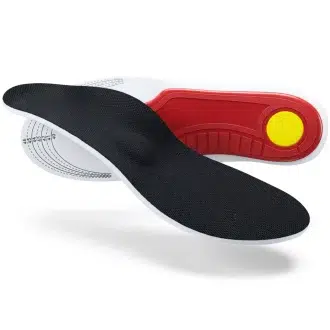
Orthotic Arch Support Insoles
An arch support insole is a shaped insert that sits under your foot inside your shoe. It supports the arch, cushions the heel, and changes how your foot meets the ground. The main points you should know are:
-
- Shaped inserts that sit inside your shoe, under your foot
-
- Support the arch and cushion the heel
-
- For adults with foot pain linked to how the foot rolls during walking or running
-
- Also for aching, tired feet after long spells of standing or walking on hard surfaces
-
- Range includes firmer designs for feet that roll inward heavily
-
- Softer designs for feet that roll outward, or that have a high, stiff arch
-
- Shaped heel area holds the heel steady inside the shoe
-
- Raised heel edges take part of the impact of landing where featured
-
- Helps limit how far the arch flattens under your weight
-
- Helps reduce the pull on the plantar fascia with each step
-
- Some designs are trimmable; others are sized to your shoe
-
- Start with an hour a day and build up gradually
-
- Not a cure; if pain is sudden, severe, or does not settle, speak to a GP, physiotherapist, or podiatrist
Arch Support Insoles: Understanding Foot Pain and How Support Can Help
If your feet hurt, it changes what you can comfortably get done in a day. Foot pain rarely stays in the foot. That ache under the arch that appears after a long walk, the heaviness that builds through your legs by the afternoon, the soreness that lingers the day after a run — these are common experiences, and they usually come down to the way your foot meets the ground. Getting to the shops, playing a sport you enjoy, or simply keeping up a normal pace all get harder when your feet hurt, and the discomfort can reach your knees, hips, and lower back as well.
Pain is a signal that a load is being placed on part of your body in a way it can’t manage well. It does not automatically mean damage. More often, it means the weight of each step isn’t being spread across the sole the way it should be, and the tissues carrying the extra work are the ones that end up sore.
Arch support insoles are one of the simplest tools for changing how your body weight is spread across the sole. An arch support insole is a shaped insert that sits inside your shoe, under your foot. It supports the arch — the curved section along the inside of the foot — and cushions the heel. Used well, it can help your foot move closer to a balanced position, take strain off the soft tissues that hold the arch up, and reduce the forces travelling up the leg.
They are not a cure, and they won’t suit every type of foot pain. But for adults whose discomfort is linked to how their foot rolls during walking or running, they can make a real difference. At NuovaHealth, the range of arch support insoles is affordable, easy to wear in everyday shoes, and shaped to hold the arch and cushion the heel through normal daily movement.
Before you decide whether they’re right for you, it helps to know what your foot is actually doing with each step, and what changes when that movement goes wrong.
What Happens in Your Foot During a Normal Step
Every step follows the same sequence, and the whole thing takes less than a second. Understanding that sequence makes it much easier to see where things can go wrong, and why the same walking or running pattern can produce pain in very different places for different people.
The sequence starts when your heel touches the ground. This is called heel strike. Your foot meets the ground at an angle, heel down and toes up, and your body weight arrives on top of it. Right then, the foot isn’t yet rigid. It needs to give slightly so the impact of landing isn’t passed straight up your leg.
Within a fraction of a second, your foot rolls inward at the ankle. The arch lowers slightly, and the sole makes broader contact with the ground. This inward roll is called pronation. Pronation is a normal part of walking, not a fault. Its job is to absorb the force of your body coming down and to let your foot adapt to the surface you’re walking on. On slightly uneven pavement, or when you step off a kerb, pronation lets the foot shape itself to the ground rather than sit rigidly on top of it.
As your body weight moves forward over your foot, the foot begins to roll back the other way. It rolls outward at the ankle, the arch rises, and the foot becomes more rigid. This outward roll is called supination. During this phase, the foot firms up to give you something to push off from. That firmness is what lets you drive forward from your toes. Without it, your push-off would be soft, and you’d have to work harder with each step.
Then your toes leave the ground, your foot swings forward, and the sequence begins again on the other side. During walking, one foot is always in contact with the ground, so the tissues in the foot, ankle, and lower leg are working almost continuously. During running, there’s a brief moment when neither foot is touching anything, and the force through the foot when it lands is significantly higher.
Most foot pain starts with what the arch does during that sequence. The arch isn’t just a shape. The curved section along the inside of your foot is formed by the bones of the midfoot, held together by strong bands of tissue. The most substantial of these runs along the sole from the heel to the ball of the foot. It’s called the plantar fascia. Alongside it, tendons coming down from the lower leg attach into the bones of the arch. Between them, these structures control how far the arch flattens when you take your weight, and how quickly it rises back up.
When your foot takes your weight, the arch lowers slightly. The tissues along the sole stretch, and that stretch stores energy. As you push off, the arch rises and the stored energy is released, adding to the force that carries you forward. So the arch does two jobs at once: it absorbs the shock of landing and returns energy for the next step. When it works properly, both jobs happen within a small amount of movement in each direction. The tissues involved are never asked to do more than they’re built for. On a hard, flat surface like pavement, the arch has to manage the whole load itself, with no give from the ground underneath. On softer, more uneven ground, the foot shifts more from step to step, so the arch lowers and rises differently with each step.
One of the tendons that helps hold the arch up runs down the inside of the ankle and attaches into the midfoot. It’s called the tibialis posterior tendon. When you stand or walk, it’s one of the main structures resisting how far the arch flattens under your weight. Other tendons on the outside of the ankle pull the foot outward, against that inward roll. When these opposing pulls are balanced, the foot moves through its step in a controlled way, and the load spreads evenly across the sole.
A normal step therefore depends on three things: a controlled amount of inward roll, a controlled amount of outward roll, and an arch that lowers and rises within a normal range. When any of those three is off, the foot compensates, and the compensation has to go somewhere. Most of the time, that somewhere is the structures above the ankle.
When the Foot Rolls Too Far In or Too Little
The two most common ways this goes wrong are overpronation and supination. It helps to be precise about what each one means, because the two don’t behave the same way in the body.
Overpronation is when your foot rolls inward too far, or for too long, during the step. Instead of a brief inward roll to absorb shock, the arch collapses further than it should, the ankle rolls inward, and the foot stays in that flattened position as your body moves over it. The tissues on the inside of the foot are stretched with every step, and the tibialis posterior tendon — the one that normally helps hold the arch up — is working against a load it wasn’t designed to manage on its own. People with this pattern often describe their feet as tiring quickly, or as feeling flat and achy by the end of the day. It’s usually worse after time on hard pavements or a long stretch of standing at work.
What happens above the ankle follows from this. When the foot rolls inward, the lower leg bone rotates inward with it. That bone is the tibia, the main bone of the shin. This isn’t a choice your body makes. The foot and lower leg are connected through the ankle joint, so rotation at the ankle carries up into the shin. As the tibia rotates inward, the knee follows into a slight inward twist. The knee is built to bend and straighten, not to rotate, so this twist loads the soft tissues around the kneecap and the joint lining in a way they aren’t designed for. If you go up and down stairs several times a day, or you’re on your feet at work, that repeated twist is happening hundreds of times, and the tissues around the knee don’t get long to settle between repetitions.
Further up, the thigh bone rotates inward as well. That bone is the femur. The hip joint is a ball-and-socket joint, which means the rounded top of the femur sits inside a socket in the pelvis and can rotate in several directions. It tolerates rotation well, but the muscles around the hip — particularly those on the outer side — have to work harder to control where the leg is going. If those muscles tire, the pelvis can tip forward or drop on one side. That change in the pelvis alters the curve of the lower back, and the muscles and joints of the lower back take on strain they wouldn’t otherwise carry.
With supination — sometimes called underpronation — the pattern runs the other way. Your foot doesn’t roll inward enough, or it rolls outward too much, so your weight stays over the outer edge instead of spreading across the sole. The arch often stays high and stiff. This reduces the foot’s ability to absorb shock, because the cushioning effect of a foot that gives inward is missing. Force arrives at the heel and travels up the leg with less of it being spread or softened on the way. People with this pattern often notice the outer edge of the foot feels bruised after longer walks, and the ankle can feel less reliable on uneven ground.
With supination, the ankle tends to roll outward. The ligaments on the outside of the ankle are stretched with each step, and the foot is less able to adapt to uneven ground. The tibia rotates outward rather than inward, which pushes the knee into a different kind of strain, concentrating load along the outer side of the joint. Higher up, the pelvis can tilt in the opposite direction to the overpronation pattern, and the lower back compensates in a different way.
The two patterns start in opposite directions, but they produce the same effect further up the leg. Foot alignment sets the direction of rotation for the shin, thigh, and pelvis. When the foot rolls too far in or far out, that rotation travels up the leg, and the body has to find a way to stay upright and keep moving. It does that by making other muscles, tendons, and joints do more of the work. Those tissues can manage for a while. Over thousands of steps a day, across months and years, they may not.
The same pattern often produces pain some distance from the foot. Someone with overpronation may notice knee pain on the inner side, or an ache across the lower back after a long walk, without connecting it to their feet. The pain is real, but the strain began lower down, where the foot first rolled too far.
Where You Are Likely to Feel It
If alignment is playing a part, the symptoms tend to follow the same map. This isn’t a way to diagnose yourself. It’s a way to see whether what you’re noticing fits the pattern, so you can judge whether an insole is worth trying.
The most common place is the foot itself. With overpronation, soreness usually sits along the inside of the arch and into the heel, because the plantar fascia is being stretched further with every step than it should be. The inside of the ankle can ache as well, especially after a longer walk or a day spent standing. With supination, the soreness runs along the outer edge of the foot and the outer side of the ankle, where the ligaments are being pulled. It often feels like a bruise under the outer part of the sole.
The next place you’re likely to notice it is the lower leg. A steady ache along the inner border of the shin is common with overpronation, because the muscles attached to the shin bone are being pulled repeatedly as the tibia rotates inward with each step. It tends to build through activity rather than appearing at the start. If your foot underpronates instead, the soreness sits on the outer side of the lower leg.
At the knee, many people first realise something is wrong. What you notice is an ache under or around the kneecap, and it’s worse going up or down stairs, or after longer activity. It can build through the day and often eases when you sit down for a while. With supination, the soreness moves to the outer edge of the knee.
Hip discomfort usually comes on gradually rather than suddenly. Both patterns make the hip muscles work harder to control rotation, and the result is often tightness or a deep ache around the outer side of the hip. It builds through the day, and it’s usually worst after a long stretch of walking or standing.
The lower back is often where the strain ends up. A heavy ache that’s worse after standing or walking for a long stretch — and often worse by evening — is a common sign that the pelvis is tilting or the lower back is having to compensate. It often eases when you sit or lie down, and then returns once you’re back on your feet.
Not everyone will feel all of this. Some people have a foot that rolls excessively and never develop pain above the foot. Others feel it only at the knee, or only in the lower back. Your structure, your activity, your shoes, and how much time you spend on your feet all play a part.
Why Arch Support Insoles Can Help
If the problem is a foot that rolls too far in or too little, an insole is one way to change how the foot meets the ground. It won’t change the direction your foot moves. It can reduce how far it moves in that direction with each step.
An arch support insole sits between your foot and the shoe. It gives you a shaped surface under the arch, so the foot rests on a contour close to its natural curve rather than flat against the shoe base. Under the heel, it adds a layer of cushioning that softens the arrival of body weight. Because the insole isn’t compressing into the shoe base under your full weight, the arch is less likely to collapse beyond the point it should. The tissues along the sole, including the plantar fascia, are under less tension with each step. Less tension means less of the pulling that produces soreness after time on your feet.
If you overpronate, the raised section under the arch gives the inside of your foot a surface to rest against. That support limits how far the arch can flatten and how far the ankle rolls in. Over a whole day of walking, the difference at each step is small, but it adds up. Your feet may feel less heavy and tired by the evening, and the ache in the shin after a day on your feet may arrive later in the day than it used to.
If you supinate, the cushioning under the heel and forefoot spreads the arrival of force across a wider area, and the arch support encourages the foot to bear weight more evenly. That helps feet that normally stay rigid over the outer edge, because the tissues on the outer side of the foot and ankle are no longer taking the whole load of each landing. The usual result is less bruising along the outer sole after longer walks.
There’s one thing an insole can’t do. It can’t change the bones. If your arch is structurally high or low, an insole won’t reshape it. What it can do is support the soft tissues — the plantar fascia, the tibialis posterior tendon, the muscles that control the arch — so they’re not doing more work than they can comfortably manage. It can also reduce how much of that twist reaches the shin, knee, and hip, because the foot is rolling less to begin with.
An insole is a support, not a treatment. If your pain comes from alignment, supporting the alignment can reduce the strain, and reduced strain often means reduced pain. If the pain comes from something else — an injury, a joint condition, a nerve problem — an insole is unlikely to be the answer, and the discomfort may continue. So it’s worth treating insoles as one part of managing foot pain, alongside supportive shoes with a firm heel and enough room for the foot, and, where needed, advice from a clinician.
How Our Range Is Designed to Support the Foot
All the insoles in the range share a few key features, but the specific details vary from product to product. Not every product has every feature, and the details of each one are worth checking before you choose.
Every insole in the range has a shaped section under the arch. What that section does is give the inside of your foot a fixed surface to rest against as you take your weight, so the arch can’t flatten as far under your weight. The height and firmness of that support differ between products. A more pronounced, firmer arch gives you more control over how far the foot rolls inward. It tends to suit feet that flatten heavily, or people who spend long hours standing on hard floors and notice their feet roll in more as the day goes on. A gentler, more flexible arch gives a softer feel, and it suits feet that need cushioning more than control.
Most designs also have a shaped area around the heel. This does two jobs. It holds the heel in a consistent place inside the shoe, so the foot starts each step from the same position instead of sliding inward or outward. Where the design has raised edges, it also takes part of the impact when your heel lands, which lowers the force passed up through the shin. A heel that’s held steadily gives the foot less room to roll in either direction. That helps if you notice your ankle turning in or out as you walk.
The materials vary across the range, and that variation changes how the insole behaves under load. Firmer materials give more structural support and hold their shape longer when they’re being pressed down under your full body weight, step after step. Softer materials feel more comfortable underfoot and are often easier to tolerate at the beginning, but they compress more quickly, so the support under the arch reduces over time. Some designs combine a firmer base layer with a softer top surface, so the support sits underneath and the comfort sits directly under your foot. The practical difference is this: a firmer insole holds its support for longer, while a softer one feels gentler at first but needs replacing sooner.
Some products can be trimmed to fit your shoe. Cut these in small steps from the front edge only, following any guide printed on the base. Others come in set sizes and should be chosen to match your shoe size.
If you need a particular level of arch height, firmness, or heel control, check the details of the individual product. If you’re unsure which suits your foot, a moderate design is the safer starting point, and a clinician can help if you have specific needs.
Whether These Insoles Suit You, and How to Choose
Signs that alignment may be playing a part
There are a few things you can check at home. Start with the soles of a pair of shoes you’ve worn regularly for several months. If the wear is concentrated along the inner edge, your foot is likely rolling inward more than it should. If the wear sits along the outer edge, the opposite is likely true. Even wear across the sole suggests your alignment is closer to neutral, in which case insoles may help less with alignment, though they can still cushion impact.
Then look at your feet while standing. Stand as you normally would and look down. If you can see very little of your arch, or your ankles lean inward, that points towards overpronation. If your arch stays high and most of your weight seems to sit on the outer edge of the foot, that points towards supination.
Finally, think about when the pain comes. Discomfort that builds through a day of walking, or that appears in the shin, knee, or lower back after time on your feet, fits the pattern described here. Pain that arrives suddenly after a specific incident, or that’s present at rest, does not, and should be checked by a clinician.
These are observations, not a diagnosis. They’re enough to decide whether it’s reasonable to try an insole, but they can’t tell you what’s causing your pain.
Matching the insole to your foot
If your foot rolls inward heavily, look for a product with a firmer, higher arch section and good heel stability. The firmer arch gives the inside of your foot more to work against, and the heel stability stops the foot starting each step from a rolled-in position. Together, they limit how far the arch can flatten. That reduces the repeated stretch on the plantar fascia and the load on the tibialis posterior tendon.
If your foot rolls outward, or if you have a high, stiff arch, cushioning is the priority. A softer, more flexible insole reduces the shock reaching the heel and forefoot without adding rigidity that would make the foot less able to adapt to the ground. You want the foot to be able to give slightly on landing, because that’s what softens the impact before the force travels up the shin.
If you’re not sure, a balanced design — moderate arch support with reasonable cushioning — is a sensible starting point. Many people find that enough.
How your activity changes what your feet need
Walking is low impact but high repetition. Thousands of steps a day add up, and small alignment issues tend to show up as tired, achy feet by the end of the day rather than sharp pain. The tissues aren’t being overloaded once. They’re being loaded slightly too much, again and again, without a long enough break to settle. A supportive insole changes the load at every one of those steps, which is why the benefit often comes through as being able to stay on your feet longer before the ache arrives.
Running raises the force considerably. The load through the foot at landing is much higher than in walking, and it arrives in a much shorter time. Cushioning and stability count for more here, because the inward or outward roll happens faster and with greater force. If you run, the insole you choose needs to handle repeated high loads without flattening out, and heel stability becomes more important because the ankle is being asked to control the foot under a bigger load.
Sports with plenty of side-to-side movement, such as tennis, put a different demand on the foot. The ankle is asked to hold against sideways forces, and a design with good heel stability gives the foot something to push against. A soft insole that compresses easily will offer less here, because it lets the foot move further sideways before it’s held.
If you use different shoes for different activities, it’s worth having an insole for each pair rather than moving one set around. Moving an insole between shoes frequently can distort its shape and reduce how well it fits either pair.
Getting the Fit Right and Looking After Your Insoles
Start by checking that your shoe has enough room. The best approach is to take out the existing insole if it’s removable, and use the arch support insole in its place. Adding an insole on top of an existing one often makes the shoe too tight across the top of the foot, which presses on the foot and can reduce circulation.
If the insole needs trimming, cut from the front edge only, in small amounts, following the guide on the base if there’s one. Check the fit after each cut. It should sit flat, with no curling at the edges and no fold under the toes. If the insole isn’t sitting flat, the arch support won’t be in the position it was designed for, and you won’t get the benefit from it.
Once it’s in place, press the insole down firmly along its length so it settles against the base of the shoe. It shouldn’t slide forward when you walk, and it shouldn’t lift at the heel. A heel that lifts lets the foot move inside the shoe, which reduces the stability you’re trying to add.
Give your feet time to adjust. The insole changes where your foot sits in the shoe and how your muscles are working, and your feet will notice the difference. Begin with an hour a day and add an hour each day after that, or build up more slowly if you prefer. Mild aching in the arch is common in the first few days and usually settles. Sharp pain, numbness, or tingling is not normal. If you get any of those, take the insoles out and rest your feet. If it continues, speak to a clinician.
Shoe choice affects how well any insole works. Shoes with a removable footbed and a reasonably firm heel hold an insole in place far better than soft, flat styles. Lace-up shoes let you adjust the fit across the top of the foot, which helps once you’ve added a layer under your foot. Very flat shoes and open styles generally don’t hold an insole securely, so the insole shifts as you walk and the support moves out of position.
When you come to look after them, keep the insoles clean by wiping them with a damp cloth and mild soap, then let them dry completely before putting them back in your shoes. Don’t put them through a washing machine or a tumble dryer, as heat can distort the materials and reduce the support they give. Check them periodically for flattening under the arch or worn-through cushioning at the heel. Once the support has compressed, the insole is doing very little and should be replaced. How long that takes depends on how often you’re on your feet with them in, and how much load they’re carrying.
What to Expect and How Long It Takes
Some people feel a difference within the first few steps. Others notice nothing for two or three weeks, and then realise the ache that used to build by mid-afternoon is no longer arriving. Both are normal.
The amount of change you feel depends on how much of your pain is driven by alignment. If alignment is the main factor, insoles can produce a noticeable improvement. If alignment is only part of the picture, or if your pain has another cause, the effect will be smaller or absent. Either way, it’s a change you notice over days and weeks rather than one you feel in your very first step. The insole is changing the load pattern while it’s in your shoe, and your tissues respond to that over time.
Insoles work through consistent use. Wearing them for a day and putting them aside because nothing changed is unlikely to tell you anything useful. Wear them daily in the shoes you use most, through the activities that normally bring on your symptoms, and give it a few weeks before you judge.
When to Seek Help
Arch support insoles are safe for most adults, but there are times when you should get advice from a clinician before using them, or instead of using them. The reason is the same in each case: an insole can support a foot that’s being loaded unevenly, but it can’t assess or treat a problem that needs looking at directly.
-
- If you have a medical condition that affects your feet, or you’re unsure whether insoles are suitable for you, speak to a GP, physiotherapist, or podiatrist first.
-
- If your foot pain came on suddenly, followed an injury, or is severe, see a GP, physiotherapist, or podiatrist rather than trying to manage it with insoles.
-
- If you develop pain, numbness, or tingling while wearing insoles, take them out and speak to a clinician.
-
- If your pain hasn’t improved, or has got worse, after several weeks of consistent use, make an appointment.
Where This Leaves You
Foot pain linked to how your foot rolls is often manageable, and arch support insoles are one of the simpler ways to change how your foot meets the ground. They support the arch, cushion the heel, and reduce how much rotation travels up through your shin, knee, hip, and lower back. They are a support tool, not a treatment, and they won’t suit every type of foot pain.
At NuovaHealth, the range of arch support insoles is designed for adults who want to support their feet during everyday walking, running, and sport without a large outlay or a prescription. If the signs suggest alignment is part of your problem, choosing a suitable pair and wearing them consistently for a few weeks is a reasonable first step. Check the product details for arch height, firmness, and heel stability, and follow the guidance on fit and build-up before you judge whether they’re helping.
If it doesn’t help, or if your symptoms are severe, sudden, or getting worse, get them looked at. There are times when what you need is a proper assessment rather than a support.
Disclaimer
The information on this page is general guidance on arch support insoles and common foot pain linked to how the foot rolls when you walk or run. It is not a substitute for individual medical advice, diagnosis, or treatment. If you are unsure whether insoles are suitable for you, or if your symptoms are new, severe, or not settling, speak to a GP, physiotherapist, or podiatrist for advice that is personal to you. No specific outcome is promised or guaranteed.
-
Plantar Fasciitis Orthotics – Shoe insoles for Arch, Heel & Foot pain
- A pair of trim-to-fit orthotic insoles for plantar fasciitis and related foot pain
- Shaped to support the arch, cushion the heel, and limit inward roll of the foot
- The arch support reduces the repeated stretch on the plantar fascia with each step you take
- 3/4-length semi-rigid shell sits under the arch and stops before the toes
- Solid heel cup spreads impact and holds the heel steady through each step
- Dual-layer foam cushioning — softer top layer, firmer base layer
- Shaped midfoot bridge fills the space under the arch when the arch drops under load
- Forefoot pad softens the transition as weight rolls from heel to toes
- Breathable top cover wicks moisture away, helping keep the inside of the shoe dry and fresher
- Smooth edges reduce rubbing through the day
- Trim-to-fit markings for a precise fit in your own shoes; available in UK sizes 3–7 and 7–11
- Suitable for everyday shoes, trainers, work boots, and walking shoes
- Wear is built up over the first week — a couple of hours on day one, then an hour more each day
- Not suited to very slim dress shoes or shallow flat shoes, and not intended for use during pregnancy
£9.99£11.99inc VAT