
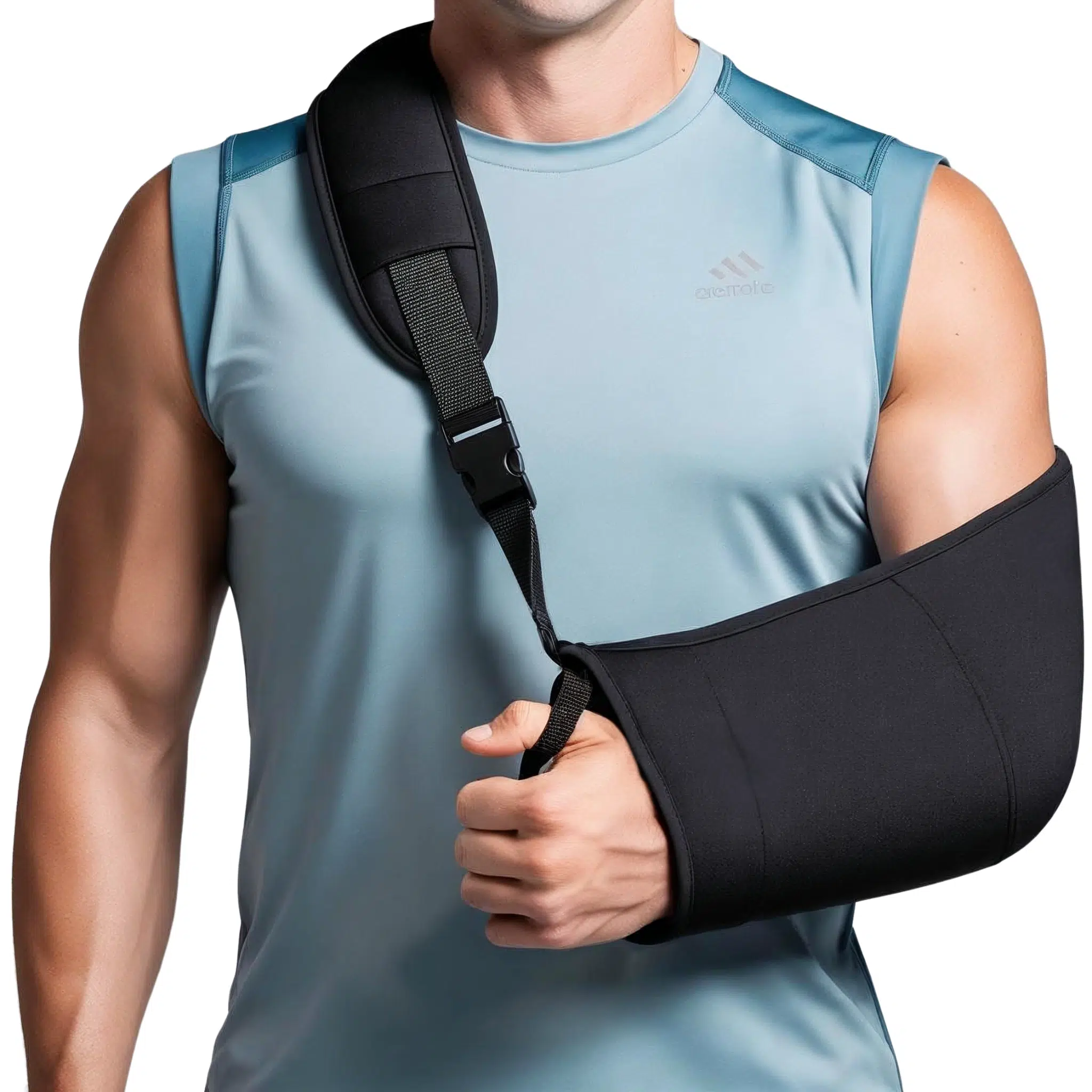
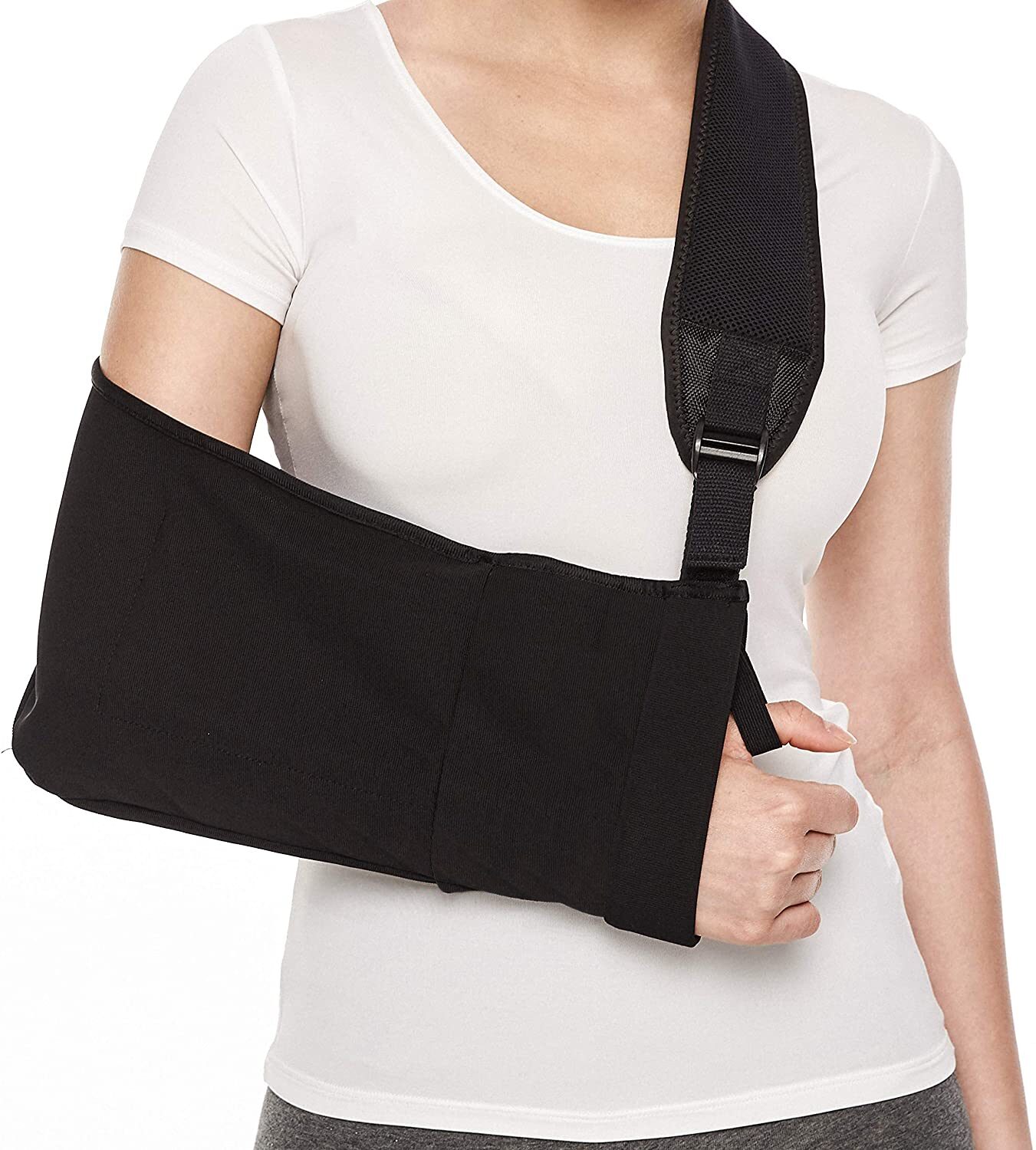
Rotator Cuff Sling
£9.99inc VAT
- Arm sling for adults recovering from shoulder, upper arm, and elbow injuries—suitable for both men and women
- Works for either left or right arm—the same sling fits both sides
- One size fits all with fully adjustable straps that let you modify position as healing progresses
- Supports rotator cuff tears, shoulder dislocations, labral tears, tendonitis, AC joint separations, collarbone fractures, upper arm fractures, tennis elbow, and post-surgical recovery
- Holds your arm in a protected position where torn tendons, ligaments, and capsule can form scar tissue without constant mechanical stress
- Padded shoulder strap spreads your arm’s 4-5kg weight over a broader area—prevents the sharp, digging-in pain that makes you want to take it off after a few hours
- Adjustable buckle lets you raise or lower your forearm to encourage fluid drainage early on, then modify position as you begin rehabilitation exercises
- Breathable fabric reduces heat build-up and moisture accumulation during 12-14 hour daily wear—keeps skin drier and reduces risk of irritation and breakdown
- Thumb loop anchors your hand and prevents your forearm from sliding forward when you lean or move—maintains correct elbow angle throughout the day
- Reinforced stitching at stress points prevents seams from separating under repeated use—critical where the cradle attaches to the strap and where the strap connects to the buckle
- Typically worn continuously for 4-6 weeks during initial healing, then progressively reduced as your GP or physiotherapist guides you through rehabilitation
- Check circulation and skin condition regularly—loosen or remove if you notice numbness, tingling, colour changes, or persistent pressure marks
- Use as part of a treatment plan guided by your GP, physiotherapist, or surgeon—not a substitute for professional medical advice
- 30-day money-back guarantee—if the sling doesn’t meet your needs, contact us for a full refund or replacement
Why your arm is so hard to rest
Anyone who has injured a shoulder, upper arm or elbow finds out quickly that deciding not to move the arm isn’t enough. The arm still hangs from the shoulder, and every moment you’re upright, gravity pulls on it.
An injured leg can be supported on crutches so it doesn’t carry your body weight. A sprained wrist can be immobilised in a splint. But your arm hangs from your shoulder, and every time you stand, sit, reach or move through the day, gravity pulls on it. The arm weighs roughly four to five kilos, and that weight has to be carried by the shoulder joint, the muscles around it, and the tendons and ligaments that hold everything together.
When those structures are injured, they can’t handle that load. Even small movements you barely notice — shifting in a chair, reaching for a cup, pulling on a sleeve — create tension at the injured area. That doesn’t necessarily mean a sharp, obvious pain. It can show up as a deep ache, a sense of strain, or a sense that the arm is never fully at ease. By the end of the day, the repeated small pulls add up.
The result is that an injury which should be healing keeps being disturbed. Your body starts to repair the damage, but every time the arm moves or takes weight, the healing tissue is pulled, stretched or compressed again. That slows progress down. In some cases, it can make the injury worse.
Gravity is a constant downward pull. It doesn’t stop when you sit down, and it doesn’t ease off when you try to keep your arm still. Removing that pull from the injured structures is the first step in letting them mend.
A well-designed arm sling breaks that cycle. It holds your arm so that the shoulder, elbow and upper arm don’t have to bear the arm’s weight. That gives the damaged structures genuine rest from the arm’s own weight — not just a rest from heavy lifting, but a rest from the constant downward pull that continues all day.
Why injured tissue needs this sort of protection
To understand why a sling helps, it helps to know a little about how the body repairs itself.
When a tendon is torn, a ligament is sprained, or a bone is fractured, your body immediately starts laying down new tissue across the gap. In the first few weeks, that repair tissue is not strong, organised or mature. It starts as a soft, delicate mesh of collagen fibres, and that mesh is easily disrupted by movement, tension or load.
If you pull on it too soon, the fragile fibres can separate. If you repeatedly stretch it, the fibres don’t get a chance to line up properly. Instead of forming neat, organised tissue that can eventually tolerate normal loads, the area can end up with a weak, haphazard scar that stays painful far longer than expected.
That risk is especially high around the shoulder and elbow, where tendons and ligaments are almost never completely slack.
Take a rotator cuff tendon, for example. Its job is to help move the shoulder and keep the joint stable. When that tendon is torn, you might not be doing anything strenuous. The simple weight of your arm hanging at your side is enough to pull on the torn edges. The same applies to an inflamed tendon at the elbow, where the weight of the forearm pulls on the irritated attachment. It also applies to a fracture where gravity is pulling bone fragments out of alignment.
Immobilisation does not mean you have to lie still. It means removing the forces that interfere with early repair. By holding your arm in a supported position, a sling keeps the injured structures in a relaxed, neutral alignment. The torn edges can sit close together. Repair tissue can form without being stretched or compressed. Swelling and inflammation have a chance to settle instead of being moved around with every shift.
That is why the first few weeks of recovery matter so much. Your body needs a protected period to build strong enough new tissue, followed by a carefully staged return to movement to restore range and strength.
How a sling helps
A sling is one of the most direct ways to give your shoulder, arm or elbow that protection.
The basic idea is simple. Your forearm rests in a cradle, and the cradle is supported by a strap that runs across the opposite shoulder. Your arm is then held close to your body, with your elbow bent to about ninety degrees and your hand resting near your chest.
Why does that position matter? Because it takes the arm’s weight off the injured structures. Instead of the shoulder joint holding the arm down against gravity, the strap carries that load. The muscles and tendons around the shoulder can relax. The elbow is supported rather than hanging freely. Any movement you do make — getting up from a chair, walking from one room to another — does not suddenly jolt or pull the injured area.
There’s another effect that matters too. When damaged tissue is repeatedly stretched or compressed, it becomes more inflamed. Inflammation brings pain, and pain makes you guard the area. But guarding alone isn’t enough. You can hold your arm stiffly by tensing your shoulder muscles, and that in itself creates fatigue, discomfort and tension. A sling lets you stop guarding because the support is doing the work for you. Your shoulder muscles can relax, and that relaxation itself reduces pain and fatigue.
That combination — less gravitational load, less inflammation, less guarding — explains why a properly fitted sling can make such a difference in the early stage of many shoulder, arm and elbow injuries.
It’s also the reason the sling should be worn consistently during your waking hours. Taking it off for a couple of hours here and there may not seem to matter, but every time you take it off the arm hangs under its full weight. For a healing tendon, ligament or fracture, that repeated stretch can disrupt newly forming tissue and set recovery back.
The angle at which the arm rests changes how much pull reaches the injured structures. Supporting the forearm across the chest reduces tension on certain tendons and ligaments, but it doesn’t suit every shoulder or elbow problem. Some conditions need the arm held further out from the body, and some need a support aimed at the wrist or hand rather than the shoulder. That’s why professional assessment matters before deciding which sling is right for you.
Is this sling for you?
This sling is designed for adults recovering from injuries around the shoulder, upper arm and elbow, where holding the arm in a supported, close-to-body position helps tissue heal.
It works for either the left or the right arm, and the same design suits both sides. If your right arm is injured, the strap goes over your left shoulder. If your left arm is injured, the strap goes over your right shoulder.
For shoulder problems, a sling like this is often used during early recovery from a rotator cuff tear (partial or complete), after a shoulder dislocation or subluxation, or after a labral tear — including a tear at the top of the socket where the biceps tendon attaches, sometimes called a SLAP tear. It can also support the arm during the intensely painful early phase of frozen shoulder, and for shoulder tendonitis or pain under the bony arch at the top of the joint (subacromial pain). You may be given one after an AC joint separation or after shoulder surgery such as a rotator cuff repair, labral repair, or a stabilisation procedure.
For elbow and upper arm problems, supporting the forearm in this way helps with tennis elbow, golfer’s elbow, elbow sprains and strains, biceps tendon tears and tendonitis, and forearm fractures, as well as recovery after elbow surgery.
You may also be advised to use a sling after a collarbone fracture, an upper arm fracture, or another soft tissue injury, or after any shoulder, arm or elbow surgery where a period of support is part of the plan.
The key point is that you have been properly assessed. The sling supports the arm, but it can’t tell you what’s wrong. Shoulder pain has many possible causes, and not all benefit from the same treatment. If your injury hasn’t yet been examined by a GP or physiotherapist, that should be your first step.
When a sling may not be appropriate
There are also situations where a sling like this is not the right answer.
If the main problem is in your wrist or hand, you’ll usually need a specific wrist support or splint rather than an arm sling. If you’ve been told that your shoulder needs to be held away from your body in an open position, a standard sling across the chest is not enough — the joint needs to be supported differently. And if your clinical team has advised against immobilisation because movement is needed early, wearing a sling may delay your recovery rather than help it.
If you’re not sure whether this type of sling fits your situation, check with your GP or physiotherapist. They can tell you whether your arm should be supported at all, and if so, in what position.
How this sling is designed for real recovery
The idea of a sling is straightforward, but wearing one well over several weeks is harder than it sounds. You may be in it for twelve to fourteen hours a day, every day, for weeks. If it isn’t comfortable, you’ll start adjusting it, loosening it or taking it off altogether, which defeats the purpose. So the design focuses on making all-day support comfortable enough to wear for the hours you need it.
Padded shoulder strap
The strap across your opposite shoulder carries the whole weight of your arm throughout the day. A thin, unpadded strap can feel fine for the first hour or two, but by mid-afternoon it tends to dig into the skin and compress the tissues underneath. By the end of the day, the area can feel bruised and sore — and that discomfort becomes as distracting as the original injury.
The padding spreads the load over a wider area, reducing pressure on any single point. The padded section sits across the fleshy part of the opposite shoulder, between the neck and the point of the shoulder, where the body can carry weight without pressing on bone or pinching the nerves and blood vessels near the neck.
When the strap doesn’t dig in, you’re far more likely to wear the sling for the hours your recovery needs.
Adjustable buckle
The arm doesn’t need to sit at exactly the same height during every stage of recovery.
In the early days, keeping your forearm level with or slightly higher than your elbow encourages swelling to drain away. As inflammation settles and you begin gentle movement exercises, you may want to lower your arm slightly to allow a more natural resting position.
The adjustable buckle allows this without changing the fit of the whole sling. Loosen the strap to lower your forearm; tighten it to raise the arm slightly. It also helps the sling fit over different clothing — you’ll need more strap length with a thick winter coat than with a t-shirt.
Being able to change the height matters because your arm won’t need the same level of support in week four as it does in week one. You can make these small adjustments without refitting the whole sling.
Breathable fabric
Your forearm sits in the cradle for many hours each day. If the fabric doesn’t allow air to circulate, heat and moisture build up. Skin that stays damp and warm becomes soft, irritated and prone to chafing.
The fabric used here is breathable, so air can move through it and moisture can evaporate from your skin. That helps prevent the rashes and sore patches that can develop when a support stays pressed against the body for hour after hour.
Because it is in contact with your skin all day, the sling also needs regular washing. Aim for at least once a week — more often if you’re sweating heavily or the fabric gets soiled. Hand wash in warm water with a mild detergent, rinse well, and let it air dry. Avoid bleach and fabric softener, as they can weaken the fabric and leave residues that irritate skin.
Thumb loop for security
While you’re moving around with a sling on, your hand and wrist can gradually slide forward inside the cradle. That shifts the position of your arm, changes the weight distribution, and can leave your wrist unsupported against the edge of the fabric. This sliding tends to happen just as you stand from a chair or reach forward.
The thumb loop prevents this. When your thumb is in the loop, your hand stays put. Your forearm remains supported along its full length, from elbow to wrist, while you walk, lean forward or adjust your position. The elbow angle stays consistent, and the arm stays where it needs to be.
Without that anchor you’d be repositioning your arm several times a day. With it, the sling remains comfortable whether you’re sitting, standing or walking.
Reinforced stitching at stress points
The points where the cradle meets the strap, and where the strap meets the buckle, carry the full weight of your arm many times a day. Every step creates small movement and friction; every time you stand or sit, the load shifts.
Standard stitching can begin to pull apart under that repeated stress. Over time, threads fray, seams weaken, and the sling becomes less dependable. This sling is reinforced at exactly these stress points, so it can withstand weeks of daily use.
It’s still wise to check the sling each time you put it on. Look at the stitching where the cradle joins the strap and where the strap meets the buckle. If you see loose threads, fraying or separation, stop using it. A sling that fails while you’re wearing it could let your arm fall suddenly, which would pull on newly repaired tissue.
How to wear it well
A good sling only works if it’s fitted properly. Wearing it too loose, too tight, or at the wrong angle can cause discomfort, reduce circulation, or fail to protect the injured area.
Take the time to get this right in the first few wears. Once you’re used to the feel of it, putting the sling on and taking it off becomes quick and straightforward.
Initial fitting
Put the sling on while you’re standing or sitting upright. It can help to have someone else adjust it on you the first time, so you can stand naturally and let your arm relax into the support.
Start by sliding your injured arm into the cradle. Check that your forearm is supported all the way from your elbow to your wrist before you do anything else. You don’t want your forearm hanging unsupported at any point. Next, pass your thumb through the thumb loop, which anchors your hand in place and stops your forearm from sliding forward later. Bring the strap over your opposite shoulder — right arm injured means the strap goes over your left shoulder, and left arm injured means it goes over your right. The strap passes across your back and attaches to the cradle at the front. Then adjust the length of the strap until your forearm sits roughly horizontal, with your elbow bent to around ninety degrees and your hand resting near your chest. Your arm should feel supported and relaxed, not pulled up or left hanging.
Check the padded part of the strap. It should sit across the fleshy part of your shoulder, not press into the side of your neck or sit so far back that it rubs against your shoulder blade.
Position check
Before you settle on a position, ask yourself a few simple questions.
Is your elbow close to your body, not pointing out to the side? A sling should keep your arm snugly against you. If your elbow is floating away from your ribs, your shoulder is still having to work.
Is your forearm fully supported? If your hand or wrist hangs past the end of the cradle, either the sling is too small for you, or your arm isn’t sitting deeply enough into the fabric.
Is your hand level with or slightly higher than your elbow? If your hand is lower than your elbow, you’re putting unnecessary strain on the structures around the top of your arm. Tighten the strap to bring it up. If your hand is very high, loosen the strap slightly.
Finally, how tight is the strap? It should be snug enough to support, but not so tight that it presses a hard line into your shoulder. As a quick guide, you should be able to slide two fingers between the strap and your shoulder. If you can’t, it’s too tight. If the strap slides around freely, it’s too loose.
Removing the sling
When you need to take the sling off — for washing, dressing, or gentle exercise — don’t just let your arm drop out of it.
Use your other hand to support the injured arm before you release the strap. Unfasten the buckle, then gently slide the strap off your opposite shoulder. Keep supporting your forearm as you ease it out of the cradle. Keep your elbow close to your body and avoid any sudden movements.
This is especially important in the early stages of healing, when the repair tissue is still delicate. A sudden, uncontrolled movement can cause a sharp pain and may disrupt the healing site.
Safety around sleep: remove the sling before bed
The sling must always be removed before you sleep or nap, even for short periods.
Wearing an arm sling while lying down is dangerous. The strap crosses your chest and neck area, and during sleep you can move around without realising it. There is a real risk that the strap could become wrapped around your throat, restricting your breathing. This is a strangulation hazard.
Do not wear the sling in bed. Do not doze off in it on the sofa. Do not wear it for any kind of rest where you might fall asleep.
If you need to lie down while wearing the sling, remove it first. Support your injured arm with pillows instead. When lying on your back, place a pillow or rolled blanket under your forearm so the arm is supported at a comfortable height, close to your body. If you prefer to lie on your uninjured side, place a pillow in front of you and rest your injured arm on it, keeping the elbow slightly bent. Avoid lying on the injured side until your clinician says it’s safe.
The sling is for upright, awake use only. Your GP, physiotherapist or surgeon will advise you on how long the arm needs daytime support. At night, the arm should be free of the sling and supported with pillows in a comfortable neutral position.
Adjusting through recovery
You probably won’t wear the sling in exactly the same way from beginning to end of your recovery, and the strap is there to let you fine-tune the fit as things change.
Early on, you may prefer your arm slightly higher, as this helps with swelling. Later, as you begin to move around more, you may want to lower the arm slightly for everyday comfort. You can use the buckle to make those small changes without needing to refit the whole sling.
Your clinician will advise you on when to start reducing sling use. The important thing is not to make that decision on your own. Too much support can stiffen the arm, while too little can delay healing.
What to expect through recovery
Recovery from these injuries tends to happen in stages, and each stage has a different purpose. Knowing what those stages involve can help you understand why the sling is needed at some points and not others.
The early stage: protection
In the first few weeks after an injury, your body is building an early bridge of repair tissue across whatever has been damaged. This stage is mainly about protection. The sling keeps the arm supported during the day and stops the injured structures from being stretched or loaded. Pain and swelling are usually at their highest here, and the sling helps take the edge off both while you’re up and about.
If the sling is taken off too often during the day, or if you’re moving the arm more than your clinician has advised, that early repair tissue is repeatedly disturbed. Healing slows down. So this stage is about being consistent with daytime sling use, even when the arm starts to feel a little easier.
At night, follow the sleep guidance above: no sling, with pillows used to keep the arm supported and close to your body. This reduces the chance of rolling onto the arm or letting it fall into a stressful position. Some people find it helpful to sleep slightly propped up with pillows, which can ease pain and swelling.
The middle stage: introducing movement
As pain and swelling settle, your body starts to strengthen that early repair tissue. This is usually when you may begin removing the sling for short periods during the day, and when your physiotherapist may introduce gentle range-of-motion exercises.
These aren’t meant to stress the healing area. They’re meant to help the tissue remodel in the right direction, maintaining length and flexibility while the sling continues to protect through most of the day.
This stage is a transition. You’re not quite ready for normal use, but you’re past the point where complete rest is needed. The sling becomes more of a part-time support while the arm gradually gets used to safe, controlled movement again.
The later stage: rebuilding strength
Eventually, the injury has healed enough that the sling is no longer necessary for every activity. This is where the focus shifts from protection to rehabilitation. You may be using the arm more, doing guided exercises that load the healing tendons and muscles gradually, and returning to normal daily tasks.
Even at this stage, it’s normal to feel some discomfort, stiffness, or awareness of the injury at the end of certain movements. That doesn’t necessarily mean the repair has failed. It often just means the tissues are still adapting. Your physiotherapist can help you distinguish between normal discomfort from working healing tissue, and pain that suggests you’re pushing too hard.
The risk of stiffness
A sling supports the arm while tissues repair, but wearing it for too long creates its own problems.
If a joint is held in one position for a long time, the soft tissues around it can become tight. Muscles begin to lose strength and size. Movements become stiffer, and the joint may feel as though it has stuck in the position you’ve been holding it in.
That’s why the length of time you wear the sling should be guided by a health professional. They will be monitoring your tissue healing, your pain levels, and your range of movement. The right time to reduce sling use is based on all of those things, not just the calendar date.
If you’re not sure, don’t make the decision alone. Your GP or physiotherapist can advise you on the right time to make changes.
Daily care and simple precautions
Your sling will be worn for many hours each day, so both the sling and your skin need regular attention.
Looking after your sling
Your sling is in contact with your skin for hours each day, so it needs to stay clean.
Wash it at least once a week. If you’re sweating heavily, or if the fabric looks dirty, wash it sooner. Hand wash in warm water with a mild detergent, then rinse thoroughly. Detergent residue left in the fabric can irritate skin during prolonged contact, so take the time to rinse it well.
Air dry the sling flat or hang it to dry. Don’t put it in a tumble dryer, on a radiator, or against a direct heat source. Heat can damage the padding and shrink the fabric.
Before every use, give the sling a quick once-over. Check the fabric for fraying or thinning, particularly at the stress points near the stitching. Test the buckle and make sure it holds firmly without slipping when the weight of your arm is in the cradle. If anything looks worn or damaged, replace the sling. A sling with weakened material may not support your arm safely.
Looking after your skin
Skin that stays under a sling all day can become irritated, so it’s worth checking the contact points regularly.
Twice a day, look at the skin on your shoulder, neck, forearm and hand where they rest against the sling. You’re checking for areas of increased redness, broken skin, blisters, or a rash.
Some temporary redness is normal when pressure is relieved. A red mark that fades within fifteen to twenty minutes after the sling is removed is nothing to worry about. But if marks stay red, if the skin feels sore, or if you can see any areas that are starting to break down, the sling isn’t fitting as well as it should. Adjust the strap, add extra padding over that area, or speak to your physiotherapist about fitting.
If you do notice skin breakdown, stop using the sling until the area heals and get advice on adjusting the fit. It will be easier to fix the problem early than to manage a developing pressure sore.
Safety, warning signs, and when to seek help
A sling worn as directed is safe for most people, but you need to keep an eye on your arm and hand while you’re wearing it. The sling should never cause numbness, tingling, colour changes or increased pain. If you notice any of these, loosen the strap immediately and check whether the symptoms settle.
Circulation checks
Every few hours during the day, check your hand and fingers while you’re wearing the sling.
Look at the colour. Your fingers should look the same as they do on your uninjured hand. If they look pale, bluish, or mottled, blood flow may be restricted.
Feel the temperature. Your fingers should feel normally warm. If they feel cold, the sling may be pressing on blood vessels.
Test your sensation. You should have normal feeling in your fingers. Numbness, tingling, or pins and needles can mean a nerve is being compressed.
Check your movement. You should be able to make a fist and straighten your fingers fully. If you can’t, or if your grip feels weak, that suggests nerve pressure.
If you notice any of these things, loosen the strap straight away. In most cases, that will relieve the pressure quickly. If your symptoms don’t settle within ten to fifteen minutes, remove the sling completely and speak to your GP or physiotherapist the same day.
When to speak to your GP or physiotherapist
You should contact your GP or physiotherapist if:
- your pain gets significantly worse despite wearing the sling as advised
- swelling increases or extends beyond the area that was originally injured
- you develop a fever or feel generally unwell, as this can indicate infection
- numbness, tingling, or weakness in your hand or fingers doesn’t settle when the sling is loosened or removed
- your fingers remain cold, pale, or bluish
- you notice skin irritation that is getting worse, or that develops into open areas
- you’re not sure whether you should continue wearing the sling, or when to begin removing it
These are all signs that the plan may need adjusting. It doesn’t mean your recovery has failed. It just means the approach needs to be fine-tuned.
When to seek urgent medical help
Call 999 or go to A&E if:
- you develop sudden, severe chest pain or difficulty breathing
- your arm suddenly becomes pale, cold, and pulseless, as this may indicate an arterial blockage
- you develop sudden severe swelling, with skin that is hot, red, and extremely tender
These are serious symptoms. They are not common, but they need urgent assessment.
Blood clot awareness
If your recovery is making you less mobile than usual, it’s worth being aware of the signs of a blood clot. Immobilisation, especially of a limb, can increase the risk of a deep vein thrombosis.
You should seek medical advice promptly if you notice pain, swelling, warmth, or redness in your calf or leg, particularly if you also develop chest pain or shortness of breath. These can be signs of a deep vein thrombosis or a pulmonary embolism, and both need urgent medical assessment.
A sling is not a treatment for blood clots. If you have concerns about your risk — because of reduced mobility, a previous clot, or any other factor — raise it with your GP or physiotherapist during your recovery planning.
Understanding common shoulder, arm and elbow injuries
Not every injury in this area behaves the same way, and a sling doesn’t help every one of them for the same reason. The descriptions below give you a clear picture of the injuries where this type of sling is most commonly used — how they feel, what’s happening in the tissues, and how the sling fits into recovery.
A responsible approach to using this sling
This sling is a tool to support your recovery, not a replacement for professional diagnosis, treatment, or clinical advice.
It’s important to use it within a guided treatment plan. Your GP, physiotherapist or specialist will help you decide how long to wear the sling during the day, when to remove it, and when to begin exercising the arm again. Use it for the hours advised, stop when advised, and seek help if you’re unsure.
If you haven’t yet had your injury assessed, a page like this can’t diagnose your injury. Shoulder, elbow and upper arm pain can have many different causes, and some need specific treatment much sooner than others. A GP or physiotherapist can examine you and confirm what you’re dealing with before you decide how to manage it.
The information above is a general guide to how immobilisation and sling support work. It isn’t tailored to your individual situation, and it should always be used alongside the advice of your healthcare team.
Your guarantee
Recovery already takes enough effort. You shouldn’t be worrying about whether the product you’re using is up to the job.
If this sling doesn’t meet your needs within the first thirty days, contact us for a full refund or replacement. No qualifying questions, no complicated process. If it isn’t supporting your recovery effectively, we’ll put it right.
A short note on what happens next
Recovery from a shoulder, elbow or upper arm injury can feel uneven. Some days your arm will feel easier. Other days it will remind you the injury is still there. That’s normal.
What matters most is that you follow a sensible plan. Wear the sling during the day as your clinician has advised. Remove it for sleep. Keep your appointments with your physiotherapist, do the exercises you’re given, and don’t try to rush the timeline on your own.
The sling protects your arm by carrying the weight your shoulder, elbow and upper arm aren’t ready to handle yet. It works best as part of a wider plan: protect the arm, keep moving the joints that are safe to move, and let your healthcare team guide the pace.
With time, most shoulder, arm and elbow injuries settle well enough for you to return to normal life. Rest, done properly, is not a passive waiting game. It is an active contribution to the repair process.
1 Review For This Product
Fast & Secure Checkout Through Paypal
Pay with Paypal the secure payment gateway that accepts all credit and debit cards. Paypal is free and secure and no credit or bank information is ever stored or shared with us.
Fast Dispatch
Enjoy your items soon with quick dispatch via Royal Mail. Expect to have your items between 1-3 working days for domestic orders. 7-10 Working days for international orders.
Return Policy – 30 Day Money Back Guarantee
In the unlikely event, you are unhappy with your purchase you can return it within 30 days for a refund. Please contact us via the form on the contact us page to start your return.
To return an item please send it to: Nuova Health UK, 81 Highfield Lane, Waverley, Rotherham, S60 8AL. Please include a note with your order id so we know who to refund. Please retain your postage receipt as proof of postage. All that we ask is that the item is in the original packaging and unused.
by Morag Poole
Purchased this sling as a spare to the one I got from the hospital after my rotator cuff surgery. I’m really glad I did as this sling offers exceptional support. As soon as you let the sling carry the weight of your arm, the Velcro holds firm and stays secure much better than the hospital one. Money was well spent!!!