

Compression Gloves
£9.99inc VAT
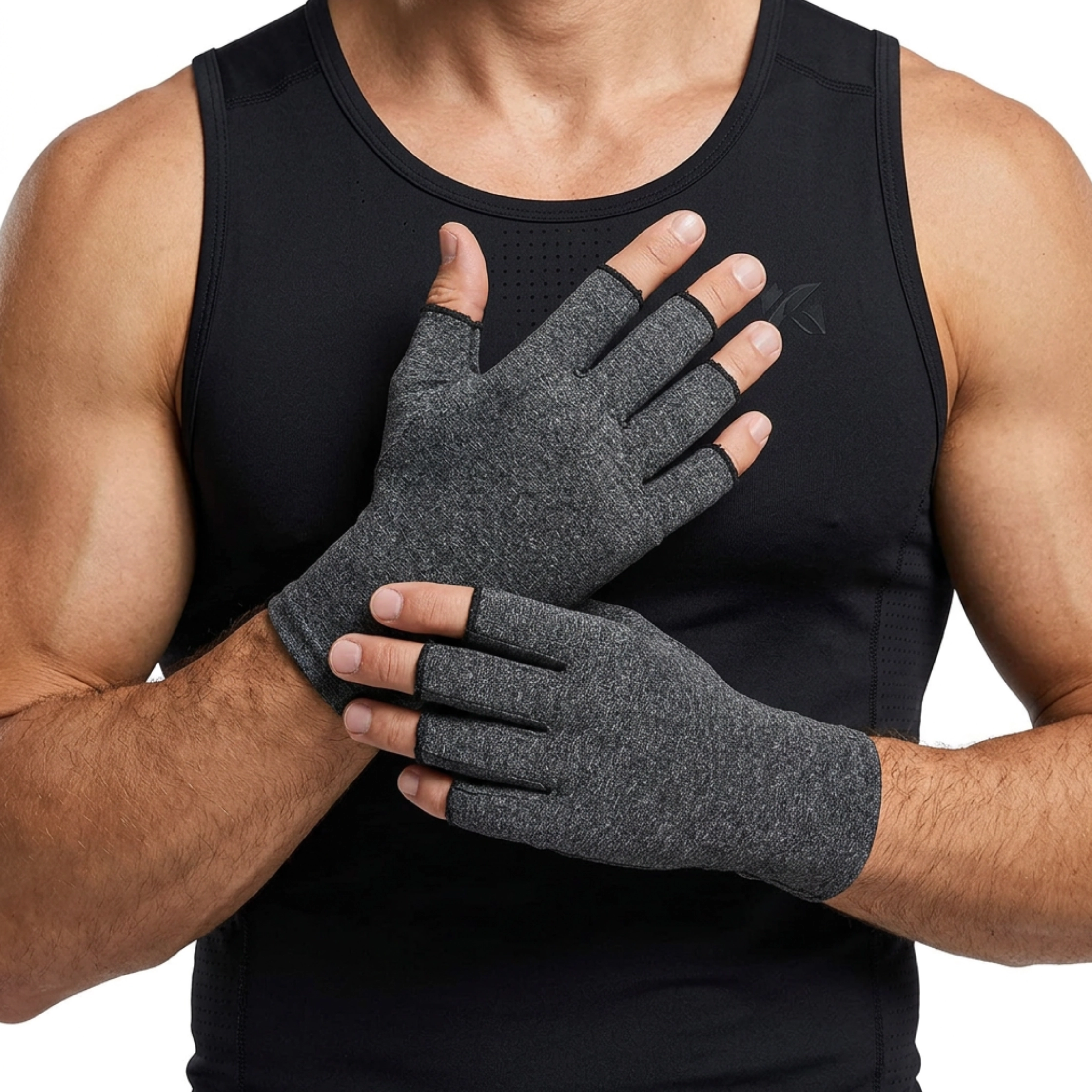
- Compression gloves designed for adults experiencing hand pain, stiffness, swelling, or reduced grip strength
- Suitable for both men and women
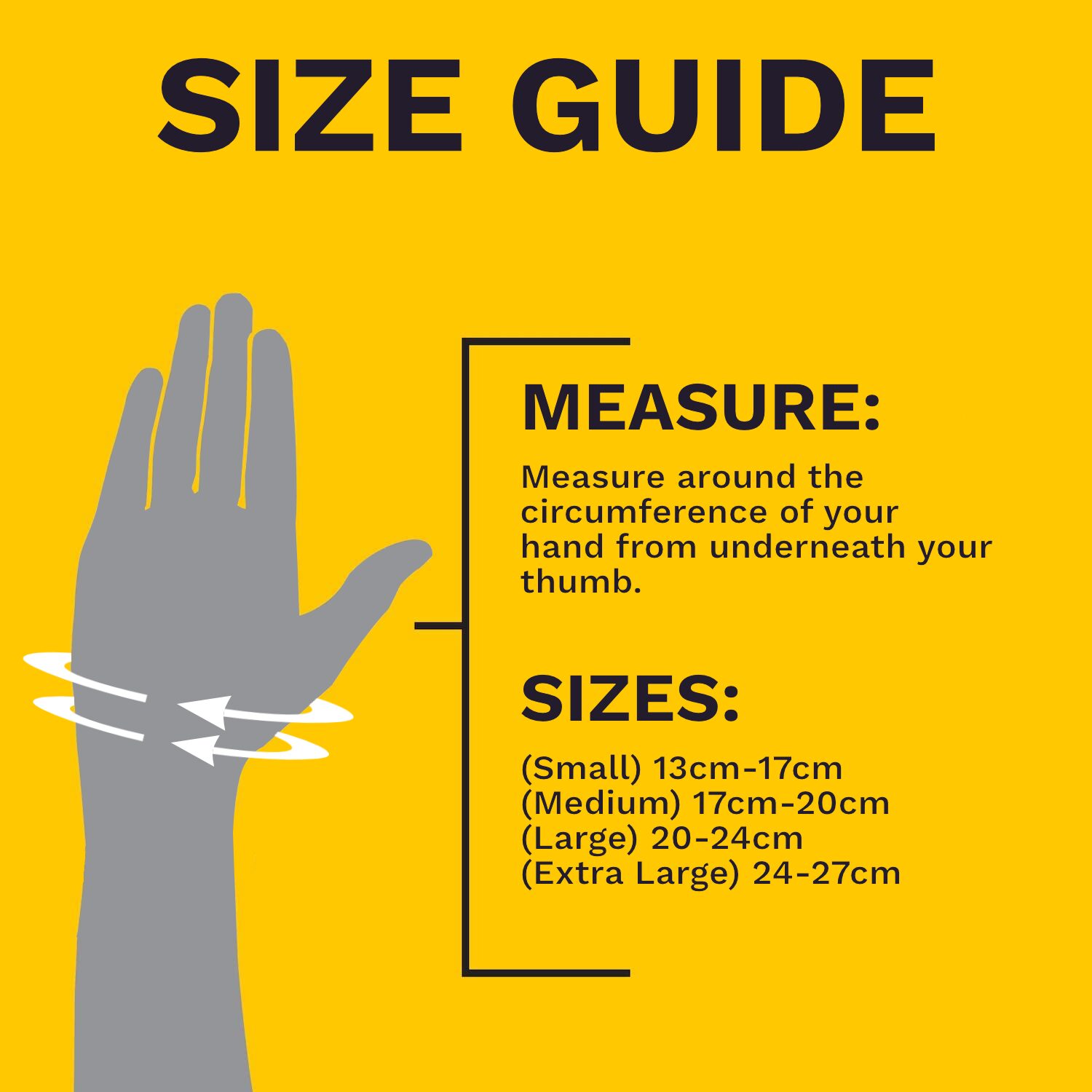
- Available in Small (13-17cm), Medium (17-20cm), and Large (20-24cm)—measure around your hand at the widest point across your knuckles
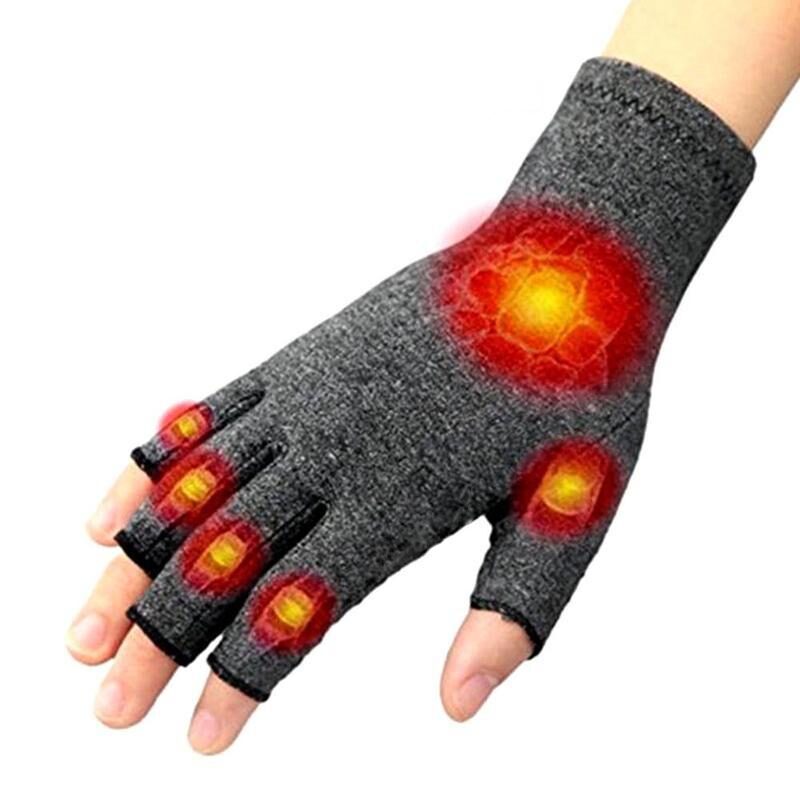
- Apply gentle, graduated pressure: firmer around the base of the thumb and across the knuckles, lighter at the fingertips
- Reduce swelling by encouraging lymphatic drainage and supporting blood flow
- Provide warmth that eases stiffness and improves tissue flexibility, especially helpful for morning stiffness
- Support inflamed tendons and strained joints during repetitive tasks without restricting movement
- May help prevent overuse injuries during repetitive tasks by supporting joints and tendons
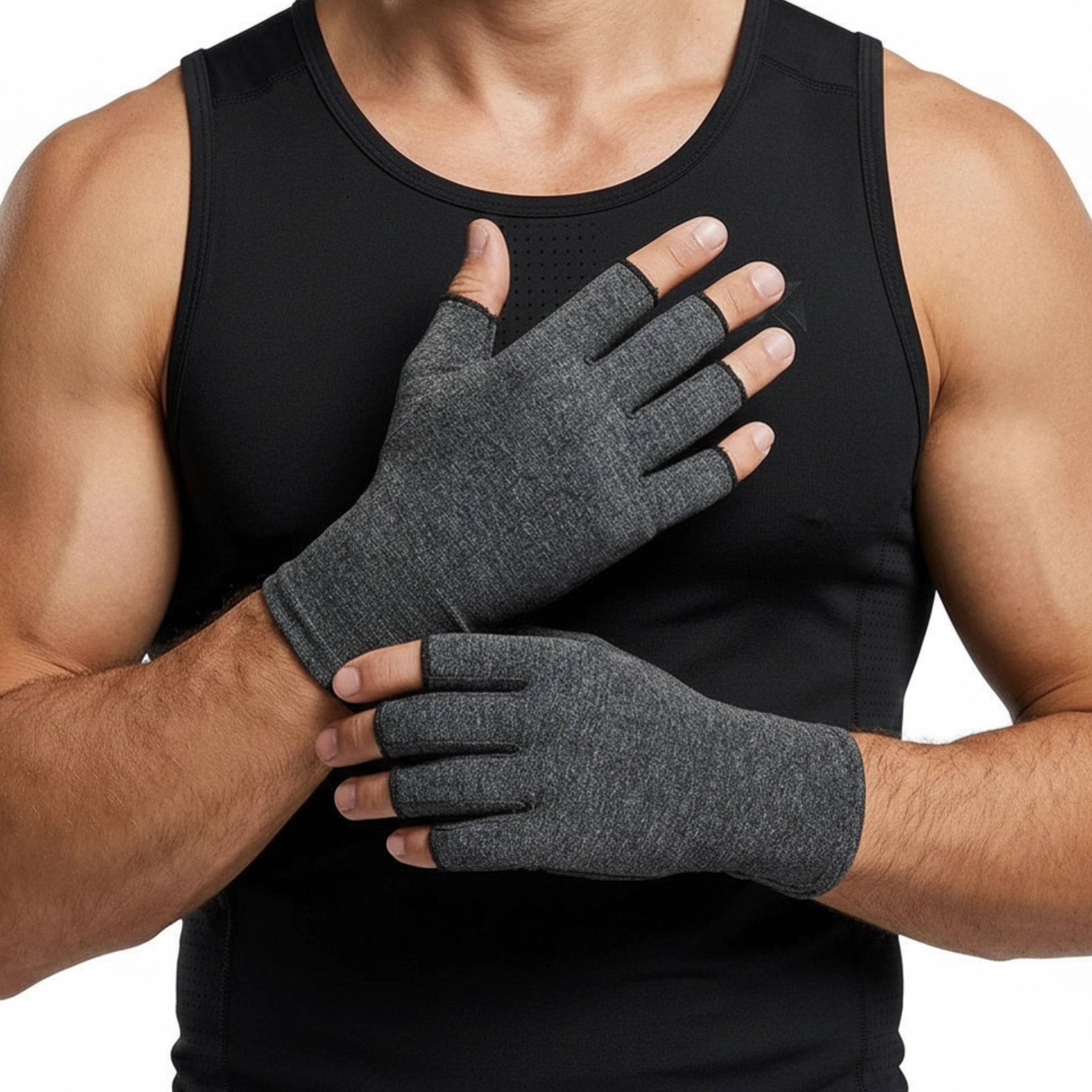
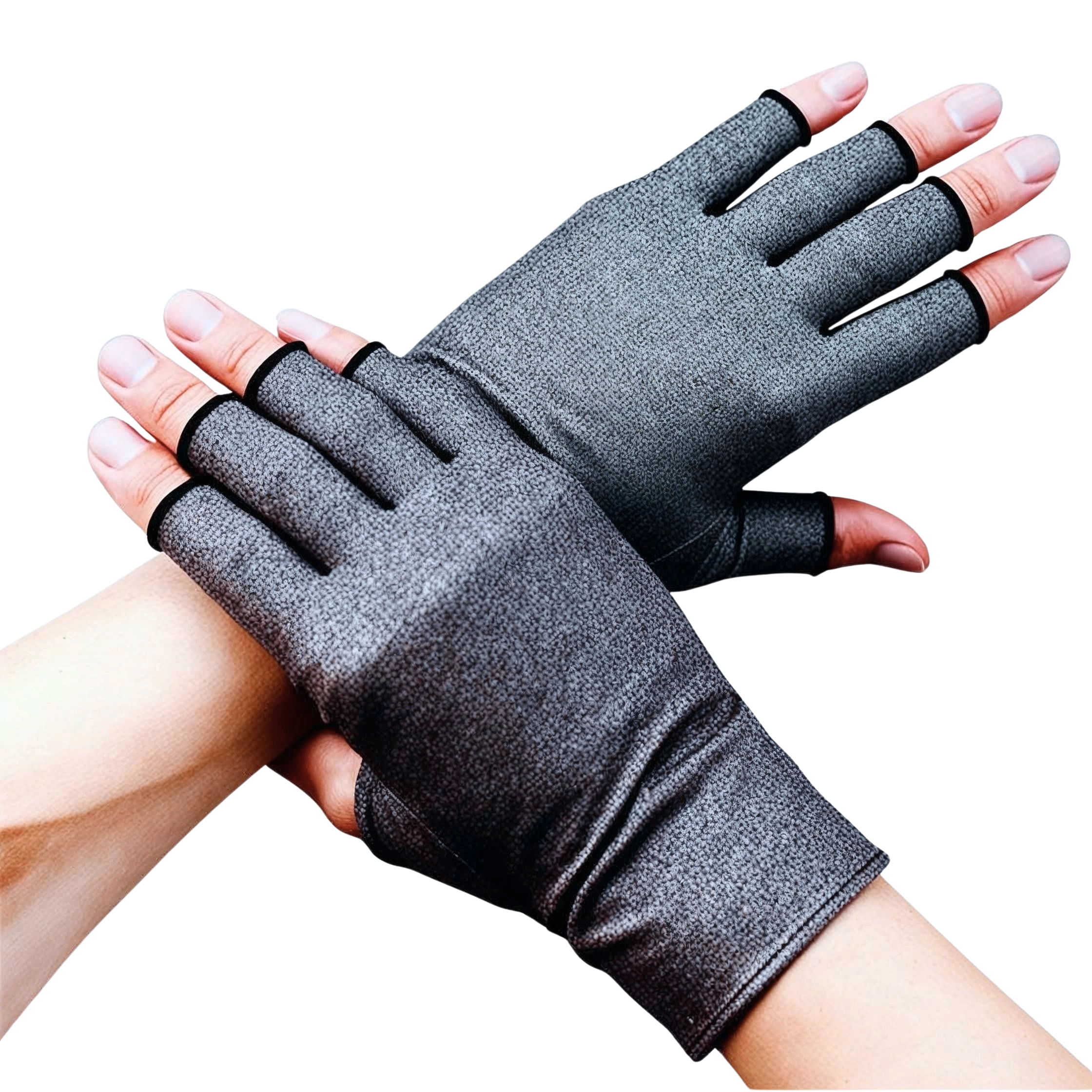
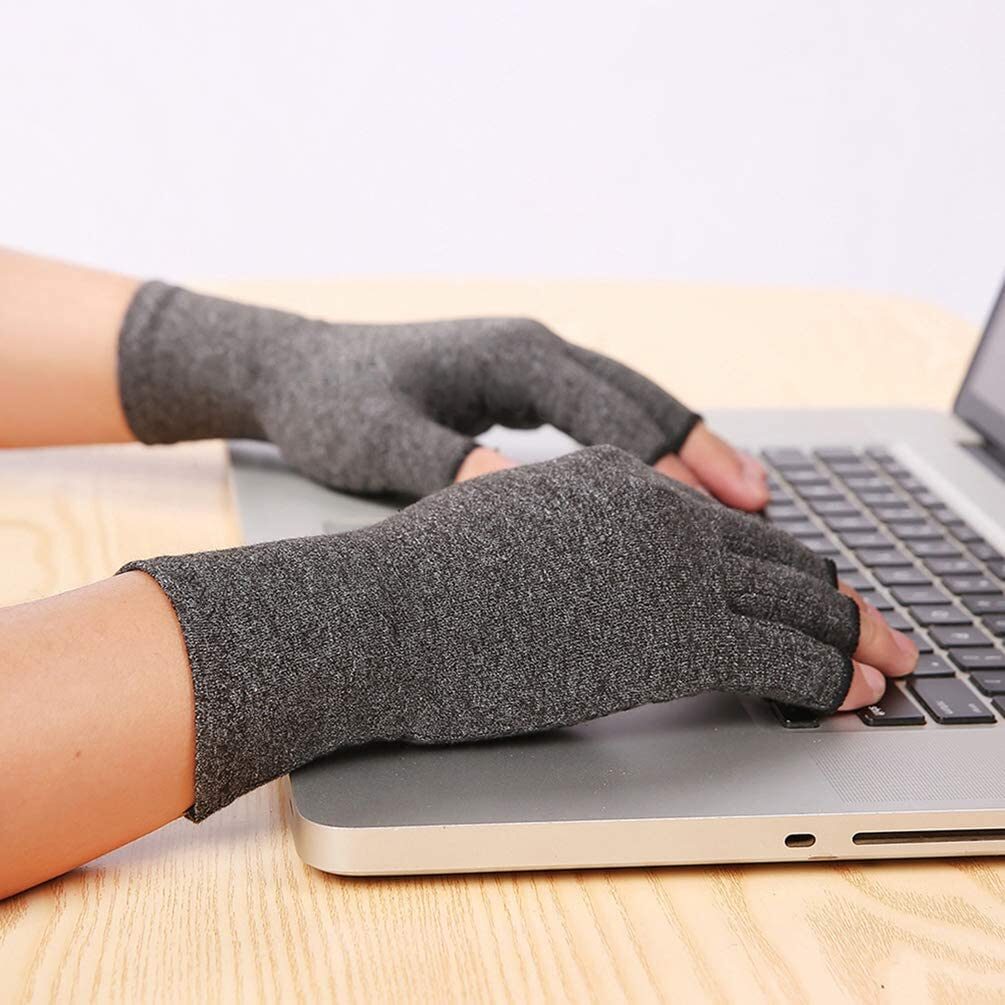
- Open fingertips preserve tactile feedback for typing, writing, and fine motor tasks
- Seamless construction with rounded edges to prevent irritation during extended wear
- Breathable fabric blend wicks moisture and maintains compression through repeated washing
- Thin enough to wear under regular gloves as a base layer in cold weather
- Suitable for arthritis, carpal tunnel syndrome, tendonitis, Raynaud’s phenomenon, and general hand fatigue
- Wear during activities or afterwards during recovery; build up wearing time gradually over the first few days
- Machine washable on a gentle cycle; air dry to maintain compression and shape
- Not suitable if you have active infection, open wounds, or severe circulatory problems in your hands
- Do not use to treat or prevent blood clots—speak to your GP if you have a history of blood clots or are at risk
- 30-day money-back guarantee: try them in your own routine and return if they don’t help
When hand pain limits what you can do
Your hands ache after a day’s work. Your fingers feel stiff first thing in the morning. Opening a jar becomes frustrating. Fastening a button takes longer than it should. Holding a pen feels effortful.
You notice your hands aren’t working the way they used to. You start avoiding tasks that require sustained grip or fine control—not because you can’t do them, but because you know they’ll hurt afterwards. Rest helps temporarily, but the pain returns as soon as you resume normal activities.
Compression gloves address these patterns by reducing swelling, supporting strained structures, and providing warmth—whilst allowing you to continue using your hands normally.
How compression reduces pain and swelling
Compression gloves apply gentle, consistent pressure across your hands and fingers. The pressure itself creates measurable changes that can reduce pain and improve function.
When you apply sustained pressure to your hands, three changes occur: improved blood flow, reduced fluid accumulation, and external support to joints and tendons. The gentle squeeze encourages better blood flow. Your body can deliver oxygen and nutrients to your tissues more efficiently, and it clears away the inflammatory chemicals that cause pain and swelling. When fluid accumulates in your tissues (swelling, or oedema in clinical terms), it increases pressure inside the tissue and makes pain worse. Compression prevents this fluid from building up in the first place. It also encourages your lymphatic system—the network of vessels that drains excess fluid from your tissues—to move that fluid away more efficiently.
At the same time, compression provides external support to the structures inside your hand: your tendons, ligaments, and joints. External support reduces strain during movement, whether you’re dealing with an existing injury or protecting your hands during repetitive tasks.
The support changes how your brain interprets signals from your hand. Your joints and tendons are packed with tiny sensors. These sensors constantly tell your brain where your hand is and how it’s moving—this is called proprioception. When joints are inflamed or injured, these sensors can send distorted or amplified signals, and that distortion contributes to pain. The consistent pressure from compression gloves provides clear, organised sensory input that allows your brain to filter out some of the pain signals. This makes your hands feel more stable and controlled, even though the compression isn’t actually strengthening the joint itself—it’s changing how the brain interprets signals from the joint.
Warmth increases tissue flexibility, which means your tendons and the capsules around your joints move more freely. For stiff, inflamed joints, warmer tissues move more freely, which means less discomfort during movement.
Compression gloves also prevent excessive movement that can aggravate existing injuries or create new ones.
Who these gloves help—quick symptom check
These compression gloves are designed for adults experiencing hand pain, stiffness, swelling, or reduced grip strength. They’re useful if you notice your symptoms follow predictable patterns.
See if any of these patterns match what you’re experiencing:
- Your hands feel locked and stiff when you wake up, but after 30 minutes to an hour of moving around, they start to feel more normal
- Your hands feel fine at the start of the day but ache by evening after hours of typing, manual work, or repetitive tasks
- Your fingers tingle or go numb, especially at night or during repetitive activities like typing or using tools
- Your fingers turn white, blue, or feel painfully cold in cool weather—even mild cold like taking something from the freezer
- You have pain with gripping, twisting, or pinching movements—opening jars, wringing cloths, using hand tools, turning keys
- Your hands just feel tired, achy, and weak after intensive use, even if there’s no specific injury
- You notice swelling in your knuckles or at the base of your thumb during the day, and your rings feel tighter by evening
If you recognised yourself in any of these patterns, compression gloves may help. The gentle pressure, warmth, and support they provide are designed to address exactly these symptoms.
Which condition matches your symptoms
Arthritis—osteoarthritis and rheumatoid arthritis
If you have arthritis, you’ll likely recognise the pattern of morning stiffness. You wake up and your hands feel stiff. Your fingers are difficult to straighten, making a fist feels effortful, and even light tasks like turning on a tap or holding a toothbrush can feel uncomfortable.
This occurs when the fluid inside your joints—called synovial fluid—becomes thicker and more viscous after your joints have been still for several hours overnight. This fluid normally lubricates your joints and allows smooth movement, but when it’s cold and hasn’t been moved, it doesn’t flow as freely. That creates the characteristic stiff feeling you experience first thing in the morning.
As you start moving and the joint warms up, the fluid becomes less viscous and movement becomes easier. Most people find that after 30 minutes to an hour of gentle activity, their hands feel significantly better than they did upon waking. However, there’s often a second wave of discomfort later in the day. After hours of use, the muscles supporting your joints become tired, which means the joints themselves have to absorb more force with each movement. Your hands might ache deeply, feel heavy, or respond more slowly to commands. The joints may also become more swollen as the day progresses, especially if you’ve been using your hands intensively.
Compression addresses several aspects of arthritic pain. The warmth soothes stiff joints, especially first thing in the morning. When you put compression gloves on as soon as you wake up, the fabric traps your body heat close to your joints, gently warming the synovial fluid inside and making those first movements of the day feel less effortful.
The gentle pressure reduces swelling in the joint capsule—the tough, fibrous envelope that surrounds each joint. When this capsule is swollen, it stretches the nerve endings within it, causing pain. The sustained gentle pressure from the gloves prevents fluid from accumulating in the first place, and encourages any existing fluid to drain away through your lymphatic system.
The external pressure also provides additional sensory input that allows your brain to build a clearer picture of where your joints are and how they’re moving. This makes your hands feel more stable and confident during movement.
Carpal tunnel syndrome
If you’ve ever woken with your hand numb or felt pins and needles running down your fingers during the day, you might be experiencing carpal tunnel syndrome.
There’s a nerve called the median nerve that runs from your forearm, through a narrow tunnel in your wrist—the carpal tunnel—and out into your hand. This nerve is responsible for sensation in your thumb, index finger, middle finger, and half of your ring finger. The tunnel it passes through is formed by the small bones of your wrist on three sides and a tough ligament across the front. It’s a tight space, and when the tissues inside swell or the tunnel narrows, the nerve gets squeezed.
When a nerve is compressed, it can’t transmit signals properly. Initially, you’ll notice tingling or pins and needles—the nerve’s response to compression. As compression worsens, you might experience numbness, where areas of your hand lose sensation entirely. Some people also experience pain that can radiate up the forearm. In advanced cases, the muscles at the base of the thumb can weaken and waste, affecting grip strength and fine motor control.
The symptoms often worsen at night because most people sleep with their wrists bent, which narrows the carpal tunnel further and increases pressure on the nerve. You might wake up shaking your hand to restore sensation. During the day, activities that involve repeated or sustained wrist bending—typing with your wrists resting on a hard surface, holding your phone, gripping a steering wheel—can trigger or worsen symptoms.
Compression gloves work here by reducing the swelling in the soft tissues around the carpal tunnel. The tendons that run through this tunnel—the ones that bend your fingers—are surrounded by slippery sheaths that can become inflamed and swollen, especially with repetitive use. When there’s less fluid pressing on the nerve, you typically experience fewer symptoms. The gentle pressure encourages your lymphatic system to drain excess fluid away, reducing the overall pressure inside the tunnel.
The gloves also provide sensory input that can mask the abnormal nerve signals causing your tingling. Your brain receives constant sensory information from your hands, and the consistent pressure from compression gloves provides clear, normal input that can reduce your awareness of the abnormal tingling sensations.
Unlike rigid wrist splints, which immobilise your wrist in a neutral position, compression gloves allow movement whilst still providing support. This makes them suitable for daytime wear during light activities, though they’re not a substitute for proper splinting if your symptoms are severe.
Raynaud’s phenomenon
Raynaud’s causes the small blood vessels in your fingers to narrow dramatically in response to cold or stress. When this occurs, your fingers might turn white, then blue, then red as blood flow returns. The mechanism is that the smooth muscle in your blood vessel walls contracts excessively—a protective mechanism that’s become overactive.
You’ll notice your fingers turning white when you take something out of the freezer, step outside on a cool morning, or even when you’re feeling anxious or stressed. The white phase occurs because blood flow to your fingers is severely reduced—the vessels have clamped down so tightly that very little blood can get through. Your fingers might feel numb and cold during this phase.
As the vessels start to open again, your fingers may turn blue as deoxygenated blood begins to flow back in. Then, as fresh oxygenated blood rushes back, your fingers turn bright red. This final phase often comes with an uncomfortable tingling or throbbing sensation as sensation returns—sometimes described as a burning feeling.
For some people, these episodes are brief and more of an inconvenience. For others, they’re painful and can last for extended periods, especially in cold weather. Severe or frequent episodes can affect your ability to work, do household tasks, or enjoy outdoor activities. In rare cases, repeated severe episodes can damage the tissue in your fingertips.
Compression gloves work by providing an insulating layer that keeps your hands warmer, reducing the trigger for vessel constriction. The fabric creates a layer of warmed air trapped between the glove and your skin, which maintains a more stable temperature. When your hands stay warmer, the blood vessels are less likely to receive the signal to clamp down in the first place.
The gentle pressure also supports healthy blood flow. The graduated compression encourages blood to keep moving through your fingers rather than pooling or stagnating. This doesn’t prevent Raynaud’s episodes entirely, but users often report they experience fewer episodes, or that episodes are less severe and resolve more quickly when they’re wearing compression gloves.
Wearing compression gloves as a base layer under your regular gloves gives you the best protection in cold weather. The compression gloves maintain warmth and support circulation, whilst the outer gloves provide additional insulation. Together, they offer better protection than either would alone. You can also wear the compression gloves on their own indoors or in milder weather when you need warmth and circulation support but not heavy insulation.
Repetitive strain injury and tendonitis
When you repeat the same hand movement hundreds or thousands of times—typing, using tools, playing an instrument, doing manual work—the tendons that move your fingers can become inflamed.
Your tendons are tough cords of connective tissue that connect muscle to bone. They run through narrow tunnels and are surrounded by a slippery sheath that allows them to glide smoothly as you move your fingers. When you overuse a tendon, this sheath can become inflamed and thickened—a condition called tenosynovitis.
When the sheath is inflamed, the tendon can’t glide as smoothly. You’ll feel pain along the palm side of your fingers when you grip a pen or a steering wheel, or across the back of your hand after a long session of typing or using a mouse. The pain is often worse during the activity that caused it, and may ease somewhat with rest, only to return when you resume the activity.
Some people also notice a feeling of weakness in their grip—not because the muscles are actually weaker, but because pain is inhibiting full force production. Your body is protecting the injured structure by limiting how hard you can grip.
In some cases, the inflammation can become severe enough that you feel or hear a creaking or crackling sensation when you move your fingers—this is the inflamed tendon catching as it tries to glide through its swollen sheath. This is sometimes called trigger finger when it affects the flexor tendons—the ones that curl your fingers into your palm—or it might affect the extensor tendons on the back of your hand.
The warmth and compression combination addresses this in two ways. First, increased blood flow clears the inflammatory chemicals that cause pain and brings in the nutrients and oxygen your tissues need to heal. When tissues are inflamed, they release chemicals that sensitise nerve endings and cause pain. Your body’s natural healing process involves clearing these chemicals away and bringing in fresh blood to repair any damage. Compression supports this process by improving circulation.
Second, the external support reduces the load on the inflamed tendon, giving it a chance to settle down whilst still allowing the controlled movement that promotes healing. Complete rest isn’t always the best approach for tendon problems—tendons need some load to maintain their strength and structure. But they need the right amount of load.
If you’re typing with compression gloves on, the fabric supports the small stabilising muscles in your hand, which means your inflamed tendons don’t have to work quite as hard. Over days and weeks, this reduction in repetitive strain can allow the inflammation to settle whilst you continue with necessary activities.
De Quervain’s tenosynovitis
This condition affects the tendons on the thumb side of your wrist—specifically, the ones that help you move your thumb away from your hand and extend it backwards. Two tendons run through a narrow tunnel on the thumb side of your wrist, and when the sheath surrounding these tendons becomes inflamed and thickened, the tendons can’t glide smoothly. The result is pain.
Common symptoms include pain when you grip, twist, or pinch—any movement that requires your thumb to work against resistance. The pain is usually felt along the thumb side of your wrist and may radiate up your forearm or down into your thumb.
New mothers often develop this because repeatedly lifting a baby requires exactly this movement—you support the baby’s head with your hand whilst your thumb provides counter-pressure. Gardeners, people who use hand tools frequently, and anyone who does repetitive pinching or gripping can develop it.
You’ll often feel sharp pain when you’re wringing out a cloth, turning a key, lifting a kettle, using secateurs, or even just making a fist with your thumb tucked inside your fingers. The pain can be severe enough to make you drop objects or avoid using your thumb entirely. Some people notice swelling along the thumb side of the wrist, and the area may be tender to touch.
There’s a simple test that can help identify this condition: make a fist with your thumb tucked inside your fingers, then bend your wrist towards your little finger. If this causes sharp pain along the thumb side of your wrist, it’s likely De Quervain’s tenosynovitis. (This is called Finkelstein’s test, though you don’t need to remember the name.)
Compression provides support to the inflamed area and reduces the swelling in the tendon sheath. When the sheath is less swollen, there’s more room for the tendons to glide, which means less friction and less pain with each movement. The graduated compression is especially helpful here because it’s firmer around the base of the thumb—exactly where the inflamed tendons run.
The warmth increases blood flow to the area, supporting your body’s natural healing process. Inflammation is part of healing, but when it becomes chronic, it can actually impede recovery. The improved circulation clears away the excess inflammatory chemicals whilst bringing in the nutrients your tissues need to repair.
The gloves also provide a degree of proprioceptive feedback—sensory information about thumb position—that can help you move more carefully and avoid the extreme positions that aggravate the condition. When you’re wearing the gloves, you’re more aware of your thumb position, which can help you modify your movements to reduce strain on the inflamed tendons.
General hand fatigue, cramps, and strain
Even if you don’t have a diagnosed condition, your hands can simply feel tired and achy after strenuous use. Whether you’ve been doing manual work all afternoon, spent hours writing by hand, or performed any activity that demands sustained grip strength or repetitive movements, your hand muscles can cramp and your joints can feel strained.
When you use your hands intensively, your muscles produce waste products—primarily lactate and hydrogen ions—that accumulate in the tissue. Your muscles produce energy through a process that generates these byproducts. Normally, your circulation clears them away as quickly as they’re produced. But when you’re working your muscles hard, they can build up faster than your circulation can clear them away.
When these waste products accumulate, your muscles start to feel fatigued and sore. At the same time, the small stabilising muscles in your hand can become overworked and cramp—you might feel a sudden tight, painful contraction in your palm or between your thumb and index finger.
Your joints can also feel strained after intensive use. Even healthy joints experience some degree of stress during repetitive or forceful activities. The cartilage that cushions your joints can become compressed, and the ligaments that stabilise your joints can be stretched. After hours of intensive hand use, your joints might feel achy, stiff, or slightly swollen.
Compression gloves support your hands during these activities and aid recovery afterwards. The improved circulation clears the waste products that build up in working muscles. When you’re wearing the gloves during intensive hand use, the gentle pressure encourages blood flow, which means waste products are cleared more efficiently and fresh oxygen is delivered more readily. This can delay the onset of fatigue and reduce the severity of post-activity soreness.
The external support also reduces the load on your joints, so they don’t have to absorb quite as much force with each grip. When you’re gripping a tool or carrying something heavy, the compression provides additional support to the small joints in your fingers and the larger joints at the base of your thumb and across your knuckles. This doesn’t replace the work your muscles and ligaments are doing, but it supplements it, reducing the overall strain.
Wearing compression gloves during intensive activities—manual work, extended writing or typing sessions—allows you to work for longer before fatigue sets in. Others prefer to put the gloves on after intensive activity to support recovery. The warmth and compression combination reduces post-activity stiffness and soreness, making it easier to use your hands normally the following day.
Why these gloves are built differently
Now that you understand how compression addresses your specific pattern of symptoms, here’s what sets these gloves apart from cheaper alternatives.
Graduated compression: firm support at the base of the thumb and knuckles, lighter pressure at the fingertips
The compression isn’t uniform across your entire hand—that would restrict movement where you need it most. Instead, it’s firmer around the base of the thumb and across your knuckles. These are the areas where swelling tends to build up and where your joints need the most stability during gripping and pinching movements.
At the same time, the compression is lighter across the back of your hand and around your fingertips, where you need flexibility and sensitivity. Your fingertips need to remain sensitive for fine motor tasks—picking up small objects, feeling textures, using a touchscreen. The lighter compression here means you can still feel what you’re touching and move your fingers precisely, whilst still receiving support to the small joints in your fingers.
This graduated approach means you get reduced swelling and enhanced stability where your hand needs it most, without restricting movement where you need dexterity.
Moisture-wicking fabric that maintains compression without trapping heat
The fabric blend is designed to sit against your skin and absorb moisture. When your hands sweat during normal daily activity, the fibres wick that moisture away from your skin’s surface and spread it across the fabric where it can evaporate. This keeps you comfortable and prevents the skin irritation that develops when moisture is trapped against your skin for hours.
The fabric provides compression and recovery. It stretches when you move your hand, then returns to its original shape when you relax. This means the gloves continue to provide consistent pressure even after you’ve worn them all day, and they maintain their shape through repeated wear and washing.
The fabric is breathable, allowing air to circulate around your hands. This prevents the clammy feeling you might associate with wearing gloves for extended periods. You can wear these gloves from morning until evening without your hands feeling uncomfortably warm or damp.
Breathable fabric that traps warmth when hands are cold and releases heat during activity
The fabric traps your body’s warmth close to your skin when your hands are cold—first thing in the morning, or when you’ve been outside in cool weather. This gentle warming effect can ease the stiffness many people experience in cold conditions.
When your hands warm up during activity or in a warmer environment, the breathable fabric allows excess heat to escape. This prevents uncomfortable overheating whilst maintaining the therapeutic compression.
For people dealing with chronic pain or inflammation, this temperature regulation serves a therapeutic purpose. Warmth reduces stiffness and can ease pain by improving tissue flexibility. If you put the gloves on first thing in the morning when your hands are stiff, the fabric traps your body heat and gently warms your joints, making those first movements of the day feel less effortful and more comfortable.
Open fingertips that preserve tactile feedback whilst supporting the small joints in the fingers
The fingertips are cut to allow precise movement. You can pick up small objects, type on a keyboard, write with a pen, and use your phone’s touchscreen whilst wearing the gloves. The fabric at the fingertips is thin enough to allow tactile feedback—you can still feel what you’re touching—whilst maintaining enough compression to support the small joints in your fingers.
When you’re typing, you can feel the keys beneath your fingertips. When you’re picking up a coin or fastening a button, you can feel the object well enough to manipulate it precisely. This matters because if gloves interfere with your ability to feel and control what you’re doing, you simply won’t wear them—no matter how therapeutic they might be.
The thumb is independently articulated, allowing the full range of opposition movement—the ability to bring your thumb across to touch your fingers. This is essential for grip and for the fine motor control you need for most daily activities. Without proper thumb articulation, even simple tasks like holding a mug or turning a key become awkward.
Seamless construction with rounded edges to prevent irritation during extended wear
These gloves are built without internal seams across your knuckles or around your fingertips—the two places where seams cause the most irritation. The finger openings have rounded, finished edges that won’t fray or dig into your skin.
This matters more than you might think. Seams create pressure points, and pressure points cause irritation, especially when you’re wearing gloves for several hours. If you’ve tried compression gloves before and found them uncomfortable, there’s a good chance it was because of poorly placed seams.
A seam running across your knuckle might not bother you for the first hour, but after three or four hours of your hand flexing and the fabric moving against your skin, that seam can create a hot spot that becomes genuinely uncomfortable. By the end of the day, you might have a red, sore patch where the seam has been rubbing.
The seamless design eliminates this problem. There are no rough edges to rub against your skin, and no raised stitching to create friction points. If you have sensitive skin, or if you’ve found other gloves uncomfortable in the past, this seamless construction with rounded edges should make a noticeable difference. You can wear these gloves from morning until evening without developing sore spots or irritation.
Thin enough to wear as a base layer under regular gloves in cold weather
During colder months, you can wear these compression gloves underneath your regular winter gloves. This gives you an extra layer of warmth whilst maintaining the therapeutic compression and support. The gloves are thin enough to fit comfortably under other gloves without creating bulk that restricts movement or makes your hands feel clumsy.
Layering is especially valuable if you have Raynaud’s phenomenon or if cold weather significantly worsens your hand pain and stiffness. The compression gloves support healthy blood flow and provide a first layer of warmth, whilst the outer gloves provide insulation against the cold. Together, they offer better protection than either would alone.
You can also wear the gloves on their own in milder weather, or indoors when you need support and warmth but not heavy insulation. This versatility means you get year-round use from a single pair of gloves, rather than needing different solutions for different seasons.
Maintain compression and shape through repeated washing and extended wear
These gloves maintain their compression and shape through repeated washing and extended wear. The fabric construction has been chosen specifically for durability and recovery properties. The fibres are designed to return to their original shape after stretching, which means the gloves continue to provide consistent compression even after you’ve worn them all day, every day, for months.
This durability means the gloves remain therapeutically effective over time—you’re not replacing them every few weeks because they’ve stretched out and no longer provide adequate compression. It also means you can keep them clean without special care, which is important for skin health and hygiene. You can machine wash them on a gentle cycle, air dry them, and they’ll be ready to wear again with the same level of support they provided when new.
Many cheaper compression gloves lose their effectiveness quickly. The fabric breaks down, becomes loose, and within a few weeks they’re providing minimal compression. You end up with gloves that look like compression gloves but don’t actually do the job anymore.
These gloves are designed for long-term use. With proper care—gentle machine washing and air drying—they should maintain their therapeutic compression for many months of daily wear.
Firm support where needed, freedom of movement where required
The core design principle is that compression gloves should support your hands whilst allowing you to use them normally. Too much compression and your hands feel restricted, making fine motor tasks difficult. Too little compression and the gloves don’t provide meaningful therapeutic benefit. Compression in the wrong places and you lose dexterity where you need it most.
Considerable time has been spent refining this balance. The graduated compression provides firm support where your hands need stability—around the base of your thumb and across your knuckles—whilst remaining lighter where you need freedom of movement. The fingertip design allows precise manipulation whilst still supporting the small joints in your fingers. The thumb articulation allows full opposition movement whilst providing compression to the base of the thumb where it’s most needed.
The result is a glove that feels supportive without feeling restrictive. You should be able to put these gloves on in the morning and go about your normal day—typing, writing, using your phone, preparing food, doing light household tasks—without feeling like the gloves are getting in the way. At the same time, you should notice reduced pain, less stiffness, and better endurance during hand-intensive activities.
Using your gloves effectively
Getting the right size
Getting the right size is important for both comfort and effectiveness. Gloves that are too small will feel uncomfortably tight and may restrict your circulation. Gloves that are too large won’t provide enough compression to be therapeutic.
Measure around your hand at its widest point—usually across your knuckles. Use a soft tape measure and don’t pull it tight; just let it sit snugly. Measure both hands, as it’s common for one hand to be slightly larger than the other. If your measurements fall between sizes, or if one hand is larger than the other, choose the larger size for comfort.
When you first put the gloves on, they should feel snug but not restrictive. The fabric should sit smoothly against your skin without any gaps or loose areas, but you shouldn’t feel any pinching or tightness that makes you want to take them off immediately. You should be able to move your fingers freely and make a fist without the fabric pulling uncomfortably.
Your circulation should remain normal whilst wearing the gloves. Your fingertips should stay their usual colour—if they turn white, blue, or purple, the gloves are too tight and you should remove them immediately. You should still be able to feel your pulse at your wrist. The gloves should feel like a supportive hug around your hands, not a constricting squeeze.
How and when to wear them
Wear your gloves consistently during the times your hands need support. If your main problem is morning stiffness, put them on as soon as you wake up and wear them through the first few hours of the day whilst your joints warm up and loosen. If your hands ache after repetitive work, wear them during those activities and for a period afterwards whilst your hands recover. If cold triggers your symptoms, wear them whenever you’re in cool environments or layer them under other gloves when you go outside.
When you first start wearing the gloves, you might want to build up gradually. Wear them for a few hours, then take them off and see how your hands feel. If they feel comfortable and supported, gradually increase the wearing time over a few days until you’re wearing them for as long as you need them.
Some people wear their gloves all day, every day. Others wear them only during specific activities or at specific times when symptoms are worst. There’s no single right approach—wear them in the pattern that works best for your symptoms.
You can wear the gloves during most everyday activities. They’re designed to allow normal hand function, so you can type, write, use your phone, prepare food, and perform light household tasks whilst wearing them. You might choose to remove them for activities that require maximum grip strength or very fine manipulation, or for tasks where the gloves might get wet or dirty. Some people prefer to remove them for activities where they need direct tactile feedback—playing a musical instrument, doing detailed craft work, cooking—and put them back on afterwards during recovery.
Desk work with carpal tunnel syndrome
If you spend most of your day typing, using a mouse, and handling paperwork, and you’ve started noticing tingling in your fingers—especially at night—compression gloves can fit seamlessly into your working routine.
Put the gloves on first thing in the morning, before you even sit down at your desk. Wear them throughout your working day—typing, writing notes, using your phone. They’re thin enough to allow normal typing speed and keyboard contact.
You’ll likely find that the tingling you used to experience by mid-afternoon doesn’t appear, or is much milder when it does. Your hands will feel more supported during repetitive tasks, and you may stop waking up at night shaking your hands to restore sensation.
Remove the gloves in the evening to allow your skin to breathe. After a few months of consistent wear, you should notice a significant improvement. You may still have some symptoms, notably after an especially busy day, but the constant background tingling should largely resolve.
Manual tasks with osteoarthritis
If you spend time doing manual work and have osteoarthritis affecting your knuckles and the base of your thumbs, you’ll recognise the pattern: stiff hands first thing in the morning, and after a few hours of repetitive gripping or carrying, your hands ache deeply and feel swollen.
Wear the compression gloves as a base layer under your regular work gloves. This keeps your hands warm and supported whilst still allowing you to grip tools properly. This combination is especially helpful during the winter months when cold makes arthritis significantly worse. The compression gloves maintain warmth and reduce swelling, whilst the outer gloves protect your hands during heavy work.
For lighter manual tasks—tying, pinching, carrying small objects—you can wear the compression gloves on their own. After a session of manual work, keep the gloves on through the afternoon and into the evening. This addresses the post-activity ache that can bother you for the rest of the day. The compression prevents your knuckles from swelling as much as they might otherwise, and the warmth soothes the deep ache.
Managing Raynaud’s phenomenon in cold weather
If even mildly cool temperatures trigger episodes where your fingers turn white and numb—taking something out of the freezer, walking to the car on a cool morning, or even sitting in an air-conditioned office—compression gloves can become an essential part of your daily routine.
Start wearing your compression gloves in autumn as soon as the temperature begins to drop. Wear them indoors as a base layer of warmth—at your desk, around the house, during your commute. When you go outside, layer your regular winter gloves over the compression gloves. This double-layer approach can make a significant difference.
You can also wear the gloves at night during winter. If your bedroom gets cold and you used to wake up with numb fingers, wearing the compression gloves in bed keeps your hands warm enough that you should sleep through the night without episodes. You’ll likely still get occasional episodes, notably in very cold weather, but they should be less frequent and less severe.
Repetitive hand movements during leisure activities
If you enjoy sewing, knitting, crochet, painting, or other activities that keep your hands busy for hours at a time, you might have noticed your hands aching or feeling stiff after a long session. Repetitive movements—guiding fabric through a machine, manipulating knitting needles, gripping a paintbrush—can strain the small muscles and tendons in your hands.
Wear the gloves between sessions, giving your hands support during recovery periods. Put them on immediately after finishing a session. The warmth and compression reduce the aching that can build up throughout the day.
Wear them in the evening after you’ve finished. This prevents the stiffness you might otherwise experience the next morning. Your hands should feel fresher when you sit down to your next session, and any sharp pain should gradually settle to a manageable level. The gloves allow you to continue enjoying the activities you love without paying for it with sore, tired hands the next day.
What to expect when you start wearing them
Some people notice improvement within the first few days of wearing compression gloves. You might find your morning stiffness eases more quickly, or that your hands don’t ache as much by the end of the day. Others find the benefit builds gradually over a few weeks as swelling reduces and tissues settle.
The gloves work by reducing swelling, supporting strained structures, providing warmth that eases stiffness, and giving your brain clearer feedback about hand position and movement. These effects can be immediate for some people and cumulative for others.
Don’t be discouraged if you don’t notice dramatic improvement in the first few days. Give the gloves a fair trial—wear them consistently for at least two to three weeks before deciding whether they’re helping. Keep track of your symptoms: Are you sleeping better without waking with numb hands? Are you able to work for longer before pain appears? Is your morning stiffness resolving more quickly? Are you dropping things less often?
Sometimes the improvements are subtle and gradual, and you only notice them when you look back over a few weeks. You might realise you haven’t thought about your hands as much, or that you’ve been doing activities you’d been avoiding.
It’s also worth noting that compression gloves work best as part of a broader approach. If you’re also modifying activities, doing exercises, managing your workload, and addressing ergonomic issues, the combined effect will be greater than any single intervention alone.
Caring for your gloves
Wash your gloves regularly to keep them fresh and hygienic. How often you wash them depends on how much you wear them and how much your hands sweat, but most people find washing them two to three times a week is about right for daily wear.
You can machine wash them on a gentle or delicate cycle using cool or lukewarm water. Use a mild detergent—your regular laundry detergent is fine—and avoid fabric softeners or bleach. Fabric softeners can coat the fibres and reduce their ability to wick moisture away from your skin. Bleach can break down the fibres and reduce the compression over time.
Some people prefer to wash their gloves by hand. If you choose to do this, use lukewarm water and a small amount of mild detergent, gently work the soap through the fabric, rinse thoroughly, and squeeze out excess water without wringing or twisting the gloves.
After washing, reshape the gloves gently—smooth out any wrinkles and make sure the fingers are lying flat and straight. Lay them flat to air dry on a clean towel, or hang them in a well-ventilated area. Don’t tumble dry them or place them on a radiator or in direct sunlight, as heat can damage the fibres and cause the gloves to lose their shape and compression.
With proper care, your gloves should maintain their compression and shape for many months of regular use. If you notice they’re starting to feel looser or stretched out, or if the fabric is becoming thin or damaged, it’s time to replace them. Most people find a pair lasts six to twelve months with daily wear and regular washing.
Complementary strategies that support hand function
Small changes that reduce strain
You don’t need to stop doing the things that cause discomfort—you just need to find ways to do them with less strain on painful structures. Small adaptations can reduce the cumulative strain on your hands over the course of a day, and these small reductions add up to significant relief over weeks and months.
If gripping a pen tightly causes pain, try using a pen with a thicker barrel or add a foam grip. The thicker diameter means you don’t have to curl your fingers as tightly, reducing the load on your flexor tendons. If opening jars is difficult, use a jar opener that gives you more leverage, or run the lid under hot water first to expand the metal slightly. If carrying shopping bags hurts your fingers, use bags with padded handles that distribute the weight more evenly, or use a wheeled trolley that takes the weight off your hands entirely.
If you’re working at a desk, make sure your keyboard and mouse are positioned so your wrists can stay in a relatively neutral position—not bent sharply up or down, and not twisted to the side. Your keyboard should be low enough that your wrists aren’t extended upwards, and if you use a laptop, consider using an external keyboard and mouse so you’re not reaching forward and upward. A vertical mouse can reduce the twisting strain on your forearm and wrist. These adjustments reduce the repetitive strain that builds up over hours of work.
For household tasks, look for tools with ergonomic handles—larger diameter grips, cushioned surfaces, designs that allow you to use your whole hand rather than just your fingers. Electric tin openers, jar openers, tap turners, and key turners are all available and can make daily tasks significantly easier if grip strength or pain is limiting you.
Gentle movement and exercises
Gentle movement maintains the mobility and strength you have. For stiff joints, moving them regularly through their comfortable range—even if that range is smaller than it used to be—prevents them from becoming stiffer.
Joints need movement to stay healthy. The cartilage inside your joints doesn’t have its own blood supply—it gets nutrients from the synovial fluid that bathes it, and this fluid only circulates properly when you move the joint.
For weak grip, simple exercises like squeezing a soft ball or scrunching up a towel can maintain strength without overloading inflamed tendons. Start gently—you’re not trying to squeeze as hard as you can, you’re trying to work the muscles through a comfortable range. Hold each squeeze for a few seconds, then release slowly. Repeat ten to fifteen times, once or twice a day.
A physiotherapist can show you exercises tailored to your specific condition and teach you how to progress them safely as your hands improve. For people with arthritis, gentle movement is generally better than complete rest. Whilst it’s important to avoid activities that cause sharp pain, keeping your joints moving maintains function and can actually reduce pain over time.
Wearing the gloves during or after your exercises can reduce any discomfort and support your joints whilst the muscles around them are working. Some people find that wearing the gloves during exercises makes the movements feel more controlled and less painful, which allows them to complete their exercise programme more consistently.
Spreading demanding tasks throughout the day
Spreading demanding tasks throughout the day rather than doing them all at once prevents the build-up of fatigue and pain that occurs when you push through without breaks.
If you know that an hour of continuous typing leaves your hands aching, break that hour into three twenty-minute sessions with short breaks in between. During those breaks, rest your hands. Gentle stretching or shaking can clear waste products from working muscles.
If you have a lot of manual tasks to do, alternate between tasks that load different structures—heavy gripping, light manipulation, and rest—rather than doing all the heavy work in one session. This approach allows different muscle groups to work and rest alternately, reducing the overall strain on any single structure.
Stopping when pain starts to build prevents flare-ups that can take days to settle. Pushing through pain often leads to a flare-up that takes days to settle, whereas stopping and resting when you first notice discomfort might mean you can return to the task an hour or two later with minimal consequences.
Heat and cold
Heat and cold can both be useful, depending on your symptoms and the stage of your condition.
Warmth generally eases stiffness and chronic pain. A warm bath or shower first thing in the morning can ease morning stiffness and make movement more comfortable. The warmth increases blood flow, relaxes muscles, and makes the synovial fluid in your joints less viscous—less thick and sticky. A warm compress applied for ten to fifteen minutes can provide targeted warmth when hands feel especially stiff. The compression gloves provide gentle, sustained warmth throughout the day, which works well for chronic conditions where stiffness is the main problem.
Cold can address acute flare-ups when a joint or tendon is hot, swollen, and throbbing. A cold pack wrapped in a thin towel and applied for ten to fifteen minutes can reduce swelling and numb sharp pain. Cold causes blood vessels to constrict, which reduces blood flow to the area and limits swelling. It also has a numbing effect on nerve endings, which can provide temporary pain relief. Use cold when inflammation is acute—immediately after an injury, or during a flare-up when a joint is noticeably hot and swollen.
As a general rule: use cold for acute, hot, swollen inflammation, and use heat for chronic stiffness and aching. If you’re not sure which to use, try both and see which feels better. If one approach worsens symptoms, try the other.
Working with other treatments
Compression gloves often work well alongside other treatments your GP or physiotherapist might recommend. If you’re taking anti-inflammatory medication for arthritis or tendonitis, the gloves can complement this by providing mechanical support and warmth whilst the medication addresses inflammation from the inside. The medication reduces the chemical inflammation, whilst the compression reduces the mechanical swelling and provides external support.
For people recovering from a hand or wrist injury, compression gloves can be useful during the later stages of rehabilitation when you’re returning to normal activities but still need some support. They provide a middle ground between rigid splinting—which protects but also restricts movement—and no support at all. As you gradually increase your activity levels, the gloves can provide reassurance and support without preventing the movement that’s necessary for full recovery.
If you’re seeing a hand therapist or physiotherapist, mention that you’re using compression gloves. They can advise you on the best times to wear them and how they fit into your overall management plan. They might suggest wearing them during specific activities, or at specific times of day, or they might adjust your exercise programme based on the support the gloves are providing.
When professional assessment helps
Compression gloves manage common hand problems. Some symptoms require professional assessment. Consider speaking to your GP or a physiotherapist if:
- Your pain is severe or getting progressively worse despite using compression and modifying your activities. Pain that’s worsening over time suggests the underlying problem may need direct treatment, not just symptom management.
- You’re experiencing significant weakness in your hand or fingers—dropping objects frequently, struggling to grip things you could manage before, or noticing your hand feels clumsy or uncoordinated. Weakness can indicate nerve compression or muscle wasting that benefits from assessment.
- You have numbness or tingling that’s constant rather than intermittent, or that’s spreading to affect more of your hand or arm. Constant numbness suggests significant nerve compression that may need more targeted treatment.
- You notice visible changes in your joints, or your fingers are starting to drift or twist into unusual positions. Progressive deformity can occur with some types of arthritis and may benefit from early intervention.
- Your symptoms appeared suddenly after a specific injury or fall. Acute injuries benefit from assessment to rule out fractures or ligament damage.
- You have swelling that’s hot, red, and tender, especially if it’s accompanied by fever or feeling generally unwell. This can indicate infection or inflammatory arthritis that needs urgent medical attention.
- Your symptoms are affecting your ability to work or perform essential daily tasks, even with supportive measures in place. If pain or dysfunction is significantly impacting your quality of life, proper assessment and treatment can help.
These signs don’t necessarily mean something serious is wrong, but they do suggest you’d benefit from a proper assessment to identify the underlying cause and ensure you’re getting appropriate treatment. Compression gloves are a supportive measure; they work best alongside other approaches when needed.
What compression can and can’t do
Compression gloves reduce swelling, support structures that are under strain, provide warmth that eases stiffness, and give your brain clearer feedback about hand position and movement. These are real, measurable effects, but they’re supportive rather than curative.
The gloves change the mechanical environment around your joints and soft tissues. They reduce swelling by encouraging lymphatic drainage—the system of vessels that drains excess fluid from your tissues. They support structures under strain by providing external pressure that supplements the work your muscles and ligaments are doing. They provide warmth that increases tissue flexibility and blood flow. They improve proprioception—your brain’s sense of where your hand is and how it’s moving—which can reduce pain and improve control.
For some people, morning stiffness that used to last an hour resolves in twenty minutes. Hands that used to ache by mid-afternoon feel comfortable all day. Tasks that were becoming difficult become manageable again.
For others, the benefit is more modest but still worthwhile. The pain might not disappear entirely, but it may reduce enough to allow you to complete tasks that were becoming difficult. You might not regain full function, but you might regain enough function to do the things that matter most to you.
They won’t cure underlying conditions. If you have arthritis, the gloves won’t repair damaged cartilage or reverse joint changes. If you have carpal tunnel syndrome, they won’t eliminate the compression on your median nerve if the underlying structural problem remains. If you have a tendon injury, they won’t heal the tendon—your body has to do that.
What they can do is reduce mechanical stress on painful structures, improve circulation, and make movement less painful—which encourages continued use, and movement itself supports healing.
Try them without risk
A 30-day money-back guarantee is offered because you should feel confident trying these gloves. Wear them, use them during your normal daily activities, and see whether they provide the relief and support you’re looking for. If they don’t meet your expectations, return them for a full refund.
What works for one person’s hands might not work for another’s. Hand pain and stiffness have many causes, and people respond differently to compression. Some people find compression gloves transformative. Others find them helpful but not life-changing. A small number find they don’t help at all. The only way to know whether these gloves will help you is to try them in your own daily routine, with your specific pattern of symptoms, during your normal activities.
The 30-day guarantee gives you time to wear the gloves consistently and assess whether they’re making a difference. Wear them for at least two to three weeks—long enough for any cumulative benefits to become apparent—and then make your decision. If you’re not satisfied, contact us and we’ll arrange a return and refund.
Think about your symptoms and your daily routine. Are your hands stiff in the morning? Do they ache after repetitive work? Do they swell during the day? Does cold weather trigger pain or numbness? Do certain movements consistently cause discomfort? Are you avoiding activities you used to enjoy because your hands hurt?
If you answered yes to any of these questions, compression gloves may help. They’re designed to address exactly these patterns—providing warmth for stiffness, support for aching joints and tendons, gentle pressure to reduce swelling, and insulation for cold-sensitive hands.
With the 30-day guarantee, you can try the gloves in your own routine and make your decision based on your own experience, not on promises or marketing claims. You’ll know within a few weeks whether they’re helping. If they are, you’ve found a tool that can make daily life more comfortable. If they’re not, you’ve lost nothing.
Why hand support matters
Your hands are involved in almost everything you do. When they hurt, when they’re stiff, when they don’t respond the way they should—it affects more than just your hands. It affects what you’re willing to attempt, what you avoid, and how confident you feel in your own body.
Compression gloves won’t cure underlying conditions, but they can help you manage symptoms and maintain the hand function you need for daily life. They’re designed to fit into your routine—wear them during activities, or afterwards during recovery, or whenever your hands need support.
If your hands hurt, if they’re stiff, if they’re limiting what you can do—try these gloves. The 30-day guarantee means you can test them in your own routine and return them if they don’t help.
Disclaimer
The information on this page is general guidance based on common patterns of hand pain and the mechanical effects of compression. It is not a substitute for individual medical advice, diagnosis, or treatment. If you have new or unexplained symptoms, or if your symptoms are severe, worsening, or not responding to supportive measures, speak to your GP or a physiotherapist for personalised advice. Compression gloves are a supportive tool; they do not replace professional assessment or treatment where needed. No guaranteed outcomes are promised, as individual responses vary.
9 Reviews For This Product
Fast & Secure Checkout Through Paypal
Pay with Paypal the secure payment gateway that accepts all credit and debit cards. Paypal is free and secure and no credit or bank information is ever stored or shared with us.
Fast Dispatch
Enjoy your items soon with quick dispatch via Royal Mail. Expect to have your items between 1-3 working days for domestic orders. 7-10 Working days for international orders.
Return Policy – 30 Day Money Back Guarantee
In the unlikely event, you are unhappy with your purchase you can return it within 30 days for a refund. Please contact us via the form on the contact us page to start your return.
To return an item please send it to: Nuova Health UK, 81 Highfield Lane, Waverley, Rotherham, S60 8AL. Please include a note with your order id so we know who to refund. Please retain your postage receipt as proof of postage. All that we ask is that the item is in the original packaging and unused.
by Margret
Simple but very effective. I’m so happy….Now my hands don’t aches anywhere near as much as they used to.
by Janet
I suffer from severe chilblains and Raynauds. I have tried various gloves over the years for my condition but nothing really works. I have only had these on for a few hours and have noticed a difference. I can move my fingers easily with less pain, and because they are a really good length on your fingers they are protecting my hands even more. I will be ordering more!
by David
Immediate improvement and have therefore ordered another spare pair
by Iona
I have Raynaud’s and have been looking for gloves that I can wear while working at my computer. I was sceptical at first that these would actually keep me warm but after just a couple of hours using them I’m really impressed! They’re going to be so helpful over winter.
by Stanley
I’ve been dealing with arthritis in my hands for years now, always on the lookout for something that could give me a bit of relief. These compression gloves have been a fantastic find. I work long hours on my computer, and these gloves provide the support and compression I need to keep going. My hands and fingers no longer ache like they used to, and I’ve been able to maintain my dexterity, something I was beginning to worry about. My hands and fingers feel so much better, and I’m not worried about further damage or injury. Highly recommended for anyone dealing with similar issues.
by Allan Brisbane
After months of really poor sleep. Using various creams and lotions that were supposed to alleviate pain my wife saw these gloves. I was a bit sceptical but they are brilliant. Couldn’t recommend them enough.
by Katie
Picked these up for my Auntie who suffers from Raynaud’s disease – she’s been struggling with her hands for as long as I can remember. She’s been wearing these compression gloves for a few weeks now, and the difference is definitely noticeable. Her hands aren’t as stiff, and she says she’s not feeling as much pain as she used to. She’s even been able to do some of her favorite hobbies with more ease. Only thing is, she wishes they had more colors to choose from. Nonetheless a great product overall.
by Pam Jones
I’m a writer, so you can imagine how much time I spend on my computer. I started to experience sore and aching hands, and then I came across these compression gloves. They are really doing their job. I can feel the targeted compression and support they give to my hands and fingers. My hands feel more relaxed, and I can write for longer periods without discomfort. These gloves are a great investment if you spend a lot of time typing.
by Mathew Thompson
I got these for my mum who’s got arthritis. She’s noticed a huge improvement in her hand pain and her fingers are more nimble now. I’ve seen her struggle for years with her hands, and it’s such a relief to see her cope better. The only downside is she says they’re a bit tight around the wrists. Otherwise, it’s a great pair of gloves.