
No products in the cart.
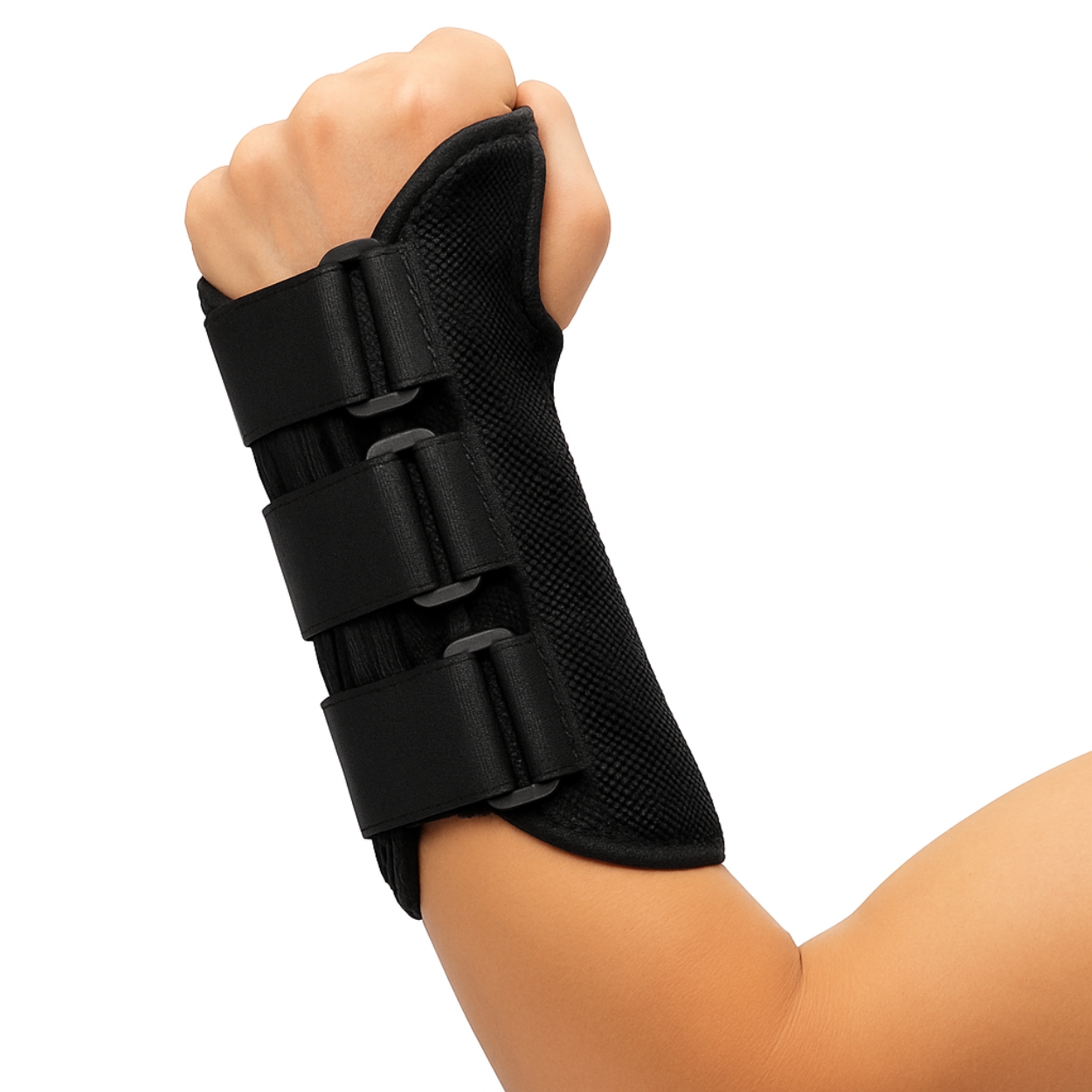


Roll over image to zoom in
Wrist Brace Splint for Sprains, Strains & Fractures
£13.99inc VAT
- Firm wrist brace splint / wrist support brace for adults with wrist pain, weakness or tingling when pushing, lifting, typing or sleeping
- Helps people looking for a wrist brace for Carpal Tunnel Syndrome, wrist sprains, fractures in recovery, tendonitis, arthritis, ganglion cysts and other common wrist problems
- Three metal stays along the palm, back and side hold your wrist straighter (neutral) to reduce painful bending, twisting and side‑tilt
- Supports the tunnels for the median and ulnar nerves to help ease tingling, numbness and burning in the thumb, index, middle, ring and little fingers, depending on the problem
- Left and right‑hand designs shaped to follow the natural curves of your palm, wrist and lower forearm so support sits where it is needed, not across bony points
- Three non‑stretch straps let you set a snug, even fit and adjust it as swelling or comfort change, without the brace slipping or cutting in
- Soft padding, smooth seams and rounded edges so you can wear it for longer spells or at night, if your clinician has recommended night‑time splinting
- Breathable, ventilated fabric helps keep skin drier during work or sleep and reduces sweat‑related irritation under the brace
- Thumb and fingers remain free so you can manage lighter daily activities while your wrist and the base of your hand are held steady
- Suitable as a wrist brace for typing or office work, light manual tasks and, after a cast is removed, as a wrist support after a broken wrist or wrist surgery when advised
- Use during tasks and times of day that usually aggravate your wrist, and, if recommended, overnight to help keep your wrist in a safer middle position
- Not a cure or a replacement for medical care; seek advice quickly if you have new severe pain, deformity, heavy swelling, worrying colour change or other unexplained symptoms
Who this wrist brace splint is for
If wrist pain is turning simple things like lifting a kettle, typing, turning a key or pushing up from a chair into a chore, that is a common experience. When the structures in your wrist are irritated, even everyday movements can feel sharper, weaker or less reliable than they should.
NuovaHealth’s Wrist Brace Splint is designed to give your wrist a break from the movements that keep setting it off, keep it closer to a safer middle position, and support it while you work, rest and sleep.
This firm wrist support brace is intended for adults who need structured support around the wrist, palm and lower forearm. It is suitable for both men and women and is available in three adult sizes with adjustable straps so you can fine‑tune the fit. It is not designed for children.
It is particularly aimed at people managing:
- Carpal Tunnel Syndrome
- Wrist sprains and ligament strains
- Wrist and hand fractures (including scaphoid fractures) during recovery phases where a brace is appropriate
- Repetitive Strain Injury (RSI) and overuse problems
- Tendon issues such as Wrist Tendonitis, Tendinosis, De Quervain’s Tenosynovitis, Intersection Syndrome
- Arthritis affecting the wrist and hand
- Ganglion cysts around the wrist
- Conditions involving the Triangular Fibrocartilage Complex (TFCC)
- Wrist Bursitis
- Ulnar Tunnel Syndrome (ulnar nerve entrapment at the wrist)
- Kienbock’s Disease
- Post‑surgical recovery where your clinician has advised a wrist splint
Many people searching for a wrist brace for Carpal Tunnel, wrist tendonitis, arthritis, a sprained wrist, TFCC injury or a ganglion cyst are looking for this kind of firm, neutral‑position splint.
These problems include nerve compression, ligament and soft‑tissue injuries, fracture recovery, tendon overuse, and arthritic or inflammatory joint conditions around the wrist and hand.
If you have new, severe wrist pain after an accident, a visible deformity, very rapid swelling, or you suspect a fracture that has not been assessed, or you develop sudden, severe wrist pain without a clear cause, you should speak to a clinician promptly before relying on any brace.
What is happening inside a sore or injured wrist?
When your wrist hurts, it is rarely just one structure causing trouble. The wrist is a compact area where several important parts share very little space:
- the small carpal bones that form the wrist joint
- strong ligaments that link those bones and help keep them lined up
- tendons from muscles in your forearm that cross the wrist into the hand and fingers so you can grip, lift and turn
- nerves and blood vessels that pass through tight tunnels on their way into the hand
In a healthy wrist, the small bones glide smoothly, the ligaments limit movement to a safe range, the tendons slide freely as you bend and straighten your wrist and fingers, and the nerves carry signals without being squeezed.
When you fall, twist, repeatedly strain the wrist, or live with a longer‑term condition, several things usually start to happen together.
Soft tissues become irritated and sore
The ligaments, tendons, or the thin linings around them can become inflamed or irritated. They swell slightly and become more sensitive to movement and pressure. Swollen tendon sheaths or joint linings take up more space, and every time you bend and straighten your wrist those sore areas are pulled and pressed.
You often notice this as:
- aching or sharper pain with certain wrist movements
- stiffness when you first start using the wrist after rest
- a pulling or catching sensation when you move quickly into the position that bothers it most
Swelling raises pressure inside tight spaces
Many of the tendons and nerves around your wrist run through narrow tunnels. On the palm side, the carpal tunnel is formed by the carpal bones underneath and a strong band of tissue (retinaculum) on top. On the little‑finger side there is another tight space (Guyon’s canal) where the ulnar nerve runs.
These tunnels do not have much spare room. When fluid builds up, pressure inside them rises. Nerves are especially sensitive to this squeeze. If the median nerve in the carpal tunnel or the ulnar nerve at the little‑finger side is compressed, you may notice numbness, tingling, burning pain, or a heavy, clumsy feeling in certain fingers.
Certain wrist positions become especially provocative
Some wrist and forearm positions place much more strain on these structures than others. Common examples include:
- bending the wrist back as far as it will go (full extension) when you push up from a low chair or the edge of a bed, so the front of the wrist and carpal tunnel are forced into a tight angle
- bending the wrist forwards fully (full flexion) when you press your palm hard against something with the wrist dropped, stretching tissues on the back of the wrist
- tilting the wrist towards the little‑finger side when you lean on that side of your hand, loading the TFCC and ulnar‑side ligaments
- twisting your forearm while your hand is fixed in place, for example when you turn a very stiff key or handle, so the forearm rotates under a held wrist
In these positions, ligaments and cartilage on one side of the joint are stretched and compressed, tendons are pulled hard around corners, and the tunnels around nerves are narrowed. If the structures are already sensitive, these end‑range positions are often the ones that trigger pain, tingling or a “giving‑way” feeling.
Even more neutral‑looking activities can load the wrist in awkward ways if they are repeated for a long time, such as resting your wrist on the sharp edge of a desk while typing, or letting your wrist sag downwards while you use a mouse.
Your body braces the wrist and the forearm gets tired
In response to pain, the muscles in your forearm often tighten up to try to protect the wrist. These muscles control wrist bending and straightening, and most of them sit in the forearm rather than the wrist itself. When they tense to guard the joint, you may:
- hold the wrist more rigid than usual
- avoid putting weight through the hand
- change how you grip or lift things with that hand
Because you are using those muscles in a tense, guarded way, they can start to feel tired, heavy or achy by the end of the day. At the same time, the small stabilising muscles in the hand can weaken if you are using that hand less. The joint capsule around the wrist can stiffen if it is rarely taken through the easier middle part of its movement.
Over time, this often becomes a cycle:
- pain makes you avoid certain positions and brace with your forearm
- that guarding pattern puts different, sometimes higher stresses on sore structures
- the ligaments, tendons, cartilage and nerves in your wrist never quite get calm time in a safer middle position to repair properly
If your job, caring roles or hobbies keep pushing your wrist back into those same painful bends and twists, this cycle can be hard to break without changing how the joint is loaded.
Why steady support and a neutral wrist position help
Once you understand that nerves, ligaments and tendons in the wrist are most irritated at the very ends of their movement, it becomes clearer why many clinicians look for ways to keep the wrist closer to the middle of its range and away from sharp bends and twists.
In this context, “neutral” means your forearm, wrist and hand are more or less in a straight line, rather than the wrist being cocked forwards or backwards or tilted to one side. In this position:
- the tunnels around the median and ulnar nerves are as open as they can be, giving any swelling more room before it presses on the nerves
- the ligaments and the TFCC at the sides of the wrist are neither fully stretched nor fully compressed
- tendons run more centrally through their grooves, sliding in a smoother, straighter path rather than being dragged over the edges of joints
For example, when you push up from a chair with your wrist bent right back, the palm side of the wrist joint and the carpal tunnel are forced into a tight angle and pressure inside the tunnel rises. When you lean on the little‑finger side of your hand with the wrist tilted over, the TFCC and ulnar‑side ligaments are both tensioned and squashed. When the wrist is closer to the middle of its bend and side‑tilt, these pressure peaks are lower and the load is shared more evenly between the forearm bones and the carpal bones.
This helps explain why your wrist can feel reasonably calm at rest in a straight, supported position, but the pain or tingling quickly returns when you push up from a low seat or lean on your hand at an angle.
A well‑fitted wrist brace splint helps in three main ways.
Limiting painful movement
By holding the wrist still, or at least cutting down how far it can bend and twist, a brace reduces the repeated strain that comes from everyday tasks. That means you are less likely to drop into those extreme angles when you:
- push up from a chair or bed and your wrist would normally bend right back
- lift and pour heavier objects like pans or kettles so the wrist bends back under their weight
- twist jars or door handles with your forearm rotating strongly while the hand is fixed
- spend long spells at a keyboard or mouse with the wrist slowly sagging or cocked up
The aim is not to stop all movement, but to keep your wrist out of those last few degrees of bend and twist where irritated ligaments, cartilage, tendons and nerves tend to complain most.
Keeping the wrist nearer a neutral alignment
Many nerve compression problems, especially Carpal Tunnel Syndrome, are worse when the wrist is held bent for long periods. Sleeping with the wrist curled under the head, resting the palm on a desk with the wrist dropped, or driving with the wrist cocked can all increase tunnel pressure for hours at a time.
A brace that supports the palm and the back of the forearm helps keep the wrist nearer that easier middle position while you are relaxed or distracted. For someone whose fingers tingle when they sleep with the wrist curled, keeping the wrist broadly in line with the forearm for most of the night gives the median nerve a break from constant squeeze.
Providing gentle compression and clearer feedback
The snug, even contact of a good brace gives your brain clearer information about where your wrist is and how it is moving. That extra awareness means you are less likely to drift into positions that you will pay for later.
Light, even compression can also help limit excessive fluid build‑up in some soft‑tissue problems, as long as the brace is fitted sensibly. If the brace is pulled too tight, you may notice throbbing, tingling, or your fingers changing colour or feeling unusually cold. Those are signs to loosen or remove it.
The brace will not cure the underlying condition on its own. But by altering the angles and forces at the wrist, and by cutting down the number of times you hit the same sore positions, it often makes day‑to‑day tasks more manageable and gives irritated structures a better chance to settle, especially when used alongside exercises and task changes agreed with your clinician.
How the NuovaHealth Wrist Brace Splint supports your wrist
The NuovaHealth Wrist Brace Splint is built around the same principles clinicians rely on when they choose a firm wrist support: keep the joint nearer the middle of its bend, control twisting and side‑tilt, and do it in a way you can tolerate for long enough to make a difference. Unlike a soft wrap, this is a firm wrist brace with metal supports along the palm, back and side of your wrist.
Shaped for left and right wrists
This brace is not a straight tube. You choose either a left‑hand or right‑hand version. Each is contoured to follow the natural curves of that side of your palm, wrist and lower forearm.
Because it follows the shape of your palm and the bony points around the wrist, the brace:
- spreads pressure over a broad area rather than digging into one spot
- avoids placing seams directly over the bony bumps on the thumb and little‑finger sides
- lets the metal supports sit where they need to, without rubbing on the most prominent bones
This is especially important if you have tenderness just above where a watch strap would sit, soreness over the little‑finger side, or a ganglion cyst around the front or back of the wrist. A flatter, less tailored support can easily press directly onto those areas.
The brace covers the palm and wrist while leaving your thumb and fingers free up to the knuckles. This means your wrist and the base of your hand are steadied, but you can still open and close your hand, hold a pen, use cutlery or manage light household tasks.
Three built‑in metal supports for firm control
Inside the brace are three aluminium strips that run along its full length:
- a broad strip along the palm side of your hand and forearm
- a strip along the back of the wrist and forearm
- a strip along the side (ulnar or radial side, depending on left or right hand)
Together, these strips:
- help keep your wrist, hand and lower forearm in a straighter line
- limit how far you can bend the wrist forwards and backwards
- reduce side‑to‑side tilt and twisting when you put weight through your hand
For example:
- when you push yourself up from a low chair, your body weight tends to bend the wrist backwards fully. The palm‑side strip resists this, so the front of the wrist is not forced into its sore end position
- when you turn a stiff key or twist a door handle with your hand fixed, your forearm rotates under the wrist. The side strip helps stop the wrist from collapsing towards the little‑finger or thumb side, which would strain the TFCC and side ligaments
- when you lift or carry something with the wrist tilted off‑centre, the back strip (dorsal strip) adds stability so the small wrist bones do not move quite as freely under load
These strips are deliberately stiff in everyday use. As your wrist starts to approach the extremes of its bend or twist, you feel a firm stop from the brace. That level of control is similar to what a clinician would look for in a firm splint, but here you can put it on and take it off yourself.
Three non‑stretch straps for an adjustable, secure fit
On the back of the brace (opposite the palm), three non‑elastic straps with sturdy buckles pull the two sides of the brace together over the metal supports.
This lets you:
- set how snug the brace feels at each level along your wrist and forearm
- adjust for slimmer or fuller wrists within each size
- keep support consistent even if your wrist or hand swell slightly through the day
Because the straps sit at different levels, you can tighten more over the wrist joint itself if you want extra control there, and leave the forearm slightly looser, or the other way round.
A good guide is:
- the brace feels snug and secure, not loose and not cutting in
- you can still move and spread your fingers freely
- your fingers and hand stay their normal colour and temperature
- you feel the brace gently resist when you try to bend or twist your wrist further, without sharp digging or pinching
If the brace is too loose, your wrist can still drop into painful positions and the metal strips may not sit correctly. If it is too tight, blood flow or nerve function can be affected. The adjustability of the three straps is there so you can find that middle ground.
Soft padded interior and smooth edging
Inside, the brace is softly padded to sit comfortably against your skin. Seams are kept low and placed away from the main pressure points around the wrist, such as the bony bumps on the thumb and little‑finger sides.
All edges are finished with a soft trim and rounded so they do not cut into the skin when you move. This matters if you plan to wear the brace for a full work shift or overnight. A single rough edge pressing on the same point for hours is enough to cause a sore area; this design aims to minimise that risk.
By reducing rubbing and pressure points, the padding and smooth edging make it more realistic to wear the brace for the length of time your clinician recommends, rather than only managing short bursts before it becomes uncomfortable.
Breathable, ventilated main body
The main fabric is supportive but lightweight, with ventilation holes to allow air to circulate around your skin. Perforations along the palm and back panels help moisture escape from the areas that tend to sweat most.
If the skin under a brace stays damp for long spells, it softens and becomes more prone to irritation and damage. Better airflow helps your skin stay in better condition when you are wearing the brace for much of the day or overnight.
You can wear the brace directly against your skin, which many people find comfortable thanks to the padded interior, or over a thin, smooth sleeve if your skin is easily irritated or you simply prefer an extra layer. NuovaHealth also offers dedicated arm sleeves that can be worn underneath to add a soft lining and make the brace glide on and off more easily.
Using the brace day to day: how and when
A brace can only help if it fits into real life. This splint is firm enough to change how your wrist moves, but simple enough to put on, adjust and remove around your normal routine.
Everyday activities, including typing and light manual work
You can use this brace during many day‑to‑day tasks that usually set your wrist off, such as:
- working at a desk with a keyboard, mouse or paperwork
- preparing food, light cleaning and other household chores that involve lifting and steadying with your hands
- steady‑hand hobbies where the wrist can stay fairly straight, such as reading, light crafting, or using a tablet resting on a stand
If your main issue is wrist pain with typing or mouse use, a wrist brace for typing like this can help by stopping the wrist from slumping onto the sharp edge of the desk and keeping it nearer the easier middle part of its bend.
When the brace is on, it helps keep your wrist nearer that middle part of its bend, in line with your forearm, and more stable. That makes it harder to accidentally drop into the sharp angles that irritate sore structures.
For instance:
- when you are typing or using a mouse, the brace can stop your wrist from sagging forwards onto the desk edge, which would increase pressure through the carpal tunnel
- when you lift lighter objects from a worktop or table, it helps stop the wrist flopping back and pulling on sore ligaments and tendons
Whether your day is mostly at a desk, on your feet doing light manual work, or a mix of both, this type of wrist support brace can help you through the tasks that usually stir your symptoms up.
For people with Carpal Tunnel Syndrome, RSI or tendon problems, this can be particularly helpful in the longer or more repetitive parts of the day. During a flare‑up, wearing the brace for tasks that usually provoke symptoms can give your wrist calmer spells between those loads, while you still take it off for lighter periods if your clinician is happy with that approach.
Night‑time symptoms and sleep
Many people find their wrist or hand symptoms are worse at night, especially if they tend to sleep with their wrists bent or curled under their head or body. In these positions, the wrist can stay at the end of its bend for hours, keeping pressure on nerves and sore tissues.
If you wake with pins and needles or burning in your hand and are searching for how to stop wrist pain at night, a night‑time wrist splint is a common recommendation, particularly for Carpal Tunnel symptoms that wake you. If your clinician has suggested a wrist brace for sleeping, this splint can be used at night because it:
- holds your wrist closer to neutral while you are asleep
- helps prevent you from curling your hand tightly under your head or body
- gives steady support if you roll or press on your hand in the night
If you wear the brace at night:
- make sure it is snug but not overly tight – you should be able to slip a fingertip under each strap
- check your skin and fingers each morning for any unusual marks, colour change or increased swelling
- stop using it and speak to a clinician if night‑time bracing seems to make numbness or pain worse, or if you notice new changes that do not settle
Many people ask whether you can sleep with a wrist brace on. If your clinician has recommended night‑time splinting and the brace is fitted sensibly, it is usually safe to wear overnight with regular checks on your skin and finger sensation.
Activities to be cautious with
This brace is designed to support and steady the wrist. It does not make heavy or risky activities safe for a sore joint. It is usually sensible to be cautious with:
- lifting or carrying very heavy objects with the affected hand so that the wrist bends or twists under the load
- sports or activities where falls or direct blows to the wrist are more likely
- using the brace to push through severe, worsening or unexplained pain instead of seeking advice
If you are thinking about a wrist brace for lifting weights or more demanding gym exercise, it is sensible to check with a clinician who knows your wrist condition. A brace controls movement but does not make the wrist joint impact‑proof.
Even with a strong brace, the bones, ligaments and tendons inside the wrist still feel the forces you put through them. The brace limits movement; it does not make the structures tougher or protect them from heavy impact. If you are unsure whether a particular job task, sport or exercise is appropriate while wearing the brace, it is wise to discuss this with a clinician who understands your specific condition and daily demands.
How long and how often to wear it
How long you should wear the brace will depend on your diagnosis, the stage of healing and what your clinician advises. Some people only need it for certain tasks or during a short flare‑up. Others may be asked to use it for most of the working day or overnight for a period.
General points that often help:
- start with shorter spells so you can see how your skin and wrist respond
- take regular breaks to move your fingers and thumb fully, and to gently bend and straighten your elbow and shoulder, so other joints do not stiffen
- from time to time, remove the brace briefly to check your skin for any sore areas, redness or marks that do not fade
People sometimes worry that wearing a wrist brace will weaken their wrist. Short‑term use for protection, alongside exercises prescribed by a clinician, is unlikely to cause lasting weakness. Problems are more likely if a brace is worn all day for many months with very little active movement.
Over weeks and months, most people do best with a balance: using the brace to protect the wrist during jobs that clearly load it, while also doing any recommended exercises and lighter, brace‑free movement to keep joints mobile and muscles working. Wearing a firm brace all day, every day, for long periods without movement can lead to extra stiffness and short‑term loss of strength if it is not paired with active rehabilitation.
Your own clinician can advise what pattern of wear is most suitable for your wrist problem and your work or home life. The brace itself is made to be comfortable for extended use when fitted correctly.
Choosing your size and getting a good fit
A wrist brace can only do its job if it fits well. This splint comes in three adult sizes – Small, Medium and Large – and each size can be adjusted with the three straps to suit different wrist and forearm shapes.
To choose your size:
- measure around your wrist at the level of the wrist crease, where a watch strap would usually sit
- use a soft tape measure held snugly against the skin, without pulling so tight that it digs in
- compare your measurement with the size guide for Small, Medium and Large
If you are unsure which size of wrist brace to choose and your measurement sits between two sizes, think about how you like a support to feel:
- if you prefer a closer, more “held” feeling, the smaller size may suit you better
- if you prefer a little more room and rely on the straps to snug it down, the larger size may be more comfortable
Because there are three adjustable straps, you can:
- accommodate slimmer or fuller wrists within each size
- tighten more around the wrist joint itself and a little less on the forearm, or vice versa
A well‑fitting brace should:
- feel secure without cutting into the skin
- let you move and spread your fingers freely
- keep your fingers and hand their usual colour and temperature
- hold the palm‑side metal strip running from just below the base of your fingers down along the forearm, with the wrist crease roughly at the bend of the brace
If you cannot fasten the straps without discomfort, if your fingers tingle or change colour, or if the brace slides around and your wrist still bends freely, the fit is not right. If your wrist measurement sits far outside the range covered by the available sizes, or you are struggling to find a comfortable adjustment, it is sensible to seek advice rather than forcing a poor fit.
You can wear the brace directly against your skin or over a thin, smooth sleeve or dedicated arm sleeve if your skin is easily irritated or you prefer that extra layer.
Safety, cautions and when to seek advice
This wrist brace splint is a supportive device. It does not diagnose the cause of your pain and it does not replace an assessment or treatment plan from a qualified clinician.
You should seek advice from a GP, physiotherapist, hand therapist or other suitable clinician before relying on this brace if:
- you have a new wrist injury after a fall, direct blow or accident and have not yet been assessed
- there is a clear deformity or misalignment and the wrist looks “out of place”
- swelling appeared very quickly or is severe, or your hand and fingers are becoming unusually pale, blue or very cold
- you have important underlying medical conditions affecting circulation or sensation in the arm or hand
If feeling in your hand is reduced, you may not notice early signs that the brace is too tight or that there is pressure damage to the skin, so you should be particularly cautious and get professional guidance before using a firm support.
If you are already under care for your wrist, let your clinician know you are using or considering this brace. They can advise whether it fits with your current treatment plan and how best to use it.
This brace does not treat or prevent blood clots and must not be relied on for that. Blood clots affect circulation in the veins and require medical treatment; a brace only changes wrist position and support. If you have been told you are at higher risk of clots, or you develop new or unexplained swelling, warmth, or marked colour change in your arm, you should seek medical advice urgently. A brace cannot manage that type of problem.
If wearing the brace causes increasing pain, numbness, tingling, or skin changes that do not quickly settle when you loosen or remove it, stop using it and consult a clinician.
How this brace fits into specific wrist and hand conditions
Different diagnoses affect different structures in the wrist and hand, but many share the same mechanical themes: irritated structures dislike repeated strain, sharp bends and heavy loading in awkward positions. A firm wrist splint that keeps the joint nearer the middle of its bend and limits twist can be helpful in several of these situations.
If you already know your diagnosis, the sections below explain, in more detail, how a brace like this can fit into that particular situation. These descriptions are for general guidance, not to diagnose new problems. A clinician should confirm the exact cause of your symptoms.
Caring for your wrist brace splint
Looking after your brace properly will help it stay comfortable and effective for longer.
- Hand wash the brace in lukewarm water with a mild detergent.
- Rinse thoroughly to remove any soap from the fabric.
- Gently squeeze out excess water without twisting or wringing the brace.
- Lay it flat or hang it to air dry away from direct heat sources such as radiators or strong sunlight.
Do not machine wash or tumble dry the brace, as this can damage the fabric, padding and the stitching that holds the metal supports in place.
Avoid bending the built‑in metal supports by hand. They are designed to keep a consistent shape that holds your wrist in a better position. Excessive bending can change how well the brace supports you and how comfortable it feels.
With normal use and proper care, the brace is designed to cope with regular daily wear. How long it remains supportive will depend on how often and how intensively you use it. If you notice significant fraying, damage, or changes in the support – such as the metal strips becoming distorted or the brace no longer holding your wrist steady – it may be time to consider a replacement, as a worn brace may not provide the same level of control and comfort.
Bringing it all together
Wrist pain, weakness or tingling can creep into many parts of the day – from opening jars and lifting a kettle to typing, driving, carrying bags and trying to find a comfortable sleeping position. For many of the problems described above, the underlying theme is the same: symptoms are often driven by bending and twisting the wrist to its limits under load, again and again.
Because your symptoms are often triggered by those end‑range positions and repeated loads, and because this brace is built to hold the wrist nearer the easier middle of its movement and stop it dropping into those extremes, it offers a clear, mechanical way to cut down the stresses that keep flaring your symptoms.
By holding your wrist, palm and lower forearm in a steadier, more neutral position, and by limiting sudden, large bends and twists, the NuovaHealth Wrist Brace Splint is designed to reduce the movements and angles that repeatedly aggravate your symptoms. That gives sore or healing structures calmer conditions in which to recover, and helps you approach work, home life, selected leisure activities and rest with more confidence instead of constantly guarding your wrist.
The anatomically shaped left and right designs, three built‑in metal supports, padded and ventilated main body, and adjustable three‑strap closure work together to provide the level of firm control clinicians usually look for in a splint, in a brace you can take on and off yourself.
If your wrist pain, tingling or weakness matches what is described here, and a GP, physiotherapist or other clinician has confirmed that a wrist splint is suitable for you, this brace is a logical option to consider. Measure around your wrist where a watch strap would sit, choose the appropriate Small, Medium or Large size, select left or right hand, decide whether you would like to pair it with a smooth sleeve from NuovaHealth, and try it during the tasks and times of day that usually set your wrist off. That is often the most straightforward way to judge whether this level of wrist support makes everyday pushing, lifting and typing more comfortable for you.
NuovaHealth offers a 30‑day money‑back guarantee on this brace. That gives you time to see how it feels in your own routine and, if it is not right for you, to return it in its original condition within 30 days for a refund.
Important information and disclaimer
The information on this page is general guidance. It does not replace individual medical advice, diagnosis or treatment. Wrist and hand symptoms can have many causes, and similar pain or tingling can arise from different underlying problems.
If you are unsure whether this brace is right for you, if your symptoms are changing, or if you notice new or unexplained symptoms that do not settle, it is sensible to speak to a GP, physiotherapist, hand therapist or other appropriate clinician. They can assess your specific situation and advise you on diagnosis, treatment options and safe use of supports.
No brace can guarantee particular results or prevent all problems. The NuovaHealth Wrist Brace Splint is intended as one part of your overall management, which may also include exercises, changes to how you use your wrist and, if needed, other treatments prescribed by your clinician.
2 Reviews For This Product
Fast & Secure Checkout Through Paypal
Pay with Paypal the secure payment gateway that accepts all credit and debit cards. Paypal is free and secure and no credit or bank information is ever stored or shared with us.
Fast Dispatch
Enjoy your items soon with quick dispatch via Royal Mail First Class. Expect to have your items between 1-3 days for domestic orders. 7-10 Working days for international orders.
Return Policy – 30 Day Money Back Guarantee
We are so confident that you will just love our product that we offer a full 30 day money back guarantee. In the unlikely event, you are unhappy with your purchase you can simply return it within 30 days for a refund. Please contact us via the form on the contact us page to start your return.
To return an item please send it to: Nuova Health UK, 81 Highfield Lane, Waverley, Rotherham, S60 8AL. Please include a note with your order id so we know who to refund. Please retain your postage receipt as proof of postage. All that we ask is that the item is in the original packaging and unused.
by Jason R
A really good brace that has really helped ease my sprained wrist. Thank you!
by Dave
Cannot fault this wrist support. Does a great job at supporting my wrist and is very comfortable to wear. Would highly recommend.