
No products in the cart.


Roll over image to zoom in
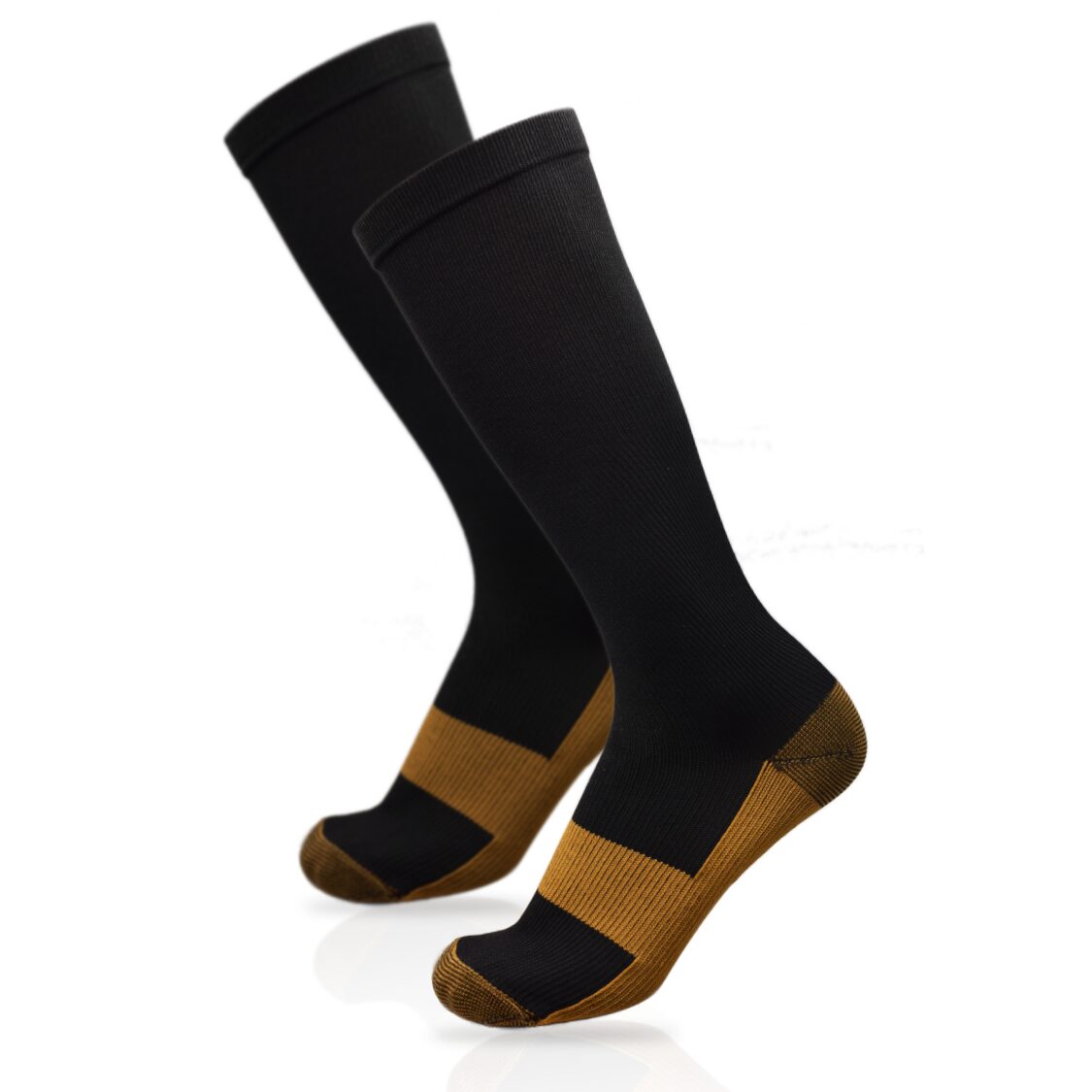
Copper Circulation Travel Socks
£8.99inc VAT
- 1x pair of FootReviver copper circulation travel socks with a medium, graduated compression level to support your feet and lower legs.
- Designed for adults who get swollen, heavy or tired lower legs on long journeys or long days of sitting or standing.
- Full‑length design up to just below the knee to give consistent support to the calves, ankles and feet – the areas that often swell and feel heavy on long journeys.
- Soft, full‑foot design in discreet black, with smoother internal seams than many ordinary socks and a copper‑coloured band around the arch and sole to give extra hold through the mid‑foot and heel.
- Graduated compression profile – firmer at the ankle and easing towards the calf – to gently narrow the veins, help the valves close properly, and encourage blood to move upwards instead of pooling around the ankles.
- Honeycomb comfort top that helps keep the socks up without digging into your calves or leaving a tight, uncomfortable band.
- Copper‑infused, breathable fabric blend that helps draw sweat away from the skin and slows the build‑up of odour‑causing bacteria, so feet tend to feel drier and fresher on long trips. Copper fibres are woven through the yarn for lasting effect.
- Targeted knit around the arch and heel for a close, supported feel through the mid‑foot and rearfoot, helping to reduce twisting and bunching without adding bulk – designed specifically for stop‑start travel days.
- Slim in‑shoe profile with smooth toe and heel seams to cut down rubbing and help prevent blisters or calluses when feet swell slightly over the day.
- Unisex sizing – available in S/M and L/XL based on typical adult UK shoe sizes. If you are between sizes or have very muscular calves, it is usually more comfortable to choose the larger size.
- Ideal for long‑haul flights and extended car, coach and train journeys, and for long days of sitting or standing when your legs tend to feel heavy or swollen.
- Recommended for adults with tired, aching, heavy or mildly swollen legs and feet, and for those prone to blood and fluid settling in the lower legs or with sensitive feet (with medical advice where needed).
- Machine washable and built for repeated use, with a 30‑day money‑back guarantee. If you travel regularly, having at least two pairs makes it easier to wash and dry between uses. Replace if they become noticeably loose or stop staying in place.
Disclaimer: These socks are designed for comfort and circulatory support during travel. They are not a medical device and will not treat, cure, or prevent any medical condition, including blood clots such as Deep Vein Thrombosis (DVT). Consult your doctor before use if you have diabetes, ischaemia, peripheral neuropathy, a history of cellulitis, congestive heart failure, or any other health concerns related to your legs or circulation. While these socks can be part of your travel routine, they are not a complete solution for clot prevention. It remains essential to keep your feet and legs moving regularly, stay hydrated, and follow all travel health advice from your healthcare provider. Your safety is our priority. Always seek professional medical advice for your personal health needs.
What many people notice in their legs and feet on long journeys
Long journeys and long days of sitting or standing still put extra strain on the veins and tissues in your lower legs. This page is here to help you make sense of what you feel, understand how these FootReviver copper circulation travel socks work, see who they are and are not suitable for, and know when symptoms mean you should seek medical advice instead of, or as well as, using them.
Many people notice the same pattern after a long trip. Both ankles look puffier than usual, the skin around the ankle bones and over the top of the foot feels tight, and shoes that were comfortable at the start of the day now feel snug. Ordinary socks may leave clear marks where the fabric has pressed into the skin. The lower legs can feel heavy, tired or “full”, and some people get cramps or a dull ache in their calves, especially when they first stand up after sitting for hours.
If this sounds familiar, you are not alone. It is a very common reaction to longer journeys by plane, train, coach or car, especially when there has been little chance to move around. It tends to be more obvious in people who already notice some swelling at the end of a normal day, who describe themselves as having “poor circulation” in the legs, or who have mild vein problems. In many cases, the main effect is discomfort and fatigue, and things ease off over the next day as you walk more and rest with your legs up.
It is still worth noticing how your swelling behaves over time. Swelling that is very marked, much more obvious in one leg than the other, does not settle between journeys, or is steadily getting worse over weeks and months can point to deeper circulation issues rather than simply a short‑term reaction to travel. Those more worrying patterns are explained in more detail in the condition‑specific overviews and in the safety section further down this page.
What long periods of sitting do to circulation in the lower legs
When you walk, the muscles in your calves and feet keep tightening and relaxing. Deep veins run between these muscles. Each time the muscles tighten, they squeeze the veins a little, pushing blood upwards towards your heart. Inside the veins are small flaps, or valves, which close when the muscles relax so blood does not simply fall back down with gravity. This “pumping” effect is often called the calf muscle pump, and it is a key part of how blood returns from the lower legs.
On a long journey, especially in a tight space, you tend to sit with your hips and knees bent and your feet down. Your calves hardly move, so they squeeze the veins far less often. The veins that run from the legs through the pelvis are also held in a more bent position, which can make the route back to the heart a little less open than when you are standing and walking. Gravity, however, continues to pull blood and fluid down into the tissues of the calves and ankles.
Because the blood is moving more slowly and the pressure inside the veins is higher near the ankle, some fluid seeps out into the soft tissues around the ankle bones, over the top of the foot and around the lower calf. That is what produces the visible swelling and the tight, heavy feeling many people notice after sitting for a long time. In people whose vein valves are already not working as well as they could, or whose veins are more stretchy, this happens more easily and can take longer to settle.
A similar slowing of flow can occur in the deep veins within the calf and thigh muscles. If that slow flow comes together with other risk factors – such as a natural tendency for the blood to clot more easily, recent surgery or certain medical conditions – a clot can sometimes form in one of these deep veins. That is the process behind a deep vein thrombosis (DVT) it is important to note however that these socks do not treat or prevent blood clots.
Planes, trains and other enclosed spaces are often warm, and shoes or boots may stay on for many hours. Feet sweat, especially around the toes, soles and heels. If that sweat is trapped against the skin and combined with rubbing from seams or shoe edges, the softened skin is easier to damage, which can lead to sore spots or blisters. For people with sensitive skin or reduced feeling in their feet, it is particularly important to control moisture and friction.
So what can you actually do about all this, especially when you cannot avoid long trips? One part of the answer is to change how blood and fluid behave at the ankle and lower leg. That is where compression travel socks come in.
Specific travel‑related leg problems explained
Some people have very specific worries about long journeys. You might be dealing with repeated ankle swelling, known vein problems, concerns about clots, very cold or colour‑changing feet, night‑time cramps after travel, or conditions like diabetes and neuropathy. Here are some of the common situations people ask about and how this type of travel sock may, or may not, fit in. They build on the general circulation picture above rather than repeating it.
Open the section that sounds most like your situation to see how these socks may fit in – and where they are not enough on their own.
Why compression travel socks are often used on long trips
Whether your main concern is swelling, existing vein problems, clot worries, cold feet or night‑time cramps, the common thread is slower blood flow and pooling in the lower legs during long periods of sitting or standing. Compression travel socks are one of the simple ways to tackle that.
For adults who have to sit or stand still for long periods, they are often recommended as a straightforward way to look after the lower legs. In simple terms, they change how blood sits and moves in the lower legs so it is less likely to gather around the ankles and calves.
Medium‑level, graduated compression means the fabric gives the firmest squeeze around the ankle and a gentler squeeze higher up the leg. This gentle pressure narrows the veins a little and supports their walls. When the veins are slightly narrower and better supported, the valve flaps inside them can meet more easily and stop blood slipping backwards between heartbeats. That encourages blood to travel upwards towards the heart rather than settling in the lower part of the leg.
With less pressure in the veins at the ankle, less fluid is pushed out into the surrounding tissues. That is why many people notice less swelling and heaviness when they wear compression socks on long journeys compared with ordinary socks. Medium compression socks like these are aimed at adults who are generally well but prone to travel‑related or day‑to‑day pooling in the feet and lower legs. They are not the same as the stronger stockings that your specialist may have prescribed for more severe venous disease and should not be used instead of those.
Compression works best as part of a simple routine. Moving your ankles and toes regularly, standing up and walking when you can, wearing footwear that is not tight and drinking enough fluid all support the lower‑leg circulation. The socks then build on that by helping the veins and valves themselves. FootReviver have set the compression in this design to be firm enough around the ankle to be useful, but comfortable enough to wear for a whole journey.
How this FootReviver travel sock works in practice
This copper circulation travel sock from FootReviver has been designed to work with the way your legs behave on long journeys. It combines medium, graduated compression with a number of practical details to support both circulation and skin comfort when you are wearing the same socks and shoes for many hours. The design reflects the sort of travel‑related leg problems that doctors and therapists see every week.
The sock covers the whole foot, including the toes, and comes up to just below the knee. That length means it can support the calf muscle that helps pump blood back up the leg, as well as the ankle, where most swelling shows. The honeycomb‑style top band is designed to hold the sock up without acting like a tight ring round your calf. The main fabric is a copper‑infused, elastic material that can stretch to fit the leg, give a firm supportive feel and then spring back between uses. The toe and heel seams are kept smooth to cut down rubbing, and a band around the arch and heel gives extra hold around the mid‑foot. The honeycomb top and copper arch band are characteristic features of this FootReviver travel design, and are not usually seen in ordinary socks.
Graduated compression from foot to calf
In this design, the squeeze is firmest around the ankle, where gravity and lack of movement tend to cause the most pooling of blood and fluid. As you move up towards the calf and just below the knee, the compression gently eases off. That shape matches the direction the veins are trying to move blood: up towards the heart.
Around the ankle and lower calf, the sock narrows the veins slightly. This brings the valve flaps inside the veins closer together so they can close more firmly. When they close well, less blood can slide back down between each heartbeat. The pressure inside the veins near the ankle falls, so less fluid is pushed out into the tissues there. This is why, by the end of a journey, the ankles often look and feel less swollen in compression socks than they would have without them.
Higher up the leg, the compression is milder. That still supports upward flow but avoids a tight band near the knee. A very firm band at the top of a sock can be uncomfortable and can encourage fluid to collect beneath it. A smooth pressure gradient from ankle to knee is kinder to the veins and to the skin.
Gentle honeycomb top that stays up without digging in
A tight sock top can cause almost as many problems as it solves. If there is a strong, narrow elastic band at one level on the calf, it can dig in, leave deep marks and create a “step” where fluid gathers below the band. That is not only uncomfortable but can work against the smoother pressure we want along the leg.
The FootReviver sock uses a honeycomb‑patterned top to spread the grip over a broader area. Instead of one narrow strip taking all the strain, the honeycomb knit holds the leg with many small contact points. That helps the sock stay up over the day without cutting deeply into the skin. It also reduces the risk of a sharp change in pressure at the top edge, so you are less likely to see a clear ridge of swelling just below the top of the sock.
For long journeys or long work days where you are mostly sitting or standing in one place, this softer top design makes it more realistic to keep the socks on without constantly wanting to pull at them or fold the top down, which would spoil the compression profile.
Copper‑infused, breathable fabric to care for your skin
On long travel days or long working days, your feet are often in shoes for many hours at a time. The skin can get warm and damp, especially around the toes and soles. If that moisture stays trapped and is combined with rubbing, the softened skin is more likely to break down or blister.
The fabric in these socks is copper‑infused and designed to be both supportive and soft against the skin. The copper is woven throughout the material. It can help slow the growth of some bacteria on the fabric, which in turn tends to reduce odour build‑up on long wears. The knit is made to be durable enough for repeated washing and wearing, with enough stretch to fit closely and return to shape.
The knit is also designed to pull moisture away from the skin and allow it to spread and evaporate more easily. That helps keep the skin on your feet and lower legs drier. Drier skin is generally tougher and less likely to blister or get sore where there is pressure or rubbing. This matters particularly if you have sensitive skin, spend long hours in enclosed footwear, or have conditions such as diabetes where skin problems can be more serious.
Smooth toe and heel seams to reduce rubbing
The tops and sides of the toes, the back of the heel and the area around the Achilles tendon are common points where socks and shoes rub. Raised seams at the toes can press on the joints or nail folds when the shoe is snug. Thick seams at the heel can rub against the back of the shoe, especially if your foot slides slightly up and down as you walk.
In this design, the toe and heel seams are kept flat and smooth against the skin. That keeps ridges to a minimum and reduces the number of local “high points” where pressure is concentrated. When you are moving through stations or terminals, standing in queues and then sitting for long stretches, this more even contact helps protect the skin. Combined with better moisture control, smoother seams mean fewer hotspots and less chance of blisters or small calluses forming over time.
Targeted support around the arch and heel
The band around the arch and sole, marked by the copper‑coloured strip, gives extra hold through the mid‑foot and heel without adding thickness. It encourages the sock to follow the curves under and around your arch and heel rather than sitting loose and straight.
When you stand and walk, the arch and heel share a good deal of your body weight. The plantar fascia under the arch and the fat pad under the heel help spread and absorb these forces. As the day goes on and your feet warm and swell, the mid‑foot can feel as if it is flattening and spreading, which can make the sole and arch feel tired.
A closer, more supportive knit around this area can help keep the arch feeling more “held together”. It may not change the shape of your foot, but it can make the tissues feel less strained. It also helps stop the sock twisting inside the shoe or bunching under the arch, which can otherwise create uneven pressure or rubbing. This band has been included by FootReviver specifically to improve mid‑foot hold on days that involve repeated short walks and long periods of sitting.
Slim in‑shoe profile for everyday footwear
It is reasonable to worry that a supportive sock might make your shoes too tight. This FootReviver sock is designed to give a firm feel without bulky padding. The compression comes from the yarns and the way they are knitted, not from thick cushioning.
Because the sock is relatively slim and has smoother seams, it usually fits well in everyday travel shoes – for example trainers, walking shoes or casual flats that already fit comfortably. It is not meant to make poorly fitting shoes comfortable. For best results, your shoes should already have a bit of room around the toes and over the top of the foot.
A sock that lies smoothly in the shoe and is not unnecessarily thick helps spread pressure from laces and straps more evenly and reduces local pinching. That can be particularly helpful on days when you move between bursts of walking and long spells of sitting, as your footwear and socks should feel acceptable in both phases.
All‑day comfort for sitting, standing and walking phases of travel
Most travel days and many work days involve a mix of walking, standing and sitting, rather than just one or the other. You might walk to the station, stand in a queue, sit for several hours, then repeat the pattern at the other end. The lower legs have to cope with these changes in demand.
The graduated compression in this sock is meant to support your veins and calf muscles through that whole cycle. When you are walking or standing, the compression supports the veins as the muscles tighten and relax, helping the blood keep moving upwards with each step. That can reduce how tired and “full” the calves feel after a long section on your feet. When you sit for longer stretches, the same compression and the non‑digging top help make up some of the difference when the calf pump is less active, slowing the build‑up of pooling.
The targeted band around the arch and heel and the smooth seams help the sock stay put and stay comfortable as you change from walking to sitting and back again. The moisture‑managing fabric helps in warmer and cooler parts of the day, pulling sweat away when you are more active and helping keep the legs warm when you are still. This balance is what makes the socks practical to wear from early in the day, through the journey, and into the evening without needing to change.
Fit, sizing and durability for regular travel use
These socks come in two sizes, S/M and L/XL, based on usual adult UK shoe sizes, and are suitable for both men and women. The elastic knit means the sock can stretch to follow the shape of your foot and lower leg while still providing a steady, medium level of compression.
When the sock is the right size and put on properly, it should feel snug and supportive rather than loose, but it should not be painful. Your toes should be able to move, and the top band should sit just below the knee without folding or digging in. The fabric should lie fairly smoothly along the leg. During wear, you should not notice numbness, pins and needles, burning or unusual coldness in your toes, and your skin should not show deep, sharp bands of colour that last a long time after you take the socks off.
The socks are machine washable and have been built to cope with repeated use, so under normal care they should hold their general shape and level of support for a good number of wears. Like all elastic items, they will gradually loosen over time. If you find they start to slide down, feel noticeably looser, or no longer give you the same sense of support, it is a sign that they are due to be replaced.
These travel socks sit within the wider FootReviver range of supports developed for people with circulation and comfort problems in their legs and feet.
Who these socks are designed for – and when to be cautious
These copper circulation travel socks are aimed at adults who:
- notice that both ankles and lower legs tend to swell on long journeys,
- feel that their lower legs become heavy or tight after sitting or standing still for several hours,
- find that ordinary socks leave deep marks around the calves on travel or long work days,
- want a sock with fewer internal seams and better moisture control because their feet feel easily rubbed or damp.
They are mainly intended for people whose main issue is blood and fluid settling in the lower legs because of gravity and lack of movement – a venous‑type problem – rather than for people whose main difficulty is a severe lack of blood getting down to the legs and feet through narrowed arteries.
You should speak to your GP or another appropriate clinician before using these socks if you have:
- diabetes, particularly if you have been told you have nerve or circulation problems in your feet, or have had ulcers,
- peripheral neuropathy of any cause, with clear loss or change of feeling in your feet or lower legs,
- diagnosed peripheral arterial disease or ischaemia affecting your legs or feet,
- cellulitis or any other current skin infection on your lower legs or feet,
- congestive heart failure or other heart conditions where you hold fluid in your legs,
- a history of deep vein thrombosis or pulmonary embolism,
- open wounds, ulcers or very fragile skin on your lower legs or feet.
In some of these situations, doctors do use compression, but only very carefully and usually with prescribed garments that are measured and fitted for you. Medium, general‑use travel socks are not always suitable and should not replace garments or treatment that have been prescribed.
These socks are designed for adults and are not suitable in pregnancy. Pregnancy alters blood volume, vein function and clot risk in a way that needs individual advice. Any use of compression in that setting should be guided by a midwife or doctor who knows your situation.
If you are unsure where you fit, or you have more than one of the conditions listed above, it is wise to ask for personalised advice before relying on compression socks.
How to use these socks day‑to‑day and on long journeys
For travel, these socks are meant to be worn during the main period when you will be sitting still or standing in one place, such as long‑haul flights, extended train or coach journeys, and longer car trips with limited stops. They are most useful when you expect several hours of limited movement, not for very short routine trips.
Put the socks on before your journey starts, when your legs are likely to be least swollen. A simple way that makes them easier to put on is:
- put your hand inside the sock and pull it inside‑out down to the heel area,
- place your toes into the toe end and gently pull the sock over the front of your foot,
- position the heel of the sock over your heel,
- then, using both hands, work the rest of the sock up over your calf in small sections, smoothing out any wrinkles as you go,
- make sure the top band sits just below the knee and lies flat.
Try to avoid pulling hard on the very top of the sock alone. Pulling from one point can stretch that area out of shape and make it more likely to dig in or slip.
During your journey or long day, the socks should feel firmly supportive. They should not cause pain. If you notice that your toes become very pale, very dark, or feel numb, tingly, burning or unusually cold, or if you see a strong, tight band where the top has dug in, it is important to remove the socks and seek advice before wearing them again. If you struggle to get them on despite good technique, that may mean the size or level of compression is not right for you.
On days when you are not travelling but expect to sit or stand in one place for many hours – such as long office days, conferences or events – you can use these socks in a similar way. They are not intended to be worn around the clock. In general, wear them while you are sitting or standing still for long stretches and for a little while afterwards if your legs still feel heavy, then take them off when you are able to move more freely or when you go to bed, unless your own clinician has advised otherwise.
Even with the socks on, movement is still essential. Simple exercises such as lifting your heels off the floor and lowering them, circling your ankles, or flexing your feet up and down every so often help get your calf muscles working. Standing up and walking short distances when it is safe and practical – for example, along the aisle of a train or during a break in a car journey – adds further support for your circulation.
What you may notice when you use them
When these socks are used properly, and combined with some simple movement and hydration habits, many people feel that their legs cope better with long journeys or long days of sitting and standing. The difference is often clearest when you think back to similar trips done without compression.
Many people find:
- less visible swelling around both ankles and lower calves by the end of a trip,
- fewer or shallower marks on the calves where socks end,
- legs that feel less heavy or “full” when standing up after sitting for several hours,
- shoes that feel more comfortable at the end of a long day, even if there is still some natural swelling.
Many also notice that after a similar long journey, their ankles look and feel less swollen in these socks than they did in ordinary socks.
Some also notice fewer or less intense calf cramps or restless feelings in their legs after travel when they wear these socks and also build in some stretching and walking. Others feel that their feet are less clammy and smell less at the end of a long day, helped by the moisture‑managing, copper‑infused fabric and the smoother seams.
It can be wearing to feel your legs swell every time you travel. Many people are simply looking for something that makes that more manageable. People differ in how much benefit they notice from compression socks. These socks are designed to help your legs cope when they are under strain from sitting or standing too long. They are not a cure for vein disease, heart conditions, diabetic foot problems or other significant illnesses, and they cannot promise that you will not develop swelling or clot‑related problems. If your symptoms are strong, one‑sided, long‑lasting, or getting worse, it is better to get them checked than to just move to tighter socks or longer wear.
Safety, important information and disclaimer
These FootReviver travel socks can play a useful role in looking after your legs on long journeys and long sedentary days, but they sit alongside, rather than replace, other health advice and treatment. It is important to know when to seek help and who should speak to a clinician before using medium compression.
Seek urgent help straight away (call 999, your local emergency service, or go to A&E or an urgent treatment centre) if, during or soon after a journey, you notice:
- Sudden, severe pain or marked tenderness in one calf or thigh – especially if that leg also looks or feels different from the other.
- Sudden, clear swelling in one leg – that is much greater than in the other, particularly if it comes on over hours rather than weeks.
- Unusual warmth, redness or a distinct colour change in one lower leg – compared with your other leg.
- Sudden shortness of breath, sharp chest pain, coughing up blood, or feeling as if you might collapse.
These can, in some cases, be signs of a deep vein thrombosis (a clot in a deep leg vein) or a pulmonary embolism (a clot that has travelled to the lungs) and should be checked urgently. Do not ignore these changes.
Book an appointment with your GP or another healthcare professional for assessment if you notice:
- Swelling around your ankles or lower legs that is new, steadily worsening, or present on most days, even when you have not travelled.
- Ongoing aching, heaviness or itching around the lower legs, especially if you can see varicose veins or the skin around your ankles is changing colour or texture.
- Changes in the colour, temperature or feeling in your toes or feet that you cannot explain.
- Any open sores, ulcers or areas of broken skin on your lower legs or feet.
- New or changing numbness, burning or other unusual sensations in your feet or lower legs, particularly if you have diabetes or known nerve problems.
These features can be signs of underlying vein disease, arterial disease, nerve problems or other medical conditions that need proper diagnosis and a treatment plan. Travel socks may still have a role in your comfort, but they are not a substitute for addressing the cause.
Speak to a doctor or appropriate specialist before using these socks if you have:
- diabetes, particularly if you have been told you have nerve or circulation problems in your feet, or have had foot ulcers,
- peripheral neuropathy of any cause, with clear loss or change of feeling in your feet or lower legs,
- diagnosed peripheral arterial disease or ischaemia affecting your legs or feet,
- cellulitis or any other current skin infection on your lower legs or feet,
- congestive heart failure or other heart conditions where you tend to hold fluid in your legs,
- a history of deep vein thrombosis or pulmonary embolism,
- open wounds, ulcers or very fragile skin on your lower legs or feet.
In these situations, compression can sometimes be helpful, but it must be carefully chosen and fitted as part of a wider plan. Doctors and specialist nurses often use stronger, prescribed compression stockings that are measured to your leg and adjusted over time. Medium, general‑use travel socks like these are not always appropriate and should not replace compression garments or treatments that have been prescribed for you.
These socks are intended for adult use and are not suitable during pregnancy. Pregnancy alters blood volume, vein tone and clot risk in ways that need individual advice. Any use of compression in that setting should be guided by a midwife or doctor who knows your full medical history.
General guidance and expectations
The information on this page is general guidance about travel‑related leg symptoms and the possible role of FootReviver copper circulation travel socks. It is not a diagnosis of your condition and is not a substitute for personalised medical advice, assessment or treatment. If you are unsure how the information applies to you, or if you have other health problems that affect your legs or circulation, speak to your GP, podiatrist, physiotherapist or another appropriate clinician.
No product can guarantee to prevent deep vein thrombosis, pulmonary embolism or other complications. The effects described here are based on how this type of sock changes the way blood and fluid behave in the lower legs. Individual responses vary, and no specific outcome can be promised.
Regular movement, drinking enough fluid and following the advice of your doctor, nurse or therapist are still the main ways to reduce risks linked to long periods of immobility. Travel socks support the way blood returns from your lower legs, but they cannot, on their own, prevent all possible problems or replace proper assessment if warning signs appear. If you have any concerns about your symptoms, if they are severe, one‑sided, getting worse, or if you develop any of the red‑flag features described above, please seek medical help promptly rather than relying on this product.
Conclusion and next steps
Long journeys and work days where you spend most of the time sitting or standing in one place put extra strain on the veins and tissues in your lower legs. That can leave your legs swollen, heavy and uncomfortable, and may aggravate existing vein problems, cramps or cold‑sensitive feet. For some people with underlying health conditions, long periods of sitting or standing can also feed into more serious risks such as deep vein thrombosis.
The FootReviver copper circulation travel socks have been designed to work with those mechanics rather than against them. Medium, graduated compression supports the deep and surface veins and their valves so blood can move back up the leg more easily and is less likely to sit around the ankles. The honeycomb top aims to keep that support in place without digging in. The targeted arch and heel band, smooth seams and copper‑infused, moisture‑managing fabric help protect the skin and keep your legs and feet more comfortable when you have to wear socks and shoes for many hours.
If your main problems are heavy, puffy legs on long journeys, mild vein‑related discomfort, cold or colour‑changing feet, or cramps after travel, the overviews above explain what is going on and where these socks may fit in. You can use them to work out whether your situation looks like general travel‑related pooling, or whether you fall into one of the higher‑risk groups that should speak to a clinician first.
For many otherwise healthy adults, without the conditions listed in the safety sections, these FootReviver socks are a sensible option to consider for your next long trip or long sedentary day. If you are in any doubt, or if you have existing circulation or heart problems, diabetes, nerve issues or known vein disease, it is sensible to discuss compression socks with your GP, podiatrist or physiotherapist before relying on them.
If swollen, tired legs are a problem for you when you travel or sit or stand for long periods, these socks are worth considering as one part of your plan to look after your lower legs, alongside movement, rest breaks and suitable footwear.
Fast & Secure Checkout Through Paypal
Pay with Paypal the secure payment gateway that accepts all credit and debit cards. Paypal is free and secure and no credit or bank information is ever stored or shared with us.
Fast Dispatch
Enjoy your items soon with quick dispatch via Royal Mail First Class. Expect to have your items between 1-3 days for domestic orders. 7-10 Working days for international orders.
Return Policy – 30 Day Money Back Guarantee
We are so confident that you will just love our product that we offer a full 30 day money back guarantee. In the unlikely event, you are unhappy with your purchase you can simply return it within 30 days for a refund. Please contact us via the form on the contact us page to start your return.
To return an item please send it to: Nuova Health UK, 81 Highfield Lane, Waverley, Rotherham, S60 8AL. Please include a note with your order id so we know who to refund. Please retain your postage receipt as proof of postage. All that we ask is that the item is in the original packaging and unused.

Reviews
There are no reviews yet.