


Massaging Gel Insoles
£11.99inc VAT
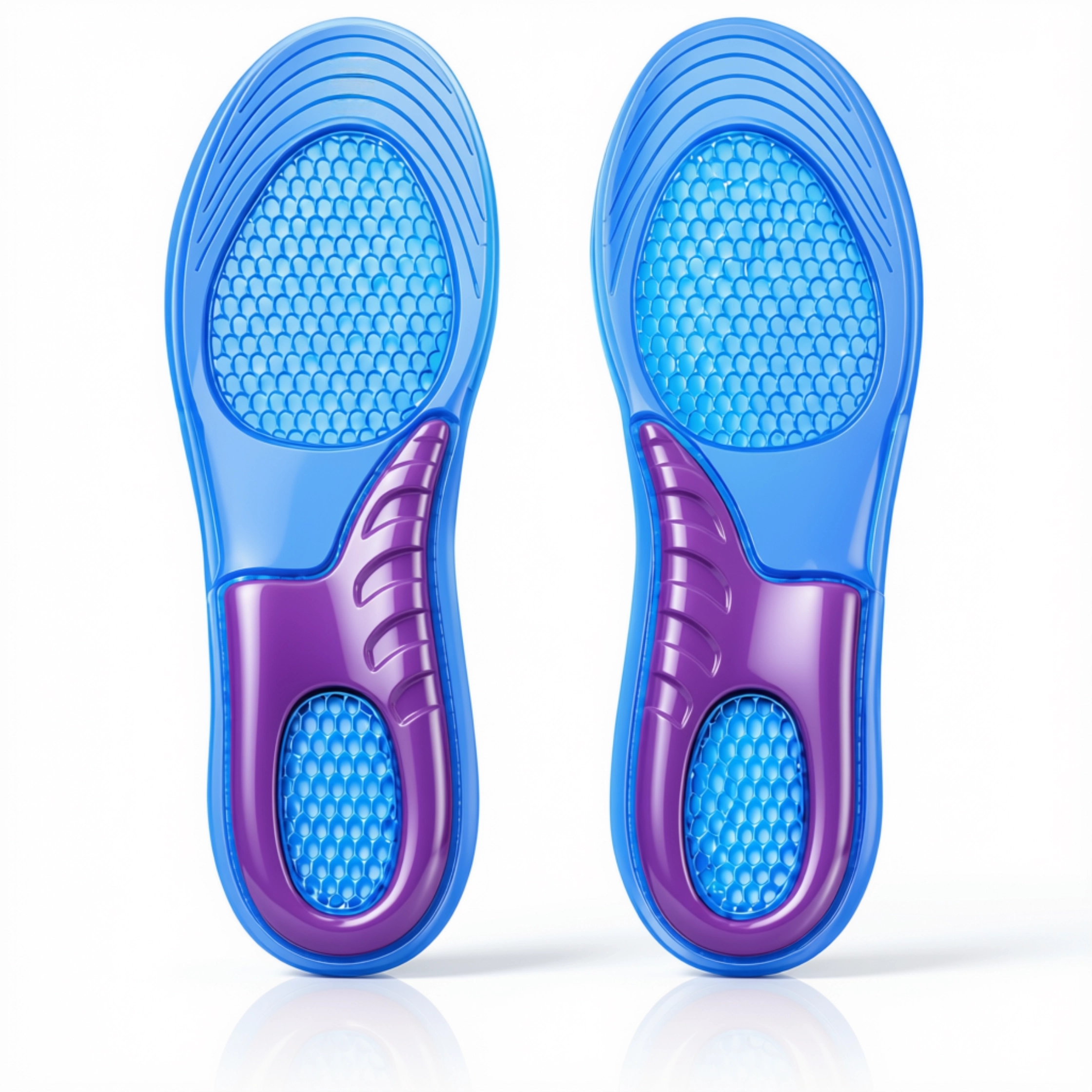
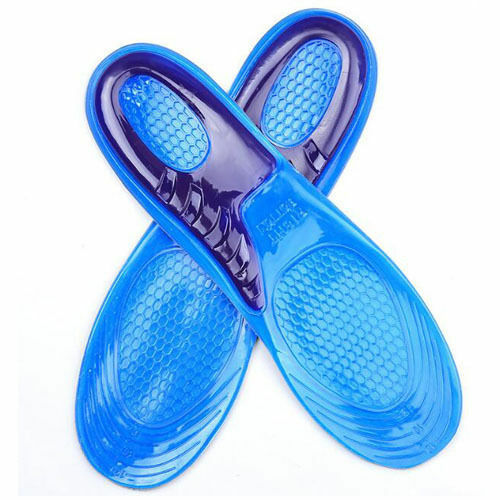
- A pair of silicone gel insoles that sit inside your shoes and add cushioning and support under the foot.
- Shaped to cushion the heel and the ball of the foot, the two areas that take most of your body weight when you stand and walk.
- Support through the arch, so the band running under the foot has a shaped surface to rest against rather than a flat shoe bed.
- Heel cups that give the heel a defined place to sit inside the shoe and reduce how much it slides from side to side.
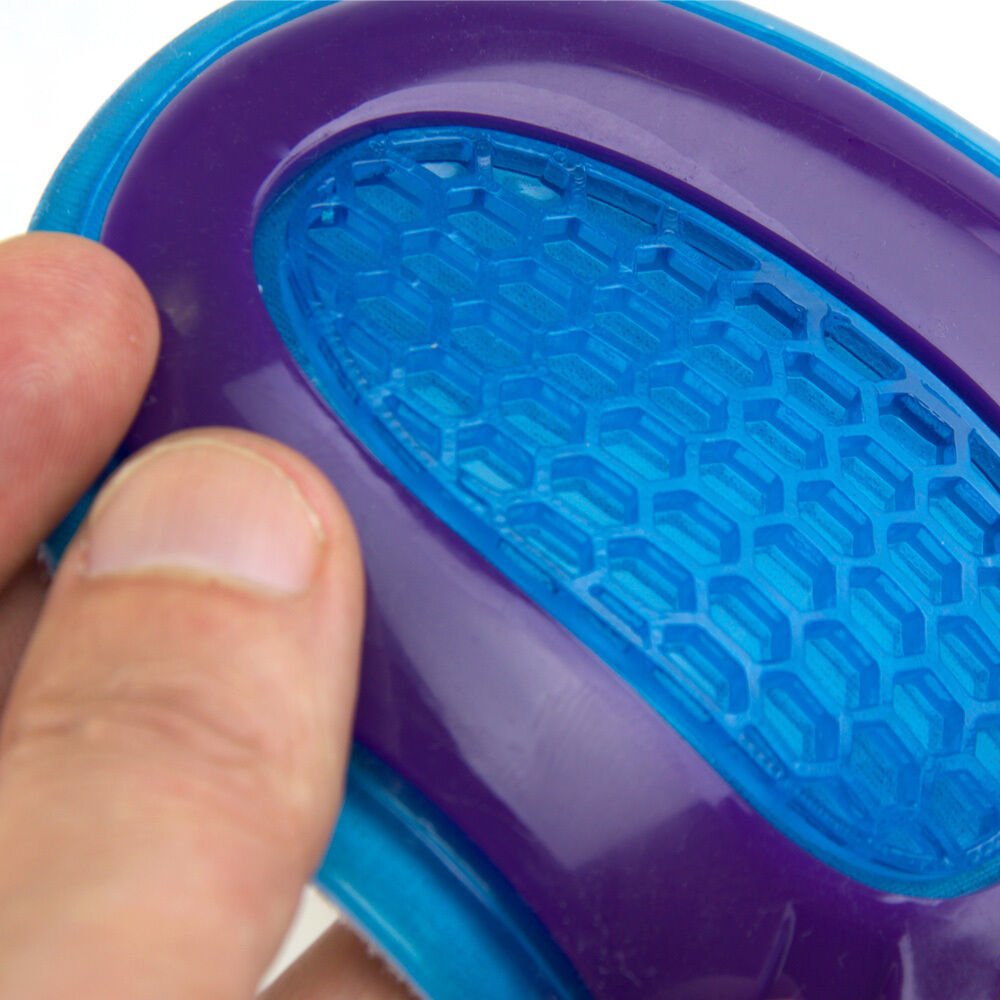
- A honeycomb cushioning structure that takes some of the peak impact out of walking and standing.
- Adaptive silicone gel that compresses under load and returns towards its shape, so the cushioning lasts through a long day.
- Intended for adults with sore feet after a recent injury, or after long periods of standing and walking on hard floors.
- May also suit people with heel and arch pain, shin discomfort, knee soreness, or hip and lower back ache linked to time on their feet.
- Not a custom orthotic: it does not change how your foot rolls through a step.
- Does not strengthen the foot, and has no effect when you are barefoot.
- Start with short periods around the house before wearing them for a full day, and check the shoe has enough room for the insole.
- Stop using them if they cause discomfort or rubbing, and speak to a GP, physiotherapist or podiatrist if pain is severe, new, unexplained or getting worse.
- Supplied as a left and right pair in a range of sizes to fit most feet, with a 30-day money back guarantee.
Sore feet after injury, long days, or time on your feet
A sore foot is easy to ignore for an hour. It becomes much harder to ignore once it changes how you walk, how long you can stand, or how much you look forward to taking your shoes off at the end of the day.
If you have injured your feet recently, you may be at the stage where you want to protect them while they settle, but you also want your normal life back. Perhaps you are returning to work, walking further than you were, or standing for longer periods. You may simply want to get through the day without that familiar ache under your heel or across the ball of your foot. A pair of silicone gel insoles can be a practical way to add cushioning and support inside your shoes while your feet recover and while you spend long periods on them.
These insoles sit inside your footwear and add a soft, supportive layer between your foot and the shoe. On a hard floor, that layer is often the difference between a shoe that feels thin and unforgiving and one that still feels manageable by late afternoon.
They are not, though, a substitute for assessment or rehabilitation after an injury. They are a support tool, and used sensibly they can make the weeks while you rebuild your tolerance for standing and walking more comfortable.
The amount of work your feet are used to is the part that often gets overlooked. Spend a week resting, then go straight back into a full shift on your feet, and you get through the day with feet that ache by mid-afternoon and feel tender again the following morning. No insole changes that. What a cushioned layer underfoot can do is make the load — the force passing through your foot with every step — easier to carry while you build back up.
You do not need to be a runner to notice the benefit. Plenty of people spend the day on their feet — in shops, in kitchens, on wards, in warehouses, or walking between appointments and errands — and by late afternoon their feet feel hot, tired and tender. The same happens after a long afternoon of shopping or a walk that went on further than you expected.
What is happening in your feet when they ache
Your feet are built to take load. Every step sends that force through the heel, along the sole, through the arch and up into the ankle and leg. Each part of the foot has a job, and knowing roughly what that job is makes the soreness easier to make sense of.
How a normal step works
Under your heel sits a pad of fatty tissue that spreads the load of each step over a broad area rather than a single point. Running along the underside of your foot, from heel towards the ball, is a strong band of tissue that holds the arch in shape — the plantar fascia. Put weight through the foot and the arch flattens slightly; the band stretches, then returns to length as the weight comes off. The ball of your foot takes pressure as you push away from the ground. Meanwhile the muscles in your foot and lower leg control how the foot meets the floor and how quickly it rolls through the step.
When all of that works well, load is shared across the whole sole and no single area does too much. Trouble starts when the load becomes repetitive, concentrated, or poorly supported. A hard sole, a long shift on a concrete floor, a sudden increase in walking, or a recent injury can all change how much work your feet are doing and where that work lands.
Why pressure builds in two small places
Your body weight does not change from one day to the next. What changes is the area it is shared across. The same weight passing through a small patch produces a much higher pressure at that spot than when it is spread across the whole sole. Your heel and the ball of your foot are where most of your weight passes through, and both are small compared with the rest of the foot. That is where pressure builds first, and it is why those are the two places most people describe when they say their feet ache.
How your foot rolls
Two patterns of foot movement matter here. Overpronation means the foot rolls inward more than usual as you take weight. Supination means it rolls outward more than usual, or stays relatively rigid instead of rolling inward. Neither is a diagnosis in itself; both describe how your foot moves. What they change is which part of the sole takes the greater share of pressure. A foot that rolls inward heavily loads the inner edge of the arch and the inner side of the ball. A foot that stays rigid and rolls outward concentrates pressure along the outer edge. Two people walking the same distance can end up sore in quite different places for that reason.
What the timing tells you
Many people find that their first steps after sitting for a while, or getting out of bed, feel stiff and sore, and that things ease as they move about. That fits with the tissues on the underside of your foot, including the plantar fascia, having been unloaded for a while, stiffened slightly, and then warmed and taken load again.
The opposite pattern — comfortable first thing, sore by evening — comes from accumulated load: repeated steps, tired tissue, and feet that swell a little inside shoes that felt fine at eight in the morning.
Both are unpleasant, and they point in slightly different directions. Soreness that is worst on the first few steps and settles as you get going comes mainly from tissue that has stiffened while you rested. Soreness that builds hour by hour and peaks in the evening comes mainly from the total time you have spent on your feet.
An insole goes to work as soon as you put your shoes on, so it has something to offer either way, but it helps more with one pattern than the other. You are most likely to notice it with the pattern that builds through the day, where pressure is being shared out over hours rather than minutes. With the first-steps pattern, the tissue itself is what has changed overnight, and no insole stops that. What a cushioned surface changes is what that first stretch happens against, so the band under the arch has something shaped to rest on from the moment you stand, rather than a flat, firm lining.
How much load your feet are used to
The rise in demand rarely comes from one decision. A walking holiday, a new job that involves more time on your feet, or a change from cushioned shoes to something thin-soled can each shift the balance. In every case the amount of work has gone up while the feet underneath it have had no time to adjust.
That adjustment takes longer than one quiet evening. Feet need time to catch up with a week of extra steps, which is why the same effort can feel harder on the fifth day than it did on the first.
Why the leg above notices
When pressure concentrates in one spot, the foot feels sore there. Impact travelling through the foot with less cushioning is felt higher up as well, and there is a straightforward reason for that. Your foot does not move in isolation; the lower leg carries it, and the way the foot rolls through each step feeds into the rotation of the shin above. A foot that rolls inward heavily turns the lower leg with it, so the shin and knee rotate a little more with every step than they would if the foot stayed closer to neutral.
None of that is harmful. It is extra movement that has to be controlled by the muscles in your foot and lower leg, and across several hours it leaves the leg tired. That is why people describe soreness in the ankles and knees after a long day on their feet.
Hips and lower back follow a different route. They are not driven by the rotation of the foot in the way the shin and knee are. They are affected more by how long you spend standing still, how often you change position, and how much your feet tolerate before you start shifting your weight from one leg to the other to find relief. Hip and back ache arise from a different set of factors than knee soreness, and the two run on separate mechanisms.
Sore feet change how you walk, and that has knock-on effects. A change in how you walk can shift strain elsewhere, and if you start avoiding walks because your feet ache, your tolerance for activity drops. A little support under the foot helps you keep moving more comfortably, which is usually part of the wider picture.
The aim is not to pretend the injury has gone. It is to make the foot more comfortable while it adapts to load again.
Why a gel insole can make sense
An insole is a layer that sits inside your shoe, under the foot. A gel insole adds cushioning and a degree of support without changing the shoe itself, which makes it a simple way to make the footwear you already own more comfortable.
Cushioning is the first thing it does. A gel layer softens the feel of the ground beneath you. On pavements, tiled floors and concrete, that makes a real difference to how much impact reaches the heel and ball of your foot. It does not remove impact; it takes the edge off it.
Support around the arch and heel is the second, and it is a different job from cushioning. Cushioning softens what sits under your foot. Support changes the shape of it. The arch is meant to flex and rarely feels well supported inside everyday shoes, which usually have a flat, firm lining with little shaping under the middle of the foot. A shaped insole follows the curve of your foot instead of sitting flat beneath it, so the band under the arch has a surface to rest on rather than holding the arch up with nothing beneath it.
Shock absorption is the third. Walking and running involve repeated impacts, and it is the peak of each one that your foot feels most. A material that compresses under load and returns to its shape takes some of the height off that peak and gives it back as it recovers. It will not stop all shock, but it gives your foot something yielding to press into rather than a hard, unyielding sole.
Comfort is not a luxury here. A softer surface underfoot makes long days on your feet less draining, and if your feet feel better you are more likely to keep up your normal activity. Staying active is usually better for recovery than sitting more than you need to.
What a gel insole cannot do is sort out every problem on its own. It will not tell you what is wrong with your foot, and it cannot promise that an injury will not come back. Its effect also lasts only while it is in your shoe: it changes how load feels while you wear it, and it does not strengthen your foot or change how you walk once you take it out. Used alongside sensible activity, it can still make your shoes a great deal more forgiving.
How these silicone gel insoles are designed to help
These insoles are made from medical-grade silicone gel — a soft, resilient material made to a standard used for products that sit against the skin. Adaptive means the gel responds to load: put weight through it and it compresses, take the weight off and it returns towards its original shape. That compress-and-recover cycle is what gives the insole its cushioning, and why it keeps working through a long day instead of flattening after an hour.
The gel sits directly beneath the sole of your foot, so it acts on the two areas that take the most pressure — the heel as your foot lands and the ball of your foot as you push away. On a hard floor, where there is nothing in the shoe to soften the peak, that layer gives your foot something yielding to press into. Over a long shift of standing, it makes a difference to how much pressure sits under the heel.
The honeycomb design adds to that. The small cells compress under load and recover as the load comes off, and because they repeat across the whole insole the cushioning is spread along its length rather than sitting in one place. You notice it most in the two moments where force is highest: heel strike, when your heel meets the ground at the start of a step, and push-off, when you drive through the ball of your foot to move forward. Softening both makes walking on pavements and using stairs feel less jarring through the foot and lower leg.
Heel cups hold the heel in a set position inside the shoe. Your heel is the first part of the foot to take load when you step, and it is also the part most likely to shift from side to side. A cup gives it a defined place to sit, so it stays put instead of sliding. That shows up as a steadier feel on uneven ground, when turning on the spot, and going up and down stairs.
Support through the arch works on the same principle: the band under the foot needs something shaped beneath it rather than a flat bed. Here the insoles give the plantar fascia — the band running from your heel towards the ball — a cushioned, shaped surface to rest against. The aim is not to force the arch into a rigid shape. It is to give it something contoured underneath.
The gel and the cellular structure run the full length of the sole, so the whole underside is cushioned rather than only the two points that take the most pressure. Those two points get the most benefit, and the rest of the foot gets a consistent surface under it.
The massaging surface and the cooling feel of the gel are comfort details rather than clinical ones. On a long, hot day they are worth having.
Each pair has a left and a right insole, shaped for the foot it goes under. They are made from adaptive silicone gel, with heel cups that hold the heel steady, a honeycomb structure through the cushioning layer, and support through the arch so the band underneath has something to rest on. They come in a range of sizes to fit most feet, drop into your shoes with no trimming, and the pair is covered by a 30-day money back guarantee if they do not suit you.
None of this is intended to reduce how much work your foot does over the long term. The aim is a more comfortable, better-cushioned shoe while you get through the day and while an injury settles. Support should help you keep moving, not give you a reason to stop.
Who these insoles may suit, and the patterns they help with
These insoles are intended for adults. They may suit you if you have injured your feet recently and want more cushioning and support inside your shoes while you recover. They may also suit you if there is no injury at all, but you spend long periods standing or walking and your feet ache by the end of the day. Beyond that, the discomforts people bring to an insole tend to fall into a few recognisable patterns, and it helps to know which one looks closest to yours.
Leisure walking has its own version of this. A long walk, a day out on foot, or a route that turned out longer than planned can leave the feet, ankles and knees tired in the hours afterwards, long after you have stopped moving. Cushioning underfoot makes that kind of day easier to manage and easier to repeat.
Some people have been told they overpronate or supinate. These insoles may give you a more even feel underfoot, though they are not a custom orthotic — that is, an insole made to a cast or scan of your own foot — and they will not change how your foot rolls through a step. What they can change is how much your heel slides around inside the shoe. That is a different thing from how the foot rolls, and it is the part the heel cup is shaped for. They also give the sole of your foot a shaped, cushioned surface, so the areas taking the most pressure have something supportive underneath them. For some people that is enough to make standing and walking less tiring.
Plantar fasciitis is usually felt under the heel and along the inside of the arch. The classic sign is a sharp, grabbing pain with your first steps after rest — getting out of bed, or standing up after sitting for a while — which eases as you move about, then returns after a long stretch on your feet. That pattern comes from two different things happening at different points in the day. First thing in the morning, the plantar fascia has been unloaded overnight and stiffened slightly, and it is stretched suddenly as your arch flattens under your weight. Later, a different mechanism takes over: the fat pad under your heel has been compressed with every step for hours, and the pressure under the heel builds as a result.
These insoles help with both, though not in equal measure. The arch cushioning gives the plantar fascia a supported, shaped surface to rest against from the moment you put your shoes on, so the first steps of the day are taken against something shaped rather than a flat, firm lining. That eases the morning soreness; it does not stop the tissue stiffening overnight. The heel cup does the more noticeable job, softening the peak under the heel and spreading it across a wider area of the pad, which is what helps later in the day once pressure has built up.
Shin splints produce a dull ache or tenderness along the shin that builds with repeated activity rather than arriving all at once, and settles with rest. It usually appears after the amount of walking or running you have been doing has risen fairly quickly. Force reaches the lower leg twice in each step: once as your foot lands, and again as you push away through the ball. Cushioning helps most at the landing, where the force is highest and the peak is sharpest, and the gel and honeycomb structure lower that peak. The effect on push-off is smaller, because the cushioned surface under the ball spreads force that is already being shared across a wider part of the foot. Neither effect will fix the fact that your activity has risen too quickly, but both can make your footwear more comfortable while you adjust.
Knee pain tends to be noticed during walking, on stairs, or after a long stretch on your feet rather than at rest. Two things travel up from your foot. The first is impact, the shock of each footfall, which cushioning under the sole can partly absorb so walking feels less jarring. The second is rotation: because the shin follows the foot, a foot that rolls in or out heavily turns the lower leg with it, and that turning is felt at the knee. Holding the heel in a steadier position limits how much the heel slides from side to side inside the shoe as you walk. It does nothing about how the foot itself rolls, so treat that as a small comfort effect rather than a correction: the foot still turns as it takes your weight, but it does so with less sliding inside the shoe around it. Some people find that makes the leg feel less unsteady on stairs and after a long day. It is not a treatment for your knee, and if knee pain persists it is sensible to have it assessed.
Hip and lower back pain linked to time on your feet often follows a pattern of its own: an ache that builds over a long day of standing or walking and eases once you sit down. Standing and walking put different demands on your feet. Walking delivers load in peaks, and softening those peaks is the main job. Standing delivers it as a steady pressure under your heels and the balls of your feet, hour after hour. Spreading that steady pressure across the whole sole changes how tired your feet feel by the end of a shift.
The rest follows on. Tired feet make you shift your weight from one leg to the other more often, and they make you less willing to keep moving. When you stop moving, you stand still for longer, and standing motionless for a long stretch asks more of the lower back than walking does, because walking keeps the muscles in the back and hips switching on and off rather than holding one position. Comfortable feet are the first link in that chain, not the last. It is a comfort measure rather than a treatment for the hip or back, and it works best alongside sensible activity rather than instead of it.
How to use them and what to expect
Put the left insole in the left shoe and the right in the right. Check that it lies flat, with no bunching at the heel or curling at the toes, and that your heel sits inside the cup rather than on its edge. Then slide your foot in and check that your toes are not pressed against the front of the shoe and that the shoe is not pressing down on the top of your foot.
That volume check is the one to take seriously. An insole takes up room, so a shoe with little spare volume will squeeze your foot rather than support it. If the shoe feels tight, or your foot feels pushed up, it is the wrong shoe for the insole, even if the size is right. Try another pair rather than forcing the fit.
Begin with a short period — around the house, or a short walk — before wearing them for a full day. That gives you a chance to check the fit and see how the cushioning feels underfoot. If they are uncomfortable, stop and check the size and position.
The first thing most people notice is a softer feel underfoot. Shoes that felt thin now feel more forgiving, and a long shift is more likely to end with feet that feel tired rather than painful. The heel slides around less inside the shoe, particularly on stairs and uneven ground. If you walk or run, the ground feels less harsh through the lower leg.
These are realistic effects, not guarantees. There is no set number of days after which anything changes. Rest, a gradual build-up of activity, strengthening work and advice from a clinician all still have their place, and an insole sits alongside them rather than standing in for any of it.
Some people like the feel of the massaging surface from the start; others stop noticing it after a few minutes. What you are checking is that the insole feels comfortable and that your foot feels supported rather than cramped or pushed to one side.
The insoles change load only while they are in your shoes. They do not strengthen your foot and they do nothing for you barefoot. If you have been injured, treat them as part of building back up: increase the time you spend on your feet in small stages, the way you would increase any other activity, rather than going from rest to a full day in one move. If pain increases, that is a signal to reduce load and seek advice if it continues.
Check the insoles from time to time for wear. When the gel no longer springs back after you press it and the surface stays flattened, it is no longer cushioning the way it did.
When to stop and seek advice
Stop using the insoles if they cause discomfort, rubbing, or a feeling that your foot is being pushed into an awkward angle. Check the size and the fit first, and that they are sitting flat in the shoe. If the problem continues, do not force it. An insole should feel supportive, not painful.
Speak to a GP, physiotherapist or podiatrist if your foot pain is severe, is getting worse, or if you have new or unexplained symptoms. That is most important after an injury, or if you are unsure whether you should be walking on the foot as much as you are. A clinician can assess what is going on and advise you on the right level of activity and support.
None of this is meant to alarm you. Much foot and heel pain improves with sensible load management — building up how much time you spend on your feet rather than doing too much at once — and with time. But when something does not feel right, or you are not sure, getting advice beats guessing.
A practical next step
Sore feet after an injury, long days on your feet, or a sudden increase in walking make everyday life harder than it needs to be. A gel insole is a straightforward way to add cushioning, support the arch and heel, and soften some of the impact of walking and standing.
These silicone gel insoles are designed for adults who want more comfort and support inside their shoes. They are easy to place, come in a range of sizes, and use adaptive silicone gel with heel cups, arch support and a honeycomb cushioning structure. They sit alongside your normal recovery and activity management rather than replacing any part of it.
They are not a cure. They change how load feels while they are in your shoes, and that can make your footwear more comfortable while you get on with your day.
If your pain is severe, new, unexplained or getting worse, have it looked at before you rely on an insole. If you are looking for more cushioning and support in your shoes, these are a sensible option to try.
Disclaimer
The information on this page is general guidance about sore feet, foot loading and cushioning insoles. It is not a substitute for individual medical advice, diagnosis or treatment, and it cannot take account of your own circumstances, history or the particular problem you are dealing with.
If you are unsure whether an insole is right for you, or if your symptoms are new, unexplained, severe or getting worse, speak to a GP, physiotherapist or podiatrist for personalised advice. Nothing here promises a particular outcome, and results vary from person to person.
Fast & Secure Checkout Through Paypal
Pay with Paypal the secure payment gateway that accepts all credit and debit cards. Paypal is free and secure and no credit or bank information is ever stored or shared with us.
Fast Dispatch
Enjoy your items soon with quick dispatch via Royal Mail. Expect to have your items between 1-3 working days for domestic orders. 7-10 Working days for international orders.
Return Policy – 30 Day Money Back Guarantee
In the unlikely event, you are unhappy with your purchase you can return it within 30 days for a refund. Please contact us via the form on the contact us page to start your return.
To return an item please send it to: Nuova Health UK, 81 Highfield Lane, Waverley, Rotherham, S60 8AL. Please include a note with your order id so we know who to refund. Please retain your postage receipt as proof of postage. All that we ask is that the item is in the original packaging and unused.
Reviews
There are no reviews yet.