
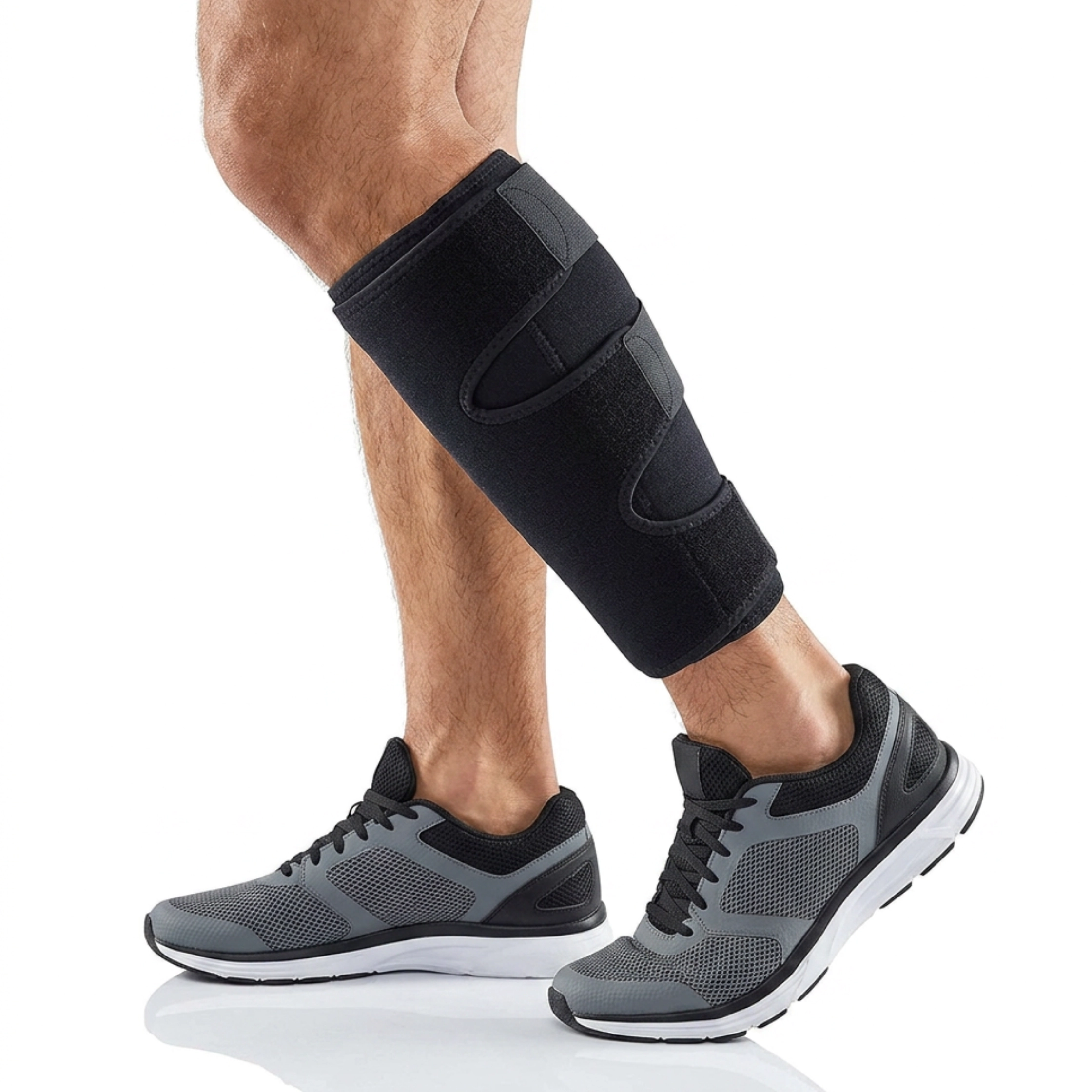
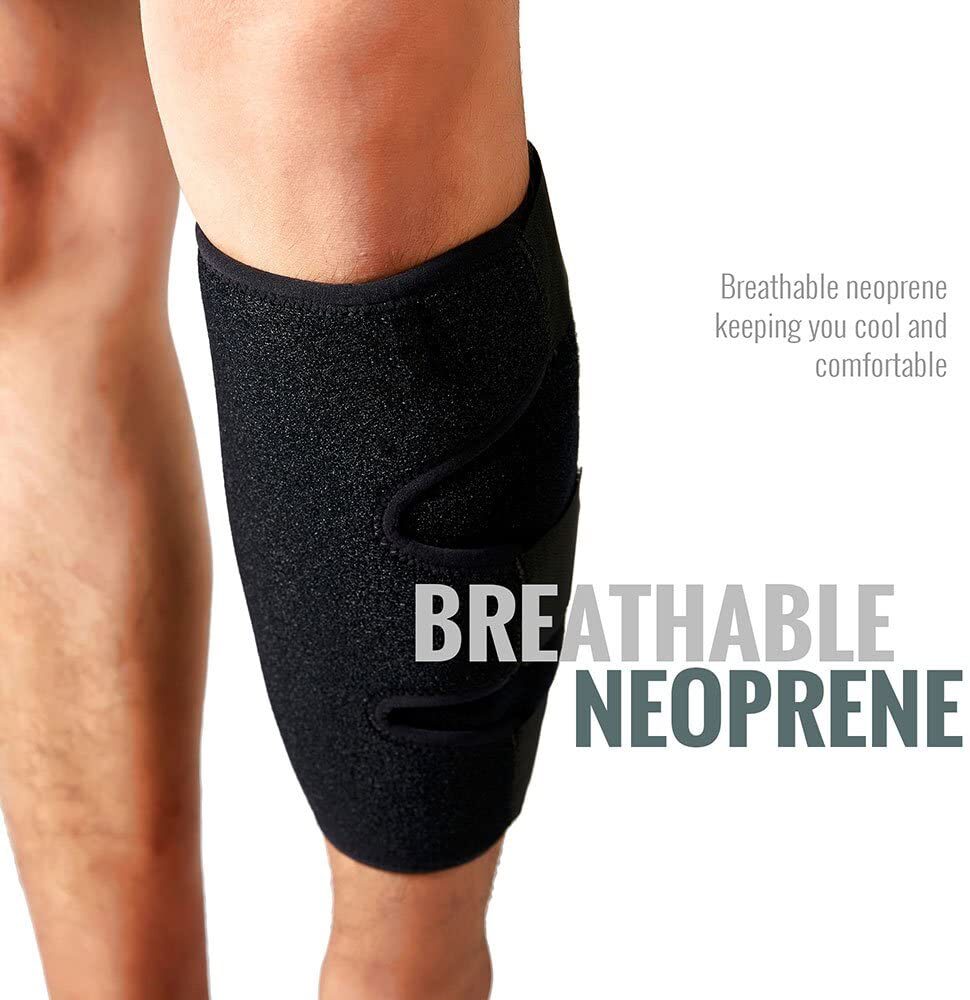
Shin Splint Brace
£11.99inc VAT
- Adjustable shin compression sleeve brace designed to support recovery from shin splints and lower-leg strain
- For adults experiencing pain along the inside of the shinbone, particularly runners, those increasing training load, or people on their feet for long periods
- Three independent Velcro straps allow you to customise compression level and fit across the top, middle, and bottom of your calf
- Holds your calf muscles in a stable, slightly compressed position to reduce repetitive strain on the periosteum—the tissue layer where muscle attaches to bone
- Brings down peak forces during walking and running, allowing you to stay active below your tissue’s pain threshold while it heals
- May help control swelling and support blood flow back toward your heart after activity or during long periods on your feet
- Made from flexible neoprene with a moisture-wicking fabric lining; lightweight enough to wear under tracksuit bottoms or loose trousers
- Can be worn during activity (running, walking, gym work) or after activity for recovery support
- Do not sleep in this brace—remove it at night
- Not suitable if you have a history of blood clots, severe circulation problems, diabetes with reduced sensation, open wounds, or unexplained swelling
- If pain is new, severe, worsening, or you’re unsure of the cause, see a physiotherapist, podiatrist, or GP before using compression support
- Combine with sensible training modification, appropriate footwear, and gradual return to activity for best results
- Hand wash in cool water, air dry flat; do not machine wash, tumble dry, or iron
- 30-day money-back guarantee if the brace doesn’t work for you
What are shin splints?
Pain along the inside of your shin? Sharp or dull, worse when you run, better when you rest? That’s shin splints. Runners get this constantly—especially when they’re ramping up mileage, coming back after time off, or pounding concrete. But it’s not just runners. Suddenly doing more, standing for hours, new shoes—any of these can trigger it.
The pain comes from stress on your shinbone—the tibia—and the tough tissue layer wrapped around it, the periosteum. Your calf muscles—the gastrocnemius (the big visible one) and the soleus (deeper down)—attach to the bone through the periosteum. These muscles control your ankle and foot. They work hardest at two points: when your foot hits the ground and absorbs impact, and when you push off.
Every footstrike sends impact force up through your foot, ankle, and shin. Your calf has to lengthen while it’s working—we call this eccentric loading—to control how fast your foot rolls in and how much your ankle flexes upward. When your calf muscle lengthens under this load, it pulls on the periosteum. Too much, too fast, too often without recovery? The periosteum gets inflamed. That’s the pain. Shin splints. Clinically, we call it medial tibial stress syndrome.
The periosteum is a thin, fibrous layer stuck tight to the bone. It’s packed with pain receptors—that’s why it hurts so much—but it doesn’t get much blood compared to muscle. So it heals slower than muscle, and it can’t adapt as fast when you ask more of it.
Why are shin splints stubborn?
Rest helps. Pain eases. But when you go back to the same training that caused the problem, the pain often returns. Why?
Because rest drops the load but doesn’t build capacity. Your periosteum hasn’t got any stronger. Your calves aren’t more resilient. Your mechanics haven’t improved. You’re asking tissue that hasn’t adapted to handle the same load. The pain returns.
That’s the load-capacity gap. Shin splints happen when load exceeds capacity—your tissue’s ability to handle load without breaking down. Rest cuts the load. Doesn’t build capacity. Long rest can actually reduce capacity. Muscles weaken. Tendons soften. Bones thin. You need some load to adapt. The trick is finding the sweet spot: enough to keep fitness and encourage healing, not so much you flare it up again.
The periosteum heals slowly. That makes this trickier. Muscle has good blood supply—repairs micro-damage in days to weeks. The periosteum? Poor blood supply. Heals slowly. Can’t be rested completely—every step loads it, even walking. Recovery is gradual. Do too much too soon? Setback.
Certain factors make shin splints more likely and harder to shift. If you have flat feet or overpronate—your foot rolls inward too much when you land—your shin rotates inward with each step. That inward twist increases the strain on the periosteum along the inner edge of your shinbone. That’s exactly where shin splint pain hits. If you have tight calf muscles or limited ankle range, your calves are working in a shortened, less efficient position, which increases the pull on where they attach to the bone. If you’ve recently increased your running mileage, changed to a harder running surface, or switched to lighter shoes with less cushioning, you’ve increased the load on your lower legs without giving the tissue time to adapt. Bone and connective tissue remodelling—the process where your body strengthens bone and connective tissue in response to load—takes six to eight weeks, much longer than muscle adaptation. Rapid training increases often outpace what your tissue can handle.
Every time you walk or run, you’re loading the same tissue again. If you haven’t addressed the factors that caused the overload in the first place—training errors, biomechanics, footwear—the pain often returns.
How a shin splint brace can help
A shin splint brace offers a practical middle ground. It reduces the mechanical load on your shinbone with each step, giving the inflamed tissue a better chance to settle while you stay active. It’s not a substitute for rest if your pain is severe, but for many people, it makes the difference between stopping completely and being able to keep moving—carefully—while they recover.
What it does
This brace holds your calf in a stable, slightly compressed position. That stability cuts the pull on your periosteum with every step. Less repetitive strain. Less pain. It brings down peak forces during walking and running, allowing you to stay active at a level below your tissue’s current pain threshold. You’re working in the middle ground: enough load to build capacity, not so much you tip back into overload.
The brace also helps control swelling and supports blood flow back toward your heart after activity or during long periods on your feet. Many people find this eases that heavy, achy feeling in their lower legs.
How it works mechanically
Compression shortens your calf’s resting length slightly. The muscle belly sits a bit shorter than usual. So when your foot lands and your ankle flexes upward, your calf muscle doesn’t have to stretch as far to control it. When your calf muscle lengthens under load—eccentric loading—that’s when the junction where muscle meets bone takes the most strain. Less stretch means less peak pull on the periosteum when the load is highest.
Compression also limits how much your muscle wobbles. When you run, your calf doesn’t just contract and relax—it wobbles and vibrates with each step. That wobble creates repetitive micro-tugging on the periosteum, especially where the muscle attaches along the inner edge of your shin. Compression dampens the wobble, reducing the cumulative micro-trauma over hundreds or thousands of steps.
The brace brings down peak forces, not total load. It doesn’t eliminate the load on your shinbone—you’re still running, still generating impact forces, still requiring your calf to control your ankle. What it does is reduce the peak force at the moment of maximum strain—footstrike and push-off—bringing it down below your tissue’s current tolerance threshold. Think of it as turning the volume down on each step, rather than muting it entirely. Over the course of a run or a day on your feet, this adds up to significantly less cumulative strain.
Additional benefits
Compression may also improve your body’s sense of where your leg is and how much force you’re putting through it—what clinicians call proprioception. It provides constant, gentle sensory feedback to your skin and muscle receptors, improving your awareness of your calf position and how well you control it. This may subtly change how you walk or run—your gait—perhaps reducing overpronation, or encouraging a softer footstrike, in ways that reduce strain on your shinbone. The effect is individual and hard to measure. But many people report that compression makes their lower leg feel more stable and controlled.
The brace applies this compression using three adjustable Velcro straps positioned at the top, middle, and bottom of your calf. You can tighten or loosen each strap independently, which means you can create a graduated compression effect if that feels more comfortable—firmer at the bottom, lighter at the top—or keep it even all the way up. Graduated compression, where pressure is higher at the ankle and lower higher up, is often used to support blood flow back toward your heart. Your calf acts as a natural pump: when it contracts and relaxes, it squeezes the deep veins and pushes blood upward against gravity. Compression mimics this effect passively, which can reduce blood pooling and the heavy, swollen feeling you get in your lower legs after a long run or a day on your feet.
Compression also helps control swelling—fluid build-up in the tissue. After exercise, blood flow to your lower legs increases—driven by your muscles’ need for oxygen and nutrients, plus inflammation. This increased flow can cause some fluid to leak out of your capillaries—the tiny blood vessels in your tissue—into the surrounding tissue space. This shows up as swelling, tightness, and that achy, heavy sensation. Compression applies gentle external pressure that opposes this fluid accumulation, keeping swelling in check.
What it won’t do
This brace won’t heal your shin splints overnight, or allow you to ignore pain and keep training at full intensity. If your pain is severe, or if you’re dealing with a stress fracture—a partial crack in the bone that can progress to a complete break if you keep loading it—or compartment syndrome, where dangerous pressure builds up in the enclosed spaces that hold your muscles, restricting blood flow and potentially causing permanent damage, a compression sleeve isn’t the right tool. Using one may delay proper diagnosis and treatment. But for straightforward shin splints—the kind that flare with activity and ease with rest—this type of support can make a real, practical difference.
Safety & Contraindications
Do not sleep in this brace. Compression and support products with straps should be removed at night to allow free circulation and let your skin breathe. Wearing compression overnight can increase the risk of circulation problems, skin irritation, and discomfort.
Do not use this brace if you have:
- A history of blood clots or circulatory problems. Compression can affect blood flow, and it may not be safe without medical advice. If you’ve had a clot before, or if you have risk factors—recent surgery, long-haul travel, clotting disorders—check with your GP first. This brace does not treat or prevent blood clots and must not be relied upon for that purpose.
- Diabetes with reduced sensation. If you can’t feel your lower leg properly, you may not notice if the brace is too tight or causing skin damage.
- Open wounds, cuts, or skin infections on your lower leg. Compression over broken or infected skin can delay healing and spread infection.
- Unexplained swelling, redness, warmth, or tenderness in your lower leg. These can be signs of infection, a stress fracture, or compartment syndrome—all of which require medical attention, not compression.
Check with a physiotherapist, podiatrist, or GP before using this brace if:
- Your pain is new, severe, or getting worse despite rest. Worsening pain can indicate a stress fracture—a partial crack in the bone that can progress to a complete break if you keep loading it—compartment syndrome, where dangerous pressure builds up in the enclosed spaces that hold your muscles, or another condition that needs urgent assessment.
- You have swelling, redness, warmth, or tenderness that doesn’t settle. These can be signs of infection, a stress fracture, or compartment syndrome—all of which require medical attention, not compression.
- You experience numbness, tingling, or pins and needles in your lower leg or foot. This suggests nerve involvement or circulation compromise, which compression may worsen.
- You’re unsure whether your pain is shin splints or something else. Conditions like stress fractures, compartment syndrome, nerve compression in your ankle or lower leg, and tendon problems can all cause lower-leg pain, but they need different management. A compression sleeve won’t help—and may delay proper treatment—if the diagnosis is wrong.
Stop using the brace and seek advice if:
- Your pain gets worse or doesn’t improve after two to three weeks of rest, reduced activity, and wearing the brace. Persistent or worsening pain can indicate a stress fracture, compartment syndrome, or another condition that needs different management.
- You develop new or increased swelling, redness, warmth, or tenderness in your lower leg. These signs can indicate infection, a stress fracture that’s progressing, or compartment syndrome—a serious condition that requires urgent assessment. Compartment syndrome is a medical emergency and can cause permanent damage if not treated promptly.
- You experience numbness, tingling, pins and needles, or any change in sensation in your leg or foot while wearing the brace. This suggests nerve involvement or circulation compromise. Compression should not cause these symptoms—if it does, remove the brace immediately and seek advice.
- You notice skin colour changes—pale, blue, or mottled skin—or the brace feels uncomfortably tight even after loosening the straps. These are signs that circulation may be restricted. Remove the brace and check with a clinician before using it again.
- Your pain is severe, sudden, or stops you bearing weight. This may indicate a stress fracture, a complete muscle tear, or another acute injury that needs urgent assessment. Stress fractures can progress to complete fractures if you continue loading the bone, so early diagnosis and appropriate rest are essential.
- You have pain at night or at rest that doesn’t ease when you stop activity. Shin splints typically hurt with activity and ease with rest. Pain that persists at rest, or wakes you at night, can be a red flag for stress fracture or other serious pathology.
- You develop any skin irritation, rash, or discomfort that doesn’t settle when you remove the brace.
- You have any other new or unexplained symptoms that concern you—unexplained weight loss, fever, night sweats, or pain that doesn’t fit the typical shin splint pattern.
If you’re in any doubt, get it checked. A physiotherapist or podiatrist can assess your lower leg, confirm what’s causing your pain, and advise whether a compression brace is appropriate for you. Early assessment and intervention give you the best chance of a full, uncomplicated recovery.
Who this may help
You have shin splints now and need support during recovery
If you’ve got pain along the inside of your shin that flares with running, jumping, or walking, and you know it’s shin splints, this brace offers the targeted support described above to reduce load while you recover. It’s most useful during the transition phase: when you’re building back up after rest, but your tissue isn’t fully healed yet.
You’re at higher risk due to training load, biomechanics, or foot mechanics
Shin splints hit hardest when training load jumps too fast, or when your biomechanics increase strain on the periosteum. You’re at higher risk if you:
- Are a runner increasing mileage or returning after a break. Bone and connective tissue take six to eight weeks to adapt—much longer than muscle—so rapid mileage increases outpace what your periosteum can handle. The brace reduces the peak load per step, buying your tissue time to adapt and strengthen.
- Have flat feet or overpronate. When your foot rolls in too much during footstrike, your shin rotates inward too, increasing the twisting strain on the periosteum along the inner side of your shin—exactly where shin splints hurt. Compression can’t correct your foot mechanics—that requires addressing footwear, insoles, or gait retraining—but it can stabilise your calf and reduce the secondary strain on the periosteum.
- Have tight calf muscles or limited ankle range. If your ankle doesn’t flex upward as far as it should, your calf muscles are forced to work in a shortened, less efficient range. This increases the tension on where they attach to the shin. Compression provides external support that reduces the muscular effort needed to control your lower leg, taking some of the load off where muscle meets bone. It’s not a substitute for stretching or mobility work, which address the root cause, but it can provide relief while you work on improving your ankle range.
You’re dealing with calf fatigue, tired legs, or mild calf strain
Prolonged standing—whether that’s nursing shifts, retail work, teaching, or just a busy day—causes blood to pool in your lower legs due to gravity. Your calf muscle pump normally helps push blood back up toward your heart, but when you’re standing relatively still, this pump is less active. Blood and fluid accumulate in your lower legs, causing that heavy, swollen, achy feeling. Compression supports blood flow back toward your heart by applying gentle, even pressure that mimics the muscle pump effect, reducing blood pooling and fluid build-up.
If you’re recovering from a mild calf strain—a partial tear of the muscle fibres—compression can limit swelling and provide a reassuring sense of stability and support when you start moving again. The brace won’t speed up tissue repair—that’s driven by your body’s natural healing processes and appropriate rehabilitation—but it can make movement more comfortable. Rest, gentle stretching, and progressive strengthening are still essential; the brace supports your recovery alongside these, not instead of them.
Not sure if this brace is right for you?
If your pain is new or you’re unsure what’s causing it, see a physiotherapist, podiatrist, or GP first. They can assess your lower leg, confirm whether it’s shin splints or something else, and advise whether compression support is appropriate. Early diagnosis matters—stress fractures and compartment syndrome need different management.
If you know you have shin splints but your pain is severe, rest first. The brace is most useful during the transition phase—when you’re starting to load the tissue again but it’s not fully healed yet—not during acute, severe pain. Give the inflammation a chance to settle, usually one to two weeks of rest or significantly reduced activity, then introduce the brace as you gradually return to training.
If you’ve had shin splints before and they keep coming back, the brace can help manage symptoms, but recurring shin splints usually mean there’s an underlying factor that hasn’t been addressed—training errors, biomechanical issues, or inappropriate footwear. Consider seeing a physiotherapist or podiatrist for a full assessment. They can identify what’s driving the problem and give you a plan to address it, so you’re not just managing symptoms but actually fixing the root cause.
If you’re unsure about fit, measure around the widest part of your calf. The brace is designed to fit most adults, and the three adjustable Velcro straps allow you to customise the fit and compression level. If your calf is particularly large, particularly slim, or if you have significant swelling, contact us before ordering.
How to wear and what to expect
When to wear it
You can wear this brace during activity—running, walking, gym work, sports—to reduce the load on your shinbone and provide support while you move. This is when the brace is most useful: it brings down the peak forces with each footstrike, allowing you to stay active at a level below your tissue’s current pain threshold.
You can also wear it after activity for recovery support, to help control swelling and ease that heavy, achy feeling in your lower legs. Compression after exercise can limit fluid build-up and support blood flow back toward your heart, which many people find soothing.
If you’re on your feet for long periods, you can wear it throughout the day for general support, as long as it remains comfortable. If you’re working a shift that involves a lot of standing or walking, the brace can reduce calf fatigue and provide a sense of stability.
Start with shorter periods—an hour or two—and build up as you get used to it. If it feels comfortable and helpful, you can wear it for longer. If it causes any discomfort, numbness, tingling, or skin irritation, take it off.
Do not sleep in this brace. Remove it at night to allow free circulation and let your skin breathe.
What to expect: realistic timelines and outcomes
Shin splint recovery happens in two overlapping phases, and the brace plays different roles in each.
The first phase is acute inflammation, which typically lasts one to two weeks. This is the early stage, when your periosteum is inflamed and painful. Rest is your priority here—reducing or stopping the activity that caused the problem gives the inflammation a chance to settle. The brace can help during this phase by reducing the load on your shinbone during everyday activities—walking, stairs, light movement—but it’s not a green light to keep training through severe pain. If your pain is acute, you need rest first. The brace supports that rest by making necessary movement more comfortable, not by allowing you to ignore the pain.
The second phase is tissue remodelling and gradual return to activity, which typically takes four to eight weeks. Once the acute inflammation has settled and your pain is mild or only present with higher loads, you can start gradually reintroducing activity. This is where the brace is most useful. It reduces the peak forces with each step, allowing you to stay active at a level that stimulates tissue adaptation without re-inflaming the periosteum. You’re working in the middle ground: enough load to build capacity, but not so much that you tip back into overload.
During this phase, combine the brace with the strategies outlined in “What else can help” below. Some people find the brace allows them to stay active with minimal discomfort, and their shin splints settle within four to six weeks. Others find it helps but doesn’t eliminate pain entirely—they still need to reduce their training load and address underlying factors like footwear, biomechanics, or training errors. A few find it makes no difference, because their shin splints are driven by factors the brace can’t address—severe biomechanical issues, stress fractures misdiagnosed as shin splints, or tissue damage that’s too advanced to respond to conservative management.
If your pain hasn’t improved after two to three weeks of rest, reduced activity, and wearing the brace, see a physiotherapist or GP. You may need a more detailed assessment to rule out other causes—stress fracture, compartment syndrome—or to address underlying issues like gait problems, footwear concerns, or strengthening exercises that are contributing to the problem.
What else can help
The brace is one part of shin splint management. These other strategies work alongside it:
Training modification
Reduce your running volume by half initially. Avoid hills, speed work, and hard surfaces like concrete or tarmac. Add extra rest days. Build back up gradually—no more than 10% increase in weekly mileage. Maintain fitness with low-impact activities—swimming, cycling, elliptical—that don’t load your shins.
Footwear
Worn-out or inappropriate running shoes increase impact forces and can contribute to shin splints. If your shoes have more than 500 to 800 kilometres on them, or if they’re not suited to your foot type and gait, consider replacing them. A running shop with gait analysis—where a specialist watches how you walk or run and identifies issues—or a podiatrist can advise.
Insoles or orthotics
If you overpronate or have flat feet, insoles or custom orthotics can help control excessive foot motion and reduce how much your shin rotates inward, which in turn reduces strain on the periosteum. NuovaHealth stocks a range of insoles that may help—speak to a podiatrist or physiotherapist for advice on what’s appropriate for you.
Calf stretching and strengthening
Tight calves increase the pull on the periosteum; weak calves can’t absorb shock effectively. A physiotherapist can give you a tailored programme of stretches for the gastrocnemius and soleus, and strengthening exercises like calf raises and eccentric loading to address both.
Running surface
Softer surfaces—grass, trails, synthetic tracks—reduce impact forces compared to concrete or tarmac. If you can, do some of your running on softer ground while you’re recovering.
Running form
Overstriding—landing with your foot too far in front of your body—increases braking forces and impact. A shorter stride length and more steps per minute—your cadence—can reduce these forces. A physiotherapist or running coach can assess your form and suggest modifications.
Rest and recovery
Tissue adaptation takes time. Don’t rush it. If you try to return to full training too quickly, you risk re-inflaming the periosteum and ending up back at square one. Be patient, listen to your body, and build up gradually.
You might also find helpful
If you’re dealing with shin splints or lower-leg strain, these related products may support your recovery:
NuovaHealth Insoles
If you overpronate or have flat feet, insoles can help control excessive foot motion and reduce how much your shin rotates inward with each step. That inward rotation increases the twisting strain on the periosteum along the inner side of your shin—exactly where shin splints hurt. Insoles work on your foot mechanics, while the shin brace works on your calf. Used together, they address two parts of the same problem.
FootReviver Heel Cups
If you’re dealing with heel pain alongside shin splints—common when you’ve changed your gait to compensate for lower-leg discomfort—heel cups can provide cushioning and support under your heel, reducing impact forces and easing strain on your plantar fascia and Achilles tendon. They’re particularly useful if you’ve been landing more heavily on your heels to avoid loading your shins.
FootReviver Rigid Ankle Brace
If you have a history of ankle instability or recurrent ankle sprains, and you’re concerned that weak or unstable ankles are contributing to your shin splints by forcing your calf to work harder to control your lower leg, a rigid ankle brace can provide external stability and support. This can reduce the compensatory load on your calf muscles and, in turn, reduce the strain on the periosteum.
Frequently Asked Questions
How does this brace help with shin splints?
It holds your calf in a compressed position, reducing the stretch and pull on your periosteum with each step. See “How a shin splint brace can help” above for full details.
When should I wear the brace?
During activity to reduce load, or after activity for recovery support. Do not sleep in the brace. See “How to wear and what to expect” above.
How long does shin splint recovery take with the brace?
Four to eight weeks typically. See “How to wear and what to expect” above for full timeline details.
Can I use this brace to prevent shin splints?
If you’ve had shin splints before, wearing the brace during high-risk periods—increasing mileage, returning after a break, running on hard surfaces—may help reduce your risk. But prevention is multifactorial: sensible training progression, appropriate footwear, adequate recovery, and strength and mobility work all matter. The brace is one tool in a broader strategy.
Will this brace fit me?
It’s designed to fit most adults. The three adjustable Velcro straps let you customise fit and compression level. See “Sizing & Fit” below for measurement guidance.
Can I wear it on either leg?
Yes, left or right.
Can I wear it under clothing?
Yes, it’s lightweight and low-profile enough to wear under tracksuit bottoms or loose trousers. You can also wear it directly against your skin or over a thin layer.
How tight should the brace be?
Snug enough to feel firm, even support, but not so tight that straps dig in, restrict movement, or cause numbness or tingling. If you experience numbness, tingling, or skin colour changes, loosen the straps or remove the brace.
How do I clean the brace?
Hand wash in cool water with mild detergent. Rinse thoroughly. Air dry flat away from direct heat or sunlight. See “Care & Maintenance” below for full details.
Who should not use this brace?
Do not use if you have a history of blood clots, severe circulation problems, diabetes with reduced sensation, open wounds, or unexplained swelling. See “Safety & Contraindications” above for full details.
What if the brace doesn’t help?
Return it within 30 days for a refund. If your pain hasn’t improved after two to three weeks of rest, reduced activity, and wearing the brace, see a physiotherapist or GP for assessment.
Can I use this brace with insoles or orthotics?
Yes. The brace works on your calf, while insoles or orthotics work on your foot mechanics. If you overpronate or have flat feet, combining the brace with appropriate insoles can help control excessive foot motion and reduce strain on the periosteum. Speak to a podiatrist or physiotherapist for advice.
Can I use this brace if I have a stress fracture?
No. If you have a stress fracture, you need rest, possibly immobilisation, and medical management. A compression sleeve is not appropriate and may delay proper treatment. If you’re unsure whether your pain is shin splints or a stress fracture, see a physiotherapist or GP for assessment and, if needed, imaging.
Can I use this brace if I have compartment syndrome?
No. Compartment syndrome is a serious condition requiring urgent medical assessment and, in some cases, surgical treatment. Compression is not appropriate and may worsen the condition. If you have severe pain, swelling, tightness, numbness, or tingling that doesn’t ease with rest, seek urgent medical attention.
Can I use this brace for a calf strain?
Yes, during the recovery phase. Compression can limit swelling and provide stability when you start moving again. Rest, gentle stretching, and progressive strengthening are still essential.
Can I use this brace for Achilles tendonitis?
The brace is designed primarily for shin splints and calf support, not Achilles tendon problems. Achilles tendonitis requires different management—eccentric strengthening exercises, load management, and sometimes heel lifts or specific Achilles support. If you have Achilles pain, see a physiotherapist or podiatrist.
Can I use this brace for plantar fasciitis?
No. Plantar fasciitis affects the thick band of tissue along the bottom of your foot and requires different management—stretching, strengthening, appropriate footwear, and sometimes insoles or night splints. A calf compression brace won’t address the root cause. NuovaHealth stocks a range of insoles and supports specifically designed for plantar fasciitis—speak to a podiatrist or physiotherapist for advice.
A practical tool for shin splint recovery
Shin splints are frustrating, but they do respond to sensible management. This brace gives you a practical way to stay active while your tissue heals. Look after your shins. They carry you a long way.
Sizing & Fit
This shin compression sleeve brace is designed to fit most adults. The three adjustable Velcro straps allow you to customise both the fit and the level of compression across the top, middle, and bottom of your calf.
Fits most adults: The brace is designed with three adjustable Velcro straps to accommodate most calf sizes comfortably. If your calf is particularly large, particularly slim, or if you have significant swelling, contact us before ordering to confirm fit.
Wearing the brace: Wrap the brace around your calf so it covers the bulk of your calf muscle, with the lower edge sitting a few centimetres above your ankle. Fasten the three straps snugly—you should feel firm, even support, but not so tight that the straps dig in, restrict your movement, or cause numbness or tingling. You can adjust each strap independently to create graduated compression (firmer at the bottom, lighter at the top) or keep it even all the way up, depending on what feels most comfortable.
Left or right leg: The brace can be worn on either leg.
Over or under clothing: The brace is lightweight and low-profile enough to wear under tracksuit bottoms or loose trousers. You can also wear it directly against your skin or over a thin layer if you prefer.
Care & Maintenance
To keep your shin compression sleeve brace in good condition and maintain its compression and support properties:
Hand wash only: Wash in cool water with a mild detergent. Gently agitate, rinse thoroughly.
Do not machine wash or tumble dry: Heat and mechanical agitation can damage the neoprene, reduce its elasticity, and weaken the Velcro straps.
Air dry flat: Lay the brace flat to dry, away from direct heat or sunlight. Do not hang it to dry, as this can stretch the material and affect the fit.
Do not iron, dry clean, or use fabric softener: These can break down the neoprene and affect the brace’s compression and support properties.
With proper care, the brace should remain supportive and comfortable through regular use.
Disclaimer
The information on this page is general guidance based on common patterns seen in shin splints and lower-leg strain. It is not a substitute for individual medical advice, diagnosis, or treatment. If you’re unsure whether this brace is appropriate for you, or if you have new, severe, or worsening symptoms, speak to a GP, physiotherapist, or podiatrist for personalised advice. No guaranteed outcomes are promised. Recovery timelines and results vary depending on the severity of your condition, your activity level, and how well you address underlying factors such as training load, footwear, and biomechanics.
Fast & Secure Checkout Through Paypal
Pay with Paypal the secure payment gateway that accepts all credit and debit cards. Paypal is free and secure and no credit or bank information is ever stored or shared with us.
Fast Dispatch
Enjoy your items soon with quick dispatch via Royal Mail. Expect to have your items between 1-3 working days for domestic orders. 7-10 Working days for international orders.
Return Policy – 30 Day Money Back Guarantee
In the unlikely event, you are unhappy with your purchase you can return it within 30 days for a refund. Please contact us via the form on the contact us page to start your return.
To return an item please send it to: Nuova Health UK, 81 Highfield Lane, Waverley, Rotherham, S60 8AL. Please include a note with your order id so we know who to refund. Please retain your postage receipt as proof of postage. All that we ask is that the item is in the original packaging and unused.
Reviews
There are no reviews yet.