
Meniscus tear Knee Brace
£15.49inc VAT
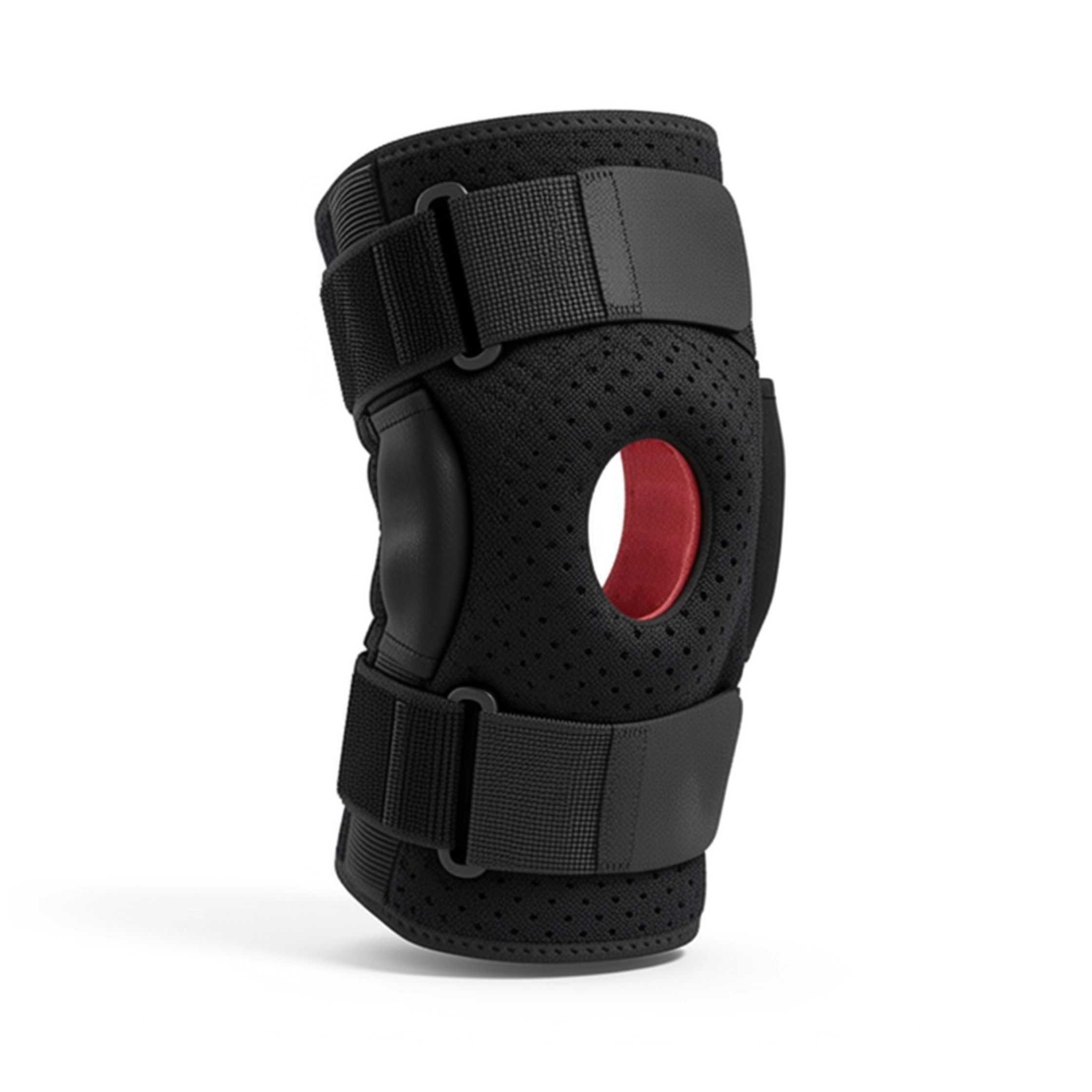
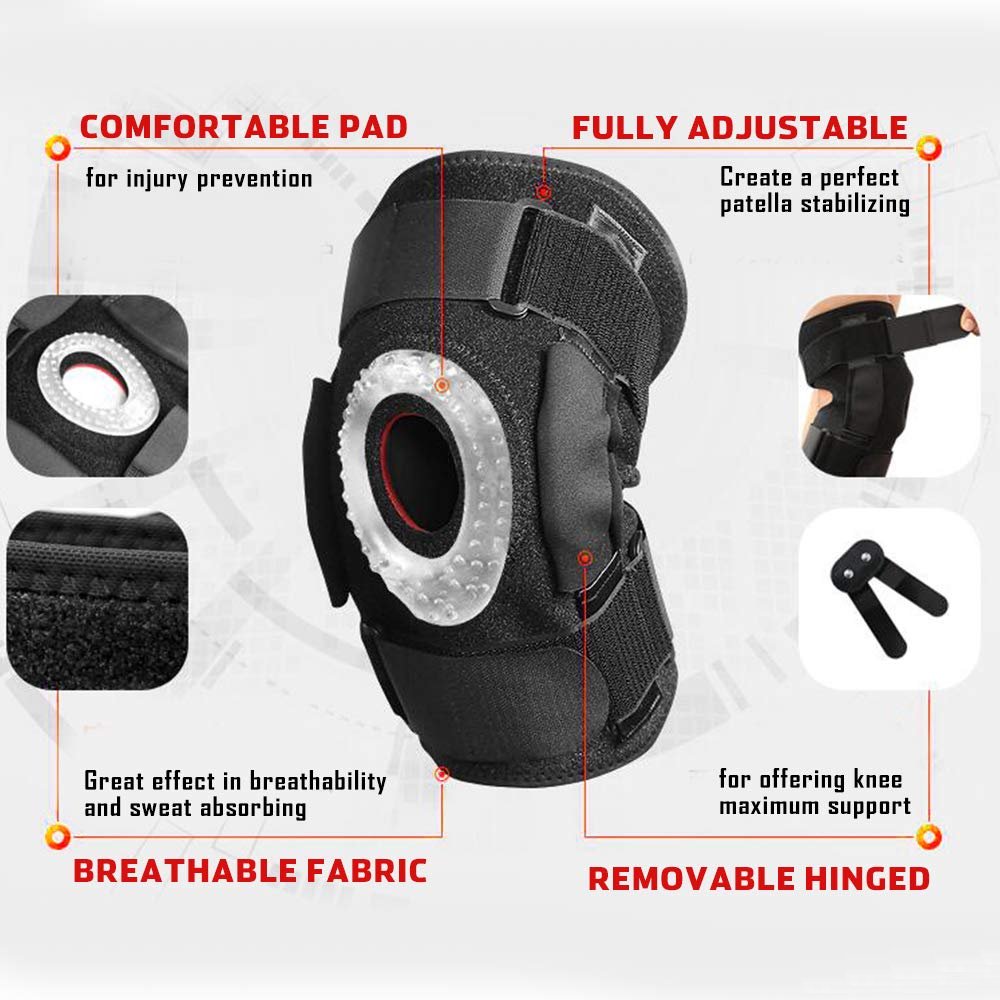
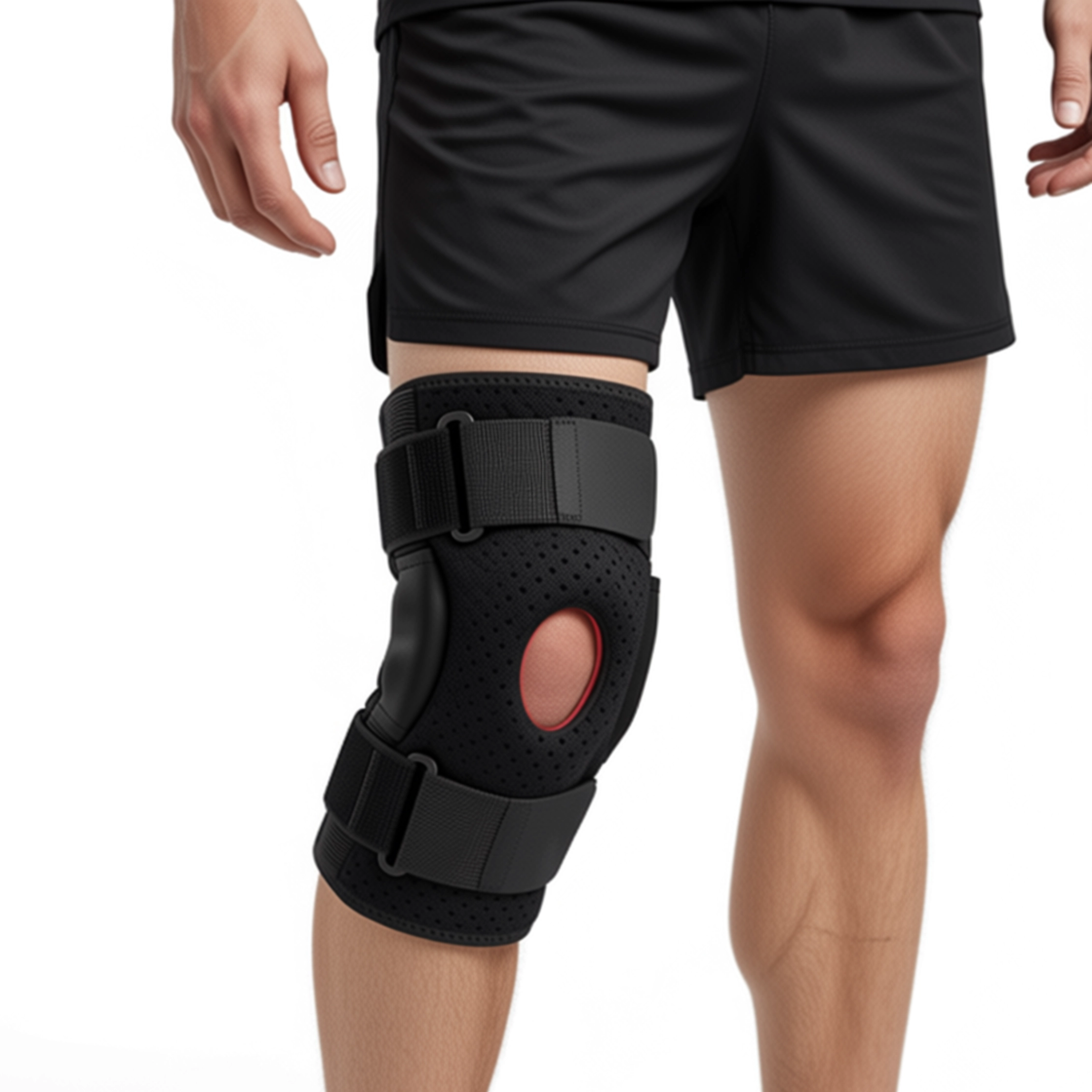
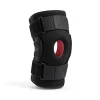
- A hinged knee brace with aluminium side supports, a neoprene body, and a silicone gel ring around the kneecap.
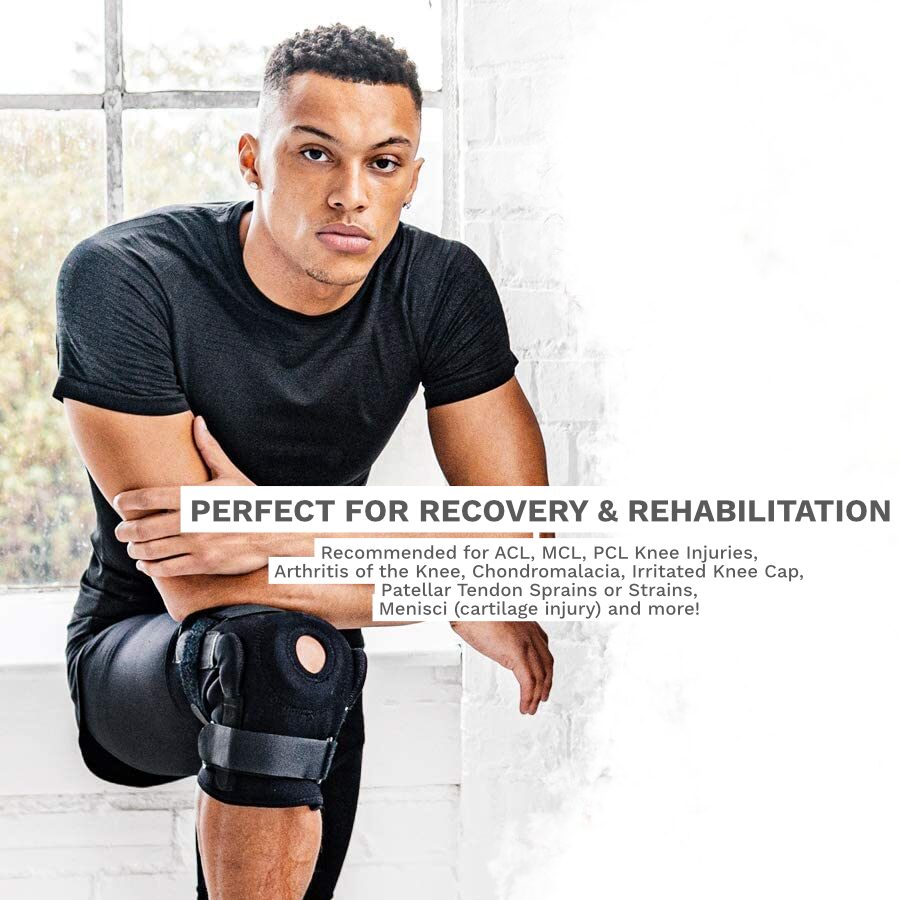
- Designed for adults dealing with meniscus tears, meniscitis, ligament sprains, osteoarthritis, kneecap pain, or patellar tendonitis.
- The side hinges allow the knee to bend and straighten while limiting twisting and sideways movement that can pinch or strain damaged tissue.
- The neoprene body provides gentle compression and warmth around the joint to help settle swelling and stiffness.
- The silicone gel ring helps keep the kneecap centred and gliding smoothly as you move.
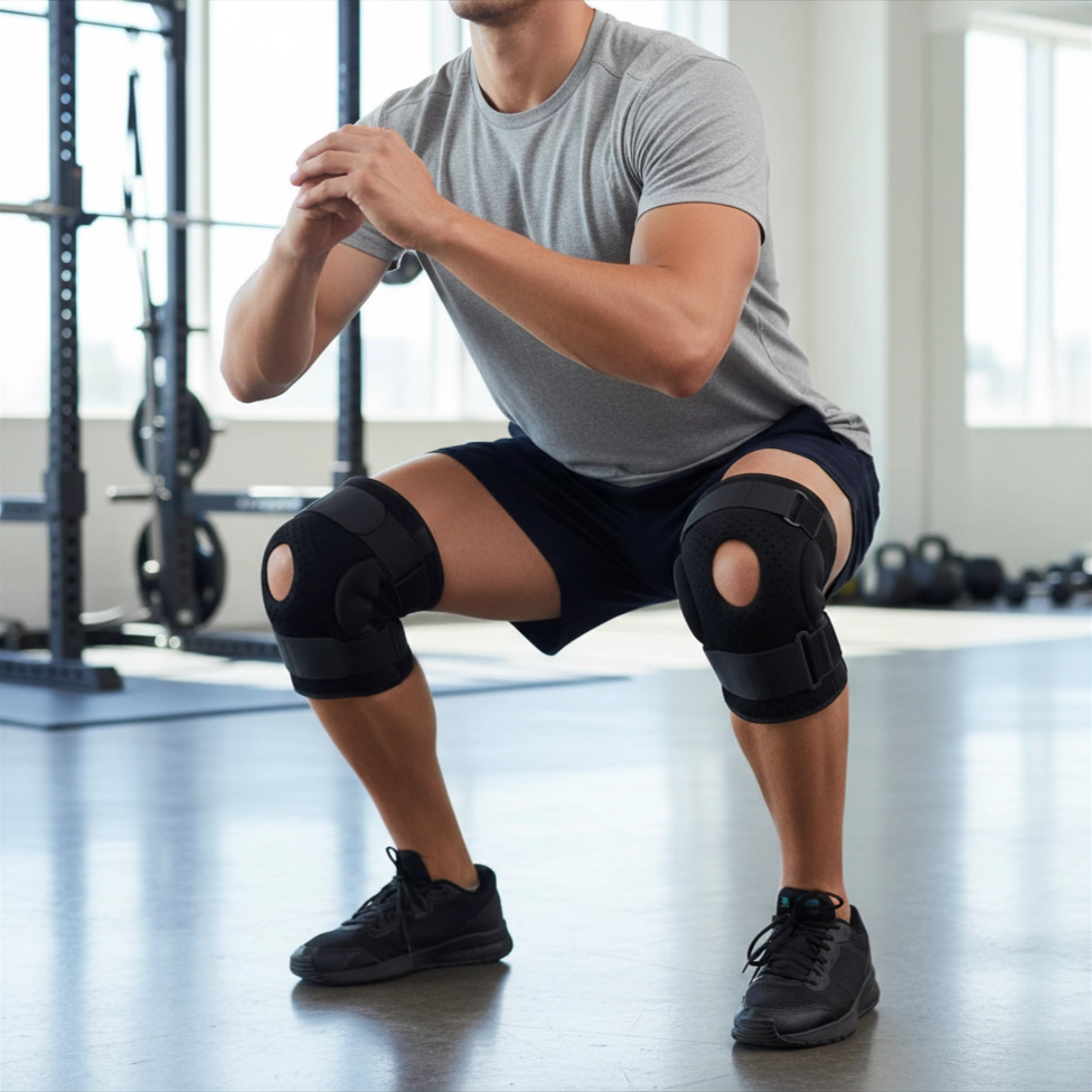
- May help you walk, use stairs, and stand for longer periods with more confidence during recovery.
- It does not lock the knee or replace the need for strengthening and rehabilitation.
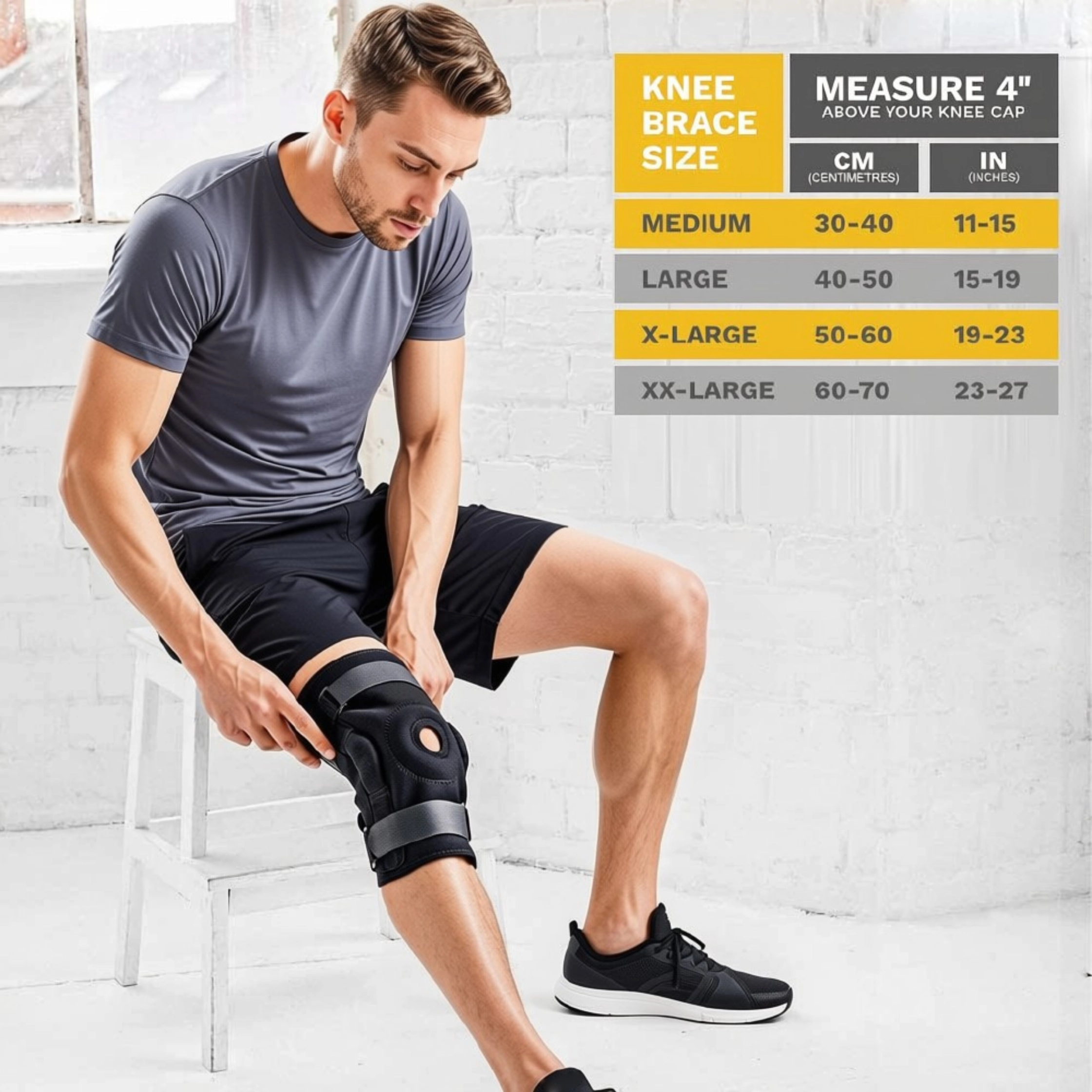
- Measure around your thigh 10 cm (about 4 inches) above the centre of your kneecap, then compare with the size table below.
- Wear it during weight-bearing activities such as walking, climbing stairs, and standing for extended periods.
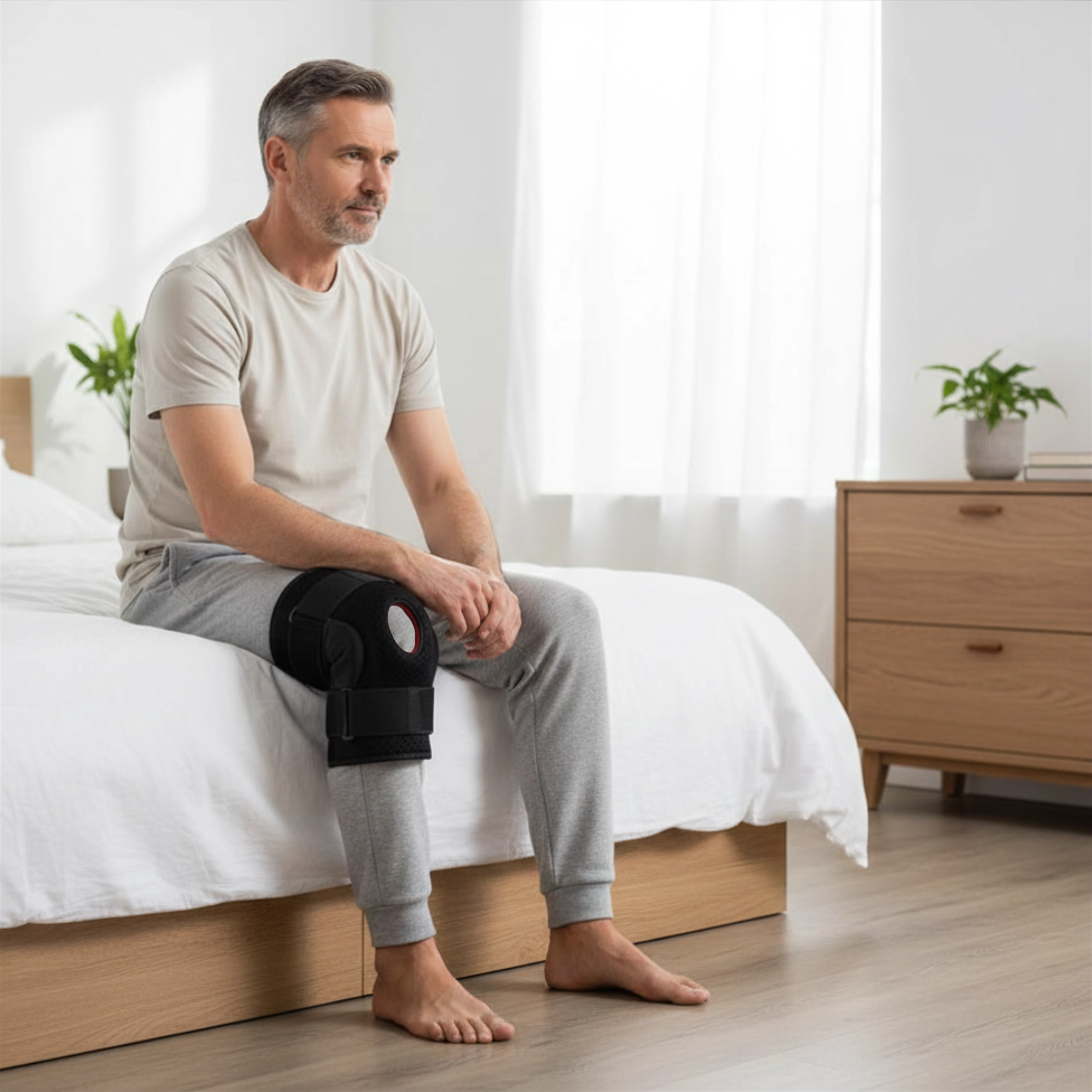
- Remove it when resting, sleeping, showering, or bathing.
- Do not use it over open wounds, infected skin, or when you have severe swelling that has not settled.
- Seek advice from a GP or physiotherapist if pain is severe, the knee locks completely, or symptoms worsen.
What you’re struggling with
If you’ve torn your meniscus, you might recall the exact moment it happened. A twist, a sudden turn, or an awkward landing. Maybe you felt a pop, maybe you didn’t. But the pain along the inside or outside of the knee was immediate, and the knee hasn’t felt stable since.
The first few weeks can be rough. Walking down stairs hurts. Squatting to pick something up sends a sharp pain through the joint. Lowering yourself into a seat makes you wince. And there’s often that unsettling feeling of catching – like something is pinching or blocking the knee mid-movement. Sometimes it swells up overnight. Sometimes it feels stiff after sitting for a while.
This is what a meniscus tear does: it changes how you move. People often start avoiding the movements that hurt. They take stairs one at a time. They hesitate before stepping off a kerb. The knee no longer feels like something they can trust.
It’s not just the pain that’s difficult – it’s the unpredictability. Not knowing whether the knee will hold when you step down or turn can make you second-guess every movement. That’s where this hinged knee brace comes in. It supports the joint after meniscus damage, helping you move more confidently while the torn tissue heals. It’s also helpful for other knee issues – ligament sprains, osteoarthritis, and a few more – but if you’re reading this because of a meniscus tear, that’s the problem we’ll focus on here.
Why your knee feels unreliable
The meniscus is a C-shaped piece of cartilage that sits between your thighbone and shinbone. It acts as a shock absorber, spreading your body weight evenly across the joint, and it helps guide the two bones as the knee bends and straightens.
When the meniscus tears, that structure is damaged. The torn edge can catch between the bones during movement – that’s the pinching sensation you feel. It can also leave the joint slightly less stable, which is why the knee may feel as though it might buckle, especially on stairs or uneven ground.
The meniscus has a limited blood supply. The outer edges receive some blood, which means they can heal. The inner areas receive very little, so tears there often struggle to heal on their own. Either way, healing takes time, and twisting or deep bending will place more strain on the tear.
But the meniscus isn’t the only part that matters. The knee is held together by ligaments – strong bands of tissue that connect bone to bone and resist excessive movement. If your meniscus tear has also stretched or damaged the surrounding ligaments, the joint becomes even less predictable. And whenever the knee is injured, the muscles around it – especially the quadriceps at the front of the thigh – quickly weaken. That makes the instability worse, because strong muscles help hold the knee steady.
So when the knee gives out, it isn’t just the torn cartilage. It’s a combination of the torn meniscus, potentially stretched ligaments, and weakened muscles all trying to cope at the same time. The knee relies on all three working together, and when one is damaged, the others have to work harder to make up for it.
This is also why the knee can feel different from one day to the next. On days when the muscles are tired or the joint is more swollen, the knee may feel more vulnerable. On better days, it might feel almost normal. That inconsistency is common after a meniscus tear, but it doesn’t mean the knee is unpredictable in a dangerous way – it means the support systems around the joint need protecting while they heal.
The logic behind a hinged brace
The knee is a hinge joint: it bends and straightens, but it isn’t designed to twist or buckle sideways. Everyday actions like turning, stepping on uneven ground, or changing direction quickly place those forces on the joint.
Complete rest isn’t helpful for most knee injuries. If you stop using the leg completely, the muscles waste, the joint stiffens, and the healing tissue ends up weaker. What you need is a middle path: protection where you need it, movement where you need it.
That’s what a hinged brace offers. The hinges allow the knee to bend and straighten normally, but they resist the twisting and sideways movement that put strain on a torn meniscus. The brace doesn’t lock the joint; it simply limits the movements that cause pain. That allows you to keep moving, keep using your leg, and stay reasonably active without constantly re-aggravating the injury.
This balance matters because the knee needs some movement to heal properly. Gentle bending keeps the joint lubricated and helps the surrounding muscles stay active. The problem isn’t bending itself – it’s the sudden twisting or side-to-side forces that pull at the torn tissue. The brace is designed to let the knee do what it’s good at while blocking the movements it struggles to control.
What makes this brace different
When you put this brace on, you’ll notice three things working together.
First, there are two aluminium rails running down the sides of the knee – one on the inside and one on the outside. These are the hinges. They sit in line with the natural pivot point of the knee, so they don’t interfere with bending and straightening. What they do limit is how far the knee can twist or buckle sideways – the movements that pinch a torn meniscus. If you’ve ever had the sensation of the knee catching or turning under you, these hinges are what prevent it. They act as a physical guide, reminding the joint to track in a straight line rather than wobbling under load.
Second, the whole brace is wrapped in a layer of neoprene – a flexible, warm synthetic rubber. This provides even compression around the joint. The compression helps reduce swelling, which is common after a meniscus tear because fluid builds up inside the knee and makes it feel tight and stiff. The warmth can also ease stiffness, making movement feel more comfortable. And the gentle pressure against your skin improves something called proprioception – your brain’s ability to sense where the knee is and what it’s doing. When the brace presses against your skin, your brain receives clearer signals about joint position, so your muscles can react faster to keep you steady. That means you’re less likely to catch the knee off guard with a movement it wasn’t prepared for.
Third, at the front of the brace is a soft silicone gel ring that surrounds the kneecap. It cushions the bone and helps the kneecap glide smoothly through its groove. A meniscus tear can alter the way the whole knee moves, and sometimes the kneecap begins to track poorly as a result. The gel ring provides a gentle centring effect, helping to prevent secondary kneecap pain from developing.
These three features work as one system: the hinges control harmful movement, the compression helps manage swelling, and the gel ring helps keep the kneecap aligned. Each one addresses a different part of the problem, so the brace as a whole feels like more than just a sleeve – it’s actively working with your body to keep the knee stable.
Using it properly
Getting the right size is essential. A brace that’s too tight can restrict circulation and become uncomfortable. A brace that’s too loose will slide around and offer very little support. Here’s how to measure.
Sit with your leg slightly bent, or stand with your leg straight. Measure around your thigh at a point 10 cm (4 inches) above the centre of your kneecap. Then use that measurement to choose your size from the chart below.
| Size | Thigh Circumference (cm) | Approximate Inches |
|---|---|---|
| Medium | 30–40 cm | 11–15 inches |
| Large | 40–50 cm | 15–19 inches |
| XL | 50–60 cm | 19–23 inches |
| XXL | 60–70 cm | 23–27 inches |
If your measurement falls exactly on a boundary – for example, 40 cm – choose the larger size. A slightly roomier fit is more comfortable than one that’s too tight. Sizes can vary a little between manufacturers, so always check the specific sizing guidance that comes with the brace.
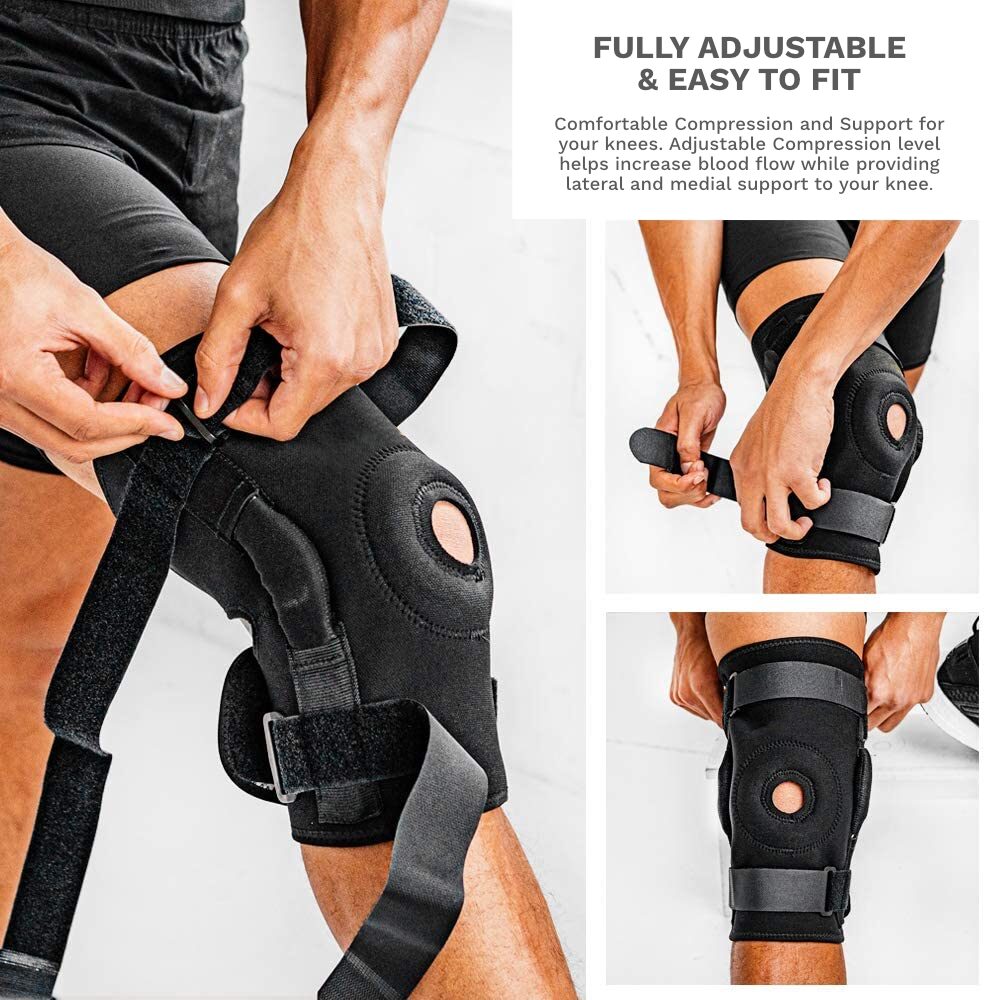
To put the brace on, loosen all the straps first. Slide it up over your leg, then position the gel ring around your kneecap. This is your anchor point – if the gel ring isn’t centred, the brace won’t sit correctly. Check that the hinges are aligned with the sides of your knee, then fasten the straps. Take a few steps and bend the knee a couple of times. The brace should stay put without sliding down or shifting to the side. If it moves, reposition it and adjust the strap tension.
The brace should feel snug, not tight. The gel ring should sit comfortably around the kneecap. The hinges should run straight down the sides of the knee, not twisted forward or backward. The straps should hold firmly without leaving deep marks or causing any tingling. It’s worth taking the time to get the fit right – a correctly fitted brace should feel like a natural part of your leg, not something you’re constantly aware of.
Pay attention to how the brace behaves when you move. It should stay in place during repeated bending, without bunching up behind the knee or rubbing against your skin as you walk. If it slides down or shifts to one side during movement, the straps may need tightening, or you may need to re-check the positioning. A brace that moves around won’t give you the support you need.
When should you wear it? A meniscus tear usually means the knee needs support during weight-bearing activities. That includes walking, climbing stairs, standing for long periods, or doing physical tasks around the house – basically any time the knee is carrying weight and there’s a risk of twisting or buckling.
Many people wear the brace for most of the day during the early phase after a tear, then gradually reduce wearing time as the knee settles and strength returns. Some find they only need it for higher-risk activities such as walking on uneven ground, exercising, or standing for extended periods. Listen to your knee. If the brace makes an activity feel safer and less painful, that’s a strong sign it’s helping.
Take the brace off when you’re resting, sitting with your leg raised, or sleeping. Remove it before showering or bathing, and let your skin breathe regularly.
What to expect during recovery
In the first few days, you should notice that weight-bearing feels more secure. The compression helps settle swelling, and the hinges reduce the sharp, catching sensations that can happen during everyday movement. You’ll likely find yourself walking more naturally because you’re not bracing yourself against every step.
After a few weeks, as the swelling drops and the initial inflammation settles, the knee should feel less painful even without the brace. That’s the time to start reducing how often you wear it. A gradual approach works best: first wear it for most activities, then only for stairs and uneven ground, then only for heavier tasks like carrying shopping or longer walks. This is a sign of progress, not a signal to stop rehabilitation.
Healing takes time. A minor meniscus tear might feel significantly better within a few weeks. More significant tears, or tears treated with surgery, can take several months. The brace doesn’t speed up the healing process – it protects the area while healing happens. What you do alongside the brace matters just as much.
Your thigh muscles provide the knee’s primary support. The stronger they are, the less external support the joint needs. That’s why physiotherapy is so important. A good rehabilitation programme will gradually strengthen the quadriceps, hamstrings, and hip muscles, improving the knee’s ability to control twisting and buckling forces on its own. The brace can support you during daily activities while you do your exercises without it, as long as your physiotherapist is happy with that approach. They can guide you on which exercises are safe, how much to do, and when you can start challenging the knee without the brace. That’s the path to long-term recovery: the brace gives you stability on the outside while you rebuild the strength that will eventually make the brace unnecessary.
Recovery isn’t always a straight line. Some days will feel better than others, and a flare-up of pain after an active day doesn’t mean you’ve undone your progress. If that happens, it usually just means you’ve done a little more than the knee was ready for. Give it a day or two of lighter activity, go back to wearing the brace for more of your daily tasks, and let the knee settle before building back up. What matters is the overall trend over weeks and months, not the odd bad day.
For some people, particularly those with osteoarthritis or chronic knee problems, a brace may become a useful long-term tool rather than a temporary one. That’s fine. The aim is to keep you moving comfortably, and if a brace helps you do that, it’s doing its job.
Caring for your brace
Caring for the brace is straightforward. Hand wash it in cool or lukewarm water with a mild soap. Rinse it thoroughly, then let it air dry naturally. Don’t put it in a tumble dryer, don’t hang it on a radiator, and don’t leave it in direct sunlight – heat can damage the neoprene, the gel ring, and the straps.
Try to wash it every couple of days if you’re wearing it regularly, especially after being active. Sweat and bacteria build up quickly and can irritate the skin. When you’re not using it, keep the brace flat or loosely rolled in a cool, dry place.
Give it a quick check every few weeks. Look at whether the straps still hold firmly, the neoprene has become creased or stiff, the gel ring has cracked or flattened, and the hinges move smoothly without sticking. If you notice any of these signs, replace the brace. A worn brace won’t provide the support you need, and it may shift during movement, reducing its effectiveness and potentially allowing re-injury.
When to check in with a professional
A brace is a support tool, not a substitute for medical assessment. There are times when the brace isn’t appropriate, and times when your symptoms need proper attention before you consider wearing one.
Don’t use the brace if you have:
-
- An open wound, cut, or broken skin on the knee.
-
- An active infection in the joint – signs which may include redness, warmth, or fever.
-
- Severe swelling that hasn’t responded to rest, ice, and elevation.
-
- Poor circulation in your legs, or a history of deep vein thrombosis (DVT).
-
- A known sensitivity to neoprene that has previously caused a skin reaction.
Speak to a GP or physiotherapist before using the brace if:
-
- The pain is severe, or hasn’t started to improve within a few days.
-
- The swelling is getting worse rather than better.
-
- The knee locks completely and won’t straighten.
-
- You have numbness, tingling, or colour changes in your lower leg or foot.
-
- The injury happened during significant trauma – a fall from height or a direct blow.
Stop wearing the brace and get medical advice if:
-
- Pain becomes worse rather than better.
-
- Swelling continues to increase even with rest and elevation.
-
- The knee feels more unstable, not less.
-
- The joint becomes hot, red, or unusually tender – possible signs of infection.
-
- You develop any new symptoms that concern you.
You don’t need to wait until things become severe to seek advice. If you’re unsure whether the brace is right for you, or how to fit it into your recovery plan, a GP or physiotherapist can give you clear, personalised guidance.
Identifying the specific problem
If you’re not sure whether your symptoms are from a meniscus tear, the descriptions below cover the knee problems this brace can help with. Each pattern feels a little different, and the brace helps in different ways. Read through them and see which one sounds like you. These are general patterns rather than a diagnosis, so if you’re still unsure, it’s always worth having a clinician look at the knee.
Meniscus tear – the sharp catch and pinch
A meniscus tear often starts with a sharp, localised pain along the joint line – the strip running between your shinbone and thighbone on the inner or outer side of the knee. You might feel a sudden stab when you twist on a planted foot, step down awkwardly, or straighten the leg after it’s been bent for a while. Along with the pain, many people describe a sensation of the knee catching or locking – as if something is physically blocking the joint mid-movement. That catch can stop you mid-step, then release with a click or a jolt.
What happens is that the torn edge of the C-shaped cartilage slips into the space between the bones. When the knee bends and straightens, that loose fragment gets pinched as the bones close together, causing the sharp pain and the feeling that something is stuck inside. It’s more likely to occur when the knee twists while bearing weight, which is why turning, pivoting, and changing direction on uneven ground often trigger it.
The hinges matter most for this pattern. They resist the twisting and sideways glide that drags the torn edge into the joint, so you’re less likely to catch the knee in that painful position. The compression helps stop swelling from building up after those catching episodes, and the gel ring gives the kneecap a little extra guidance while the knee moves through its natural range.
Meniscitis – the dull ache that builds up
Meniscitis is different from a tear, although the pain can sit in a similar place. Instead of a sharp catch, you tend to feel a dull, nagging ache along the joint line that builds over hours or days. It’s often worse after a day of repeated squatting, kneeling, or deep bending – gardening, lifting low items, or working under a car, for instance. You might not notice it at the time, but the knee starts to complain later that evening or the next morning.
In meniscitis, the meniscus itself is inflamed and swollen, but there’s no torn edge to catch. The problem is that deep bending repeatedly squashes the already-irritated tissue, and each squash adds to the irritation. Because the swelling takes time to develop, the pain tends to lag behind the activity rather than arriving during it.
The brace helps here mainly by limiting how far the knee can bend. The hinges stop the joint from going into that deep, end-of-range position where the inflamed meniscus gets compressed most. With that movement restricted, the tissue gets a chance to settle, while the compression around the knee helps to ease the swelling that’s driving the ache. You can keep moving and using the leg, but the knee stops being re-aggravated with every squat or deep knee bend.
Osteoarthritis – when the joint has worn down
Osteoarthritis rarely follows a single injury. It’s a gradual wearing of the smooth cartilage that lines the bones inside the knee. As that cushion thins, the bones sit closer together, and every step transmits more force through the joint than it was designed to handle. The result is a deep, sometimes hard-to-pinpoint ache that’s often worst in the morning, eases for a short while as you move around, then returns after you’ve been on your feet for a long spell. Many people also notice stiffness after sitting still for a while, and some feel a grinding or grating sensation as the knee moves.
The pattern tends to build over years rather than weeks, and there’s rarely a clear “moment it started.” You may have noticed it becoming more noticeable when walking on hard pavements, using stairs, or getting up from a low chair. The joint lining can become irritated by the extra load, adding to the pain and making the knee feel tight and swollen by the end of the day.
In this case, the hinges help by reducing the twisting and sideways forces that place extra strain on already-worn areas. The neoprene body spreads the load more evenly around the joint, and the warmth helps keep the knee supple, which can ease that first-thing-in-the-morning stiffness. The brace doesn’t reverse the wear, but it can make daily loading more tolerable, so you can stay active without provoking the joint as much.
Ligament sprains – when the knee gives way
A ligament sprain feels different from a meniscus problem. Instead of a catch or a dull ache, the knee gives way – it buckles, slips, or feels as though it’s about to slide out of place when you step down, turn, or plant your foot awkwardly. There’s often a clear moment of injury, like a stumble, a fall, or a sudden twist. Two ligaments are commonly involved: the MCL on the inner side, and the ACL deeper inside the joint.
An MCL injury usually causes pain along the inner side of the knee, with a feeling that the joint is being forced inward. It often happens after a blow to the outside of the knee or an awkward inward twist. An ACL injury, on the other hand, creates a deeper and more alarming sensation – as if the knee has shifted forward or “gone out” of place, sometimes with a pop at the moment of injury. Both can leave the knee feeling less secure, because the ligament is stretched or partially torn and no longer holds the bones together as firmly as it should.
The muscles around the knee also respond more slowly after a ligament sprain, which makes the giving-way feeling worse. The hinges on this brace act as an external restraint: for MCL injuries, they resist inward buckling, and for ACL injuries, they limit rotation and the forward-sliding sensation. The compression also improves your brain’s awareness of where the knee is, so your muscles can react faster to prevent the joint from collapsing. That’s one of the main reasons a hinged brace can feel reassuring during everyday movement after a ligament sprain.
Patellofemoral pain – pain around or behind the kneecap
Patellofemoral pain is a common source of front-of-knee discomfort. The ache is usually felt around or behind the kneecap rather than along the joint line on the sides. It tends to appear when the knee is loaded while bent – climbing stairs, squatting, sitting for a long time with the knee folded, or getting up from a chair. Some people also notice it during or after a run, especially on hard ground or after increasing their distance.
In most cases, the problem is that the kneecap isn’t tracking perfectly through the groove at the end of the thighbone as the knee bends. If the muscles around the thigh and hip pull unevenly, the kneecap can shift slightly off-centre, and the cartilage on its underside becomes irritated with repeated movement. There may not be any major damage – just an alignment and control issue that builds up over time.
The silicone gel ring is the key feature for this pattern. It sits around the kneecap and helps keep it centred during movement, so the underside isn’t rubbing against the groove at an awkward angle. The compression adds comfort and gives your muscles better feedback about the kneecap’s position. The hinges aren’t directly treating the kneecap, but they do reduce twisting forces that can make tracking worse, so they’re a useful secondary support.
Patellar tendonitis – pain at the front of the knee, just below the kneecap
Patellar tendonitis is an overuse injury affecting the tendon that connects the kneecap to the shinbone. The pain is very specific: it sits at the bottom tip of the kneecap, maybe extending a little way down the tendon. It tends to be sharpest when the knee is loaded while bent – going downstairs, getting out of a car, standing up from a low chair, or doing anything that involves jumping or running. Pressing on the spot is usually tender too.
The problem starts with repeated strain on the tendon, especially from activities that involve a lot of jumping, sprinting, or deep knee bending. The tendon becomes irritated at its attachment point on the kneecap, and that irritation builds up if the knee isn’t given enough time to recover between sessions.
The compression and warmth from the neoprene body are the most helpful features here, as they ease stiffness and improve local comfort in the front of the knee. The hinges add a small extra layer of protection by reducing the twisting and buckling forces that can place additional stress on the tendon during active movements. The brace won’t cure the underlying irritation, but it can make daily movement more manageable while you rest, stretch, and strengthen the area with proper rehabilitation.
Knee bursitis – swelling and tenderness around the kneecap
If you’ve spent a day working on your knees – laying flooring, scrubbing, or kneeling in the garden – and woken up with a soft, tender swelling just above or below the kneecap, you may be dealing with knee bursitis. The area can feel warm and puffy, and it may hurt when you kneel or bend the knee. Unlike a meniscus problem, the pain is usually on the front of the knee rather than along the joint line, and it doesn’t cause catching or locking.
The swelling is coming from the bursae – small, fluid-filled sacs that sit between bone and soft tissue to reduce friction. When they’re compressed or rubbed repeatedly, they become inflamed and fill with extra fluid. That’s the lump you feel. It’s not dangerous, but it can make kneeling or deep bending uncomfortable enough to interrupt your day.
The compression and the silicone gel ring help most here. The compression gently squeezes the swollen area, which can discourage fluid from pooling, and the gel ring provides a soft cushion around the kneecap so you’re not pressing directly on the tender spot. The hinges are a secondary benefit – by limiting deep bending, they reduce the pressure on the bursae when you do need to crouch or kneel.
Plica syndrome – a thickened fold of tissue catching inside the knee
Some people have a thin fold of tissue inside the knee called a plica – a remnant from early development that usually stays soft and unnoticeable. In some cases, it can become thickened and irritated, especially after repeated bending or an injury. When it catches over the edge of the thighbone or kneecap, you might feel a snapping or clicking sensation on the inner side of the knee, sometimes with a sharp stab that comes and goes. The pain often builds during repetitive bending, like cycling, rowing, or climbing many flights of stairs.
What’s happening is that the thickened fold acts a bit like a guitar string, flicking over the bony surfaces as the knee moves. It doesn’t cause the joint to give way, but the snap can be jarring and can irritate the surrounding lining over time.
The hinges on this brace are the most relevant feature for plica syndrome. By limiting how far the knee can bend at the end of range, they reduce the tension on that fold and give the irritated tissue a chance to settle. The compression helps manage any low-level swelling, and the gel ring keeps the kneecap tracking smoothly so the plica isn’t constantly flicked by unusual movement.
Iliotibial (IT) band syndrome – pain on the outer side of the knee
IT band syndrome tends to surface as a sharp or burning pain on the outer side of the knee, often after a period of increased running, cycling, or long downhill walking. You might feel it most clearly when your heel strikes the ground or just as your knee bends to absorb the impact. The pain can be intense enough to force you to stop, then ease fairly quickly once you rest. It’s not usually accompanied by swelling or a feeling of instability.
The cause is friction. The iliotibial band is a thick strip of tissue running from your hip down the outside of your thigh, and it crosses the bony bump on the outer side of your knee. When the knee bends and straightens repeatedly, especially with poor control or tightness higher up the leg, that band rubs against the bone, and the area becomes inflamed.
The compression from the neoprene body can help a little by supporting the soft tissues around the outer knee and improving your sense of joint position as you move. The hinges play a more direct role: by limiting the rotational forces at the knee, they reduce the sideways pull that tugs the IT band across the bone. The brace won’t fix the underlying tightness, but it can take the edge off the friction during daily walks while you work on stretching and strengthening.
Post-meniscus surgery support – protection during recovery
If you’ve recently had surgery to repair or trim a torn meniscus, you’ll likely have been given specific advice about how much you can move and what to avoid. In the early weeks, the knee can feel vulnerable even after a relatively straightforward procedure. A hinged brace can offer an extra layer of confidence, particularly when you start weight-bearing again.
After surgery, the joint tissues need time to heal, and the muscles around the knee are often weakened from the period of reduced activity. The hinges on this brace prevent the twisting, pivoting, and deep bending movements that could put stress on the surgical repair, while still allowing you to bend and straighten the knee as your surgeon advises.
The compression helps keep post-operative swelling in check, and the gel ring supports the kneecap, which can sometimes feel irritated as the joint adapts after surgery. The brace is not a substitute for your surgeon’s instructions – you should always follow their guidance on movement, weight-bearing, and rehabilitation. But for many people, having the extra external support makes the first few weeks feel far less nerve-wracking.
Mild knee instability without a clear diagnosis
Sometimes the knee doesn’t have a specific diagnosed problem – it just doesn’t feel right. You might get a vague sense that the joint is going to give way when you step off a kerb, or it feels “loose” when you turn quickly. There may be no sharp pain, no swelling, and no clear moment of injury. This pattern is common after a previous knee strain, or simply from muscles that have become weak from long periods of reduced activity.
This type of instability often comes down to a lack of dynamic control, particularly in the quadriceps and the muscles around the hip. When those muscles don’t react quickly enough, the knee can feel as though it’s shifting beyond its normal limits, even though nothing is structurally torn. The sensation can be disconcerting and may cause you to avoid activities you used to do without a second thought.
For this general feeling of insecurity, the brace’s combination of features works together rather than any one element standing out. The hinges provide a physical barrier against excessive twisting and side-to-side movement, so you have a clear limit on how far the knee can go. The compression wraps the joint snugly, giving your brain constant feedback about the knee’s position, which helps your muscles fire a little earlier and more confidently. The gel ring adds a reassuring presence around the kneecap, making the whole joint feel more contained. It’s not a cure, but it can help you feel stable enough to start rebuilding strength safely.
Kneecap instability (patellar subluxation)
If your kneecap has ever slipped out of place, you’ll know the feeling: a sudden jolt, a sensation of the knee “popping” to one side, and then a sharp pain as everything shifts back. In some people, the kneecap doesn’t fully dislocate but partially slides out of its groove – a mild subluxation. This can happen during twisting movements, stepping down awkwardly, or even just getting out of a car. Afterward, the knee may feel sore and vulnerable, and you might feel anxious about it happening again.
The kneecap normally glides through a groove at the front of the thighbone. If the groove is shallow, or the muscles on the outer side of the thigh pull more strongly than those on the inner side, the kneecap can be dragged slightly sideways during bending. Once it starts sliding off track, it tends to do so again, partly because the supporting tissues become stretched and less effective at holding it in place.
The silicone gel ring is the standout feature for this pattern. It surrounds the kneecap and creates a gentle physical barrier that discourages it from drifting sideways as the knee moves. The hinges add another level of control by limiting the twisting forces that can pull the kneecap off line, and the compression gives your muscles the feedback they need to correct tracking in real time. The brace won’t change the shape of the groove, but it can significantly reduce the likelihood of that alarming slip.
Your next move
Whichever pattern matches your symptoms, the goal is the same: to keep you moving while your knee heals. If you’re ready to try the brace, measure around your thigh, choose the size that matches, and start with short periods of wear. If you’re still in doubt about whether a hinged brace is right for you, a GP or physiotherapist can confirm that before you buy.
You don’t need to keep living with that hesitation on the stairs, or the fear of a sudden catch. With the right support, the knee can feel stable again – and that makes the first step easier.
Disclaimer
This information is general guidance and is not a substitute for individual medical advice, diagnosis, or treatment. It does not guarantee any particular outcome. If you are unsure about your symptoms, or if you have new or unexplained symptoms that do not settle, please speak to a GP, physiotherapist, or another appropriate clinician for personalised advice.
1 Review For This Product
Fast & Secure Checkout Through Paypal
Pay with Paypal the secure payment gateway that accepts all credit and debit cards. Paypal is free and secure and no credit or bank information is ever stored or shared with us.
Fast Dispatch
Enjoy your items soon with quick dispatch via Royal Mail. Expect to have your items between 1-3 working days for domestic orders. 7-10 Working days for international orders.
Return Policy – 30 Day Money Back Guarantee
In the unlikely event, you are unhappy with your purchase you can return it within 30 days for a refund. Please contact us via the form on the contact us page to start your return.
To return an item please send it to: Nuova Health UK, 81 Highfield Lane, Waverley, Rotherham, S60 8AL. Please include a note with your order id so we know who to refund. Please retain your postage receipt as proof of postage. All that we ask is that the item is in the original packaging and unused.
by Vaila Randle
Got myself a KneeReviver Brace after a rather nasty sprain, and it’s been a great help. The brace provides the stability I need, and it’s surprisingly comfortable to wear. Plus, the quality is top-notch, and it’s holding up well so far.