
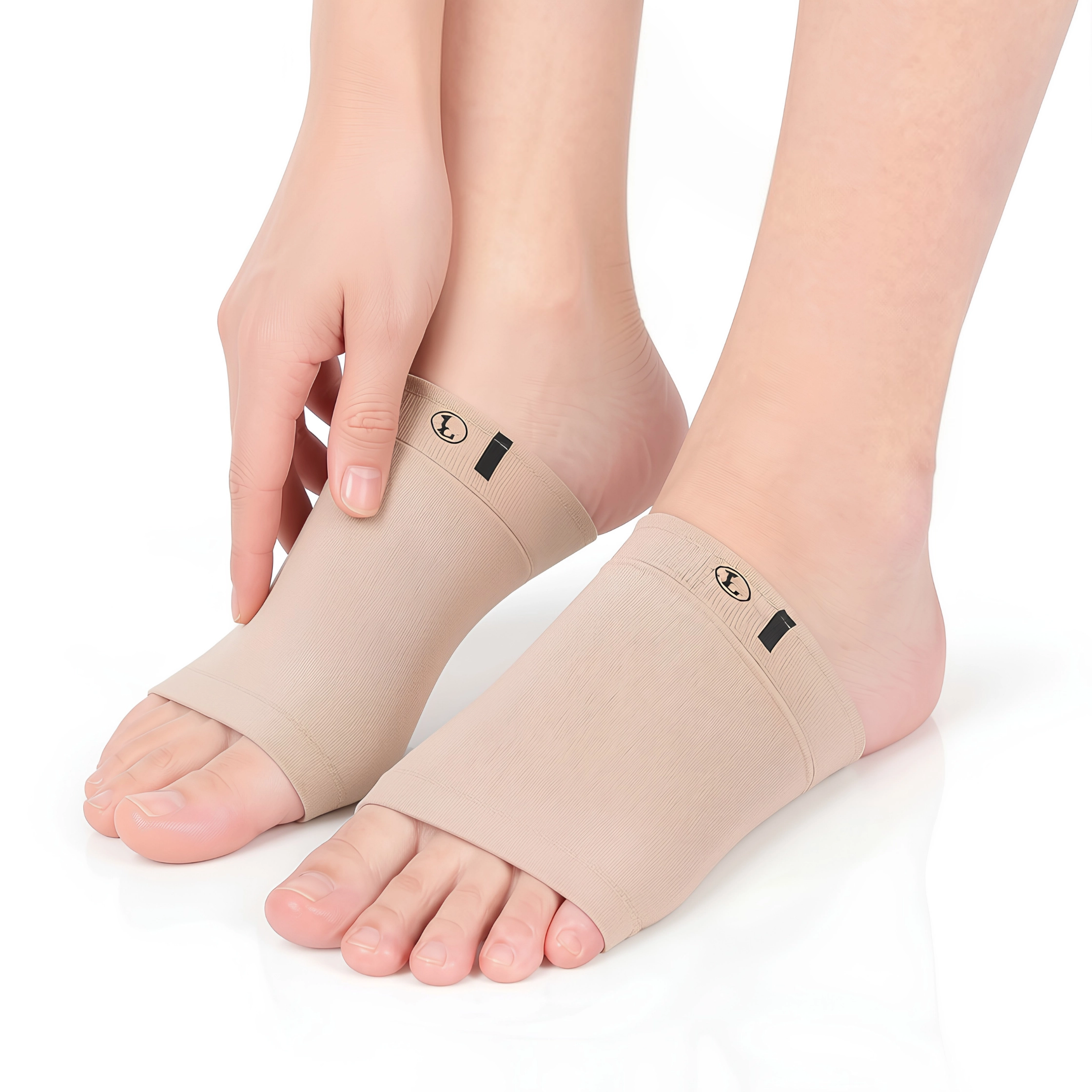
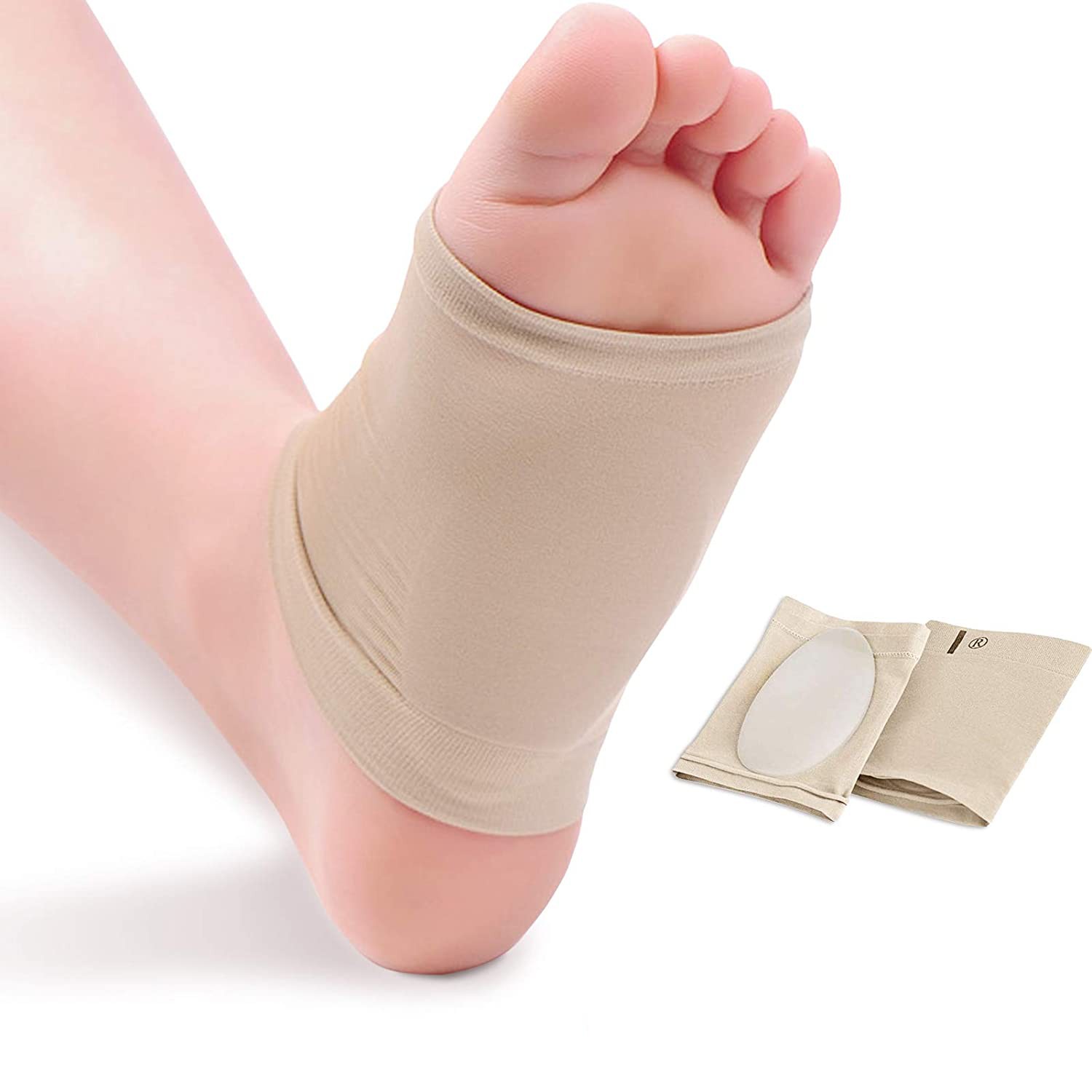
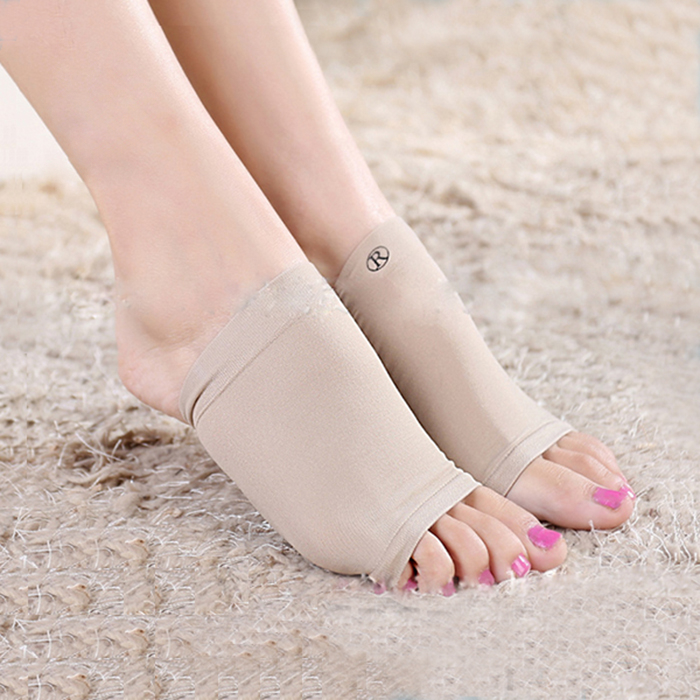
Gel Arch Support Sleeve Socks for Plantar Fasciitis
£7.99inc VAT
- A pair of slip-on gel arch support sleeves, worn on the foot under the arch
- Intended for adults with arch, foot and heel pain linked to plantar fasciitis
- Also suited to flat feet, fallen arches and high arches
- Shaped silicone gel pad that sits under the arch and moulds to the shape of your foot, cushioning as well as supporting
- Firm, even compression across the arch and the top of the foot
- Non-slip cuff holds the pad in place under the arch while you walk and stand
- Breathable, moisture-wicking fabric
- One size, stretch fit, for men and women; fits either foot
- Wear against the foot, under or over socks, inside your usual shoes, or barefoot around the house
- Useful if you stand for long periods on hard surfaces such as concrete or tiles
- Build up wear gradually, starting with a few hours, and take them off before sleeping
- Stop wearing them if you feel pinching, tingling, numbness or pins and needles
- Compression sleeves do not treat or prevent blood clots, so speak to a clinician first if you have circulation problems or a history of clots
- Includes a 30-day money-back guarantee
Heel pain that greets you in the morning
Your alarm goes off, you swing your legs out of bed, and the moment your foot takes your weight there’s a sharp, searing pain right under your heel. It’s not a dull ache. It’s the kind that makes you grab the doorframe.
Then you take a few more steps, and it starts to ease. By the time you’ve made it to the kitchen it’s more of a background throb than a stab. You think you’ve got away with it. Then you sit down for twenty minutes, stand up again, and there it is once more.
That sequence — worst first thing, better once you’re moving, back again after rest — is what plantar fasciitis usually looks like. It’s one of the most common causes of heel pain in adults.
If any of that sounds familiar, the rest of this page will help. Understanding what’s going on under your foot explains why the pain behaves the way it does, why it can drag on longer than you’d expect, and where a simple piece of support fits in.
You don’t need to be an anatomy expert to follow it. The point is simply to know what you’re dealing with, so what you do next makes a difference.
What the plantar fascia is and what it does
Start with the structure itself.
Running along the sole of your foot is a thick, tough band of tissue. It’s called the plantar fascia. Think of it as a strong, slightly elastic strap that begins at the heel bone and fans out towards the base of your toes. You can’t see it from the outside, but it’s working every single time your foot hits the floor.
Its job is to hold the arch of your foot in shape. Your arch isn’t a solid structure like a bridge. It’s held up by a combination of bones, ligaments, tendons and this band of fascia working together. The fascia is the tension line underneath. When you stand, it takes up part of the load — part of the force your body weight sends down through your foot. When you walk, it stretches as your foot flattens, then springs back as you push off.
When you push off, your toes bend upwards against the ground. That upward bend pulls the fascia tight, and the tightening lifts the arch and firms the whole foot into a rigid lever. You get a stiff platform to push off from, which is exactly what you need to move forward efficiently.
So the fascia does two jobs at once. It holds your arch up while you’re standing, and it stiffens your foot into a lever while you’re moving.
As you land, the arch flattens slightly and the fascia stretches, storing energy. As you push off, it recoils and gives some of that energy back, helping to propel you forward. That helps explain why walking feels relatively effortless when everything is working properly.
It’s also a band of tissue that has to absorb an enormous amount of force over time. Every step you take sends load through it. Thousands of steps a day, day after day, year after year. Under normal circumstances it copes fine. It’s built for it.
The trouble starts when the load it’s carrying stops matching what it’s conditioned to cope with.
How it becomes painful
This is the part a lot of people misunderstand, so it’s worth getting straight.
Plantar fasciitis is rarely the result of one single injury. You didn’t tear it lifting something heavy or twist it stepping off a kerb. What usually happens is far more gradual. The fascia is subjected to more stress than it can recover from, repeatedly, over weeks and months.
That repeated stretch and strain causes microscopic damage. Not one big tear — lots of tiny ones, mostly where the fascia anchors onto the heel bone, because that’s the point of highest tension. The band is anchored at the heel and fans out towards the toes. When it stretches, the pull concentrates at the anchor point, which is why the pain so often sits under the heel, usually towards the inside edge, rather than along the whole sole.
The body’s response to that repeated strain is inflammation, which is part of the normal repair process. That inflammation is what you feel as pain. It’s an attempt to protect and repair an area that keeps being loaded beyond what it can recover from between steps.
The problem is the repair never quite gets finished, because the very act of walking and standing keeps re-stressing the tissue. So you get a frustrating cycle. Damage, inflammation, pain, any stretch of time off your feet, partial healing, then more load, and back to where you started.
This is why plantar fasciitis is so often described as a condition that niggles, improves, and then comes back. The reason is that the thing causing the ongoing strain — how you load your foot with every step — was never really dealt with.
What it tends to feel like is fairly distinctive. A sharp, stabbing pain under the heel, often with an ache through the arch alongside it. Some people describe a feeling of a tight cord being pulled along the sole. Others find the heel is tender to press on directly, so much so that standing barefoot on a hard kitchen floor first thing feels unpleasant before they’ve taken a step.
What overloads the plantar fascia
The fascia doesn’t become overloaded for no reason. There’s usually something driving it, and often more than one thing. Working out which of these apply to you makes the rest of this much easier to act on.
Take how much you’re asking of your feet, and how quickly. If you’ve recently increased how far or how often you run, or changed from softer ground to pavement and concrete, the tissue may simply not have had time to adjust to the new demand. Tissue adapts to load, but it adapts slowly. Ask a bit more of it than it’s ready for, consistently, and you tip it past the point where it can keep up. This is why the condition turns up so often in runners, especially when training loads climb quickly or a new pair of shoes changes how the foot lands.
Time on your feet adds the same kind of strain, and it’s easy to overlook because it doesn’t look like training. If your working day involves hours standing on hard flooring — a shop floor, a warehouse, a hospital corridor, a factory line — your feet are absorbing load continuously with very little relief. Concrete and tile don’t give, so your foot takes the full force of every step. A long shift keeps that going for hours, with no obvious point at which you stop and recover. You go home, sleep, and do it again.
Footwear changes how much of that load reaches the fascia. Shoes with thin, flat soles and no arch support let your foot flatten further than it should with each step, which puts more stretch through the band. Worn-out shoes are a quieter version of the same problem. The cushioned layer inside the sole flattens over time, gradually losing the shock absorption it once provided. Because that happens slowly, people tend to keep wearing a pair long past the point where it was offering any real protection. If your shoes feel comfortable but flat and lifeless underfoot, they may be adding to the daily load without you noticing.
Body weight feeds into it as well. Carrying more weight increases the load travelling through your feet with every stride, which is one reason the condition is seen more often in people who are overweight. That’s not a judgement on anyone. It’s simply that more load per step, over the same number of steps, adds up.
Sometimes it isn’t a gradual build at all. A new job with more walking, a holiday spent on your feet, a change in routine, or a return to activity after time off can all push the tissue into new territory faster than it can adjust.
And then there’s the way your foot is built and how it moves. That’s the biggest single factor for a lot of people, and it’s where the picture starts to make sense.
Why mornings are the worst part
Most people find the first steps out of bed are the sharpest of the day, and there’s a clear reason for it.
While you sleep, your foot sits in a relaxed position. Your toes point slightly downwards, and the plantar fascia is not stretched. Over several hours of this, the tissue — already inflamed and irritated — settles into a shortened, slightly contracted state. It stiffens up.
Then you stand up. Your full body weight comes down through that foot in an instant. The fascia is asked to stretch suddenly, from cold, while it’s shortened and stiff. That’s a sharp pull on tissue that’s already damaged and inflamed.
Hence the searing pain on those first few steps. It isn’t new damage occurring out of nowhere. It’s the sensation of a stiff, inflamed tissue being abruptly stretched before it’s ready.
Once you’ve been up and about for a while, the fascia warms up and lengthens. It becomes more forgiving, and the pain eases. But the underlying irritation hasn’t gone anywhere, which is why sitting still for a while and standing up again brings it back. The same thing happens when you get out of the car after a long drive, or stand up from your desk after a couple of hours seated.
This is also why the mornings are the hardest part of the day to protect. It’s the one moment when your foot goes from fully unloaded to fully loaded in a single second, with no warm-up in between.
Why it takes so long to settle
If you’ve had this for months and you’re wondering why it isn’t shifting, there’s a good reason, and it isn’t that you’ve done anything wrong.
Tissue heals at different speeds depending on how much blood it gets. Muscle has a rich blood supply, which is why a strained muscle often feels much better within a week or two. The plantar fascia has a much poorer blood supply. It’s a dense, fibrous band, and the blood flow reaching it is limited.
Less blood means slower delivery of the things your body needs for repair, and slower removal of the waste products of inflammation. Everything simply takes longer.
That’s compounded by what the tissue is made of. The fascia is mostly collagen — tough, fibrous protein laid down in bundles — and collagen rebuilds slowly. Even once the initial irritation settles, the tissue needs a long stretch of relatively protected loading to rebuild its strength and elasticity properly. Push it hard again too soon and you’re back to where you started.
On top of that, you can’t really rest your foot. If you’d injured your shoulder, you could avoid using it for a while and let it recover. Feet don’t work that way. Every trip to the kitchen, every walk to the car, every shift at work loads the fascia again. It’s mending while it’s still being used, and that slows the process down.
That combination of poor blood supply and unavoidable daily loading is why plantar fasciitis is measured in months rather than days. It’s also why so many people describe it as the injury that never quite goes away.
The encouraging part is that the tissue still responds to the right conditions. Reduce the strain on it during the day, support it properly, and you give it a real chance to catch up with the repair work.
What happens if you keep pushing through
Some people do recover without doing very much. Others push on for months, assuming it’ll sort itself out, and find it slowly gets worse. It’s worth knowing what’s going on if you’re in that group, so you spot it early.
Over a long stretch, the repeated cycle of damage and incomplete repair starts to change the tissue itself. It can thicken and lose some of its elasticity, becoming stiffer than it should be. Stiffer tissue doesn’t absorb shock as well, so it takes more strain with each step, and the pattern becomes harder to turn around.
Scar tissue, which is less flexible than the original tissue, can build up in the affected area. Pain can spread from a single point under the heel to a broader area along the arch, so what started as a morning nuisance becomes something you feel throughout the day.
The heel itself can become increasingly sensitive to direct pressure. Many people reach a point where standing on a hard floor barefoot feels unpleasant even when they’re not moving much, and where the first few steps after any period of sitting are consistently sharp.
Your day starts to narrow as well, and it builds without you noticing. You start planning around it. You avoid the stairs and take the lift. You sit down on the bus rather than standing. You stop walking to the shop and drive instead. None of these are dramatic decisions on their own, but over months they add up to a real reduction in how much you’re comfortable doing.
None of this is meant to alarm you. It’s simply that plantar fasciitis is far easier to manage in the early months than it is after a year of hoping it’ll settle. The longer it goes on, the more set the pattern becomes.
Foot shape and pronation: the mechanics underneath
Foot shape is where the picture usually starts to make sense, and it’s where support makes a real difference.
How the foot rolls as you walk
Pronation is the natural inward roll of your foot as it lands. When your heel strikes, your foot rolls slightly inwards and the arch flattens a little. This is normal and useful. It’s how your foot absorbs shock, a bit like a spring compressing so the impact doesn’t travel straight up your leg.
Supination is the opposite. After your foot has rolled in, it rolls back outwards and the arch rises as you push off. Your foot becomes a rigid lever to propel you forward.
That’s the healthy cycle. Roll in to absorb, roll out to push. In and out, step after step.
Problems start when one half of that cycle goes too far.
Flat feet and fallen arches
With a flat foot, the arch is low or absent. When you land, the foot rolls in much further than it should. This is called excessive pronation. The arch drops under load, and the plantar fascia, which is supposed to hold that arch in shape, gets stretched far more than it was designed to be.
Repeat that thousands of times a day and you can see why the fascia becomes irritated. It’s being over-stretched with every single step. For people with flat feet or fallen arches, this is often the underlying driver of the whole problem, and it’s why the pain tends to sit along the arch as well as the heel.
High arches
Here the arch is high and rigid, so it doesn’t flatten enough on landing. The foot can’t absorb shock properly, so the impact travels through it more directly. The arch itself doesn’t have much give, which means the plantar fascia is under constant tension rather than sharing the load through movement.
People with high arches often find that their feet feel tired and sore after time on hard surfaces, and the heel takes a disproportionate share of the impact. It happens for a different reason, but the band ends up under the same strain.
Walking patterns that load one part of the foot
Some people land with their weight concentrated on one part of the foot rather than spread across it. Maybe the foot turns out slightly as it lands, or the whole leg rotates inwards as you step forward, or the stride is short enough that your foot never quite rolls through to the toes. Each of those changes where the pressure sits and how long it stays there. If the foot lands at an angle that keeps weight on the inner edge, the arch gets pushed down harder with every step, and the fascia anchoring that arch is stretched further than it should be. If the foot rolls late, or not at all, the push-off happens while the arch is still flattening. That means the band is being stretched as the arch drops, while your body weight is still travelling down through the foot at the same time. These patterns are often unnoticed, because you’ve walked this way for as long as you can remember. It simply feels normal to you.
Here’s what ties all three together. Whether the arch is low and dropping, high and rigid, or landing at an angle that concentrates weight on one side, the effect on the fascia is the same. It takes more strain than it was built for, and it takes it with every stride.
That’s how the strain builds up. The pain it produces then starts to change how you walk, and that adds a second layer to the problem.
How pain changes the way you walk
This is the part most people never notice, and it’s often the key to understanding why the problem spreads and lingers.
When something hurts, you stop doing it. That’s instinct, and it’s usually helpful. But with a foot, you can’t stop walking.
So your walking pattern changes to avoid the pain. You might start landing more on the outside edge of your foot, or shift your weight forward onto your toes to keep the heel off the ground. You might shorten your stride so your foot spends less time in contact with the floor. You might turn your foot outwards slightly as you walk. You might find yourself hobbling rather than walking the way you normally would.
You can see this most clearly on stairs. Going up, you’ll often find yourself pushing off with the front of the foot rather than rolling through the heel, because that’s the version that hurts least. Coming down, you might take steps one at a time instead of alternating feet, or hold the handrail more tightly than you used to. The same thing happens getting out of a car, or standing up from a low chair — you find a way of transferring your weight that avoids loading the sore spot directly.
Do this for a few days and it’s a temporary adjustment. Do it for weeks or months and it becomes your new normal. Your body re-learns a walk that protects your heel but loads the rest of the leg differently. That’s the compensation — the way you’ve adapted how you move to keep weight off the sore spot.
The difficulty is what it does above the foot. The position your foot lands in affects how force travels up through it, and changing that position changes which structures are doing the work. The ankle adjusts to the new landing angle. The muscles running up the shin work harder than they did before. Load that used to be absorbed smoothly through the arch and heel gets redirected into places that weren’t carrying it.
That shows up as stiffness or tiredness in the foot and ankle that wasn’t there before, especially after a long day on your feet or a walk that used to feel easy. Because the change is gradual, it’s easy to miss.
The relief your new walking pattern gives you is real. The problem is that the fascia is still being strained in the same way. It’s been worked around, and the workaround brings its own strains.
Why arch support makes sense
So where does that leave you?
You have tissue that’s irritated, being re-stressed every day, healing slowly, and taking more strain than it should because of how your foot is built and how it moves. What arch support offers is a way to take some of that strain off the tissue while it recovers.
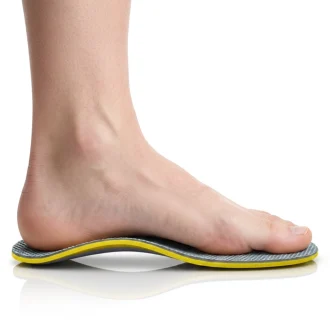
It does that in three ways. It fills the space under the arch so the band isn’t stretched as far with each step. It spreads pressure away from the point where the fascia anchors into the heel. And it holds the foot in a more supported position while you’re moving, so it rolls less with each step.
To be clear about one thing: this is support while you wear it, not a permanent change to how your foot is built. But that’s valuable in itself. If the hours when you’re on your feet are the hours when the strain accumulates, then supporting the foot during those hours puts the help exactly where it’s needed.
Ideally, you want that support to be easy. Something you put on without thinking, that doesn’t change your routine, and that you can wear during the parts of the day that really count.
How the gel arch support sleeve is designed to help
This is where the FootReviver gel arch support sleeve comes in. It’s a pair of slip-on sleeves, each with a shaped silicone gel pad that sits directly under the arch of your foot.
It’s a simple design. There’s nothing here that needs setting up, adjusting or getting used to. You slide it on, it sits under your arch, and the gel pad does the work.
The gel pad
The gel pad is the centrepiece. The silicone is soft enough to mould to the shape of your arch rather than sitting on top of it, but supportive enough to hold that shape while you’re standing and moving. Because it’s gel, it also absorbs some of the shock that would otherwise travel up through your foot with each step.
That’s why the pad is shaped the way it is. A rigid support holds your arch but does nothing to soften impact. A soft cushion absorbs impact but doesn’t hold the arch. The gel does both. For someone whose fascia is being over-stretched and taking repeated shock, that combination is the whole point.
Because the gel adapts rather than forcing your arch into one fixed shape, it works for different foot types. A flat foot needs something that fills the space under the arch and limits how far it drops. A high, rigid arch needs something that cushions underneath without pushing it higher. Since the pad moulds to your shape rather than imposing one, both get support that suits them.
When you stand on a hard floor, the pressure under your sole gathers in a few spots — most often under the heel and along the inner edge of the arch. That inner edge is where the fascia runs and anchors, so it’s the spot that stays irritated longest. The gel pad spreads the load across a wider section of the arch instead of letting it sit in one strip. A long shift on hard flooring is where you’d notice that most, and it’s usually felt as less pinpoint soreness under the arch by the end of the day.
How the sleeve stays in place
The sleeve wraps around the arch and the top of the foot rather than running the full length of the sole. That’s deliberate. The pad only works if it’s held firmly against the underside of the arch, and the wrap is what holds it there while you walk, stand on your feet at work, or climb stairs. Pull it down over the heel and the pad slides away from the spot it needs to sit on, so take a moment to position it properly when you put it on.
The fit is close and even across the arch and the top of the foot, firm enough to support the tissue underneath without squeezing it. Because the compression is steady rather than tight, it tends to feel settled on the foot rather than gripped.
The cuff is shaped to grip the foot gently and hold the sleeve in position, without pressing in or leaving a mark. A support that shifts during the day stops being useful, and if it bunches or rolls it can create new pressure points instead of relieving existing ones. Having it stay put means the pad stays where it needs to be when your weight comes down through the arch.
Through a long shift, when the foot has been bearing weight for hours, many people find that steady support under the arch is more comfortable than having nothing there at all. That’s the everyday value of it: a foot that feels steadier through the day, without changing anything about the shoes you already wear.
The fabric lets air move and draws moisture away from your skin rather than trapping it. Feet that stay dry are more comfortable, and you’re far more likely to keep wearing something through a full working day if it doesn’t leave your feet hot and clammy.
One size, stretch fit, for men and women. The sleeve stretches to fit, so there’s no sizing chart to work through and no guessing. It fits either foot, which means you don’t have to keep track of left and right.
Wearing them with or without shoes
You can wear the sleeves directly against your foot, underneath your socks, on top of your socks, inside your usual shoes, or around the house with nothing on your feet at all.
Many foot supports are tied to your shoes. They live in one pair of trainers or one set of work boots, and the moment you take those shoes off, the support goes with them. That leaves the barefoot hours completely uncovered. If your worst pain is those first steps in the morning, or padding around the house in the evening, then a support that only works inside a shoe misses some of the hardest moments of your day.
Because this one sits on the foot itself, it’s there for the walk to the bathroom first thing, for the evening on the kitchen tiles, and for your working day. You get support during the hours that cause you trouble, without changing anything about your routine.
Who tends to get on with them
The sleeve suits people whose arch needs help bearing weight, and whose symptoms follow the pattern described here. That often means a low or fallen arch that drops with each step, or a high, rigid one that can’t absorb the impact. It suits either.
A second group is anyone whose day is built around being upright. Long shifts spent standing on hard floors, or walking jobs on hard pavements, are the situations where load builds fastest and support counts for most.
If you’re already being seen by a GP, physiotherapist or podiatrist for plantar fasciitis, a sleeve like this can sit alongside whatever advice you’ve been given. It’s not a replacement for that, but it doesn’t conflict with it either.
Beyond plantar fasciitis and arch pain, some people with arthritis in the foot, varicose veins in the lower leg, or reduced circulation also find gentle support and compression helpful. If any of those apply to you, it’s sensible to raise it with your GP or podiatrist, who can tell you whether a compression sleeve is appropriate in your particular case.
How to wear them
Start simple, and build up.
Getting the position right
The sleeve sits directly against the skin of your foot, with the gel pad positioned underneath your arch. Slide it on so the pad is centred under the arch. Not off to one side, not pushed so far down that it bunches under the heel, and not pushed so far forward that it sits under the ball of your foot. Get that position right and it should feel immediately comfortable.
Snug means supportive but not restrictive. There should be a gentle, even hold across the arch and the top of the foot, with no pinching and no mark left behind when you take it off. If you can feel it digging in, or your toes start to tingle, feel numb or go pins and needles, that’s a sign it’s too tight. Take it off. Compression should never cause those sensations.
You can wear them on their own against the skin, under your usual socks, or over the top of thin socks if you prefer a layer between the fabric and your foot. They fit inside ordinary shoes, trainers and work boots without changing how your footwear fits, provided you’re not already wearing a very close-fitting pair.
Shoes and the sleeve
The sleeve works with whatever you’re already wearing, because it supports your foot rather than relying on the shoe to do it. It will feel most useful, though, in footwear that has some structure underfoot — a shoe with a bit of cushioning and a sole that doesn’t flex too easily. If your everyday pair has a very thin, flat sole with no support, the sleeve still helps, but it’s compensating for the shoe rather than working with it.
It’s worth giving that a moment’s thought when you choose what to put on. A shoe that already holds the arch a little and softens some of the impact gives the gel pad a steadier base to sit on, so the two are supporting your foot together rather than the sleeve doing all of it. Look for a sole that resists twisting in your hands and a firm panel around the back of the heel. Both are signs that the shoe is holding its own shape rather than collapsing under you. If a pair twists and folds with very little effort, the sleeve is carrying most of the work on its own, and it will feel less settled for it.
Building up wear
If you’re not used to having something supporting your arch, build up gradually. A few hours on the first day, then longer as it starts to feel natural. Some people wear them for the hours that hurt most, such as the morning routine or a long shift, and take them off for the rest of the day.
For first-step pain, put the sleeves on before you get out of bed. That way the support is already in place before you stand, rather than you starting the day unprotected and putting them on afterwards.
They’re designed for daytime wear, and most people find they’re not needed once they’re off their feet for the evening. If you’re wearing them for a long shift, take a few minutes without them when you can, so your skin gets a break.
Wash them by hand in cool water and let them air dry. Keep them away from a hot wash or a tumble dryer, which will shorten the life of the gel and the fabric. With reasonable care, they’ll hold their shape and their support for a good while.
Over time, the gel will start to lose its spring and the fabric will lose some of its stretch. The practical sign is that they stop feeling supportive. The pad flattens, or the sleeve no longer holds your arch the way it did at the start. That’s the point to replace them, rather than continuing with support that’s past its best.
What to expect
You may notice a difference fairly quickly in how your foot feels through the day. Many people find that the ache after a long shift is less pronounced, that standing on hard flooring is more tolerable, and that the first steps in the morning settle sooner. If that happens in the first week or two, that’s a good sign. It means you’ve taken some of the load off the tissue.
What you shouldn’t expect is for it to fix the problem overnight. Plantar fasciitis is a slow-healing condition — the tissue has a limited blood supply, and it can’t be rested completely while you keep walking on it. The sleeve doesn’t replace that healing process. What it does is reduce the strain going through the fascia while your body gets on with the repair, which gives the repair a better chance of keeping up.
Think in weeks rather than days. If you’ve been struggling for six months, the tissue has been in an irritated state for a long time. It will settle gradually rather than all at once.
The most useful thing you can do is be consistent. Support worn from time to time, whenever the pain is bad, gives you relief in bursts but doesn’t change the underlying strain. Support worn regularly during the hours you’re on your feet keeps the load off the fascia day after day, which is what lets the cycle break.
That cycle is the thing you’re trying to interrupt. Over-stretch, micro-damage, inflammation, pain, part-healing, over-stretch again. Each stage feeds the next. Break the cycle at the point where the over-stretching happens, by giving your arch support through the day, and the rest of the chain has a chance to settle down.
Expect good days and bad days along the way. That’s normal with this condition, and a bad morning after a heavy day on your feet doesn’t mean it isn’t working.
When to seek help
Support sleeves are a sensible, low-risk thing to try, but they’re not a substitute for proper assessment when something needs looking at.
Speak to your GP, a physiotherapist or a podiatrist if:
-
- the pain is severe, or it’s getting worse rather than settling
-
- you have persistent pain that hasn’t improved after several weeks of consistently supporting your foot
-
- you notice new or unexplained symptoms, such as swelling, redness, or changes in the skin or nails
-
- you have numbness, tingling or loss of sensation in your foot
-
- you have diabetes or reduced circulation in your feet, or any condition that affects how you feel sensation in your feet
-
- you’re unsure whether compression is appropriate for you
That last point covers more people than you’d expect. If you have circulation problems, or you’re managing a long-term condition that affects your feet, a clinician can tell you whether a compression sleeve is right for you and how long to wear it for.
A compression sleeve acts on the foot. It doesn’t treat or prevent blood clots, and it shouldn’t be relied on for that. If you have a history of clots, or you notice new swelling, warmth or a colour change in your leg that doesn’t settle, get clinical advice rather than managing it with a sleeve.
Most of the time, the answer will be that a support sleeve is a sensible thing to use alongside whatever else you’re doing. But if something doesn’t feel right, or the problem is shifting rather than settling, get it looked at.
Where to go from here
The pattern running through this page — worst first thing, better once you’re moving, back again after rest — is the one this support is aimed at. If it matches what you’re dealing with, you’ve got two realistic options. Carry on as you are and see whether it settles, or take a simple step to reduce the strain on the tissue while it heals.
Carrying on is a real choice, and plenty of people make it for a while. But the problem tends to shift over time rather than stay the same. The tissue takes more strain, the way you walk changes, and what started as a morning nuisance settles into something that’s there most of the day.
Doing something about it doesn’t have to be complicated. Support your arch during the hours you’re on your feet, keep it up consistently, and give the tissue the conditions it needs to repair. These sleeves are a small, practical way to do that, and they’re easy to work into whatever your day already looks like.
Take a moment to get the pad sitting properly under your arch when you first put them on, give them a fair run of a few weeks rather than judging them on a single shift, and if your symptoms are new, getting worse, or don’t follow the pattern described here, speak to your GP, a physiotherapist or a podiatrist before assuming a support sleeve is all you need.
Disclaimer
The information on this page is general guidance for adults in the UK. It isn’t a substitute for individual medical advice, diagnosis or treatment, and it can’t take account of your own history or circumstances.
If you’re unsure whether a compression sleeve is suitable for you, or your symptoms are new, unexplained, or more complex than the pattern described here, speak to a GP, a physiotherapist or a podiatrist for personalised advice.
No specific outcome is promised or guaranteed. How much a support sleeve helps varies from person to person.
1 Review For This Product
Fast & Secure Checkout Through Paypal
Pay with Paypal the secure payment gateway that accepts all credit and debit cards. Paypal is free and secure and no credit or bank information is ever stored or shared with us.
Fast Dispatch
Enjoy your items soon with quick dispatch via Royal Mail. Expect to have your items between 1-3 working days for domestic orders. 7-10 Working days for international orders.
Return Policy – 30 Day Money Back Guarantee
In the unlikely event, you are unhappy with your purchase you can return it within 30 days for a refund. Please contact us via the form on the contact us page to start your return.
To return an item please send it to: Nuova Health UK, 81 Highfield Lane, Waverley, Rotherham, S60 8AL. Please include a note with your order id so we know who to refund. Please retain your postage receipt as proof of postage. All that we ask is that the item is in the original packaging and unused.
by Josh
I’m a postal worker, and I have to be on my feet all day long. I got these socks because of my plantar fasciitis, and boy, they’ve been a game changer. They’re like a comforting hug for your feet and the gel pads, oh, it’s like walking on a cloud. They sure have made my rounds a lot more bearable!