
FootReviver™ Foot Drop Splint
£11.99inc VAT
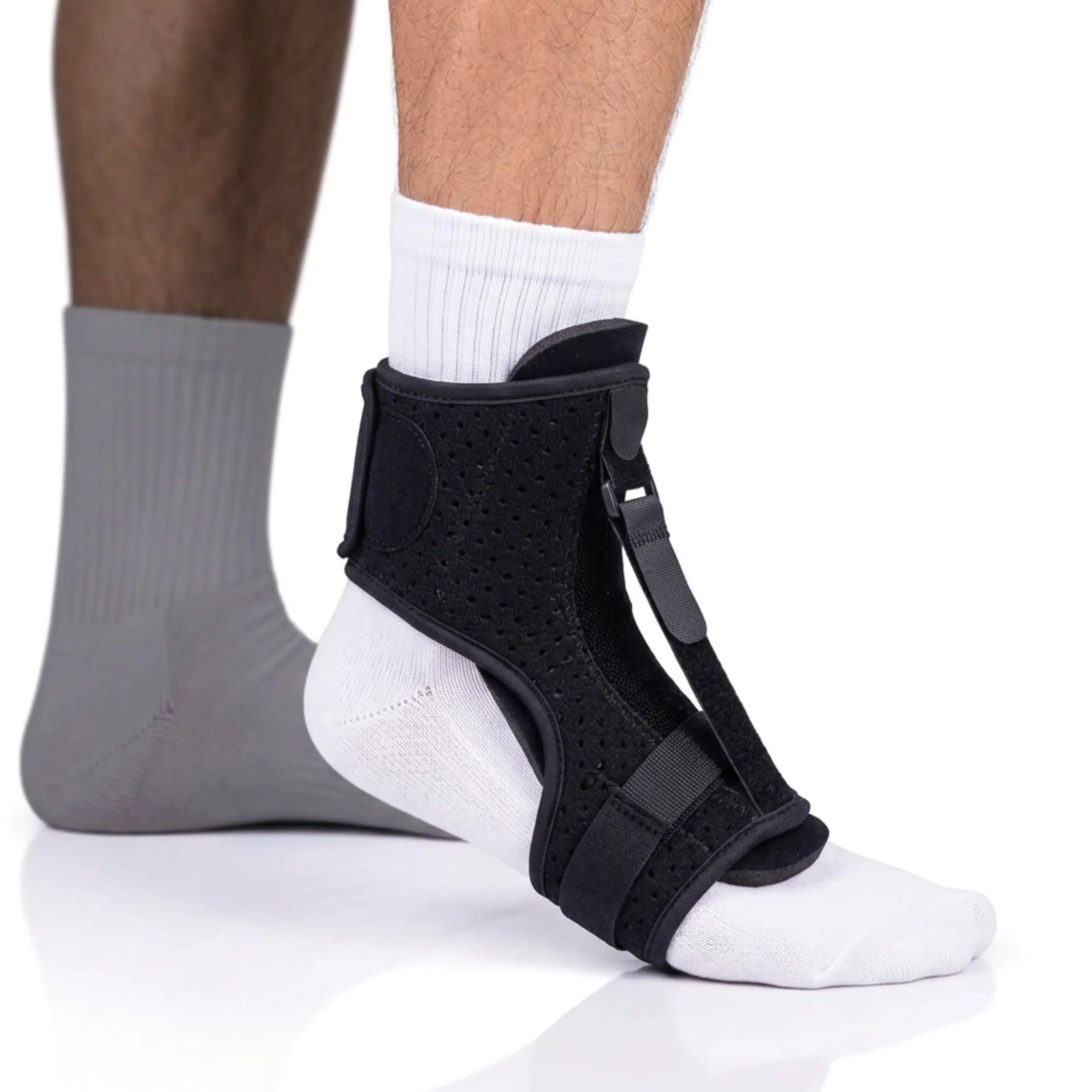
- A semi-rigid foot and ankle splint designed to help adults with foot drop.
- Intended to help keep the front of the foot from dropping too low during walking.
- May help improve toe clearance, reduce dragging, and make steps feel more controlled.
- Can also help reduce foot slapping by supporting the ankle in a better walking position.
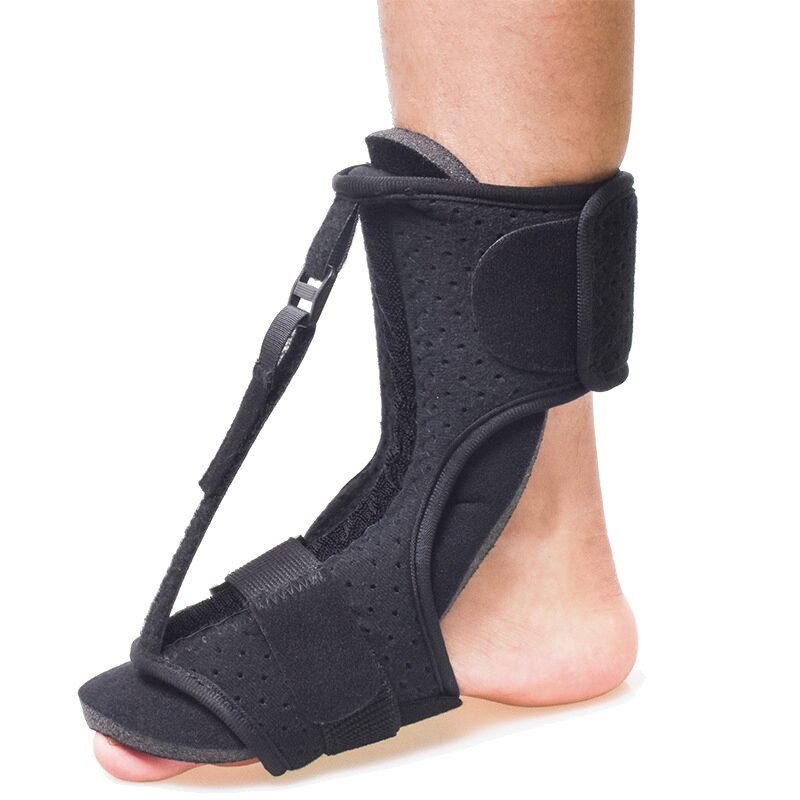
- Uses a bendable aluminium splint to help hold the foot closer to the chosen angle.
- An adjustable tension strap adds upward lift from the forefoot towards the front of the ankle.
- Forefoot and ankle wraps help keep the brace secure so the support stays more consistent as you move.
- The support sits over the top of the foot, where the lifting force needs to act.
- The open heel and open underside help avoid extra bulk under the foot.
- Made with perforated neoprene, soft padding, and a moisture-wicking lining for more manageable day-to-day wear.
- Can be worn with or without shoes, although roomier footwear is usually easier.
- Best suited to practical support for mild to moderate foot drop rather than as a cure for the underlying cause.
- Stop using it and review the fit if it feels too tight, causes rubbing, or becomes uncomfortable.
- If symptoms are new, unexplained, worsening, or still making walking feel unsafe, speak to a GP, physiotherapist, podiatrist, or another appropriate clinician.
When lifting the front of the foot becomes more difficult
If lifting the front of your foot has become harder, you may already have noticed how quickly it starts to affect ordinary walking. The toes catch the floor from time to time. The foot brushes the ground as the leg comes through. Sometimes it lands with a slap instead of lowering in a controlled way. These are common signs of foot drop, and they are often first noticed during everyday movement rather than anything out of the ordinary.
For many adults, the change is gradual. Walking simply begins to feel less dependable than it used to. You may slow down slightly, watch the ground more carefully, or find yourself thinking about each step in a way that never used to be necessary. That extra effort can become tiring. In many cases, it is not only the weakness in the foot that wears people down, but the repeated need to work around it.
Stairs, kerbs, uneven pavements, thresholds, and tighter indoor spaces often make the problem more obvious because the front of the foot needs to lift cleanly and clear the ground at the right moment. When that lift is reduced, people often begin to adapt without really noticing at first. You may raise the knee higher, swing the leg slightly outwards, or place the foot down more carefully to avoid catching the toes.
A foot drop splint is designed to help with that day-to-day walking difficulty. By helping hold the front of the foot in a more lifted position, it may reduce dragging, improve clearance, and make each step feel more secure and less awkward.
What is happening when the foot starts to drag
Foot drop affects dorsiflexion, which is the movement that lifts the front of the foot upwards at the ankle. In plain language, it is the movement that raises the toes enough to clear the ground as the leg swings forward during walking.
In a usual step, the muscles at the front of the lower leg lift the foot as the leg moves through, then control it again as it comes back down towards the floor. If those muscles are weak, or if the nerve signal to them is reduced or disrupted, the front of the foot can hang down instead of lifting properly. The result is straightforward: the toes are more likely to scrape, catch, or drag.
Strength is only part of the issue. Control matters just as much. The foot has to lift at the right moment in the step and then lower in a measured way ready for contact with the ground. If that control is reduced, the step can feel uneven or uncertain. One stride may feel acceptable, the next less steady. That is why people often describe the foot as floppy, awkward, or difficult to place rather than just weak.
Some people also notice that the foot drops down too quickly after the heel touches the ground. Instead of lowering gradually, it comes down abruptly and slaps. This usually reflects the same underlying problem: the muscles that should be lifting the front of the foot are also not controlling its descent properly.
Foot drop is not usually a diagnosis by itself. More often, it is a sign that something is affecting the muscles, the nerves supplying those muscles, or the wider control of movement needed to lift the foot during walking. Different causes can produce much the same walking difficulty.
What you may notice in day-to-day walking
Once foot drop starts to affect walking more regularly, the signs are usually practical ones. The front of the foot does not come through as cleanly. The toes are more likely to catch the floor. The foot may land less smoothly than it used to. Walking can begin to feel less automatic and less reliable.
For some adults, it is most noticeable when walking more quickly. For others, it becomes more obvious later in the day, when tiredness makes the foot harder to control. Uneven ground, stairs, rugs, door bars, and changes in floor level can all make the problem stand out more because they demand more accurate lift from the front of the foot and more precise placement when it lands.
This is often the point at which confidence begins to change. A step that would once have been automatic starts to need more attention. You may hesitate before stepping off a kerb, take stairs more carefully, or favour routes that feel more predictable underfoot. Those adjustments are understandable, but they also show how much extra thought the foot is starting to demand.
Some people also notice altered feeling in the foot or lower leg, such as numbness, tingling, or a duller sense of where the foot is in space, depending on the cause. When that happens, the difficulty is not only lifting the foot. Judging where it is and how it is moving can become harder as well.
Over time, this can affect more than the step itself. People may walk shorter distances, avoid certain situations, or feel less confident when out and about. The weakness may sit at the ankle and foot, but its effect often reaches further into routine daily movement.
Why support can help so much with walking
A foot drop splint supports the foot and ankle in a better position when the muscles that would normally lift the front of the foot are not doing enough on their own. Put simply, it helps stop the foot from hanging too far down during the part of the step where it needs to clear the ground.
This matters because reduced toe clearance is one of the main reasons walking becomes awkward. If the front of the foot starts the swing-through part of the step from a better angle, the toes are less likely to catch the floor. That can make ordinary movement easier, whether you are stepping over a threshold, walking on uneven ground, or turning in a tighter space.
Support can also reduce the need for tiring workarounds. If the foot is being held nearer a more useful position, there may be less need to lift the knee excessively, swing the leg outwards, or take an over-cautious step simply to get through cleanly. For many people, that means walking feels less effortful and takes less concentration.
It is still important to be realistic about what a splint does. It does not replace assessment of the underlying cause, and it does not correct every kind of weakness or neurological problem on its own. What it can do is help with the walking difficulty itself, which is often the part people notice most clearly from one day to the next.
What can cause foot drop
Foot drop can happen for several reasons. Most causes affect either the muscles that lift the foot, the nerves supplying those muscles, the nerve roots feeding into the leg, or the wider parts of the nervous system involved in organising movement. Although the cause may differ, the result during walking can look very similar.
One common cause is a problem affecting the peroneal nerve, which helps control the muscles that lift the foot and toes. If this nerve is compressed, irritated, or injured, those muscles may no longer work strongly enough or at the right time. Even a modest loss of lift can change walking noticeably because the toes only need to drop slightly before they begin to catch.
In other cases, the problem starts higher up, with a nerve root in the lower back affected before the signal reaches the lower leg. There are also wider neurological, nerve, and muscle conditions that can contribute, particularly where movement becomes weaker, less coordinated, or less dependable.
Foot drop may also appear after certain injuries or procedures involving the leg, hip, knee, or spine. Although the source varies, the effect on walking is often much the same. The foot does not come through cleanly, the toes catch more easily, and the person starts adapting the way they move.
This is why proper assessment still matters. A splint may help with walking, but similar symptoms can arise from quite different underlying problems, and that influences what wider treatment or rehabilitation may be needed.
Where this kind of support fits into wider care
The right approach depends on what is causing the foot drop. Some people may be advised to do exercises or have physiotherapy to work on strength, flexibility, movement control, and walking technique. Others may need assessment and treatment aimed more directly at a nerve, spinal, or neurological problem contributing to the weakness.
In some situations, support is only needed for a shorter period while recovery or rehabilitation continues. In others, it becomes part of longer-term day-to-day management. A foot drop splint fits into that wider picture as a practical aid that supports walking while the underlying cause is being explored, treated, or reviewed.
Its value is straightforward. It helps with the part of the problem people have to deal with most often: getting through ordinary walking with less dragging and less uncertainty. For some adults, that support also makes it easier to stay active enough to keep up with the rest of their rehabilitation or usual routine.
How the FootReviver splint helps during walking
Holding the front of the foot in a better walking position
The FootReviver foot drop splint is a semi-rigid foot and ankle support designed to help hold the front of the foot in a more lifted position during walking. A bendable aluminium splint is built into the upper part of the brace and helps hold the foot closer to the chosen angle, usually around a right angle to the lower leg. This means the front of the foot is less likely to point down as the leg swings through.
The brace also uses an adjustable tension strap with a buckle, running from the forefoot area up towards the front of the ankle and lower leg. This applies upward pull where it is needed most. The aluminium splint helps set the basic ankle position, while the tension strap adds adjustable lift through the front of the foot.
Together, these features are designed to help stop the front of the foot dropping too low during walking. For adults with mild to moderate foot drop, that may improve toe clearance and make the step feel cleaner and more predictable.
Why the top-mounted design makes practical sense
One of the more useful parts of the FootReviver design is where the support sits. The main brace body lies over the top of the foot and across the front of the ankle and lower leg, while the heel and underside of the foot remain open.
This makes sense for foot drop because the lifting force needs to act from above. The aim is to draw the forefoot upwards, not to place extra material under the sole. Leaving the underside open helps avoid unnecessary bulk under the foot, which can make the brace easier to tolerate when walking and more practical for day-to-day use.
It also leaves the heel free, so the brace is less likely to interfere with heel contact when the foot meets the ground. Just as importantly, the open-underfoot design allows the wrap sections to anchor the upper part of the brace more effectively. The support works from the top of the foot, while the underside stays clear.
This is one of the reasons the design stands out. It is arranged around the job the brace actually needs to do, rather than simply covering more of the foot than necessary.
Keeping the brace secure so the lift stays consistent
For a foot drop splint to work well, it has to stay in the right position while you move. The FootReviver uses a forefoot wrap, an ankle wrap, and a separate tension strap to do that. The forefoot wrap helps secure the lower part of the brace around the front of the foot, while the ankle wrap holds the upper section against the ankle and lower leg.
Because these wraps sit over the neoprene body, they help keep the main support structure in closer contact with the foot and ankle. That matters because a brace that shifts during walking often becomes less reliable. If the support moves, the lifting pull may no longer be directed where it needs to be, and the amount of toe lift can vary from one stride to the next.
The tension strap adds another level of adjustment. Its pull can be increased or reduced, so the amount of lift can be set more closely to what feels supportive without becoming too restrictive. The buckle also allows that strap to be disconnected when needed.
This adjustability is useful in practice because not everyone needs the same amount of assistance, and the foot does not always behave in exactly the same way at every time of day. A brace that can be set more precisely is often easier to live with than one fixed level of support.
Semi-rigid support without the feel of a full-shell brace
The FootReviver sits between a very soft sleeve and a larger, more cumbersome brace. Its semi-rigid structure gives it more lifting and positioning ability than a fabric support alone, but without turning it into a full heavy shell around the foot and ankle.
That balance matters. The brace needs enough structure to influence foot position during walking, but it also needs to feel practical enough for everyday use. Because the support is concentrated over the top of the foot and front of the ankle rather than enclosing the whole foot, it can guide the foot without fully boxing it in.
For adults with mild to moderate foot drop, that middle ground may be enough to make walking feel more manageable without the brace feeling excessively cumbersome. It gives more direction than a soft support, while remaining simpler and lighter than a larger boot-style option.
Made to feel more manageable through the day
Comfort matters because even a well-designed brace is only useful if you can wear it often enough for it to help. The FootReviver is made from lightweight neoprene with perforations to improve breathability, along with soft padding, a softer inner lining, and moisture-wicking fabric to help keep the area drier and more comfortable during regular use.
That lighter, padded build can reduce the sense of bulk around the foot and ankle, especially during repeated walking or longer periods on your feet. The perforations help limit heat build-up. Soft edging and low-profile seams are intended to reduce rubbing where the brace needs to sit securely.
This may sound like a smaller point, but it matters in day-to-day use. If a brace feels hot, awkward, or irritating, people usually stop wearing it. If it feels manageable, it is far more likely to be used at the times it is actually needed.
Using this support in day-to-day life
The FootReviver splint is designed to be practical enough for everyday use. Depending on your needs, it may be worn with or without shoes, which gives some flexibility across different settings and times of day. If you do wear it with shoes, roomier footwear is usually the better option because the brace does add some bulk.
Some people prefer to use it mainly for walking or at the times of day when the foot feels least reliable. Others may also wear it during rest if that feels comfortable for them. The key point is that it helps most when it is worn for the activities where dragging, catching, or poor control are most noticeable.
Because the fit can be adjusted around the foot and ankle, the support can be set so that it feels stable without feeling unnecessarily restrictive. In everyday terms, that may mean using it for outdoor walking, stairs, or later in the day when tiredness tends to make the foot less dependable.
What this splint may realistically help with
The main aim of a foot drop splint is to improve foot position and make walking easier to manage. Many people use this sort of support to help reduce dragging, improve toe clearance, and make steps feel steadier.
For some, the difference is noticeable quite quickly because the foot is being guided into a better position as soon as the splint is worn. For others, the benefit is less dramatic but still worthwhile. The foot feels less unruly, the step feels less awkward, and walking takes less concentration than it did before.
How much difference it makes depends on the cause of the foot drop, how marked the weakness is, how active you are, and how regularly the splint is used. It is best thought of as a practical support rather than a cure on its own.
Even so, that support can matter a great deal. Without it, many people carry on relying on tiring compensatory movements simply to get the foot through each step. Reducing some of that extra effort can make ordinary walking feel more manageable and less wearing.
Other existing foot and ankle problems it may also support
Although this splint is mainly intended for foot drop, some adults may also find it useful for certain other existing foot and ankle problems where extra support helps make movement feel more manageable. That includes plantar fasciitis, Achilles tendonitis, gout, and arthritis. In these cases, the benefit is not really about lifting a dropping forefoot. It is more about giving the foot and ankle a steadier, more supported position when irritated tissues or joints are making ordinary walking less comfortable.
With plantar fasciitis, the painful structure is usually the thick band under the sole that runs through the arch towards the heel. With Achilles tendonitis, the sore area is the tendon at the back of the ankle that connects the calf muscles to the heel. These are different structures, but both can become more troublesome when repeated walking keeps pulling on them or loading them through the same uncomfortable range. By helping hold the foot and ankle in a more controlled position, a splint like this may reduce some of that repeated strain and make day-to-day movement easier to tolerate. It is not a direct treatment for either condition, but it may still be a useful support measure in some cases.
With gout or arthritis, the issue is often more about joint pain, stiffness, and sensitivity in the foot or ankle. When those joints are already irritated, even normal walking can feel awkward because each step asks the foot to bend, accept weight, and stay stable at the same time. Extra support may help by making the foot feel more settled and by limiting some of the movement that tends to aggravate sore joints. This is still a secondary role rather than the main purpose of the splint, but it helps explain why the same design may also suit some people whose main difficulty is not weakness, but pain and sensitivity around the foot or ankle.
When it is worth getting professional advice
If you are experiencing symptoms of foot drop, are unsure what may be causing them, or do not know whether this type of splint is suitable for you, it is sensible to speak to a healthcare professional. A GP, physiotherapist, podiatrist, or another appropriate clinician can help assess the cause and advise on the most suitable approach for your situation.
This matters especially if the symptoms are new, unexplained, getting worse, or making it difficult to walk safely even with support. If you notice spreading numbness, increasing weakness, or other new unexplained symptoms that do not settle, it is worth getting checked rather than relying on a splint alone.
If the splint feels too tight, causes rubbing, or becomes uncomfortable, stop using it and review the fit. If you are wearing it with shoes, roomier footwear is often a better option than tighter footwear.
A splint can help support walking, but it does not replace proper assessment of why the foot is dropping in the first place.
A practical option for more settled walking
Foot drop can make walking feel awkward and uncertain because the front of the foot is not lifting clearly enough to get through the step in the usual way. The FootReviver foot drop splint is designed to support that specific problem by helping hold the foot in a more lifted position during movement.
Its semi-rigid aluminium splint, adjustable tension strap, and secure wrap design work together to support the foot closer to a more useful walking angle. The top-mounted design and open underside help keep that support practical by avoiding unnecessary bulk under the foot.
If you are looking for a straightforward, non-invasive way to support the foot and make walking easier to manage, this splint may be worth considering. It is most likely to suit adults who want day-to-day help with mild to moderate foot drop, especially where toe dragging and poor foot lift are making walking feel less reliable. If you are unsure whether it fits your situation, it is sensible to check the fit guidance and speak to a GP, physiotherapist, podiatrist, or another appropriate clinician before relying on it as your main support.
Disclaimer
This page gives general information about foot drop and how a splint of this type may help with walking. It does not diagnose the cause of your symptoms or replace individual medical assessment, advice, or treatment. Foot drop can happen for different reasons and can vary in severity, so this kind of support will not be right for everyone. If you are unsure what is affecting your foot, or whether this splint is appropriate for you, speak to a GP, physiotherapist, podiatrist, or another appropriate clinician. No specific outcome can be guaranteed.
Fast & Secure Checkout Through Paypal
Pay with Paypal the secure payment gateway that accepts all credit and debit cards. Paypal is free and secure and no credit or bank information is ever stored or shared with us.
Fast Dispatch
Enjoy your items soon with quick dispatch via Royal Mail. Expect to have your items between 1-3 working days for domestic orders. 7-10 Working days for international orders.
Return Policy – 30 Day Money Back Guarantee
In the unlikely event, you are unhappy with your purchase you can return it within 30 days for a refund. Please contact us via the form on the contact us page to start your return.
To return an item please send it to: Nuova Health UK, 81 Highfield Lane, Waverley, Rotherham, S60 8AL. Please include a note with your order id so we know who to refund. Please retain your postage receipt as proof of postage. All that we ask is that the item is in the original packaging and unused.
Reviews
There are no reviews yet.