
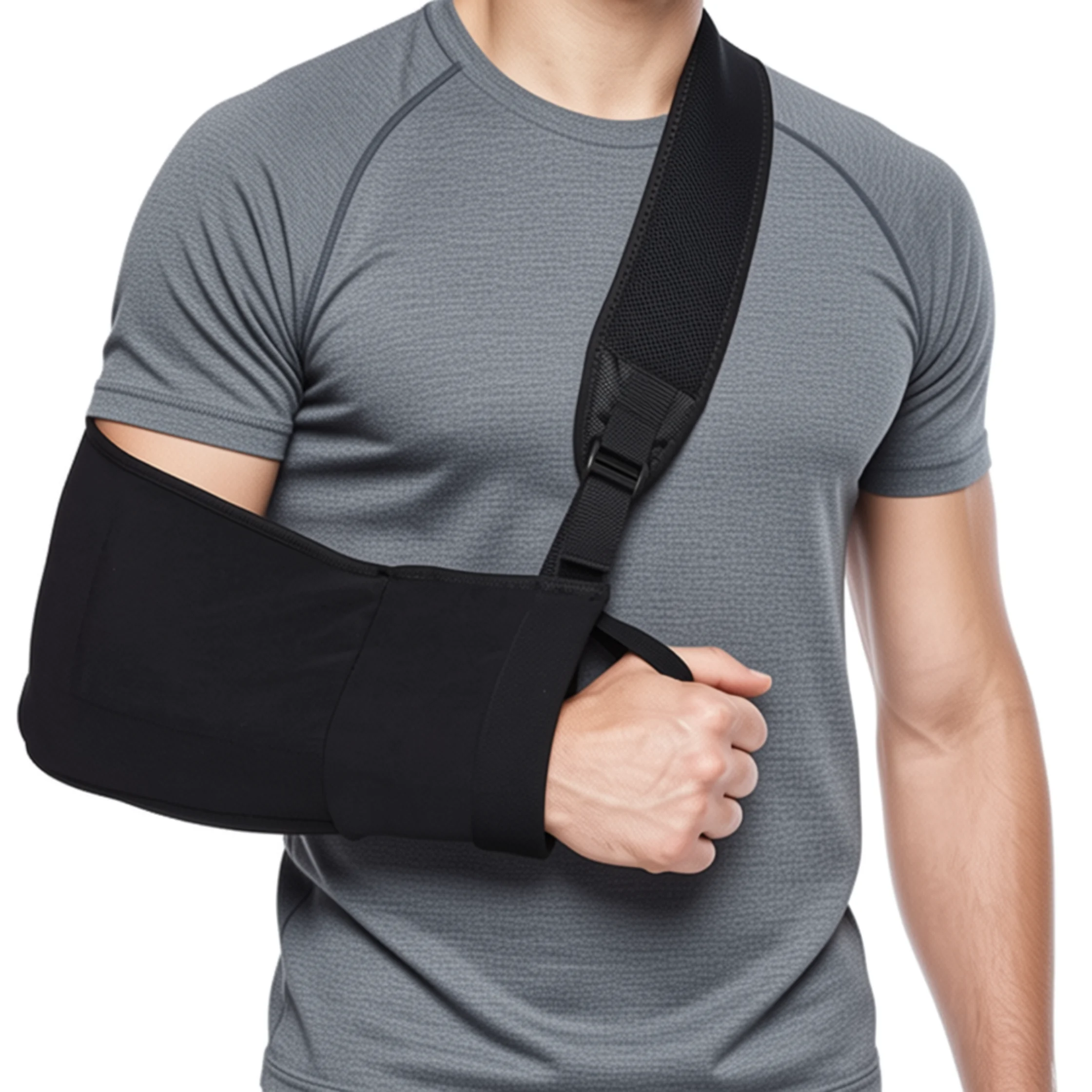
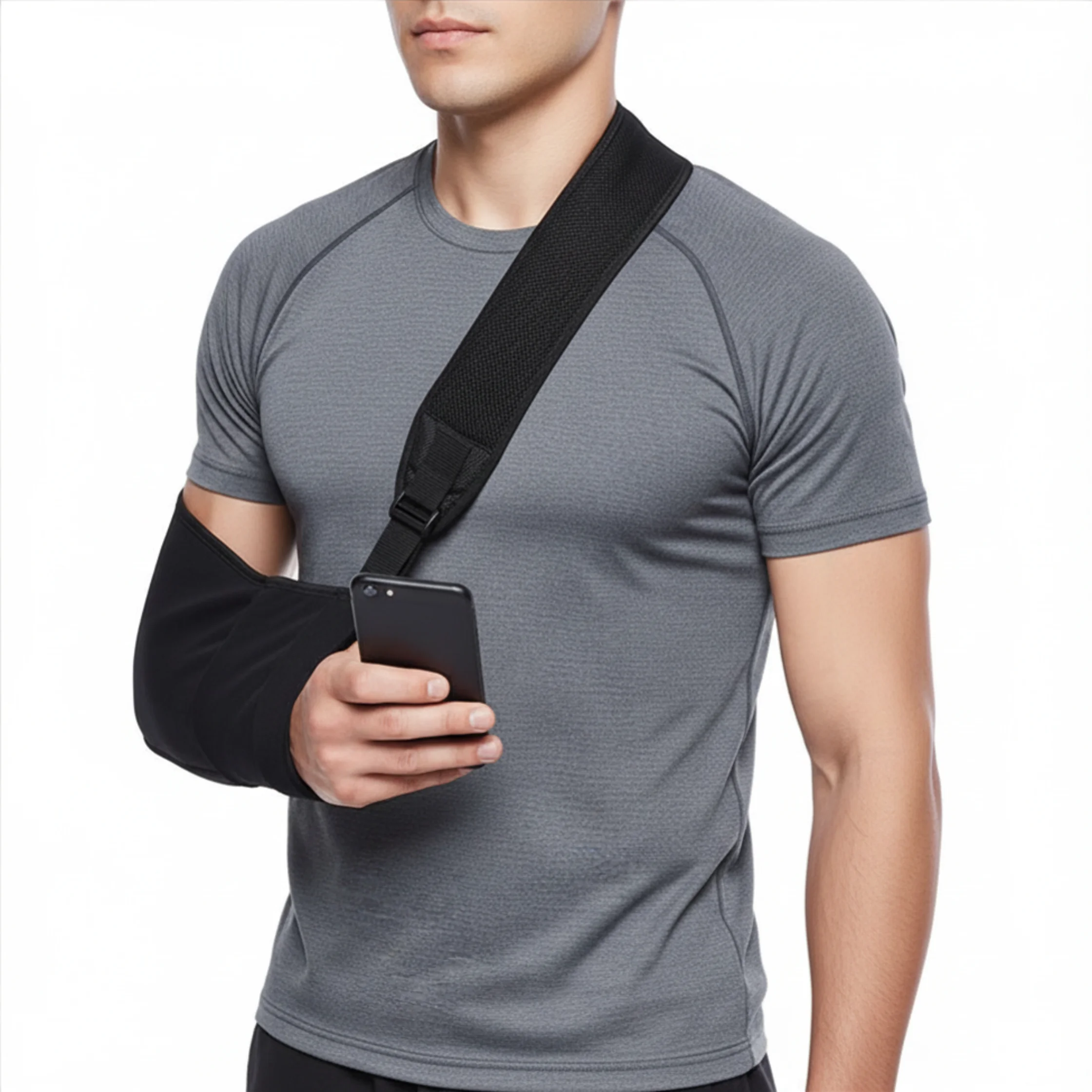
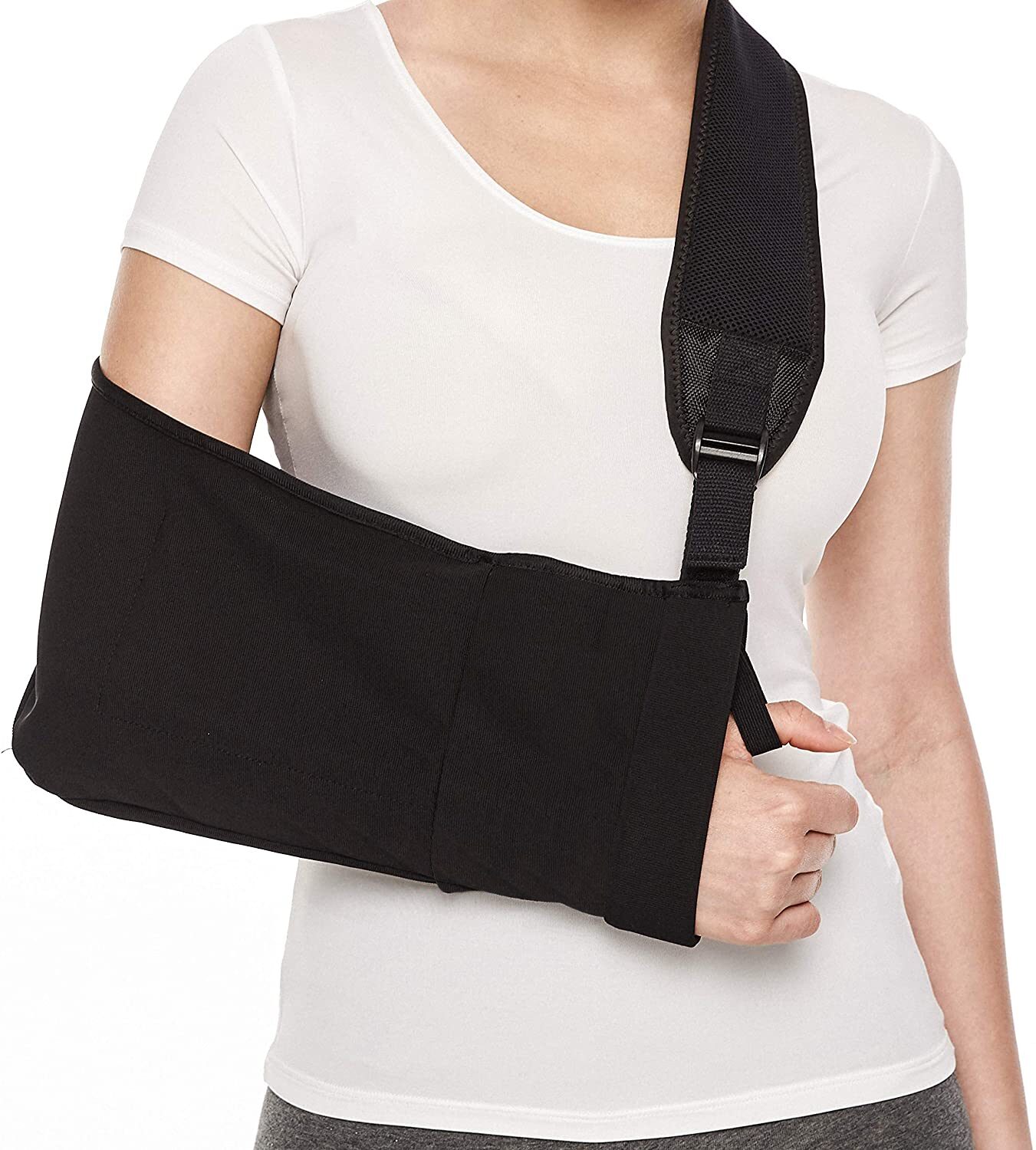
Arm Sling
£9.99inc VAT
- Takes the weight off your shoulder – supports your arm so injured tissues can rest and heal without constant strain
- Fully adjustable throughout recovery – one-handed buckle control; adapt as swelling changes or injury heals
- Comfortable for extended wear – lightweight, breathable fabric with padded shoulder strap distributes weight evenly
- Versatile injury support – rotator cuff tears, shoulder dislocations, collarbone fractures, post-cast recovery, elbow and wrist sprains
- Smart immobilisation – restricts risky movements while allowing safe hand and finger use to prevent stiffness
- 30-day money-back guarantee – return for full refund if it doesn’t meet your needs
After a shoulder injury, the world shrinks
You find this out quickly — often within the first day. You wake up in the night, turn over, and a bolt of pain jolts you wide awake. You try to pull on a jacket, and something deep inside your shoulder catches and stops you. You go to pour a kettle, and your arm feels like it’s made of lead. Every small movement becomes a negotiation. You start planning how to get dressed, how to open a door, how to sit down without jostling the arm. And all the while, your body is telling you to stop, to hold still, to protect whatever is torn or broken or inflamed.
The exhaustion that follows isn’t just physical. It’s the mental drain of having to think about every single thing you do. Supporting your own arm all day — because leaving it hanging feels wrong, feels painful, feels heavy — becomes a constant, unseen effort. Your shoulder muscles tense up to keep the arm from dangling. You hold your elbow with your other hand whenever you walk. You arrange cushions around yourself at night, trying to find a position that doesn’t hurt. That effort wears you down just as much as the injury itself.
Here’s the thing about that nighttime struggle: it’s often the accumulated result of a long day of your arm hanging, pulling, and working against gravity. Every hour of that constant strain adds up, and by night-time your shoulder is already sore and exhausted — which is why it’s so hard to settle.
That’s why an arm sling isn’t just a piece of fabric. It’s a way to put the weight down during the day. By supporting your arm when you’re up and about, the sling stops that daily wear and tear from building up. Less strain during the day usually means less pain and restlessness at night.
But — and this is important — you do not wear this sling to bed. The strap can tangle during sleep and become a strangulation risk, and keeping your arm perfectly still for hours also raises the risk of blood clots. Instead, you support your arm at night with pillows, arranged in a comfortable neutral position. Use the sling during the day for protection, and use pillows at night for support.
This adjustable arm sling is designed for people recovering from shoulder injuries, rotator cuff tears, dislocations, collarbone fractures, post-cast recovery, and elbow or wrist sprains. It supports the arm in a comfortable, protected position. It limits the movements that are most likely to re-injure healing tissue. It gives your shoulder, arm, or wrist the rest it needs to recover — whether you’re in the first painful days after an acute injury, or you’re managing a chronic condition that flares up from time to time.
If you’ve just been injured, you probably feel fragile and anxious. You don’t know what you’re allowed to do, what will make things worse, or how long it will take to get better. This sling won’t answer all of those questions. But it will give you something you need right now: a way to stop having to hold your own arm up, to stop worrying about every twitch of movement, and to give your body a chance to do what it does best.
Why Immobilisation Helps — The Science Made Simple
When you injure your shoulder, arm, elbow, or wrist, your body responds with inflammation. That’s the swelling, heat, pain, and stiffness you feel in the first few days. Inflammation is a necessary part of healing — it’s your body sending blood and nutrients to the damaged area, clearing away dead cells, and beginning the repair process. But inflammation also makes tissues fragile. The area is swollen, the fibres are damaged, and the tissue has less strength than normal.
If you keep using the injured area in the same way as before, you’re continually re-injuring it. Each stretch of the damaged tissue causes more micro-tears, more inflammation, more pain. The healing process keeps getting interrupted, and the injury can drag on for months. That’s why you need rest and protection early on.
But rest isn’t just about sitting still. It’s about removing the specific forces that damage the healing tissue. And one of the biggest forces on your shoulder and arm is gravity.
When your arm hangs at your side, gravity pulls it down. That pull goes through the shoulder joint into the muscles and tendons around it. The rotator cuff — a group of four muscles and tendons that surround your shoulder joint — has to work continuously just to keep your arm from pulling away from the socket. If one of those tendons is torn or inflamed, every second of that continuous contraction pulls on the damaged fibres. Your shoulder muscles are effectively working non-stop, as if you were holding a weight — except the weight is your own arm. A typical arm weighs around 4 to 6 kilograms, and you feel every gram of that when your shoulder is injured. That’s the last thing an injured shoulder needs.
Think about it this way: if you sprain your ankle, you don’t keep standing on it all day. You sit down, elevate it, and take the weight off. But with an injured arm, there’s no obvious way to take the weight off unless you hold it with your other hand — which you can’t do all day. That’s where a sling comes in. It supports your forearm, keeps your elbow bent, and lets the injured muscles and tendons rest in a protected position. The relief is often immediate: the deep ache from holding your own arm up fades, and the pain settles.
A sling also stops you from making the movements that stretch injured tissue — reaching overhead, lifting your arm out to the side, rotating your shoulder outward. These are exactly the movements that can re-tear or further strain healing tendons and ligaments. When your arm is in a sling, those movements are physically out of reach, which is especially valuable in the first few weeks when you’re tired, distracted, or not thinking about how you move.
At the same time, the sling doesn’t immobilise everything. Your hand and fingers stay mobile, which helps keep circulation moving and prevents stiffness. A good sling supports without being restrictive.
It’s also worth being clear about what a sling doesn’t do. It doesn’t speed up bone or tendon healing. It doesn’t make torn tissue grow back faster. It doesn’t realign a fracture. What it does is let your body heal without the extra strain. By removing the constant pull, limiting risky movements, and allowing your arm to rest, the sling lets your natural healing processes work at their own pace.
What This Sling Does — A Quick Overview
Put simply, this arm sling does three things.
First, it holds your arm where it should be — with your hand resting slightly higher than your elbow, and your elbow bent at a comfortable angle. That position removes the tug of gravity from injured tissues, so your shoulder muscles don’t have to work constantly to keep your arm from hanging.
Second, it limits the risky movements that commonly slow healing — the ones we described above. The sling naturally keeps you from reaching overhead, lifting your arm out to the side, or rotating your shoulder outward, so you can’t accidentally set your recovery back.
Third, it carries your arm’s weight for you. Your arm is heavier than you think — typically 4 to 6 kilograms for an adult — and when it hangs unsupported, gravity stretches the muscles, tendons, and ligaments around your shoulder. By cradling your forearm and transferring the load to your opposite shoulder through the padded strap, the sling removes that constant downward pull. For most people, the pain eases the moment the sling takes over — because you’re no longer working against gravity.
This sling is suitable for a wide range of injuries and situations:
- Rotator cuff tears and strains
- Shoulder dislocations
- Collarbone fractures
- Post-cast recovery after arm or wrist fractures
- Elbow injuries such as tennis elbow, golfer’s elbow, and sprains
- Wrist sprains and carpal tunnel support
You might wear it all day in the early stages after an acute injury, then gradually reduce how much you rely on it as you heal. Or you might use it only when you need it — for a trip to the supermarket, on public transport, or during a flare-up of a longer-term condition. The sling is there to be used as your body tells you, not as a rigid schedule.
And if it doesn’t give you the comfort and support you need, you’re covered by a 30-day money-back guarantee. You can return it for a full refund, no questions asked.
Key Features
Here are the features that matter when you’re wearing a sling for days or weeks. This is a quick reference. The section after this goes into what each feature actually feels like in daily use.
- Adjustable buckle — Fine-tune how high your arm sits and how snugly the sling holds it. Swelling changes through the day, and the buckle lets you keep pace with those changes. It locks securely, releases easily, and can be operated one-handed.
- Padded shoulder strap — Your opposite shoulder is going to carry the weight of your injured arm. The padding spreads that load across a wider area, so you don’t develop a new pressure point on your other shoulder.
- Breathable, lightweight fabric — Keeps air moving around your arm and pulls moisture away from your skin. This matters more than you’d think when you’re wearing the sling for hours at a time.
- Thumb loop — Anchors your hand inside the cradle so it doesn’t slide forward. It also keeps your wrist in a neutral, comfortable position — useful if you’re also dealing with wrist discomfort.
- Reinforced stitching — The stress points are reinforced so the sling holds up through weeks of daily wear and repeated washing.
- Simple to put on and remove — No confusing straps or complicated clips. You slide your arm in, pull the strap over your opposite shoulder, and adjust the buckle. It takes seconds, even with one hand.
How This Sling Works — The Experience in Daily Use
You’ve read the feature list. Now here’s what it actually feels like to wear the sling for a full day — and what each feature does for you when you aren’t thinking about it.
Putting It On
The first time you put the sling on, you’ll probably be sitting down. That’s a good way to start. Sit in a comfortable chair, take a breath, and place your injured arm into the fabric cradle. The cradle is shaped to hold your forearm from elbow to wrist, with enough room for your arm to rest naturally. Your elbow should be bent at roughly 90 degrees, so your forearm sits across your body.
Slide your thumb through the thumb loop. It should sit around the base of your thumb — not tightly, but firmly enough to anchor your hand in place. This stops your hand from sliding out of the sling as you move, and it keeps your wrist in a neutral, comfortable line.
Now bring the padded strap over your opposite shoulder. The strap should lie flat across the back of that shoulder, not on your neck. Adjust the buckle at the front — it sits near your chest, so you can reach it easily with your other hand. Pull the strap until your forearm sits level or with your hand slightly higher than your elbow. You’ll feel the weight lifting off your shoulder. That’s when it feels right.
A well-fitted sling feels snug but not tight. You should sense that your arm is supported, but you shouldn’t feel pressure points or numbness anywhere. Your fingers should be free to wiggle and move. If they start to tingle, the sling is too tight or your arm is hanging too low. Loosen it and try again.
Adjusting to Changing Swelling
Your arm will change size over the course of a day, especially early on. The sling that felt perfect in the morning may feel restrictive by mid-afternoon, as inflammation builds and your arm swells slightly. By evening, when you’re tired and fluid has pooled, it may feel different again.
So expect to adjust the sling through the day. Loosen it slightly if your arm feels squeezed. Tighten it if your arm feels like it’s drooping. This is normal, and the more you adjust, the more comfortable you’ll be. You’ll be tempted to set it once and forget about it — don’t. Let the sling move with your body, and your body will thank you.
One thing that makes this easier is the buckle. It locks firmly in place once you set it, so you don’t have to re-tighten it constantly. But when you want to release it, it opens cleanly — even one-handed. That means you can fine-tune the fit whenever you need to, and it won’t slide loose on its own. No more fighting with a sling that gradually droops an inch every hour.
You might wonder, “How high should my arm sit?” The position you’re aiming for is the same as we described earlier — with your hand resting a little higher than your elbow. That’s the position that most effectively reduces swelling in your hand and wrist, because fluid can drain back toward your body. If your hand hangs below your elbow, you’ll notice a puffy, uncomfortable feeling in your fingers by the afternoon. Lift the sling up a bit, and that sensation will settle.
The Thumb Loop — A Small Anchor
At first glance, the thumb loop might look like a minor detail. But after a day of wearing the sling, you’ll appreciate it more than you expected. Without the loop, your hand has a tendency to slide forward. You’ll find yourself unconsciously pulling it back into place again and again. That motion uses energy and creates tension in your hand and wrist — the opposite of what you need during recovery.
The loop anchors your hand, so you can relax your arm fully. Your fingers stay relaxed, your wrist stays neutral, and your arm stays exactly where it should be. This is especially helpful if you’re managing a wrist sprain or carpal tunnel symptoms alongside your shoulder or arm injury. The loop keeps your wrist in that comfortable, protected line, so you’re not constantly bending it into uncomfortable positions.
The Padded Strap — Saving Your Uninjured Shoulder
Your opposite shoulder is about to become the hardest-working part of your body. It’s carrying the weight of your injured arm all day, every day. Without padding, that weight would press into a narrow strip of flesh and bone. You’d develop a red mark, then a sore spot, then a deep ache that spreads up your neck and down your back. By the second week, you’d be just as uncomfortable on your uninjured side as on your injured side.
The padded strap prevents that. It spreads your arm’s weight across a wider area of your shoulder and back, so no single point bears the entire load. The padding is firm enough to provide real cushioning, but not so soft that it bunches or shifts. You’ll notice it most at the end of a long day, when your shoulder still feels fine — and you realise that’s because the padding was working quietly.
Staying Comfortable During Extended Wear
When you wear a sling for hours at a time, fabric matters far more than you might think. Non-breathable materials trap heat and moisture. Your arm gets clammy, your skin gets sticky, and eventually you feel like you’re wrapped in plastic. That’s not just uncomfortable — it can cause rashes, itching, and irritation.
The lightweight, breathable fabric in this sling allows air to circulate around your arm. It wicks moisture away from your skin, drawing sweat to the surface where it can evaporate. This keeps you drier and cooler, which reduces the risk of skin problems and makes long days far more bearable. The fabric is also durable enough to handle daily wear and repeated washing — you can refresh the sling whenever it needs it.
Built to Last
A sling gets pulled, adjusted, and worn for hours every day. Over time, the stress points — where the strap meets the cradle, around the buckle, and at the thumb loop — are exactly where cheaper slings start to tear. This sling reinforces those areas with double stitching, so it holds up through weeks of constant use. It’s made to support you for the whole length of your recovery, not to fall apart halfway through.
What Recovery Looks Like — A Realistic Timeline
Healing takes time — more time than most people expect. It also doesn’t follow a straight line. Some days you’ll feel dramatically better, and the next day a small movement will remind you that you’re still injured. That’s expected. Don’t let it discourage you.
Here’s a general sense of how recovery progresses, so you know what lies ahead and can plan accordingly.
The Acute Phase — The First Few Days
The first few days after an injury can be the toughest. Inflammation is at its peak. Swelling is building. Pain is sharp and constant. You’ll probably wear the sling all day, taking it off only to shower, to get dressed, or to do any gentle exercises your clinician has advised.
You might notice that your pain settles as soon as the sling is on. That’s because your shoulder muscles are finally getting rest instead of constantly working. The dull ache you felt when your arm was hanging free should fade. You may still get sharp pains with accidental movements, especially at night when you shift in your sleep. That’s frustrating, but it’s part of the process.
Ice can help during this phase. Apply it for 15 to 20 minutes at a time, several times a day, wrapped in a cloth — never directly on the skin. Your GP may also recommend pain relief medication. Follow their guidance on what’s appropriate for your injury.
The Settling Phase — Weeks Two to Four
As inflammation settles, the sharp pain starts to fade. You’ll still wear the sling for most of the day, but it won’t feel quite so restrictive. You might start to feel comfortable taking it off for short periods at home — perhaps while sitting at a desk, eating a meal, or doing an activity where your arm won’t be moving much.
This is when your physiotherapist will typically introduce gentle movement exercises. They help prevent stiffness, because a joint that stays completely still for too long will start to freeze. You’ll take the sling off for these exercises, then put it back on afterwards. It can feel strange to move a part of your body that has been protected, but the movement is essential.
During this phase, you might also start removing the sling for short, safe stretches around the house. Trust your body — if an activity makes your arm ache, put the sling back on. If it feels fine, you can gradually extend those sling-free periods.
The Strengthening Phase — Weeks Four to Eight
By this stage, pain has usually settled into a more manageable level. You might still have discomfort with certain movements or at the end of a busy day, but the constant, sharp pain is gone. Your physiotherapist will progress you to strengthening exercises. These start with very light resistance and gradually increase the load, so your healing tissues can handle more force without becoming painful or inflamed.
You’ll be wearing the sling less and less during this phase. Maybe you put it on for a few hours in the morning, take it off during quiet times at home, and put it back on when you go out somewhere crowded or if your arm feels tired. The exact pattern depends on your injury and how well you’re healing.
For collarbone fractures, you’re often out of the sling entirely by six to eight weeks. Rotator cuff tears and shoulder dislocations may take longer, and you might keep using the sling in high-risk situations — like busy streets or public transport — for a few more months.
Weaning Off the Sling
The transition away from a sling is gradual. You’ll remove it for longer stretches — first an hour, then two, then a full morning. Your arm will feel heavy and achy when you’ve used it more than it’s ready for. That’s your body telling you to put the sling back on and rest. Listen to it.
Often, you’ll stop wearing the sling at home but keep it for trips out. A jostle from a stranger or a bump against a doorway can set you back, and the sling provides a visible reminder to others to be careful. Eventually, you’ll feel confident enough to leave it at home altogether.
Resist the urge to stop too suddenly — that can lead to a setback. But don’t stay in it too long either, because muscles will weaken and joints will stiffen. The goal is to find the right balance for your specific injury, guided by your physiotherapist.
Returning to Normal Activity
Full recovery — meaning you can return to all your regular activities without pain — takes months for many injuries. Rotator cuff tears and shoulder dislocations often take three to six months. Collarbone fractures can take three to six months for the bone to regain full strength, even though you’re out of the sling much earlier. Elbow and wrist injuries often recover more quickly, but chronic conditions like tennis elbow can take months of consistent physiotherapy.
During this time, the sling may become a support you only reach for during flare-ups, if at all. Your physiotherapist will guide your rehabilitation with exercises that slowly rebuild strength, mobility, and confidence. The sling supports the early part of recovery, but it’s the active rehabilitation — the exercises, the gradual return to normal movement — that ultimately restores your function.
Condition-Specific Guidance
Now let’s talk about your specific injury. Each condition has its own pattern of pain, its own healing timeline, and its own way of responding to the sling. For each one, keep in mind the general mechanism from earlier: the sling keeps your arm from pulling on injured tissue and prevents the risky movements that slow healing. Here’s what matters for your particular situation.
Rotator Cuff Tears and Strains
Your rotator cuff is a group of four muscles and their tendons that wrap around your shoulder joint, holding the ball of your upper arm in the shallow socket. These muscles are responsible for lifting your arm, rotating it, and keeping the joint stable while you move. When one of these tendons tears or becomes inflamed, simple movements like reaching for a cup or brushing your hair can become agonising.
The pain sits deep in your shoulder, often on the top or outer side. It’s there all the time — a constant dull ache that sharpens when you lift your arm, reach behind your back, or roll onto the affected side at night. Putting on a coat becomes a matter of strategy. Reaching for a high shelf can feel impossible. Your arm can feel weak and heavy, as if it’s barely staying in its socket.
For this injury, the sling is your most valuable support in the early weeks. It holds your arm in a position where the torn tendon isn’t being stretched by gravity. That means quicker relief and a better chance for healing. You’ll likely wear it most of the day during this initial period, removing it only for washing, dressing, and gentle pendulum exercises or range-of-motion work your physiotherapist prescribes.
As pain settles, you’ll start reducing how much you rely on it. You may keep using it in crowded places, on the bus, or during flare-ups. If you have a complete tear or significant weakness, your clinician might discuss surgery. The sling will still be essential after surgery — it protects the repaired tendon while it heals.
Shoulder Dislocations
There is nothing quite like the feeling of your shoulder popping out of joint. It’s a deep, visceral pain, and the arm hangs uselessly. Fortunately, most dislocations are relocated quickly in emergency care. But the injury isn’t just the moment of dislocation. The ligaments and the joint capsule — the thick fibrous sleeve that holds the shoulder together — are stretched and torn. After the joint is popped back in, those tissues are fragile and vulnerable.
For weeks afterwards, you’ll feel a constant sense of instability. Your shoulder feels untrustworthy. Certain positions — reaching out to the side, rotating your arm outward, lifting your arm overhead — feel risky. You instinctively pull your arm back to your body. That wariness is protective, but it’s not enough on its own.
The sling provides the extra layer of protection your shoulder needs. It holds your arm across your chest, in a stable position, so the healing ligaments aren’t stretched. It prevents the movements that could pull the ball of the joint back out of the socket. And it stops you from doing things by reflex — reaching for a falling object, catching something before it drops — until the pain reminds you to be careful.
Typically, you’ll wear the sling for two to three weeks after a first-time dislocation. You’ll remove it for washing, dressing, and gentle exercises to keep the shoulder mobile. After that, you’ll gradually reduce use, but you may keep wearing it in situations where your arm could be jostled — busy streets, public transport, crowded shops.
A shoulder that has dislocated once is more vulnerable to dislocating again, especially in the first year. Raising your arm above shoulder height or moving it suddenly in an awkward direction can risk another injury. The sling helps during the early healing phase, but the real long-term protection comes from strengthening your shoulder muscles through physiotherapy.
Collarbone Fractures
A broken collarbone is a very distinctive injury. There’s sharp pain right along the bone, often with a visible bump or step where the two sides have shifted. Your shoulder on that side may droop, and you’ll instinctively hold your arm with your other hand to protect the fracture from jostling.
Inside, your collarbone is the strut between your shoulder blade and your breastbone. When it breaks, the outer fragment — the piece attached to your shoulder — is pulled downward by the weight of your arm. The inner fragment, attached to your breastbone, can be pulled upward by the muscles in your neck. If the two ends separate too far, the bone can’t knit back together as well.
Here, the sling works by stopping that downward pull. Supporting your arm removes much of the force on the broken bone, allowing the ends to stay in a reasonable position and reducing pain with movement. The sling also keeps your arm from swinging as you walk, which would otherwise jar the fracture.
Most collarbone fractures are treated without surgery. You’ll wear the sling for most of the day for three to six weeks. The pain generally settles as the initial inflammation calms, and by two weeks you’ll feel a significant difference. You’ll need follow-up X-rays to confirm the bone is healing in good alignment.
A common worry is the visible bump that forms over the fracture site. This is callus — the extra bone your body lays down to bridge the fracture. It may feel like a hard lump in the early weeks, but it usually smooths out over time, though a small bump may remain. This is a normal part of healing and doesn’t affect strength or function.
If you notice the bone shifting more obviously, a significant increase in pain, or numbness in your hand or fingers, contact your fracture clinic. Some collarbone fractures — those that are badly displaced, shortened, or involving the joint ends — may need surgery to hold the bone in alignment.
Post-Cast Support — After an Arm or Wrist Fracture
The day your cast comes off is a strange mix of relief and vulnerability. Your arm is finally free, but it feels nothing like your arm. The skin is pale and dry. The muscles look soft and wasted. The joints are stiff. You may feel a twinge of fear when you look at it, because you know what happened the last time you used it without protection.
That fear is understandable. So is the weakness. After weeks in a cast, your muscles have weakened and reduced in size. Even holding a cup of tea can be tiring. But the bone has healed enough to allow movement. You don’t need the cast anymore. You need to start rebuilding strength and flexibility.
This is where the sling earns its place in a different way. You’re not wearing it all the time — that level of immobilisation is behind you. Instead, you use it selectively.
- When you’re going out: On the bus, in a supermarket, at a gathering — the sling signals that your arm needs extra care. People are less likely to bump into you or grab your arm. And if they do, the fabric absorbs some of the impact.
- When your arm is tired: After a physiotherapy session, or after an activity that uses your arm more than it’s used to, your muscles will feel fatigued and achy. Put the sling on for an hour or two and give them a rest.
- When you’re nervous: In the first week or two after cast removal, you might feel anxious about re-injury. Wearing the sling in certain situations gives you confidence, and that’s a valid reason to use it.
One important note: as with any sling, don’t wear it to bed. Use a pillow to prop your arm instead. The full safety guidance covers this in more detail later.
Most people use a sling intermittently for one to three weeks after cast removal. You’ll know you’re ready to stop when your arm feels strong enough for daily tasks, you’re not experiencing fatigue after normal activity, and you’ve regained enough movement and confidence. Your physiotherapist will confirm.
A crucial limitation: this sling is not the right treatment for a fresh fracture. If you have just broken your arm or wrist, you need a rigid cast or splint to hold the bone ends in alignment. A soft sling by itself is not enough. Use it only after your doctor or fracture clinic has told you the cast can come off and you can begin mobilisation — unless your clinician has specifically advised a sling for a break at the top of the upper arm bone, near the shoulder, which is a special case.
Elbow Injuries — Tennis Elbow, Golfer’s Elbow, and Sprains
Elbow pain makes everything harder. Gripping, twisting, lifting, even holding a steering wheel can feel like it’s pulling at the bone. Tennis elbow and golfer’s elbow are overuse conditions affecting the tendons that attach to the outer and inner sides of your elbow. They’re caused by repeated gripping and twisting movements — often from daily tasks like gardening, DIY, or desk work, rather than a specific sport.
With tennis elbow, the pain is on the outside of your elbow and can radiate down your forearm. You feel it when you grip something — a door handle, a frying pan, a pen — or twist your forearm, like turning a key. Golfer’s elbow is similar but affects the inside.
For these conditions, the sling has a limited but useful role. It holds your arm with your elbow bent, which shortens the affected muscles and takes tension off the tendons. It also prevents you from using your arm for heavy lifting or repetitive gripping, because the arm is physically supported. You’ll use it during acute flare-ups, when pain is high, or on days when you’ve already pushed your arm too far.
But the main treatment for these conditions is physiotherapy. Specific eccentric exercises — where you lower a weight slowly — are the most effective way to rebuild tendon strength. The sling doesn’t replace those exercises. It’s a way to rest the arm during a bad patch.
If you have an elbow sprain from a fall or a sudden twist, the sling can be used for the first week or two to keep the elbow supported while ligaments start to heal. After that, you’ll gradually reintroduce movement.
Wrist Sprains and Carpal Tunnel Support
A wrist sprain usually comes from a fall onto an outstretched hand. The ligaments that connect the small bones of your wrist were stretched or torn. It hurts when you bend your wrist, grip something hard, or put weight on your hand — like pushing yourself up from a chair.
For an isolated wrist sprain, a dedicated wrist splint is often better, because it supports the wrist while leaving your fingers free. But if you have a wrist sprain alongside a shoulder or arm injury, this sling works well. The thumb loop keeps your wrist in a neutral, unstressed position, which takes pressure off the injured ligaments and reduces pain.
Carpal tunnel syndrome involves compression of the nerve that runs through your wrist. It causes numbness, tingling, and sometimes weakness in your thumb and first two fingers. Symptoms are often worse at night or in the morning.
The most common treatment is a wrist splint worn at night to keep your wrist neutral while you sleep. This sling is not a replacement for that dedicated splint. However, if you have carpal tunnel syndrome along with a shoulder or arm injury, the thumb loop on this sling can keep your wrist in a comfortable position during the day, which may ease symptoms. But if carpal tunnel is your primary issue, use a proper splint recommended by your doctor.
How to Fit, Wear, and Adjust Your Sling
Getting the sling on and off doesn’t need to feel like a puzzle. Once you’ve done it a couple of times, it becomes second nature — even when you only have one working hand.
Fitting Steps
Sit down and get comfortable. Fitting is easier when seated. If you have a mirror nearby, use it the first few times to check that everything looks right.
- Place your injured arm into the fabric cradle. Your elbow should be bent at roughly 90 degrees, with your forearm lying across the cradle. The fabric should support your arm from elbow to wrist, with your hand and wrist resting naturally at the end.
- Slide your thumb through the thumb loop. The loop should sit around the base of your thumb, holding your hand gently in place. This anchors your hand and keeps your wrist in a neutral, unstressed position.
- Bring the padded strap over your opposite shoulder. The strap should lie flat across the back of your uninjured shoulder — not on the side of your neck. The padding should rest on the shoulder muscle, spreading the load.
- Adjust the buckle at the front. Pull the loose end through the buckle until your forearm sits level, or with your hand slightly higher than your elbow. The sling should feel snug enough to support your arm’s weight securely, but not so tight that it digs in or restricts your breathing.
- Check the fit. Your fingers should be free to wiggle, make a fist, and move around. You should feel a clear reduction in the downward pull on your shoulder — if you don’t, tighten the strap a little more.
Adjusting the Fit Throughout the Day
Your arm changes size during the day. Swelling builds up, muscles fatigue, and your posture shifts. The sling that felt right at breakfast may feel different by lunchtime. That’s expected.
The adjustable buckle is there for this reason. Don’t put it on once and leave it. If the sling feels restrictive, loosen it slightly. If your arm feels like it’s drooping or slipping forward, tighten it. In the first few days after injury, you might adjust it five or six times. That’s fine — it’s the right way to use it.
Here are signs that your sling needs adjustment:
- Your hand or fingers feel puffy or swollen. This usually means your arm is hanging too low. Raise the sling so your hand sits a little higher than your elbow.
- Your shoulder or neck is getting sore. The strap might be too tight or lying in the wrong place. Loosen it slightly and check that the padding sits on your shoulder muscle, not against your neck.
- Your fingers tingle or feel numb. The sling may be too tight or pressing on a nerve. Loosen it immediately. If the tingling doesn’t improve within 15 minutes, seek medical advice.
- Your arm keeps sliding out. The thumb loop may have slipped, or the sling is too loose. Check the loop and tighten the strap.
Removing the Sling
Taking the sling off is just as important as putting it on. Do it carefully:
- Support your injured arm with your other hand. Don’t let it drop. Keep your elbow bent and your forearm supported.
- Release the buckle. Use your other hand to pull the fabric through the buckle, loosening the strap.
- Lift the strap off your opposite shoulder.
- Lower your arm gently. Your arm may feel heavy and unprotected without the sling. Keep it close to your body and avoid sudden movements.
Common Mistakes to Avoid
- Wearing it too loose. If you don’t feel a clear reduction in the downward pull on your shoulder, the sling isn’t doing its job. Tighten the buckle until your arm feels securely supported.
- Positioning your arm too low. If your hand hangs well below your elbow, fluid will pool in your fingers. Keep your hand slightly elevated relative to your elbow.
- Forgetting to move your fingers. Even while the sling is on, your fingers, hand, and wrist should stay active. Gently flex your fingers, make a fist, circle your wrist if your injury allows. This keeps circulation flowing and prevents stiffness. Set a reminder if you tend to forget.
- Wearing it in the shower. The fabric will soak up water and the buckle can rust. Remove the sling before showering. If you need support, hold your arm with your other hand.
- Keeping it on for exercises. Your physiotherapist’s exercises are meant to be done without the sling. Take it off, do the exercises, then put it back on afterwards.
- Ignoring pain. The sling should make things more comfortable, not less. If you experience increased pain, numbness, tingling, or circulation problems, loosen the sling immediately. If symptoms persist, contact a healthcare professional.
Washing and Caring for the Sling
Keeping the sling clean matters, especially if you’re wearing it daily for weeks.
- Hand wash in warm water with mild detergent. Avoid harsh chemicals or bleach.
- Rinse thoroughly to remove all soap residue.
- Air dry completely. Do not put the sling in a tumble dryer, and do not iron it. Heat can damage the fabric and reduce its supportiveness.
If you’re wearing it daily, wash it every few days or whenever it becomes soiled. Having a second sling on hand can make rotation easier while one dries.
The Three Key Rules
Here’s a quick summary of the most important points:
- Wear it during the day to protect your arm and reduce strain.
- Don’t wear it to bed — use pillows instead.
- Follow your clinician’s advice on when to wear it and when to start weaning off.
Safety Information and When to Seek Medical Advice
Your safety is the most important thing. Please read this section carefully — even if you think you already know how to use a sling. These are the situations where you need to stop, adjust, or get professional help.
Do Not Wear This Sling Overnight
This is not optional. Do not sleep in this sling. There are two serious reasons.
First, the strap can tangle during sleep and create a strangulation risk. If you roll over, the strap could wrap around your neck or limbs. This is an extremely serious safety hazard, and no benefit outweighs that risk.
Second, keeping your arm entirely still for seven or eight hours increases the risk of blood clots. Movement keeps blood flowing. When a limb is immobilised for long periods, blood can pool and clot, which can have dangerous consequences.
If you need arm support while sleeping, prop your arm on a pillow in a comfortable, neutral position. A regular pillow works fine, or you can use a specially designed support pillow. If your clinician has advised overnight immobilisation for your specific injury, talk to them about a safer alternative designed for nighttime use. Do not use this sling overnight under any circumstances.
This Sling Is Not a Replacement for Medical Assessment
If you have not had your injury properly diagnosed, the sling is not the first step. See your GP, a physiotherapist, or the emergency department first. Some injuries need a cast, surgery, or other specific treatment. Using a sling without a diagnosis can delay proper care and potentially make things worse.
Always follow your clinician’s guidance on how long to wear the sling each day and when to begin reducing use. Wearing it longer than necessary causes stiffness and weakness. Stopping too soon delays healing. The sling is a support, not a substitute for professional advice.
Blood Clot Awareness
Any period of reduced limb movement carries a small risk of blood clot formation. While the risk from wearing an arm sling is much lower than from leg injuries or bed rest, it’s still important to know the warning signs.
Seek immediate medical help (call 999 or go to A&E) if you develop:
- Sudden, severe pain in your arm that doesn’t ease with rest or pain relief
- Considerable swelling in your arm that develops quickly or worsens rapidly
- Warmth, redness, or discolouration in your arm
- Swollen, prominent veins in your arm or chest
- Sudden shortness of breath, chest pain, or coughing up blood — this may indicate a clot has travelled to your lungs, which is a medical emergency
To reduce the risk of clots while wearing the sling, move your fingers, hand, and wrist regularly as you go about your day. Gently squeeze a soft ball, make fists, and circle your wrist if your injury allows. Take the sling off for a few minutes several times a day to stretch your arm gently, following your physiotherapist’s advice. Stay well hydrated and avoid sitting or lying completely still for long periods.
Numbness, Tingling, or Colour Changes
If your hand or fingers go numb, tingle, or look pale or blue, the sling may be too tight or pressing against a nerve. Loosen the sling immediately and elevate your arm on a cushion. If symptoms don’t improve within 15 minutes, or if your hand becomes pale, blue, or noticeably cold, contact your GP or go to A&E. Persistent numbness or colour changes can indicate nerve or circulation problems that need urgent assessment.
Worsening Pain
If your pain gets significantly worse after the first few days, or if pain that had settled returns to sharp, constant discomfort, contact your GP or physiotherapist. This could mean the injury is more severe than originally thought, that you’ve re-injured the area, or that complications are developing. Don’t try to push through it — get professional advice.
Signs of Infection
If you have any wounds (including surgical wounds) associated with your injury, watch for increased redness, swelling, heat, or a foul-smelling discharge. A fever can also indicate infection. If you develop any of these, see your GP promptly.
Lack of Progress
If you’re not seeing improvement after several weeks — if you can’t move your arm more than before, if pain and stiffness continue to disrupt daily life, or if you’re struggling to regain strength despite following your rehabilitation plan — it’s time for a reassessment. Some injuries benefit from additional treatment, such as injections, imaging, or surgery. Early reassessment gives you the best chance of full recovery.
Frequently Asked Questions
Here are answers to the questions we hear most often. If yours isn’t listed, contact our customer support team and we’ll do our best to help.
How long should I wear the sling each day?
In the early stages after an acute injury, you’ll typically wear it most of the day — except when washing, dressing, or doing prescribed exercises. As you heal, you’ll gradually reduce usage. Your physiotherapist or doctor will give you specific guidance. Wearing it too long causes unnecessary stiffness; stopping too soon delays healing.
Can I drive while wearing the sling?
No. You should not drive while wearing a sling. You need both hands available and a full range of movement to steer, change gears, and react quickly. If you’re wearing a sling, you cannot meet those requirements. Check with your GP and your insurance company about when it’s safe to return to driving after your injury.
Will the sling cure my injury?
No. The sling does not cure or treat your injury. It provides support and immobilisation that create the conditions your body needs to heal. Bone, tendon, and ligament healing happens on its own schedule. The sling removes the constant strain that slows recovery — it doesn’t speed up the healing process itself. Professional care and physiotherapy are also essential.
My hand feels puffy and my fingers tingle. Is that normal?
A little hand swelling is common in the first few days after injury, especially if your arm has been below heart level. However, considerable puffiness, tingling, numbness, or colour changes are not normal. Loosen the sling immediately, raise your arm on a cushion, and move your fingers gently. If symptoms don’t improve quickly, seek medical advice.
Can I use this sling for a broken wrist?
This sling is not primary treatment for a recent wrist fracture. Most wrist fractures need a rigid cast or splint to hold the bone ends aligned. Once the cast is removed and your doctor has cleared you for movement, this sling can provide useful support during the transition. If you haven’t had your wrist injury assessed, do that first.
Can I wear the sling for both arms?
No. This sling supports one arm at a time. The strap goes over your opposite shoulder to distribute weight. If you’ve injured both arms, seek immediate medical assessment and ask about appropriate support.
Can I shower with the sling on?
No. Remove the sling before you shower. The fabric absorbs water and the buckle can rust. If you need to keep a dressing or bandage dry, cover it with a plastic bag or waterproof protector. Support your arm with your other hand while you move around.
Can I exercise while wearing the sling?
Do only the exercises your physiotherapist has prescribed. Usually you take the sling off for exercises, then put it back on afterwards. The sling is for protection during everyday life, not for movement practice.
How do I wash the sling?
Hand wash in warm water with mild detergent, rinse thoroughly, and air dry. Do not use a tumble dryer or iron, as heat can damage the fabric.
What if the sling doesn’t help?
If you’ve been wearing it correctly for several days without any reduction in pain, contact your GP or physiotherapist. The injury may need a different approach. If the sling doesn’t fit well or is uncomfortable, you’re covered by our 30-day money-back guarantee.
Is this sling covered by insurance?
Some private health insurance policies or workplace injury schemes may cover the cost of medical supports. Check with your provider. You may need a receipt and a letter from your GP or physiotherapist confirming medical necessity.
How many sizes does this sling come in?
We don’t currently offer separate sizes. The adjustable buckle allows a wide range of body sizes to fit comfortably. The strap length is adjustable, so most adults can achieve a customised fit.
Can I use it on my left or right arm?
Yes. The sling is symmetrical and can be worn on either arm. The thumb loop works on both sides, and the strap crosses your body in the same way. Simply place your injured arm into the cradle and adjust the fit.
About NuovaHealth and This Product
NuovaHealth is a UK-based company that provides practical, honest health and wellness products for everyday recovery. We work with physiotherapists and healthcare professionals to make sure our products meet real-world needs and support effective rehabilitation.
Our approach is simple. We don’t make miracle claims or overpromise. We give you clear information, realistic expectations, and tools that do what they say they will. We’re always happy to answer questions before you buy, and we take customer care seriously.
This adjustable arm sling is exactly what it sets out to be: a straightforward, well-made support for people recovering from shoulder, arm, elbow, or wrist injuries. It takes the weight off your arm, keeps it protected, and makes the daily business of healing a bit more manageable. It doesn’t replace medical care or physiotherapy — and we would never pretend otherwise. It’s a support that works alongside your rehabilitation plan.
We’re proud of this sling, and we think you’ll be pleased with it too. If it doesn’t provide the support and comfort you need, you’re covered by our 30-day money-back guarantee. Return it for a full refund, no hassle. We’d rather you get the support that actually works for you.
If you have any questions about this sling or need guidance on managing your injury, contact our customer support team. We’ll do everything we can to make sure you get the right product for your needs.
Medical Disclaimer
This arm sling is designed to provide support and immobilisation for arm, shoulder, elbow, and wrist injuries. It is not a medical device and does not diagnose, treat, cure, or prevent any medical condition. Always seek professional medical advice for any injury or health concern. If you have not had your injury assessed by a qualified healthcare professional, see your GP, go to A&E, or see a physiotherapist before using this sling. Some injuries require specific treatment beyond immobilisation, and a proper diagnosis is essential for appropriate management.
Safety Warning
Do not wear this sling overnight. The strap can tangle during sleep and pose a strangulation risk. Immobilising your arm during sleep also increases the risk of blood clots. If you need arm support while sleeping, prop your arm on a pillow. If your clinician has advised overnight immobilisation, talk to them about a safer alternative designed for nighttime use.
Individual results may vary. Recovery timelines and outcomes depend on the type and severity of your injury, your age, overall health, and how well you follow your rehabilitation plan. This information provides general guidance only and should not replace personalised advice from your healthcare professional.
1 Review For This Product
Fast & Secure Checkout Through Paypal
Pay with Paypal the secure payment gateway that accepts all credit and debit cards. Paypal is free and secure and no credit or bank information is ever stored or shared with us.
Fast Dispatch
Enjoy your items soon with quick dispatch via Royal Mail. Expect to have your items between 1-3 working days for domestic orders. 7-10 Working days for international orders.
Return Policy – 30 Day Money Back Guarantee
In the unlikely event, you are unhappy with your purchase you can return it within 30 days for a refund. Please contact us via the form on the contact us page to start your return.
To return an item please send it to: Nuova Health UK, 81 Highfield Lane, Waverley, Rotherham, S60 8AL. Please include a note with your order id so we know who to refund. Please retain your postage receipt as proof of postage. All that we ask is that the item is in the original packaging and unused.
by James
Does a great job at keeping my arm stable and is very comfortable to wear.