
Anterior Cruciate Ligament Injury Knee Brace
£15.49inc VAT
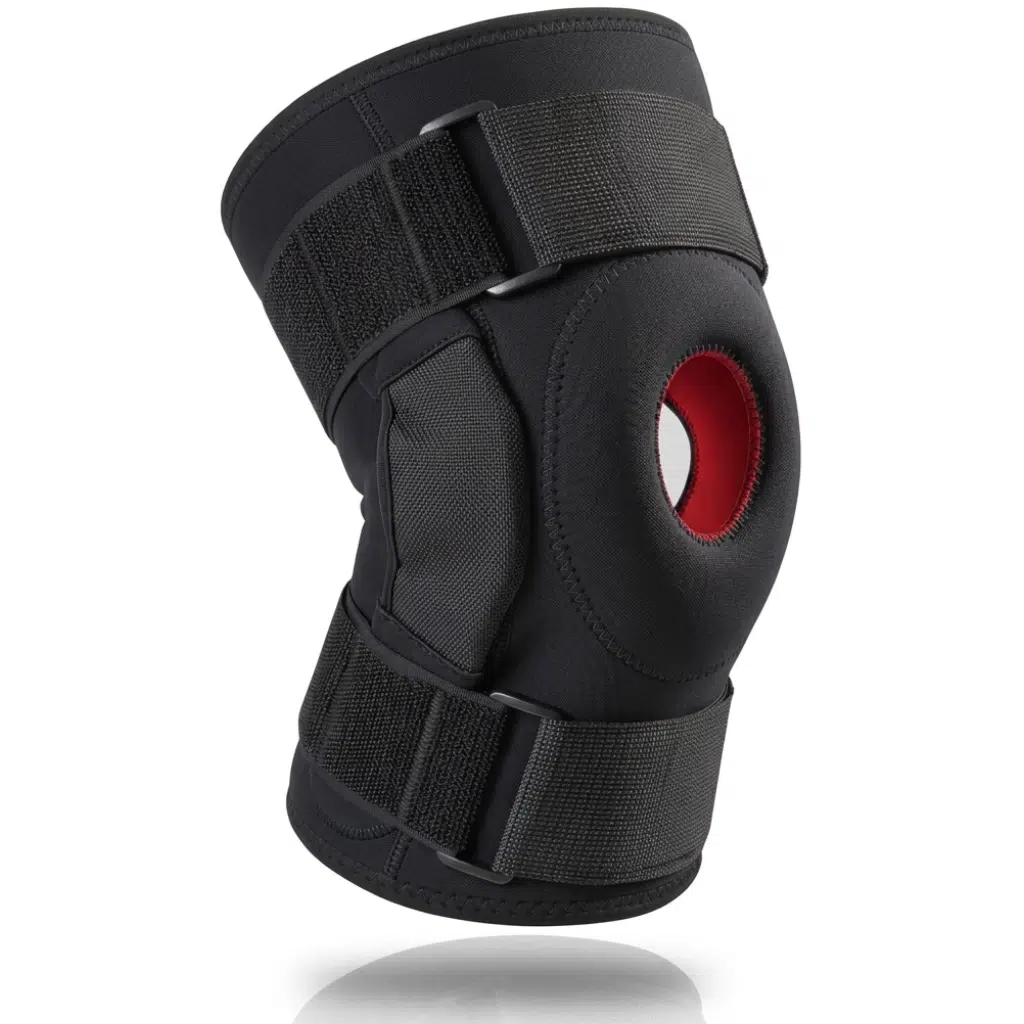
- Your knee gives way. You can’t trust it on stairs, turning, or uneven ground. A basic sleeve isn’t enough. The KneeReviver ACL Knee Brace provides the firm, mechanical control that an ACL-deficient knee needs—rigid aluminium hinges that limit forward slide and resist rotation, adjustable strapping that prevents slipping, and targeted compression that improves proprioception and manages swelling.
- Designed specifically for adults with ACL tears or post-reconstruction recovery. This isn’t a general-purpose knee sleeve. It’s a functional, hinged brace that provides external stability during the tasks that matter most—walking, stairs, work, and return to sport. The hinges are removable, so you can adjust the level of support as your knee strengthens through rehabilitation.
- Evidence-informed design, not marketing hype. Developed in collaboration with UK physiotherapists, the brace addresses the two movements a torn ACL can no longer control: forward slide of the shin bone and excessive rotation. The silicone gel patella ring supports kneecap tracking. The moisture-wicking neoprene stays comfortable during extended wear. The silicone anti-slip strips prevent the brace from sliding down—a common problem with basic sleeves.
- Five sizes available (Small to 2X-Large) to fit a wide range of leg shapes, including plus-size and muscular legs. Universal design—can be worn on either left or right knee. Suitable for non-surgical management and post-reconstruction rehabilitation.
- Backed by a 30-day money-back guarantee. If the brace doesn’t provide the stability and confidence you need, return it for a full refund. No risk. No hassle.
- Take control of your recovery. The KneeReviver ACL Knee Brace gives you the external support you need to move confidently, engage with rehabilitation, and gradually return to the activities you’ve been avoiding because of instability or fear.
KneeReviver ACL Knee Brace: Functional hinged support for torn ACL and ACL reconstruction recovery
An ACL tear changes how your knee feels and moves. The joint feels loose. It gives way on stairs, when you turn, or on uneven ground. A basic knee sleeve isn’t enough. You need firm, mechanical control—the kind that only rigid hinges can provide.
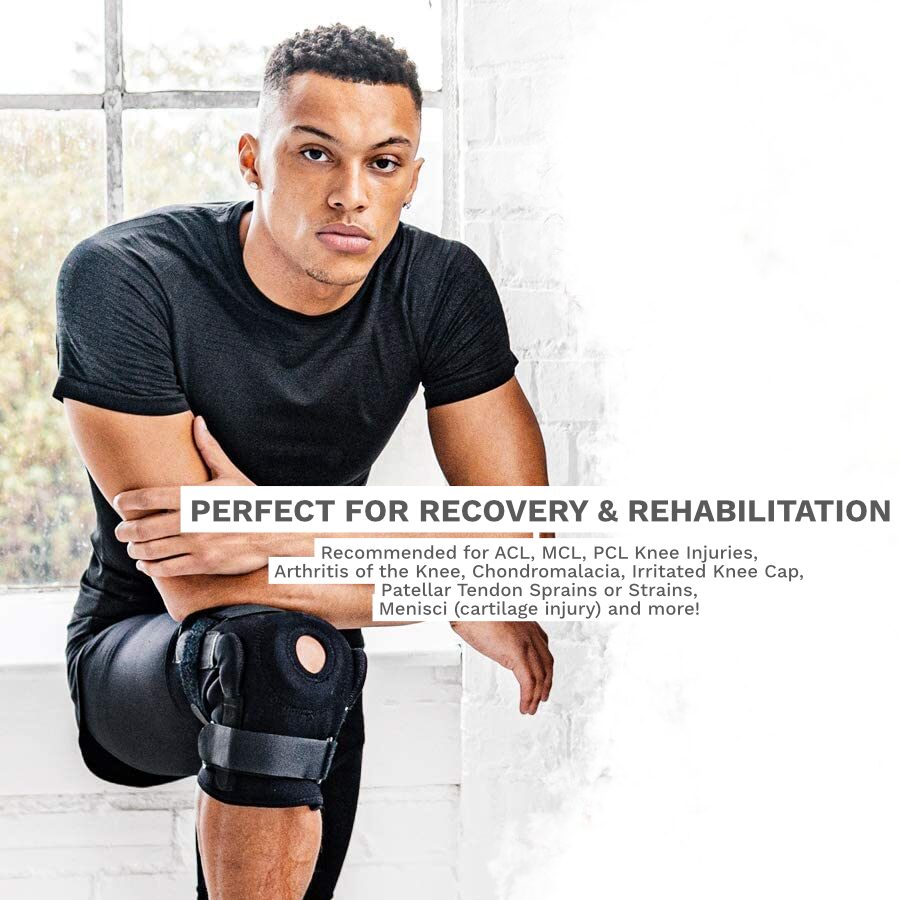
The KneeReviver ACL Knee Brace is designed specifically for adults with ACL tears—partial or complete—who are managing the injury without surgery or recovering after ACL reconstruction. It provides immediate, practical support that reduces instability, improves confidence, and helps you move through everyday tasks without the constant fear that your knee will buckle.
This description explains what an ACL tear is, how it affects your knee, what you can do about it, and how the KneeReviver ACL Knee Brace fits into your recovery plan. It’s written in plain English, informed by evidence and clinical experience, and designed to help you make a confident choice.
At a glance
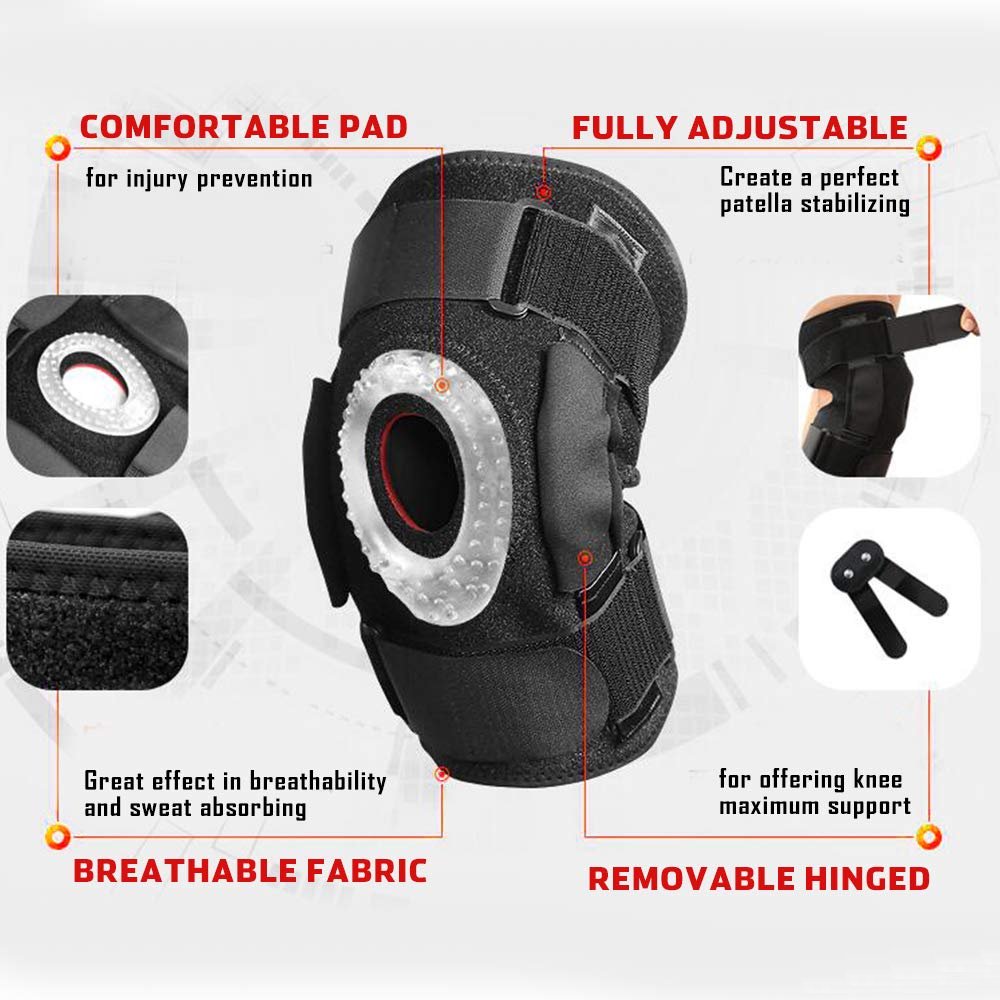
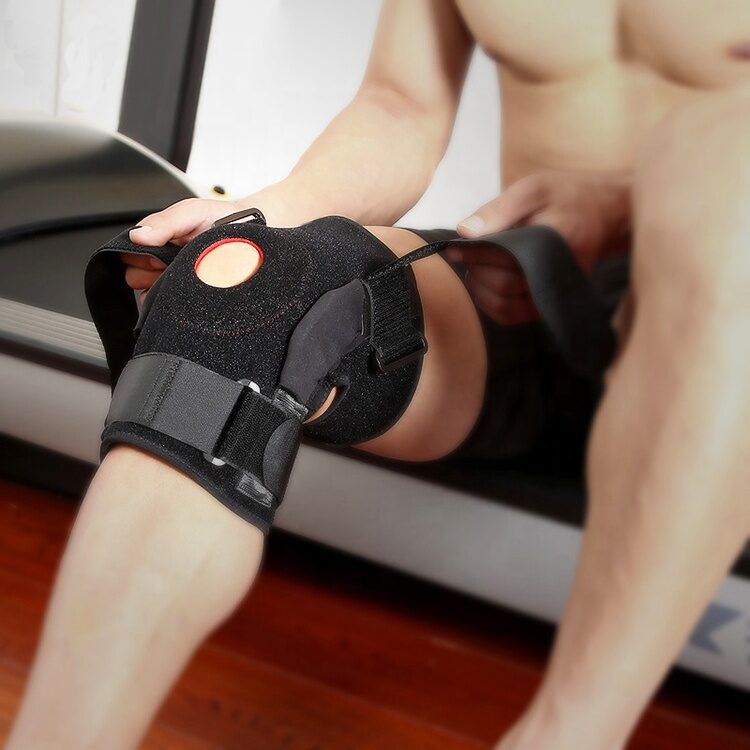
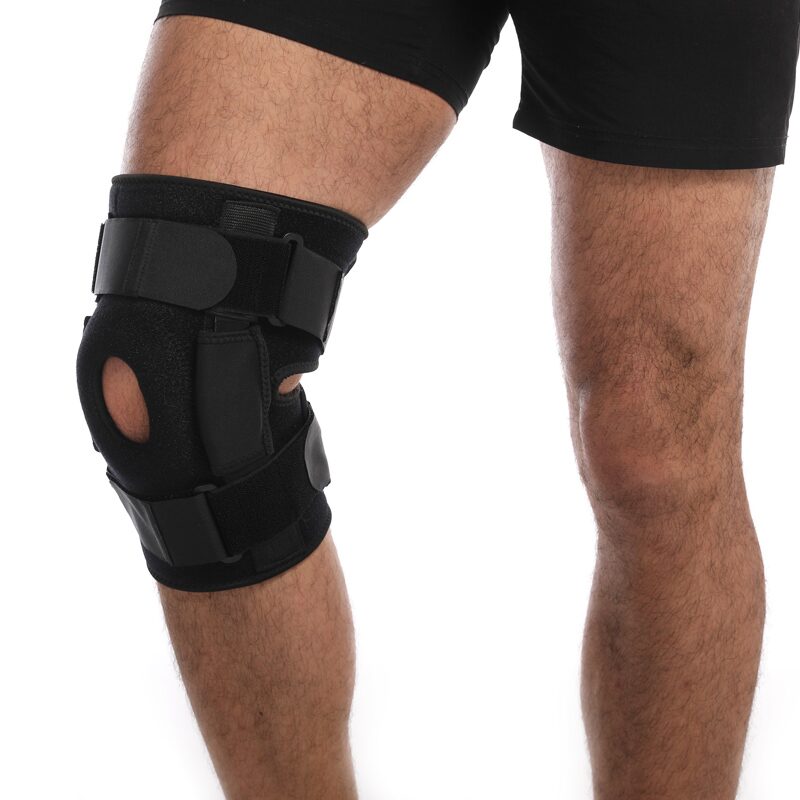
- Rigid aluminium hinges on either side of the knee provide firm mechanical control over forward slide and rotation—the two movements that a torn ACL can no longer restrain
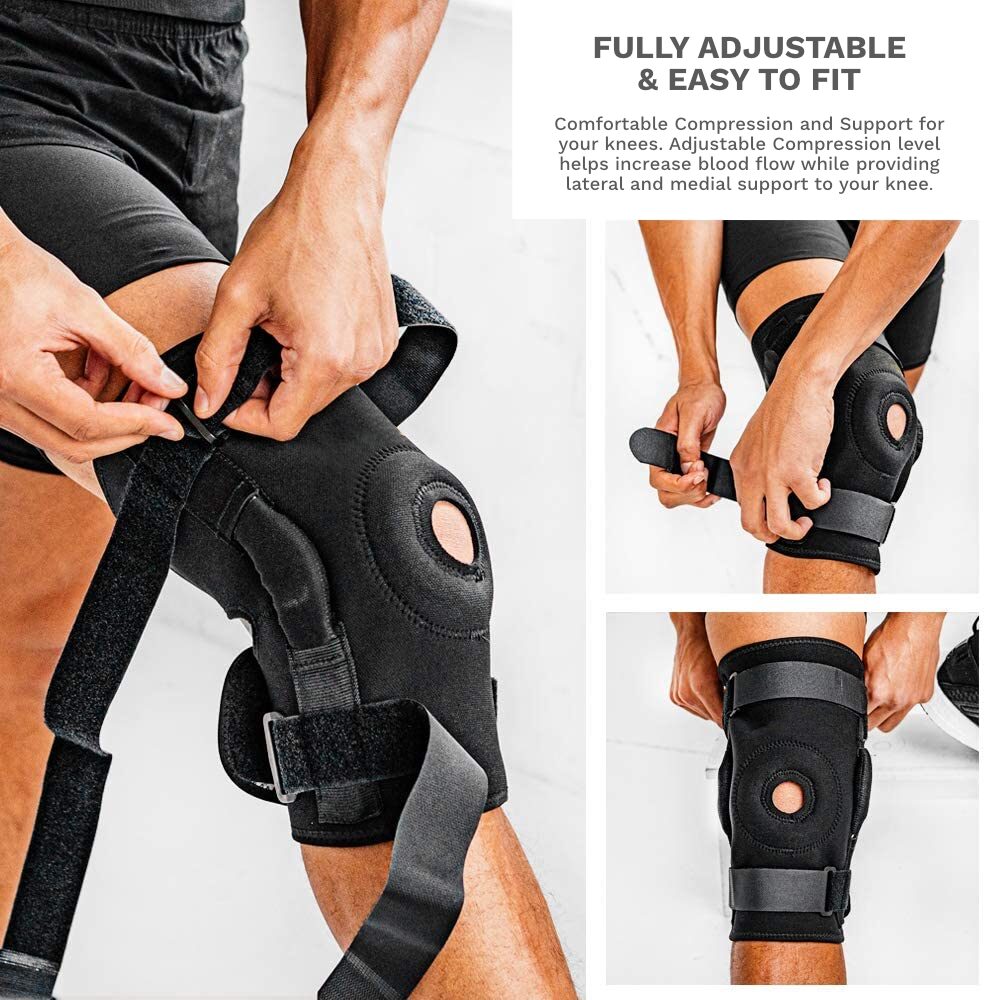
- Adjustable strapping system with two hook-and-loop straps provides a secure, customisable fit that resists slipping and rotation during movement
- Open patella design with silicone gel ring provides targeted support for the kneecap and improves tracking, which is particularly important if you’ve developed patellofemoral pain after the ACL tear
- Removable hinges allow you to adjust the level of support as your knee strengthens—wear with hinges for maximum stability during high-demand tasks, or remove them for lighter activities
- Moisture-wicking, breathable neoprene body with perforated ventilation holes, rounded edges, and flat seams reduces irritation during extended wear
- Silicone anti-slip strips inside the top and bottom cuffs prevent the brace from sliding down—a common problem with basic knee sleeves and wraps
- Five sizes available (Small, Medium, Large, X-Large, 2X-Large) to fit a wide range of leg shapes, including plus-size and muscular legs
- Universal design—can be worn on either left or right knee
- Adults aged 18 and over—not suitable for children or adolescents
Understanding your ACL injury
Before we talk about the brace in more detail, it helps to understand what’s happened to your knee and why it feels the way it does.
What is the ACL and what does it do?
The anterior cruciate ligament—ACL—is one of four major ligaments that stabilise the knee joint. It runs diagonally through the centre of the knee, connecting the femur (thigh bone) to the tibia (shin bone). Its primary job is to stop the shin bone sliding forward relative to the thigh bone, and to limit how far the knee can rotate inward.
When you walk, run, turn, or land from a jump, the ACL is under tension. It’s constantly working to keep the bones aligned and the joint stable. When it tears—partially or completely—that restraint is lost. The shin bone can slide forward more than it should. The knee can rotate excessively. The joint feels loose, unpredictable, and unsafe.
How ACL tears happen
Most ACL tears happen during sport or physical activity, but they can also happen during everyday tasks if the forces are high enough or the movement is awkward.
The most common mechanism is a non-contact pivot—you plant your foot, your body turns or decelerates sharply, and the knee twists inward while the shin rotates outward. This happens in a fraction of a second. The knee can dip inward and rotate while your thigh muscles pull the shin forward. The ACL is stretched beyond its capacity and tears. About 70% of ACL injuries happen this way—no direct blow to the knee, just an awkward movement under load.
The second most common mechanism is landing awkwardly from a jump. You land with your knee straight or slightly bent, your weight shifts forward, and the shin slides forward relative to the thigh. The ACL can’t hold it back and tears.
Less commonly, a direct impact to the front or side of the knee—such as a tackle in rugby or football—can force the shin backward or sideways and tear the ACL, often alongside other ligaments or structures.
Many people hear or feel a pop at the moment of injury. The knee swells rapidly—usually within a few hours—and becomes painful and stiff. Walking is difficult. Stairs feel frightening. Turning or pivoting on the injured leg feels impossible.
What’s going on in your knee right now
When the ACL tears, the immediate response is pain, swelling, and loss of function. The swelling comes from bleeding where the ligament tore and from inflammation as your body responds to the injury. The pain comes from the torn ligament itself, from the stretching or damage to other structures inside the knee, and from the inflammation.
But the instability—the feeling that the knee might give way—persists long after the initial pain and swelling have settled. This is because the ACL doesn’t heal in a way that restores its function. Unlike a muscle or a bone, a torn ligament doesn’t knit back together with the same strength and structure. Even if the torn ends scar over, the ligament remains lax and can’t provide the same restraint it did before the injury.
The muscles around the knee—particularly the thigh muscles at the front and back—try to compensate for the missing ligament by contracting more forcefully to stabilise the joint. But in the early weeks and months after injury, these muscles are often weak, inhibited by pain and swelling, and not coordinated enough to do the job effectively. The result is that the knee feels unstable during weight-bearing activities, particularly when you turn, step down, or walk on uneven ground.
This instability isn’t just a mechanical problem. It’s also a sensory one. The ACL contains nerve endings that provide feedback to your brain about the position and movement of the knee. When the ligament is torn, that feedback is lost. Your brain doesn’t know exactly where the knee is in space or how it’s moving, which makes it harder to coordinate the muscles that stabilise the joint. This loss of proprioception—your sense of joint position—contributes to the feeling that the knee is unreliable and might give way at any moment.
Partial vs complete tears
ACL tears can be partial or complete. A partial tear means that some of the fibres of the ligament are torn but some remain intact. A complete tear means that the ligament has ruptured entirely and the two ends are no longer connected.
Partial tears can sometimes be managed without surgery, particularly if the remaining fibres provide enough stability for everyday activities and the muscles around the knee are strong enough to compensate. But partial tears can become complete tears if you put further stress on the knee before it’s had time to heal and strengthen.
Complete tears almost always cause significant instability, particularly during activities that involve turning, pivoting, or sudden changes of direction. Many people with complete tears choose to have surgery—ACL reconstruction—to restore stability and allow them to return to sport or physically demanding activities. But surgery isn’t always necessary. Some people manage complete tears successfully without surgery by building strength and control through rehabilitation and using external support—such as a functional knee brace—during higher-risk activities.
Whether your tear is partial or complete, the principles of management are the same: reduce swelling and pain, rebuild strength and coordination, and provide external support during the period when the muscles aren’t yet strong enough to stabilise the knee on their own.
Your recovery plan
Recovery from an ACL tear follows a clear sequence, whether you choose surgery or not. The brace fits into this plan by providing external support while your muscles rebuild the strength and coordination needed to stabilise the knee.
Immediate phase (first 1 to 2 weeks)
The priority is to manage swelling and pain, protect the knee from further injury, and begin gentle movement to prevent stiffness.
Rest doesn’t mean complete immobility. Gentle movement—bending and straightening the knee within a comfortable range, ankle pumps, and gentle quadriceps contractions—helps to reduce swelling by encouraging fluid to drain away from the joint. It also prevents the muscles from weakening too quickly.
Ice, elevation, and compression all help to manage swelling. Apply ice for 10 to 15 minutes at a time, several times a day, wrapped in a thin towel to protect the skin. Elevate your leg above heart level when resting. Compression—from the brace or from an elastic bandage—provides gentle pressure that encourages fluid to drain.
Avoid movements that provoke instability or pain. No quick turns, no pivoting on the injured leg, no jumping or running. Modify tasks rather than pushing through instability. Take stairs slowly, one step at a time. Turn your whole body instead of twisting on the injured leg. Use crutches if walking is too painful or if the knee feels like it might give way.
The brace provides external control during this phase, which allows you to move around the house, manage basic tasks, and begin gentle rehabilitation exercises without constantly worrying that the knee will buckle.
Early rehabilitation (weeks 2 to 8)
Once the acute pain and swelling have settled, the focus shifts to rebuilding strength, range of motion, and basic control. This phase is about laying the foundation for more demanding activities later.
Range of motion exercises—heel slides, gentle knee extensions, and assisted bending—help to restore the knee’s ability to bend and straighten fully. Stiffness is common after an ACL injury, particularly if you’ve been avoiding movement because of pain or fear of instability. Gentle, consistent stretching helps to reverse this.
Strengthening exercises focus on the thigh muscles at the front and back, the glutes, and the calf muscles. These muscles are the primary stabilisers of the knee, and they need to be strong enough to compensate for the missing or weakened ACL. Exercises might include straight leg raises, bridging, mini squats, step-ups, and resistance band work.
Balance and proprioception exercises—single-leg standing, wobble board work, and controlled weight shifts—help to retrain the sensory feedback that was lost when the ACL tore. These exercises teach your brain and muscles to work together to keep the knee stable during movement.
The brace continues to provide external support during this phase, particularly during weight-bearing exercises and everyday tasks. As your strength and control improve, you may find that you need the brace less for simple tasks like walking on flat ground, but you’ll still want it for more challenging activities like stairs, uneven ground, or longer walks.
Progressive loading (weeks 8 to 16 and beyond)
As your strength and control improve, you’ll begin to add more demanding activities—longer walks, inclines, light jogging (if cleared by your physiotherapist), and sport-specific drills if you’re planning to return to sport.
The key is progression that’s gradual and controlled. Add running, sharp turns, and contact only after you meet clear strength and function targets—typically when your injured leg has regained at least 80% to 90% of the strength and function of your uninjured leg, measured through objective testing such as hop tests, strength tests, and movement quality assessments.
The brace provides additional protection during this phase, particularly during activities that place high demands on the knee. Many people continue to wear the brace for sport, physically demanding work, or walking on uneven ground, even after their knee feels stable during everyday tasks.
Surgery or no surgery?
Not everyone with an ACL tear needs surgery. The decision depends on several factors: how unstable your knee feels, how it responds to initial rehabilitation, whether you have other injuries that need repair (such as a meniscus tear), and what activities you want to return to.
Many people—particularly those who don’t play pivoting sports and whose knees feel reasonably stable after rehabilitation—manage ACL tears successfully without surgery. They use a combination of strengthening exercises, activity modification, and external support (such as a functional knee brace) to keep the knee stable and functional.
Surgery—ACL reconstruction—is usually recommended if the knee continues to give way frequently despite good rehabilitation, if you want to return to sports that involve quick turns and pivoting, or if you have other injuries inside the knee that need to be repaired at the same time.
After reconstruction, most people need at least 9 to 12 months before they’re ready to return to sports that involve turning and jumping. The graft needs time to heal and integrate, and the muscles need time to rebuild strength and coordination. A brace can help with comfort and confidence during this phase, but return to sport only when tests show your injured leg has regained about 90% of the strength and function of your other leg.
If you’re unsure whether surgery is right for you, speak to your GP or physiotherapist. Many clinicians recommend starting with a brace and rehabilitation for 8 to 12 weeks, then reassessing. If the knee feels stable and function is good, surgery may not be needed. If instability persists despite good rehabilitation, surgery becomes a stronger option.
Prevention and risk: what lowers your chance of tearing the ACL again
Once you’ve torn your ACL, the risk of tearing it again—or tearing the ACL in your other knee—is higher than it was before the injury. This is partly because the injury itself changes the biomechanics of how you move, and partly because the activities that caused the first injury are often the same activities you’ll return to.
But the risk isn’t fixed. There are things you can do to lower it.
Who’s more at risk
Women have a higher rate of ACL injury than men in comparable sports—about two to three times higher in research tracking these patterns. The reasons are multifactorial: differences in anatomy (wider pelvis, narrower intercondylar notch), hormonal influences on ligament laxity, and movement patterns (tendency to land with the knee more upright and rotated inward).
Younger athletes—particularly those aged 15 to 25—have higher rates of ACL injury than older adults, likely because they’re more active in high-risk sports and because their movement patterns are still developing.
People who’ve had one ACL tear have a significantly higher risk of tearing the same ACL again (if managed without surgery) or tearing the ACL in the opposite knee. Estimates vary, but some studies suggest the risk of a second ACL injury within two years of the first is around 15% to 25%, particularly in people who return to pivoting sports.
What lowers your risk
Structured neuromuscular warm-ups that include balance, landing control, and movement quality drills have been shown to reduce ACL injuries in athletes. Regular practice of landing control, turning technique, balance, and torso control can reduce ACL injuries significantly. Some research shows reductions of 30% to 70% when these warm-ups are done consistently.
Strength training—particularly exercises that build strength in the back of your thigh and your glutes to balance the front thigh muscles, which limits forward slide of the shin—reduces the load on the ACL during movement. Stronger muscles mean better control, which means less reliance on the ligament to stabilise the knee.
Movement retraining—learning to land with the knee slightly bent rather than straight, to turn with the whole body rather than twisting on a planted foot, and to decelerate in a controlled way rather than stopping abruptly—reduces the forces that the ACL has to withstand.
Wearing a functional knee brace during high-risk activities—sport, uneven ground, physically demanding work—provides an additional layer of external control that reduces the risk of the knee giving way and potentially causing further damage.
Pacing your return to activity is essential. Returning to sport too soon—before your muscles are strong enough, before your movement patterns are controlled, before your confidence is rebuilt—increases the risk of re-injury. Most clinicians recommend waiting at least 9 to 12 months after ACL reconstruction before returning to pivoting sports, and some recommend waiting even longer.
How a hinged knee brace helps
A functional hinged knee brace doesn’t heal the torn ACL. It doesn’t make your muscles stronger or your proprioception sharper. But it provides a layer of external mechanical control that compensates for what the torn ligament can no longer do.
The mechanism
The rigid hinges on either side of the knee joint create a stable external frame that limits the movements that cause instability. When you step down from a kerb or turn to reach something, the hinges resist the forward slide of the shin bone and limit excessive rotation. This reduces the frequency of the knee giving way and protects the structures inside the knee from repeated episodes of abnormal movement.
The compression from the brace stimulates nerve endings in your skin and the tissues beneath, which helps make up for the lost feedback from the torn ACL. This improved sense of where your knee is in space can make it feel more stable and controlled, even during movements where the hinges aren’t doing much of the work.
The adjustable strapping system resists rotation and keeps the brace securely in position, even during movement. This is important because a brace that slips or twists during activity can’t provide consistent support.
The psychological benefit is often as important as the physical one. Knowing that the brace is providing external control over the movements that cause instability allows many people to move more freely and confidently than they would without it. This confidence makes it easier to engage with rehabilitation exercises, to walk further, and to return to activities that you may have been avoiding because of fear that the knee would give way.
Meet the KneeReviver ACL Knee Brace
The KneeReviver ACL Knee Brace is designed specifically for adults with ACL tears—partial or complete—who need firm, mechanical support during everyday activities and rehabilitation.
Rigid aluminium hinges
The hinges are the most important feature of the brace. They’re made from rigid aluminium and sit on either side of the knee joint, aligned with the natural axis of rotation. They provide firm mechanical control over forward slide and rotation—the two movements that a torn ACL can no longer restrain.
The hinges are removable, which allows you to adjust the level of support depending on what you’re doing. Wear the brace with hinges attached for maximum stability during high-demand activities—sport, running, jumping, uneven ground, carrying heavy loads, or any task where you feel the knee might give way without the extra support. Remove the hinges for lighter activities—walking on flat ground, standing, gentle exercise—when you want compression and strapping support but don’t need full mechanical control.
Removing the hinges also reduces the bulk and weight of the brace, which can make it more comfortable to wear under clothing or during extended periods of use.
Adjustable strapping system
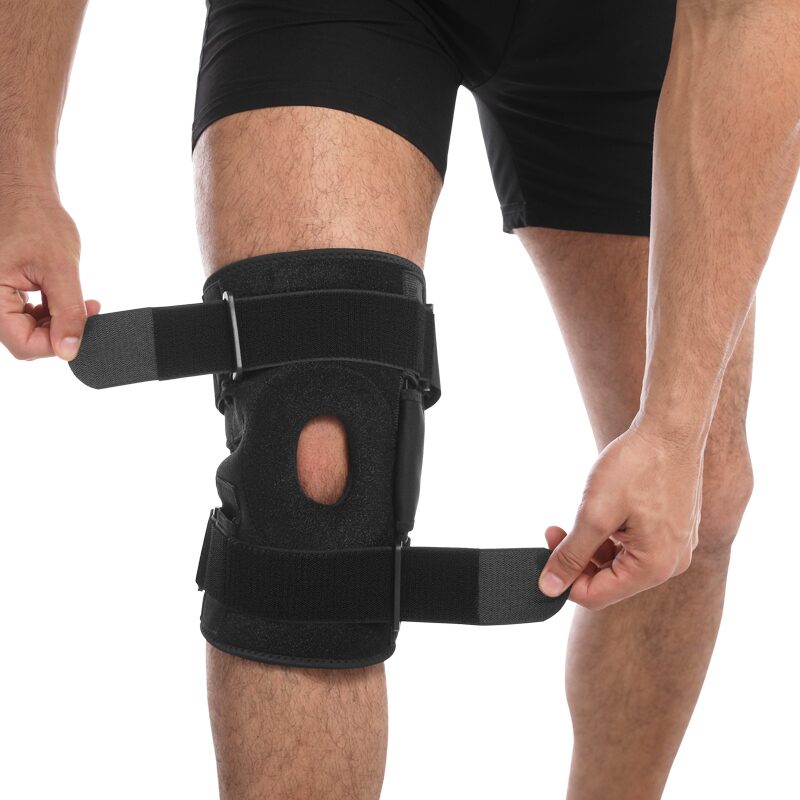
The brace has two adjustable straps—one above the knee and one below—that loop through anchor buckles and fasten with hook-and-loop closures. This system provides a secure, customisable fit that resists slipping and rotation during movement.
The straps can be tightened or loosened independently, which allows you to adjust the fit to match the shape of your leg and the level of compression you need. The upper strap sits around the thigh, the lower strap sits around the calf, and both can be adjusted throughout the day if swelling increases or decreases.
The hook-and-loop fastenings are wide and strong, which means they hold securely even during vigorous activity. They’re also easy to adjust with one hand, which is useful if you need to tighten or loosen the brace while you’re out and about.
Open patella design with silicone gel ring
The front of the brace has a circular opening that sits over the kneecap. This open patella design reduces pressure on the kneecap and allows it to move freely during bending and straightening.
The edge of the opening is lined with a silicone gel ring that provides targeted support for the kneecap and improves tracking. This is particularly important if you’ve developed patellofemoral pain—pain around or behind the kneecap—after the ACL tear. Patellofemoral pain is common after ACL injuries because the altered movement patterns and muscle weakness can cause the kneecap to track abnormally in its groove.
The silicone gel ring is soft and flexible, which means it provides support without digging into the skin or causing discomfort during extended wear.
Neoprene body with perforated ventilation
The body of the brace is made from neoprene—a synthetic rubber material that’s flexible, durable, and provides consistent compression. Neoprene is moisture-wicking, which means it draws sweat away from the skin and allows it to evaporate through the material. This keeps the skin drier and more comfortable during extended wear.
The neoprene is perforated with small ventilation holes that allow air to circulate and heat to escape. This reduces the build-up of heat and moisture inside the brace, which is particularly important if you’re wearing the brace for several hours at a time or during physical activity.
The edges of the brace are rounded and the seams are flat, which reduces the risk of irritation or chafing against the skin.
Silicone anti-slip strips
The inside of the top and bottom cuffs of the brace is lined with silicone anti-slip strips. These grip your skin gently and prevent the brace from sliding down during movement—a common problem with basic knee sleeves and wraps.
The silicone strips are soft and flexible, so they don’t dig into the skin or cause discomfort. They work best when they’re in direct contact with your skin, so if you’re wearing the brace over clothing, the anti-slip effect will be reduced.
Universal design and sizing
The brace is universal, which means it can be worn on either the left or right knee. There’s no need to specify which knee you’re ordering for.
Five sizes are available—Small, Medium, Large, X-Large, and 2X-Large—based on the circumference of your thigh and calf. The size range is designed to fit a wide range of leg shapes, including plus-size and muscular legs. Full sizing instructions and a size chart are provided in the Size guide section below.
Comparing your options: basic sleeves, functional braces, and post-operative braces
Not all knee supports are the same. Understanding the differences helps you choose the right one for your situation.
Basic knee sleeves and wraps
Basic knee sleeves—the kind you can buy in most pharmacies or sports shops—provide compression and warmth, but they don’t provide mechanical control over the movements that cause instability after an ACL tear.
They’re useful for mild knee pain, general support during sport, or managing swelling. But they’re not designed for ACL injuries. They don’t have hinges or rigid structures that limit forward slide or rotation. They rely entirely on compression and proprioceptive feedback, which isn’t enough when the ACL is torn.
If you’ve tried a basic knee sleeve and found that your knee still gives way during stairs, turning, or uneven ground, you need something with more mechanical support.
Functional hinged braces (like the KneeReviver)
Functional hinged braces—like the KneeReviver ACL Knee Brace—are designed specifically for ACL tears and ACL reconstruction recovery. They provide firm mechanical control through rigid hinges, combined with compression, adjustable strapping, and proprioceptive feedback.
They’re designed to be worn during everyday activities, rehabilitation exercises, and sport. They’re less bulky than post-operative braces, more comfortable for extended wear, and provide a good balance between support and mobility.
This is the type of brace that most physiotherapists and orthopaedic surgeons recommend for people who are managing an ACL tear without surgery, or who are in the later stages of recovery after ACL reconstruction and want to return to physically demanding activities.
Post-operative braces
Post-operative braces are rigid, bulky braces that are prescribed immediately after ACL reconstruction surgery. They often have adjustable range-of-motion locks that limit how far the knee can bend or straighten, which protects the healing graft during the first few weeks after surgery.
They’re designed for short-term use—typically 2 to 6 weeks—and are not intended for long-term wear or for use during sport or physically demanding activities. Once the initial healing phase is over, most surgeons recommend transitioning to a functional hinged brace like the KneeReviver for ongoing support during rehabilitation and return to activity.
If you’ve been given a post-operative brace by your surgeon, follow their advice on when to start wearing it, how long to wear it each day, and when to transition to a functional brace.
Which one do you need?
If your knee is giving way during everyday tasks—stairs, turning, walking on uneven ground—and you’ve tried a basic knee sleeve without success, you need a functional hinged brace like the KneeReviver.
If you’ve had ACL reconstruction surgery and you’re in the first few weeks of recovery, your surgeon may prescribe a post-operative brace first, then recommend transitioning to a functional brace once the initial healing phase is over.
If you’re managing an ACL tear without surgery and your knee feels reasonably stable during everyday tasks but you want additional support for sport, physically demanding work, or higher-risk activities, a functional hinged brace provides the external control you need without being overly restrictive.
Who this is for
The KneeReviver ACL Knee Brace is designed for adults aged 18 and over with an ACL tear—partial or complete—who are managing the injury without surgery or who are recovering after ACL reconstruction.
You may benefit from this brace if:
- Your knee gives way during everyday tasks like stairs, turning, or walking on uneven ground
- You’re in the early months after ACL injury and your muscles are still weak
- You’re recovering after ACL reconstruction and need external stability while the graft heals
- You’ve tried a basic knee sleeve and found it wasn’t supportive enough
- You want to return to sport or physically demanding activities but need additional protection
- You’re managing the injury long-term without surgery and need external control during higher-risk tasks
Safety note: Do not use this brace if you have an active infection, open wounds, or a history of blood clots without medical clearance. Full safety guidance is provided in the Safety boundaries section below.
What to expect when you start using the brace
What the brace will help with
The brace provides immediate, practical support that reduces instability and improves confidence during everyday tasks and rehabilitation.
Stairs feel safer. The hinges resist the forward slide of the shin bone when you step down, which reduces the feeling that the knee might buckle. Most people notice this within the first few uses—stairs that felt frightening before the brace feel manageable with it.
Turning and pivoting feel more controlled. The hinges limit excessive rotation, which reduces the frequency of the knee giving way when you turn to reach something, change direction while walking, or pivot on the injured leg.
Walking on uneven ground feels less risky. The external support from the hinges and the proprioceptive feedback from the compression help your brain and muscles respond more quickly to changes in terrain, which reduces the risk of the knee collapsing when you step on an uneven surface.
Confidence improves. Knowing that the brace is providing external control over the movements that cause instability allows many people to move more freely and engage more fully with rehabilitation exercises, daily tasks, and social activities that they may have been avoiding because of fear.
Swelling may reduce. The compression from the brace encourages fluid to drain away from the joint, which can help to reduce swelling, particularly if you’ve been struggling with persistent puffiness around the knee.
Pain may reduce. The improved stability and reduced frequency of the knee giving way can lead to less pain over time, particularly if the pain is related to repeated episodes of instability or abnormal movement inside the joint.
You can do more. Many people find that the brace allows them to walk further, stand for longer, and engage in activities that felt too risky without external support. This increased activity level is important for rehabilitation—movement is what rebuilds strength and coordination.
Return to activity feels more achievable. The brace provides a bridge between the acute injury phase and full return to activity. It allows you to begin loading the knee progressively while the muscles are still rebuilding strength, which accelerates rehabilitation and reduces the risk of deconditioning.
What the brace won’t do
The brace is a tool, not a cure. It provides external support, but it doesn’t heal the torn ligament, rebuild muscle strength, or restore proprioception on its own.
It won’t make your knee completely stable. The brace reduces instability, but it can’t eliminate it entirely. If your ACL is completely torn and your muscles are weak, the knee may still give way occasionally, particularly during high-demand activities or if the brace isn’t fitted correctly.
It won’t replace rehabilitation. The brace provides external support while your muscles are weak, but the goal is to rebuild enough strength and control through exercises that you rely on the brace less over time. If you wear the brace without doing the rehabilitation work, your muscles will remain weak and the knee will continue to feel unstable when you’re not wearing the brace.
It won’t prevent all re-injuries. The brace reduces the risk of the knee giving way and provides some protection against abnormal movements, but it can’t prevent all re-injuries, particularly if you return to high-risk activities before your muscles are strong enough or if you experience a direct impact to the knee.
It won’t be comfortable immediately. Most people need a few days to adjust to the feel of the brace—the compression, the bulk of the hinges, the pressure from the straps. This is normal. The discomfort usually settles within a week as you get used to wearing it and as you learn how to adjust the fit for maximum comfort.
It won’t fit discreetly under slim-fit clothing. The hinges add bulk, and the brace is designed to be firm and supportive rather than invisible. It will fit comfortably over leggings or under loose trousers, but it’s unlikely to fit discreetly under tailored or slim-fit clothing.
Typical timeline: when to wear it and for how long
How long you need to wear the brace depends on the severity of your injury, how quickly your muscles rebuild strength, and what activities you want to return to.
First few weeks (acute phase): Wear the brace during all weight-bearing activities—walking, standing, stairs, light household tasks. Remove it when you’re sitting or lying down with your leg elevated, unless your physiotherapist or surgeon has advised otherwise. Most people wear the brace for several hours a day during this phase, removing it periodically to check the skin and allow the leg to rest.
Weeks 2 to 8 (early rehabilitation): Continue wearing the brace during weight-bearing activities and rehabilitation exercises. As your strength and control improve, you may find that you need the brace less for simple tasks like walking on flat ground, but you’ll still want it for more challenging activities like stairs, uneven ground, or longer walks. Most people wear the brace for 2 to 6 hours a day during this phase, depending on their activity level.
Weeks 8 to 16 and beyond (progressive loading): Wear the brace during higher-demand activities—sport, running, jumping, physically demanding work, or walking on uneven ground. You may not need it for everyday tasks like walking around the house or standing in the kitchen, but you’ll still want it for activities that place higher demands on the knee. Many people continue to wear the brace for sport or physically demanding activities for several months to a year or more after the injury, even after the knee feels stable during everyday tasks.
Long-term use: Some people—particularly those who are managing an ACL tear without surgery—continue to wear the brace long-term for higher-risk activities, even after they’ve completed rehabilitation. This is a personal choice based on how stable the knee feels, what activities you want to do, and how confident you feel without the brace. There’s no fixed endpoint—use the brace for as long as it provides benefit.
Practical steps: what to do in the first 48 hours
When the brace arrives, take a few minutes to familiarise yourself with how it works before you put it on.
Check the contents. Make sure you’ve received the brace, the two removable hinges (pre-installed), and the fitting instructions.
Check the size. Compare the measurements you took when ordering against the size chart. If you’re unsure whether the size is correct, try the brace on before removing any tags or packaging, so you can return or exchange it if needed.
Read the fitting instructions. The brace needs to be positioned correctly to provide effective support. The full fitting guide is provided in the How to fit and adjust the brace section below.
Start with short periods of wear. Wear the brace for 30 minutes to an hour during a light activity—walking around the house, standing in the kitchen, gentle movement. Check how it feels. Is it too tight? Too loose? Rubbing anywhere? Adjust the straps and reposition the brace if needed.
Build up gradually. Once you’re confident that the fit is correct and the brace is comfortable, increase the duration of wear gradually over the first few days. Most people are wearing the brace for several hours a day by the end of the first week.
Check your skin regularly. Remove the brace every few hours and inspect your skin for any signs of pressure, redness, or irritation. Some mild redness that fades within 10 to 15 minutes is normal, particularly in the first few days. But if you notice persistent redness, blistering, or broken skin, stop using the brace and speak to your GP or physiotherapist.
Adjust as needed. The fit may need to be adjusted throughout the day as swelling increases or decreases, or as you move between different activities. Don’t be afraid to loosen or tighten the straps as needed—the brace should feel snug and secure, but not so tight that it causes discomfort or restricts circulation.
How to fit and adjust the brace
Correct fitting is essential for the brace to provide effective support and remain comfortable during extended wear. Take your time with this—it’s worth getting right.
Step-by-step fitting instructions
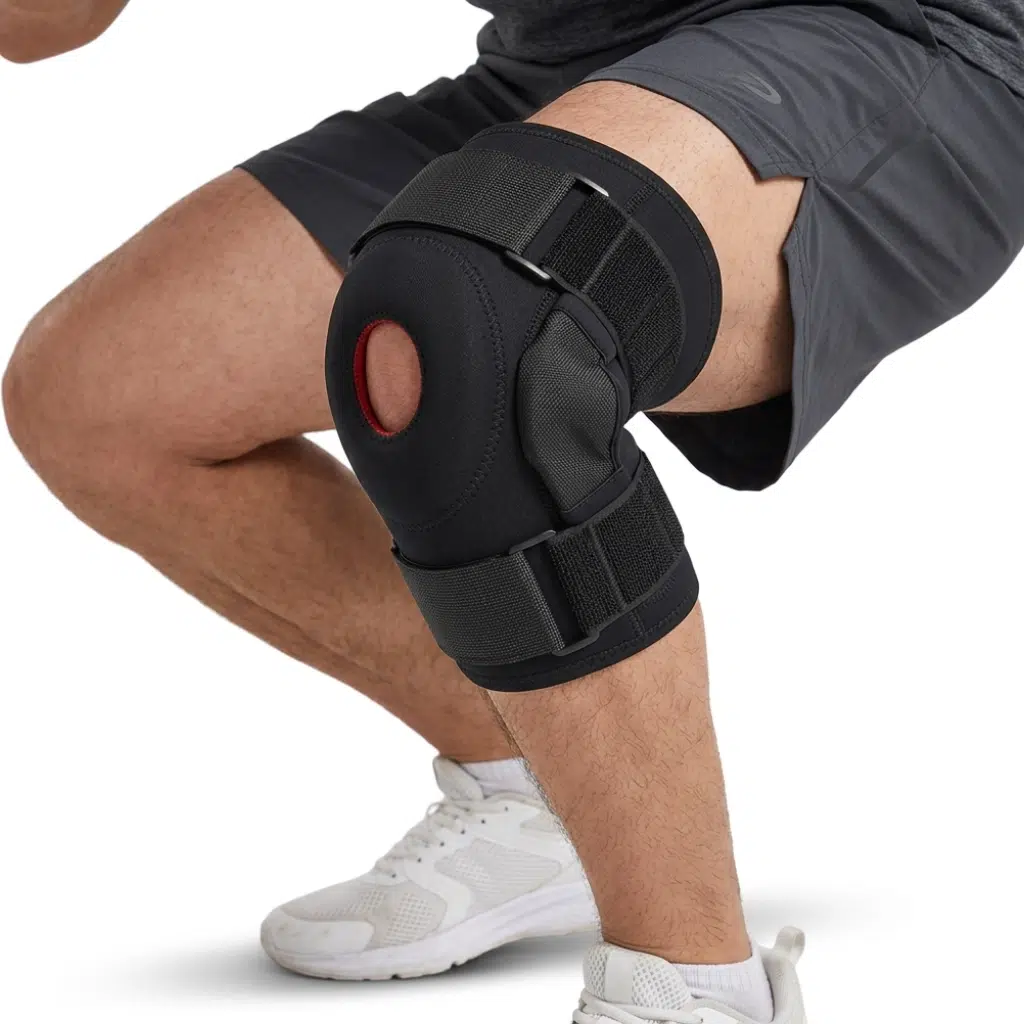
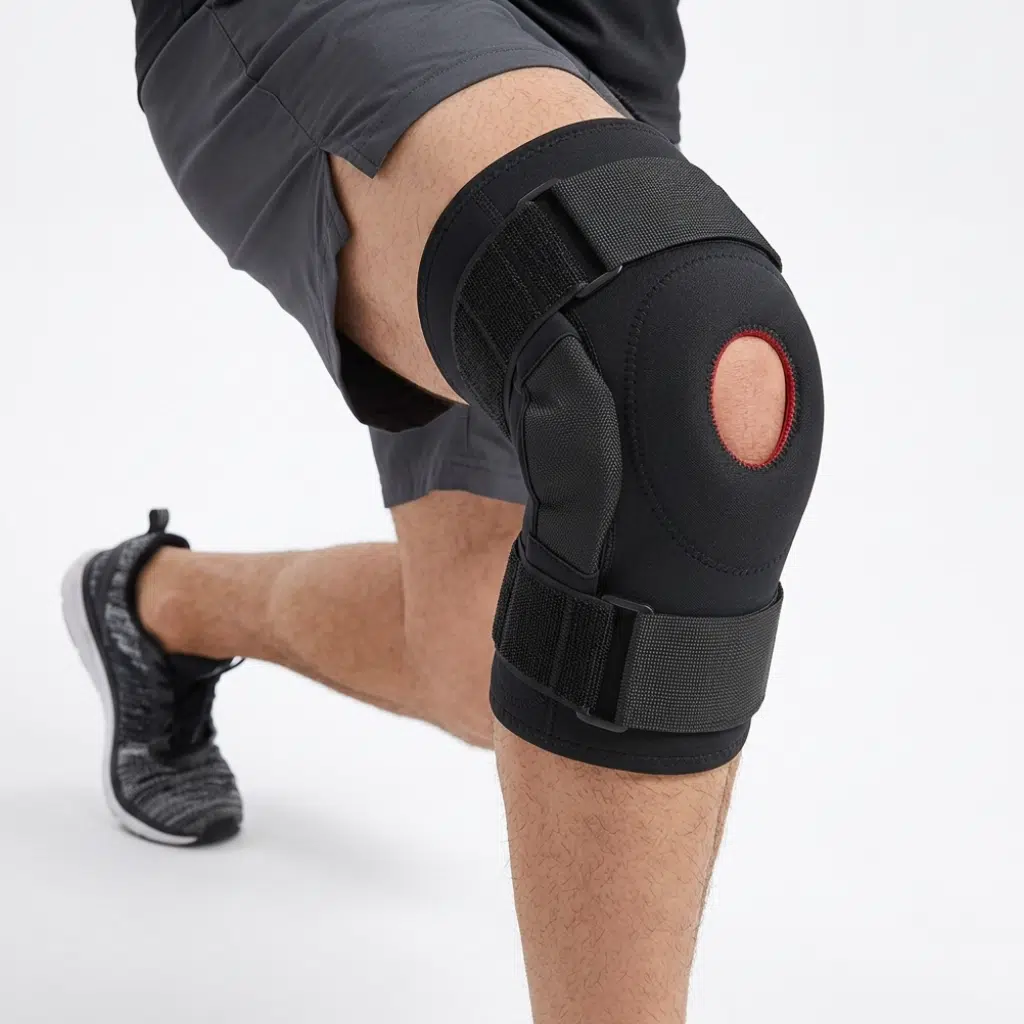
Step 1: Position the brace on your leg. Sit down with your knee slightly bent (about 30 degrees—roughly the angle your knee makes when you’re sitting in a chair with your foot flat on the floor). Slide the brace onto your leg so that the circular opening at the front sits directly over your kneecap. The hinges should be on either side of your knee, aligned with the centre of the joint.
Step 2: Check the hinge alignment. The hinges should sit flat against the sides of your leg, aligned with the natural axis of rotation of the knee joint. If the hinges are angled forward or backward, or if they’re digging into the front or back of your leg, adjust the position of the brace by rotating it slightly until the hinges sit comfortably on either side of the knee.
Step 3: Fasten the upper strap. Take the upper strap (the one that sits around your thigh, above the knee) and pull it firmly across the front of your thigh. Loop it through the anchor buckle on the opposite side, then fold it back on itself and press the hook-and-loop fastening down securely. The strap should be tight enough that the brace feels snug and secure, but not so tight that it causes discomfort or restricts circulation. You should be able to slide one finger between the strap and your skin without difficulty.
Step 4: Fasten the lower strap. Take the lower strap (the one that sits around your calf, below the knee) and pull it firmly across the front of your calf. Loop it through the anchor buckle on the opposite side, then fold it back on itself and press the hook-and-loop fastening down securely. Again, the strap should be tight enough to feel secure, but not so tight that it causes discomfort.
Step 5: Check the fit. Stand up and walk around for a few minutes. The brace should feel snug and secure, with no slipping or rotation. The hinges should stay aligned with the sides of your knee, and the circular opening should stay centred over your kneecap. If the brace slips down, tighten the straps. If it feels too tight or causes discomfort, loosen the straps slightly.
Step 6: Check your circulation. Look at your toes and foot. They should look a normal colour and feel warm. Wiggle your toes—you should be able to move them freely without numbness or tingling. If your toes feel cold, look pale or blue, or if you notice numbness or pins and needles, the brace is too tight. Loosen the straps immediately and check that the symptoms resolve.
Adjusting the fit throughout the day
The fit of the brace may need to be adjusted throughout the day as swelling increases or decreases, or as you move between different activities.
If the brace starts to slip down during movement, tighten the upper and lower straps. If it feels too tight or uncomfortable, loosen the straps slightly. If you’re moving from a low-demand activity (sitting, standing) to a higher-demand activity (walking, stairs, exercise), you may want to tighten the straps for additional support. If you’re moving from a higher-demand activity to a lower-demand one, you may want to loosen the straps for comfort.
Check your skin regularly—every few hours—and look for any signs of pressure, redness, or irritation. If you notice any problems, adjust the fit or remove the brace for a short period to allow the skin to recover.
Wearing the brace over or under clothing
The brace can be worn directly on the skin or over thin, close-fitting clothing such as leggings or compression shorts.
Wearing the brace directly on the skin provides the best compression and allows the silicone anti-slip strips to grip effectively, which reduces the risk of the brace slipping during movement. But some people find it more comfortable to wear the brace over a thin layer of clothing, particularly if they have sensitive skin or if they’re wearing the brace for extended periods.
If you choose to wear the brace over clothing, make sure the clothing is thin and close-fitting. Thick or loose clothing can bunch up under the brace, which reduces the effectiveness of the compression and increases the risk of the brace slipping or rubbing.
The brace can be worn under loose trousers, tracksuit bottoms, or shorts. It’s unlikely to fit discreetly under slim-fit or tailored trousers because of the bulk of the hinges.
Removing or reinstalling the hinges
The hinges are removable, which allows you to adjust the level of support depending on what you’re doing.
To remove the hinges, locate the fastening mechanism at the top and bottom of each hinge. Release the fastening and slide the hinge out of the pocket on the side of the brace. Repeat for the other hinge.
To reinstall the hinges, slide each hinge back into the pocket on the side of the brace, making sure it’s aligned correctly with the top and bottom of the brace. Secure the fastening mechanism at the top and bottom of each hinge.
Store the hinges in a safe place when they’re not in use, so they don’t get lost or damaged.
Caring for the brace
The brace should be washed regularly to keep it clean and hygienic, particularly if you’re wearing it for several hours a day or during physical activity.
Hand-wash only. Remove the hinges before washing. Fill a basin or sink with cool or lukewarm water and add a small amount of mild detergent (avoid harsh detergents, bleach, or fabric softeners, as these can damage the neoprene). Submerge the brace in the water and gently agitate it to remove dirt and sweat. Rinse thoroughly with clean water until all the detergent is removed.
Air-dry flat or hanging. Squeeze out excess water gently (do not wring or twist the brace, as this can damage the material). Lay the brace flat on a clean towel or hang it over a drying rack in a well-ventilated area. Allow it to air-dry completely before wearing it again. Do not tumble dry, iron, or dry-clean the brace. Do not use direct heat (such as a radiator or hairdryer) to speed up drying, as this can damage the neoprene and cause it to shrink or crack.
Wash every 2 to 3 days. If you’re wearing the brace daily, aim to wash it every 2 to 3 days to prevent the build-up of sweat, bacteria, and odour. If you’re wearing it less frequently, wash it as needed.
Check for wear and tear. Inspect the brace regularly for signs of damage—fraying straps, worn hook-and-loop fastenings, tears or thinning in the neoprene, or loose or damaged hinges. If you notice any problems, stop using the brace and contact NuovaHealth for advice on repairs or replacements.
Troubleshooting: common problems and solutions
The brace slips down during movement
Cause: The straps aren’t tight enough, the size is too large, or the silicone anti-slip strips aren’t in contact with your skin.
Solution: Tighten the upper and lower straps further, making sure they’re firm and secure but not so tight that they cause discomfort or restrict circulation. Make sure the silicone anti-slip strips inside the top and bottom cuffs are in direct contact with your skin—if you’re wearing the brace over clothing, the anti-slip effect will be reduced. If the brace continues to slip despite tightening the straps and ensuring skin contact, you may need a smaller size. Contact NuovaHealth for advice on exchanges or returns.
The brace rotates around your leg
Cause: The straps aren’t tight enough, or the hinges aren’t aligned correctly with the sides of your knee.
Solution: Remove the brace and reposition it so that the hinges sit flat against the sides of your leg, aligned with the natural axis of rotation of the knee joint. Fasten the straps firmly, making sure both the upper and lower straps are tight enough to resist rotation. If the brace continues to rotate, you may need a smaller size or a different style of brace with additional strapping.
The hinges dig into your leg or cause discomfort
Cause: The hinges aren’t aligned correctly, the brace is positioned too high or too low on your leg, or the size is incorrect.
Solution: Remove the brace and reposition it so that the circular opening sits directly over your kneecap and the hinges sit flat against the sides of your leg. If the hinges are still digging in, try adjusting the position of the brace slightly up or down your leg. If the problem persists, the size may be incorrect—contact NuovaHealth for advice.
The circular opening doesn’t sit over your kneecap
Cause: The brace is positioned too high or too low on your leg, or the size is incorrect.
Solution: Remove the brace and reposition it so that the circular opening sits directly over your kneecap. If the opening is too high or too low even when the hinges are aligned correctly with the sides of your knee, the size may be incorrect. Contact NuovaHealth for advice on exchanges or returns.
You develop redness, irritation, or chafing
Cause: The brace is too tight, the edges or seams are rubbing against your skin, or you’re wearing the brace for too long without breaks.
Solution: Loosen the straps slightly and check that the brace isn’t digging into your skin. Make sure the edges of the brace are sitting flat against your leg and aren’t folded or bunched up. Remove the brace every few hours to allow your skin to breathe and recover. If you’re wearing the brace directly on your skin and experiencing irritation, try wearing it over a thin layer of close-fitting clothing. If the irritation persists or worsens, stop using the brace and speak to your GP or physiotherapist.
You notice numbness, tingling, or pins and needles
Cause: The brace is too tight and is restricting circulation or compressing nerves.
Solution: Loosen the straps immediately. Check your toes and foot—they should look a normal colour and feel warm. Wiggle your toes to check that you can move them freely. If the numbness or tingling doesn’t resolve within a few minutes of loosening the straps, remove the brace completely and allow your leg to rest. If the symptoms persist after removing the brace, or if they return every time you wear the brace even when the straps are loose, stop using the brace and speak to your GP or physiotherapist.
The brace feels too bulky or restrictive
Cause: The hinges add bulk, and the brace is designed to be firm and supportive rather than lightweight and flexible.
Solution: If you’re finding the brace too bulky for everyday tasks, try removing the hinges. The brace can still be worn without the hinges for compression and strapping support, which reduces the bulk and weight while still providing some external control. If you need the hinges for stability but find the brace uncomfortable, give yourself a few days to adjust—most people find that the discomfort settles within a week as they get used to the feel of the brace.
The brace develops an odour
Cause: Sweat and bacteria build up in the neoprene material if the brace isn’t washed regularly.
Solution: Wash the brace more frequently—every 2 to 3 days if you’re wearing it daily, or after every use if you’re wearing it during physical activity. Follow the care instructions provided in the Caring for the brace section above. If the odour persists despite regular washing, the neoprene may have absorbed bacteria or sweat that can’t be removed with hand-washing alone. Consider replacing the brace.
Swelling increases when wearing the brace
Cause: The brace is too tight and is restricting circulation, or swelling is increasing for reasons unrelated to the brace (such as increased activity, infection, or a complication from the injury).
Solution: Loosen the straps and check that the brace isn’t restricting circulation. Elevate your leg above heart level when resting, and apply ice for 10 to 15 minutes at a time to help reduce swelling. If the swelling continues to increase despite loosening the brace and elevating your leg, or if you notice other symptoms such as increased pain, redness, warmth, or fever, remove the brace and speak to your GP or physiotherapist urgently—these may be signs of infection or another complication.
Size guide: how to measure and choose the right size
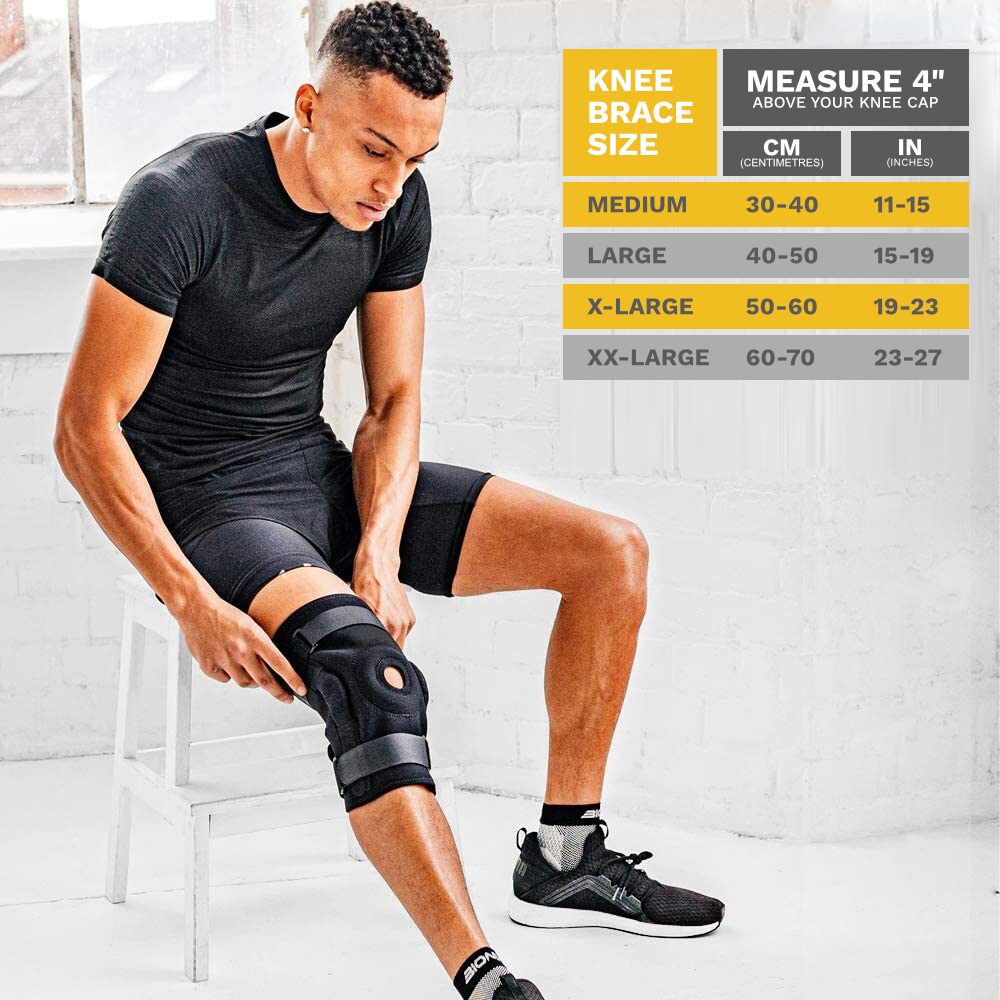
Correct sizing is essential for the brace to provide effective support and remain comfortable during extended wear. The brace is sized based on the circumference of your thigh and calf.
How to measure
You’ll need a flexible tape measure (the kind used for sewing or tailoring). If you don’t have one, you can use a piece of string and then measure the string against a ruler.
Thigh circumference: Measure around the widest part of your thigh, approximately 15 cm (6 inches) above the centre of your kneecap. The tape measure should be snug but not tight—you should be able to slide one finger between the tape and your skin. Make sure the tape is horizontal and not twisted. Record the measurement in centimetres or inches.
Calf circumference: Measure around the widest part of your calf, approximately 15 cm (6 inches) below the centre of your kneecap. Again, the tape measure should be snug but not tight, horizontal, and not twisted. Record the measurement in centimetres or inches.
Which leg to measure: Measure the leg that you’re planning to wear the brace on. If both legs are similar in size, measure the injured leg. If there’s significant swelling in the injured leg, you may want to measure both legs and choose the size based on the larger measurements, or wait until the acute swelling has settled before ordering.
Size chart
| Size | Thigh circumference | Calf circumference |
|---|---|---|
| Small | 40–48 cm (15.5–19 inches) | 30–36 cm (12–14 inches) |
| Medium | 48–56 cm (19–22 inches) | 36–42 cm (14–16.5 inches) |
| Large | 56–64 cm (22–25 inches) | 42–48 cm (16.5–19 inches) |
| X-Large | 64–72 cm (25–28 inches) | 48–54 cm (19–21 inches) |
| 2X-Large | 72–80 cm (28–31.5 inches) | 54–60 cm (21–23.5 inches) |
Choosing between sizes
If your measurements fall on the border between two sizes, or if your thigh and calf measurements suggest different sizes, use the following guidance:
If your thigh measurement is at the top of one size range and your calf measurement is at the bottom of the next size up: Choose the larger size. The straps can be tightened to provide a secure fit, but a brace that’s too small will be uncomfortable and may restrict circulation.
If your thigh measurement is at the bottom of one size range and your calf measurement is at the top of the size below: Choose the smaller size, but be prepared to adjust the straps carefully to ensure the brace doesn’t slip.
If your measurements are right in the middle of the border between two sizes: Choose the larger size if you prefer a looser, more comfortable fit, or the smaller size if you prefer a firmer, more supportive fit. Remember that the straps are adjustable, so you have some flexibility.
If you’re unsure: Contact NuovaHealth before ordering. We can provide advice based on your measurements and your individual situation. We also offer exchanges or returns within a certain period, so if you receive the brace and find that the size isn’t right, you can exchange it for a different size.
Plus-size and muscular legs
The size range is designed to accommodate a wide range of leg shapes, including plus-size and muscular legs. The 2X-Large size fits thigh circumferences up to 80 cm (31.5 inches) and calf circumferences up to 60 cm (23.5 inches).
Swelling and sizing
If your knee is significantly swollen at the time of ordering, your measurements may be larger than they will be once the swelling settles. This can make sizing difficult.
If possible, wait until the acute swelling has reduced before measuring and ordering. If you need the brace urgently and can’t wait for the swelling to settle, measure your leg as it is now and choose the size based on those measurements. Be aware that the brace may feel loose once the swelling reduces, and you may need to tighten the straps further or exchange the brace for a smaller size.
Alternatively, if you have access to measurements from before the injury (for example, if you’ve been measured for compression garments or other supports in the past), you can use those measurements as a guide, provided your leg shape hasn’t changed significantly.
Safety boundaries: when not to use this brace
The KneeReviver ACL Knee Brace is designed for adults aged 18 and over with ACL tears or recovering from ACL reconstruction. It’s not suitable for everyone. Read this section carefully before using the brace.
Do not use this brace if:
- You have an active infection or open wounds on or near the knee. The brace should not be worn over broken skin, open wounds, or areas of active infection. Wait until the skin has healed completely before using the brace.
- You have a history of blood clots (deep vein thrombosis or pulmonary embolism) and have not been cleared by your doctor. Compression around the leg can increase the risk of blood clots in people who are already at risk. If you have a history of blood clots, speak to your GP or specialist before using the brace.
- You have severe peripheral arterial disease or significant circulatory problems. The compression from the brace can reduce blood flow to the lower leg and foot. If you have poor circulation, diabetes with vascular complications, or any condition that affects blood flow to your legs, speak to your GP before using the brace.
- You are under 18 years of age. This brace is designed for adults. Children and adolescents have different biomechanics and growth patterns, and they require specialist assessment and bracing if needed. If your child has an ACL injury, speak to their GP or paediatric orthopaedic specialist.
Speak to your GP, physiotherapist, or orthopaedic surgeon before using this brace if:
- You have diabetes. Diabetes can affect sensation in the legs and feet, which means you may not notice if the brace is too tight or causing pressure damage. Diabetes can also affect circulation and wound healing. If you have diabetes, speak to your GP or diabetes specialist before using the brace, and check your skin regularly for any signs of pressure or irritation.
- You have reduced sensation in your leg or foot. If you have nerve damage, neuropathy, or any condition that reduces your ability to feel pressure or pain in your leg, you may not notice if the brace is too tight or causing damage. Speak to your GP before using the brace, and ask someone to help you check your skin regularly.
- You have significant swelling that doesn’t improve with rest, elevation, and ice. Persistent or worsening swelling can be a sign of infection, blood clot, or another complication. Speak to your GP before using the brace.
- You have other injuries or conditions affecting the same leg. If you have a fracture, ligament injury other than the ACL, meniscus tear, or any other injury or condition affecting the knee or leg, speak to your GP or physiotherapist before using the brace. They can advise whether the brace is appropriate and whether any modifications are needed.
- You’ve had surgery on the same knee within the last few weeks. If you’ve had ACL reconstruction or any other knee surgery, follow your surgeon’s advice on when to start wearing a functional brace. Some surgeons recommend starting immediately after the initial post-operative brace is removed; others recommend waiting until certain milestones in rehabilitation are reached.
- You’re pregnant. Pregnancy increases the risk of blood clots and can cause swelling and changes in circulation. If you’re pregnant and have an ACL injury, speak to your GP or midwife before using the brace.
Stop using the brace and speak to your GP or physiotherapist if:
- You develop persistent redness, blistering, or broken skin. Some mild redness that fades within 10 to 15 minutes of removing the brace is normal, particularly in the first few days. But if the redness persists for more than 20 to 30 minutes, or if you notice blistering, broken skin, or sores, stop using the brace and seek advice.
- You notice numbness, tingling, or pins and needles that don’t resolve when you loosen or remove the brace. This may be a sign that the brace is compressing a nerve or restricting circulation.
- Your toes or foot become cold, pale, or blue. This is a sign that circulation is being restricted. Loosen or remove the brace immediately and seek medical advice if the symptoms don’t resolve quickly.
- Swelling increases significantly while wearing the brace. Some swelling is normal after an ACL injury, but if the swelling gets worse while you’re wearing the brace, or if you notice other symptoms such as increased pain, redness, warmth, or fever, remove the brace and seek medical advice urgently—these may be signs of infection or a blood clot.
- Pain increases significantly while wearing the brace. The brace should reduce instability and improve comfort, not cause pain. If the brace is causing significant pain, it may be fitted incorrectly, the size may be wrong, or there may be another problem. Stop using the brace and seek advice.
- The knee continues to give way frequently despite wearing the brace and doing rehabilitation exercises. The brace provides external support, but if the knee is still giving way frequently, you may need a different type of brace, additional rehabilitation, or surgical intervention. Speak to your physiotherapist or GP.
General safety advice
- Check your skin regularly. Remove the brace every few hours and inspect your skin for any signs of pressure, redness, irritation, or damage. If you notice any problems, adjust the fit or stop using the brace until the skin has recovered.
- Don’t wear the brace too tight. The brace should feel snug and secure, but not so tight that it causes discomfort, restricts circulation, or leaves deep marks on your skin. You should be able to slide one finger between the strap and your skin without difficulty.
- Don’t wear the brace while sleeping unless advised by your clinician. Most people don’t need to wear the brace while sleeping, and wearing it overnight can increase the risk of circulation problems or skin damage. If your clinician has advised you to wear the brace overnight, follow their instructions carefully and check your skin regularly.
- Don’t rely on the brace alone. The brace provides external support, but it doesn’t replace rehabilitation. Continue with your strengthening and balance exercises as advised by your physiotherapist, and use the brace as part of a comprehensive recovery plan.
- Don’t return to high-risk activities too soon. The brace provides additional protection, but it can’t prevent all re-injuries. Return to sport or physically demanding activities only when your physiotherapist or surgeon advises that it’s safe to do so, and only after you’ve met clear strength and function targets.
Common questions
Can I wear this brace immediately after tearing my ACL?
Yes, in most cases. The brace can be worn from the first few days after injury, once the acute pain and swelling have started to settle. It provides external support during the early phase when your muscles are weak and the knee feels most unstable. If you’ve had surgery, follow your surgeon’s advice on when to start wearing a functional brace—some surgeons recommend starting immediately after the post-operative brace is removed, while others recommend waiting until certain milestones in rehabilitation are reached.
How long should I wear the brace each day?
This depends on your activity level and how stable your knee feels. In the first few weeks after injury, most people wear the brace during all weight-bearing activities—walking, standing, stairs, light household tasks—and remove it when sitting or lying down. As your strength and control improve, you may find that you need the brace less for simple tasks but still want it for more challenging activities. There’s no fixed rule—wear the brace for as long as it provides benefit, and adjust the duration based on how your knee feels.
Can I sleep in the brace?
Most people don’t need to wear the brace while sleeping. Wearing it overnight can increase the risk of circulation problems or skin damage, particularly if you move around in your sleep and the brace shifts or tightens. If your clinician has advised you to wear the brace overnight, follow their instructions carefully and check your skin regularly. Otherwise, remove the brace before bed and put it back on in the morning.
Can I wear this brace for sport?
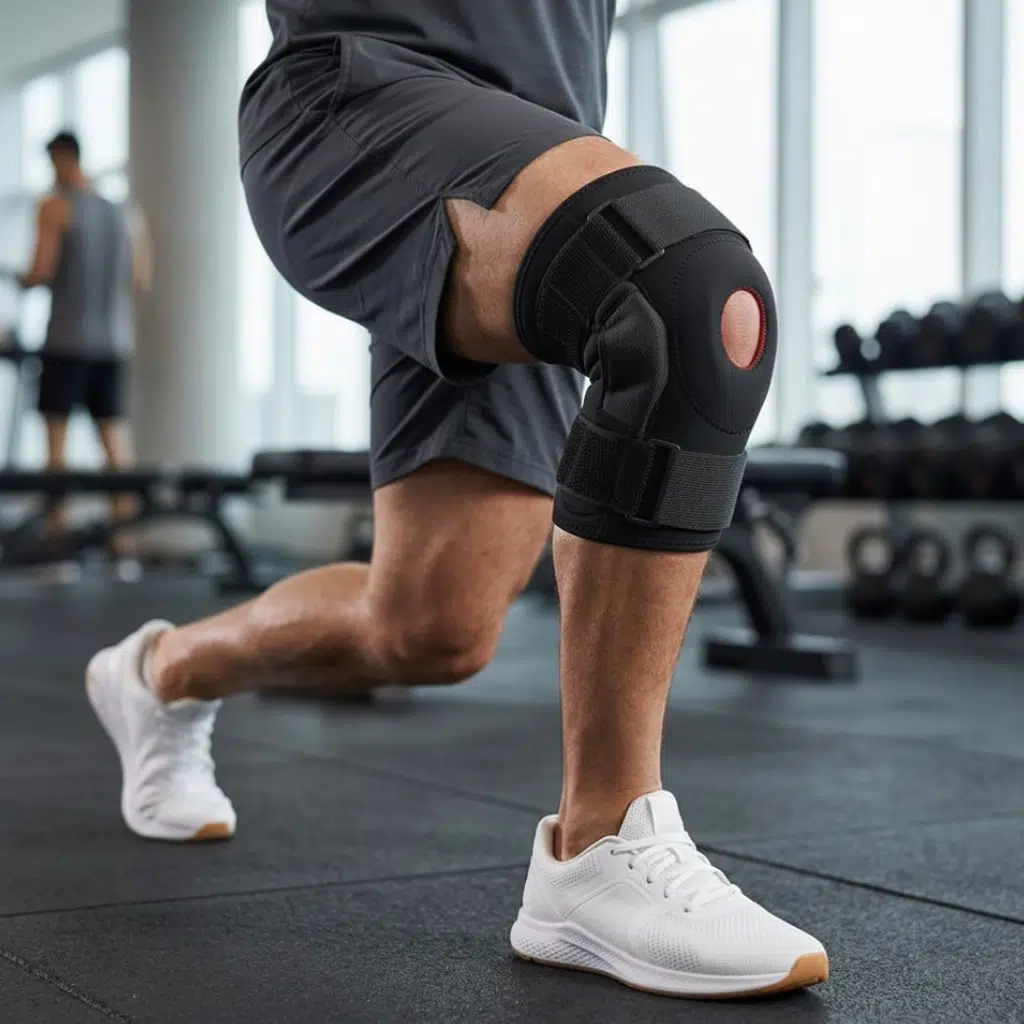
Yes. The brace is designed to provide external support during physically demanding activities, including sport. Many people wear the brace for running, football, rugby, netball, basketball, skiing, and other sports that involve turning, pivoting, or jumping. But the brace provides additional protection, not complete protection—it can’t prevent all re-injuries. Return to sport only when your physiotherapist or surgeon advises that it’s safe to do so, and only after you’ve met clear strength and function targets.
Will the brace prevent me from tearing my ACL again?
The brace reduces the risk of the knee giving way and provides some protection against abnormal movements, but it can’t prevent all re-injuries. The most effective way to reduce your risk of re-injury is to complete a structured rehabilitation programme that builds strength, control, and movement quality, and to return to high-risk activities only when you’re ready. The brace is a useful tool as part of that plan, but it’s not a substitute for rehabilitation.
Can I wear the brace without the hinges?
Yes. The hinges are removable, which allows you to adjust the level of support depending on what you’re doing. Wear the brace with hinges attached for maximum stability during high-demand activities, or remove the hinges for lighter activities when you want compression and strapping support but don’t need full mechanical control. Removing the hinges also reduces the bulk and weight of the brace, which can make it more comfortable for extended wear.
Will the brace fit under my clothing?
The brace will fit comfortably under loose trousers, tracksuit bottoms, or shorts. It’s unlikely to fit discreetly under slim-fit or tailored trousers because of the bulk of the hinges. If you need to wear the brace under work clothing, consider wearing slightly looser trousers or removing the hinges to reduce the bulk.
Can I wear the brace on either knee?
Yes. The brace is universal and can be worn on either the left or right knee. There’s no need to specify which knee you’re ordering for.
How long will the brace last?
This depends on how often you wear it and how well you care for it. With regular use and proper care—washing every few days, air-drying, and storing in a cool, dry place—the brace should last for several months to a year or more. The neoprene material will eventually wear out, and the hook-and-loop fastenings will lose their grip over time. Inspect the brace regularly for signs of wear and tear, and replace it when it no longer provides effective support.
Can I get this brace on the NHS?
This depends on your local NHS trust and your individual circumstances. Some NHS trusts provide functional knee braces for people with ACL tears, particularly if surgery isn’t appropriate or if the brace is needed as part of post-operative rehabilitation. Others don’t routinely provide braces and recommend that patients purchase them privately. Speak to your GP or physiotherapist to find out what’s available in your area.
Do I need a prescription to buy this brace?
No. The brace is available to purchase without a prescription. But it’s a good idea to speak to your GP or physiotherapist before ordering, particularly if you have other health conditions or if you’re unsure whether the brace is appropriate for your situation.
What if I order the wrong size?
NuovaHealth offers exchanges or returns within a certain period, provided the brace is in its original condition with tags attached. Check our returns policy before ordering. If you receive the brace and find that the size isn’t right, contact us as soon as possible to arrange an exchange.
Final summary
An ACL tear changes how your knee feels and moves. The joint feels loose, unpredictable, and unsafe. A basic knee sleeve isn’t enough. You need firm, mechanical control—the kind that only rigid hinges can provide.
The KneeReviver ACL Knee Brace is designed specifically for adults with ACL tears—partial or complete—who are managing the injury without surgery or recovering after ACL reconstruction. It provides immediate, practical support that reduces instability, improves confidence, and helps you move through everyday tasks without the constant fear that your knee will buckle.
The rigid aluminium hinges on either side of the knee provide firm mechanical control over forward slide and rotation—the two movements that a torn ACL can no longer restrain. The adjustable strapping system provides a secure, customisable fit that resists slipping and rotation during movement. The open patella design with silicone gel ring provides targeted support for the kneecap and improves tracking. The removable hinges allow you to adjust the level of support as your knee strengthens.
The brace is most effective during moderate-demand tasks like walking, standing, stairs, and light household activities—the movements that make up most of daily life. It provides additional protection during higher-demand activities like sport, running, or walking on uneven ground. It’s designed to be worn as part of a comprehensive recovery plan that includes rehabilitation exercises, activity modification, and gradual return to function.
The brace doesn’t heal the torn ligament, rebuild muscle strength, or restore proprioception on its own. But it provides a layer of external mechanical control that compensates for what the torn ligament can no longer do, which allows you to move more freely and confidently while your muscles rebuild the strength and coordination needed to stabilise the knee.
If your knee is giving way during everyday tasks—stairs, turning, walking on uneven ground—and you’ve tried a basic knee sleeve without success, the KneeReviver ACL Knee Brace provides the firm, mechanical support you need to move safely and rebuild confidence during recovery.
Important: This brace is designed for adults aged 18 and over. Do not use if you have an active infection, open wounds, or a history of blood clots without medical clearance. Full safety guidance is provided in the Safety boundaries section above.
Not sure if this is right for you? Speak to your GP or physiotherapist. They can assess your knee, advise on whether a functional brace is appropriate, and help you choose the right size and type of support for your individual situation.
Ready to order? Measure your thigh and calf circumference using the instructions in the Size guide section above, choose your size, and place your order. If you have any questions or need advice on sizing, contact NuovaHealth before ordering.
About KneeReviver
KneeReviver is part of the NuovaHealth range of evidence-informed supports and braces designed for real-world use. We work with UK physiotherapists and product designers to create practical, effective solutions that blend expert insight with lived experience.
All KneeReviver products are designed with a focus on biomechanics, comfort, and usability. We don’t over-promise. We don’t hype. We provide clear, honest information so you can make confident choices about your recovery.
For more information about KneeReviver products, or to speak to our team about sizing, fitting, or product advice, visit our contact page.
Medical disclaimer
This product description is for information only. It does not replace professional medical advice, diagnosis, or treatment.
Always seek the advice of your GP, physiotherapist, orthopaedic surgeon, or other qualified healthcare provider with any questions you have about a medical condition or treatment. Never disregard professional medical advice or delay seeking it because of something you’ve read in this description.
If you experience severe pain, significant swelling that doesn’t improve with rest and elevation, signs of infection (redness, warmth, fever, discharge), or symptoms of a blood clot (sudden severe pain in the calf, swelling, warmth, redness), seek medical attention immediately.
The KneeReviver ACL Knee Brace is a medical device intended to provide external mechanical support for adults with ACL tears or recovering from ACL reconstruction. It is not a substitute for proper medical assessment, diagnosis, rehabilitation, or surgical intervention when needed.
Use of this brace should be part of a comprehensive recovery plan that includes professional guidance, structured rehabilitation exercises, activity modification, and regular monitoring of your progress. The brace provides external support while your muscles rebuild strength and coordination, but it does not replace the need for active rehabilitation.
NuovaHealth and the manufacturers of this product accept no liability for injury, complications, or adverse outcomes resulting from improper use, incorrect sizing, failure to follow safety guidance, or use of the brace without appropriate medical supervision.
If you have any concerns about whether this brace is appropriate for your situation, or if you experience any problems while using it, stop using the brace and speak to your GP or physiotherapist before continuing.
5 Reviews For This Product
Fast & Secure Checkout Through Paypal
Pay with Paypal the secure payment gateway that accepts all credit and debit cards. Paypal is free and secure and no credit or bank information is ever stored or shared with us.
Fast Dispatch
Enjoy your items soon with quick dispatch via Royal Mail. Expect to have your items between 1-3 working days for domestic orders. 7-10 Working days for international orders.
Return Policy – 30 Day Money Back Guarantee
In the unlikely event, you are unhappy with your purchase you can return it within 30 days for a refund. Please contact us via the form on the contact us page to start your return.
To return an item please send it to: Nuova Health UK, 81 Highfield Lane, Waverley, Rotherham, S60 8AL. Please include a note with your order id so we know who to refund. Please retain your postage receipt as proof of postage. All that we ask is that the item is in the original packaging and unused.
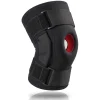
by David
So, I had this nasty ACL injury and was recommended this Knee brace. This thing, let me tell you, solid as a rock. Held up real good for months. It’s like a second skin, comfy yet firm. I’ve noticed it really helps keep my knee stable. The price might seem a bit steep, but considering the quality and effectiveness, it’s a bargain. Putting it on and taking it off is no hassle at all. Plus, it doesn’t look half bad. In a nutshell, it’s been a game-changer for me. Recommended 100%!
by Raj Patel
My dad has arthritis. His knees are always hurting. We tried the KneeReviver. What a relief! He’s moving around so much better now. He even danced at my sister’s wedding! What a sight. This brace is magic. Totally worth it.
by Debbie Murphy
I’m not one to write reviews, but the KneeReviver Knee Brace deserves all the praise. I bought it after my meniscus tear and it’s been a great asset in my healing journey. The brace is easy to wear and adjust, and it doesn’t chafe or cause discomfort. It’s a must-have for anyone dealing with similar knee conditions
by Ahmed Khalid
I tore my ACL playing footie. Could barely walk after. This KneeReviver brace? A lifesaver. The support is incredible. I feel secure, even running again. My knee feels protected. The fit is snug but comfortable. No slipping. No pain. Just joy. Highly recommend for any athlete.
by Emily
OH MY GOODNESS! After my skiing accident, my knee was a wreck. The KneeReviver made a HUGE difference! Comfortable and sturdy. I wore it all day without any issues. Pain? Gone! Stability? Amazing! Love this brace. Best purchase ever. 😊