
Ankle Brace for Sprains, Strains, Fractures, Achilles Tendonitis & Heel Pain
£12.49inc VAT
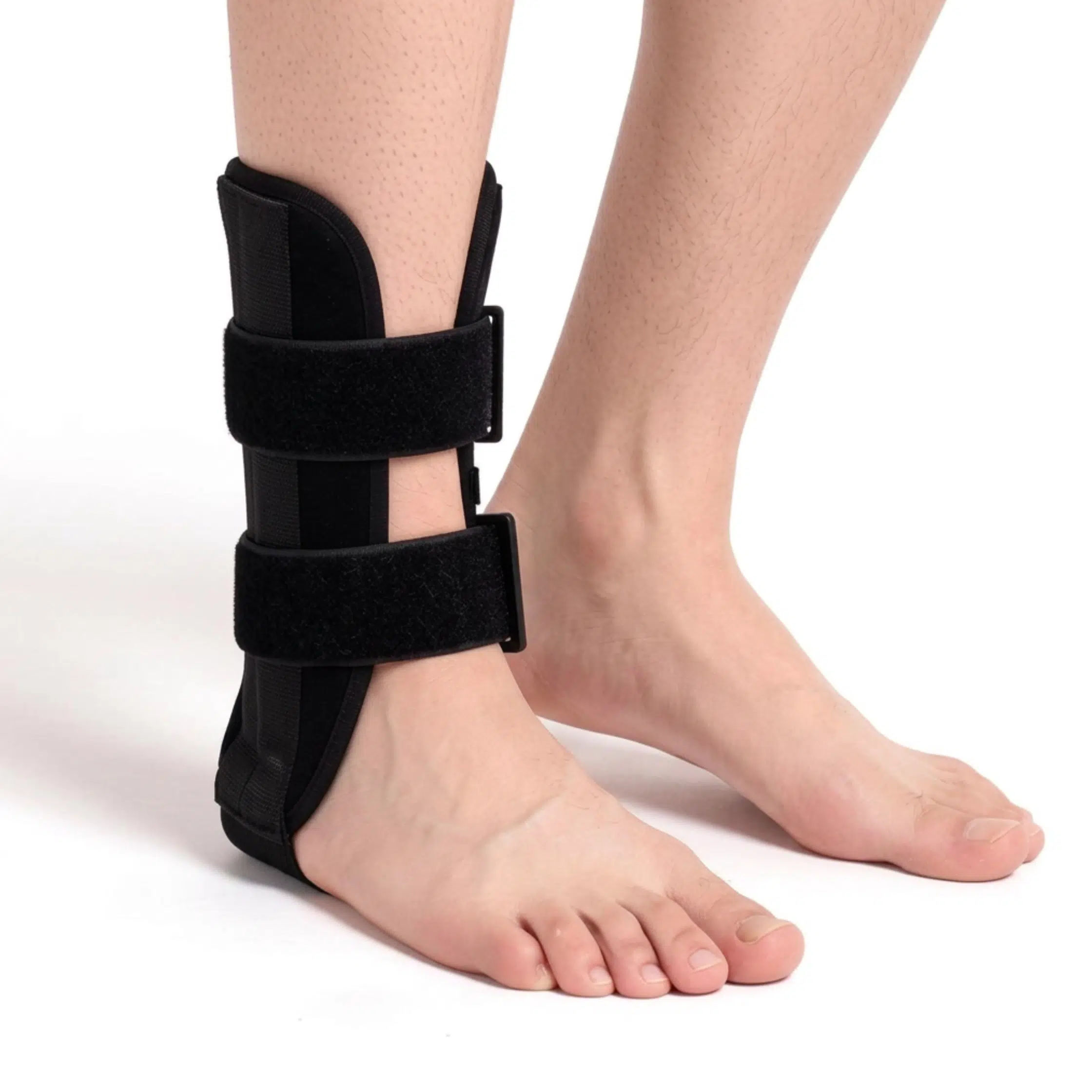
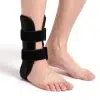
- Rigid ankle brace with twin aluminium side splints and cushioned heel pad, designed by FootReviver and supplied by Nuvoahealth
- For adults whose ankle still rolls, aches or feels unreliable after sprains, fractures, immobilisation or longer‑term instability
- Often chosen by clinicians for the stage after a cast or boot, or when a simple elastic sleeve is not enough to stop giving‑way
- Side splints extend above the ankle joint to give strong, early resistance against inward and outward rolling
- Built‑in cushioned heel pad gently lifts and supports your heel to soften impact and reduce strain on the Achilles tendon and heel area
- Open front around the ankle and no rigid shell over the foot, so your ankle can bend forwards and backwards and your foot can roll from heel to toe more naturally
- Padded, breathable interior with seams set away from the ankle bones and heel to reduce rubbing where people most often report problems
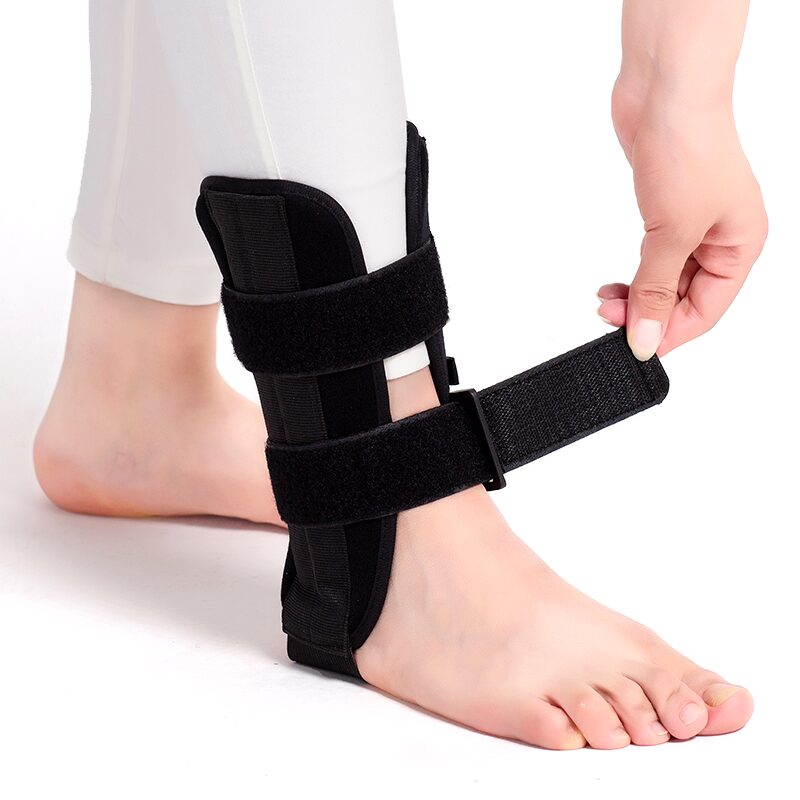
- Two independent elastic straps and buckles so you can set firmer support close to the ankle joint and slightly lighter support higher up if that suits you
- Available sizes (approx. UK shoe size): Small 3–5, Medium 5–8, Large 8–11; unisex and can be worn on either ankle, usually over a thin sock
- Intended for everyday walking, standing and controlled exercise, not for high‑impact or collision‑type sports or for use in water
- Best used at the times of day when your ankle does the most work, building up wear gradually and checking skin and comfort regularly
- Does not replace medical assessment, does not act as a cast or boot, and does not treat or prevent blood clots – speak to a clinician if you have more complex or worrying symptoms
Get 15% off - When bought together with:
- This item: Ankle Brace for Sprains, Strains, Fractures, Achilles Tendonitis & Heel Pain(£12.49inc VAT)
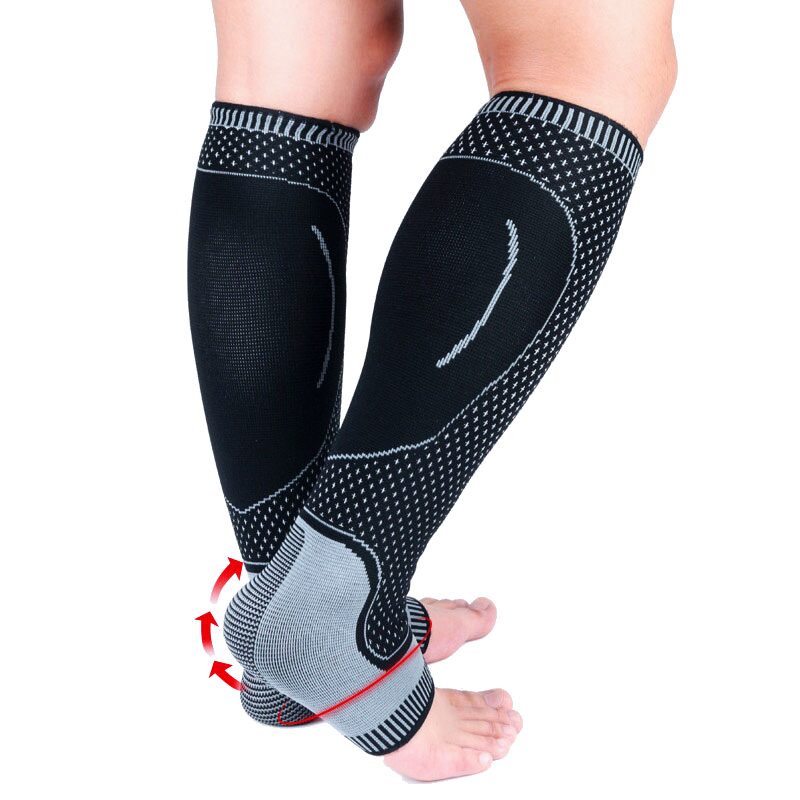
- Compression sleeves for legs(£9.99inc VAT)
Who this ankle brace is for and what you’re struggling with
When your ankle feels painful or unsteady, even simple movements such as walking or standing can take more effort. You may find yourself planning your day around what your ankle can manage comfortably. Walking, climbing stairs, standing for longer periods, or stepping across uneven ground can start to feel uncertain rather than effortless.
You may notice a sharp pain or sudden twinge around the bony points on either side of your ankle when it rolls or tips unexpectedly. These are the areas where the main supporting ligaments are located. A dull ache or stiffness at the front of the ankle when your knee moves forward over your foot — such as when walking downhill or going downstairs — is also common. This happens because that bent‑forward position increases pressure on the front of the joint surfaces and capsule.
Pain, tightness, or a pulling sensation at the back of your heel or just above it when you push off is another common sign. This is where the Achilles tendon attaches into the heel bone and works hardest, which is why stairs and slopes often feel uncomfortable or sore.
This brace is designed for adults who experience these symptoms in their ankle. You may have recently twisted or rolled your ankle. The swelling and bruising have gone down, but it still aches or feels unsteady. In many cases, this happens when the foot suddenly turns inwards (more often) or outwards under body weight, stretching the ligaments that normally limit that movement.
You may have had a more serious injury such as an ankle fracture and are now moving out of a cast or boot into a more active stage of recovery. The bone has healed or been confirmed as fully healed by your clinician, but the ligaments, muscles, and joint capsule have been held still and are now weaker and stiffer, making the ankle feel less stable — especially on stairs, slopes, or uneven ground.
If your ankle has given way more than once, you may become more guarded on uneven ground. You might walk more stiffly or take smaller, cautious steps because it still feels unreliable. A persistent ache or sharp pain around the back of the ankle or just above the heel, especially when pushing off, climbing stairs, or walking for longer periods, is also common. These movements bend the ankle joint forward and increase the pulling force through the Achilles tendon and heel structures, which can cause pain.
You may have tried a soft elastic support that feels comfortable but doesn’t stop the sharp twists that worry you. It may warm and compress the area but doesn’t provide the secure support you need.
In simple terms, this brace is for people whose ankle needs more than light compression. It is a rigid, side‑splinted brace with rigid side panels, a cushioned heel pad, and adjustable elastic straps, designed by FootReviver and supplied by NuovaHealth. FootReviver developed it for ankles that have moved on from a boot or cast but still feel too loose or vulnerable for a soft sleeve. It provides targeted stability in the directions where the ankle is most vulnerable — especially the inward and outward twists that cause many sprains and episodes of giving way.
The brace supports the heel and absorbs impact under your heel, helping the heel bone, Achilles attachment, and natural fat pad make walking more comfortable. At the same time, the toes and forefoot remain free, allowing a natural forward roll through each step rather than feeling locked in place.
This brace is intended for adult use during daily walking and standing, as you return to normal tasks after an ankle injury or immobilisation, and for gentle exercise or activity where extra stability is needed. That includes steady, controlled movements such as rehabilitation exercises or light walking. It is not a substitute for a cast or boot in the early stages of a fracture and is not suitable for swimming or high‑impact sports involving repeated hard landings or sudden forces that a semi‑rigid brace cannot absorb. If you cannot bear weight through the ankle after a new injury, or can only take a few steps with severe pain, get checked before using a brace like this.
What is actually happening inside your sore or unstable ankle
It’s easy to think of the ankle as a simple hinge that should bounce back quickly. In reality, it’s a complex joint made up of several bones, many ligaments, a network of tendons, and a capsule filled with synovial fluid — the slippery liquid that lubricates movement. When one part is injured or held still, the way it moves and supports you can change.
Understanding what happens inside your ankle after an injury helps make sense of why it can still feel sore and unstable weeks or months later.
Ligaments after a sprain
Ligaments are strong bands of connective tissue that link one bone to another and keep joints stable. Around the ankle, they sit mainly on the inner and outer sides, running from the leg bones down to the foot bones. They hold the ankle bones in their correct alignment, limit how far the joint can move in each direction, and send signals to your nervous system about joint position and movement — known as proprioception, your sense of joint position.
Most ankle sprains affect the ligaments on the outer side of the joint. A typical sprain happens when the foot suddenly turns inwards underneath you as your body weight moves over it. The heel and ankle turn inwards, stretching the outer ligaments beyond their normal range. Less commonly, the foot turns sharply outwards, stressing the inner ligaments instead.
When a ligament is stretched beyond its usual range, some of its fibres may tear. In a mild sprain, only a few fibres are affected and the structure remains mostly intact. In a moderate sprain, more fibres are torn and the ligament becomes weaker. In a severe sprain, the ligament may tear completely or pull away from the bone. In all cases, the body responds by sending fluid and repair cells into the area, causing swelling, warmth, and stiffness.
As healing begins, new collagen fibres form to repair the damage. However, the new tissue may be slightly longer than before, leaving the ligament a little looser, and the nerve endings may not send position signals as clearly for a while. Even when bruising and swelling have gone down, the ankle can still twist more easily, especially when turning quickly, walking on uneven ground, or when tired. The joint may feel less steady, as if it could give way again.
When this position sense is reduced, the muscles react more slowly to correct instability, and the ankle can feel unsteady. Ligaments can recover, but this slower feedback is one reason the ankle often takes longer to feel normal than expected.
Even a mild sprain can leave the ankle feeling mildly unstable for several weeks if you return to full activity too soon. Repeated small twists keep the ligaments irritated and can stretch them further. Over time, this can make the joint less stable and put more strain on the cartilage surfaces — the smooth coverings on the bone ends inside the joint — leading to stiffness and aching.
Muscles and tendons after injury or less use
The muscles and tendons around the ankle help control movement and stability. A tendon is the strong cord that connects a muscle to bone. On the outer side of the ankle, the peroneal muscles and tendons run down from the outside of the lower leg, behind the outer ankle bone, and into the outer side of the foot. They help stop the heel and ankle from turning too far inwards. On the inner side and front, the tibial muscles and tendons run behind the inner ankle bone and across the front of the ankle to support the arch and lift the front of the foot. At the back, the calf muscles merge into the Achilles tendon, which attaches to the back of the heel bone. Together, they control push‑off and landing.
After an injury, or when movement is reduced because of pain, these muscles weaken and lose endurance quickly. Walking patterns often change as a protective response — you may shorten your stride, avoid putting full weight through the injured leg, or turn your foot outwards to feel safer. Some muscles then overwork while others weaken, creating imbalances around the ankle joint.
Turning the foot outwards shifts more work to the outer muscles and tendons. Avoiding full weight on the sore leg makes the opposite leg, hip, and back work harder to keep you moving. A shorter stride means the calf and Achilles tendon on the sore side do less push‑off and gradually lose strength.
Tendons don’t respond well to repeated strain. If you walk, stand, or climb more than they can handle, small areas of irritation can build up faster than the body can repair them. The tendon thickens and becomes more sensitive to load, so everyday movements — such as walking up a slope, climbing stairs, or pushing off to step forward — can cause sharp or pulling pain around that tendon.
These changes usually develop gradually rather than from one incident. Common signs include stiffness and soreness when you first move after rest, easing as you warm up, then aching or sharper pain later in the day or the next morning if you’ve done more than the tendon can currently manage. Without steady support or a gradual rehabilitation plan, the problem can persist. The tendon isn’t torn through, but it doesn’t recover fully between bouts of activity, so irritation builds instead of settling.
For this reason, the first few steps after sitting often feel more painful or stiff than the rest of the walk, even though it may ease once you get going.
Joint surfaces, capsule and stiffness after being held still
Your ankle joint is enclosed by a capsule — a tough, fibrous envelope that surrounds the joint, keeps the joint fluid in place, and contributes to stability. Inside the joint, the ends of the bones are covered in cartilage, a smooth, slightly springy surface that allows the bones to glide over one another with very little friction. Synovial fluid made by the joint lining nourishes and lubricates this cartilage and spreads more effectively when the joint moves.
If you’ve had a fracture or a serious ligament or tendon injury, you may have needed a cast, boot, or other immobilising support. This protects healing tissues but also affects how the joint behaves afterwards. While the ankle is held still, the capsule can tighten, the cartilage surfaces don’t move through their usual range, and synovial fluid doesn’t circulate as effectively because movement is what spreads it across the joint surfaces. When these structures aren’t moved regularly, they lose some of their smooth movement, and the joint feels stiff when you first try to bend it.
When you start using your ankle again after weeks in a cast or boot, it often feels stiff, weak, and unfamiliar. You may struggle to bend the ankle forward so your knee moves over your toes, or backward so your toes lift towards your shin. Stepping off a kerb can be especially difficult because it makes the joint bend further and take a sudden increase in load. The front of the joint and capsule are pressed more tightly in this position, and if you push too hard too soon, the capsule and surrounding tissues can become sore and irritated.
You may unconsciously avoid moving the ankle through its full range, taking short, guarded steps and placing more stress on other joints such as your knees, hips, and lower back. Keeping the ankle stiff means the knee and hip have to bend more to complete each step, which can lead to fatigue elsewhere. Gentle, supported movement helps you regain flexibility and confidence without overloading the joint.
Why you have “good days” and “bad days”
As you recover from an ankle injury, it’s common to have good days and bad days — this is normal during recovery. On a good day, the joint feels settled, so you walk further, stand longer, or try more demanding tasks. The next day, the ankle can feel swollen, stiff, or painful again.
This pattern usually reflects how much the healing ligaments, tendons, and joint surfaces can currently manage — and how much load or movement they’ve been asked to handle. For example, a short flat walk might be fine one day, but doubling that distance or adding slopes may push those tissues beyond their current capacity. Balance and control also take time to rebuild, so the joint may still struggle with sudden, multi‑direction movements even if straight‑ahead walking feels comfortable.
Without the right support and a gradual, structured increase in activity, it’s easy to fall into a cycle of doing more on good days and then paying for it afterwards. The ankle feels better, so activity increases again. A small twist, a longer day, or an unexpected step overloads it again. Pain and swelling increase, so you instinctively move less to protect it. Muscles and ligaments then lose a little more strength and control. The next time you put it under strain, it copes less well.
Many people describe feeling as though they’ve gone backwards after one demanding day — for instance, comfortably managing a short walk one day, then feeling as stiff and sore as they did weeks earlier after a longer or harder day. Understanding that this often comes down to how much healing tissues have been asked to do, rather than meaning you’ve made things worse, can be reassuring.
A well‑designed brace can help interrupt that cycle by guiding the ankle within a safer range, reducing the number of sharp twists and painful lapses in confidence, and making it easier to rebuild movement and trust gradually. Over time, a useful sign of progress is fewer ups and downs, even if some variation remains.
How this rigid ankle brace helps at this stage of recovery
Once you understand what happens to the ligaments, muscles, tendons, and joint surfaces after an injury or a period in a cast or boot, it becomes clearer why your ankle sometimes needs additional support.
When the ligaments are slightly stretched and slower to sense and signal the ankle’s position, your muscles and tendons must work harder to keep the ankle steady with each step. In sudden or awkward movements, they may not react quickly enough to prevent the ankle rolling, especially when you are tired, walking on uneven ground, or not concentrating fully. This often feels like the ankle suddenly giving way, a sharp twinge when you mis‑step, or a constant sense that your ankle is close to rolling again.
If the muscles and tendons around your ankle become tired or irritated, they cannot provide steady support throughout the day. The ankle may feel less stable when you stand or walk, which can in turn irritate the ligaments and joint surfaces. Normal muscle tiredness usually feels like a general heaviness that eases with rest. Irritated tendons and muscles tend to cause more localised pain that lingers or worsens after activity.
If your ankle joint has become stiff after being immobilised, you may not yet move smoothly through the full range of movement needed for walking, climbing stairs, or managing slopes. Any unexpected twist or uneven surface can feel more unstable because the joint has less flexibility before painful tissues are strained. You may find yourself keeping the ankle stiff and relying more on your knee and hip to take the strain.
This FootReviver brace provides a rigid external frame around your ankle, with semi‑flexible fabric where movement is still needed. The aluminium side splints are set into padded panels on either side of the ankle and extend slightly above the joint. Thanks to that extra height, when your heel and ankle start to roll inwards or outwards, the splints resist that roll earlier, before the movement reaches its limit.
By limiting how far and how fast the ankle can roll inwards or outwards, the brace reduces the chance of the sudden twists that overstretch ligaments. It gives your ankle more controlled movement, so each step feels more stable and confident. You can adjust the straps to suit how much support you need each day — for example, a firmer setting for longer walks, uneven ground, or when you feel more fatigued, and a lighter setting on quieter days.
At the same time, the open front around the ankle and lack of a rigid shell over the foot mean it can still bend forwards and backwards. This allows you to move naturally — walking, sitting, standing, and climbing stairs. Maintaining that balance is important for recovery: the aim is to protect against unwanted sideways movement without locking the joint in one position.
The brace complements, rather than replaces, strengthening, balance training, and a gradual return to activity. These remain essential for helping your muscles and ligaments gradually resume their stabilising role. The brace’s role is to reduce painful slips, jolts, and minor re‑sprains that can set you back while you rebuild strength and control.
How this rigid brace differs from softer sleeves and wraps
Lighter elastic sleeves or simple wraps can help when ankle pain is mild, settles quickly after short periods of standing or walking, does not cause giving‑way, and does not stop you walking normally. They may be suitable if you haven’t had repeated giving‑way and mainly need gentle warmth and compression around the ankle.
Because soft ankle sleeves are made from elastic material that stretches easily in every direction, they move with your ankle instead of limiting risky movement. If your heel and ankle suddenly roll inwards or outwards, a soft sleeve offers little resistance, so your ligaments and tendons still take most of the strain. In that situation, a soft sleeve often feels more like comfort than support when you’re concerned about twisting it again.
This FootReviver brace, with its fixed aluminium side splints, responds differently when your ankle starts to roll. The splints are built into the side panels rather than being removable inserts, so they do not shift or twist inside pockets. They provide a firmer stop in the inward and outward directions while still allowing useful bending forwards and backwards. Because each splint extends above the ankle joint, when the ankle starts to tip, the brace pushes back with more leverage, resisting that movement earlier in the roll.
Two separate elastic straps sit over the top — one close to the ankle joint and one slightly higher on the lower leg. This lets you set more support near the joint where you feel least secure, and a little less higher up if that feels more comfortable. A single central strap cannot adjust this as precisely. Compared with many basic braces that use shorter plastic stays and one strap, this longer aluminium splint and twin‑strap design provide earlier resistance to rolling and a more tailored fit around the ankle.
In everyday recovery, most people move through stages of support. In the earliest stage of a severe injury or fracture, a cast, boot, or similar device may be needed to restrict movement almost completely. As healing progresses and you begin to bear weight, a rigid or semi‑rigid brace like this one is often used to support the ankle while allowing functional movement. Later, as strength and control improve, people often move on to lighter soft sleeves, simple wraps, or taping, and eventually to no external support.
Within that progression, this brace usually fits the middle and later stages — when you are ready to move more but still need a strong, reassuring frame around your ankle. As your muscles, ligaments, and balance responses improve, a clinician can help you decide when to use the brace mainly for longer days, uneven ground, or more demanding activities, and when it is reasonable to rely more on your own control.
How this brace is built – and why those design choices matter
Structural design, coverage, and open ankle
The brace is constructed around two supportive side panels. One sits along the inner side of your ankle and lower foot, beside the ankle bone on the inside. The other sits along the outer side in a similar position. Each panel contains a rigid aluminium splint that extends slightly above your ankle joint. Because the splints rise higher than the joint itself, they have greater leverage over the forces that cause the ankle to roll. When your heel and ankle begin to turn inwards or outwards, the long splint acts as a lever, resisting that movement along its length and limiting how far and how quickly the joint can tilt.
Beneath your heel, a cushioned pad connects the two side panels. This pad is built into the brace rather than being a removable insert, so it stays aligned with the splints as you move. It supports the back of your foot and heel bone and spreads pressure more evenly beneath the heel, reducing sharp, localised impact on sensitive tissues such as the heel bone, the attachment of the Achilles tendon, and the heel’s natural cushioning pad. By gently altering the angle between your heel and lower leg, it acts like a small heel lift: your heel sits slightly higher than it would otherwise, so the Achilles tendon and heel structures are not stretched to their full length with each step. This reduces the degree of bend required at your ankle and lessens strain on the Achilles tendon and heel area.
The front and back of your ankle remain open by design. There is no rigid panel across the front of the shin or over the top of the foot, and no hard shell behind the Achilles tendon. This allows your ankle to bend forwards and backwards within a safe, controlled range, which is essential for everyday movements such as walking, sitting, and standing. Your toes and forefoot remain free, so the natural rocking motion from heel to toe can still happen naturally. Your forefoot can feel the ground more directly, providing your body with useful balance feedback and making the brace easier to fit comfortably inside shoes than a full shell that covers the entire foot.
The fabric connecting these parts of the brace is a padded, lightly elastic synthetic material. It is firm enough to keep the splints and heel pad in place so that they move with you rather than sliding around, but flexible enough to allow small, comfortable adjustments as you move, instead of feeling like a hard, rigid shell. Extra padding is placed around the ankle bones and heel, where people most often notice rubbing with other designs, and seams are positioned away from these points to reduce irritation.
The splints are built into the structure of the brace. This avoids the common problem of removable stays shifting during use or being reinserted unevenly, and provides a consistent level of side‑to‑side control each time you put the brace on. If you and your clinician agree that you’re ready for a softer or lighter support, the next step is usually to transition to a different type of brace or sleeve rather than altering this one.
Adjustable straps, fit, and compression
Across the top of the brace are two separate elastic straps, each with its own buckle for adjustment. The lower strap sits close to your ankle joint, while the upper strap sits slightly higher on your lower leg. Each strap wraps around your ankle and foot, passes through its buckle, and folds back on itself. You pull it to the level of tension that feels supportive and then secure it in place.
Because there are two straps, you can adjust support where your ankle feels least stable. For example, you might choose a firmer setting on the lower strap, close to the ankle joint, and a gentler setting on the upper strap. You can also vary the tension from day to day — for instance, using a firmer setting when you anticipate more walking or uneven ground, and loosening it slightly if your ankle feels swollen.
Because the straps stretch slightly, they provide gentle, even pressure around the ankle. This can give a secure, supported feeling and may help normal fluid movement around the ankle during activity. The fit should be snug but not tight: the brace should feel firm and secure, as though it is giving your ankle a reliable frame, but it should not cause pins and needles, numbness, deep skin marks, or noticeable colour changes in your foot or toes. If that happens, the straps are probably too tight and should be loosened.
Support mechanics: how it changes movement and load
The side panels, splints, heel pad, and straps work together to change how forces are managed by your ankle with each step.
When you place your foot down and weight begins to load through the ankle joint, the brace helps guide the ankle into a more central position rather than allowing it to drift towards an inward or outward lean. This reduces repeated stretching of the inner and outer ligaments described earlier. If your heel and ankle start to tip inwards or outwards, the splints resist this motion before the ligaments are stretched to their painful limit.
The heel pad provides a cushioned platform, softening the shock that travels up through your heel, ankle, and leg at heel contact and moderating sudden changes in angle during the middle part of the step. By lifting the heel slightly and spreading pressure more evenly, it also reduces the pulling force on the Achilles tendon and the back of the heel when you push off.
For recurrent sprains and instability, the brace acts as an external check on the movements that caused the original injury. Instead of your ankle ligaments having to absorb the full force of a sudden roll, the splints and side panels take some of that load and limit how far the joint can move. The firm, consistent contact of the brace around your ankle also helps your body sense where the joint is in space, supporting quicker muscle responses. This reduces strain on healing fibres and the risk of another sharp injury from an unexpected mis‑step.
After a period in a cast or boot, the brace provides a secure, predictable framework as you start to bear weight and walk more. It makes your steps more consistent, reducing the number of unexpected wobbles that can make you feel unsafe and cause you to tense up. This can make it easier to focus on regaining a more natural walking pattern and on doing rehabilitation exercises without constantly worrying that the ankle might give way.
For Achilles and heel problems, the heel pad supports the back of your foot and slightly reduces the degree of ankle bend needed at each step, especially when your heel lifts and your body weight moves forwards. This decreases the stretch and pulling forces at the most irritated part of the tendon or heel area. By keeping your ankle from rolling excessively inwards or outwards, the brace also reduces sideways twisting through the tendon, which can be particularly aggravating. Overall, the brace is designed to make each step feel more even, with fewer sudden changes in force through sensitive tissues.
Making it comfortable enough that you can actually wear it
Support only helps if you can tolerate wearing it. Discomfort is one of the main reasons people stop using braces, so this one has been designed with longer wear in mind.
The inside of the brace is softly padded to cushion the ankle bones and heel. The fabric is breathable and draws moisture away from your skin, helping to keep it dry and reducing the risk of rubbing or irritation. The inner surface grips gently against the skin or sock so that, once positioned, the brace is less likely to twist or ride up as you move. All edges are smooth and rounded for comfort, and seams are directed away from key contact points to reduce rubbing.
Because most of the structure sits along the sides of your ankle rather than across the whole foot, the brace can often be worn with slightly roomier standard footwear, especially shoes with adjustable fastenings rather than tight slip‑on styles. It can also be used on its own indoors when you are walking without footwear.
Wearing the brace during the times your ankle works hardest – such as long periods of standing, longer walks, frequent stair use, or walking over uneven ground – is what allows the support to make a difference in your recovery. You don’t need to wear it all day. What matters most is having it on when your ankle is under the greatest strain.
How and when to wear the brace in daily life
Choosing the right size
The brace is available in three sizes, based on UK shoe size:
- Small: UK 3–5
- Medium: UK 5–8
- Large: UK 8–11
It is suitable for both men and women and can be worn on either ankle. If one foot is larger than the other, it is usually best to choose the size that fits the larger foot and ankle, then adjust the fit with the straps.
When deciding which size to choose, consider your usual shoe size, whether your ankle is currently swollen, and whether you plan to wear the brace over a thin sock or directly against your skin. A thin sock can reduce rubbing and help with hygiene, but it adds a little extra bulk inside footwear. If you are between sizes and have a broader foot or a noticeably larger ankle – for example, if swelling is still present – the larger size will often be more comfortable. You can then tighten the straps to achieve the level of support you need. If you have fragile skin or reduced sensation, wearing a thin sock under the brace and checking the skin regularly is especially important, as you may not feel early rubbing or pressure as clearly.
Putting it on and adjusting it
The first few uses are about learning a simple routine and finding strap tension that feels both secure and comfortable. It can take a few tries to find what feels right, and that’s normal.
Sit with your leg supported and place your heel onto the cushioned pad so that the back of your foot rests comfortably on it. Make sure any sock is smooth and there are no wrinkles under your heel. Check that the side panels lie flat along the inner and outer sides of your ankle, with the top edges sitting just above the bony points on each side.
Bring the lower strap across the front of your ankle, feed it through its buckle, then pull it back on itself to your chosen tension and secure it. Repeat with the upper strap, again pulling to a firm but comfortable tension before fastening it.
Once both straps are fastened, stand up slowly and take a few careful steps on a flat surface. Notice how supported your ankle feels and whether there are any points of pressure or rubbing. After a short walk – perhaps a minute or two around the room – sit down again and re‑check the straps and position. Fabric and padding can settle with movement, so it’s often worth making small adjustments at this stage.
If anything feels too tight or pinching, if your toes feel numb or tingly, or look unusually pale or dark, or if you notice redness or soreness under the edges, gently ease the straps and test again. The aim is a snug but not restrictive fit: the brace should hold your ankle securely without causing discomfort further down the foot.
Once you’re used to the brace, putting it on becomes quicker and more straightforward. Taking time to adjust the fit properly early on improves comfort and support later.
Building up wear‑time and choosing when to use it
Most people find it helps to build up wear time gradually rather than wearing the brace all day from the start. This allows your skin to adapt to the contact and compression, your ankle and lower leg to adjust to the new support, and you to see how your symptoms respond.
A simple approach is to begin with shorter periods at home in the early days, such as 30–60 minutes at a time, while you’re up and moving rather than sitting. If this feels comfortable and your ankle isn’t more sore or swollen afterwards, you can gradually extend to a few hours at a time. Focus on wearing it when your ankle tends to feel least stable – for example, when you expect to be standing for a while, walking further than usual, using stairs repeatedly, or walking over uneven ground.
Care, cleaning, and how long it stays effective
Cleaning
Looking after the brace helps it stay supportive and comfortable when worn. To clean it, hand‑wash the brace in cool or lukewarm water with a mild detergent. Rinse thoroughly to remove any residual detergent, as this can irritate the skin. Gently press out excess water without twisting or wringing it, then leave the brace to air‑dry naturally away from direct heat sources such as radiators or direct sunlight.
Do not use bleach or harsh cleaning agents, as these can damage the fabric and may irritate your skin. Avoid tumble‑drying or placing the brace on high‑temperature surfaces, as this can warp the components and reduce its ability to support your ankle effectively.
How long it stays effective
With regular use and proper care, the brace should maintain its level of support for many weeks to months. How long it remains at its best depends on how frequently and how heavily it is used, and how tightly the straps are usually pulled. Wearing it all day during physically demanding work will cause faster wear than occasional, lighter use.
Over time, the straps may lose some elasticity and grip if they are often pulled tightly, the fabric may show wear in high‑friction areas such as the heel or strap edges, and the splints may develop minor surface marks with use. Replace the brace if the straps no longer hold it firmly even when pulled to a normal tension, if the splints bend or twist and no longer sit straight along the sides of your ankle, or if the brace feels less supportive and your ankle feels less stable than when it was new.
Wearing a brace that has lost much of its structure can create a false sense of support. It may feel secure, but your ankle may still roll further than you expect, reducing the protection it provides. A simple way to check is to review monthly how easily the straps stretch, whether the splints look straight, and how stable your ankle feels when you first put the brace on. It can be easy to overlook small changes in fit. If you’re unsure, mention it at your next appointment with a clinician, who can advise whether it needs replacing. Regular checks help you stay confident that your brace is still doing its job.
Safety, circulation, and when to seek professional advice
An ankle brace is just one part of managing an injury or longer‑term condition. It does not replace clinical assessment, diagnosis, or treatment, and may not be suitable for everyone.
This brace will not treat or prevent blood clots, replace a cast, boot, or other immobilisation device when those are required, or substitute for medical review after a significant new injury. Blood clots are collections of blood that can form in veins, particularly in the legs when movement is limited for long periods. Reduced activity after injury can contribute to this risk. The main risk is prolonged immobility, not the brace compressing the leg.
If you notice symptoms such as unexplained swelling, warmth, or pain higher up in your leg, or any sudden shortness of breath or chest discomfort, seek urgent medical attention immediately.
When to get advice before using the brace
Consult a GP, physiotherapist, podiatrist, or another clinician before using this brace if you:
- have known circulation problems in your legs
- have recently had surgery to your foot, ankle, or lower leg
- have very fragile or easily damaged skin
- have reduced sensation (for example, if you cannot reliably feel rubbing or pressure)
- have complex conditions such as significant heart or vascular disease, or illnesses that slow healing, and are unsure whether a rigid brace is appropriate
A clinician can confirm whether the brace suits your diagnosis, ensure the fit and wear‑time are tailored to your circulation, skin, and overall health, and explain how to use the brace alongside exercises and activity pacing. This balance between activity and rest helps you avoid repeated flare‑ups of pain or stiffness after movement.
When to seek prompt professional advice
Seek prompt professional advice if:
- you cannot put weight through the ankle at all after an injury, or can only manage a few steps with severe pain
- pain, swelling, or a feeling of instability are getting worse rather than gradually easing over days and weeks despite using the brace
- you notice obvious changes in the shape of the joint, or episodes where the ankle briefly catches or feels stuck
- there is no meaningful improvement over several weeks in a new or recently worsened problem, even though you are using the brace, pacing your activity, and following basic self‑care advice
These signs may suggest that other structures are involved, that your current level of activity or type of support is not well matched to your ankle’s needs, or that you would benefit from a more tailored rehabilitation plan. A clinician can confirm what is most likely driving your symptoms, advise on how best to use the brace alongside specific exercises and other treatments, and help you plan when and how to reduce support safely as you recover.
How this brace fits common ankle and heel problems
The same mechanical principles – controlling excessive movement, providing a stable base, and cushioning impact – apply across many ankle and heel conditions. Below are some of the more common situations where this type of FootReviver rigid brace is used as part of a wider management plan. The anatomy and mechanics sections above explain the general background; these overviews show how those principles apply in specific problems and how this brace can fit alongside the rest of your treatment.
Key ankle and Achilles problems
Other ankle and heel conditions where this brace may be used
Bringing it together and next steps
An ankle that feels painful, weak, or ready to give way can quietly undermine confidence and independence. Ligaments may have become looser and slower to respond, tendons may be irritated, and the joint surfaces and capsule may be stiff or sensitive after time in a cast, boot, or period of reduced movement. Together, these changes alter how you walk and stand, placing extra strain on other joints and making everyday movement more tiring.
External support limits the movements most likely to re‑injure or irritate those tissues, particularly sudden inward or outward rolls of the ankle and heel. It also spreads forces more evenly through the joint and heel, softening sharp impacts. This gives you a secure base to rebuild strength, control and confidence in your ankle.
This rigid, side‑splinted FootReviver brace, supplied by NuovaHealth, was developed with those goals in mind. The rigid aluminium side splints resist unwanted tilting and help keep your ankle in a safer, more central position. The cushioned heel pad absorbs impact and supports the back of your foot and heel. The semi‑elastic, padded fabric with smooth edges is made for comfort during longer wear, and the two adjustable straps allow you to set the level of firmness and support to suit your recovery stage and daily needs.
FootReviver’s rigid side‑splint design is trusted by clinicians for its balance of firm control and comfort, and it’s one of the most frequently recommended supports in the NuovaHealth range. If your ankle symptoms match what’s described here, and you do not have complex medical issues that need specialist advice first, this brace can be a practical step towards steadier, less painful movement. At NuovaHealth, this is the brace many physiotherapists and podiatrists trust and recommend when firm sideways control is needed but a full boot is no longer appropriate — especially for ankles that have progressed beyond a cast but still feel too loose for a soft sleeve.
It includes a 30‑day money‑back guarantee if returned in its original condition, giving you time to assess how practical and comfortable the design feels in daily use. This period allows you to assess comfort, fit and the level of support it provides in your usual activities, rather than to promise that all symptoms will fully resolve within that time. Many people can tell within a few days of regular use whether the brace feels supportive and practical.
If your symptoms resemble the ankle and heel problems described here, this brace is worth considering — especially if a clinician has advised you to look for a rigid support with side splints and heel cushioning. Select the size that best fits your foot and ankle, taking into account swelling and the socks you normally wear. Think about when your ankle feels least stable — such as longer walks, stairs, time on hard floors, or crowded, uneven environments — and plan to use the brace during those activities.
If you are unsure whether this brace is right for your specific diagnosis, it is sensible to discuss it with a GP, physiotherapist or podiatrist for guidance. When used with their guidance, as part of a clear plan, the brace is designed to help you move more confidently as your ankle continues to heal and adapt. As your strength and control return, you’ll probably find you rely on it less.
Used correctly, the FootReviver brace is designed to give your ankle firm, balanced support so you can move more freely and with greater confidence. It’s a practical, clinician‑trusted solution for people ready to take the next step towards steadier, more comfortable movement.
Disclaimer
The information on this page is general guidance for adults and is not a substitute for individual medical advice, diagnosis or treatment. It cannot take account of your full medical history or personal circumstances. If you are unsure whether this brace is suitable for you, or if you have new, complex or worsening symptoms, you should speak to a GP, physiotherapist, podiatrist or another appropriate healthcare professional. No specific outcome can be guaranteed from its use.
1 Review For This Product
Fast & Secure Checkout Through Paypal
Pay with Paypal the secure payment gateway that accepts all credit and debit cards. Paypal is free and secure and no credit or bank information is ever stored or shared with us.
Fast Dispatch
Enjoy your items soon with quick dispatch via Royal Mail. Expect to have your items between 1-3 working days for domestic orders. 7-10 Working days for international orders.
Return Policy – 30 Day Money Back Guarantee
In the unlikely event, you are unhappy with your purchase you can return it within 30 days for a refund. Please contact us via the form on the contact us page to start your return.
To return an item please send it to: Nuova Health UK, 81 Highfield Lane, Waverley, Rotherham, S60 8AL. Please include a note with your order id so we know who to refund. Please retain your postage receipt as proof of postage. All that we ask is that the item is in the original packaging and unused.
by Norman
I took a tumble down the stairs and my ankle took the brunt of the fall. I purchased the Ankle Brace and it’s been a game-changer. The quality is top-notch and it’s given me the support I needed during recovery. I’ve finally been able to get up and about without the constant throbbing. I wholeheartedly recommend it.